Author Archives: ericellis
AFGHANISTAN’S CONTROVERSIAL NEW FUND
INTERVIEW WITH ANWAR IBRAHIM
UKRAINE WAR PACKAGE-AUGUST/SEPT 2022
Spain banking: Unicaja swims against the stream
Spain banking: Unicaja swims against the stream
By Eric Ellis
October 05, 2020
As Spain prepares to digest the €17 billion merger of CaixaBank and Bankia, Andalucían lender Unicaja faces a threat to its regional dominance. While its community roots are an advantage, it also needs an answer to the calls for change.
In the heart of the southern Spanish port of Malaga, one building soars unavoidably above the bustling cityscape: the headquarters of Banco Unicaja.
Built in a severe brutalist style that seems at odds with Malaga’s summery vibe, local commerce revolves around the Unicaja tower, extending across rural Andalucía beyond. Unicaja is the sum of a 1991 merger of a regional group of centuries-old savings thrifts and credit unions, or cajas, and is today a banking powerhouse in the region. No other Spanish bank comes near it here in terms of local spread, retail business and brand recognition.
Indeed, in many of Andalucía’s characteristic pueblos blancos, the area’s famous white villages, Unicaja is the only game in town. To many locals, Unicaja is simply ‘El banco.’
But Unicaja’s Malaga edifice reveals a deeper truth about this purely retail bank – its limitations, both geographical and in the business it does. And that has implications in the ever-changing Spanish banking sector, as the industry prepares for further consolidation following the announcement in September of the €17 billion acquisition of Madrid’s Bankia by Barcelona-based CaixaBank to create Spain’s biggest lender.
Since Spain’s crippling banking crisis of the early 2010s, the number of savings banks has contracted through failure and takeovers from around 45 to 12 today. Most of them are active in Malaga. From the Unicaja building’s upper floors, at least 10 other banks are visible along Malaga’s main Avenida de Andalucía; Spanish and foreign, all hungrily pitching for business – Unicaja’s business.
These deep-pocketed usurpers include Spain’s big five – the now-to-be-combined CaixaBank and Bankia, BBVA, Sabadell and Santander – as well as ING Bank and Deutsche Bank.
All are of them bigger, more sophisticated entities with broader franchises than Unicaja, though pointedly not in Andalucía, Spain’s most populous region. In this ancient land Unicaja’s HQ seems like a defiant citadel keeping well-armed aggressors from storming its ramparts.
Unicaja’s Oxford-educated chief financial officer, Pablo González Martín, doesn’t dispute the metaphor.
“Yes, they are getting close,” says the 25-year veteran of Unicaja, who is widely expected to be its next chief executive. “We know that it is competitive out there. That just makes us work harder and be as best as we can. In order to have a profitable retail banking franchise, you need to be among the top two to three players in the region where you are.”
Which Unicaja plainly is in Andalucía, a clear number one with about 25% of the market and as much as 30% in the sparsely populated central Spanish region of Castile and Leon, where in 2014 it bought another combination of cajas, the struggling EspañaDuero, in what was Unicaja’s only big sortie beyond Andalucía.
González says Unicaja’s strength is because it is a regional champion and a prudent one that boasts a common equity tier-1 ratio of 15.8%, the highest among Spain’s listed banks.
But as the industry consolidates, Unicaja’s dominance at home is also its problem, one heightened by the imminent CaixaBank-Bankia deal.
Unicaja is largely unknown beyond its two home regions, indeed, in the wider Spanish market, it is a relative minnow. Analysts calculate Unicaja’s national market share at around 3% in customer funds and 2% in loans.
With around €63 billion in assets, it floats between seventh and 10th spots on the national league table with Galicia’s Abanca, Zaragoza-based IberCaja and the Basque Kutxabank.
Madrid’s industrial-focused BankInter is at six. Then there is clear air to fifth place nationally, the Catalan bank Sabadell, which took over the UK’s TSB Bank in 2015 and is three to four times bigger in assets than Unicaja. The new Spanish leader, the prospective Caixa-Bankia, is nearly three times bigger again than Sabadell and around 10 times the size of Unicaja.
Citi bank analyst Stefan Nedialkov says Unicaja is “a big fish in the small pond of Andalucía, but a small fish in the big pond of Spain.”
The CaixaBank-Bankia merger has roused Unicaja’s management because it poses a direct challenge in western Andalucía around Seville and Cadiz, where Caixa is already Unicaja’s main competitor following its €1 billion purchase in 2012 of Banca Civica, which included the Andalucía-centric CajaSol.
For smaller banks like Unicaja, the deal raises questions of response and highlights the likelihood of more mergers and takeovers.
Unicaja is solely a retail bank – it doesn’t do big-ticket syndicate loans and has no fee-generating, deal-making investment bank in Spain’s equity capital markets.
“And we don’t want to be one,” says González.
Unicaja’s space to expand might seem limited, but González makes no apologies for its lack of national girth and clout.
“The problem is everyone was thinking to go beyond their home region because they wanted to diversify, so everyone was chasing that strategy,” he says. “We decided that wasn’t the right strategy because it was too expensive.”
González dismisses funding growth through corporate acquisition, which is a popular strategy among many of the country’s larger banks (Caixa was able to fund growth through large stakes in firms such as Telefonica and Repsol). Not only would this take too long, but, he says, it is not the right approach for the bank.
“It is a national thing when you go to corporate banking, but in household banking it is local; you need to know the people, the small and medium-sized enterprises, the suppliers, have ATMs close to where they work for the payrolls that we do for a lot of local companies.
“It is where we can make the economies of scale, to be more profitable,” he says. “We still have to deliver banking to all customers. They can have small banking needs, but still they need to have their pension, do payments and do some investments.”
González takes his counsel from the heady 2000s, when he remembers Unicaja being criticized by ratings agencies as not being competitive enough as Spanish markets took flight during frothy times.
“They said you’re not doing structured lending, that sort of thing,” recalls González. “We had double-digit growth, but I told them we didn’t want that kind of risk. And we were right. We want to be here through the cycle.”
The Costa del Sol became Spain’s bubbliest and then most seriously impacted property market during Spain’s banking crisis, which swallowed up household banking brands, led to a €40 billion bailout by the European Central Bank and even threatened Spain’s membership of the euro.
Unicaja was one of the few Spanish banks that did not receive state aid – a point of pride for González, which he puts down to the bank’s conservative culture. He says that Unicaja was seen as boring, but as things turned out, it was prudent.
Unicaja never went to shareholders for support, unlike BBVA, Caixa and Santander.
“We maintain our ties with the local communities because it helps us to have a prudent approach,” he says.
Being entrenched within local communities means “you know who is trustworthy, you have a strong relationship with the local business community, you know their customers, their suppliers.”
Expansion opportunities
Unicaja’s survival of the crisis opened expansion opportunities elsewhere in Spain, and in 2014 it took one, acquiring an ex-caja combine with a city-rural mix profile similar to itself, the struggling Salamanca-centred Banco CEISS, which dominated the Castille and Leon region as Unicaja did Andalucía.
CEISS had been bailed out by the Spanish state during the crisis but was barely breathing when Unicaja arrived with a bid. The deal took three years to absorb; today the expanded entity operates solely under the Unicaja marque.
Much of the €688 million raised by Unicaja’s 2017 IPO went to pay back Madrid’s handouts that kept CEISS afloat during the crisis.
But there are now fewer opportunities like that in Spain.
Unicaja was in protracted talks during 2018 and 2019 with Spain’s 12th biggest bank, Liberbank, which operates on Unicaja’s flanks in Extremadura and Castille-La Mancha, until Unicaja walked away from what would have become Spain’s sixth biggest bank.
But that was before the Caixa-Bankia deal and analysts believe it’s time for Unicaja’s proverbial Rolodex to be dusted off again.
González says: “We remain open to analyze any option in M&A that could be positive for earnings per share for our existing shareholders. We don’t believe in getting bigger just for the sake of getting bigger.”
Since 2017, when Morgan Stanley and UBS Group took Unicaja public, Unicaja has a new constituency to answer to: the stock market.
Francisco Riquel, senior banking analyst at Madrid brokerage Alantra Equities sees consolidation among Spanish smaller banks as key to their growth if not survival. He says the Caixa-Bankia deal is Spain’s big banks telling the country’s smaller banks that they are not interested in buying them, that there is little to gain from them.
With its vast network of branches, Riquel says Unicaja has a higher cost base than other Spanish banks.
“Its profitability could be much better,” he says, “its returns are poor.”
He describes Unicaja’s franchise as old-fashioned and traditional, lacking diversity and dynamism. He says Unicaja, as a listed bank and with a healthy balance sheet, has an opportunity to drive consolidation among Spain’s smaller banks.
Citi’s Nedialkov agrees that Unicaja is well placed to play a key role in the “in-organic growth” of lower-end market consolidation. Nedialkov says “we like that it’s risk-averse”, and has Unicaja rated as a buy.
But could Unicaja be bought?
Unlikely, say analysts, as it depends on its controlling shareholder, the Unicaja Banking Foundation. Some observers describe that as Unicaja owning itself.
Independently directed, the foundation is a charitable collection of regional interest groups and identities crucial to the creation of Unicaja and its caja predecessors. The foundation now controls 49.7% of Unicaja, with the family office of Andalucía’s richest family, the fashion-based Domínguez de Gor, owning around 6%.
Marbella-based shopping mall billionaire Tomas Olivo Lopez has around 3% to 4%, as does the Santander asset management group, the investment arm of Norway’s central bank and US fund manager Fidelity.
Riquel says the Unicaja foundation could be an impediment to Unicaja’s growth.
“It needs to be more dynamic,” he says. “Caixa is also controlled by a foundation, and look what it is doing.”
The bank was floated at €1.10 per share in the 2017 IPO; the share price peaked at €1.63 in June 2018. But since then it’s mostly been a steady slide to a low of €0.42 in May this year at the depths of Spain’s Covid-19 pandemic.
As Euromoney went to press, the stock was trading at €0.71, valuing the bank at just over €1 billion, about 70% of its 2017 IPO valuation.
Still, that seems positive compared with Spain’s other listed banks. Since mid 2017, the Bolsa de Madrid’s banking sub-index has fallen by around 70%.
CaixaBank stock has fallen steadily from a peak of €4.50 in June 2017 to €1.94 after the Bankia deal was announced. Since July 2017, Bankia stock has fallen from €4.62 to €1.44.
Unicaja Banco posted net profits of €172 million in 2019, up 12.9% on 2018, and announced as dividend a healthy 45% of income, although this was postponed as Unicaja complied with European Central Bank guidance to bolster balance sheets.
Earnings in the pandemic-hit six months to June 30, 2020 were steady at €86.25 million.
But one banking analyst says Unicaja hasn’t hit its IPO growth targets.
“Organic growth hasn’t worked in the way they’d hoped,” the analyst says.
With interest rates stagnant in its core home mortgage book, efforts to expand into more lucrative corporate and SME banking means Unicaja is competing with the nationwide banks.
“They don’t have an amazing product factory,” says the analyst, “and they just don’t have the scale like the others.”
The Andalucían market is tricky for any bank.
Some of the world’s oldest cities – Malaga, Cadiz, Granada, Sevilla and Huelva – are located here and tracts of its heavily-urbanized coastline, such as parts of the Costa del Sol, are wealthy international tourist playgrounds. But move a few kilometres away from these centres and the region’s agricultural base soon becomes strikingly evident. This is Andalucía profunda (deepest Andalucía), a mountainous undeveloped region that can be very conservative and often quite poor.
Villages here have a history of their townsfolk migrating to pursue education and jobs elsewhere in Spain because of the lack of economic opportunity at home.
With three million customers, about a quarter of the total population of its two main regions, Unicaja has deep roots in these communities. They are its legacy customers, carried over generations as the bank evolved through a series of mergers of village savings societies and thrift co-operatives, a network that partly arose because they were shunned by metropolitan banks.
A big chunk of Unicaja’s franchise remains in these rural communities and helps define the bank’s culture – of pensioners with passbooks, of over-the-counter deposits and withdrawals, where cash very much remains the preferred medium.
“This still belongs to our DNA,” says González. “Our very roots are in very strong local community ties. That’s where we come from, and we come with a plain vanilla product offering.”
González believes that the ever-continuing finessing of his deeply entrenched rural franchise may also prove Unicaja’s best defence, in part because Unicaja’s traditional customers are loyal, channel much of their financial needs through the bank and still value a physical branch.
But far-flung branches are expensive to run and staff, and Unicaja has 1,028 branches and 6,300 employees across Andalucía and the central region of Castille and Leon, the buildings split about 50-50 between Unicaja-owned and rented.
González wants fewer branches and staff but knows that his customers don’t always agree.
“You have to ask for a balance and we are closing branches,” he says, adding that Unicaja today has 20% fewer branches than four years ago.
Technology is helping bridge that divide – and trim Unicaja’s costs and headcount – but it can be a struggle to convince Unicaja’s rural base.
A feature of management life at the bank in recent years has been fielding petitions from remote communities anxious that their village is losing its bank, at least their physical one, and not being comfortable online.
For González and colleagues, it’s a diplomatic dance between the rigours of a stock-market listing and soothing a customer base that can be wary of change to lure them online.
“Though people are getting more used to online banking, they still need to sometimes go to a physical branch,” he says. “Your online life relates to your offline. The trend [to online] is unstoppable, but we don’t want people to be left behind. We have to try to maintain local interest.”
In its urban markets, González says, tech take-up has been as solid as any metropolitan market anywhere.
Unicaja invested strongly in technology, and its online offerings are intuitive and up-to-the-minute, run from a state-of-the-art data centre outside the tourist town of Ronda. The bank has even made royalties from licensing its tech backbone to banks in Latin America.
Although banks remained open during Spain’s strict Covid-19 lockdown, González says there was a sharp jump in Unicaja’s online users. Branch teller staff were re-assigned to online and telephone services during the pandemic.
Nevertheless, González thinks Unicaja’s local network is its true fortress. “When you go to another area, you don’t get the best-quality loans because the incumbent doesn’t know the nitty-gritty, good quality real-estate developer, the household situation,” he says. “In order to deliver financial services to these people, you need to have a local presence. [People] need to trust you, a branch manager that is known in the town.
“We still have to deliver banking to all customers. Our challenge is not to withdraw from these places but improve our services.”
TROUBLE IN THE SIERRA
Unicaja’s experience in Ronda – a town that has seen its economy transform from agricultural services to tourism – provides a model for the bank.
The magnificent headquarters of Caja de Ronda, a savings collective with religious roots, stood on Ronda’s main street for decades.
Caja de Ronda was one of the strongest of Unicaja’s component cajas and, in a land of intra-regional rivalries, initially resisted the push to merge.
A first among equals, Ronda’s culture infused the newly merged bank.
Pablo González Martín, Unicaja’s CFO, says: “It took quite some time for people to forget saying: ‘I am from Ronda, I am not Unicaja.’ Some people still say: ‘I am Unicaja Ronda,’ ‘I am Unicaja Almeria.’”
Ronda’s ornate banking hall – opposite one of Spain’s oldest bullrings – was a source of civic pride, a place to be seen. But that building was closed as a bank in 2016 and has since been transformed into a five-star hotel, the building rented from Unicaja. A utilitarian branch remains next door, but the banking chamber is now the hotel lobby.
While locals lament no longer banking in such grandeur, they are pleased the building has been faithfully maintained and that new jobs have been generated in the hotel. The hotel’s outlets are patronized by Unicaja customers. The outcome is seen as a win-win by locals and by Unicaja, which also banks the new business.
But deep in the sierra 50 kilometres south of Ronda in the village of Gaucin, opposition highlights Unicaja’s delicate dance with its client base. Local councillors last year launched a ‘Save our bank’ campaign after rumours spread among townsfolk that Unicaja was shutting the only bank in a town of 1,500.
Village mayor Pedro Godino set up posts around town imploring villagers to petition Unicaja to keep the branch “as crucial to our economy.”
Godino told villagers that Unicaja seemed “on the way to becoming a dividend-counting machine, forgetting what the essence of a savings bank is.”
He promised to help ensure “this basic service continues to be provided in our town”, one which had just been upgraded to high-speed fibre internet.
Suggestions that the council encourage tech-illiterate townsfolk to bank online and that, like Ronda, the Gaucin branch could be transformed, perhaps into a hotel or restaurant generating more local jobs than the three the Unicaja branch did, were not considered.
Unicaja deploys an agency model in such towns; in Gaucin it contracted a part-time out-of-town lawyer who fields much grumbling from locals feeling abandoned.
Is Unicaja’s agency banking model the half-way house to eventual closure?
“Probably,” says González. Branches in buildings that Unicaja owns are being sold and leases halted in branches it doesn’t own. “If you have a fixed cost, it’s hard to maintain good quality.”
González says he is sympathetic to customer concerns: “We are not leaving the customer without a bank. We try to fill the gap so the transition is smooth.”
But Alantra Equities analyst Francisco Riquel says Unicaja is being “too politically correct” to placate sentiments such as those of the Gaucin mayor.
“The world is changing,” Riquel says. “Online banking is inevitable and people need to understand that.”
Israel and Palestine – the practical partnership
The conference setting is stunning and fitting too; a sumptuous spa on Jordan’s Dead Sea shore, with magnificent views overlooking the West Bank.
Corralled by the Union of Arab Banks, delegates come from across the Arab corporate mainstream; bankers (central and commercial), businessmen and officials, to talk banking in Palestine and do some power networking.
Over three cold and clear winter days at the end of January, they carouse, kiss the cheeks of old friends and break bread with new ones. They get some deals done, all the while expressing solidarity with Palestinian colleagues, who have travelled long hours, negotiating checkpoints through what they frequently call “our Israeli-occupied homeland”, to attend from homes and offices just a few kilometres away.
And there is plenty to talk about. A day earlier, the Trump administration has decreed bans on travel to the US by nationals from seven Muslim-majority countries, while provocatively flagging that Washington could move its embassy in Israel from Tel Aviv to contested Jerusalem.
Mostly in furious agreement, delegates also bat around topics including ‘The reality of the banking sector in light of the economic strangulation,’ and ‘The importance of investing in Al-Quds,’ as Jerusalem is known in Arabic.
But first there is the customary denunciation of Israel. Opening the conference, speaker after speaker lines up to condemn Israel. Mohammad Al Barghouti, chair of Palestine’s Association of Banks, laments “Palestine’s partial freedom”. Mohammad Al Rabie, long-time secretary-general of the Cairo-based Council of Arab Economic Unity, denounces the “vicious Israeli occupation”, while other bankers rail at Palestine’s “Israelization” and “Judaization”.
Conference co-host Ziad Fariz, central bank governor in Jordan, which has long had diplomatic relations with Israel, also chimes in to attack the “Zionist Israeli occupation” of “our Palestine”. Such is the anti-Israel fervour, by the time delegates sit down to lunch on day one, the conference is already two hours behind schedule.
Israel has not been invited to this conference. “The Arabs don’t see Israel as a partner in strengthening Palestine,” a Palestinian conference delegate tells Euromoney.
But all is not what it seems.
In a meeting room on the conference sidelines, the leadership of Ramallah’s quasi-central bank, the Palestine Monetary Authority (PMA), has gathered to articulate a different reality of the relationship between Israelis and Palestinians, an often artful one in tough circumstances, one where cross-border central banking gets done by WhatsApp.
It is a version not likely to make this conference’s agenda. But it is a reality where, against the odds, PMA technocrats in Ramallah and their counterparts at Jerusalem’s central Bank of Israel are in frequent contact and respect and even like each other.
“Ah, my favourite people,” says PMA governor Azzam Shawwa of his counterparts at the Bank of Israel. “We know each other well enough by now that we can handle things by WhatsApp.”
“I like him, he’s my details man,” Shawwa says of a senior BoI official that he is in near daily contact with. “He is details, details, details, and after that he will tell you there are still more details. But he’s doing it because he is a professional, not because he wants to complicate things as an Israeli.”
“And she is excellent,” he says of another senior BoI official. “They have a good heart, very professional. They both handle issues away from the disputes and the political areas.” And it is not just Palestinians confounding the conventional wisdom.
At the BoI’s headquarters in nearby Jerusalem, there is a similar genuine warmth for their PMA ‘colleagues’ just 20 kilometres away, albeit through Israel’s myriad walls and checkpoints. “PMA-BoI relations are warm because of the mutual respect and the joint aim to focus on doing business while leaving the politics to our governments,” says one Israeli official. “This feeling comes from the trust that both central banks see in each other.”
PMA deputy governor, Riyad Abu Shehadeh, has been with the PMA since its inception in 1994. “We always meet their payments people, their legal advisers,” he says. “I meet with IMPA [Israel’s anti-money laundering authority under the Justice Ministry].” When Shehadeh meets his Israeli colleagues, he speaks to them in English, Hebrew and Arabic. “I let them practice their Arabic.”
Their mutual respect and contact goes back years. Before current governor Karnit Flug took over the central bank in 2013, the BoI was run (from 2005) by the high-profile Stanley Fischer. He is now a vice-chair of the US Federal Reserve in Washington, but while in Israel, his counterpart at the PMA in the mid-2000s was Palestinian economist, George Abed. Before Fischer and Abed became governors of their respective institutions, they were long-time colleagues at the IMF in Washington, senior executives of the fund during the reigns of Michel Camdessus and Horst Köhler.
For all the regard, it is a relationship that frequently faces big obstacles. Palestinians are severely restricted from entering Israel, a curb that can also extend to PMA staffers needing to go to nearby Jerusalem or Tel Aviv for a meeting with the BoI.
Getting Israeli travel approvals is often tedious and bureaucratic for Palestinians; the BoI’s influence through Israel officialdom extends only so far. “Often it can boil down to the whim of an individual down the line,” grumbles a PMA official.
PMA officials in their capital, Ramallah, relate many stories of being granted permission to enter Israel for official business only to be turned away en route or delayed for hours at checkpoints by Israeli soldiers because the permissions have not filtered through the system.
When work is to be done, or an immediate crisis looms, BoI and PMA officials get around these barriers by connecting via smartphone, most commonly with WhatsApp.
It is central banking by social media and text message, but that, too, can be tricky for a Palestinian official on the move. Mobile data access in Palestine is severely restricted by Israel. Open WiFi signals are widespread across the West Bank and it is common to see Palestinians gathering in knots outside hotels and public buildings, waving their smartphones to catch a signal.
The glue that binds the BoI and the PMA springs from geography, economic necessity and security. The two monetary authorities, which both claim independence from politicians, are compelled by realities on the ground to put enmities aside.
The 4.5 million people of the Palestine Territories – 1.9 million in the Mediterranean-facing (but blockaded by Israel) Gaza Strip and 2.6 million living in the landlocked West Bank – are separated by Israel, the region’s economic powerhouse.
Under terms derived from the landmark 1993 Oslo Accords, which delivered limited self-rule to the Palestinian Authority, three currencies are official tender in the two territories: the dollar, Jordan’s dinar and the Israeli shekel.
Today the Palestinian Authority government, Palestine’s biggest employer, pays its thousands of staff in shekels, as does the PMA, which regulates 15 banks operating in the West Bank and Gaza. Palestine may have a central bank of sorts but the PMA, founded in 1994, does not issue or administer its own currency.
A potent symbol of independence, a New Palestinian Pound was forbidden under the so-called Paris Protocol of 1994, an adjunct to the Oslo Accords. The Paris Protocol covering the Palestinian economy were only supposed to last five years, as peace and development supposedly advanced, ultimately to Palestinian statehood.
But 23 years after ratification, they remain in place. Palestinians favour the dollar and the dinar for savings and so-called ‘stored-value’ transactions such as property. But, overwhelmingly, the shekel is in daily use for up to 70% of everyday transactions, which pass through Palestinian banks regulated by the PMA and, eventually, are cleared by the BoI. Estimates vary of the total shekels circulating in Palestine, ranging from 10% to 25% of the currency issued by the Bank of Israel.
For many years the economy of Palestine was donor-supported, and the PMA lacked the capacity to administer its own currency. But a year into his initial four-year term as governor, Shawwa says that is no longer the case, as he prepares to move into new headquarters in Ramallah.
“Of course, I want Palestine to have a currency,” he says. “We have the expertise to manage it. I don’t mind seeing my signature on the pound. They [Israel] would not have these worries about their currency because the currency would not be crossing the border. When it’s the time to do it, I’m going to do it. We are much more self-sufficient now.”
Politically, that goal remains a long way away; Israeli and Palestinian central bankers have to manage the complex issues of Palestine having the shekel as legal tender.
The practical engagement between the central banks in Ramallah, Jerusalem and Tel Aviv might be something of a model for cooperation in these troubled parts but it is no less sensitive for it, particularly from the Israeli side.
The PMA is happy to talk openly about its relationship with the BoI, but the Israelis are rather less so. The BoI was initially reticent about the relationship between the two banks. “We are usually not that generous in providing information on the issues of the Palestinian economy, as they are very sensitive,” an official told Euromoney.
After we informed the BoI that a cooperative PMA was willing to speak, BoI handlers insisted on draconian terms before even considering a briefing about its side of the relationship with the PMA. Any background conversation, should the BoI even agree to one, would be conditional on the names of the BoI staffers whose job it is to liaise with the PMA being left out. The BoI as an institution could not be cited as a source in any way.
The sensitivity, an Israeli official confided, was as much about blowback from Israeli hardliners unhappy about the extent of the BoI’s contact with Palestinian colleagues in Ramallah as it was about ‘normal’ cross-frontier sensitivities.
The PMA, too, has tricky local issues to navigate. As PMA insiders describe it, the authority is obliged to work with the Israelis to keep the Palestinian banking system functioning and the wider economy lubricated. But getting too close to Israel risks credibility issues with Palestinians, particularly with the Hamas hardliners who control Gaza, where West Bank-based Palestinian banks have operations under purview from the Ramallah-based PMA.
“You cannot avoid politics but I’m not in a political position. I’m a technocrat. I would like to handle issues in that manner,” Shawwa tells Euromoney. “My two [BoI] counterparts, the governor Karnit [Flug] and the deputy governor also handle the issues away from the disputes and the political arena,” he says. “They are independent. They don’t have to do things they don’t believe in. That way they do their job much better.”
The shekel’s primacy in Palestine, along with Israeli control over Palestinian entry points, means that Israel and Palestine are effectively bound into a customs union, albeit one seen by many Palestinians as economic colonization.
Palestinian activists have also protested that Israel earns seigniorage from distributing its shekels in the Palestine territories. But the BoI rejects this charge, citing the current climate of near-negative inflation and interest rates it sets. In January, the BoI maintained its benchmark interest rate at a negligible 0.1%. “These days it’s the other way around, it costs a lot to produce and maintain the currency and you get nothing,” says an Israeli official.
Many Palestinians claim that the Israeli economy is dependent on Palestine, but that is also disputed by Israeli authorities, who point out that Palestine’s GDP is around 5% of Israel’s. Trade between the two sides is low-level and low-tech, extending little beyond basic foodstuffs and supermarket items. About 70% of Palestinian imports are from Israel, which buys about 80% of Palestinian exports. By contrast, Palestine accounts for less than 10% of Israel’s total trade. The Bank of Israel has estimated that around 90,000 Palestinians work in Israel, legally and illegally, and are paid less than guest workers from elsewhere.
The BoI likens its relationship with the PMA to the eurozone before 2014, where member state central banks have a supervisory role over their own local banking system, albeit one with a common currency. By treaty, Israel’s shekel is Palestine’s primary currency, but Israel has no formal regulatory authority over the Palestinian banks that handle it.
This division of regulatory responsibilities between the BoI and the PMA can throw up oddities, such as Palestinian bank branches located inside frontiers manned by Israeli security forces but administered by the PMA. By contrast, the BoI administers Israeli banks operating in contested Israeli settlements inside the West Bank.
But the shared interest in the shekel is such that each central bank expresses near identical anxieties – and often to each other – each time an unexpected external event occurs. That might involve the political elevation of a hardliner, a terror attack, military escalation, a withholding of taxes or political tensions over new settlements – anything that might threaten common cause.
“The focus has tended to be on the problems rather than on what works,” notes an Israeli official.
Security concern Israel’s primary concern is its own domestic security. The Israeli official says: “The system worked perfectly fine for decades and then things started to go wrong.”
He is referring to Gaza, separated by Israel from the West Bank and separated from mainstream Palestine by its politics since 2005, when Hamas prevailed in elections. Gaza is internationally recognized as notionally under the wing of the Ramallah-headquartered Palestinian Authority.
But since the ‘Battle of Gaza’ opposing Fatah and Hamas in 2007, the region has been controlled by Hamas. Fatah retained control of the West Bank. Committed to Israel’s destruction, Hamas is proscribed by Israel, the US and EU among many others as a terrorist organization. Israel bans its banks from dealing with more than 200 international groups and individuals, citing terror sponsorship or activities.
“For every truck that enters Gaza from Israel with, say, flour for bread, the most basic humanitarian goods, there is a guy from Hamas 200 metres from the checkpoint who takes a customs tax,” says an Israeli official. “Every transaction is financing Hamas.”
For the BoI, Hamas’ takeover of Gaza was a turning point in its relationship with the PMA. Hamas in Gaza has threatened and intimidated PMA officials and seized some of their assets. When the PMA moved to close Hamas-related accounts, a bank branch was bombed, while another had a hand grenade attached to its door.
PMA officials in Ramallah also have to cross Israel to regulate Palestinian banks operating in Gaza. Although born in Kuwait, PMA governor Shawwa is of Gazan background, which he says helps in his administration there.
But Hamas’ takeover of Gaza immediately became a problem for Israeli banks, which until then had maintained normal commercial accounts for Palestinian banks, clearing around NIS40 billion ($10.8 billion) annually for customers in both Gaza and the West Bank.
“Israeli banks don’t want to do business with Gazan banks, because they can be sued in the US, where they also have business,” explains an Israeli official. Israeli banks such as Bank Hapoalim and Discount Bank have progressively pulled back from these Gaza connections, doing business only with Palestinian accounts in the West Bank, under PMA control.
But that has excluded vast numbers of Palestinians transacting normal business and led to a dramatic slump in the already anaemic Gazan economy. Hapoalim and Discount have both found themselves facing allegations that they had violated US anti-money laundering and countering the financing of terrorism (AML-CFT) laws by allegedly providing a financing channel for Hamas.
In 2007, Jordan’s Arab Bank, which itself had been facing similar allegations in the US since 2005, filed a countersuit against the two Israeli banks, claiming that they too had been dealing with Hamas. The two Israeli banks denied the claims. The PMA has also been subject to legal actions in the US by the families of terror victims.
The threat of lawsuits heightened the Israeli banks’ concerns over links to Palestine and led them to refuse to clear transactions related to accounts based in Gaza. They also baulked at accepting cash, because of doubts about its provenance.
Spooked by international risk, particularly from US authorities, the Israeli banks lobbied to exit their Palestine business. According to an Israeli official, it became a question of balancing profit against risk: “It’s small business with a lot of risk. It’s half a million cheques a year, the value is not particularly large and the fees they take are small, but they are thinking each time one of those cheques could bring them a lawsuit, into a danger zone.”
According to deputy governor Shehadeh, these boycotts create problems for the Palestinians, who have excess shekels and a need to deposit them at their accounts in Israeli banks to keep basic trade ticking over.
Gazans, starved of an outlet for their shekels, moved to open accounts in the West Bank, which still had links to Israeli banks. With the risk, as they saw it, simply shifted, Israeli banks responded by progressively withdrawing from West Bank business, too.
“They weren’t sure of the provenance of the money, or the destination very often,” says an Israeli official.
But with no Israeli bank willing to accept Gaza-generated shekels, the BoI stepped up, agreeing to accept a portion of the mounting shekel pile. In 2009, Bank Hapoalim extended its Gaza ban to stop accepting cash from all Palestinian clients. As shekels stockpiled in Palestine, the BoI became the outlet and forwarded cash to the Israeli banks.
Palestinian banks maintain active accounts with Israeli banks to facilitate trade and business with Israel and beyond. But the ‘de-risking’ ban by Israeli banks soon saw stockpiles of up to NIS400 million a month accumulating in Palestinian banks.
The upshot of this de-risking is that Palestine has progressively been cut off from the international financing system, with a resultant impact on its economy. As Bank of Palestine’s CEO Hashim Shawa sees it, that is a problem for Palestine, but also for Israel. “A strong Palestinian economy is in the interest of both sides,” he tells Euromoney. “It’s jobs, it’s hope, it’s self-respect, it’s trade.”
The BoI seems to agree. “It’s a much more severe problem for the Palestinians,” says an Israeli official close to the central bank. “The Palestinian businesses don’t have an outlet to pay their importer who is sitting in Germany or whatever.
For Palestinians, it’s their daily activity which is impacted because they use the shekel. And the Middle East in general is affected.” The PMA’s deputy governor Shehadeh asks: “What is the alternative? How would we pay for our imports from Israel? “I say [to the Israelis] this is your currency, this is your shekel, your legal tender. When you issue a currency and it floats to our economy, you have to take it back,” he says. “I cannot ship it to India, I cannot ship it to Australia.”
The BoI found itself on the sharp horns of a dilemma. Its responsibility is to regulate – and respond to – Israeli banks that want to sever Palestinian connections, which generate little business. But BoI-issued currency is, by treaty, the main tender in Palestine, which gives the BoI a de facto say in keeping the Palestinian economy lubricated. “We have been between a rock and a hard place,” says the Israeli official.
“The reason why there is such high sensitivity of maintaining the relationship is because this would be dramatic for the Palestinian economy. And if it’s dramatic for the Palestinian economy, this would probably have a security impact on us.”
Adding to this combustible mix is the pressure applied on Israeli commercial banks from two directions: by Israeli hardliners who want to cut all contact and by Israel’s pragmatic centre to keep it going for fear of the security risk if the Palestinian economy implodes.
“There has been pressure on them for 10 years not to cut the relationship,” the official says. “They’ve stayed in the game very reluctantly, and there’s no foreign banks willing to step up and take their place.” On January 15 this year, there was a breakthrough.
Faced with a possible economic collapse in Palestine, the Israeli government decided to issue letters of immunity to legally indemnify Israeli banks. The decision followed a 10-month study by a working group led by Israel’s finance ministry with input from the defence, justice and foreign ministries, Israel’s intelligence bodies, as well as the PMA.
The decision came just days after a Palestinian from East Jerusalem drove a truck into a group of Israeli soldier cadets, killing four. But urged on by Israeli finance minister Moshe Kahlon, the panel recommended that Bank Hapoalim and Discount Bank be provided with full indemnity for two years should they face foreign legal action for dealing with Palestinian banks. The arrangement has the backing of US and EU authorities.
PMA governor Shawwa insists to Euromoney that the PMA adheres to the strictest observance of international AML-CFT laws, as do the Palestinian banks on his watch. He says the IMF and US Treasury have also advised the PMA to ensure strict international norms are followed.
“We have to present and defend the Palestinian banking system correctly,” he tells Euromoney. “That is extremely important for us and also for Israel. “That’s how trust builds up, and they [the BoI] are very confident we follow international best practices.”
As for the PMA’s ongoing contact with their Israeli colleagues, the PMA’s ‘resident encyclopaedia’, Shehadeh ranks current relations as close to warm as they have ever been.
“I would say eight (out of 10). “I always say: ‘Don’t speak politics to me; speak AML, CFT, Basel standards, international best practices.’ That’s it. I don’t accept anything below that. “Leave politics to the politicians,” he says.
“We are here to do business.”
Cuba’s unlikely banking pioneer
Urbane and well-groomed, career banker Dave Seleski is an unlikely revolutionary. Tiny by US standards, with assets of around $3 billion, Seleski’s Stonegate Bank has found itself in the extraordinary position of being the only US bank to be authorized by both Washington and Havana to do business in Cuba. The nimble Seleski has, for the moment at least, an effective monopoly on US banking with Cuba; his reward for resolving an issue that had threatened to derail Washington’s diplomatic rapprochement with the Castros.
Full article: http://www.euromoney.com/Article/3605993/Dave-Seleski-Cubas-unlikely-banking-pioneer.html?copyrightInfo=true
Mulyani rides to Indonesia’s rescue (again)
Indonesians well remember the moment when their popular finance minister Sri Mulyani Indrawati unexpectedly resigned her post in 2010, defeated by the country’s venal money politics, her reform work unfinished. It was a dark time, as Indonesians fretted that their most trusted public official had been crushed and, with her demise, so too their hard-fought struggle to reform after generations of kleptocratic dictatorship. Bruised and, for that moment at least, bowed after losing a brutal battle with the country’s powerful oligarchs, Mulyani responded in time-honoured local style. She sang. Bound for a consolation job at the World Bank in the US, Mulyani crooned a version of ‘New York, New York’ on her last day at the ministry. But what moved Indonesians most was her heartfelt rendition of a local folk song ‘Ke Jakarta Aku Kan Kembali’ (To Jakarta I will return) that ministry staffers still…
Full article: http://www.euromoney.com/Article/3598039/Asia-Mulyani-rides-to-Indonesias-rescue-again.html?copyrightInfo=true
Shades of Kafka in Castro’s new Cuba
Franz Kafka, who wrote about European bureaucratic labyrinths, would have found much inspiration in Cuba officialdom’s Soviet-inspired maze.
Euromoney had hoped to see some of the state-owned Cuban banks during our visit to Havana in August, but multiple requests failed to gain any response.
The Banco Central de Cuba’s public affairs officer says she can’t help with access because “these banks are legally independent of us”. She says we need to go via the foreign press centre at Cuba’s Foreign Ministry, which controls media visits to the island.
But our minder then tells us access to Cuba’s banks are the BCC’s purview. We explain this Catch 22 situation in person to BCC vice-governor Irma Martínez Castrillón, hoping she can help open some doors. “You will not be able to have an interview with any of them,” she declares. “They are not available now.”
Her resistance may simply be because we haven’t followed the central bank’s requested dress code for our interview. The BCC’s public affairs officer asks us to wear a ‘light-coloured shirt’ to the Martinez meeting because, she explains, the central bank’s receiving room is dark, and she wants to photograph the encounter for internal publicity. Unfortunately, Euromoney only has a dark shirt freshly laundered that day.
But as we try to plumb deeper into Cuba’s economic bureaucracy, the surreal moments only multiply. For our arranged meeting with two senior finance ministry officials, our press minder has asked repeatedly for advance questions. We arrive for the meeting, only to be told apologetically by the press centre’s co-ordinator, our usual handler’s boss, that it has suddenly been cancelled.
Ashen-faced, she says that one of the officials has been in a “car accident”, and goes into considerable detail about the incident. We offer sympathies and ask when the new meeting will be. The next day, our foreign ministry press handler telephones. There wasn’t any car accident involving any finance ministry official, he admits.
But his boss described the incident and injuries quite extensively, we say. There has been a “misunderstanding”, he replies. The proposed meeting is now considered “inconvenient” and won’t be rescheduled.
As for our questions to the finance ministry, which have been rejected by the BCC as outside its brief, he says the ministry won’t answer them either because they pertain to the BCC. But several of our questions are about tax collection, Euromoney replies, and we have been advised that one of the officials attending would be José Carlos del Toro, Cuba’s general director of tax policy.
“I’m deeply sorry about it all,” says our handler.
Full article: http://www.euromoney.com/Article/3589581/CurrentIssue/96742/Shades-of-Kafka-in-Castros-new-Cuba.html?copyrightInfo=true
Banks at the heart of Cuba’s existential battle for reform
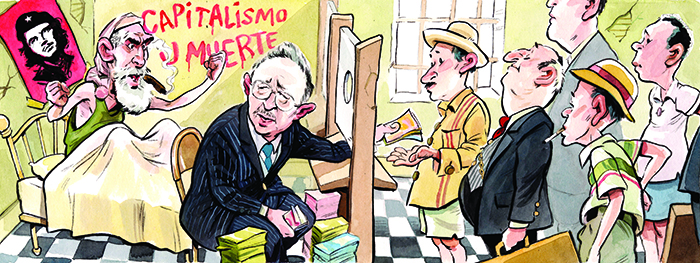
“We don’t have banks in Cuba!”
The taxi driver helming a splendid 1957 Pontiac Pathfinder clasico off the taxi rank at Havana’s Hotel Nacional snorts with scorn.
Euromoney has asked him to drive us to a rare meeting at the Banco Central de Cuba (BCC), one of his country’s most important institutions. But the cabbie neither knows what a central bank is, nor where his country’s own is located. Euromoney tells him the address, in Havana’s crumbling old town, along what was once Cuba’s raffish version of Wall Street at a time when his car arrived on this famously feisty island.
He knows the street, but that’s all. “Are you sure it’s a bank?” he asks.
It’s a reasonable question.
Fidel Castro’s communist command economy advantages its ruling military elite but pays most of its workers around $25 to $30 a month. Though five years into an erratic embrace of free-market reforms of their sclerotic Soviet-styled economy, most Cubans don’t yet have much call – or money – for banking services.
The cabbie is wrong, but he’s kind of right too. There are no formal capital markets in Cuba. There are some domestic banks, but in the island’s primitive financial system, they bear little resemblance to banks elsewhere. As for confidence in the island’s socialist system, ask a Cuban where they keep their cash, particularly those in the peppier tourism sector, and they’ll indicate under the proverbial mattress at home or gesture across the sea to Miami.
It wasn’t always like this. Before Castro nationalised Cuba’s banks in 1960, a year after his fabled revolution, some 49 banks serviced the island, including six foreign banks operating with full licences. Such was their acclaim that a 1957 edition of American Banker listed two Cuban-owned banks in a Latin America top-10 list, second in the region only to Brazil’s top banks of the day.
Today, BCC lists nine domestic banks, eight of them owned by the state. Moving about the capital, the only bank with any retail visibility is an occasional branch of Banco Metropolitano, largely created from the commercial side of Cuba’s old central bank, Banco Nacional de Cuba (BNC) in the 1990s and mostly serving Havana’s handful of diplomats and foreign firms. One of Metropolitano’s branches was once the majestic neoclassical head office of Canada’s Bank of Nova Scotia before the revolution, just three blocks from the central bank.
The ninth bank with a local licence is also state-owned, but by Venezuela. Banco Industrial de Venezuela opened with immediate access to the local market in 2005 after a visit by the late Hugo Chavez, then Venezuelan president and Fidel’s fellow ideological traveller. But the BCC’s list of local banks needs updating. The Venezuelan bank was shuttered in Caracas earlier this year after a succession of corruption scandals and massive losses.
A Havana banker says Cuba’s local banks “function as departments of the central bank. Bank credit to the business sector is practically zero”.
But now the Cuban government says it wants to transform its banks, to make them compete with each other. Where they’ve been traditionally run as the financial arms of ministries, there are plans to turn them into more universal banks, offering products like mortgage loans, hitherto largely unknown in Cuba. Banks here lend for basic household items or home improvement, but not for outright property purchases.
Banco Internacional de Comercio (BICSA) and the military-owned Banco Financiero Internacional (BFI) have traditionally dominated Cuba’s foreign trading. As the most outward-looking of Cuba’s banks, they have an eye on the fast-expanding private entrepreneur ‘cuentapropista’ class that has been unleashed by reforms.
Likewise, the traditionally Havana-focussed Banco Metropolitano (BM) and the nationwide savings bank Banco Popular de Ahorro (BPA), which operate the bulk of Cuban bank accounts, want exposure in trade finance and business. Bank account penetration among Cubans, usually via state-issued debit cards for salary, is no more than 20% to 25%.
That Cuban banks need capital might provide an opportunity for a foreign joint venture or takeover in a reformist economy that legally does not bar them. Despite the notionally liberal law, Havana economists say the market is effectively closed to outsiders.
For the foreign financiers that once revelled here, Cuban law officially does not restrict foreign banks from operating on the island. And there are four more listed by the BCC in Havana today than the six present up to 1959/60; Spain’s BBVA, Bankia and Sabadell, Canada’s Scotiabank and National Bank, Republic Bank of Trinidad and Tobago, Lebanon’s Fransabank, BPCE of France and the defunct Venezuelan bank that the BCC deems local.
“Generally, the foreign banks that come here tend to be provincial in their home markets, not the leading bank, and so they’re looking for opportunities,” says a Havana-based foreign banker. “There’ll be some dominant alpha male at head office who says: ‘We’re going to do Cuba’.”
There’s a 10th foreign bank registered with the BCC, the little-known London-based HavinBank, the former Havana International Bank, the Cuban state’s only foreign-domiciled bank. HavinBank is 86% owned by the BCC, with minority stakes held by Cuba’s Bank of Investment, Popular Savings Bank and Bank of Credit and Commerce.
Regulated by the UK’s banking agencies, HavinBank claimed assets of £177 million in 2015, mostly “loans and advances to banks and other financial institutions”, generating a modest £1.22 million profit. HavinBank boasts an eclectic board. Its members include UK Labour party peer Baron Triesman, an under-secretary in the Blair-era Foreign Office and a one-time British Communist Party member, who once ran that bastion of new wealth, the English Football Association.
HavinBank’s chairman is Gustavo Roca Sanchez, who the BCC website lists as a vice-president of Cuba’s central bank. Cuban dissidents claim HavinBank enables a network of international assets controlled by the communist party’s elite, particularly its military top brass. They cite repeated reports and academic studies that claim the Castro brothers, regarded as ‘Castro Inc’ by many Cubans, are some of the world’s richest national leaders.
Indeed, Cuba’s international bankers and business fixers in the UK, Spain and Switzerland have often been subject to US government sanctions. But last year, amid warming relations between Washington and Havana, the US Treasury department removed various people associated with HavinBank and Cuba’s central bank from its sanctions blacklist.
In Havana, local bankers regard a stint at HavinBank’s Canary Wharf office as an international finishing school, a chance to learn about international finance and earn some extra money. HavinBank’s 2015 annual report reveals one director, believed to be the BCC’s monetary policy specialist Guillermo Gil Gómez, last year earned the equivalent of around Ps50,000 (depending on which version of the Peso you use, that’s either $50,000 or $1,900), in contrast to the Ps600 annual salaries the BCC is currently offering banking specialists.
Far from the extensive branch network and market access that foreigners from Scotiabank, Chase Manhattan and a Taiwan-owned Bank of China enjoyed before Castro, today foreign banks in Cuba are mostly confined to an ambassadorial representative desk, perhaps dabbling in some modest trade financing.
With the US economic blockade of Cuba still formally in place, foreign banking in Cuba has been fraught. France’s BNP Paribas shuttered its Havana office in 2014 after huge fines for busting US sanctions. ING Bank did likewise in 2009 after penalties, while liquidating the Netherlands Caribbean Bank joint venture it had with Cuba’s BPA and the state shipping company Acemex. Deutsche Bank, Crédit Agricole and Société Générale have also been fined or investigated by Washington over their Cuba dealings. Spain’s BBVA dodged a bullet by scaling back its Cuban activities when it started buying in the US, notably Alabama-based Compass Bancshares in 2007.
“At the end of the day,” says a foreign banker in Havana, “you had to decide if Cuba was worth it when you wanted more to be in New York.”
It can also be tricky to be in Cuba itself. The expatriate community is littered with horror stories about foreign businessmen who unwittingly found themselves on the wrong side of revolutionary justice, for something as innocent as incentivizing local staff, or saw their painstakingly formed joint ventures mysteriously wrenched from them by powerful local players, sometimes accompanied by a stint in prison.
Now that is all changing. Cuba’s reforms and a US softening toward Havana have got foreign bankers looking more meaningfully at Cuba. Various Spanish and German banks were in town for exploratory look-see inspections when Euromoney was there.
In July, Cuba’s central bank, with the Florida International Bankers Association, hosted a landmark Havana conference of US and Cuban bankers. The US Federal Reserve even made a presentation, unthinkable barely a year earlier. One of the attendees was Raul Faldes-Vauli Jr, CEO of Florida’s Professional Bank, whose family had owned Banco Pedroso that had been seized by Castro decades earlier. Another delegate was David Seleski, CEO of Florida’s tiny Stonegate Bank, which recently became the first US bank authorised by the BCC to use its debit MasterCards at 10,000 outlets in communist Cuba. Seleski tells Euromoney he believes US-Cuban banking joint ventures will soon follow.
]Ten dollars and five minutes in the Pontiac later – Havana cabbies can make more money in a morning than Cuba’s state doctors and scientists do in a month – and we are in tumbledown Old Havana’s one-time financial district. It’s very evocative, but anything vaguely resembling a booming business district seems a very long time ago. The banks and buildings that once crackled with commerce here had their chambers divided into tenements and outposts for the official ‘defenders’ of Castro’s revolution. Sepia-toned alleys that in a previous Havana might have heaved with bars of suits dealmaking over mojitos today house occasional kiosks offering shoddy local goods to Cubans with little cash. A few streets away is Calle Obispo, once the pounding heart of commercial Cuba. It’s also charmingly photogenic for tourists, but it’s not Oxford Street.
A gold plaque struck by Cuba’s National Association of Economists and Accountants on a wall outside the central bank informs passers-by that here on November 26, 1959, 11 months after dictator Fulgencio Batista fled the island, the guerrilla hero Ernesto Guevara ‘took possession’ of the then central Banco Nacional de Cuba.
Che, as he’s lovingly known, was central bank governor for 15 months, serving concurrently as finance minister too. (A tale oft-told by Havana-based bankers describes how Che got the posts. After taking power, Fidel Castro canvassed volunteers for a ‘good economist’ to lead the central bank. Che raised his hand, believing that Castro had wanted a ‘good communist.’ Apocryphal or otherwise, Che was appointed.)
Though the BCC admits on its related BNC website: “Guevara was not an expert in economics or anything like that”, his pecuniary legacy lives on in Cuba’s unwieldy dual currency system, his image illustrating the three convertible peso note used primarily in the tourism sector, and its local three peso note, valued at 1/25th its convertible counterpart.
Che’s plaque is opposite the BCC, occupying a building that doesn’t so much dwarf its low-rise neighbours as out-renovates them, one of Old Havana’s few structures to have benefitted from restorative masonry or a post-revolutionary coat of paint.
If the central bank’s 510-odd functionaries, 63% of whom are women and 89% university graduates, need any reminder as to why they toil, a mural opposite the main entrance reminds them of ever-vigilant revolutionary heroes Guevara, Camilo Cienfuegos and Juan Almeida, and epic depictions of the 1959 uprising.
It’s not just on Cuba’s banknotes and walls where the spirit of Che lives on. Irma Martinez Castrillon, the BCC’s first vice-president and a former BNC president before its central bank functions were absorbed by the BCC, tells Euromoney that Che’s “inspiration” infuses the central bank today.
“How is it not so?” Martinez asks. “For us it’s very important to follow and know that Che’s spirit and his political and economic policy thinking is present in all the work and all the policies of our central bank.”
When Martinez arrives, she’s tapping into an iPad, a device rarely seen in Cuba. One of the country’s most powerful officials, the formidable Martinez is a Moscow-educated 50-something lawyer who has been at the bank for six years, having moved across from BNC, where she also was president.
The economic reforms announced in 2011 by president Raul Castro, Fidel’s 85-year-old younger brother (by five years), uncorked a free market genie after decades of Soviet-inspired central planning. Today, as many as 450,000 self-employed entrepreneurs have emerged, kickstarting an embryonic private sector.
These so-called cuentapropistas are transforming the tourist sector, making it the most dynamic part of the otherwise moribund military-run economy, opening bars and restaurants in atmospheric spaces and guest houses in their homes, turning private cars into cabs and rejuvenating basic services that had ossified under state control.
According to economists, Cuba now allows private operators in around 200 types of businesses, which in turn employ around 20% of the Cuban workforce, and are steadily tilting salaries away from state control.
Though the economy remains firmly under the wing of military conglomerates, ordinary Cubans now have more of a say in its direction. They can now sell their homes and cars, travel abroad (where many keep bank accounts), import goods, stay in what were once foreigner-only hotels and own mobile phones, though internet data services are either not available or prohibitively expensive.
Despite the advances, Martinez is most comfortable ploughing through safe ideological ground, describing almost by rote the history and legal remit of the central bank. “We have the same function as any central bank in the world,” she claims. She cites the law and date – May 28, 1997 – when the BCC was incorporated, and says its role is to supervise local banks, to issue and safeguard the peso, and manage Cuba’s national reserves. “It should contribute to the economic balance and orderly development of the economy,” she intones. “Our philosophy is based on building an efficient banking system.”
Euromoney asks Martinez about the bank’s independence in implementing policy, citing foreign examples where central banks operate separate of government. “It is not like that here,” she says. “We have comprehensive contact in order to avoid contradictory policies. We don’t respond to the entities and companies of the state.” But “given the peculiarities of the Cuban economy,” she says, key decisions such as monetary policy and interest rates “are discussed and approved with other instances of macro coordination.”
So far, so doctrinaire and formulaic and, perhaps, so revealing too, a contrast to the meeting with another powerful Cuban bureaucrat, Deborah Rivas Saavedra, the dynamic general director of foreign investment at the Ministry of Foreign Trade and Investment. At her Vedado office in a building that was once a showroom for General Motors’ cars, Rivas enthusiastically maps out a vision for her country that could well be Singaporean; of foreign investors being able to hire and fire staff as they see fit, of tax holidays, full repatriation of profits and 100% ownership of Cuban subsidiaries.
Educated in Cuba and Sweden, Rivas worked for years at the state sugar monopoly, the country’s biggest exporter. “We are trying to increase the GDP to 5% to 7% annually,” Rivas says. “We don’t have internal savings, so we have to attract foreign savings in order to invest, and to increase the (savings) rate to 20%. Now we achieve not more than 10%.”
The economic and political challenges confronting Cuba today are starkly, and unwittingly, evidenced in a July post on the Banco Central de Cuba’s own Facebook page, advertising jobs at the central bank. The BCC (above) solicits a range of ‘banking system specialists’; compliance officers, bank inspectors, specialists in finance and economic law, bookkeepers, accountants and computer scientists. Tertiary qualifications are a prerequisite. But few Cubans have the facility to access the BCC’s social media activity, or any sort of online information, even were they inclined to. The Castro government severely limits internet access for Cubans, or makes the few – grindingly slow – connections that are available prohibitively expensive for public use. The more pressing issue for communist Cuba 57 years after a revolution few Cubans today have any profound connection to, are the salaries the BCC offers for highly qualified people to fill its vacancies, especially when compared with what Cuban entrepreneurs can now make working for themselves. A banking specialist at the prestigious BCC will be paid Ps315 ($13.50) a month. A senior bank inspector or lawyer specializing in monetary and economic law will receive Ps415 ($17.90) a month. There’s the ‘incentive’ of a Ps180 ($7.70) monthly top-up, plus a 21 convertible peso ‘stimulus’, making the highest monthly take available, for a highly educated computer scientist or principal banking inspector, around Ps1,100 ($49.50). By comparison, a cuentapropista (who doesn’t need a university degree) taxi taking foreign passengers to and from Havana’s international airport charges 50 convertible pesos (around Ps1,200). One privately owned Havana restaurant, La Guarida, serves around 1,000 covers a week at an average of $50 a diner. It’s very popular with Havana’s communist nomenclature.
Rivas continues: “We don’t want to depend anymore on anyone. We used to depend on Spain, then the US, then the USSR because of the US blockade and now we have some dependency on the oil from Venezuela. “Our main goal is not to depend. That’s why our foreign investment law is so open.”
The discussion with Martinez turns to Cuba’s economic reforms. But the career apparatchik seems at odds with the very term, perhaps reflecting what diplomats and other Cuba observers say is a thorny ideological struggle inside the bureaucratic establishment about what sort of Cuba should emerge after the Castro brothers pass, about how far Castro’s market opening should go or, as far as the doctrinaire Martinez thinks, whether they should even be regarded as reforms at all.
“What do you mean ‘reforms’?” she asks. “We are not implementing reforms. What we are doing is updating the economic management model in Cuba. One of the main tasks that we are performing today is contributing to the transformation of the economic environment. We cannot say we are following a specific model. We cannot lose sight that our economy is a planned economy.”
Euromoney raises Cuba’s dual-currency dilemma. President Castro has committed to unifying them, with primacy to the peso (the weaker CUP), over the convertible peso (CUC) that shadows the US dollar, and which is 25 times stronger than the CUP.
Economists say there are huge structural issues in combining the two pesos, what they call ‘Day Zero,’ not least the inflation implications for ordinary Cubans operating outside the CUC universe, and devaluation issues for those within it.
While economists say the simplest method would be an abolition of the CUC alongside a newly floating and convertible CUP, the US blockade and Cuba’s inability to call readily on multilateral financing makes even that ‘big-bang’ approach problematic.
Cuba has made a number of stop-start attempts to combine its currency, making the CUP convertible and balanced against a table of international currencies, including the euro, yuan and dollar. There was also a brief experiment to introduce CUC1/CUP10 exchange rates in the state sector but that proved too disruptive, and extension to the wider economy didn’t proceed.
Local bankers describe ‘peso piles’ at banks like BPA, which it’s estimated has as much as Ps15 billion on its books, but an unconvertible currency few want to touch. One banker describes currency union as a “ticking time bomb”, particularly with private, CUC-touting cuentapropista entrepreneurs becoming more prominent in the economy. “Everyone wants CUCs now, and you don’t know how much of them are covered by reserves.” Another banker says: “The right time to join the currencies is when the US embargo is lifted.”
Euromoney asks Martinez if the CUC economy is bigger than the CUP economy, as should be indicated by the BCC’s supply of both currencies. She bristles. “This information is not available for you. We don’t share those indicators outside of the bank.”
But she relents, admitting that the BCC has been working on currency union since Raul Castro urged action in 2011. “It has been said publicly that one of the clearest examples of how complex the process of implementing the (market reforms) guidelines is precisely this topic.” “We must do it without shock therapy, without it having a direct impact on the population,” she says. “It’s a complex process. There will not be a magical solution to all the problems of the economy.”
Asked if this is the biggest challenge on her desk, Martinez says a greater problem is Washington’s continuing financial blockade of Cuba, despite the improving diplomatic relationship. We ask about Cuba’s foreign reserves and import cover, some of the most basic information a central bank can make publicly available.
“(That is) even less (available),” Martinez says defiantly. “It is information we consider very sensitive.” To stress the point, she repeats three times: “We do not share this information.” She continues: “I believe that we are transparent, (but) certain information could be used against the national interests of our country.” She breaks into English as if to underline how seriously she regards the matter. “Everybody likes to know.”
What is her take on the economy? “This is a question for the economy ministry, not the central bank,” Martinez says, referring us to speeches made at the recent communist party congress and the state statistics agency. Discussion of Cuba’s ambitions at the World Bank and IMF are also off-limits, because they are “political matters”.
Euromoney runs Martinez’s defensive responses past foreign bankers in Havana. “It’s an artless old-school Soviet reply,” says one. “She could score a political point by revealing the number, which we think would probably be around $10 billion, and say the reason it’s so low is because of the US blockade.” Says another banker: “I doubt very much that they would actually know. Their data is hugely unreliable.” Another says: “They won’t go very far with this kind of reasoning. The market wants disclosure. Yes, there is a US blockade, but a lot of other countries that have not blockaded need to do business in Cuba.”
Robert Feinberg, a former national security adviser in the Clinton presidency, and professor at the University of California’s School of Global Policy and Strategy, agrees, saying: “Investors want to know what the capital account looks like, what’s the reserve levels, the monthly coverage, the basics and they tell you that’s a state secret?”
He adds: “If they really want to attract meaningful foreign investment, they have to create a business climate, and a business climate means at least some degree of transparency.” Feinberg has just published ‘Open for business’, a book on the recent Cuban reforms. “They’ve got to come to grips with this transparency if they really want to open to the global economy and eventually join the international financial institutions. They are facing a serious foreign exchange crisis and I bet in their heart of hearts they’re thinking: ‘Oh boy, wouldn’t it be great if we could go to the IMF and World Bank and borrow a couple of billion’,” he says. “But that’s not going to happen until they at least show some cracks in this non-transparency mode they’ve been in for decades.”
As for Cuba’s banking system, Martinez says it needs strengthening to be more efficient. “We should focus on financing, not only the state companies, but also the new forms of management which are non-state. We are hoping to have a banking system that is in accordance with international standards, as a necessary element of long-term growth.”
Martinez says that the banking sector is open to foreign investors “but we suggest they start with a representative office…. and so long as they are within the regulatory framework”. She says she has travelled widely, an opportunity not readily given to the bulk of her countrymen for years, until it was included in Raul Castro’s 2011 reform package. She cites study tours of central banks in China, Vietnam and Mexico.
“I cannot say that I am impressed by one central bank in particular as a model for us,” she says. “We review all of them and try to take the best experiences out of all of them.” She continues: “Some central banks have shared their experiences in similar processes to the one we are now involved in, this updating of our economic model. We try not to repeat those actions which did not work in those cases.
“We are not like any other central bank.”
Quite.
Ukraine: The perils of PrivatBank
Assailed by conflict and politics, Alexander Dubilet admits that the task of running Ukraine’s biggest bank is complicated. But he insists that PrivatBank can cope with the loss of large parts of its network and dismisses rumours about secret loans and the need for state support. “How’s business?” Euromoney asks of Alexander Dubilet, a man with one of the most challenging jobs in international banking. He is chief executive of Ukraine’s biggest bank, PrivatBank. The question, of course, is loaded. Ukraine is at war, its economy close to dysfunctional. Members of PrivatBank’s staff have been kidnapped and held hostage, its branches firebombed and its network is under near constant siege from hackers. Also constant is a nasty whispering campaign about the bank, some of the rumours plausible, most of them not, but any of them liable to set off panic. If all that wasn’t enough, since 2014 PrivatBank has lost as much as 20% of its branch territory, the outlets in the seized Crimea and across Ukraine’s contested eastern flanks. And then there’s its divisive owner and Dubilet’s boss, the oligarch Igor Kolomoisky, whom Russian president Vladimir Putin has called “a…
Full article: http://www.euromoney.com/Article/3550245/CurrentIssue/96031/Ukraine-The-perils-of-PrivatBank.html?copyrightInfo=true
Ukraine: Yulia’s tale: serving clients amid hostage-taking and betrayal
July 7, 2014 loomed as a normal business day for Yulia Vyalova, PrivatBank’s branch network boss in Ukraine’s eastern Luhansk region. Normal that is, inasmuch as circumstances allowed Vyalova and her charges to do their job, staffing the 155 PrivatBank branches around Luhansk after war had erupted three months earlier across this industrial city of 500,000, just 40 kilometres from the Russian frontier. With neighbouring Donestk, the Moscow-leaning ‘Luhansk People’s Republic’ had wrenched itself from Ukraine in April, exploiting the chaos of Kiev’s pro-Europe ‘Maidan’ revolution, and then Moscow’s seizure of Crimea. The clashes between separatists and the Ukrainian military unnerved Yulia, as did the mines laid around besieged Luhanks that occasionally exploded, sometimes only metres from PrivatBank’s office.
Full article: http://www.euromoney.com/Article/3550177/Yulias-tale-serving-clients-amid-hostage-taking-and-betrayal.html?copyrightInfo=true
Njoroge stresses need for Kenya banks to innovate
Patrick Njoroge, governor of the Central Bank of Kenya, is reflecting on the topic of weight. But it is not the balancing of fiscal levers or the appropriate spreads for Kenya’s $7.2 billion in foreign reserves that is concerning him. No, for this recent arrival – he took over the CBK last June after 20 years at the IMF – the subject is more personal: his own girth, or lack of it. Euromoney has asked if Njoroge is enjoying his new role. A tall, trim man who looks more mid-40s than his actual mid-50s, Njoroge consults the My Fitness Pal app on his smartphone. On June 8 last year, he explains, a week after being nominated for the CBK role by president Uhuru Kenyatta, Njoroge weighed 180.4 pounds, around 82kg….continued
Kenya: central bank governor Njoroge: Calling it as he sees it
Patrick Njoroge has spent much of his career outside Kenya, mostly in Washington at the IMF as a senior economist. Two decades in that role took him around the world, occasionally as its ambassador, more often in a team of firemen fixing damaged economies. As for central banks, he has met and advised many. “I know them all,” Njoroge says, his eyes brightening. “I can tell you every single governor in the world, just about; I’ve pretty much met them all.” He says the CBK is a good central bank “relative to our peers in East Africa.” But that is not enough for Njoroge. “We are thinking [we should be] world-class. “My legacy plan is very simple. What I want is a strong, world-class central bank in a vibrant financial sector, that’s my vision for the my-work-is-done moment. Then I can fade into the sunset,” he says. “But it’s more than just practices, it’s bank supervision, robust systems, internal procedures, the way we relate, the way we communicate, all those things should be world-class, our people too, transparency is essential….continued
http://www.euromoney.com/Article/3542982/Category/0/ChannelPage/207415/Kenya-central-bank-governor-Njoroge-Calling-it-as-he-sees-it.html?
Technology: Traditional banking is Finn-ished
A conversation with Dr Tom Dahlström of Finland’s OP Group, the ubiquitous financial services firm, is like having one’s own TED talk about banking. Firstly there’s his ‘doctor’ thing. Not many banking executives can claim to be one – Dahlström’s doctorate is for economics, which he got in Helsinki after post-graduate studies at London’s LSE. Then there’s his title: chief strategy officer. Such deal-spotting jobs are increasingly commonplace at banks but, after 15 years at the decidedly Nordic OP Group, Dahlström functions more as an in-house boffin, with a mandate to research, think and divine trends as to where and how OP can extend its reach….continues..
http://www.euromoney.com/Article/3534678/Technology-Traditional-banking-is-Finn-ished.html
Kenya: Patrick Njoroge, corruption-fighter
Patrick Njoroge, governor of the Central Bank of Kenya, is reflecting on the topic of weight. But it is not the balancing of fiscal levers or the appropriate spreads for Kenya’s $7.2 billion in foreign reserves that is concerning him. No, for this recent arrival – he took over the CBK last June after 20 years at the IMF – the subject is more personal: his own girth, or lack of it. Euromoney has asked if Njoroge is enjoying his new role. A tall, trim man who looks more mid-40s than his actual mid-50s, Njoroge consults the My Fitness Pal app on his smartphone. On June 8 last year, he explains, a week after being nominated for the CBK role by president Uhuru Kenyatta, Njoroge weighed 180.4 pounds, around 82kg. By July 17, barely three weeks into his term, he weighed just 170.2 pounds, or 77kg. “And I wasn’t doing any exercise,” this enthusiastic jogger insists. As he describes it, things were grim and getting grimmer. “When I got the offer, I couldn’t even go back to Washington to wind up my affairs,” he says. “This place was burning, inflation was surging, the exchange rate was dropping like a stone, there were pressures on the current account. It was a mess and somebody needed to deal with it. It was triage situation, an emergency room. “When I come in in the morning, I am concerned about various things,” he says. “But I’m also concerned that I do not want to make a mistake because the stakes are very high. This requires a lot of work. “The point is there is a lot of stress. And when I get stressed, I lose weight. So, you ask, do I enjoy it?” Six months on, the answer would seem to be yes, just. Another tap on his phone confirms it. “Yesterday, I was 171 pounds. “But it’s enjoyable. Why is it enjoyable? Not because I enjoy pain; it’s because I can see the prospects. If we get things right, this economy will just rocket. We have a substantial unique responsibility fixing the financial sector. If that happens, the sky’s the limit.” Optimism Njoroge’s optimism about an under-achieving country ravaged by chronic corruption brings to mind that old aphorism about Brazil, India and Russia that they are countries of the future… and always will be. Njoroge knows the line, but shakes his head. “No, that does not apply to Kenya,” he says, citing a GDP forecast for 2016 projecting a stabilised Kenya as an emerging East African powerhouse growing at 5.5% to 6.0%. This estimate is “very conservative,” Njoroge says, but points out that it is substantially higher than what his former employer, the IMF, predicts for the wider sub-Saharan African economy, which it downgraded in October from 4.5% growth to 3.75%. The IMF, which recently had a team in Kenya, is tipping the country to grow at 6% in 2016. The government gets a tick for economic management, he says. Macroeconomic stability has returned, and policy direction has been encouraging. “They just need to execute it now,” he says. “We cannot rest on our laurels, we cannot be complacent.” An athletics obsessive, he cites Kenya’s recent record at the Olympic Games as a warning. “We are the best runners in the world,” Njoroge says. “I mean it’s in my passport, right? I’m Kenyan, I’m a marathon runner right? But what happened to us in the marathon?” Favoured to win both the men and women’s events at the London Olympics in 2012, Kenyans disappointingly only managed silver in both. “We get complacent and we lose the race,” he says. “One day we are the most dynamic, and then, boom, others will be more nimble, maybe innovate faster. They will just accelerate and leave us in the dust.” Njoroge’s appointment as the ninth governor – and eighth Kenyan – since independence was something of a watershed. An economics graduate of the University of Nairobi, Njoroge and his family had virtually no profile among Kenyans. His career was outside the bank and, as he proudly points out to Euromoney, “I didn’t have any political connections whatsoever.” He grew up in a village on Nairobi’s outskirts, one of eight children in an academic family. His father was a career civil servant in the education ministry and his mother a primary school teacher. In the late 1980s, Njoroge won a scholarship to study for a PhD in economics at Yale University, where he was lectured by the Nobel economics laureate James Tobin, a noted advocate of decisive government intervention in the economy. After Yale, Njoroge returned to Kenya and served two years as an economist at the finance ministry, helping stabilize an economy reeling from the Goldenberg export scandal, which had ravaged the Daniel arap Moi presidency and the central bank. In 1995, Njoroge joined the IMF, where he worked for 20 years, starting out as an economist and leaving, last year, as senior adviser to deputy managing director Mitsuhiro Furusawa and arguably the most senior African at the fund. Transparency The deeply religious Njoroge has eschewed the perks of the governorship – the limousines, the official house in Nairobi’s leafy Muthaiga district – for a modest VW Passat from the CBK fleet and near-monastic house sharing with fellow members of the Roman Catholic Opus Dei organization. His press adviser quietly points out that Njoroge donates “a decent share” of his salary to charity. Njoroge says his selection process was “100% transparent, so far as I’m aware.” He goes further by claiming that the transparency of his appointment – an open interview, the subsequent vetting by parliament, the presentation of vetted candidates to the president – was the first time an African central banker had been appointed in such a manner. “It’s not like I had it in my plan that one day I would come back and do X or Y, or build my retirement home by the sea or whatever else. I lived one day at a time, my planning horizon was a year.” While in Washington, there were regular visits back home to see family but, as per IMF home-country rules, Kenya was not part of his brief in Washington. “I maintained contact with the country, and obviously Kenya has always been home and has done so much for me. I kept up like any person in the diaspora would, but I wasn’t trying to second guess what everyone else was doing here. “I had a lot of other countries to worry myself about professionally, countries that were in deeper crisis, in Europe, the US, those were major financial crises. “I never felt like one day I had to go back and fix Kenya. I never felt that. I was always open to coming back. I could have continued my career at the IMF and retired to anywhere in the world – New Zealand seems to be a great place for people to go. And then this job came along.” Uhuru Kenyatta-350 Uhuru Kenyatta, president of Kenya Njoroge says he was not headhunted or handpicked, he simply applied from Washington. He had no history with any of the political decisionmakers. “It became clear that the time of the [previous] governor was coming to an end… And I said to myself: ‘Oh you know, I have unique experience’. Looking at all of them [the other prospective candidates], none of them had had the experience that I have. I mean I’ve been working with two thirds of the central banks of the world, so it wasn’t just experience working with just one bank.” Once he threw his hat into the ring, then came the profile. “I found it curious that some people said of me: ‘You’ve never really worked in the financial system’, when I had worked in around 200 – and helped fix a good number of them.” He was then criticized for not being ‘political enough,’ that he lacked political connections, which he sees as a virtue. He says he did not know Kenyatta and had only met him in Washington when Kenyatta had visited the IMF as minister of finance in the late 2000s. “He was very amiable… but it’s not like there was any deal cut in a smoke-filled room.” Lifestyle choices Then came the vetting. Six months later, Kenyans are still talking about Njoroge’s appearance before Kenya’s parliament. No matter that at the time Kenya’s economy was struggling, it seems that Njoroge’s candidacy balanced more on his marital status than his impressive CV. In a God-fearing society where the average marrying age is 26, local lawmakers were puzzled as to how a then 54 year-old Kenyan man could be single. One member of parliament insisted his interrogation of Njoroge and his personal life was valid because he, the MP, knew a fellow parliamentarian whose sister was single. Njoroge was calm. “I am single by choice and I am comfortable that way,” he told MPs. “There is nothing sinister with that. I am sure this committee has done its due diligence on what sort of a person I am.” Njoroge then patiently explained how the central bank is structured, revealing a decided lack of understanding among MPs. Then they quizzed Njoroge, who had lived outside Kenya for much of his career, as to why he had no assets in Kenya. “Yes,” he agreed, “I don’t have a single asset here in Kenya and this is where I am at this point. But it doesn’t mean that this is how it will be for ever, and I subscribe to being very deliberate about that. This is my economic model and it may be, years after retirement, I would want to invest in other things. That should not mean I have any financial inabilities. It comes with the profession,” he said, insisting that “it’s not that I don’t have faith in the economy. I do.” Kenya’s robust media was furious, and Njoroge’s parliamentary grilling became the touch paper for a spirited debate among Kenyans about the quality of their public officials. Nairobi’s Daily Nation newspaper fumed that in dwelling on Njoroge’s “lifestyle choices,” lawmakers had wasted an opportunity to set an economic agenda. “While worrying about the lack of title deeds in the proposed governor’s name, MPs probably did not notice how clear and independent-minded (Njoroge) was on crucial issues and how easily he articulated positions contrary to those taken by the government and MPs,” the newspaper wrote. Looking back, Njoroge smiles at the fuss. “In terms of technical ability, the technical questions, let’s just say I would have been very surprised if I was asked a question that stumped me. So from that perspective I was very comfortable. I mean I’ve spent 25 years worrying about these things, and then you ask me a question that floors me?” He laughs. He says he felt most exposed over political matters, which he says he has had less experience of in his career. The personal stuff floored him, but it did not show. “I was a bit embarrassed,” he admits, “I tend to be very private, and nobody enjoys having their private life paraded in public over TV and radio. On the other hand, there is nothing to hide, so if you have a problem with that, there it is. What you see is what you get, and I think that’s how the people responded.” For a person who claims to possess no political skills, his handling of the vetting process was a masterstroke, if an unwitting one. “It became even more amusing when people started to offer me a wife, this sort of thing. I explained who I am, what makes me tick, in the end they need to know this.” Njoroge’s tight IMF connections could help if things turn bad in Nairobi. Kenya can reportedly access a special IMF $700 billion-strong fund if need be. Although his appointment has been well-received by Kenyans, Njoroge’s governorship is beginning to grate on some Kenyan bankers, who note a tendency to lecture and, they say, dabble outside his mandate. Njoroge makes no apology for his style. “The bankers, the financial sector, they cannot be stuck in the 20th century, or even worse the 19th century, so they need to innovate. There are some things in the financial sector that need to change… and it’s our job to midwife the thing.” “It’s not the job of a central bank governor to tell bankers how to run their banks, but to compel them to run them prudently within the law,” grumbles one senior banker. Njoroge disagrees: “It’s my job to tell them that they need to innovate even more, lower their cost, produce products that are relevant to the people… So when they say: ‘We have a new product’, I say: ‘Who do you have in mind?’ My biggest question is how are you dealing with entrepreneurs and small and medium-sized enterprises?” Imperial Bank Since coming to the chair, he has set down a decisive marker, seizing control of struggling mid-sized Imperial Bank on grounds of “irregular lending”, while forcing the smaller Dubai Kenya Bank into receivership. At Imperial, Njoroge also called in Washington-based forensic auditor FTI Consulting, best known for its work on the Bernie Madoff scandal and the Lehman Brothers wash-up. As the Imperial case continues to ripple around the system, Njoroge’s own colleagues have not escaped censure. “This in a sense shows there may be some blind spots in the way we operate,” Njoroge said, after moving on Imperial. “We will do our own in-house introspection and see why did we miss this. There is no doubt in my mind that if indeed there was something [wrong] there will be consequences. “We are very much wedded to market-based solutions,” he tells Euromoney. “We are not going to deviate from market discipline.” After his moves on Imperial, Njoroge says, “now it’s clear that when a problem takes place in any area, whatever, we have made it very clear how we will approach those things, and it will be credible.” More moves may come. Njoroge says he would like to see consolidation in Kenya’s banking sector, where 45 banks vie for business in a market where perhaps 15 would be sufficient. Finance minister Henry Rotich also has consolidation on his mind, telling Euromoney he intends to introduce legislation to raise capital thresholds that smaller banks would be unlikely to meet. Njoroge is pushing for a moratorium on new bank start-ups.
Zeti ups the ante in fight with 1MDB
Malaysia’s formidable central bank governor Zeti Akhtar Aziz endured quite a month in October. It began with her contemplating the fresh lows that her beloved ringgit had plumbed on September 30, having lost 40% of its value in a year to become Asia’s worst-performing currency, and taking much of her carefully-tended reserves nest egg with it. While in Lima networking at the annual IMF-World Bank meetings, she stood up to Malaysia’s prime minister Najib Razak to defend the independence she had so painstakingly won for Bank Negara Malaysia (BNM), the country’s central bank. On October 9, BNM said it would pursue criminal prosecution of Malaysia’s controversial sovereign fund 1Malaysia Development Berhad (1MDB) for breaching Malaysia’s exchange controls…..continues
Malaysia: Zeti’s last stand
Alas poor Zeti Akhtar Aziz, Malaysia’s embattled central bank governor. At 68, and after 15 years in the job, she is due to retire next April. But it is not certain whether she will make it that far. Her beloved ringgit has collapsed to its lowest level in 17 years, further than even during the crippling Asian financial crisis. The foreign reserves she carefully accumulated above $140 billion have fallen below $95 billion in the ringgit’s defence in 2015. But for what?
Full article: http://www.euromoney.com/Article/3493942/Malaysia-central-bank-Zetis-last-stand.html?copyrightInfo=true
Zeti tries to rise above Malaysia’s creeping crisis
For Zeti Akhtar Aziz, the venerable governor of Bank Negara Malaysia (BNM), the country’s central bank, these should be the best of times. Deep into her last year of what will be, by her retirement next April, 16 years at the helm of BNM, it should be a period of reflection for the magisterial Zeti, to accept the congratulations of a grateful nation to this 68 year-old trailblazer of modern Asia’s economic miracle.
Full article: http://www.euromoney.com/Article/3495882/Zeti-tries-to-rise-above-Malaysias-creeping-crisis.html?copyrightInfo=true
Spain: Sabadell tries out a new look
Since the financial crisis the bank has been transformed from a Catalan regional to the fifth largest bank in Spain. It now has ambitions in Europe and the Americas.
Byambasaikhan offers Mongolia a fresh exchange of ideas
In doing the rounds of Ulaanbaatar, it doesn’t take long to encounter someone who used to work at the Mongolian Stock Exchange. Former MSE staff seem to be deposited most everywhere across the narrow universe that is Corporate Mongolia; at its handful of banks, its few private equity firms, the central bank and the state-owned mining houses. With five chief executives and myriad board members since 2010, the MSE is virtually a local version of LinkedIn, a transit lounge of talent.
Full article: http://www.euromoney.com/Article/3488645/Asia-Byambasaikhan-offers-Mongolia-a-fresh-exchange-of-ideas.html?copyrightInfo=true
Sri Lanka: Showdown at the central bank
Vendettas waged by government bureaucrats never look good but, in Sri Lanka, such higher-minded considerations seem to have evaded two powerful men who should know better. Arjuna Mahendran and Ajith Cabraal, the current and former governors of the Central Bank of Sri Lanka, have been at each other’s throats over all-too-common allegations on the Indian Ocean island – corruption and insider dealing.
Full article: http://www.euromoney.com/Article/3488240/Sri-Lanka-Showdown-at-the-central-bank.html?copyrightInfo=true
Bankia’s Alvarez: Saving the bank that didn’t exist
In early 2013, Jose Sevilla Alvarez, the then newly appointed chief executive of Spain’s Bankia, sat down with his chairman, the storied Spanish banker Jose Ignacio Goirigolzarri, to have a critical conversation about where Bankia was going. Outside, the atmosphere in Spain was as toxic as the rancid bank they were tasked with fixing. The country’s financial crisis that had begun in 2008 seemed unending, and at 27% – 50% for under-25s – Spain was besieged by the social and political consequences of Europe’s highest unemployment levels.
Full article: http://www.euromoney.com/Article/3477276/Bankias-Alvarez-Saving-the-bank-that-didnt-exist.html?copyrightInfo=true
Jho says it ain’t so: Malaysian tycoon denies role in 1MDB ‘heist of the century’
Low Taek Jho’s high-rise lair in Hong Kong is the stuff of thrillers, appropriately enough for a young Penang-born tycoon cast by his countrymen as a mysterious villain whose shadowy dealings have exposed the secrets of Malaysia Inc. The intrigues are felt the moment one steps inside the stylish foyer of Jynwel Capital, his family’s private equity investment house based in downtown Central. A receptionist purrs that “Mr Low is expecting you” as a wall magically slides aside to reveal a minimalist ante-room framed by a panorama of the city’s harbour and the promise of China beyond.
Mugur Isarescu: Romania’s central figure
THE soaring walls and revolving doors of Romania’s communist-era finance ministry on Bucharest’s Constitution Square expose a deeply rooted instability that hampers one of Europe’s more volatile economies. Portraits of former ministers are displayed around the walls of the ministry’s foyer, their faces looking beyond those doors to the pompous People’s Palace, one of the world’s largest buildings, that dictator Nicolae Ceausescu had built for him before he was toppled during the revolutions that swept eastern Europe in 1989. Ministers must have departed office before their depictions go up here, and on the foyer’s southern panels, it’s getting rather crowded. This side displays Romania’s finance ministers since 1989, since Bucharest embraced democracy, capitalism, the European Union and, by 2019 as envisaged here, the fiscal disciplines demanded of its euro aspirations. When Euromoney visited the ministry in mid-December, near 25 years to the day since Ceausescu fell, there were 20 portraits on the post-1989 side of the building. That’s a new minister every 15 months, a record few other nations can, or would want to beat. By comparison, Romania had just six finance ministers during Ceausescu’s 32 years in power. We were in Bucharest to speak to Romania’s 21st finance minister since 1989, Ioana Petrescu. At 34, Harvard-schooled Petrescu was the youngest incumbent finance minister of an EU state. Appointed with much fanfare because of her youth and apparently impeccable education, she had been in the job since March, promoted by prime minister Victor Ponta from being his economic adviser. When we saw Petrescu late on a snowy Sunday, she seemed somewhat harassed. She had endured weeks of arm-wrestling cabinet colleagues, the World Bank, Brussels and an austerity-insisting IMF, which bailed out Romania in 2009 with a €20 billion package, to produce a budget that was already a month overdue, and that Romanians were impatient for. The starting point was an accounting department, a cashier and a personnel department, that’s all. [The rest], monetary policy, research, supervision, regulation, a payments system, the culture – everything was built Mugur Isarescu Outside, rumours swirled that Petrescu would not be long for the ministry. She told Euromoney she hoped to stay in office until her work is completed. “I’m a technocrat, not a politician,” she said, pointing out “there are serious reforms needed across the economy.” She cited the state’s inefficient domination of key enterprises, a hangover from communist times, as one of many. Few doubt that, but any prospects she might have had to implement them didn’t seem to be helped by the man who appointed her, the PM Ponta who Euromoney had interviewed a few days earlier. When Euromoney asked him about Petrescu’s future, he said he “hoped” his youthful charge would keep her job. His assurance had all the sincerity of a football club owner insisting his win-less team’s manager had the full support of the board. And so it proved. A few days after an unremarkable interview with Petrescu, that southern panel of post-1989 ministerial portraits would get another portrait – hers – as Romania’s 22nd finance minister in 25 years, Darius Valcov, the budget minister, took over. Of course, managing complex capitalism is trickier than communism’s command economy. But neighbouring Bulgaria, which rivals Romania as the EU’s weakest member, has had just 11 finance ministers since it tossed out communism in 1989. The eurozone’s ‘sick man’ Greece, though never part of the former socialist bloc, has had 16 in 25 years – and eight of them since 2008. By contrast, Europe’s undisputed wirtschaftsmeister Germany has seen just five finance ministers in 25 years, only two more than it has had chancellors in that period. In Bucharest, that revealing ministry wall may soon become even more crowded with ex-ministerial portraits. The new minister Valcov is widely seen as an unexceptional member of Ponta’s cabinet, and is not expected to last long in office while Ponta is being squeezed by the country’s new president Klaus Iohannis. Under Romania’s French-style cohabitation system, Ponta’s government is constitutionally in office until 2016. But momentum politics is against Ponta after his presidential bid was soundly defeated by Iohannis in a November poll. Iohannis became Romania’s first ethnic German leader, a victory seen as a comprehensive cut with Romania’s corrupt and cronified politics, its oligarchical tentacles reaching back to the Ceausescu era, mostly via Ponta’s Social Democratic Party. Romania may offer a lucrative career for the country’s portrait artists, but such has been the tortured progress of its transition from communism, the finance ministry’s revolving doors tell a story of chaos, corruption and bungling in this ‘twixt-‘n-tween’ nation at the EU’s southeastern extreme, a tale of myriad missed opportunities to catch up with its more prosperous European partners. Defining figure The political part of Romanian economic policymaking might be in chronic flux, but there’s another side that’s anything but. Since 1990, Romania has had one reassuring constant who the country and its multilateral supporters in Brussels, Frankfurt and Washington repeatedly turn to whenever economic gloom descends – its central bank and its 65 year-old governor Mugur Isarescu. In the absence of effective political leadership on the economy, Isarescu has been a defining figure in securing Romania’s shift to the market. Having stepped into the National Bank of Romania chair less than a year after the revolution, he modestly jokes of “sometimes making it up as we went” in building a functioning central bank from communism’s ashes. “The process was incredibly complex,” he recalls. “No theoretical approach was correct, there was no text book. To build market institutions in one or two years was almost impossible. We started virtually from ground zero.” Romanian governments are not traditionally renowned for their sagacious decision-making. In 1917, against the advice of Bucharest bankers, the government of the day dispatched the nation’s horde of gold, precious stones, art and religious icons – worth billions by today’s valuation – to Moscow for safekeeping and away from the German-led Central Powers of WW1 descending on Romania. Mugur_Isarescu-529 Early on in his reign, Mugur Isarescu established the NBR’s independence from the government to execute policy As every Romanian knows, Moscow has never returned the trove and it’s become a perennially irritating pebble in relations between Romania and Russia. Some historians have opined it has even influenced Romania’s westward tilt to Europe’s embrace, and has become a long-standing ritual of the NBR chairmanship. Any new incumbent has not properly assumed office until he is solemnly handed the dossier of sealed documents proving both claim and contents of the ‘Romanian Treasure.’ Isarescu has been the custodian of that dossier – and of Romania’s modern monetary treasures – since September 1990. Discounting a brief absence in 2000, he is one of the world’s longest-serving incumbent central bank governors. (Sir Kenneth Dwight Venner has run the Caribbean monetary authority amalgam, the Eastern Caribbean Central Bank, since 1988.) In a nation repeatedly disappointed by its politicians and civil servants, scandal-free Isarescu can lay strong claims to being Romania’s most trusted public official. He has been, by considerable measure, the most important decisionmaker involved in the Romanian economy, his job in large part to limit and often repair the effects of ministerial mismanagement during that time. Early on in his reign, he established the NBR’s independence from the government to execute policy. And the continuing chaos at the finance ministry has clearly helped Isarescu do his job and keep the NBR’s professional distance from government, says banking analyst and economist Dragos Cabat. “We can genuinely say we are one of the most independent central banks in the world,” says Cabat. Offered to rank the NBR on an increasing one to 10 scale of independence, Isarescu says “perhaps nine.” He says the Bank of England once ranked international central banks on a 1-100 scale based on the operational scope of functions; the more tasks performed such as supervision, note-issuing and so on the higher the rating. Isarescu’s NBR rated 92. Having so many finance ministers and governments (18) during his term has meant, Cabat explains, that no one minister stays around long enough to get the better of him. “They come and go so frequently,” Cabat says, “I doubt he’d even bother with them if they did call.” But ministers do call, Isarescu says. “Because I am senior and they are junior, they ask to come here.” He smiles. “Now… hmm… when they call, it’s something like that they try to have an interview with me.” Through the 1990s it was different. Isarescu says governments would implore him to attend their cabinet meetings, to ask his advice and for money too. He put a stop to this practice when he became prime minister in 2000. “I made a rule then that the central banker will not be in the cabinet room,” he says. “Never! For ever!” Critics Isarescu is not without his critics. Prominent economic commentator Radu Soviani says some of Isarescu’s ‘misjudgments’ on currency markets have cost Romania billions. Isarescu admits he’s made “a lot” of mistakes during his governorship. Inflation, never an issue in the state-set pricing of the communist era, had been a persistent blot on Isarescu’s record that also took years to break, peaking above 300% through 1993/4. It has been steadily brought down to under 2%, helped in no small part by the rigours set by the European Central Bank. The historically-unstable leu has been tamed, its managed float bringing it in line with preparations for Romania’s anticipated entry to the euro in 2019. “The confidence in the national currency has returned,” he says. “Borrowing in leu now means there is no exchange-rate risk. There is more confidence to invest.” Foreign reserves are just over €32 billion, around six months’ worth of import cover. It’s curious, he adds, that the closer Romania gets to adopting the euro, “the market share of the national currency is getting higher and higher, not lower and lower as perhaps one would expect.” In 2014, according to ING Bank research, the leu depreciated by a minimal 0.5% against the euro, compared to the Polish zloty (off 4%) and the Hungarian forint (off 8%). However, the recent currency gymnastics by the Swiss central bank have spooked markets in Bucharest. It comes a month after the mid-sized Banca Transilvania acquired the local unit of Austria’s Volksbank, which had led a mid-2000s push for low-interest Swiss franc loans in Romania. Those loans are now around double in leu terms. Periodically dubbed the ‘Tiger of Eastern Europe,’ usually after Bucharest adds another confidence-securing club membership such as Nato (2003) and the EU (2007), Romania hit a wall in 2009, when the IMF stepped in with a €20 billion bailout. As the 2008 post-Lehmann crisis gathered globally, Isarescu went on TV in an attempt to explain and calm public anxieties. He told Romanians there was a “psychological” danger of contagion, but there was no actual toxic exposure in the system. Several years on, Isarescu is relieved if not proud that Romania has not needed to bail out any ailing local bank or suffered any big financial scandal, unlike, say, Bulgaria. Today, he claims systemic risk is limited, with the leading six banks comprising as much as 60% of the market, with the biggest, BCR, at around 17%. And all of them, save the state-owned CEC Bank run by Radu Gratian Ghetea, are foreign-controlled, with capital adequacy levels higher than the Basle requirements. It is an irony that a part of society is complaining that there are too many rich [people] and too many poor, and they look back to the old times Mugur Isarescu As austerity has kicked in, so have Romania’s euro membership aspirations been set back, from an initial 2010 to 2012, which then pushed out to 2015. Even that has proved ambitious. With the euro in turmoil, Isarescu says it is better for Romania to stay outside the euro, while still aiming to meet the convergence criteria disciplines. Romania currently meets five of the seven entry criteria, with work still needed on legislative harmony with eurozone states. Romania will also need to spend a few preliminary years on euro trainer-wheels, entering the leu into the euro-fixed exchange rate mechanism, ERM II, something that’s not yet on the near horizon. It’s painstaking going, but prime minister Ponta told Euromoney that euro membership remains a central policy plank of his government, while new president Iohannis is also strongly pro-EU and pro-euro. Isarescu says that while political consensus has been near impossible to obtain in Romania, there is agreement on the euro, he says. The euro, he says, will be a “very profound cultural change” for Romania. Aside from recent euro adoptees Slovakia and Slovenia, he claims that Romania, once the laggard of the enlarged EU’s five post-communist members, “is now the sole EU member which fulfills entry criteria. It’s incredible.” The 2019 entry target is necessary as an “anchor for the economy, to keep the country on track, and a catalyst for further structural reforms,” he adds. Euro membership represents a critical milestone for Romania, as well as for Isarescu. A nationally popular figure – he even has a coffee blend named in his honour – he was urged by many Romanians to bid for the presidency in the November poll but chose instead to accept a sixth five-year term as NBR governor until 2019. He’ll be 70 by then, not only one of the world’s longest-serving governors but also among its oldest. If Romania does qualify for euro membership by 2019, the country’s economic history since 1989 suggests it will be in so small part because of the NBR’s technocratic hand stewarding the national till. As monetary policy is ceded to the European Central Bank, the next five years will likely see Isarescu effectively managing himself out of his long-held job, and Romania from a critical aspect of its economic sovereignty. (Unless policy is dramatically changed at the ECB, euro membership will also mean a reversion for Romanians to unpopular paper banknotes. Romania has been using Australian-style plastic or polymer notes since 1999, an Isarescu innovation.) Sharp contrast Today, as Isarescu surveys the magnificence of his domain on Lipscani Street, the old neo-classical finance ministry in downtown Bucharest, the impression of the NBR is of a calm, self-operating machine, in stark contrast to the turmoil within Romania’s economy ministries. It is also in sharp contrast to the old NBR that Isarescu took over in 1990. In Ceausescu’s time, the NBR functioned as a de facto commercial bank, or at least something that tried to pass for one in what was then a command economy. “There were 6,000 employees,” he recalls. “But the only central bank function it did back then was to print money. There was no monetary policy made here, no supervision, everything was central planning under the control of the finance ministry, and the NBR was like a department where ‘banking’ was simply to send money to the central planners.” Isarescu’s post-revolutionary task was to create a central bank from scratch. First, he hived off the commercial function to become what is today Romania’s biggest private bank, Banca Comerciala Romana, after it was privatised by the state to the World Bank’s International Finance Corporation and the multi-lateral European Bank for Reconstruction and Development and, later, to Austria’s Erste Group of Sparkassen fame. BCR is now part of one of eastern Europe’s biggest banking networks. Further reading Klaus Iohannis_R-large Romania risk falls after surprise election result The BCR separation left Isarescu with an office and an administrative rump of just 500 employees, the bare bones of a central bank. “The starting point was an accounting department, a cashier and a personnel department, that’s all,” he says. The rest, he recalls, “monetary policy, research, supervision, regulation, a payments system, the culture, everything was built. “I had no hesitation to ask the IMF and other central banks to come here and advise,” he says. He hosted delegations from the central banks of France, Italy, Belgium, Austria and the US Federal Reserve. “The Bank of Norway gave us our first personal computer,” he remembers. With Romania among the last of the eastern bloc nations to transition, Isarescu says he had the advantage of being able to examine the experiences in Prague, Warsaw and Budapest to decide what worked, and what didn’t. These were crazy times, he says. Out in the street, Romania’s economy was fast becoming an unregulated free-for-all, particularly its nascent finance sector. “People were opening new banks like they would open a bar,” remembers Raiffeisen Bank Romania’s chief executive Steven van Gronigen. Isarescu plucked bright graduates from economic research institutes and trained them to be bank inspectors, “supervising grumpy old guys from the communist system.” Trained up, some of them would leave to start and join commercial banks. The extent of NBR’s independence from Romania’s near-anarchic politics was also up for debate. This was 1990, Isarescu was getting help from western central banks when, as he recalls, “the only real independent central banks back then were the Bundesbank and the Fed.” He recalls a fateful occasion in 1990 at the annual gabfest the Kansas City division of the Federal Reserve Bank hosts at Jackson Hole in Wyoming. The hot symposium topic of the day was central banking in the ‘new’ eastern Europe, and Romania was represented by Decebal Urdea, who’d been NBR chairman in Ceausescu’s last year and had somehow survived the transition. Urdea was a rusted-on party hack, a member of Ceausescu’s central committee. He also couldn’t speak English so he outsourced his presentation at the conference to an economist-translator temporarily stationed in Bucharest’s embassy in Washington to learn Western central banking: Mugur Isarescu. Soon, Urdea was out and Isarescu would return home to Bucharest to implement the plans he’d proffered in Wyoming. Carte blanche In the revolutionary atmosphere of the time, Isarescu was given carte blanche to create the type of central bank he wanted. “I said the Bundesbank, it was an inspiration.” It was the right call. By 1992, the then European Community’s Maastricht treaty mandated that the central bank of member states must be independent. That mandate was translated into Romanian to become law, one of the first post-1989 occasions where Bucharest was aligning its statutes with the emerging European Union. Though the Bundesbank was Isarescu’s general working model, sometimes critical decisions were made on the hoof. Isarescu had the option of keeping bank supervision outside the NBR purview, as it was at the Bundesbank. It was decided the NBR would retain a supervisory role, for the simple reason that there weren’t suitable offices at the time to house any such body. He laughs, as if he’s unburdening himself of a long-held secret. “It was simply that. It’s good to be able to say this after 25 years.” Corruption remains a persistent sore, which he says appeared in “an avalanche of crooks in the 1990s”. It’s a problem of culture, “perhaps related to our historical tradition close to the Orient” and of “perseverance to maintain the independence of the justice system.” He believes euro entry could help reduce corruption on cultural grounds, that its embrace by Romanians, who polls say are about 70% in favour of adoption, is seen a modernising device, “to encourage good entrepreneurship.” Isarescu has travelled a remarkable journey. He graduated as a Marxist economist in 1971, then worked for years at the Institute of International Economics, the country’s only body that tracked economic developments in the west, informing superiors negotiating the terms of what minimal external trade Romania had beyond the Comecon group. His loyalty to the state assumed, he had privileged access to different publications and influences forbidden to other Romanians. He has read Euromoney since the early 1970s so as to track developments in international banking and finance. He remembers the rationing and austerity of the 1980s when, as one of the few communist members of the IMF, Ceausescu exported the bulk of Romania’s output to pay back loans and build his pompous palace in central Bucharest. “It was incredible, Bucharest was in total darkness. A banknote was called a lottery note back then,” he recalls. When the communist regimes of eastern Europe began to fall, he was one of the few Romanians able to track events elsewhere, by virtue of a Reuters terminal in his institute. So, after 25 years of the market and as the critical economic policymaker of the country, does this one time Marxist economist believe the aspirations that fired the 1989 revolution have been delivered for Romanians? Yes, he says, “and fulfilled quickly after the revolution because shortages disappeared and Romanians suddenly had choice. They could hold foreign currency and speak with foreigners without needing a permit or being detained, and read what they wanted, and travel. “But then other dreams appeared, a new generation, and it is an irony that a part of society is complaining that there are too many rich (people) and too many poor, and they look back to the old times. “Of course, there are a lot of dreams which are not fulfilled.”Full article: http://www.euromoney.com/Article/3425720/Mugur-Isarescu-Romanias-central-figure.html?single=true©rightInfo=true
Visit http://www.euromoney.com/reprints for additional distribution rights. For more articles like this, follow us @euromoney on Twitter.
Visit http://www.euromoney.com/reprints for additional distribution rights. For more articles like this, follow us @euromoney on Twitter.
Artistic licence in Romania
When Euromoney visited the hulking headquarters of Romania’s finance ministry in Bucharest in December to interview Ioana Petrescu, the then occupant of that prestigious office, we were taken by the portraits in the entrance foyer that honoured those who had served before her. There were 20 portraits – and that was only since 1989, when Romania threw off communism. A few days after we saw her, Petrescu herself would become the 21st to be interred in oils, a victim of Romania’s rancid politics. Now, her replacement, the unremarkable ruling party hack Darius Valcov, has become the 22nd. That’s because he’s facing corruption allegations, after investigators found a Renoir, gold bars and a swag of cash in his safe. He maintains his innocence. Valcov was ditched in March, after three months. With the field of candidates clearing narrowing, prime minister Victor Ponta replaced Valcov – with himself. website analysis report Euromoney isn’t allowed to make investment recommendations but if we were, there would be worse punts than backing Bucharest’s extremely busy official artist.
Full article: http://www.euromoney.com/Article/3442719/Artistic-licence-in-Romania.html?copyrightInfo=true
Visit http://www.euromoney.com/reprints for additional distribution rights. For more articles like this, follow us @euromoney on Twitter.
Turkey: The Battle for Bank Asya
Turkey’s president has tried to kick of one of the country’s largest banks into touch, through public attacks and behind-the-scenes pressure. Despite becoming a political football, Bank Asya is still in the game. Can Turkey’s reputation in the west as a place to do business survive Erdogan’s continued, politically-motivated vendetta?
Just six years after the most devastating banking crisis since the Great Depression, a calamity that forced governments to spend trillions to rescue financial systems and save ‘too-big-to-fail’ banks, it’s surely inconceivable that a national leader should openly badmouth one of his country’s leading banks to bankruptcy. Not in Recep Tayyip Erdogan’s Turkey.
Downfall of a dynasty: The last days of Ricardo Salgado and Banco Espírito Santo
Bankers in Lisbon say the demise of BES is a watershed moment for the country: the turning point when old Portugal became new Europe. Ricardo Salgado tried every trick he knew to save his empire, but found that the Portuguese establishment could not – or would not – save him.
Early summer along the charming cobbled pavements of Rua Barata Salgueiro, Lisbon’s leafy financial quarter, is usually a leisurely affair.
As the heat kicks in, deals – those precious few to have exercised Portugal’s decimated banking community since it succumbed to the post-2008 eurozone malaise – start winding down, and bankers start thinking of their holidays; of the Algarve, the beach, of golf and lazy afternoons devouring plates of the delicious sardinhas grelhadas much prized by the loafer set.
But this summer was different in Lisbon, and not because of a sudden surfeit of late-spring business.
Getaways were temporarily put on hold and local restaurateurs reported a steady, later-than-usual traffic of suits into their eateries. And far from the sober occasions business lunches have been these lean recent years, bottles of alvarinho were broken out, and even champagne was spotted. Unusually for the mild-mannered Portuguese, large helpings of Schadenfreude were also on the menu.
“It’s been too exciting to go away,” one banker tells Euromoney on a hot, late August day. “Usually we don’t drink at lunch but these are special days. This has been the biggest and best thing to happen to us in years.”
The reason for all this celebration? That would be the dramatic failure of the closest thing Portugal has to an oligarch, Ricardo Espírito Santo Silva Salgado, and with him the demise of the bank that bears his family’s storied name across 20 countries.
Portugal’s biggest privately-owned bank and second only in industry terms to the state-owned Caixa Geral de Depósitos, Banco Espírito Santo (BES) fell 145 years after it was founded by his great-great grandfather when, on August 2, the Banco de Portugal stepped up with Brussels’ backing to make a €4.5 billion rescue of BES.
That’s about the same amount that seems to be missing from the wider accounts of Salgado’s Espírito Santo group, in a scandal that at one point forced Portugal perilously close to systemic failure and, as Brussels briefly fretted, possibly Europe with it.
A few weeks on, and BES is no more, its solvent bits shuffled off under BdP supervision into a newly-constituted entity called Novo Banco, which is seeking a major shareholder to pay back the bailout funds that the central bank’s Resolution Fund temporarily ‘lent’ Portugal from the €78 billion that Europe provided in 2011 at the depths of the eurozone crisis. The central bank has appointed BNP Paribas to assist with the sale of Novo Banco and hopes to have a deal done “within a few months,” a source close to the central bank tells Euromoney. “There is a very good chance to sell Novo Banco in a couple of months. It’s an attractive asset. It’s not exactly life as usual but very close to it.”
The BES bailout would guarantee the funds of thousands of BES depositors and, so far at least, has prevented a systemic meltdown that regulators feared would again afflict Portugal – and possibly the still shaky eurozone with it – with a new viral strain of financial contagion. As Portugal wobbled yet again, President Anabel Cavaco Silva warned that “if some citizens, some investors, suffer significant losses they may delay investment decisions, or some of them may find themselves in very big difficulties. We cannot ignore that there will be some impact on the real economy”.
BES’s bad parts, mostly comprising its catastrophic exposure to Salgado’s largely unregulated and unaudited Espírito Santo Group, have been sectioned off out of further harm’s way, with the big losers being Salgado’s fellow travellers along the tumultuous BES journey; his wider family, France’s Crédit Agricole, Portugal’s state-owned Caixa Geral de Depósitos and BES shareholders, which include many of Portugal’s wealthiest people.
The credibility of the Banco de Portugal and its governor Carlos Costa has been called into question over the collapse of BES. But a source close to the central bank says: “Our solution was well received in the political arena, and amongst our international peers and by Portuguese bankers. To have a public backstop is not luck”
Meanwhile, investigators in at least six countries – Portugal, Switzerland, Venezuela, Panama, Luxembourg and Angola – pore over bank documents, transfers and deals, trying to make sense of Salgado’s last days battling to keep his empire afloat. In Lisbon’s elite circles, they are referring to the Salgado collapse as “Portugal’s Madoff”.
As allegations of fraud, tax evasion and money laundering swirl around Salgado and his now defunct empire, there are few tears about his sudden removal from Portuguese banking. “They had tentacles and conflicts everywhere, in big companies, in politics, in the civil service,” a local banker says. “They were very close to the government, every government and so they would stand in the market as the de facto official bank of the system.”
A senior Portuguese investment banker echoes this view. “Because they had helped a ministry here, and another there, you know that this system would just continue when you stood in the market bidding for a deal. “This is the real cleansing of Portuguese banking,” he says, referring to the ‘half-completed’ clean-out that followed the European Union/IMF/European Central Bank-led rescue of the Portuguese financial system in 2011. “The end of the Espírito Santo group is the real restructuring of the Portuguese economy, it’s what the troika didn’t do. It was forced but it had to happen. Ultimately it is good, the cold shower after a hangover.”
From the commanding heights of Salgado’s 15th floor eyrie in BES’s head office at the end of Rua Barata Salgueiro, the 70 year-old backroom networker had a ruthless knack of inserting himself, often uninvited, into nearly every corner of Portugal Inc – telecoms, property, tourism, hotels, construction and, of course, the financial sector. Overcoming dictatorship, revolution, exile and Portugal’s modern transition to democracy, Salgado seemed to regard the nation as his personal fief, Portugal’s ‘Last Banker’ as a recently-published and none-too-flattering unofficial biography dubs him.
To his countrymen and competitors, he was part-godfather, part-oligarch. If people wanted to think he was an aristocrat that was fine. But to most, Salgado was a man known simply as DDT, ‘Dono Disto Tudo’ – Portuguese for ‘Owner of Everything’.
“They had contacts, they had friends and they knew all their secrets,” says a competitor banker still reluctant, despite Salgado’s demise, to go public with his observations. “Salgado didn’t let anyone fall,” he says. “There is always a safety net. They might go to work in the government, and then they return to BES…knowing something (useful). They always had some kind of lever to pull to get the deal. They knew where the proverbial bodies were buried because they helped bury them.”
The business media too were courted. Espírito Santo was famous among Lisbon’s media for inviting favourite journalists to go on Swiss skiing holidays and other exotic locales, where they would make a corporate presentation or announcement that would justify these trips. According to another senior Portuguese banker, also a competitor to BES, Salgado didn’t operate on the level playing field Portugal was supposed to have become under European rules. “There are lots of former BES people around the government and the civil service, placed in strategic jobs,” he says. “BES is a bit like an old boys’ network, one with political power.”
Hindsight is a wonderful thing in business, and as Lisbon’s post-Salgado banking community hails his terminal eclipse, there seems to be a lot of reflection about those triumphant mid-summer business lunches, as bankers recall myriad ‘I-knew-it’ signs that all was not well at the Espírito Santo group.
There were the discreet word-of-mouth suggestions dropped around town by BES lieutenants that various Salgado assets might be for sale; a trophy hotel here, a telco stake there, a private hospital or perhaps a share of the family’s much-coveted 12klm-long coastal retreat at Comporta, south of Lisbon. And the now notorious golf day earlier this year at a family-owned resort where Lisbon’s great and good were invited to a lavish day out on Espírito Santo’s coin, downtime presented as a no-frills goodwill junket to treasured clients and associates that unexpectedly turned into a hard-sell of Espírito Santo commercial paper on easy terms over post-dinner coffees.
Commercial paper came to play a key, and costly, role in the downfall of Salgado’s empire. Despite the Banco de Portugal’s specific instructions to Salgado from 2013 not to blur the lines between BES’ business with that of his family empire, post-collapse revelations in the media describe undeclared deals with institutions like Venezuela’s state oil company for it to buy $400 million worth of bonds in the family business.
Goldman Sachs also reportedly loaned money, as much as $835 million, to BES just weeks before the central bank took it over. The terms of the merger of Portugal Telecom and Brazil’s Oi also had to be revised after it was revealed that Portugal Telecom had built up a €847 million holding of short-term debt in commercial paper issued by Rioforte, a private holding company for some of the Espírito Santo family assets. Banco Espírito Santo had a 10% stake in Portugal Telecom.
But one of the more revealing windows into Salgado’s mindset during his 11th hour scrambling that marked the last months of the Espírito Santo regime came from Professor Joao Duque, a former director of Portugal’s securities market regulator, the Comissão do Mercado de Valores Mobiliários (CMVM) and now a senior professor of Lisbon’s prestigious School of Economics and Management.
In January this year, Duque received a call “out of the blue” from Salgado, who invited him to lunch at BES’s private dining room. Salgado was, according to Duque, his ‘golden’ self. “It was a very nice lunch, lots of sweet words,” Duque recalls. “He was charming.”
But soon came the rub. “He wanted me to do some research, to write a paper in order to support something he was doing,” Duque says. “One of his companies was issuing zero coupon bonds, commercial paper based on the value of their assets.”
The Salgado company, the professor explains, was listed on the Lisbon exchange and thus its assets should have been valued in its books according to their market price, which he says is “normal international practice”. “But they (Espírito Santo) were not doing that,” Duque recalls. “They were valuing (the assets) using discounted cash flow, which gives a different value about, let’s say, 10 times the actual value of the market price. He wanted me to write a paper saying that not only was this possible but that it was appropriate.”
Duque says Salgado offered to pay him for this service. If Duque understood correctly, it seemed that Salgado wanted to avail of the professor’s stellar academic qualifications to legitimise the inflated valuations of Espírito Santo group assets, for a modest fee, of course. Duque says he diplomatically told Salgado that he could not do it because he did not have the appropriate qualifications. “The issue had two components,” he explains. “One was based on market prices and the second was an accounting issue. I told him that I couldn’t write the paper in full alone because I’m not a licensed accountant, I’m not an academic in accounting and that meant that my paper on the subject would be easily destroyed.”
Duque chuckles at the memory: “Luckily, I didn’t do it.” But the professor found Salgado a fascinating host, and told him so. At the end of the lunch, Duque says: “I told him ‘look, you have an appearance of someone who, regardless of the time of the day, it seems as if you just came out of the shower. You look so clean and fresh, so nice, so fluffy.’” Duque says: “He just laughed.” Salgado may have appeared to Duque to be unruffled, but his request for help could have been prompted by an article in the Wall Street Journal just a month before the lunch.
On December 12 last year, the WSJ published a story headlined ‘Espírito Santo engages in financial gymnastics to survive crisis’. The article detailed how, following the international bailout of Portugal in 2011 and with the capital markets closed to Portuguese issuers, Espírito Santo had sold around €6 billion of its own debt into one of its own investment funds, ES Liquidez. At one point, around 80% of ES Liquidez’s assets consisted of commercial paper issued by the Espírito Santo group or its affiliates.
The article revealed that in 2012 Espírito Santo had valued its 33% stake in BES at €1.55 billion, when the stake had a market value of closer to €365 million. The valuation might have “strictly followed regulatory rules”, as Espírito Santo claimed at the time, and was justified by the illiquidity of the shares and the holding company’s control premium. The inflated valuation meant that Espírito Santo International’s debt did not exceed the value of its assets.
According to data provider Dealogic, various parts of the Espírito Santo network continued to issue commercial paper in size right up until the end. On July 15 and 16, Espírito Santo plc issued €300 million in two trades. July 15 was the day Rioforte failed to repay its debt to Portugal Telecom.
A fued between Salgado and a the head of another Portuguese business dynasty, headed by industrialist Pedro Queiroz Pereira (known locally as PQP), also played a key role in BES’s downfall. Pedro Queiroz Pereira Pedro Queiroz Pereira That row was fuelled by Salgado’s clandestine attempts over the course of a number of years to build stakes in some of PQP’s core and profitable businesses, notably the construction company Semapa.
Insiders say Salgado was looking to take over the cash-rich Semapa and absorb it into the Salgado holding company to shore up the Espírito Santo group’s balance sheet. Says Salgado biographer Maria Joao Babo: “If the holding company absorbed Semapa it would give it more strength. Everything was collapsing so if you put it in there, he could consolidate.” The feud simmered into 2013, amid saucy leaks from all sides to friendly media.
Here were two great clans at each others’ throats, as if, in US terms, the Vanderbilts and the Rockefellers were fighting to the death. Says one banker: “It was nasty, very un-Portuguese but very entertaining. We are more like the English than the Spanish. We are gentlemen.”
Incensed at the now permanent rupture Salgado had created in one of Portugal’s premier dynasties, as well as the damage of a whispering campaign, PQP commissioned grandee Lisbon lawyer Jorge Bleck and a crack 15-strong team of analysts to pore over the entrails of the Espírito Santo empire. PQP was now playing a very hard ball, seemingly intent on nothing less than Salgado’s destruction.
He deployed old shareholdings he held in the Espírito Santo group dating from happier times, so his team could legally demand information and previously-unseen documents. A dossier was prepared and, according to those who have seen it, it was damning. But rather than go public with the material en masse, on September 24 last year the PQP-commissioned report was handed to Pedro Duarte Neves, the vice-governor in charge of supervision at the central bank.
Through October and November, extra material was added, as the PQP-Salgado war intensified. (Duarte and Bleck did not respond to Euromoney’s requests to be interviewed). Last November and December came the denouement. For Portugal Inc, this was monumental. Under terms negotiated between Lisbon banker Fernando Ulrich, the CEO of Banco Português de Investimento who was representing PQP, and Francisco Cary of BES’s investment bank representing Salgado and PQP’s breakaway sisters, the ancient shareholding links connecting the two clans, dating from the 1930s, were comprehensively severed.
All legal fireworks ceased and, as the fascinated onlookers of Rua Barata Salgueiro saw it, PQP and those who travelled with him had triumphed. Salgado really brought himself down but that probably wouldn’t have happened if it weren’t for PQP.
PQP wasn’t to know at the time, but he was able to extricate himself from lifelong holdings in BES and Salgado’s wider Espírito Santo group six months before it collapsed. PQP had managed to maintain control of his wider Semapa and Portucel interests within his grip while, more importantly for him, keeping them well away from Salgado.
Outwardly, Salgado had exited with what appeared to be a profit but what the market didn’t know then but would fatefully come to know six months later, was that the exit deal was a disaster for him. As would be revealed in July and August this year, he had failed to get access to the liquidity lifeblood that would help keep his empire afloat.
“Salgado really brought himself down but that probably wouldn’t have happened if it weren’t for PQP,” says a banker. “It was ruthless, and PQP is the winner.”
When Banco de Portugal moved on BES this August, it didn’t take long for followers of the PQP-Salgado brawl to muse that PQP had led his demise, that the central bank had been led by the analysis contained within the Pereira dossier.
But the central bank vigorously denies this, claiming it was already aware of and was investigating ‘dangerous’ irregularities in the relationship between BES and the Salgado holding companies. The source close to the central bank says it was ahead of the Quieroz Pereira report by a year “by a different means…when it started to make questions of ESI (Espírito Santo International).”
Those questions, the source says, were not linked to a specific investigation of BES but were instead part of the EU-driven asset quality reviews. More than a year ago, under European directives from the 2011 bailout it began asset quality reviews at BES and other banks.
But the source close to the BdP admits: “There is not such a thing as a stress test that detects all the problems of a bank. If the accounts of a bank under review are fraudulent or incorrect, there is no way to detect it.” On July 30 this year, the annual accounts of BES were publicly released. Salgado’s bank had lost €3.6 billion.
“Losses were extremely high,” the BdP source says, “and some provisions were made but much of it was not. The solvency ratios were on the very low side and there were signs of increasing pressure on the bank from investors and depositors and therefore it was necessary to take a decision…we had to take action pretty soon. We understood there would not be any private solutions in the foreseeable future to handle such a problem.”
The BdP source is keen to portray matters in the dry, methodical manner of a technocrat, but he is essentially describing a big systemic bank that’s primed to explode. Things had now dramatically changed. After months, if not years by some accounts, of his desperate paddling below the surface to keep BES and his family business afloat, the tide had risen too high for the drowning Salgado.
The BdP source says “we were expecting that private investors would step up” to bail out BES, notably the Salgado family interests. He says the central bank was receiving “endless” offers of interest elsewhere but, in the event, no-one actually did step up, least of all the Salgado interests.
The central bank source is at pains to point out that we “were very well prepared” to move on BES. “That’s how we could decide (what to do with BES) in a couple of hours. This was the best way to protect financial stability. Our depositors have been extremely resilient and calm.” The source points out, sleeplessly, that it has been a summer of office Sundays at the central bank.
“Our solution was well received in the political arena, and amongst our international peers and by Portuguese bankers. To have a public backstop is not luck. If you do not have a backstop, you don’t have anything credible to show that if you have a problem you have a way to get it sorted out.”
Some bankers are not convinced. “How come a regulatory alarm bell didn’t go off in Lisbon somewhere?” asks one. “This has been going on for a long time. How come someone at the Banco de Portugal didn’t ask? Someone has to take the fall for that.” Another banker says: “The problem is now that people have less trust in the central bank. People are worried about the credibility of the regulator. BES passed the stress tests but these tests, they should also relate to shareholding structures. This is not part of the troika’s remit, not anyone who looks at banks.” Their name was the door opener everywhere. It provided the confidence of people to give them money, the most-trustworthy name in banking here, but now that name is worthless. There is no coming back.”
So, what now for Salgado, Portugal’s now one-time billionaire, the ‘owner of everything,’ friend of plutocrats and kings, a man feared and admired in near equal measure? He has been arrested for tax offences as investigators pore over his and family’s affairs. His empire has been accused of fraud by no less an authority than Carlos Costa, governor of the Banco de Portugal, who only weeks earlier had been persuaded by Salgado that BES – and Salgado – had enough reserves to prevent the very action that the state later took.
Across several continents, investigators and regulators have launched forensic examinations of the Espírito Santo realm, including earlier declarations and filings to corporate authorities. The market regulator CMVM is also investigating market manipulation. “They will come with something and almost certainly it’s going to be bad for the Espírito Santo family,” a banker says.
As for Salgado himself, he has been spotted in the grounds of the glorious Hotel do Palácio in Cascais, the resort community west of Lisbon and a retreat popular among Portugal’s elite, alone save for a detail of Israeli-trained bodyguards engaged, his associates say, to protect him not because he fears reprisals from grumpy Portuguese who have been broken by him, but from Angolan interests who have lost a collective €4 billion in the wider BES wash-up.
Euromoney attempted to speak to Salgado through his appointed lawyers and media advisers, and posed detailed questions about the circumstances of the fall of BES and his own role leading up to its filing for bankruptcy. Salgado’s advisers declined to comment on our specific questions, and instead reiterated the public statements that Salgado made in July and August.
These say: “Ricardo Salgado reiterates its willingness to co-operate in establishing the truth, as he has done under the process for about two years. [He] believes that truth and justice will ultimately prevail.” Additionally, Salgado has said: “Ricardo Salgado is awaiting the findings of the forensic audit report on the accounts of Banco Espírito Santo, for the first half of 2014, which is being made by the Bank of Portugal and by PwC, and reserves the right to comment on them. When time and context allow for an objective and calm analysis of what precipitated the abrupt fall in the value of the BES and the consequent intervention of the state, Ricardo Salgado will pronounce on what, in his perspective, provoked this crisis and its outcome.”
As for Portugal, BES and Salgado have failed but the country has soldiered on, scarred but undimmed. Unlike Spain’s experience with the crisis fallout and myriad allegations of collusive corruption between business and the political elite, Portugal has seen no mass demonstrations and spontaneous displays of people power in the wake of the BES failure.
“We are not like that,” says Salgado biographer Babo. “The people who have lost money are shareholders, who are seen as being able to afford their losses. Maybe it would be different if it was depositors.”
So is there any chance of a comeback for a determined corporate tap dancer who has proven over 70 action-packed years that no obstacle, no regulation can’t be overcome? “No,” insists a competitor, one of Portugal’s leading bankers, “he is finished, the family is defeated. They will not come back from this.”
“It was always about their name,” says another Lisbon banker. “Their name was the door opener everywhere. It provided the confidence of people to give them money, the most-trustworthy name in banking here, but now that name is worthless. There is no coming back.
“People always thought of Espírito Santo as a great banking house, and there were many family members working in many connected businesses based on their name, and living well on their dividends from the bank, and suddenly they are nothing.”
Will Salgado go to jail? “I doubt it,” says Duque at Lisbon’s School of Economics & Management. “Ricardo is a specialist at hiring and ‘touching’ people, a great networker,” he says. “He’ll do something.” And besides, Duque says, noting the lack of public outrage at the large-scale fraud and corruption allegation surrounding the Espírito Santos, “we don’t kill the bull here”.
A senior banker and one-time rival of Salgado says: “Out of crisis comes opportunity. The country will reinvent itself, regenerate, and for the better. A cancer has been removed. The world has changed, this is new Europe now, not old Portugal.”
Espírito Santos and Queiroz Pereiras: Duel of two dynasties
Ricardo Salgado went to war with a rival pillar of the Portuguese business establishment in his frantic efforts to shore up Espírito Santo group. But Pedro Queiroz Pereira had the last laugh….
For a man steeped in family honour, there is a rueful irony in the fact that it was a dynastic feud that ultimately proved instrumental in bringing down Ricardo Salgado and the Espírito Santo name.
In 2001, one of the country’s leading businessmen and a long-standing associate of the Espírito Santo clan, the industrialist Pedro Queiroz Pereira, first became aware of intriguing movements in the share registers of companies around his family’s corporate jewel, Semapa, which dominates Portugal’s pulp, paper and concrete industries.
‘Pequepe’ or PQP, as he is known to the Portuguese, had noticed that a stake in a key holding company of his empire was acquired by what appeared to be a Luxembourg shelf company called Mediterranean, which was represented in official filings by a nominee company owned by Ricardo Salgado’s Banco Espírito Santo.
The Espírito Santos and the Queiroz Pereiras have long been the titans of Portugal Inc. They have a shared history over decades of doing deals, and often with each other, at the intoxicating nexus where business acumen meets proximity to power, most significantly as the financiers and builders of dictator Antonio de Oliveira Salazar’s Estado Novo regime, which ruled Portugal from 1932 beyond Salazar’s death in 1970 to the toppling of his successor Marcello Caetano in the Carnation Revolution of 1974.
Once vigorous competitors in Portuguese banking, the two families became partners in the early Salazar years of the 1930s, where they became the regime’s favoured business clans and erstwhile allies. There were few transactions either family would turn down when the junta showed up to deal. For example, in the late 1940s, when Salazar decided he wanted a world-class hotel to host visiting dignitaries and the international investors who would modernise his regime, he turned to the two families to finance and build the Hotel Ritz.
Now the Four Seasons Lisboa, the hotel holds prime position over the capital’s most prestigious address, the magnificent Marques do Pombal Square named for the 18th century ruler who rebuilt modern Lisbon after its devastating 1755 earthquake. Today, the square is home to the headquarters of businesses at the heart of Portugal Inc, many of which find themselves uneasily tangled in the messy tentacles of the Espírito Santo scandal.
But the two clans’ formative deal came in 1937 when they merged their respective banks, Banco Espírito Santo and the Banco Comercial de Lisboa to form Banco Espírito Santo e Comercial de Lisboa (BESCL). Though crossholdings were maintained despite disagreements between the clans through the 1950-60s, BESCL would later become Banco Espírito Santo, as if to underline the Espírito Santo family’s paramount role in the merged bank, and in Portuguese finance.
Finding themselves somewhat eclipsed, the Queiroz Pereiras developed their empire in industry, where they dominated the cement and pulp and paper sectors. When the Salazar-Caetano dictatorship was toppled in 1974, various regime cronies were arrested by the new democrats, and their empires nationalised.
The Queiroz Pereiras were among them, their businesses seized as various family members fled to exile in France and Brazil, including the young Pedro Queiroz Pereira, the clan’s presumptive heir but better known as an aspiring rally driver. The Espírito Santos’ BESCL bank was also seized but Ricardo Salgado, then a rising 35 year-old executive in the family bank, slipped detention to exile himself abroad as well, moving between Brazil, the UK, Switzerland and Luxembourg, where he set up Espírito Santo International Holdings, the family’s new corporate vehicle. Portugal’s post-dictatorship democracy matured through the 1980s, and the economy normalised under the wing of European benevolence.
By the early 1990s the Espírito Santos and Queiroz Pereira clans were back in business in Lisbon, and with a new generation – PQP and Ricardo Salgado – at the helm of each clan and determined to restore – and exceed – their families’ former glories. PQP was back in the cement business, creating Semapa – which would eventually take over the old 1950s family holdings – while Ricardo Salgado took the helm of Banco Espírito Santo, which he had bought back in a sweetheart deal from the state.
A veteran Lisbon banker explains: “At the time the Portuguese government felt it owed something to the Espírito Santo family because the government had seized it in the past. There was a kind of guilt complex from the state. The family bought the bank and the insurance company (Tranquilidade) with zero equity. Everything was leveraged, the finance provided. The government made some of the other Portuguese banks lend them money.”
The Espírito Santos had made some influential – and wealthy – international contacts from their time in gilded exile. People like the Rockefellers in the US and France’s venerable Crédit Agricole also stumped up cash to help Salgado buy back the family jewels. So did the Queiroz Pereiras, renewing a business relationship between the rival families from the 1930s. And that’s the way things stayed for the best part of the 1990s and into the 2000s.
By now a liberal democracy, Portugal had joined the European Economic Community, the forerunner of today’s European Union, in 1986 and through the 1990s enjoyed the fruits of Brussels’ largesse, booming with huge investments in infrastructure, industry and tourism.
These were golden times for the two business clans, with Semapa pouring much of the cement of this fast-track development while Banco Espírito Santo financed it courtesy of Ricardo Salgado’s assiduous networking of Portugal’s new political class, much as his father and grandfather had done back in Salazar’s day.
By the mid-2000s, both Semapa and BES would be ranked in the top 20 of Portuguese businesses. By all accounts the two patriarchs, PQP and Salgado, enjoyed a cordial relationship, if not as close as that of their fathers and grandfathers. The straight-talking PQP has a reputation as a doer, a no-nonsense builder of assets in contrast to the profile of the elusive, the charitable say charming, Salgado, who effected a more aristocratic air and whose best work was done out of view.
Then came the activity in PQP’s Semapa empire, which Salgado observers today believe was an early signal that the Espírito Santo empire wasn’t as solid as Salgado would have the market believe. Says one banker: “He never created much value over time and it wasn’t much shared with minority shareholders.” Another banker describes Salgado’s modus operandi as ‘skimming’.
By all accounts a personally charming man, Salgado gave the impression of effortless outward calm; aristocratic, ambassadorial and distinguished when the reality was, certainly in recent times, of frenetic activity just below the surface, the family enterprise barely solvent if at all.
His high water mark came in 2007, just before the Portugal’s eurozone crash, when BES shares peaked, making him a notional billionaire. A family insider says this was the only time over the last 20 years “when the family was in the black”. By then a Luxembourg-based entity called Mediterranean was accumulating shares in various companies associated with PQP’s Semapa group.
This niggled at PQP. Banco Espírito Santo was cited in official filings as its representative and, naturally, PQP asked his old sparring partner, BES chairman Salgado, what he knew of it. Nothing, came the answer. PQP declined to speak to Euromoney but a close associate who recently dined with him picks up the story he was told by PQP himself. Portugal Inc can be messy.
In common with many corporate dynasties, crucial shareholdings in the Queiroz Pereira empire are spread across various members of his family, where 65 year-old PQP holds court as the patriarch rebuilding the family empire. His family, in turn, have links to Salgado’s Espírito Santo clan via residual business and personal connections dating back to the two families’ eight-decade long relationship, not least the 1991 funding of Salgado’s re-entry to the bank his ancestors built from a modest lottery and forex stall in 1869.
“There are connections everywhere,” says the PQP associate, “that’s one of the big problems with Portugal, we’re too small, there’s not enough of us.” Over the years, various cash-strapped PQP relatives had sold their interests in the Semapa-based empire, but usually with PQP’s knowledge and blessing.
But there were also stakes which PQP did not know had been sold on, and his suspicions coincided with the appearance on company registers of this undisclosed Luxembourg entity, Mediterranean, notionally clients of Salgado’s BES. Through the 2000s, whenever the holding edged up, PQP repeatedly inquired of BES, only to be constantly reassured it was a long-term investment by “very private Norwegian and British interests”. BES, he was guaranteed, was simply a “postbox”.
By 2011, these ‘private investors from Luxembourg’ had built a stake variously measured at between 15%-20%. Crucially, at the same time, tensions were simmering between some of the Queiroz Pereira relatives. The patriarch PQP suspected they were selling to this secretive Luxembourg player.
Family matters would come to a head in early 2012 when ‘Mediterranean’ moved to have a representative appointed to a key Semapa-related board. Soon after, in June, the Espírito Santo group announced that it, in fact, was the owner of ‘Mediterranean’.
PQP’s instincts had been sound. Salgado and the BES group had been building the stock all along, in a move that appeared to be aimed at forcing a merger between the two clans, the Salgado financial empire and the cash-heavy Queiroz Pereira industrial interests.
Says a banker: “Looking back, this was very strange because Salgado was a money man. He had no real experience about how to run a factory.” Says the PQP associate. “It’s now clear that he (Salgado) was trying to get hold of the cash flow, so he could kick the can down the road.” Though Espírito Santo had initially portrayed the holding as a recent purchase, it became increasingly clear to many in Lisbon that this was an attempt at a creeping takeover of Semapa by Ricardo Salgado.
As PQP saw it, one of Portugal’s most famous business clans was under siege by another. If inter-clan relations had been strained over the years, they were now positively poisonous. Once Salgado’s tactics became known, Pereira lawyered up, hurling legal volleys at Salgado by dusting off his clan’s long-standing position as a shareholder in the Espírito Santo entities, positions dating from that fateful bank merger of the 1930s, and the friends-and-family round of the Salgado’s BES repurchase 60 years later.
Salgado also got hostile with PQP, hiring lawyers while – most galling of all for PQP – making one of the backroom manoeuvres he was famous for, recruiting PQP’s own share-owning sisters as allies in the takeover battle, splitting the Pereira clan. “He decided to go to war,” says Salgado’s biographer, Maria Joao Babo. “He needed to, but that war was expensive.”
http://www.euromoney.com/Article/3389661/Esprito-Santos-and-Queiroz-Pereiras-Duel-of-two-dynasties.html?single=true©rightInfo=true
Ashraf Ghani, Afghanistan’s new president: Death and Taxes (from 2004)
Shortlisted for the 2005 British Business Journalist of the Year Award (Economics)
Finance Minister Ashraf Ghani is battling warlords, cabinet colleagues, indifferent global donors and stomach cancer as he struggles to salvage Afghanistan’s ravaged economy. If he fails, the world could pay an enormous price. Eric Ellis reports from Kabul
DEATH haunts Ashraf Ghani. A gaunt 55-year-old who constantly fingers his prayer beads, the Finance minister of Afghanistan consumes three meals in as many hours during a recent visit, to provide constant sustenance to his cancer-ravaged body. “I only have about 2 percent of my stomach left,” he explains matter-of-factly as he devours a breakfast of rice and bananas while his chef prepares another helping.
Nearby, four bodyguards carrying Kalashnikovs scan the grounds of Ghani’s modest villa in the leafy Wazir Akbar Khan district, where Kabul’s elite live and work, barricaded against car bombs. From overhead comes the nonstop buzz of NATO helicopter gunships. Barely a week goes by without at least one senior Afghan official being assassinated.
“This job is one of the worst on the face of the earth,” sighs Ghani, whose cancer, at least, is in remission. His job is certainly one of the most challenging. A former World Bank technocrat with a Ph.D. in anthropology, Ghani’s brief is to do nothing less than rebuild Afghanistan’s wrecked economy. He must accomplish this, moreover, as a member of President Hamid Karzai’s transitional government, which controls the dusty, high desert capital of Kabul — with the aid of 20,000 U.S. and NATO troops — but only patches of the rest of the country, where most of the people live.
As if this weren’t daunting enough, the Taliban, the fanatical group that turned Afghanistan into an extreme Muslim theocracy until it was ousted by the U.S.-led invasion three years ago, has issued what amounts to a death warrant on Ghani. An Islamic scholar, he in February 2001 used an ancient Arabic insult — jahil, meaning pre-Islamic and therefore pre-enlightened — to suggest the Taliban were uncivilized. The Taliban, though routed, remain a significant presence throughout Afghanistan. Remnants of al-Qaeda also lurk in the rugged mountains on the Pakistani border.
Powerful provincial warlords, hardened by brutal civil war, oppose ceding power to, or even sharing resources with, the weak, foreign-backed government. As Ghani acknowledges, “I am a force for modernization and moderation, and I know that offends many people in this country.”
For their part, many ordinary Afghans are angry about the government’s slow progress in addressing economic, security and political needs.
“Normalcy is what the people of this country crave,” Ghani says, fingering his omnipresent worry beads. “They want to be able to get into a bus, sit next to a stranger, a foreigner preferably, to talk to who they want, to go home and be guaranteed that their houses will be there when they do. Afghans want a routine that moves their lives forward. We don’t want helicopters, and we don’t want bodyguards.”
The Finance minister, who spent 25 years in the U.S. before returning to his homeland at Karzai’s behest in February 2002, adds, “If we can achieve that, then my work will be done.”
If Ghani fails, however, the consequences could be dire not only for Afghanistan but also for the West, notably the U.S. Afghanistan, with its difficult mountainous terrain, could readily revert to being a terrorist haven, but for sustained foreign military intervention on a large scale.
What’s more, Ghani points out, Afghanistan, once one of the world’s biggest exporters of dried fruit, today depends on opium to sustain its economy. The raw ingredient of heroin netted about $2.2 billion for the country in 2003, or the equivalent of half its legal economy. Making a pitch for foreign investment, Ghani says that the global private sector isn’t doing its part in fighting terrorism and drugs in Afghanistan. Foreign companies invested just $100 million in the country last year. Ghani tells Institutional Investor that Afghanistan must attract $15 billion in foreign private sector investment to create a modern economy.
The Finance minister, though, has a more immediate priority. On October 9 the economic rebuilding campaign of Karzai and Ghani faces a crucial test: Afghanistan’s first-ever elections. Although the U.S.-backed Karzai is considered the favorite, he faces an unexpectedly large number of opponents; 18 candidates have registered — including a few warlords, such as the feared Uzbek leader Abdul Rashid Dostum. The Taliban, meanwhile, have been seeking to disrupt the United Nations’ surprisingly successful efforts to register Afghan citizens (some 90 percent of the country’s estimated 9.6 million eligible voters have signed up). And insurgents have become increasingly bold in attacking U.S., NATO and Afghan troops. One disturbing sign: In July, Doctors Without Borders pulled out of Afghanistan after 24 years; five of its staffers had been killed the month before, and the government couldn’t guarantee protection for the others.
A distinct possibility now exists that Karzai won’t receive the majority of votes he needs to avoid a debilitating runoff with the second-place finisher. And even if the president does prevail in a runoff, his government could be badly weakened.
Indeed, the legitimacy of the foreign-sponsored Karzai transitional government — and, in a real sense, of Afghan democracy itself — is at stake in the forthcoming election. If Karzai wins at least 51 percent in the initial vote and the elections pass reasonably peacefully, Ghani can push forward with his program of restoring the Finance Ministry’s capabilities and authority so that it can streamline the country’s messy fiscal processes and create a national budget. In the unlikely, but not inconceivable, event that Karzai is supplanted by a warlord opposed to the concept of a strong national government, Ghani could well be out of a job. The Finance minister will accept whatever happens. “If you want to get results,” he says, “you have to take the risks.”
Ghani, through his wide contacts in the international aid community, has been able to keep Afghanistan’s lifeblood — foreign assistance — flowing. Aid organizations, including the World Bank and the International Monetary Fund, have provided $2 billion and pledged a further $8 billion through 2007.
“If I say no to Ashraf, he calls George Bush or [World Bank president] Jim Wolfensohn because he knows he can — I didn’t have that issue in Ouagadougou,” says the World Bank’s country chief in Afghanistan, Jean Mazurelle, who arrived in Kabul from a posting in Burkina Faso.
“Ghani is a visionary,” says Allan Kelly, the Asian Development Bank’s representative in Afghanistan. “He knows the development community, he knows what the community wants, he knows what he wants, and he has the intellectual rigor to demand it. He’s also very committed, he’s charming, and at times one sees — how best to put this? — a mercurial edge that can be used strategically.”
To Ghani that $10 billion from the IMF and World Bank is a start but “won’t be enough.” He estimates that Afghanistan will need $28 billion to $30 billion in foreign aid and private investment over the next six years to rebuild roads, schools and hospitals, and on and on.
Afghanistan, after being invaded by superpowers twice in the past 25 years (the Soviet Union in 1979, the U.S. in 2001) and engaging in fierce internal wars of its own — on top of which it has suffered a series of devastating droughts — is in shambles. This onetime regional trading center has a skeletal transportation system and hardly any power infrastructure. Not far behind opium as the biggest driver of the economy is spending by foreign advisers. Without these two sources of revenue, GDP per capita would be far less than the U.N.’s estimate of a meager $700 (based on purchasing power parity).
ON THE MORNING OF SEPTEMBER 11, 2001, GHANI was working at his desk at the World Bank on H Street in Washington when hijacked planes ripped into New York’s World Trade Center and the Pentagon in Washington. He was horrified by what he saw on television. But he also recognized that the disaster might provide a serendipitous chance for Afghanistan to make a new beginning. After most of his colleagues had left for home that day, he says, “I sat in my office for three hours, and I thought through the strategy for transition in Afghanistan. I knew absolutely, instinctively, that horrible though that day was for many people and also for humanity, that the Taliban and al-Qaeda were finished and that there was an opportunity for this country that we had to grasp.”
Ghani had been waiting for 25 years for a chance to come to his homeland’s assistance. From the aristocratic Ahmadzai nomadic clan from Afghanistan’s south — his brother Hashmat is a national leader of the nomadic Kuchis — Ghani spent the early 1970s at Beirut’s prestigious American University. Initially enrolled in the engineering school, he switched to political science. It was at American University that he met his wife, Rula, a Lebanese Christian who also studied political science and has held a variety of jobs, including being a journalist, over the years. She has joined her husband in Kabul and works with several organizations that help local children.
While at school, Ghani made influential friends. One of his former classmates is Anwar Ul-Haq Ahady, head of Afghanistan’s central bank. Ahady, who was a year behind Ghani, remembers him as a “very serious student.” Another ex-classmate is Zalmay Khalilzad, the U.S. ambassador to Afghanistan, whom some consider the most powerful person in the country because of his sway over Washington’s deployment of aid and his influence in local politics.
Ghani returned to Afghanistan in 1974 and taught Afghan studies and anthropology at Kabul University before winning a government scholarship to study for a master’s degree in anthropology at New York’s Columbia University. As he was preparing to leave for the U.S. in the summer of 1977, Afghanistan was already experiencing what would turn out to be protracted political upheaval. Four years earlier King Mohammad Zahir Shah had been ousted in a coup, while visiting Italy, by his cousin, Lieutenant General Mohammad Daud. Daud installed a military government, but in early 1977 he returned the country to nominal civilian rule — with himself as president.
Afghanistan’s economy was at this point self-sustaining. The country was a net exporter of farm products. Connoisseurs deemed Afghan dried fruits and nuts the best in the world. Kabul and Kandahar were popular spots along the hippie trail across Asia, drawing college-age kids to a laid-back lifestyle that featured plenty of hashish and opium. Now-defunct Pan American Airways owned a 49 percent stake in local flag carrier Ariana Afghan Airways (which still flies old Pan Am Boeing 727s).
But within a couple of years of Daud’s proclaiming himself president, Afghanistan was spiraling out of control. His strong-arm tactics, which included purges, had antagonized everyone from warlords to local politicians to Islamist fundamentalists, known as the mujahideen. In 1978, Daud and several members of his family were murdered by pro-Soviet leaders. The mujahideen and many ordinary Afghans resisted the effort by Soviet puppets in Kabul to impose Communist-style central control. Moscow sent some 80,000 troops into Afghanistan in December 1979 to secure a client buffer state in the heart of Islam and placate the Soviet Union’s own restive Islamic republics.
Ghani found himself stuck in New York. “I left with the intention of only being away for two years,” he says. “It ended up being a very long stay.” His ancestral village of Sorkhaab was one of the first that the Soviets bombarded. The male members of his family were imprisoned and later fled the country. “Our nationalism was being systematically destroyed,” he recalls.
The mujahideen fought the Soviets with massive assistance from the U.S., including ample supplies of state-of-the-art weapons. The costly but ultimately successful resistance lasted nine years, until early 1989. About 2.5 million of Afghanistan’s 25 million citizens died in a bitter struggle that has been likened to the U.S. war in Vietnam. Some 5.5 million Afghans fled the country, almost all to Pakistan and Iran. Many are returning, but many others remain abroad.
Today Ghani must contend with political critics who say that he and other wealthy, well-educated Afghans abandoned their country during its time of need. He briefly considered joining the mujahideen, he says, but concluded that “the space of operation was not for me.” The Finance minister, who maintains joint U.S.-Afghan citizenship, explains that his “resistance was done in a different theater — building contacts outside Afghanistan that I hoped would be fruitful at some point” rather than by taking up the armed struggle.
After completing his doctorate in anthropology at Columbia, Ghani taught at the University of California, Berkeley, and then, in 1983, joined Johns Hopkins University’s anthropology faculty. He lectured on social theory and political economy from an Islamic perspective. Ghani became a frequent commentator on Afghan political affairs for the BBC’s Pashto and Dari language shortwave service, beamed to his homeland.
After the withdrawal of the Soviets, Ghani made a brief visit home and contemplated staying. But with no common enemy to fight, Afghanistan’s religious and tribal factions had already become embroiled in brutal civil wars that would last for a decade. So he decided to remain abroad. In 1991, Ghani left academia to join the World Bank as its head anthropologist; his mission was to give advice on the human dimension of economic programs. He would stay at the Bank for the next 11 years, living in the comfortable Washington suburb of Bethesda, Maryland, with Rula and their children, Mariam and Tareq, while advising governments in China, India, Pakistan, Vietnam and — ironically — Russia. He regards assisting the country that did so much to destroy his own as a “very good test for a true international civil servant,” adding, “I volunteered for the job.”
After the U.S.-backed Northern Alliance, the mostly ethnic Tajik resistance movement, had kicked most of the Taliban and al-Qaeda out of Afghanistan following 9/11, World Bank President Wolfensohn gave Ghani a one-year leave to become a media analyst on Afghanistan for America’s Public Broadcasting System. In late November and early December 2001, he attended the Bonn conference where Afghanistan’s first workable post-Taliban administration took shape. Ghani became Karzai’s financial adviser. The Ghanis had gotten to know the Karzais at the latter’s Baltimore restaurant, Helmand, a popular spot for Afghan-Americans.
From Bonn, Ghani headed directly to Afghanistan, arriving at the U.S. air base in Bagram, north of Kabul. It had been a decade since his short visit and more than 24 years since he had left for New York. He made straight for his home in the province of Logar, the mostly Pashtun region that borders Kabul to the south, where his family has lived for 400 years. Ghani, like roughly four out of ten Afghans, is Pashtun.
He couldn’t believe what he found in Logar. “It was absolutely devastated; the land had gone back to the Genghis Khan era, the combination of drought, terror and war, and oh, the people, the people were so emaciated,” he says. “They had all been reduced to bone. You could literally see that people were at the last phases of their ability to cope.”
Ghani had planned to work in Afghanistan on an interim basis, but he resigned from the World Bank on February 14, 2002, and was named Finance minister four months later. His appointment took place at a loya jirga, a grand council of clan leaders, in Kabul. Karzai, who had returned to Afghanistan a few months before September 11, 2001, from exile in Pakistan and the U.S. to help foment armed insurrection against the Taliban, was chosen president. “I did not know I was going to be Finance minister,” Ghani says. “Karzai had asked me five times to be Interior minister, and five times I refused. I wanted to be president of Kabul University.” Ghani accepted the finance job because he knew his World Bank experience gave him unique qualifications and thought the appointment would provide at least some continuity from his brief advisory work.
He had also been devastated by the world’s neglect of Afghanistan after its victory — a grievance his countrymen share. “We won the cold war,” he says vehemently. “The world does not understand that. It’s an extremely important thing, and we feel it very deeply. We sacrificed two and a half million of our people, every third one of us became a refugee, and then ten years of abandonment. The world saw the consequences of that on September 11.”
WHAT DOES A BACKGROUND IN ANTHROPOLOGY have to do with finance? In Afghanistan, quite a lot, surprisingly, as the events of Monday, June 2, 2003, illustrate. On the previous Friday, the Islamic holy day, Ghani had boldly journeyed to the western city of Herat, a desert oasis near the Iranian border, to meet Ismail Khan, a much-feared warlord. Khan has gotten immensely rich by having his militia exact tolls and tariffs, often at gunpoint, from the Iran-Afghan road trade.
“I talked to him for hours and hours,” Ghani remembers. “I told him that under the rules of this country, I am the minister of Finance and he is a provincial governor and is subject to my authority.”
Three days later two white Toyota Land Cruiser 4x4s guarded by a light security detail pulled into the gated courtyard of the ramshackle Finance Ministry in Kabul and unloaded dozens of bags of money — about $20 million in U.S. and Afghan currency. Ghani had flown back from Herat with the money in sacks and then had it transported from the airport. As word spread that a huge cache of money had arrived, a big crowd surrounded the SUVs. Says Ghani, “Our civil servants got paid” as a result.
“It was a memorable day,” recalls Michael Carnahan, an economist who had been on loan as a budget adviser to Ghani’s ministry from Australia’s Ministry of Finance for two years until July. Carnahan recorded the delivery of the money with a digital camera. “Ashraf didn’t show it, but we all knew he was pretty pleased,” he says.
Ghani’s mission to Khan’s stronghold was an exercise in grassroots democracy (and economics) and a start at building a cohesive, centrally funded state. “I went to seven districts of Herat and explained to the people who I was and what I was doing, that I was the custodian of the public purse,” he says. “I explained this on a Friday, in the mosques, in the presence of Governor Ismail Khan. I explained that under the Islamic theory of governance, I was responsible to the people and that every penny of the public’s money had to be properly accounted for.”
Ghani says he wasn’t worried about Khan’s reaction. “Our tradition of governance, our Islamic theory of governance, is older than all of us and will endure long beyond me or Ismail Khan or any of us,” he explains. “You have to maneuver within a cultural system of norms. Every place I have gone, I have taken myself to the ordinary people and explained what it means to be the minister of Finance, what knowledge I have and what I do not have and how they can help. Our people are very wise.”
Khan has continued to remit taxes to the ministry, and Ghani has begun to collect at least some state taxes from other warlords, though the gap between the tariffs they record and those that they collect can still be sizable. Nonetheless, for the first time in years, Kabul is regularly meeting the payroll of its 17,000 employees. Ghani’s ambitious goal is to make the government (excluding the military) self-funding by 2007. The Finance Ministry has calculated that tax collections this year will rise by roughly $100 million, to $309 million, or enough to meet half of the government’s operating budget.
(The Taliban, by contrast, were notorious for walking into Afghanistan’s central bank and demanding cash at gunpoint. If none was available, the bank printed more.)
“When I first came to the Finance Ministry, there was nothing here,” says Ghani. “It didn’t have any controls, the processes were broken, the people were dispirited, it didn’t have the autonomy to function, so it required a very firm hand.”
Carnahan recalls that the ministry had no workable phones or Internet access and only about four hours of power a day. His laptop was one of just two computers in the ministry, and it kept going down because he had to wait for power to come back on to recharge its batteries.
There were bigger problems, however. The currency, the afghani, was trading at 50,000 to the dollar, and some warlords had taken to issuing their own money. Corruption and inflation were both rampant. People were exchanging sacks of cash for food smuggled over the Khyber Pass from Pakistan because there were no border patrols to stop them. Despite the Taliban’s promise to ban opium, much of its revenue reportedly came from a 20 percent levy on the drug business, which may have employed as many as 1 million people. The Taliban’s annual budget for government spending (excluding military expenditure), however, has been put at all of $100,000.
At the Finance Ministry processes and procedures, insofar as they existed at all, were archaic: a confusing mélange of creaking British Rajera bureaucracy, leftover Soviet central planning and Taliban anarchy. Carnahan recalls seeing “sacks and sacks” of pay chits for ministry employees that had to be pored over by an army of low-level clerks and approved by higher level officials. “It took weeks to go through them, and then another lot would arrive,” he marvels. And as time-consuming as the procedure was, it didn’t ensure that employees would get paid.
Ghani plunged in to straighten out the mess. He toured the ministry’s offices around the country. “I asked the oldest employees who among their peers were the most knowledgeable and honest, and then I asked these people who were the most corrupt,” he recalls. “I asked them to name names, and they were not shy about it. It was remarkable how much of a consensus there was.”
Ghani fired those deemed untrustworthy. Those let go “badmouthed me for a while, but then they were gone,” he says. “It was established that we could — and would — act on corruption.” The firings have eradicated about 60 percent of the corruption in the ministry, he contends, and, he adds, “I have a good idea where the other 40 percent is.”
Ghani has found support for his reform crusade in unexpected places. In March 2003 he traveled to Uruzgan, one of Afghanistan’s poorest provinces and the home of Taliban leader Mullah Omar. There the new minister met some 300 community leaders to solicit advice on how to fix the country. He recounts what happened: “They laughed at me. I was puzzled and asked why, and they said, ‘We know your voice from the radio — we haven’t invested all this time and money and faith in you for nothing. Just go get it done.'” For Ghani, “it was quite humbling.”
Not everything has gone so smoothly. The dismissal of the allegedly corrupt employees gave Ghani a reputation for high-handedness and stoked divisions within the ministry. Following the corruption purge in the ministry’s treasury department last year, some remaining staffers were beaten up, while others received so-called night letters, or death threats. One senior adviser in the department admits that the shake-up was necessary but says that it was handled “very, very badly.”
Ghani makes no apologies. “Management style is a device that must be suitable to the circumstances where one lands,” he argues. “But now things are changing here. We are fixing this ministry, and now I am much more a chairman of the board rather than the autocratic chief executive officer. We are getting there.”
Three deputy ministers, none of whom has formal training in finance, now oversee much of the day-to-day operations of the Finance Ministry. Jelani Popal is responsible for revenue and customs collections; Abdul Salam Rahimi handles budget, treasury and bank-related issues; and Tareq Formoli manages the administrative, auditing and accounting functions.
The ministry’s treasury functions have been computerized, and a hodgepodge of government accounts have been put in order and streamlined. “The Ministry of Finance is possibly in the Stone Age when comparing it to the West, but it’s light-years ahead of the vast majority of ministries here,” says Ghani adviser Richard Bontjer, who is on leave from the Australian Treasury to assist the Finance minister in preparing next year’s budget.
The ministry, in conjunction with the central bank, has done a remarkable job of restoring credibility to the beleaguered afghani. Over several months the two institutions withdrew the previous currency and replaced it with new notes in a smooth transition. The new afghani has held steady at about 48 to the dollar since its launch early last year. The stability is all the more striking in that Afghanistan doesn’t have a full-fledged economy or huge central bank reserves to speak of. The hastily exiting Taliban had to leave behind $90 million in gold bullion in Kabul, and the New York Federal Reserve Bank holds some $250 million in formerly frozen funds on the country’s behalf. Otherwise, what has been keeping the afghani afloat is billions in foreign aid, the political support of foreign governments and Kabul’s strict no-deficit fiscal policy. “We do not issue checks on the central bank if we don’t have the cash,” Ghani declares.
Deputy Finance minister Popal is making headway in starting a tax collection system — considered by Ghani to be the most critical job in the ministry. “There is still a lot of smuggling,” concedes Popal, who is seen as Ghani’s likely successor. “Of all the [taxable] money coming into our country, we are getting about 50 percent. But last year it was 30 percent, so we are making progress.”
The ministry’s target of funding Kabul’s administrative budget entirely out of domestic revenues within three years assumes spending then of $800 million, versus $600 million this year. That’s no small order: Kabul takes in only about $300 million in taxes now, the $300 million budget gap being filled by foreign aid. Taxes on earnings — Popal’s next order of business is to institute an income tax system from scratch — are expected to make up the lion’s shares of the extra revenues required. “This is the biggest tax haven in the world,” he half jokes. “But that’s about to end.”
The additional tax proceeds are desperately needed, Ghani says, to pay the salaries of government employees. “It’s extremely mundane, but mundane is what is at the heart of legitimacy,” he explains. “It’s all about being a normal country, and normal countries pay their government officials adequately, promptly and regularly, on time and in full.”
TO WALK THROUGH THE RAMSHACKLE FINANCE ministry is to be reminded of how far Afghanistan remains from normalcy. The dull Soviet-era building fronts Kabul’s Pashtunistan Square, where five streets full of buses, taxis, carts and four-wheel drive vehicles intersect and usually overwhelm hapless traffic police. Ministry offices are sandbagged against bombs and mortar attacks. Sullen guards in fatigues who tote Kalashnikovs patrol nearly every corridor.
“Finance ministers don’t win popularity contests anywhere,” observes Australia’s Carnahan. “But at least in Washington or Canberra or London when someone hates you they tend not to send a hit squad of assassins around.” (Ghani has been threatened with death, but no attempts on his life have been made.)
Yet as Ghani well appreciates, the enemies of reform in the new Afghanistan aren’t just the Taliban or al-Qaeda. Some of his fiercest opponents occupy Karzai’s cabinet. “The cabinet does not yet have a common vision,” Ghani says euphemistically.
The president split bitterly with his own vice president, Mohammad Qasim Fahim, in late July when Karzai didn’t select him as his running mate for the upcoming election. By making an enemy of this prominent Northern Alliance commander, who was both vice president and Defense minister, Karzai has added a new measure of uncertainty to the polling. His moderate Foreign minister, Abdullah Abdullah, has tossed his support to Fahim, Abdullah’s former commander and fellow Tajik. Uzbeks and Tajiks make up about one third of the population, Karzai’s and Ghani’s Pashtuns just under one half.
Will Ghani serve in the next government if asked, regardless of who wins? “It depends on the next government, and it depends on the degree of alignment within the cabinet,” he says guardedly. Pausing to sip his beloved Starbucks coffee (he has the beans flown in from the U.S.) and click his worry beads, he adds half hopefully and half resignedly: “I’d love to go back to teaching, but I’m committed to serving Afghanistan, to paying back my debt of education. My time in the U.S. is over — my future is this country.”
Ghani: ‘A narco-mafia state is very possible’
In December 2001, 25 years after leaving Afghanistan to do graduate work at New York’s Columbia University, Ashraf Ghani returned warily to his homeland. Only a month before, Afghan and foreign forces led by the U.S. had ousted the fanatical Taliban regime, which had brutally imposed a radical Islamic theocracy on the country — and played host to al-Qaeda. Ghani, who in his years as an expatriate had earned a Ph.D. in anthropology with an emphasis on Islamic culture and taught college before becoming the resident anthropologist at the World Bank, was named his country’s Finance minister in July 2002 by Afghanistan’s new president, Hamid Karzai. The job is a daunting one. Afghanistan’s economy has been shattered by more than two decades of war and unrest. Yet Ghani has already launched a new currency, framed new budgets and begun to collect taxes — even from provincial warlords. More important, he has played a key role in extracting aid from foreign donors, like his old employer, to help rebuild the country. In June the 55-year-old Finance minister, who is recovering from stomach cancer, spoke at his modest Kabul villa with Institutional Investor Contributor Eric Ellis about what Afghanistan needs to do if it is to recover.
Institutional Investor: Do you have an economic model for Afghanistan?
Ghani: We are trying to develop a liberal economy. I admire the South Korean and Chinese economies. The Chinese have managed to unleash their latent economic dynamism. We have a similarity with the Chinese. We are traders, fundamentally entrepreneurial: It’s our calling.
How do you see your economy evolving?
Our future is to become the land bridge from Europe and the Middle East to Central Asia and the Indian subcontinent. Afghanistan’s agenda for the next 20 years is going to be economic. It will be at the center of our national focus. It’s absolutely paramount. Aid is a temporary phase. It cannot be sustained here.
One reason Afghans spend so much time on politics is that they are not occupied elsewhere, on economic matters. Economic creativity releases energy, but here our efforts have been diverted to war and hatred. We need to generate a different type of politics that focuses on alleviating poverty, on building the economy.
Is the best way to combat the power of the warlords to encourage them to become Russian-style oligarchs?
This is one possible route. They must become stakeholders in Afghanistan. There are a lot of stakeholders who have a vested interest in not reforming. But their money and power must be directed toward productive activities. They could make enormous money legitimately. The money they are making from extraction — crime, highway taxes, rent — is petty money. It is pathetic compared to the really big money they could make in legitimate activities, in partnerships, in investment in agriculture.
How do you defeat the drug economy?
As a cash crop, cotton does not compete with poppies, but a T-shirt produced in a textile factory would compete. There needs to be a wholesale change in culture, a move away from agriculture to light industry; change will come with industrialization. I have warned that a narco-mafia state is very possible. That is unprecedented for a Finance minister to say. This would be as destabilizing as an Afghanistan that was taken hostage by terrorists. It would kill more people than any September 11.
Afghanistan is one of the world’s biggest recipients of foreign aid. Is it being properly disbursed?
No, the technical assistance part of the global aid program [hundreds of foreign advisers serve in key ministerial positions] is in need of radical reform. In terms of overall effectiveness, technical assistance is the least satisfactory. It is not transparent as to how this [foreign aid] money is disbursed. It needs fundamental reform: Aid must become effective. This is globally precious money, and we are all stakeholders in eradicating poverty globally. Part of my agenda here is to address these discrepancies.
What about the 50 or so foreign advisers within your ministry and the central bank?
They are not my advisers. I only have two advisers, Clare Lockhart and Michael Carnahan. [Lockhart, an economist who worked with Ghani at the World Bank, and Carnahan, who was on loan from Australia’s Ministry of Finance but left Kabul recently because his two-year stint was up, are budgetary experts.] I coordinate them; I decide what they do; I direct them; I tell them what to do. It’s a constant battle, but the leadership of the government has been accepted by the donor community and their representatives.
Are there too many advisers in Kabul?
Advisers’ accountability cannot be evaluated, because they are not implementers. Some work with obscene salaries, which brings a structural inequality that undermines the heart of the aid effectiveness. They lead to a false economy, lead to resentments, and undermine one’s ability to push forward the agenda of global engagement, which is the whole reason why they are here.
Suppose all the advisers were to leave. Would your ministry be able to function?
Absolutely. The three deputy ministers are extremely capable. Without them the ministry would not function. I did not know a single one of them before September 11 or July 2002 [the month he was appointed]. But they are integral, and I defend them with my life. Each one of them is cabinet material.
Would you like to be president?
No. What I can do as minister I would not be able to do as president.
Inside Ukraine’s Economic Crisis
When Euromoney penetrated the economy and finance ministries in Kiev in late May, as well as the central bank, it found an atmosphere of unease and uncertainty. A supposed dream-team, which in reality is a collection of talented and driven novices, has a battle on its hands to keep Ukraine’s economy afloat. Can Kubiv, Schlapak and Sheremeta make the transition from protest to pro-growth?Full article: http://www.euromoney.com/Article/3348545/Inside-Ukraines-economic-crisis.html?copyrightInfo=true
Visit http://www.euromoney.com/reprints for additional distribution rights. For more articles like this, follow us @euromoney on Twitter.
Visit http://www.euromoney.com/reprints for additional distribution rights. For more articles like this, follow us @euromoney on Twitter.
When Euromoney penetrated the economy and finance ministries in Kiev in late May, as well as the central bank, it found an atmosphere of unease and uncertainty. A supposed dream-team, which in reality is a collection of talented and driven novices, has a battle on its hands to keep Ukraine’s economy afloat. Can Kubiv, Schlapak and Sheremeta make the transition from protest to pro-growth?Full article: http://www.euromoney.com/Article/3348545/Inside-Ukraines-economic-crisis.html?copyrightInfo=true
Visit http://www.euromoney.com/reprints for additional distribution rights. For more articles like this, follow us @euromoney on Twitter.
Visit http://www.euromoney.com/reprints for additional distribution rights. For more articles like this, follow us @euromoney on Twitter.

When Euromoney penetrated the economy and finance ministries in Kiev in late May, as well as the central bank, it found an atmosphere of unease and uncertainty. A supposed dream-team, which in reality is a collection of talented and driven novices, has a battle on its hands to keep Ukraine’s economy afloat. Can Kubiv, Schlapak and Sheremeta make the transition from protest to pro-growth?
http://www.euromoney.com/Article/3348545/Inside-Ukraines-economic-crisis.html
Spain: Laboral flies the co-op flag
Jon Emaldi Abasolo surveys the remains of Spain’s devastated banking landscape and scratches his head. He’s genuinely confused. “We know how we manage our bank,” says Abasolo, a director of the Basque savings bank Caja Laboral Kutxa, part of the Mondragon group of co-operative businesses (MCC), “and we know that it is managed properly. And we ask ourselves if it could be any better managed than it is if we paid ourselves 10 times more?” He answers his own question: “I don’t think so.” It’s a question that may well be asked of the British enterprise regarded by many as the grandfather of co-operative banking. Once seen as a global model for community banking and business, the Manchester-based Co-op has become a byword for notoriety, capped last month by losses of £2.5 billion ($4.2 billion), mostly accumulated at the Co-op Bank, revealed by its parent, The Co-operative Group after what the group admitted were “fundamental failings in management and governance at the group over many years”. Jon Emaldi Abasolo Jon Emaldi Abasolo, Caja Laboral Kutxa Abasolo’s musings come as he leafs through industry comparisons matching Laboral with competitor banks in Spain, including its main rival in this prosperous part of Spain, the Bilbao-based and privately owned Kutxabank. Unlike many of their competitors, such as the giant Bankia, still sputtering through Spanish banking’s prolonged crisis, neither Kutxabank nor Caja Laboral have needed – or sought – to be rescued by Spanish or other European taxpayers. And both have been healthily profitable in not doing so. In the past calendar year, Kutxabank made €108.3 million in profit. Caja Laboral, headquartered an hour’s drive east from Bilbao in the small mountain town of Mondragon, made €104.3 million. These banks have been fortunate to be primarily operating across the prosperous and heavily industrialized Basque region, which has been only slightly dented by Spain’s crisis because, many Basque nationalists argue, their homeland is not really Spain. Abasolo says hard work is an entrenched part of Basque culture, equating it to the British cliché about Scots being thrifty. But that’s where the comparisons end. Kutxabank’s senior managers achieved those results with average annual salaries of just over €400,000, low by recent standards in Spain, where bankers routinely award themselves €1 million-plus remuneration packages, running high-risk banks that would ultimately vanish during the crisis. At the Caja Laboral co-operative bank, executives managed to achieved its solid numbers while taking home an average annual salary of €88,000, a positively parsimonious number many bankers wouldn’t bother getting out of bed for. But, surely, given industry norms, Laboral’s labours must be ballasted by a generous share options and bonus package? No, insists Abasolo, who’s worked at Laboral and its Mondragon associates for the best part of three decades. He’s a part owner of Laboral, as are thousands of his colleagues through the Mondragon network, and owns stock worth about €150,000. Abasolo says the volume of business and productivity generated by staff at both banks is very close. His point is a simple, though unstated one: bankers pay themselves too much. He says that when he sees articles in the international business press about the gigantic salaries and bonuses of bankers elsewhere “we do tend to think they are a bit crazy”. The broader incentive Laboral executives work for is to do good for their community, he says. This community of purpose is more compelling to nationalist Basques banding together for the common cause than it is to get rich, he insists. “If you are personally ambitious, or if you became a banker to get rich, you won’t find your career here at Laboral,” Abasolo says. He adds: “You can be ambitious in wanting to reach a high post in a bank. Yes, you can do that here, but it won’t be to make a lot of money for yourself. We are a unique bank in Spain, and probably the world, because 90% of the employees are owners of the bank.” It’s clear that Laboral is not like other banks. With an asset base of €25 billion, outwardly Laboral operates as a normal retail bank, a traditional Spanish caja with its emphasis on housing and community. Its main retail business is centred in Spain’s northwest, bordering France, with some 380-odd branches through the Basque country and neighbouring Navarre region and around 20 in Madrid and Barcelona. In its home region, Laboral has filled the meat-and-potatoes retail niche largely abandoned by Spain’s traditional community-oriented cajas in their rush over the past decade to corporatize and transform themselves, often with catastrophic outcomes, into sharp and slick commercial banks. The caja branch network across Spain has fallen by more than a fifth since the crisis. As Spain roared, cajas like Laboral looked quaint and old fashioned in eschewing the big corporate borrowers, the proverbial tortoise to the impatient hares being reinvented in faster, sexier climes elsewhere. But by 2011/12, that strategy, if that’s what it was, looked prudent as scores of Spanish cajas-cum-banks crashed, were forced into mergers and begged for bailouts. Abasolo says Laboral watched as the world changed around it, but was precluded by Mondragon’s co-operative principles from joining the party. “We wouldn’t have been able to keep up even if we had wanted to,” he says. Mondragon, the Basque region’s biggest commercial enterprise, is better known as the world’s largest co-operative. Operating across manufacturing, finance, retail and education, it doesn’t have employees but ‘members’, around 80,000 of them and most of them – around 85% – owners of the businesses they work for. And they direct them too. Management at Mondragon is organized in linear structure, with power flowing from the bottom up. Via a series of assemblies and formal consultations, worker-members choose their executives – and can fire them too – and have the authority to make the critical decisions of the enterprise they work for. It’s the precise opposite of how power flows in conventional capitalism, with executive decisions handed down the power pyramid from executive board to factory floor. “The key word here is consultation, at every level,” says Abasolo. He says that every management conversation about risk and investment at the bank is underpinned by a firm belief in and adherence to the co-operative’s values. Abasolo’s point about salary and designs on accumulation of personal wealth is also well made. At Mondragon, executive salaries are restricted to just 6.5 times the lowest-paid workers’ salaries. The Mondragon Corporation lays claims to have virtually reinvented capitalism. It was founded in the early 1940s by a Catholic priest from a tiny Basque village – Father José María Arizmendiarrieta’s bust is proudly displayed in the Laboral lobby – at a time when Spain was still smouldering in the ashes of the civil war that had ravaged much of the Iberian peninsula. Jobs and security were needed and Arizmendiarrieta’s vision was a self-sustained and community-based bank, focused less on profit than on humanism. With a casual atmosphere that’s more university campus than Wall St, religion is absent from Mondragon’s guiding philosophy, Abasolo says. “When bankers talk about social responsibility, they are really talking about this,” he says. “I think our priest was 40 years ahead of his time.” Transparency at Laboral, explains Abasolo, means sharing everything within the reasonable boundaries of commercial discretion. “Some people who have dealt with us have said we are too transparent, that there is too much information.” Because of Laboral’s tendency to debate and decide via committee, it has been criticized as being too linear in its management style, and time-consuming in its careful, perhaps even over-analysed, decision-making. “Yes, this is a criticism that we have faced,” Abasolo concedes, “but when the crisis comes, there are no complaints about our speed. Not at all.” He sees it as maintaining a “special care” in customer relationships, almost to a degree familiar in private banking. “We are still here.” More than 50% of Laboral profits are ploughed back into Mondragon for reserves, as well as job creation and social goals, while 10% goes to various charities and community groups, including NGOs such as Amnesty International. Laboral also sponsors the region’s premier basketball team, Saski Baskonia, based in the nearby Basque capital, Vitoria, and a leading team in Europe’s peak basketball Euroleague competition. Given the huge imprint that the Mondragon co-operatives have over the Basque region, it is unsurprising that members have been elected to posts such as the Mondragon mayoralty and as head of the Basque regional government. But unlike the cosy politician-banker nexus that has developed elsewhere in Spain over the past decade, Abasolo insists neither were placemen of the co-operatives in seeking office. “We do not have politicians involved in Caja Laboral.” Politically, he says MCC employees tend to be “very nationalist”, which in this historically restive region has tended to means pro-Basque independence. “They have been left-wing in terms of independence from Spain,” he says, “but not necessarily in terms of their social commitment.” Euromoney asks Abasolo, a one-time lecturer in economics, if business Mondragon-style equals capitalism as it is conventionally understood and practised. He pauses for thought. “It’s a good question. It is market capitalism in the sense that the interchange of products and services takes place in the market, and the market here goes according to capitalist principles. But within the business itself, capitalist rules don’t apply up to quite a level.” That’s because, under Mondragon’s founding charter, workers participate in the ownership of their corporation’s assets, profits and management. “This is something that our group [of co-operatives] stresses.” Abasolo says the “most difficult one is the democratic management rule” in which MCC’s utopian principles need to give way to a more workable pragmatism, lest chaos reign. Given the banking-is-broken sub-text of much of the discussion surrounding global banking since the 2008/09 trans-Atlantic meltdown, and in wounded Spain in particular, it’s intriguing that the Laboral model has been put forward in corporate academic circles as a workable alternative to the sharper practices that contributed to banking’s fall, a return to a genuinely customer-focused relationship of years past. The curiosity is all the more so given that it is neither Wall Street, The City, nor even Madrid’s Azca district outside Laboral’s windows, but a small town in rural Spain, an hour from any city of size. Despite its politically restive reputation for independence, the Basque region has traditionally been healthier, economically, than the rump of Spain. Unemployment in Spain has reached 27%. In the Basque region, it is around 15%. Rusted-on Basque nationalists like to say that’s because their heavily industrialized homeland, which they call Euskadi, isn’t really Spain; that the region functions with a different mentality to the rest of a country that’s still reeling from the economic crisis, with its deep recession, crippling unemployment and collapsed property market. Laboral’s Abasolo laughs, and adds with a wink. “I wouldn’t say so, even if I think it.” But there is no doubting Laboral, and indeed the MCC, takes its Basque cultural identity very seriously, as evidenced by the distinctive works of the late and celebrated sculptor Eduardo Chillida, regarded as a national treasure in the region, whose large sculptures surround the Laboral buildings. (Indeed, in the culture battle waged alongside the violent 50-year terror campaign by Basque extremists, Chillida’s style was often copied by such groups so as to underline their nationalism.) txomin garcia Txomin Garcia Txomin Garcia has been Laboral’s executive chairman since 2009, coming to Laboral from industry, not banking. And it has been an eye-opener. “The losses in the system, with provisions and so on, have been equal to the total capital of our banking system as at the beginning of the crisis. We have lost 25 banks. Just disappeared,” says Garcia. “But the situation here at Laboral is very different. We didn’t have a real estate boom like the Mediterranean coasts. The different thing about the Basque region is that the industrial base is more than double that of other parts of Spain.” Despite the recent Brussels-directed clean-out, Garcia foresees further restructuring of Spanish banks, citing the crisis-merged Bankia among others as needing to be sold or merged into stronger entities. Garcia says the main reason why the Basques have been able to dodge the worst of the crisis that has beset the rest of Spain is because the local government administrators, who operate autonomously from Madrid, are more efficient. “We are much better regulated and managed,” he says. Industrialization has also helped. The region’s economy has a manufacturing and exporting base that is 10% higher than the Spanish average. He cites Laboral’s non-performing loans, compared with the overall bad debt in the Spanish banking system. He says that by the end of 2014, NPLs are expected to account for 14.3% of all loans in the Spanish system, up from 10.4% in 2012. But it’s a different picture at Laboral, with NPLs measured at 7.9% at the end of June last year, as against the national average of 12%. Moreover, Laboral says around a third of what it classifies as NPLs are actually functioning and serviced. “It is just that we apply a very conservative rule to our portfolio.” In common with many Spanish banks, Laboral had bonds from Lehman Brothers, amounting in its case to €162 million. It absorbed a €70 million hit in 2008 when Lehman failed. Such numbers haven’t escaped the notice of the ratings agencies. In October last year, Moody’s measured Laboral as a Ba1 risk, one of the highest of the Spanish banks it follows. Moody’s said “the confirmation of the ratings reflects the bank’s ongoing resilience to the challenging operating environment, as evidenced by the very moderate asset-quality deterioration in Q2 2013, significantly better than the Spanish banking system average.” Fitch too was complimentary. In ascribing a BBB rating to Laboral, the same as the Spanish treasury itself, just shy of the BBB+ plus it afforded to big Spanish banks Santander and BBVA, but better than the BBB- of Madrid and EU-assisted Bankia, Fitch noted that Laboral’s “conservative risk management prior to the crisis has resulted in fairly low exposure to troubled real-estate developers and relatively low impaired asset books. In Fitch’s view, Laboral’s impairment reserves appear strong.” Things were even better a year earlier, before the conservative Laboral embarked on a rare expansion. In November 2012, Laboral took over the smaller Basque caja Ipar Kutxa, based in nearby Bilbao, which had failed to seal a 2011 deal with France’s Crédit Agricole and its Basque-based Bankoa operation. Laboral had been following negotiations closely, and when the French demurred, distracted by worsening numbers back home, Laboral stepped up. Abasolo says Laboral knew Ipar Kutxa well, and was close to it in culture and co-operative philosophy. Although Ipar Kutxa was a fifth the size of Laboral and easily absorbed, the merger helped earn the combined entity a ticking off from Moody’s. The ratings agency noted that Ipar Kutxa appeared to be more exposed to the struggling commercial real estate sector, making the merged bank “more vulnerable to scenarios of further economic deterioration”. Although Moody’s said it believed Laboral’s strong retail franchise would help the bank fiscally weather any drama that might arise, it was enough to earn a downgrade to “Ba1, outlook negative”, the level it maintains. Abasolo says Laboral has been growing an average 5% annually in the savings market over the past decade, despite the wider national catastrophe. He says savings have been stable because the bank took a conscious decision at the outset of the crisis not to participate in the price war that Spanish banks embarked on in a desperate bid to win new business to offset loan losses when the national property bubble burst through 2008/09. He says that decision meant a slowing of new business after 2011, as the fuller extent of the meltdown gripped Spain, but that period has now passed. “We don’t share the view that the crisis is over,” he says. “From a technical point of view, yes, but not measured by demand and confidence, the view of the man in the street.” The recession will break in the last quarter of 2014, he predicts. At Laboral, lending to property developers accounts for less than 6%, while mortgages to first-home buyers are around 75% of its loan portfolio. “We have a basic rule: no speculation,” Abasolo says. But he says it’s a rule that is leading to a loss of opportunities, as asset classes have tumbled in price to attractive investment levels. “We didn’t decide not to invest in real estate. We did, but did it fairly late and we saw it as a business that was not worth the risk and without community benefit. “It is not a question of having our type of values, but a question of the way we manage our bank.” The current debate at Laboral, as Spain’s trashed economy shows signs of recovery, is whether or not Laboral should invest in nascent SMEs seeking start-up credit. “We tend to think we need to provide more loans to SMEs,” Abasolo says. “We will continue to be extremely conservative in capital markets, whereas in SMEs we are a bit less conservative.” All this prudent prosperity is supposed to guarantee job security, seen as one of the guiding principles of the Mondragon ethos. Indeed, in the town of Mondragon and its surroundings, where MCC provides about half the jobs, unemployment is largely nonexistent, a stark contrast to the 26% being suffered elsewhere in Spain. Indeed, such is its reputation that the region has been a magnet for jobseekers from other, crisis-stricken parts of Spain. Still, there is no such thing as corporate utopia, as a rudimentary protest in the centre of Mondragon village betrays. A crude sign locals never thought they would see asks: “MCC? Sabeis lo que significa de la palabra co-operativismo? – Do you know the meaning of the word co-operative?” That it is written in Castellano, or conventional Spanish, and not the Basque Euskera that’s commonly – and controversially – spoken in these nationalistic parts. It makes the protest message more eloquent, implying that Mondragon’s predicament isn’t simply a local drama; it’s a national crisis. The protest has been prompted by the €1 billion-plus bankruptcy of MCC’s main business unit, the big Spanish domestic appliances maker Fagor, the Mondragon flagship. There has also been the less than edifying sight of a sit-in at industrial estates around Bilbao, where Fagor has long been a big employer. At one visited by Euromoney, about 200 staff gather around winter log fires in a rolling vigil in what ordinarily has been a Fagor distribution and despatch bay. “They’ve abandoned us,” says one protestor. “They say they will place us in other companies, but there has been nothing yet. They are liars.” Another complained that the worker-members have not been given a say in Fagor’s plight, and that management has trashed the business. Fagor has been the victim of a perfect storm, and partly of Mondragon’s own corporate principles. As a leading appliance maker, competing with Philips, Ariston et al, Fagor has seen its competitors maintain price-effectiveness by sending manufacturing offshore, particularly to low-cost China. That’s an anathema to Mondragon and its community-first ethos. But if that was a tough strategy in maintaining low costs, the economic crisis made it a struggle too far. Sales at Fagor slumped from €1.7 billion in 2007 to €1.2 billion in 2011. As the parent co-operative kept bailing it out, debt piled up, eventually reaching more than €1 billion before Mondragon pulled the plug. Former Mondragon executive Adrian Zelaia, who now runs an economic think-tank for the Basque region, says Fagor ignored basic business principles in not investing in product development and seeking new markets. “It thought it could get by with being a big supplier in Spain and France,” he says. Fagor’s failure has shocked Mondragon, leading to criticism that the co-operative is little more than a fair-weather friend. Abasolo says he understands the outrage, adding that it’s natural that when people lose their jobs they look to the co-operative for protection. But he says the co-operative system is not a safety net. “We are not the government, providing the shelter of a nanny state. That is absolutely impossible in this economy,” he says. He says the community is riven by a debate as to why MCC has decided not to put more money into saving Fagor, its flagship business. “We have lost a lot of money [at Fagor],” says Abasolo. “There comes a moment when it’s no longer possible to go on. You should find another way to develop your business.” Mindful of the dramas besetting Fagor, Abasolo is keen to point out that loans to other parts of Mondragon amount to just 3.2%. “We are not the private bank of Mondragon,” he insists. Despite the dramas at Fagor, Mondragon’s plight is a long way from the crisis and scandals that have beset the UK’s Co-operative Group in recent months. Abasolo says a posse from the Co-op visited Mondragon in the late 2000s to seek help in developing what Abasolo describes as a “better equilibrium” between its members. They also came looking for investment. “They thought our model was sounder,” Abasolo says. “We made some steps, but it was not possible at that time. Our interests here are more calibrated. We don’t have problems with trade unions. We have a different culture.” Is being Basque the key defining point, Euromoney asks? He’s diplomatic, saying that the Co-op Bank’s struggle in the UK springs from the fact that it operates on a national scale, whereas Laboral’s more nationalistic focus is as an alternative bank for the prosperous Basque region. “If they were focused on Manchester, it would be a completely different profile.” “When we have gone outside the Basque country [Laboral opened 30 branches in Spain’s Zaragoza region just before the onset of the crisis], it worked only up to a point. Ten branches were subsequently closed. “It’s very important to be relevant in the market. The Co-operative Bank has this problem. They are spread everywhere and they are not really relevant. “Who goes into a Co-operative Bank? Someone who is politically interested, who is left-wing. But that is not enough.”
Indonesia: Flight of the Navigator

Muhammad Chatib Basri is not a big fan of bureaucracies. “One of the reasons so many Indonesians have become religious,” jokes Indonesia’s 48-year-old finance minister, Jakarta’s ninth in 16 years, “is because they have to deal with the government.” Citing a common gripe of his 250 million compatriots – and international investors too – “you submit a document and you never know when it will be completed. So you wait for everything. And you need to pray for the day they contact you and say everything is settled.” His gentle jest about Indonesia’s notorious bureaucracy betrays a truism about operating in this often-trying country, east Asia’s only G20 economy, one that many investors, local and foreign, invariably fall in and out of love with at regular intervals. It’s a widely aired riff that echoes in such places as Brazil, India and large tracts of developing Africa: that Indonesia is a nation of enormous economic potential – and always will be. A country with a history of mediocre administrations that succeeds in spite of its government, not because of it. Chatib Basri knows the criticism all too well. So his mission as a minister is to make government easier to navigate, in a country where such navigation is notoriously difficult. He cites his experience from his previous job running Indonesia’s Investment Coordinating Board, the body overhauled by the current administration of president Susilo Bambang Yudhoyono (SBY) under Chatib’s predecessor, the former JPMorgan country head in Jakarta, Gita Wirjawan, to be a one-stop shop facilitating inward investment. The BKPM, as it is known in Bahasa, is the reformed ministry behind those ubiquitous soft-focus “Invest in remarkable Indonesia” advertisements that blanket the world’s news and business TV channels. Its business-and-foreigner-friendly image has been instrumental in helping quadruple foreign investment in Indonesia since 2009. Although the exponential jump in foreign direct investment, from $4.8 billion in 2009 to $19.6 billion last year, obviously can’t entirely be attributed to Chatib’s reform efforts, the smoother bureaucracy so coveted by investors here doubtless helps. So he’s introducing something similar at his new job at the finance ministry, by trying to reform Indonesia’s taxation procedure and increase what has been an anaemic collection regime. A new procedure called kring pajak – literally ‘tax call’ in Bahasa – is designed to make it easier to pay tax, to simplify what has traditionally been a laborious and often corrupt procedure here. Although the largest economy in Asean, and the region’s only G20 member, Indonesia struggles to collect tax revenue, partly because of an inefficient bureaucracy, as well as a reluctance by many Indonesians to volunteer taxes, in protest against sub-standard services and official graft. Tax authorities here collect around 12% of the optimal estimated take, compared with around 15% in Malaysia, 18% in Thailand and 25% in Vietnam. The aim is to bump that number up by 2020. “Our tax revenue-to-GDP ratio is around 12%,” Chatib says. “This country should be getting around 19% to 20% of GDP in tax. I needed to be very pragmatic, do something smart. I needed to come up with a policy that does not require many people or a lot of knowledge.” Indonesia’s tax apparatus has been very inefficient; Chatib cites a random example that a commonplace Rp100,000 (about $9) refund can take three or four months to process. So he has sought to do away with cumbersome low-level investigations bureaucracy by imposing a 1% flat tax on small village-level enterprises. “Yes, it’s very small, the collection in the past three months is only Rp450 billion (around $40 million), but before it was zero. “And you pay once a year instead of once a month, so you save 12 times on manpower. It’s a start. And you need to start reform on something like that; once there is success, you capitalize on it.” He says he’s “not a big fan of using state-owned enterprises” as a source of budget revenue for the state. “We need to treat SOEs as a company. If you rely on them as a source of income, then you cannot expect them to play as a normal company. If they need more capital, then let’s do it. I always prefer privatization.” Susilo Bambang Yudhoyono’s presidency has provided plenty of excitement for Basri Susilo Bambang Yudhoyono’s presidency has provided plenty of excitement for Basri Indonesia is coming to the end of an important era – with a democratically elected leader leaving office after two full terms. So, in Chatib’s view, what’s going to happen to Indonesia beyond the 2014 elections? Is the relative stability of SBY’s safe hands as good at it gets for Indonesia? There are many Indonesians and foreign analysts who agree that SBY’s ability to serve out his full term is his greatest achievement and yet an indictment of his presidency. They argue that he had a mandate to press much harder with deeper reform, but baulked at crucial moments, dogged by chronic inertia. “Whoever becomes president, he or she will need to provide jobs in order to reduce poverty, otherwise they won’t gain political support,” Chatib says. “If you want to add jobs, you need to grow the economy by 6.5% to 7%, about 38% to 40% investment over GDP. There is no way you can achieve this if you are not open to foreign investment.” This view is contrary to electioneering by the front-running party, Megawati Sukarnoputri’s Democratic Party of Struggle, known as the PDI-P, which has endorsed the popular Jakarta mayor, Joko Widojo, as its candidate for the July poll. In early March, the PDI-P raised eyebrows among the business community in its economic manifesto for the election season in stating that Indonesia “needs to stand on its own two feet” and that “we are facing a situation where our economic sovereignty and policies are being dictated by foreign powers”. “National interests,” the PDI-P manifesto said, “have taken a back seat to foreign interests”, adding that Indonesia must limit foreign ownership in certain sectors, in particular banking. Local media splashed with the headline ‘Indonesia needs fewer foreign investors: PDI-P’, and Chatib picked up on the concerns buzzing around town, which most attributed to pre-election populism. “Whoever becomes president, even if previously they have shown an ultra-nationalistic view, once they are in power they will be constrained by the economic realities,” he says. “Otherwise they must be willing to accept 4% to 5% growth and it means they cannot provide jobs.” He says 6% in Indonesia equates to maintaining current employment levels, but “I believe this country should grow by even higher than 7%. If we focus on human capital, on infrastructure, we can achieve more than 8% growth.” Muhammad Chatib Basri, Indonesia’s finance minister Muhammad Chatib Basri, Indonesia’s finance minister Chatib was Jakarta-born, but earned a PhD from Australia’s National University in Canberra, one of three ANU graduates on the technocratic side of the Indonesian cabinet, alongside foreign minister Marty Natalegawa and former trade and now tourism minister Mari Pangestu. His home town, he jokes, is the “direct opposite” of the planned Australian capital where he studied. “Jakarta is a city without a plan, Canberra is a plan without a city,” he says. “Initially I wasn’t thinking to become an economist,” he says. “I like more literature rather than economics. I hated economics and politics. I studied economics simply because my parents asked me to do that.” Although he now says that he hated politics, in 1998 at the time of the turmoil surrounding the late dictator, Suharto, who had spent 32 years as a strongman leader, Chatib says he led the pro-democracy demonstrations of Indonesian students studying in Canberra. He was appointed finance minister last May by SBY to replace the former boss of state-owned Bank Mandiri, Agus Martowardojo, who moved to govern the central Bank of Indonesia (BI) and who, like his predecessor governor at the BI, is widely expected to tip his hat into this presidential race as a technocratic running mate to one of the emerging candidacies. Chatib is no stranger to Djuanda, the finance ministry’s modern headquarters named after an aristocratic former prime minister. He served on the prestigious presidential economic think-tank known as KEN (the National Economy Committee), after cutting his teeth as an adviser in the wake of the 1998 collapse of the Indonesian financial system. Later, he would work alongside post-Suharto Indonesia’s most celebrated – and longest-serving – finance minister, Sri Mulyani Indrawati, a former Euromoney finance minister of the year and now a Washington-based managing director of the World Bank. Chatib was Mulyani’s close aide through much of her five years to 2010, including managing the 2008/09 spillover crisis from the sub-prime storms of the US. “I knew the territory,” he says of the finance ministry. “Half of my career I spent dealing with economic crises.” Eugene Galbraith, the American co-chief executive of Indonesia’s biggest private-sector bank, Bank Central Asia, rates Chatib’s finance portfolio as the most efficient of the ministries BCA has to deal with: “I find him very impressive, and he understands the type of environment the market needs to function efficiently.” If the academic-cum-administrator Chatib has brought corporate-style smarts to a creaking bureaucracy that’s because he’s done his time on the other side. Rare for an Indonesian state technocrat, he’s been a director of the Malaysian government-controlled regional telco Axiata and a commissioner of some big Indonesian corporations, such as auto distributor Astra International and government-owned cement producer Semen Gresik. He has also consulted for the World Bank, Asian Development Bank, OECD and various international aid agencies. Chatib’s first year in office as finance minister has not been without its dramas too. Last summer Indonesia was swept by the financial squalls that buffeted the emerging market darlings of global investment, as it has been for much of the Yudhoyono presidency. Far from becoming the extra vowel in Brazil, Russia, China and India’s roaring Bric club, Indonesia was suddenly relegated by Morgan Stanley to sit among its “fragile five”, along with Turkey, Brazil, South Africa and India – G20 developing economies that, it said, were rushing economic growth. This coincided with some of the first signs of recovery in the trans-Atlantic western economies, which induced warm money to swing out of the once-fashionable emerging markets such as Indonesia, and which hiked interest rates to defend their currencies. Looking for justification, analysts seized upon Indonesia’s current-account deficit, which had swollen to a record $10 billion by mid-year, around 4.4% of GDP. In Indonesia’s case, Morgan Stanley’s description was at odds with a widely held view of a generally rosy decade – that rambunctious Indonesia has been too conservative in stoking growth, that it could have gone faster, more in keeping with China-style expansion. Indonesia’s then central bank governor, Martowardojo, initially defended the currency, a strategy in keeping with other big developing economies now being sold off. But by August/September last year, that support policy appeared to have been abandoned. As Bank Indonesia stepped back from the market, the rupiah went into a mini free fall, slumping 15%. Several months on, it seems to have had Chatib’s desired effect, to narrow Indonesia’s current-account deficit. Encouraged by the cheaper currency, the deficit had halved by the end of 2013 and the rupiah has turned around, holding at around 11,000 to the dollar. The stock market also rallied. Chatib says his policy direction is to focus on the short term first. “We choose stabilization of our growth… so we decided to slow down the economy; it was by design.” GDP growth at the latter end of 2013, which had briefly threatened to look alarmingly anaemic, came in at a respectable 5.7% in the fourth quarter. Still, the annualized 5.78% rate for 2013 was Indonesia’s slowest in four years. Chatib explains: “Bank Indonesia raised interest rates by 175 basis points, then we adjusted the fuel price by 44% so we had policy tightening by a cycle. As a result we were able to lower the current-account deficit… to make the overall current-account deficit in 2013 to become 3.2% of GDP.” But he does not think this is enough. For sustainable growth, he says Indonesia is “aiming to achieve the current account at 2.5% of GDP by the end of 2014. Don’t expect too strong a growth this year. Because we choose stabilization of our growth, the economy may grow 5.8% to 6%, not over 6%.” Chatib is pragmatic about recent events, saying the global economy has been going through a necessary period of normalization. “We are no longer living in a world driven by quantitative easing,” he says. “For the past four years we have been living in an abnormal world.” Warming to his argument, he cites Indonesian sovereign bonds, which were yielding around 9% to 10% through 2008/09, and now returning around 8%. The rupiah, he says, was around 12,600 to the dollar in 2008 and is now trading in the 11,000-12,000 range, having traded as high as 8,400 in mid-2011. Asked if he is happy with the currency’s level today, he dodges the question by saying he is more focused on “smoothing the volatility,” while deferring to the notionally independent central bank. These policies will take Chatib through to the elections, when SBY stands down and his finance minister is expected to follow suit. Except that he might not. With the upcoming election season upon this untidy nation – there are two, the parliamentary poll in April and the more closely watched presidential election in July – Jakarta swirls with political intrigue and gossip – some of it centring on whether or not the technocratic Chatib can hold on to his job in the new government. That would be an Indonesian first. Only one Indonesia finance minister has served two presidents – Frans Seda in the transition between the Sukarno and Suharto dictatorships in the mid-1960s – but it was meaningless as Suharto had effectively overthrown Sukarno in a military coup and appointed his own cabinet, with Sukarno briefly serving as a powerless figurehead. Indeed, in the modern Indonesian era known as reformasi (reformation), when Indonesia developed a democracy, the finance ministry has become something of a revolving door. Nine ministers have served four presidents over the 16 years since Suharto was ousted, four of them during the 10-year term of SBY. Chatib is aware of the speculation about his future, but dismisses it. “I’m not a politician,” he says, reminding Euromoney that he’s not a member of any political party. But he offers a politician’s answer to Euromoney’s pressing him if he would like to remain as finance minister in the post-SBY era. “After this I would like to go on vacation with my family,” he says, smiling. “I’m a technocrat, so my job is really to ensure that whoever becomes the president and the next minister of finance, she or he, doesn’t have any problems with the fiscals. “What I am doing now is to ensure as much as possible that we focus on stabilization this year. We have taken the stern action on macro policy, on fiscal tightening to let the next administration have some room for growth. If you don’t provide this, the next administration will be in trouble.” As for the SBY era that’s now drawing to a close, he says he prefers to offer a judgement as an Indonesian instead of as a government minister. “One thing that is very new is that this is the first time that a directly elected president can fulfil two full terms,” he says. “If you are a policymaker, you really need political stability. President SBY has set the tone for political stability of the last 10 years. I think there is a lot of improvement.” The next stage for Indonesia, he says, is to “expand the supply side, improve the infrastructure”, which he agrees needs much work; Indonesia’s creaking roads, airports and ports are falling far behind its fast-developing neighbours. “Not all is perfect, I can see a lot of shortcomings, to improve infrastructure, land procurement procedure, the issue of corruption,” he says. New infrastructure is sorely needed. This is a country where no new railway line has been constructed since the end of Dutch colonial rule in 1947. Last November, the government announced plans for $35 billion in new infrastructure to ease bottlenecks, but economists said those plans don’t go far enough. “Indonesia could absorb $50 billion in infrastructure and you still wouldn’t notice much change,” says a foreign banker and infrastructure specialist. “Ten times that amount and now you are talking…” It isn’t just ground infrastructure that needs work. First Media, one of the country’s few broadband cable providers, offers consumers a subscription at claimed, but rarely reached, speeds of 100MBps for a staggering $265 a month. But internet connections are so unreliable – web forums are full of disgruntled users – that businesses are forced to subscribe to back-up providers. Many foreign e-commerce outlets refuse to deliver to Indonesia because items simply disappear, often in the sclerotic and famously corrupt customs system. With commutes for Jakarta middle-class office workers as much as seven hours a day, Chatib says the problem is an “out-of-touch political class who live in Menteng” – Jakarta’s most prestigious suburb, adjacent to the capital’s administrative quarter – “and get chauffeured to the office and helicoptered to the airport.” On corruption, Chatib says the “genuinely independent” anti-corruption agency KPK has been one of the success stories of the SBY decade. “There is no such thing as a perfect institution, but it is very important to have this institution like KPK, to set the tone, to send a signal.” That’s a hotly debatable point in Indonesia. Founded in 2002 but given more muscle when SBY came to power, KPK does not yet appear to have had a deterrent effect among Indonesians, who complain it has pulled its punches. Chronic corruption continues to plague the nation. In 2004, Indonesia was ranked 133rd of 145 nations on Transparency International’s corruption index. Ten years on, it has marginally improved its standing to 113, or “highly corrupt”. The local media carry dozens of colourful stories daily about the latest transgression of, say, a district governor and his or her well-oiled political machinery, often revolving around a local dynasty. Ex-finance minister and independent presidential candidate Rizal Ramli says post-Suharto Indonesia is little different to Russia in that it has a bunch of oligarchs monopolizing the business/politics nexus. Ramli says: “While Indonesia enjoys plaudits from the international community for being one of the largest democracies in the world, I would argue that beyond the right to vote in elections there are few other reasons to wax eloquent about our particular brand of freedom. “So while we may be categorized as an electoral democracy, there is another sobering reality that needs to be addressed: although Indonesians have the right to vote, their votes have only brought them what is best described as a ‘criminal democracy’. What this means for the average citizen is that the system is only successful at increasing the wealth of crony businessmen, executive officials and legislators.” Rare in Indonesia as a popular and trusted institution, the KPK has been hit by its own corruption scandal. Through 2009/10, its chairman, Antasari Azhar, was tried and convicted of ordering the murder of a prominent businessman who, it was claimed, was blackmailing him over Azhar’s affair with a female caddy from his golf club. When he was a state prosecutor, Azhar was notorious in Jakarta for his lax treatment of Suharto’s disgraced son, Tommy, who had earlier been found guilty of paying hitmen to kill a judge who had convicted him of graft. Last month, the KPK struck at the heart of Indonesia’s economic decision-making by citing the entire Bank Indonesia board of governors as being involved in “malfeasance” in approving the controversial state-funded bailout of the ailing Bank Century in 2008. Among those slated by the KPK are current vice-president Boediono, the BI governor, and the current head of Indonesia’s new corporate regulator, the Financial Services Authority, Muliaman Hadad. Amid the impatient clamour of today’s Indonesia, Chatib urges investors to have patience and perspective. “We cannot compare Indonesia with Malaysia, Korea and Thailand,” he says. “Because none of them changed the political system from authoritarian to democracy in one night. None of them changed from centralization to decentralization in one night. So what Indonesia has achieved has been quite remarkable.”
Emerging Europe: A free market for Georgia?
By the seasoned standards of the world’s finance ministers, Georgia’s Nodar Khaduri, aged 43 and just over a year in the slot, is a relative babe in arms.
“Despite being on the edge of Europe and Asia, Georgians perceive themselves as being Europeans historically. We have very clear expectations. One day we will become part of a huge market.”
Schapelle Revisited..
There are braying reporters, dozing judiciary members, colourful lawyers and assorted hangers-on basking in the limelight and baking in the Indonesian heat. Centre stage, an Australian woman’s life is at stake..
Judgement in Denpasar
The Bali expats and intelligentsia are disgusted by Australia’s racist reaction. The other 230 million Indonesians ask, “Schapelle who?”
Eric Ellis on the weeping, xenophobic hysteria in Australia over the conviction of Schapelle Corby for smuggling drugs into Indonesia
SCHAPELLE Corby, the 27-year-old daughter of a fish-and-chip shop proprietress from Queensland, is not your usual Australian heroine. She is a drug smuggler, and was last month sentenced by a court in Indonesia to 20 years in prison. Back home, however, they won’t hear a word against her. According to the polls, something like 70 per cent of Australians are either members of her fan club or keenly sympathetic to her. One can understand the sympathy — 20 years does seem a bit rough — but the hysterical and uncritical adulation is bewildering, and very Old Australian..
AT 27, SCHAPELLE CORBY IS probably a bit too young for Warren Zevon but, given her present predicament, she would doubtless appreciate the American singer’s sentiments. Which are surely appropriate now that Jakarta’s most flamboyant lawyer, Hotman Paris Hutapea, has stepped into her troubled life, well practised as he is in law, guns and, particularly, in money.
When Indonesians lament their legal system is the best money can buy, possibly it is advocates such as Hotman, a 46-year-old Australian-educated Sumatran with an impressive mullet, that they have in mind
Protected: Sandra
What China’s Off-the-Books Figures Mean for Australia
Last September, a small news item in China’s official media, that in less skittish economic times might have sailed through unremarked, revealed a disturbing truth about this suddenly most essential of nations – that too often its official statistics are bogus.
Portents and truths sprung from China in recent times include the New York Times’ coverage, and our own story in collaboration with the International Consortium of Investigative Journalists (ICIJ) which exposes the ill-gotten fortunes of China’s faux-communist leaders. But among the more revealing of tales for anxious economic crystal-ball gazers is this one from China’s remote southwest.
In a rare, perhaps even unwitting, moment of candour, the state news agency Xinhua described how the good burghers running Luliang county in far-flung Yunnan Province had been very naughty. And dumb too, in being caught being naughty.
Xinhua explained how China’s official National Bureau of Statistics (NBS), an institution whose quality of bookkeeping hasn’t always enjoyed the most dependable of reputations among China watchers, had discovered a “serious case” of fraud among the economic statistics filed by Luliang officials to their masters in faraway Beijing.
So far so, well, so what? Since Mao’s Great Leap Forward, provincial mendacity about how well the boondocks are doing, and how communist party edicts made in Beijing backrooms are dutifully obeyed, has long been a national sport in China.
For ambitious apparatchiks anxious to be seen singing to Beijing’s hyper-growth tune, fudging the facts is a convenient tactic for getting noticed, getting promoted, perhaps even getting richer. And distant Luliang is a long way away from China’s main action, closer to Bangkok than to Beijing, nearer to Hanoi than even to Chongqing, the booming one-time bailiwick of disgraced party pin-up, Bo Xilai.
But even by the standards of China’s notoriously elastic official numbers, Luliang’s overstatement was a doozy.
Some 28 local companies had reported what appeared to be a healthy 6.34 billion yuan increase in industrial output over 2012, a stellar performance that Luliang county officials passed on to approving higher-ups. In the first half of 2013, another 25 companies booked 2.74 billion yuan worth of work, claimed Luliang.
For ambitious apparatchiks anxious to be seen singing to Beijing’s hyper-growth tune, fudging the facts is a convenient tactic for getting noticed, getting promoted, perhaps even getting richer.
In step with many other Chinese provincial counties, Luliang seemed to be thriving. Importantly, Beijing’s economic edicts were being out-performed. China’s spinners are happy to deploy such outlier heartwarmers to illustrate that prosperity isn’t just a city or coastal phenomenon, but that the party delivers its mandate of heaven for all Chinese.
But when a more assertive NBS decided to crunch the numbers around Luliang Inc, it turned out that the real figure for 2012 output was about 56 per cent lower than the county had officially reported. In 2013, Luliang’s fudge was even more outrageous – the NBS found that just 39 per cent of the officially recorded industrial output number was the grimmer reality.
Chinese outposts are also required to report their inward investment numbers, and it turned out that Luliang had faked those as well. Local companies described how they had been “coerced” by county functionaries to inflate their numbers, because if they didn’t “their reports would be returned by local government departments”. Far better for all, it seems, to nod off a dodgy report than a correct one; better numbers mean bank loans can more easily be secured.
Glossed-up numbers, easy bank loans, spiralling debt; at about this point, places like Luliang start sounding rather like Middle America circa 2007-08, just before the sub-prime loan meltdown kicked in.
Official window-dressing has been refined to a careerist art in China. China’s long-ruling Communist Party, with its 82 million-plus membership – near equal to the population of Germany – today resembles less an ideological movement than it does a chummy chamber of commerce to be navigated to personal advantage. The mendacious mandarins of Luliang simply did what has often come easily to too many Chinese officials – they made stuff up.
Indeed, as Xinhua wrote, “the National Bureau of Statistics did not specify the reasons behind the county’s faking of data but it is a well-known fact that local government leaders are assessed for their performances based on economic data”.
And lest one believe that such fabulism was a one-off, Xinhua put readers straight: “Nice-looking data sheets mean promotion opportunities,” it noted. Xinhua didn’t elaborate on what has become of Luliang’s perfidious penpushers, but one suspects a round of enforced “re-education through labour” may loom in their immediate future.
China’s one-party system, increasingly built on upstream patronage and personalities, doesn’t help to mitigate such practices. With uncommon exceptions, it sorely lacks the self-cleansing checks and balances of a sceptical media, of genuinely independent law enforcement and regulation protected by robust regional and national parliaments and institutions. Although bodies like the modernising NBS are developing teeth and steadily being reformed, the starting point – the current benchmark of transparency – is low. Even new Premier Li Keqiang once famously warned that China’s “man-made” GDP numbers should only be read “as a guide”.
This matters because of the many groups who rely on official Chinese information and must work with what’s served up to them — economic and business analysts and decision-makers of important trading partners such as Australia whose national forecasts, budgets and futures crucially depend on a China’s sustained economic health.
Local companies described how they had been “coerced” by county functionaries to inflate their numbers, because if they didn’t “their reports would be returned by local government departments”.
Perhaps more credulously, they are also expected to accept that after barely a generation of xiahai (to ‘jump into the sea’, meaning to go into business), China Inc follows world’s best practices for ensuring the accuracy of its official data, as filed in company prospectuses, as reported to stock exchanges, and as provided to the International Monetary Fund et al.
No-one likes a party pooper, though, and China’s rubbery figures mattered less while the wider global economy was motoring along, and everyone was getting richer. But times changed and the trans-Atlantic financial crisis from 2008, and Europe’s sustained stagnation since, is seeing the end of such magnanimity. China is now a crucial driver of global growth, and important people are starting to demand better standards.
A year ago the American Congress’s influential US-China Economic and Security Review Commission published an extensive study into China’s dodgy numbers, that was hardly complimentary. “The reliability of China’s statistics is also a crucial challenge for the world economy,” it wrote. “Because China is now the world’s second-largest economy, and is suffering from economic imbalances, the debate carries more weight than in the past.”
The commission noted that Beijing’s “attempts to conceal the poor quality of air in China’s largest cities, and the subsequent loss of public confidence in the government’s credibility, illustrate the pitfalls of official mendacity.
“China remains a very open economy heavily reliant on both exports and imports,” the US government study also said. “It is also the primary destination of foreign direct investment worldwide. Countless firms, not to mention their shareholders and creditors, depend heavily on accurate statistics to make decisions.”
But Geoff Raby, a former Australian ambassador to Beijing, cautions against getting too antsy about China’s official statistics.
“More importantly, the broader trend-line analysis is in the right order of magnitude,” he says, adding that Luliang-style fudges are immaterial in the wider national analysis. “I tend not to bother with provincial data. The simple self-evidently supportable fact is that the broader Chinese economy is twice the size as it was seven years ago and is tracking to double in size every decade. That’s what really matters to economies like Australia.”
Raby is now on the board of resources billionaire Andrew Forrest’s Fortescue Group, one of Australia’s biggest exporters to China. He admits he’s been “a self-confessed China bull for 30 years – and I’ve been right to be one”. Even so, as Australia’s man in Beijing, Raby often met with the NBS and with senior economic decision makers who were inquiring after the official numbers. “Much as many outside China like to talk it down, as if there is some national confidence trick underway, the people that matter are very much aware of what is going on, and they do their checking. It’s not like these people wander around with their eyes closed.”
He says China is “several diverse economies” taken as one. “People forget that China remains in many respects a poor developing economy.” In mature sub-economies such as Shanghai, for example, growth is around three to four per cent – levels more in keeping with advanced economies – while in backward areas, growth is ticking along in double digits. “The gaps are being filled in,” Raby says.
Since 2007, around the time Raby became ambassador, China has vaulted to the top spot on the league table of Australia’s export partners. In 2012, China bought 31.6 per cent of Australia’s exports; $84.635 billion in products, and some $78 billion of that designated as ‘goods’, which really means the iron ore and coal extracted by Rio Tinto, BHP-Billiton and Fortescue, among others. In 2007, a year former Australian Treasurer Wayne Swan refers to as ‘Mining Boom Mk I’, Australia sold $23.8 billion in goods to China, which was almost a fifth more than in 2006.

MIKE CURTAIN/RIO TINTO
In 2012 China bought $78 billion of Australia’s ‘goods’, which really means iron ore and coal.
Today, China buys three times the value of Australian exports than it did six years ago. China’s increasing importance to Australia’s economic prospects broadly mirrors the period since the global financial crisis that felled the still-stricken Atlantic economies. Swan cites his massive fiscal-stimulus package of 2008-2010 as the panacea that shielded Australia from the GFC, but it was handy to also have a similarly stimulated China – ‘Mining Boom Mk II’ – booming into the national hip pocket.
But how much longer can Australia rely on Chinese demand? In recent months, it’s become de rigueur among international economists to predict the China bust – much as it was, just a year ago, to forecast when a thrusting China would take over from the US as the world’s biggest economy. Back then, the venerable magazine The Economist even turned China’s march to the top of the global economic table into a game, and challenged the bearish American economist Michael Pettis of Peking University to bet on when it would happen.
Now the experts are lining up to portend gloom. Billionaire investor George Soros argued last week that China has taken over from Europe as “the major uncertainty facing the world today”. Today, there’s more criticism of the country’s rotten stats as pundits fret about how China’s economy is unbalanced, with way too much emphasis on asset investment; and about the resultant alarming rise in official municipal debt, now massing around $3 trillion (some $1 trillion less than Beijing’s foreign reserves); and that too much of the country’s money is secreted off-the-books in China’s ‘shadow banking sector’, or concealed by unreliable numbers.
“[China’s] growth model responsible for its rapid rise has run out of steam,” Soros wrote.
The IMF warned last October that Australia’s was the most vulnerable economy, apart from that of China’s neighbour Mongolia, to a China slowdown. Australia got another reminder of its heightened exposure when Beijing claimed slightly lower growth in GDP of 7.7 per cent in 2013, almost its slowest year since 1999, which prompted the Australian dollar to tumble.
Nouriel Roubini, the New York University economist widely credited with having predicted the 2008 meltdown, frets about asset bubbles, while the well-followed former Morgan Stanley economist Andy Xie argues that a hard landing for the Chinese economy will ultimately be healthy. And that China will eventually overtake the US, just later than most had expected, if the numbers can be believed.
Swan and Raby, two of the Australians most intimately involved in monitoring China’s economy, agree that such gloom is mostly ill-founded – a “phase pundits are going through”, as Raby puts it.
Raby says the municipal-debt drama that has China watchers fretting is ultimately sovereign debt that is “more than covered by the state’s capacity”. The emergence of the shadow banking issue simply indicates how China’s conventional – Raby says conservative – banking industry isn’t responding to market demand.
Raby admits that if China’s slowdown does turn into a hard landing, Australia will be affected, and “our living standards could face a big cut”. But his view of the China horizon doesn’t include that. China is now Australia’s leading trading partner, and that’s irreversible, Raby says; “No country will ever replace China at number one in economic importance to Australia.”
Raby adds that China’s challenge now is to nail its re-balancing between investment and domestic consumption as its economic driver and, yes, smarten up its books.
Australia’s best defence against a future, sputtering China, he says, “is to make China as dependent on us as possible”.
ASIO Took It – But Was It Timor’s or Australia’s?
Apparently in international law as in life, the most important things get hidden in plain view.
And so it was that on Tuesday in The Hague, an International Court of Justice judge from Somalia – a tiny impoverished land that in recent times has come to know a thing or two about how people get away with nicking other people’s stuff – cut to the chase in the case being heard over Australia’s raid last month on the office of East Timor’s Canberra lawyer, Bernard Collaery.
Dr Abdulqawi Ahmed Yusuf’s question was clear and simple: “To whom did the individual items listed in the ASIO property seizure record of 3 December 2013 and their content belong at the time of the seizure?”
Posed amid the rarefied climes of The Hague’s Peace Palace, at the end of two long-winded days of submissions from a barristocracy reaching for all manner of arcane international precedents to support sharply polarised arguments, Judge Yusuf’s question was refreshingly uncomplicated, and almost naïve among ‘learned friends’ who make their living spouting hundreds of words when a few would suffice.
To an Australian ear, the innocence was made all the more so by Judge Yusuf spelling out the acronym for the Australian Security Intelligence Organisation as “Ay-Ess-Eye-Oh”, a moniker by which the organisation is unknown in Australia. Surely some ICJ legal intern could’ve told him our bumbling spooks are most commonly referred to as “Ayseo”, and sometimes “Arseo”.
But Judge Yusuf’s was the right question, and the polyglot judge could’ve asked it in any of his five official languages – Somali, Arabic, Italian, French or English. Basically, he was asking whether big, rich Australia had pinched stuff that belonged to tiny, poor East Timor.
The court gave the combatants the rest of this week to answer the Somali judge.
While East Timor will doubtless reiterate that Australia did pinch its stuff, Australia provided some idea of its response before Judge Yusuf had even asked the question.
“To place classified information in the hands of a foreign state is a serious wrong to Australia ”
Australia’s Solicitor-General Justin Gleeson had already told the court that East Timor may have perpetrated a little pilfering of its own, by allegedly obtaining Australia’s classified information from a rogue former spy from the Australian Secret Intelligence Service, ASIS, who has claimed that Australia bugged East Timorese officials during 2006 negotiations over oil and gas resources in the Timor Sea.
He said this had prompted ASIO’s December 3 swoop which is at the core of the matter, a raid which Gleeson said had been authorised in a well-considered “personal decision” by Australian Attorney-General George Brandis. “We do not believe in ambush,” Gleeson said.
“To place classified information in the hands of a foreign state is a serious wrong to Australia,” Gleeson told the court. “Timor-Leste may be encouraging the commission of that crime.”
It’s believed that the material – a laptop, USB-stored files and reams of documents – seized from Collaery’s office last month, details allegations heard in court that Canberra bugged and spied on Dili during the treaty talks.
Dili wants that 2006 treaty voided because, it claims, Australia obtained advantage by espionage. It brought that grievance before The Hague’s in camera Permanent Court of Arbitration (PCA) last month, but launched this more public case before the ICJ following the ASIO raid, which occurred two days before the related PCA case was to commence.
On Monday, East Timor’s counsel told the court it was concerned Australia would improperly use the seized material in any new negotiations between the two countries. But in yesterday’s lawyerly session that contrasted to Monday’s relative courtroom bonhomie, Australia yesterday dismissed those concerns as unfounded and, indeed, offensive.
Gleeson told the court that Brandis had made a new and broader undertaking overnight to contain the seized material, vowing he would not even read them himself. The documents and data, Gleeson claimed, would not be available to anyone in government for any purpose apart from the protection of national security.
Gleeson continued by saying that East Timor’s chief advocate, the British silk Sir Elihu Lauterpacht, had impugned Brandis’s integrity and conduct with his “inflammatory” questioning of Brandis’ sincere intention to abide by this undertaking over the seized documents. Sir Elihu’s remarks were, Gleeson claimed, “frankly, offensive”.
It would also be a “quantum leap” by the court, Gleeson said, to agree with East Timor’s assertion on Monday that ASIO’s seizing of the documents was akin to an invasion of sovereign territory.
As for Sir Elihu’s Monday observation that Australia’s sovereign regard for accepted international standards in law and behaviour had deteriorated dramatically since he worked as a lawyer for Canberra in the mid-1970s, John Reid, Australia’s formal agent before the court, said that assertion was “wounding”. Brandis, he said, had given the matter his “most conscientious attention”.
The case continues in The Hague on Wednesday, when both sides submit their second and final round of oral evidence in open court.
Ghosts and Memory Sticks: Court Hears East Timor Case Against ASIO Swoop
PERHAPS it was a glow emanating from the Mandela bust outside the court, or from the bronzed Gandhi next to it, but an unexpectedly gentile civility pervaded The Hague’s baronial Peace Palace on Monday, as the United Nations’ International Court of Justice (ICJ) began hearing a case that outwardly seems anything but civil.
Courtesies were evident from the outset in the matter of the Democratic Republic of Timor-Leste versus the Commonwealth of Australia, for this is no courtroom thriller of grandstanding egos and preening beaks – at least not yet.
As extravagantly robed judges from countries as diverse as Slovakia and Somalia filed in from the winter grey of a Dutch morning to take their seats, they discovered counsel and juniors, ministers, diplomats and aides from both sides of the case warmly and genuinely embracing each other as old friends, as doubtless they are in the common recent history of the two nations.
That would be the history before December 3 last year. On that date about a dozen agents of the Australian Security Intelligence Organisation (ASIO) raided the Canberra offices of East Timor’s lawyer in Australia, Bernard Collaery – who has also journeyed to The Hague this week – and carted off a laptop computer, legal documents and a USB memory stick. Australian Attorney-General George Brandis justified the swoop on the grounds of “national security”.

East Timor claims the material is crucial to a separate case it has brought before another international court in The Hague, over who has rights – and in what proportions – to the billions in oil and gas under the Timor Sea, which separates East Timor and Australia.
Dili wants the seized material back and has petitioned the ICJ to rule in its favour, to stop Australia using it; Timor contends that Canberra bugged its negotiators during the talks that led to the disputed 2006 oil and gas deal, and the ASIO-seized material may include details of a witness who would testify to that. The ghosts of Mandela and Gandhi may have been about, and amidst claims of espionage, a whiff of Snowden was also evident in the room.
This opening day belonged solely to East Timor putting its case – Australia will get its chance on Tuesday. The cordial tone was set on opening when Joaquim Fonseca, Dili’s ambassador, told the court how close Australia and East Timor are, how much East Timor appreciates the role that Australia played in the country attaining its independence from Indonesia in 2002 and what immense respect East Timorese have for Australians; he said he couldn’t imagine that this case, whatever its outcome, would change these feelings. The Australian bench, rather more numerous in its representatives – and portlier too – than the opposite side, graciously nodded back.
And then entered Sir Elihu Lauterpacht, the bewigged octogenerian Queen’s Counsel leading the Timorese team. At 85, he wasn’t quite a tour de force, but his performance was nonetheless arresting, as he scythed through the Australian actions.
Head theatrically bowed in sorrow, he first explained to the serried rank of robes in sitting judgment how profoundly disappointed he was to find himself arguing in a case against Australia, a country he said he bears a particular fondness toward.
It was in Australia, Lauterpacht once told a biographer, that he had spent “probably one of the best periods of my life”, the three years of the mid-1970s when the 40-something Elihu worked in Canberra as an international law specialist.
The Whitlam government – the same government that in 1974 told Indonesia’s President Suharto that Canberra wouldn’t oppose Indonesia’s seizure of what was then Portuguese Timor – had appointed him to represent Australia in international legal fora.
With a growing reputation as an expert in international law, Lauterpacht then fronted for Australia in bodies such as the UN General Assembly and at the Law of the Sea conferences that established maritime boundaries and protocols – rather like the treaty between Dili and Canberra over regional oil and gas spoils that East Timor now wants to tear up.
Indeed, Lauterpacht was on the Australian team in the first ever case Canberra brought before the International Court of Justice in The Hague. He fought Australia’s corner in 1974, as the country’s then diplomatic David sought to stop the French nuclear-testing Goliath, not long after Whitlam met Indonesian President Suharto in Java to tell him that “East Timor was too small to be independent.”

UN Photo/CIJ-ICJ/Frank van Beek
Australia’s legal delegation.
Four decades on, a rueful Sir Elihu told the court on Monday that in its raid on East Timor’s legal material, Australia has “fallen so far short of the standards” expected of a law-abiding nation that “it defies understanding”.
Sir Eli described the raid as “undoubtedly a violation of the national security of Timor-Leste”, and also argued that ASIO’s seizure of the documents was akin to an invasion of sovereign territory.
“What’s required is a clear, firm and severe condemnation of what Australia has done,” he said. The raid, he said, doesn’t just violate long-established diplomatic norms and international law but possibly Australian laws as well.
These documents, he said, are of the “utmost sensitivity” in informing a matter “crucial to the future of Timor-Leste as a state and to the welfare of its people”.
The matter continues Tuesday.
Morocco: Attijariwafa stakes claims south of the Sahara
It’s a steamy mid-September and l’atmosphere in downtown Casablanca could well be mistaken for a languid late summer in Marseilles.
In myriad chic eateries, Fashionable Young Things in oversized Jackie O sunglasses tap instant messages to each other into new iPhones over café au lait, while their male equivalents motor by in late-model Mercs and SUVs.
It’s a similar scene in the city’s southwestern beach suburbs at Africa’s biggest shopping centre, a complex that could have been transplanted from Singapore.
With its array of aspirational brands, the Morocco Mall has in the two years since its opening quickly become the weekend playground of Morocco’s expanding middle class.
And after Morocco’s weathering of both the European economic meltdown and the worst of the Arab Spring that has coursed through its Islamic fraternity, ‘Casa’ seems rather pleased with itself these days.
Although wounded by Europe’s protracted crisis – as many as 4 million Moroccans live in – and send remittances from – the continent – and so far dodging the sclerosis that came with the Arab Spring revolutions elsewhere in the region, the economy here has proved resilient. GDP grew 3.2% last year.
The biggest port and city in the Maghreb, and its commercial capital too, Casablanca has always been regarded as cosmopolitan, a city as much a draw for northern-bound Africans on the make as it is profoundly Moroccan with a distinct European vestige.
The lingua franca here is somewhere between the local Arabic-Berber tongues and the French of Morocco’s colonial masters, who provided Morocco with the basis of its financial and banking systems.
It all combines in a rising cultural and economic profile that suits just fine one Ismail Douiri, the polished chief executive of Morocco’s royal family-owned Bank Attijariwafa, as he pushes beyond the bank’s comfort zone at home into the challenging markets of sub-Saharan Africa.
In less than a decade, Attijariwafa – a product of a 2004 merger of Banque Commerciale du Maroc and Wafabank – has spent more than €400 million to establish a portfolio across 10 mostly francophone African nations.
But the big leap forward came in 2008, after taking out various French interests on the continent, notably Crédit Agricole’s west African network.
The deal-making Douiri now reaches as far south as Crédit du Congo in Brazzaville and east to Attijari Bank in Tunisia, and several leading local banks in between: Compagnie Bancaire de l’Afrique Occidentale of Senegal, Côte d’Ivoire’s Société Ivoirienne de Banque, Cameroon’s Société Commerciale de Banque, Mali’s Banque Internationale and Gabon’s Union Bank.
There are also Attijariwafa operations in Mauritania, Burkina Faso and Guinea-Bissau. It’s a reach that complements both Attijariwafa’s strong domestic franchise in Morocco, where it edges the government-owned Banque Populaire for cross-sector market leadership, and an existing pan-European network that serves the remittances of the Moroccan diaspora, one of Europe’s largest.
Indeed, Attijariwafa likes to say it now boasts Africa’s second-biggest banking network outside the continental superpower South Africa. “It’s a good portfolio,” says EFG Hermes analyst Elena Sanchez. “None of them are small players in their respective markets.”
Douiri explains: “We had a maturing market in Morocco, excess capital and a lot of skills. And we had a will from the board to continue investment. We have a team of 200 people who were involved with consultants and investment banks during the merger that created Attijariwafa bank, so we have been perfectly placed to conduct and transform acquisitions.” Douiri himself is ex-McKinsey.
“We were already a large player in a concentrated market that was going to grow only by economy-plus-inflation,” he adds.
For Attijariwafa, that meant a near-guaranteed 7% annual growth, “which is OK compared to developed countries, but it was not enough for our shareholders and for the market.”
Although only 43, US- and French-educated Douiri has totted up almost a decade at Attijariwafa, now as the operational chief executive answering to the bank’s executive chairman, Mohammed El-Khattani.
Douiri is cementing Attijariwafa in Africa just as the continent is beginning to mature as a legitimate investment destination.
Emerging market strategist Samir Gadio of South Africa’s Standard Bank – the continent’s biggest bank – says the expansion has been impressive. “Attijariwafa would now have one of the top-five networks in Africa,” Gadio, an Ivorian, says.
Attijariwafa puts its Africa-wise branch network at more than 3,040, up from 2,882 in 2012, which Douiri says is Africa’s first or second largest outside South African banking.
Attijariwafa’s expansion into Africa also comes as profits have weakened slightly in the bank’s domestic Moroccan stronghold.
In September, it reported first-half net profits of Dh2.2 billion ($256 million), 4.8% down. Return on equity, which had regularly been pegged at 18% and better, was measured at 16.1%.
Sub-Saharan Africa is not ordinarily the natural commercial habitat of Corporate Morocco in a continent that tends to be grouped by geographic axes.
But to Douiri and Attijariwafa’s main shareholder, the Moroccan royal family’s holding company Société Nationale d’Investissement, it makes sense from a cultural, linguistic and even religious point of view, not to mention to trade into the long-overdue New Emerging Africa story now catching on in financial markets.
Still, Attijariwafa’s thrust into Africa has not been without its tricky moments.
In Côte d’Ivoire, its 51%-owned subsidiary Société Ivoirienne de Banque was forced to close in early 2011 in the aftermath of a disputed presidential election that descended into civil war. Some 3,000 Ivorians were killed and many businesses were closed, virtually collapsing the economy.
That conflict ended a few months later with the forced ousting by French and UN troops of president Laurent Gbagbo, whose government owned the other half of the Attijariwafa unit. With a new government installed, a tentative peace has been restored and the Attijariwafa operation is back in operation and opening new branches.
Mali, one of the world’s poorest countries, has also been a challenge. Attijariwafa beat 19 bidders to pay $93 million for a 51% stake in Banque Internationale Mali in 2008 in what was then Bamako’s largest privatization deal.
Then, last year, Islamist rebels took control of northern Mali, prompting a military coup and intervention by French troops. Branches in Timbuktu and Gao were closed, but Douiri insists the investment is a core holding.
In Tunisia, Attijariwafa reluctantly found itself in the midst of the Arab Spring that would sweep through the region. In 2005, it had partnered with Spain’s Grupo Santander to take control of Tunisia’s Banque du Sud and set about restoring the bank.
Another important shareholder was Mohamed Sakher El Materi, the son-in-law of then long-time dictator President Zine el-Abidine Ben Ali.
Then one of Tunisia’s richest men, El Materi was notorious in Tunis for his lavish lifestyle and the caged tiger, known as Pasha, that he kept at his villa, which came to symbolize the excesses of the Ben Ali regime.
Come the revolution, El Materi fled to the Seychelles as the new authorities picked through his assets. The authorities were worried about capital flight and investigated foreign collaboration in transactions with the Ben Alis. Douiri admits that Attijariwafa bank had loaned money to family members, but he insists only for “legitimate businesses with clients and real activities”.
Sakher El Materi was notorious but Attijariwafa has been left ‘unscathed’ from its association with Tunisia’s ancien regime, says Douiri.
The Tunisian central bank sent a team to check the books and ultimately issued Attijariwafa with a clean bill of health. “We didn’t compromise with the big issues. All post-revolutionary suspicions of corruption proved wrong; everything was legal and above board,” says Douiri.
Despite the association with the Ben Ali’s regime, Douiri says: “I consider we went through this revolution unscathed.” As for El Materi, now being sought by the Tunisian authorities for extradition as well as the return of his ill-gotten fortune, Douiri observes that “his personal situation is probably very difficult for him”.
Morocco too has had its moments. The political tremors emanating from Tunisia and Egypt through 2011/12 were also felt there, when thousands of Moroccans spilled onto the streets in protest.
Douiri says he “felt uncomfortable” in the face of these demonstrations, and was worried in early 2011 as political tension built and there were “two or three weeks of incredible silence from the authorities”.
“Things ground to a halt as everybody watched and waited. New consumer loan disbursements stopped and people postponed payment of their installments, but eveything went back to normal after the King’s speech on March 9, 2011,” he says.
As King Mohammed VI moved to defuse tensions with unprecedented political reforms and pledges to limit his involvement in business, Douiri notes that although Attijariwafa is owned by the king’s investment company, Société Nationale d’Investissement, its branches were not targeted by anti-royal protesters.
“We had a few broken windows and Wafacash suffered some isolated looting, but none of it was directed symbolically at the royals.”
But it has been Algeria, the biggest Maghrebi economy, that has proved most vexatious for Attijariwafa and Corporate Morocco generally. “Culturally it’s exactly the same as Morocco,” enthuses Douiri.
Attijariwafa has had a banking licence application before the central Banque d’Algérie since 2005, but it has gone nowhere, as Morocco and Algeria spar politically over the disputed Western Sahara region.
While Morocco has bilateral relations across the continent, Rabat is not a member of the African Union, leaving after its predecessor movement, the Organization of African Unity, failed to recognize Moroccan sovereignty over Western Sahara.
“We’ve been told time and again our application is very good, that nothing more needs to be done,” Douiri says. Since then, a frustrated Douiri has seen non-Moroccan banks, such as France’s BNP Paribas, get the footholds in Algeria that he had expected for his own bank.
He puts the snub down to politics and, years on, the opportunity has dimmed and Algeria scores lower than it once did on his acquisition metrics. “Had we started at the same time [as Paribas] we would have done better. It’s a little bit irrational.”
He acknowledges that Africa can be prone to volatility and economic nationalism, sometimes related to corruption, but he says that rarely impinges when it comes to “the rational interests of the market.”
Douiri doesn’t regard his bank’s presence across Europe as part of its internationalization but rather an extension of its domestic Moroccan market. That’s mainly because these outpost branches, which Attijariwafa has mostly gathered under its wholly owned French bank, Attijariwafa Bank Europe, cater to expatriate workers and emigrants for remittances to support families back home.
Of the almost 5 million Moroccans living outside Morocco, around three-quarters are gathered in France, Spain, Belgium, the Netherlands, the UK and Italy. Remittance banking is one of the few sectors of Moroccan banking that Attijariwafa does not lead; that position is held by the government-owned Banque Populaire du Maroc, which often had branches inside Moroccan diplomatic missions (a positioning advantage for BPM that Douiri says he has lobbied its owners in the capital Rabat long and vigorously against).
“What we did instead is to open branches in front of consulates,” he says, with some satisfaction, “so that Moroccans could see our branch before they went in.”
BPM’s one-time 70% market share in remittance banking, measured by Morocco’s central Banque Al-Maghreb at between $6 billion and $7 billion annually, has fallen to under 50%, says Douiri.
Attijariwafa claims around a quarter of the remittance market via its 60 European branches, adding that 22% of the bank’s deposits are held by overseas Moroccans.
Indeed, it was partly the regulatory rigours that came by connecting its European presence to Morocco that has prompted Douiri and colleagues to push Attijariwafa to open a sub-Saharan frontier.
As Douiri explains, the 2008 Icelandic banking debacle, which snared foreign depositors from the Kent County Council to more than 100,000 average Dutch households in what proved an unsustainably high-interest grip, led to tighter pan-European control over transfers and remittances across the continent.
In operating a fully French bank, albeit one largely patronized by expatriate Moroccans, Attijariwafa faced extra costs from what Douiri now describes as “over-protecting”savings.
“It’s much more costly to operate like that than we used to do,” he says. Douiri says he supports appropriate regulation, but “we had to find additional revenue because of all those cost pressures you had as a bank in Europe. Now we are generating additional revenue by being a retail bank of the migrants.”
It is a model that he says is progressively being rolled out to feed into markets in Attijariwafa’s expanding African portfolio. The aim is to change Attijariwafa’s brand profile from -specific to incorporate and engage a new catchment market between Europe and new acquisitions in Tunisia, Mali, Congo and beyond.
“No bank in Tunis has been doing this efficiently,” he claims. “Even the French banks, well established in Morocco, have never been able to grab a good share of the migrants.”
He attributes this to “cultural discomfort” on the part of the French. “In our case we go to the mosque on Friday, we go visit the family when there is a death. There is a real sense of community.
“It’s additional synergies and mainstream business for the domestic operation, that channels into the mortgage market and so on – migrants buying second houses for vacation or their retirement. Immigrant banking is mainstream to the business of retail banking in Morocco.”
Getting the politics right is crucial in volatile Africa and part of Douiri’s due diligence was to assess the diplomatic relationship between Morocco and the target nation, and how close, for example, were the ties between government agencies, such as central banks and regulators.
Eventual EU-style regional integration is also hoped for. “The end result is that we are only in French- or Arabic-speaking countries,” he says. That doesn’t preclude expansion in other markets – Attijariwafa has been looking at anglophone Nigeria.
“Can we overlook Nigeria, with its 450 million people?” he asks. “It’s something we are looking at.”
Attijariwafa has also run a measure over a few Egyptian banks, notably Paribas’ offshoot there – although it’s not in the immediate timeline. “The aim is to be in the top three in each market, with full control over the affiliate, though that is not yet achieved everywhere,” he says.
“We need to capture economies of scale,” he says. “Each one of these markets is too small to support the fixed cost of a modern banking system.”
Right now, Attijariwafa is focused on introducing new services and products into its rebranded network. In Tunisia, it’s investing in corporate and institutional banking, advisory and risk management, while in Senegal it has rolled out a modern consumer credit operation based on its domestic Moroccan model.
In Côte d’Ivoire, it is extending a rapid cash-to-cash transfer system based on its Wafacash operation in Morocco, where it has 1,100 branches. Douiri notes that 53% of Moroccans have a bank account, while in its new African markets the figure is between 5% and 10%. “Everywhere else it’s a catch-up story. The size of the banking system will grow more than the economy.”
EFG Hermes’ Sanchez notes that in building its African portfolio Attijariwafa “hasn’t overpaid”, despite being quite aggressive in targeting acquisitions. She also likes the fact that though each of its acquisitions are among sector leaders in their respective national markets, none of them is big enough to unbalance the parent if things turn awry.
She notes that the biggest operation, in Senegal, comprises less than 3% of Attijariwafa’s overall asset base. “It’s not a big hit at the group level,” she says.
As Africa emerges and Morocco continues to reform, Sanchez believes Attijariwafa presents an attractive partnership opportunity for a big foreign bank light on African presence. Foreign partners are nothing new to Attijariwafa.
Santander owns 5.5% of the bank, after selling down from a 14.5% position in 2008 to confront the then emerging crisis in Europe. At various times, Italy’s UniCredit, Spain’s Caja Madrid and France’s Crédit Agricole boasted stakes in Attijariwafa.
Those interests have since been absorbed by the market as well as the king’s investment house, SNI. It owns 47% of Attijariwafa after it bought out the European minorities to support the bank.
As Europe smouldered, SNI and Attijariwafa were worried about an overhang in the market and SNI stood up as a buyer. Now SNI is regarded as a seller, expressing an interest in a more passive role at the bank, and its other holdings in Morocco – a recent example is Singapore’s Wilmar Group buying into SNI-owned sugar monopoly Cosumar.
Douiri says that SNI’s 47% stake in Attijariwafa “is not the natural long-term holding”.
EFG Hermes’ Sanchez agrees. “There’s a lot of scope here for a foreign player, so long as they bring something to the table,” she says.
In Singapore’s Shadows
From the late 1960s until last Sunday night, the closest Singapore has ever come to a race riot was in June this year when McDonald’s offered locals a Hello Kitty soft toy in blackface, with an order of burger and fries.
Bad idea.
The inner Singaporean was uncorked. Chaos reigned under the Golden Arches across this uptight island usually so obsessed with its international image. Spoilt kids screamed at parents, who sharpened elbows and boots, and jumped queues for tickets that got faster access to the Kitty litter. This being Singapore, a roaring secondary scalpers’ market emerged online for both tickets and Kittys. It’s perhaps instructive to note that the World Bank ranks Singaporeans as the globe’s third-wealthiest people, after Qatar and Luxembourg.
Images of The Ugly Singaporean, and there were many, were inevitably captured on phones, and quickly despatched to YouTube posterity: One grumpy dad railed at no-one in particular when a compatriot reached Hello Kitty utopia before he did. “Is this a human being?” he raged. “Is he a Singaporean? Is he educated? Does he deserve a ticket?”
McDonald’s should’ve known better, because it was involved in the previous pseudo-riot experienced by Singapore in 2000, also involving Hello Kitty. The Japanese-owned feline phenomenon was this time allured with wedding clobber. Stores were swamped and their plate-glass windows smashed, as were faces, by parental fists flailing in millennial mayhem.
Perhaps McDonald’s and Sanrio, Hello Kitty’s corporate owner, should consider rolling out a Mandela version of the cat, to get the global love flowing.
Not that there’s much chance of that happening in Singapore. Local strongman Lee Kuan Yew was among the many mourners lavishing treacle on Mandela’s legacy after Madiba’s recent death, doubtless not reflecting on the fact that Lee was responsible for the plight of Chia Thye Poh, a dissident who has been dubbed Asia’s Mandela. Chia was a political rival of Lee’s in the 1960s. Fingered by Lee as a communist, Chia was stripped of his citizenship and detained, without trial, by Lee’s government for 32 years – five years longer than Mandela endured.
There was little of Mandela’s famed forgiveness in evidence on Singapore’s Racecourse Road during last Sunday night’s very real riot, when workers from the subcontinent went on a rampage after one of their number was struck by a bus and died.
Earlier that day, the Lee family fief, the People’s Action Party (PAP), had been holding its annual convention, marking 54 years of uninterrupted power. The PAP passed an eight-point mission statement for Singaporeans. One of its points: the PAP would foster a Singaporean identity that allows different races, religions and backgrounds to “live harmoniously together, embrace one another as fellow citizens and work together for a better Singapore”.
The PAP passed its plan on Sunday, which happens to be the one day of the week that the million-odd low-wage foreign workers in Singapore – people such as 33-year-old Indian labourer Sakthivel Kumaravelu, who make up about 20 per cent of the island nation’s population – have as time off.
A few hours after the state-controlled Straits Times made public the PAP edicts, Singapore’s Little India was aflame; Sakthivel Kumaravelu had been killed while enjoying his holiday with friends, struck by a bus driven by a Singaporean.
The national Kumbaya moment hadn’t lasted long. Singapore’s police force describes what happened next. “A riot broke out involving a crowd of about 400 subjects where the subjects damaged several vehicles including 16 police vehicles. About 300 Police Officers, including those from the Special Operations Command and the Gurkha Contingent, responded to the scene. The accident victim, a 33-year-old Indian national, succumbed to his injuries and was pronounced dead at scene…. 22 Police Officers and 5 Auxilliary [sic] Police Officers have sought treatment at the hospital. The officers sustained injuries and lacerations. The driver of the private bus, a 55-year-old Singaporean, was conveyed conscious to the hospital. 27 subjects, aged 23 to 45, have been arrested in connection with the rioting incident. Out of the 27 subjects, 24 are Indian nationals, two are Bangladeshi nationals and one is a Singaporean Permanent Resident.”
Kumaravelu’s tragic demise wasn’t exactly mourned by Singaporeans. Indeed, his passing seemed almost a footnote to the story. It took a fair amount of digging into local news reports to determine what, in fact, had prompted the riot, the thrust of the attention being more on the rioters. On Singapore’s Channel News Asia, which likes to think of itself as Asia’s CNN, the anchor mentioned his death only in passing.
The riot set off the island’s barely concealed racial torchpaper, most conspicuously in the online comments section of the quasi-official Straits Times. “Cane these hooligans and let them rot in jail”, posted one reader. Posted another; “a lot of Indian and Bangla foreign workers arrested. Good … hang them all. The rest who watched and did nothing, send to Saudi Arabia as slaves … Problem solved!”
Noted yet another: “foreign trash are working over time … pappy [Singapore slang for the ruling PAP] ask us to be what, inclusive and more tolerant? Think these 2 words should stuff up into the spokesperson’s body where the sun don’t shine. That what you get when ICA [Singapore immigration] approve the work permits like toilet papers, in rolls. They allow the companies to employed CHEAP foreigners, so this is what you get.”

AFP PHOTO/THE NEW PAPER/JONATHAN CHOO
A police car flipped on it side and set on fire by rioters in Singapore’s Little India district.
When other posters pleaded for calm and rational discussion, they were swiftly condemned by the baying online mob. “Oh, I should be more caring, so one wrong word and they riot????? So why don’t you spend your time going down there now to comfort these trash or start a campaign IN PERSON to champion for these trash?”
For Singaporeans, race is a discussion that’s ordinarily out of bounds, a forbidden topic lying beyond what are commonly known as ‘OB markers’. The term derives from golf, a passion of the Singaporean elite – the so-called “cosmopolitan” regime insiders who lord it over less-advantaged heartlanders. The vast bulk of the Singaporean population, heartlanders have been agitated in recent years by the arrival in significant numbers of armies of foreign workers, people like the late Sakthivel Kumaravelu, to cheaply do the jobs most Singaporeans won’t.
OB markers aren’t so much formally codified by the state – though the former editor of the Straits Times once had a go, after his retirement. Rather, they have become understood by self-censoring Singaporeans, the boundaries usually determined after someone strays across a line and gets whacked back into suffocation by the PAP government – typically by public admonishment, the threat of punishment and, on occasion, lawsuits and detention.
For many Singaporeans, baiting foreigners is fair game, until someone important says it’s not. The anonymous trash-talking in social media about unfortunates, such as Sakthivel Kumaravelu allows Singaporeans to air irrational, even pent-up, racial grievances and still appear to stay inside OB markers.
OB markers mostly seem to surface around election time. What would pass for reasonable political debate in most countries tends in Singapore to be curtailed by OB markers; criticising the ruling party and the wealthy Lee regime is a good way to cop a crippling libel suit. Corruption and state wastage is another OB marker, as is discussion of the huge salaries politicians pay themselves, and the business activities of the ruling Lee family too. In recent years, examination of the nationally public business activities of the state sovereign fund Temasek Holdings, (run by Prime Minister Lee Hsien Loong’s wife Ho Ching), has become out of bounds.
OB markers also extend to foreign media. In reporting the story of Sunday’s riot, Forbes Magazine, which publishes Lee Kuan Yew as a contributor, was quick to point out that the weekend’s disturbances didn’t represent a race riot. Forbes is published in Singapore.
Race and its close relation, religion, are societal dynamite in Singapore, and in neighbouring Malaysia, which the island was once part of. The race riots of 1964 and 1969, in which mostly Buddhist Chinese and Muslim Malays attacked and killed each other – the ugliness held out by authorities as a dystopia no-one wants – strongly define the social character of modern Singapore.
But resentments simmer. Immigration over generations has made the indigenous Malay Muslim community a minority on their own soil — they now form only 12 to 13 per cent of the population and are the least economically advantaged of Singapore’s communities. Around 10 per cent of Singaporeans are of Indian, mostly Tamil, descent. The island’s authority and wealth lie overwhelmingly with the majority 74 per cent ethnic Chinese majority.
These racial ratios are rarely replicated in the strata of society. Malays are over-represented in the lower levels of the civil service and under-represented in government, business and the military, while Indians tend toward the professions and family businesses. Ethnic Chinese, led by the Lees, are the first among equals dictating the national political and corporate agenda, while nodding to an often-laboured national inclusiveness as Singaporeans.
Rising wealth and the recent construction boom has seen an influx of foreign workers onto the glistening island. They are well-visible being moved from building site to building site, rather like cattle, unsecured in the backs of trucks. Hailing from the impoverished backblocks of Bangladesh, Burma, Nepal and India, many of these people do dirty and dangerous jobs in construction and manufacturing. They muck out drains and public toilets, and keep Singapore’s public spaces famously immaculate. Women from Indonesia, the Philippines and Sri Lanka clean homes, hotels and offices for wages they are a fraction of what Singaporeans receive. Singapore doesn’t have an official minimum wage. The presence of cheap foreign labour in local households liberates Singaporeans from tiresome domestic chores, free to work and become even wealthier.
No matter that the average Singaporean wouldn’t even faintly countenance doing such work, the presence in numbers of unskilled foreign labour in Singapore sets off urban grumbles about jobs, cultural erosion and crime. The xenophobia hasn’t quite descended to the extremes of foreigners being blamed for freeway gridlock, as happened in Australia during the recent election campaign, but if Singapore’s flaming internet forums are any guide, that’s not far off.
The hate being spewed online prompted PM Lee to respond. Describing the rioters as an ‘unruly mob’, he urged Singaporeans to show restraint. “We must not let this bad incident tarnish our views of foreigner workers here,” said a post on his official Facebook page. “Nor should we condone hateful or xenophobic comments, especially online.” In Sunday night’s aftermath, as the government charged 24 Indian workers for rioting and banned alcohol sales in Little India next weekend, it said it found no evidence that foreign workers in Singapore were unhappy with their employers or the authorities.
The Singaporean charity, Transient Workers Count Too, says there are about a million low-wage migrant workers in Singapore, a good few of them off the books. Official Singapore-government statistics show that there are almost 1.3 million foreign workers servicing the Singapore boom, compared to 3.3 million Singapore citizens.
Transient Workers Count Too is a small but passionate voice trying to cut through a controlling Singaporean regime traditionally suspicious of NGO’S. “Migrant workers contribute immensely to Singapore society and our economy,” they say, “yet they often suffer unconscionable exploitation.”
It describes migrants’ working conditions, which Singaporeans wouldn’t tolerate. They include long shifts with few breaks, dismal accommodation and missed paydays.
But what’s not evident in official statistics or ministerial rhetoric is the grief many foreign workers have suffered working in Singapore, a supposed employment El Dorado where instead they can find themselves vilified and dehumanised by hosts who are deaf to their reasonable concerns. There are the upfront loan repayments to sponsors and employment-agency sharks back home, the intimidation and harassment of their families for money, the pent-up frustrations of the culturally displaced poor, some of whom hail from democracies where striking and public protest are lawful and commonplace, and who don’t quite get the notion of OB markers.
It all amounts to indentured labour, and sure, such matters can fall outside Singapore’s official control – that is, if the country much cared beyond its perennial need to meet a construction deadline.
The Brothers’ Grip
Meet Sumanadasa Abeygunawardena. He’s every saver’s dream come true – a bank director who can predict the future.
Abeygunawardena is the ‘working director’ of one of Sri Lanka’s biggest banks, the state-owned National Savings Bank (NSB) – that is, when he’s not being a celebrity soothsayer.
Abeygunawardena’s main claim to fame in Sri Lanka is as an astrologer. With his columns in government-friendly newspapers, a regular star-gazing spot on national television and a lucrative personal horoscope service delivered via SMS with the state telco, he’s one of the country’s most visible faces.

“World renowned” Abeygunawardena had no formal experience in banking before his “close family friend” Sri Lanka’s President Mahinda Rajapaksa – who is also Finance Minister – tapped him for the NSB board in 2007.
That was the year before the world’s financial system melted down, when a judicious bit of fortune-telling could have come in handy, for bankers and investors alike. Unfortunately, Abeygunawardena’s astrological skills didn’t seem to do NSB much good that year – profits fell by 32 per cent as times got very tough for bankers everywhere.
But what perspicacious predictions this seer has made elsewhere.
https://markfinger.github.io/recent-work/sri-lanka/brothers-grip.html
Myanmar’s Little Helper
Revolutions have a way of revealing inconvenient truths; the dictator is toppled, his cronies flee in haste while they can, and in the ransacked files of the regime’s abandoned palaces, the dark secrets of tyrants – and the hypocrisy of their embarrassed enablers, too – are revealed.
But sometimes revolutions are bloodless, the transitions managed. Triumphant revolutionaries who might have ravaged ministries are kept at bay, sparing tyranny’s enablers their blushes. The sleazy deals and the signatures of those who made them are kept private, to prosper another day.
In Singapore, which has for years been the Myanmar military junta’s little helper, the sighs of relief are almost audible.
Aung San Suu Kyi may have contemplated some of this during the past week, as she made her way among Singapore’s political and business leaders while on her first visit to the gleaming little city-state.
Her hosts were the same Singapore leadership that had helped one of the world’s most brutal military regime’s subdue Suu Kyi and her opposition National League for Democracy for years. Singapore sold the long-ruling junta many of the tools of repression that made Myanmar an international pariah until, in November 2010, it released Suu Kyi from 15 years of house arrest and embarked on a painstaking process of democratic reform.
Her hosts were also the same Singapore leadership that has long cracked down on any suggestion of political protest by Myanmar expatriates in Singapore itself, even expelling such protestors when they got too uppity for local taste. As Singapore has seen it, a lucrative business relationship with a military regime is not enhanced by providing a forum for its opponents.
Singapore has been Myanmar’s most valuable international ally during the decades Yangon (Rangoon) spent under international sanctions. In Myanmar, the stamp of Singapore is everywhere; stay in a smart Myanmar hotel, for example, and the management was inevitably Singaporean, as was the bank that processes your credit card when you check out.

Suhaimi Abdullah/Getty Images
Aung San Suu Kyi meets with Singapore Prime Minister Lee Hsien Loong in Singapore on September 23.
Singapore provides essential structural support to the Myanmar economy, which effectively functions as a branch office of Singapore’s financial system by enabling bank transfers and clearing transactions that international trade sanctions prevented Myanmar from directly undertaking.
Just three hours’ flight from Yangon, Singapore’s world-class hospitals keep Myanmar’s brass and their families healthy. Its private banks asked no questions as Singapore securely invested the ill-gotten fortunes of generals and their drug-dealing cronies. And the country’s private schools educated the advantaged children of Myanmar’s leaders, who parked their families there to function as Singapore-based proxies, so they could get around official business blockages that restricted people from operating out of Myanmar itself.
It’s been an everyone’s-a-winner relationship. Stridently arguing against the imposition of economic sanctions on Myanmar, tiny Singapore was able to extend its diplomatic influence in its backyard while making billions for its domestic economy by providing a comfortable bolthole for the junta if ever things got tricky for its members back home.
If any of this was on Suu Kyi’s mind in her five days in Singapore this week, she kept a diplomatic, even pragmatic silence. As close as she got to criticism was to remark that she thought Singapore “could learn from us, a more relaxed way of life, perhaps warmer and closer relationships. I want to learn a lot from the standards that Singapore has been able to achieve but I wonder whether we want something more for our country.”
As Suu Kyi toured Singapore, even taking in the Formula One Grand Prix, its political leaders – mostly untrammelled by genuine democracy in the 50 years their monolithic People’s Action Party have been in power in the city-state – clamoured to be photographed, beaming, with a dissident-democrat they had struggled to even acknowledge existed until recently.
Prime Minister Lee Hsien Loong even declared that Suu Kyi would be a “capable” president if she got elected in 2015, and that naturally Singapore would be there to help Myanmar economically if asked.
Singapore “helped” Myanmar economically after the junta cracked down on Suu Kyi’s democrats in 1988, when the generals ignored her election victory and would massacre more than 1,000 of her supporters when they rose in an ultimately failed rebellion. Government-owned Singaporean companies directly provided the junta with crucial surveillance equipment and weaponry, and acted as a middleman channelling such equipment from arms-length third parties. Singapore has also enabled a notorious Myanmar drug baron, Lo Hsing Han and his family, to prosper, showing extreme hypocrisy doing so, given Singapore’s take-no-prisoners approach to drugs.

ROSLAN RAHMAN/AFP/Getty Images
Campaigners opposite the entrance to the Myanmar embassy in Singapore in 2007, protesting against a bloody crackdown on dissent in Myanmar.
Much of this activity has been documented by the Australian academic Andrew Selth, now of Brisbane-based Griffith University’s Asia Institute.
Selth is a former staffer of Australia’s Office of National Assessments, the intelligence-gathering agency that is part of the Prime Minister’s Department in Canberra. Once a diplomat posted to Yangon, he has long written about Myanmar for leading international journals under the pseudonym of William Ashton, and is regarded as a leading international authority on Myanmar’s military, known as the Tatmadaw.
“Having developed one of the region’s most advanced armed forces and defence industrial support bases, Singapore is in a good position to offer Burma a number of inducements which other ASEAN countries would find hard to match,” Selth/Ashton has written in the prestigious Jane’s Intelligence Review. “It is highly unlikely that any of these shipments to Burma could have been made without the knowledge and support of the Singapore Government. By assisting with weapons sales, defense technology transfers, military training and intelligence cooperation, Singapore has been able to win a sympathetic hearing at the very heart of Burma’s official councils.”
Former Singapore diplomat Matthew Sim would seem to agree. As his country was extending its controversial corporate relationship with the Myanmar regime through the 1990’s, he wrote Myanmar On My Mind, a guide for Singaporeans doing deals there.
Of the many books written to help businesspeople successfully chart the supposed mysteries of corporate Asia, Sim’s tome may well rank as one of the more remarkable – and perhaps most revealing of Singaporean attitudes to its struggling neighbour – of the genre.

Published in 2001 by a Singapore government-linked media house, Myanmar On My Mind was written by diplomat Sim after he’d spent time posted in Yangon, where he managed his nation’s burgeoning trade relationship with the generals. Today, he’s a business lecturer at Singapore’s Temasek Polytechnic and consultant to some of Singapore Inc’s leading government-owned companies.
No matter that Myanmar’s barbaric regime was under international sanctions, and no matter either that Singapore has a famously hard line on corruption on its own pristine little island, Sim’s breezy book offered helpful hints for Singaporean investors sallying forth into Myanmar’s new corporate frontier.
Want to get a general to sign off on a much-coveted contract? Nothing some targeted prostitution wouldn’t fix, writes Sim, as he goes into intimate detail – no doubt obtained for research purposes only – about how to pay for sex in Myanmar.
“I have always said that women have their cosmetics while men have their money,” Sim writes. “With money, men who are old, fat and ugly can be instantaneously transformed into desirable creatures sought by young pretty women everywhere.”
Killing someone in a car accident in Myanmar would be unfortunate, but by Sim’s artful hand it need pose no impediment to deal-making. Sim devotes a chapter, Committing Manslaughter When Driving, to such a possibility, and offers two ways of evading prosecution in the event.
First, he writes, one should quickly hand the victim’s family some cash to dissuade them from pressing charges. If this gambit were to fail, you could fund an uninvolved Myanmar third party to shoulder the blame and officially declare themselves to have been the driver.
“An international businessman should not make the mistake of trying to argue his case in a court of law when it comes to a fatal accident, even if he is in the right,” Sim advises. “He highly probably will spend time in jail regretting it. It is a sad and hard world. The facts of life can be ugly.”
Confronted by a grasping official insisting on a large wodge of “tea money” to get a lucrative deal across the line? Sim’s bloodless advice is to go along with it. “One important factor to keep in mind is that gifts for VIPs must be easily re-saleable for cash, and the amount should reflect their rank.”
Matters are moving on in Myanmar from Sim’s advisories but as Suu Kyi reminded her Singaporean audience, Myanmar still isn’t a democracy and it still has a military regime of generals intimately engaged in the nation’s business affairs and remains very corrupt. As she told Singapore businesspeople: “I would like you to continue your investments. But make them as responsible as possible.”
Sri Lanka – Rajapaksa Calls “Bull Shit” On Global Mail Coverage
Last weekend, as a courtesy, The Global Mail emailed Sri Lanka’s unelected Defence Secretary Gotabaya Rajapaksa a link to our story on the nepotism among Sri Lanka’s powerful elite.
Gota, as Sri Lankans know him, is the country’s enforcer-in-chief. The former soldier is credited with having masterminded his presidential brother Mahinda’s 2009 victory over Tamil separatists and ending a 26-year civil war that killed more than 100,000 people – as many as 75,000 in its brutal last weeks.
He had chosen not to co-operate in our research, but we sent on this piece anyway, the third in a three-part series How Not To Win A War. The series examines how his tiny island is emerging from that war and why, four years on, so many Sri Lankans, particularly of its minority Tamil community, are risking their lives on leaky boats in the vain hope of starting new lives in Australia.
‘The Brothers’ Grip’, in particular, reported how Gota and his triumphant Sinhalese relatives and cronies are getting rich quick as they turn Sri Lanka into their family’s political and business fief, a ‘mafia state’ as some Sri Lankans even described it.
In overall numbers of serving personnel, Gota commands a military bigger than the German or British forces.
Since President Mahinda Rajapaksa came to power in 2005, his brothers, cousins and myriad relatives have been installed in highly paid and influential roles – which many Sri Lankans consider to have conflicting interests – in government, state-owned companies and the private sector. For example, four Rajapaksa brothers – Mahinda, Gota, Basil and Chamal – control as much as 80 per cent of the Sri Lankan government budget.
After sending the link to Gota’s Gmail account, at 16.14 GMT last Saturday, we received a response an hour later, which read ‘BULL SHIT’.
But ‘The Brothers’ Grip’, once posted, lit up the Lankan Twittersphere and blogosphere, where it was devoured by local and diaspora readers unaccustomed, as the Colombo think-tank Centre for Policy Alternatives and others put it, to such focussed foreign examination of their island. Some readers helpfully pointed out other Rajapaksa relatives suddenly doing important jobs, whom we’d overlooked in our family tree.
The CPA and others said it was a description of the country’s leadership that Sri Lankans don’t get much of in their decimated home media.
Locals have despairingly watched as the island’s independent commentators have been harassed, censored, exiled and even murdered. In fact, Sri Lanka has become one of the world’s most dangerous places to be a journalist. Extraordinarily for a democracy, the country ranks 162nd out of 179 in the press-freedom index compiled by Paris-based Reporters Without Borders.
As for Gota’s military, far from being peaceably de-mobbed in the wake of its victory over the Tamil Tigers, today it is bigger and more powerful than ever.
Indeed, four years after war’s end, the Sri Lankan armed forces now have more personnel in actual numbers than nations with recent pasts as military dictatorships – Nigeria, Bangladesh, Spain and the Democratic Republic of Congo – and which have far greater populations than Sri Lanka’s 20 million people. In overall numbers of serving personnel, Gota commands a military bigger than the German or British forces. Syria, currently gripped by civil war, has a similar-sized population to Sri Lanka – and 15 per cent fewer soldiers.

Lankan soldiers are also richer than they were four years ago. On Gota’s watch, as The Global Mail discovered and documented, Sri Lanka’s soldiers are cementing themselves into their nation’s economic mainstream. If its commercial interests were gathered together, Gota’s ‘Military Inc’ would be one of Sri Lanka’s biggest conglomerates, with investments in hotels and resorts, a hairdressing chain, catering, golf clubs, international cricket stadiums, a security company, even whale-watching tours and a pet shop.
Gotabaya Rajapaksa’s “BULL SHIT” take was mild, by his recent standards. At least he didn’t threaten us with death. Last year, celebrated Sri Lankan reporter Frederica Jansz inquired of Gota why a state-owned SriLankan Airlines flight from Zurich to Colombo had been re-scheduled, bouncing paying passengers. She was following up a tip that the change had been made so that the pilot boyfriend of his niece could personally fly a puppy from Switzerland, for her Defence Secretary uncle – Gotabaya Rajapaksa.
Jansz was then the editor of Colombo’s The Sunday Leader, an independent weekly the previous editor of which, Lasantha Wickrematunge, had been murdered in 2009, gunned down in central Colombo. (Wickrematunge had ominously written in his paper just days before his death that he would be killed by the government.)
Gotabaya confirmed Jansz’s tip, only to then threaten her, saying she would be killed if she published the story. But publish she did, in the next edition of The Sunday Leader, in a piece headlined ‘Gota Goes Berserk’.
A month later, a Rajapaksa crony bought the paper, and sacked Jansz as editor. She received a succession of death threats and sought asylum in Australia, which turned her down. Today, she’s alive, albeit living in exile with her children in a town outside Tacoma, in the United States, her investigative journalism much missed by many Sri Lankans.
Gota has a history of spitting out death threats. In 2010, he told the BBC’s Hard Talk program that Sri Lanka “will hang” General Sarath Fonseka. This commander had helped win Gota the war against the Tigers and later ran for the presidency against Gota’s incumbent older brother, Mahinda, only to lose and be jailed – though not yet executed – by the regime.
The Global Mail is not the only voice exposing the Rajapaksas’ Sri Lanka. Last Saturday, Navi Pillay, the UN’s High Commissioner for Human Rights issued an interim statement in New York about her findings on a recent mission to the island.
Many prominent Sri Lankans didn’t cover themselves in glory during Pillay’s week-long fact-finding tour.
As she points out in her August 31 statement, Rajapaksa propagandists in media, online and in government have described her as a “Tamil Tigress in the UN”, claiming she was being paid by the Tamils to do the now vanquished terrorist group’s bidding.
Gota has a history of spitting out death threats. In 2010, he told the BBC’s Hard Talk program that Sri Lanka “will hang” General Sarath Fonseka. This commander had helped win Gota the war against the Tigers and later ran for the presidency against Gota’s incumbent older brother, Mahinda, only to lose and be jailed.
Pillay, who has Indian Tamil heritage, is disgusted. “This is not only wildly incorrect,” she says, “it is deeply offensive. This type of abuse has reached an extraordinary crescendo during this past week, with at least three government ministers joining in.”
A former International Criminal Court judge, Pillay has been moved to point out that she is “South African and proud of it”. She notes that the only other time she’s been to Sri Lanka was to attend a memorial for a scholar who’d been killed by the Tigers in a 1999 suicide bombing. The Tigers, she says, were a “murderous organisation that committed numerous crimes and destroyed many lives”.
Pillay’s interim report on Sri Lanka is blunt and excoriating.
She describes, as had we, the post-war military grabs of Tamil lands, and the harassment and intimidation of civilians by security forces and government officials – even while she was in the country. She spoke of the uninvestigated ‘white van’ disappearances now commonplace in Sri Lanka, in which the regime’s critics and opponents are snatched off the street and bundled into unregistered vehicles, often never to be seen again.
“This type of surveillance and harassment appears to be getting worse in Sri Lanka, which is a country where critical voices are quite often attacked or even permanently silenced,” the Pillay statement says.
To this she adds, “Utterly unacceptable at any time, it is particularly extraordinary for such treatment to be meted out during a visit by a UN high commissioner for human rights.”
Pillay visited the war-torn Tamil north-east, to observe the appalling conditions endured by the island’s long-suffering Tamil community. She writes that she, “was extremely moved by the profound trauma I have seen among the relatives of the missing and the dead, and the war survivors, in all the places I have visited, as well as by their resilience.
“This was particularly evident among those scratching out a living among the ghosts of burned and shelled trees, ruined houses and other debris of the final battle of the war along the lagoon in Mullaitivu.
“It is important everyone realises that, although the fighting is over, the suffering is not,” she says.
Pillay also notes the rise, under Gota’s patronage, of the Buddhist extremist group Bodu Bala Sena, expressing “concern at the recent surge in incitement of hatred and violence against religious minorities, including attacks on churches and mosques, and the lack of swift action against the perpetrators.
“I was surprised that the Government seemed to downplay this issue, and I hope it will send the strongest possible signal of zero tolerance for such acts and ensure that those responsible (who are easily identifiable on video footage) are punished,” she says.
Pillay also expresses concern at how deeply Gota’s military is “putting down roots and becoming involved in what should be civilian activities, for instance education, agriculture and even tourism.
“Clearly, the army needs some camps,” she says, “but the prevalence and level of involvement of soldiers in the community seem much greater than is needed for strictly military or reconstruction purposes four years after the end of the war.”
Pillay also challenges Gotabaya Rajapaksa and his military commanders to install a policy of zero tolerance towards sexual harassment and abuse of women and girls by their soldiers.
After Gotabaya Rajapaksa wrote to say our reports about Sri Lanka were “bull shit”, we sent him the Pillay statement for his comment, asking him if he felt similarly about the findings of the United Nations.
He didn’t respond.
Sri Lanka Part Three – The Smugglers’ Prey
On the rare occasions that Gnanaseelan does snare some work, he’s paid some 1,000 rupees a day (around $A8.35), and a rice-and-curry meal if the employer is feeling generous.
Gnanaseelan – and thousands of Tamils like him – is an innocent victim of Sri Lanka’s lethal ethnic politics. Tamils have endured decades of misrule under the Tigers, a calamitous civil war, the devastating 2004 tsunami, the horrendous bombardment of 2008-09 and now post-war persecution by a menacing Sinhalese military. It’s hardly surprising that Tamils here have a fatalistic saying: “The dead are lucky.”
Unsurprising too, that the promise of safer harbours abroad beckons these people. Of course now, if Gnanaseelan somehow managed to gather the minimum $5,000 it costs to be smuggled on a rickety Australia-bound boat, his prospect would be for a life in Papua New Guinea, if he didn’t drown en route.
Indra Devi with Rajani on her knee, and his cousin standing close, sees the plight of the Tamils as ‘fate’.
Asylum seekers once looked like John Nguyen, the Australian Liberal Party’s election candidate for the middle-class Melbourne seat of Chisholm. In 1979, he and his grandparents fled persecution in Vietnam – by boat, in the wake of war. Nguyen’s boat landed him in Malaysia, before he was accepted by Australia.
Today, a generation and another Asian war on, Nguyen is hailed in Australia as a refugee success story, and has been re-born as an Australian politician – who’s now campaigning on his party’s hard-line ticket to “stop the boats” of refugees coming from places such as northern Sri Lanka.
Asylum seekers today might look like Rajani. That’s him sitting on the knee of Indra Devi, his aaya, or maternal grandmother. Rajani is five, about the same age Nguyen was when he fled Vietnam, and clings tightly to his aaya, perhaps much as John Nguyen clung to his own grandma on that terrifying boat journey in 1979.
Rajani’s lower left arm was blown off when he was just one, not even walking age, severed in the same shell attack that injured his father, the same shelling that killed his mother Asintha, who he doesn’t remember. Asintha’s husband and mother remember her – she was 26 years old when she was killed and “a beautiful woman” says her widower, Gnanaseelan.
Asintha’s mother, Indra Devi, recalls how, in early 2009, the family had retreated to a bunker on that now notorious killing field called Mullivaikal, after the Sri Lankan military swept through their village. Asintha was breastfeeding Rajani when a mortar struck the shelter, blasting her from behind. She died instantly, her body ripped apart, and Rajani was maimed.
The family’s nightmare continued for months as they became one of thousands of Tamil families caught between the last stronghold of the Tigers’ ruthless leader Velupillai Prabhakaran and the surging government forces desperate to kill him.
Indra Devi says that more than 2,000 Tamil civilians had gathered in the immediate area around their bunker. Gnanaseelan estimates there were about 150,000 people massed on the narrow sand spit.
Asintha was one of eight people killed by that single shell, and Indra Devi says it was impossible to tell which side fired the mortar because “both were fighting”. When the shelling stopped, Gnanaseelan, Indra Devi and little armless Rajani were allowed leave. They subsequently spent months being screened and ‘de-Tigerised’ in massive government camps before being allowed back to their devastated village, where this modest shack was built with foreign aid. Four years on, Indra Devi regards her family’s desperate plight as “fate”.
On the rare occasions Gnanaseelan does leave his family, he passes by the home of his neighbour, another Sri Lankan Tamil who could also be an asylum seeker.
HIS NAME IS RAVI CHANDRAN, and what you can’t see from this photograph are the two prosthetic limbs that replaced his legs, which were blown off at Mullivaikal.
A Christian charity provided 35-year-old Ravi with his prostheses, and built Ravi the rudimentary house he and his family moved into last year, but couldn’t provide water, sanitation or power – responsibilities that the Rajapaksa government, now advancing new casinos and a Formula One racetrack in the victorious Sinhalese south, hasn’t yet fulfilled here.
No Tiger either, legless Ravi is even less employable than Gnanaseelan. He makes a few rupees selling eggs from the chickens clucking about his plot. Ravi doesn’t want us to hang around. He’s scared because he says Sri Lankan army intelligence has a camp near here, and will find out he’s been talking to suddos, as foreigners are known in Sinhala slang, and intimidate him, or worse, simply because they can around here. He didn’t ask us to visit him, and he’s genuinely worried that we’re here. He allows us to quickly photograph him if it will help get him that coveted freshwater well.
About a kilometre from here, by the main road that connects Mullaitivu to Colombo, 340 kilometres away, an Australian government billboard has toppled over. It’s one of the 41 signs that Australian taxpayers have paid to erect up this way; its purpose, to discourage Tamils like Gnanaseelan and Ravi from coming to Australia.
The number of Sri Lankans getting on illegal boats has jumped about 25-fold since the war ended. But with an Australian election looming, a poll which will inevitably be fought on the asylum-seeker issue, Canberra has taken a tougher stance. Starting in July 2013, a new “no visa” campaign has spread across Sri Lankan print, radio and television, to discourage asylum-seeker departures, and to break the smugglers.

But the steady procession of boats leaving from beaches here suggests it’s money poorly spent.
In a land of desperate people, people smuggling is a lucrative trade, and there’s no certainty that Rudd’s PNG solution will much change things. As Dr Paikiasothy Saravanamuttu of the Colombo-based think tank, the Centre for Policy Alternatives (CPA), says, “It’s not really about where people are going, it’s what they are wanting to leave.”
“You are talking about people, call them political refugees, call them economic refugees, the bottom line is they have no faith in what the hell is going on where they are, and they obviously feel the grass is greener on the other side,” he says.
“It’s an indictment on the government policy that economic development is [touted as] the panacea for reconciliation and [it’s claimed] that everything is more or less hunky dory in the north, and in particular that’s not the case.”
The Global Mail asked Renuka Marshall of TBWA-TAL, the Colombo advertising agency that designed the anti-smuggler billboards for Australia’s Customs and Border Protection Service (ACBPS), about their effectiveness. She had been warned off speaking to media by Canberra, and said she had to refer our questions to the ACBPS, which responded in Canberra-speak: “The Australian Government is committed to providing people in Sri Lanka with up to date information on Australian Government policy in this area.”
We saw five of Marshall’s signs on our travels through the Tamil region and, at the very least, the billboards that remain erect provide shady relief from the scorching tropical sun for local cops soliciting pagawa (bribes).
PERHAPS CANBERRA’S CASH would be better spent “providing up to date information” to military brass at Trincomallee, where the Sri Lankan Navy has a big base and training academy, and at military headquarters in Colombo, which is ruled by one of President Mahinda Rajapaksa’s brothers, Gotabaya.
Gota, as he’s known, is the regime’s much-feared enforcer. He has further image problems up here, not least the widespread perception that the military is rotten, and possibly that his relatives are as well. This stretch of coastline has long been rife with rumours of official involvement in people smuggling, or of the navy sailing the other way as another refugee boat hits the high seas.
While we were in the north-east, we heard myriad stories of precarious passages to Indonesia and beyond, of 200 people cramming into a fishing boat built for 20, of berths costing as much as $US10,000 per passenger – money paid to shady agents with government and military connections.
On August 17, Sri Lankan media reported that four Sri Lankan navy signalmen had been arrested on suspicion of organising a boat voyage for a group of 111 asylum seekers, 46 men, 20 women and 45 children. Some 108 of those caught on board a fishing vessel said to be headed for Australia were Tamils from civil-war-affected areas. This follows repeated emphatic denials by the Sri Lankan Navy of the complicity of its personnel, if not its officers, in people smuggling; its defence in the face of such accusation previously has been ‘lack of proof’.
The CPA’s Dr Saravanamuttu says the waters of the north-east are now so tightly controlled, it’s almost inconceivable that an unofficial vessel could leave Sri Lanka without being detected. “You cannot get out of territorial waters without the navy letting you out,” he says. “It just can’t be done.”
Indeed, there are suspicions that the boat convoys are operated like a spigot, to be turned on and off by officials in Colombo at their political whim — the valve is opened whenever tiny Sri Lanka wants to punch above its international weight, and send a back-off message to Australia should it dare criticise Colombo.
Which might explain why successive Australian administrations – unlike their Western counterparts in Washington, the United Nations, Ottawa and across Europe – have been reluctant to point fingers at the Rajapaksas’ handling of the war and their half-hearted reconciliation with the country’s Tamil community.
In Canada, Prime Minister Stephen Harper has, by way of protest, ruled out attending the 2013 Commonwealth Heads of Government Meeting (CHOGM) to be held in Colombo in November, while Britain’s deputy Prime Minister Nick Clegg told the House of Commons there will be “consequences” for Sri Lanka if “despicable human rights violations” are not addressed by the Rajapaksa regime.
But, as a Tamil leader in Trincomallee put it, “Our people aren’t getting on a boat for Canada or the UK, they are heading for Australia, and the government here knows there’s soon going to be an election there.”
“Australia has behaved in a peculiar fashion,” says Saravanamuttu. “The government here is very much aware of what the pressing election issues are in Australia.”
A smooth CHOGM is essential to the Rajapaksas, he adds, because then, “They can show they are not international pariahs and that the international community endorses them.”
Australia seems anxious to help. One diplomatic insider in Colombo told The Global Mail how Australia’s Foreign Minister Bob Carr, during his visit to Sri Lanka last December, was “told in no uncertain terms what havoc the Rajapaksas could wreak on Australia if they wanted to”.
Saravanamuttu has been picking up the same message. “When Carr came here, I think he was told directly or indirectly that the numbers could increase,” he says.
Since Carr’s visit, a succession of Australian officials, such as shadow foreign minister Julie Bishop, shadow immigration minister Scott Morrison and shadow minister for border protection Michael Keenan, have made sanitised tours of Sri Lanka, and have come away in unanimous agreement. “Since the end of the war things have been vastly improving,” Keenan told the Australian Broadcasting Corporation in April.
“The government’s plan post-war is to make sure the Tamils become a negligible minority.”
Which is not how resident Tamils, such as Jaffna lawyer and civil-society activist Kumaravadivel Guruparan of the Forum for Social Empowerment, see it.
“Structural genocide,” says Guruparan, is the Sinhalese-led government’s “very well-calculated generational plan … to de-Tamilise the community”. He believes, “The government’s plan post-war is to make sure the Tamils become a negligible minority, so that the things that identify Tamils as a collective are eliminated.”
Guruparan says Tamils are constantly intimidated and harassed by authorities. He cites military land grabs and says that in the four years since the war ended the general social conditions of Tamils have become “definitely worse than [in] the 1970s” – the tumultuous period that gave rise to the Tigers and to Tamil militancy.
“None of this was present in the 1970s,” says 28-year-old Guruparan, an Oxford-educated lawyer. “There was never an army presence like this. My parents say they weren’t exposed to the army as much as I have been.”
A TAMIL POLITICIAN HANDS us this map of the Jaffna peninsula, Sri Lanka’s Tamil heartland.

Pat Armstrong / The Global Mail
“This is the reason why Tamils are getting on boats,” he says. “They [the military] are stealing their property.”
The map, which we have reproduced to protect the source, purports to illustrate how much land has been taken over for ‘security reasons’ by the mostly Sinhalese military – it amounts to around 20 per cent of the region. Tamil activists say more than 100,000 Tamils have been displaced since the war ended, adding to the estimated 150,000 already displaced by fighting during the 26-year conflict and who still live in refugee shanties around Jaffna. It also shows the military bases that have sprung up in the area – at least 60 of them.
“There is one army soldier for every 11 people here,” says Guruparan. That’s one of the highest soldier-to-civilian ratios in the world, notes the CPA analyst Dr Saravanamuttu.
We send the map to Gotabaya Rajapaksa, Sri Lanka’s Defence Secretary and mastermind of the military victory over the Tigers, for comment, but he does not respond. The military presence in the north is sensitive, and it seems the locals are not completely subdued. in July 2013, Colombo announced it was shutting 13 army camps around Jaffna and returning the land to its original owners who, it insisted, had been paid rent while the sites were occupied. The army claimed the move had nothing to do with provincial elections scheduled for September – the first in 25 years – that are expected to be swept by the opposition Tamil National Alliance.
North of Jaffna, around the town of Kankesanturai, lies the military’s biggest ‘high-security zone’ (HSZ); it stretches along 30 kilometres of coast and six kilometres inland. This is the part of the island’s far north that is closest to India, the regional superpower. Tamil sources told The Global Mail that the Rajapaksas are secretly building a lavish “official residence” here, close to Palaly, Jaffna’s airport. They say the President will fly Commonwealth leaders here for a retreat during the November CHOGM, to show off, “the crowning glory of the Sinhalese victory in the war”.
The Global Mail bluffs its way into the heavily armed HSZ. Restricted in where we can go, we don’t see any lavish presidential piles under construction, but we do visit a military-owned beach resort that shows Sri Lanka’s soldiers are also keen for their share of the post-war economic spoils. Little wonder, perhaps, that under Gotabaya Rajapaksa, the Ministry of Defence is now combined with the country’s Urban Development Authority – soldiers as property developers?
Saravanamuttu says his research indicates that 16 of the Sri Lankan army’s 19 brigades are now stationed in the north-east. That means there are more than 100,000 troops in the mostly Tamil Jaffna Peninsula and adjacent Vanni region, with its combined civilian population of around 1.3 million (of the nation’s total of nearly 21 million people).
The government’s plan, says the Jaffna academic Guruparan, is more “Chinese in Tibet” than the Israeli efforts to re-settle the mostly Occupied Territories. It started with a massive ‘land grab’ by the predominantly Sinhalese military. On the coast north of Jaffna, Guruparan says that, under the banner of ‘national security’, the military has seized 6,000 acres of property since the war. And the military is settling soldiers and their families here, in order for them “to become a more normalised part of the population over generations”.
He tells how Sri Lankan soldiers are being ordered to marry female former members of the separatist Tamil Tigers.
He tells how Sri Lankan soldiers are being ordered to marry female former members of the separatist Liberation Tigers of Tamil Eelam, the Tamil Tigers. He describes the case of one woman he has legally represented, a former civilian administrator in the Tigers’ civil service when this area – which covers about 15 per cent of the island’s landmass – was their de facto state, Eelam.
The woman’s husband was a ranking commander in the Tiger navy, the Sea Tigers, and died in battle in 2008. Since the war ended, a year later, she has been constantly harassed by army agents, Guruparan says: “She was told that for her to lead a secure life, she would have to re-marry an army soldier.
“These are the kind of subtle ways in which Sinhala Buddhists, these extremists, this hegemony, is taking place – what I call the normalisation of abnormalcy,” he says. “This is what the government means by ‘time and space’ and ‘reconciliation’.” He says such examples are now being used in school seminars in former LTTE-controlled areas to illustrate what ‘reconciliation’ means.
Talk of such matters does not go over well among the Rajapaksas in Colombo. As an articulate advocate in middle-class Tamil civil-society circles, Guruparan says he has also been harassed, and that his vice-chancellor at the state-funded University of Jaffna was warned by military intelligence about his activism.
Guruparan says the government is suspicious of anyone who had any sort of contact with the Tigers, and in the north-east, that includes just about everybody. The Tigers were, for decades, the administrators here. They forcibly conscripted soldiers from among the families of the region, often under the threat of death. “There is no family who doesn’t know someone, who was a friend or a relative [who was a Tiger]. This was a movement that touched everybody in some way,” Guruparan says. That history gives Colombo carte blanche to harass and intimidate anyone on “national security grounds”, part of what activist Tamils see as their de-culturalisation by Sinhalese authorities.
“The Tamil people are being told that no-one is going to help you, the international community is not going to come in, this government is not going to change, so you have to learn to live with the army.” Guruparan says.
Guruparan is concerned that, “people will learn ways to cope with living with the army, that this will become normal, as it is clear the army has no intention of going away”.
The streets of Jaffna, traditional Tamil territory in Sri Lanka’s north-east, where now there is reportedly one army soldier for every 11 people.
THE TIGER’S FORMER PROPAGANDA ‘MINISTER’ (or one-time official spokesman), Daya Master, meets with me in Jaffna. In April 2009, a month before the war ended, Daya Master walked out of the jungle to surrender to government forces in what was one of the conflict’s most spectacular defections. A month later he was back in battle, this time helicoptered into the kill zone by the government to identify the corpse of Velupillai Prabhakaran, the feared Tiger leader. Daya Master was one of the few surviving Tigers close to Prabhakaran who could have made the identification.
“There was no purpose in fighting,” he says. “The LTTE was weakened, no arms, no shells, no manpower. It was finished.”
Today, Daya Master has been rehabilitated as a candidate for Sri Lanka’s ruling party in upcoming northern provincial elections. “I think I have a chance,” he says. “I want to help the people, the only way to help them is in the government. The people supported the LTTE for their political rights. Then the war finished. What is the alternative? The government is the only alternative.”
Daya Master joined the Tigers in the 1980s (Master is an honorific which has stuck from his original qualification as an English teacher) and became the go-to guy for foreign officials and press visiting Eelam. Now he claims he was “just” an employee, and only became a formal member of the Tigers in 2005. I had met him previously, in the Tigers’ capital Kilinochchi, in 2003, when the Tigers and the government were in uneasy peace talks after an oft-broken Norwegian-brokered ceasefire.
Today, he’s a free man working as the ‘news director’ of a government-friendly TV channel broadcasting to Tamil communities, a propaganda position near identical to the one he performed for the Tigers for decades. “Yes, same job, different organisation, different way,” he says.
Daya Master leafs through a gallery of photographs I took in Eelam in 2003. There are shots of the Tigers’ myriad ‘martyrs’ cemeteries where fallen soldiers were buried, and the house where Tiger leader Prabhakaran was born, which had become a shrine. After the war, the government bulldozed them all.
“All these destroyed,” he says. “Gone … all gone.”

He instantly recognises the old Tiger headquarters in Kilinochchi, which is just south of Jaffna. “This is my bunker!” he exclaims. There’s a photo of his assistant, a young man wearing the cyanide-filled suicide capsule necklace all Tigers were required to wear. “My boys!” he says “Gone, gone.”
“The LTTE fought for the Tamil people’s rights, that is no doubt, but time to time their strategy should have changed.”
“It was futile, no? It was a mistake,” he says, albeit one that took him 30 years of profound involvement and a frightening month of bombardment to realise. “We lost many lives. What was the outcome of that? Nothing … for 30 years …100,000 people we lost, no achievement, nothing. There were so many dead bodies lying on the ground – innocent people, not all Tigers.” He confirms that at the war’s end some 300,000 to 400,000 people were caught in the crossfire with no proper water, food or protection.
And what of ‘Prabha’, the Tiger supremo? Was he the mad tyrant, portrayed by government propaganda? Even today, Daya Master seems reluctant to condemn his former leader. “If only he changed his way from time to time …”
I ask who killed Rajiv Gandhi, the much-loved Indian Prime Minister assassinated in 1991 by a Tiger suicide bomber in retaliation for India’s entry into the civil war. I’d asked him the same question in 2003, when he steadfastly denied any Tiger involvement.
Ten years on, with the Tigers vanquished and Daya Master angling for political office among the forces that defeated his once-beloved LTTE, he still struggles to answer, pausing before positing, “The Tigers?”
I tell him that the reason I’m asking is to see whether his spin has changed. He cackles with laughter, “That’s the difference!”
And what happened to the Tigers’ international business empire – which included mobile-phone companies and petrol stations, all estimated to be worth $3-4 billion and generating $200-300 million a year for the organisation’s war machine? The Tigers even had a central bank – the Bank of Tamil Eelam – which in 2005 boasted foreign reserves of $500 million. Rumours have swirled in Sri Lanka that government officials privately purloined the assets in the end-of-war chaos, or that the money has been used to form the basis of a new fighting fund for a re-emergent Tiger army among the Tamil diaspora. Some have pointed an accusing finger at the slippery Daya Master.
“The money-handling people at the time, they vanished with the money,” he says.
I ask him why his fellow Tamils are getting on boats. “Our political leaders,” he says, “so far they have not given the hope of prevailing peace here … Our politicians so far have not shown a good way to them. They are losing this opportunity to peace.”
Sri Lanka Part Two – The Monks’ Army


Beijing is the main player behind all this construction, as it adds yet another stronghold to its string of pearls – China’s network of strategic boltholes around the Indian Ocean intended to counter Western commercial influence in the region. Beijing financed most of the Hambantota projects and shuttles Chinese workers in to build them; this in a region suffering crippling unemployment.
In Colombo, work has started on a Dubai-style ‘Port City’ – replete with de rigueur Formula One circuit – to be built on land Chinese companies are reclaiming from the sea. In November this year, all this will be flaunted in a diplomatic coup for the Rajapaksa regime – Colombo is hosting the biennial Commonwealth Heads of Government Meeting (CHOGM).
Colombo may still be one of Asia’s poorest capitals, but its Rajapaksa-linked business community is re-arranging the skyline on borrowed money. It is studded with the new skyscrapers of hip hotels and soaring towers in various states of completion, which they hope will be filled by the ambitions of international tycoons. Australia’s James Packer, for example, has teamed with a Rajapaksa crony to build a US$350 million casino complex here.
But of the many towers now poking through Colombo’s fast-fading colonial vista, few have gone up as fast or been fêted with as much official attention as the Sri Sambuddhathva Jayanthi Mandiraya, a massive temple and office complex now soaring over the capital’s leafy southern suburbs.
Opened in 2011, just two years after the war ended, the complex claims to be the world’s biggest repository of Buddhist texts. Its modern foyer has the air of a busy library, criss-crossed by orange-hued tourists and locals in search of their inner Gautama. Less advertised, however, is that an adjacent wing is home to the headquarters of a shadowy ultra-Buddhist activist group called Bodu Bala Sena, which was formed in July 2012.
That translates as the “Army of Buddhist Power”. Patronised by senior government officials, the BBS was born after militant fringes of the main religious party in Sri Lanka, the Jathika Hela Urumaya (JHU), or National Heritage Party, broke away because they felt the JHU was too moderate.
Since then, the BBS has emerged as the self-proclaimed true protector of Buddhism on the island, and many say it chooses to see anti-Buddhist demons where none exist. Sri Lanka may be at peace, with Sinhalese Buddhists in command and a pious and powerful practising Buddhist in the presidency, but to hear the BBS hierarchy tell it, Buddhism and Sri Lanka have never been more at risk.
Part vigilante group, part religious police, partly a Sri Lankan Tea Party, the BBS has been behind many of the attacks on Muslim practices and businesses here, and on Christian groups too, often encountering little police intervention. BBS members make mostly unchallenged claims, on scant evidence, that Muslims dominate Sri Lanka’s business community and foment religious fundamentalism, and that Muslim doctors secretly sterilise Sinhalese women. The group has also taken aim at Christians, warning churches against expanding their flocks by converting Buddhists.
Secularist Sri Lankans are alarmed. Social Integration Minister Vasudeva Nanayakkara has described the BBS as “extremist”. Prominent Sri Lankan diplomat Dayan Jayatilleka labels it as an “ethno-religious fascist movement from the dark underside of Sinhala society”, while the island’s most prominent Buddhist intellectual, the Venerable Professor Belanwila Wimalaratana Anunayake, has dissociated Sri Lanka’s sangha, the mainstream Buddhist clergy, from BBS extremism.
Tamil leaders are also concerned. “I think this is a game that they are playing,” says Kumaravadivel Guruparan, law lecturer at Jaffna University and civil-society activist in the war-ravaged north-east. “We thought you can’t get more Sinhala Buddhist-extremist than this government,” but then groups like the BBS suddenly emerged on the government side – “so now they [the Rajapaksa regime] start looking like a moderate”.
The post-war rise of militant Buddhism in Sri Lanka, which mirrors similar activism in reformist Burma and elsewhere in South-East Asia, has particularly sinister overtones here.
One of Sri Lanka’s most controversial post-colonial dynastic leaders, Solomon Bandaranaike, was assassinated in 1959 by a Buddhist monk who felt betrayed that Bandaranaike’s pro-Sinhalese policies – which many Sri Lankans believe sparked the separatist Tamil uprising in the north-east – didn’t go far enough to advantage the Sinhala-speaking majority. (There is another view that the assassin, who converted to Christianity before his execution, was hired by a senior monk avenging the loss of business opportunities.)
The BBS’s layman chief executive and program co-ordinator of its Buddhist Leadership Academy, Dilanthe Withanage, met The Global Mail at the group’s nerve centre, a bland suite of offices that wouldn’t be out of place in the new corporate Sri Lanka.
A nuggety man in his 40s, Withanage wears civilian garb, in contrast to the orange-robed monks drifting through the office. He speaks English and Russian – by virtue of his Soviet-era-sponsored education in Georgia.
According to Withanage, the BBS came into being because “we felt that Buddhism is not protected in this country and Buddhists face a big danger locally as well as internationally”. This despite the fact that as many as 75 per cent of Sri Lankans identify themselves as Buddhist Sinhalese.
Many Sri Lankans believe that the BBS is a creation of the government, in particular of President Rajapaksa’s brother Gotabaya, Sri Lanka’s unelected Defence Secretary, a former soldier and the mastermind of the 2009 victory over the mostly Hindu Tamil rebels. Gotabaya has denied any involvement in the emergence of the BBS.
The BBS seems to be a Lankan re-run of India’s ethnocentric Mumbai-based Shiv Sena movement; and of the Rashtriya Swayamsevak Sangh, the National Patriotic Organisation of Hindu extremists, which shadows India’s nationalist Bharatiya Janata Party.
Withanage rejects such comparisons. “We don’t have any political influence,” he claims.
But if the president’s powerful brother is not an architect of the BBS, Gotabaya Rajapaksa seems at the very least to be a patron of the organisation. In March, he officiated at the opening of a BBS outpost in the southern port city of Galle, which has a big Muslim community centred on its ancient fort.
But that’s not quite how the “German fellow”, a Buddhist called Michael Kreitmeir, sees it. He told The Global Mail his ‘Meth Sevena’ retreat outside Galle, set up in 2007 as part of his interfaith charity, Little Smile, had recently become embroiled in an ownership dispute. He said he had approached the Buddhist Cultural Centre in Colombo for co-operation, but was “most surprised” to discover it had “some connection” with the BBS, and that Gotabaya Rajapaksa then showed up to open his project. “Meth Sevana is not and will never be a centre of Bodu Bala Sena,” Kreitmeir says.
Earlier this year, when Milinda Moragoda, an erstwhile presidential advisor and leading figure in Colombo’s civil society lobby, brokered a cross-religious community deal over cattle slaughter and the halal certification of food products, Buddhist and Muslim leaders linked hands in a public display of unity.
But the Moragoda deal fell short of the blanket ban on halal labelling demanded by the BBS. Outraged, the BBS then accused Moragoda of creating “an unholy inter-religious alliance, and attempting to destroy our learned monks [who were] now in the grasp of infidels”. These monks, the BBS lamented, “were pseudo Buddhist leaders who never stood against Muslim extremism and Christian fundamentalism”.
For his part, Morogoda told The Global Mail, “as a practising Buddhist … in my view, true Buddhism is all about the Middle Path, moderation and tolerance. That is the Buddhism that I follow. Extremism is antithetical to the teachings of the Lord Buddha who preached moderation and tolerance. There is no need for self-proclaimed protectors of the doctrine.”
“RELIGION is a private thing,” Withanage tells The Global Mail. And many conflict-weary Lankans would agree.
But in recent months Withanage’s group has chosen to make some very public religious protests.
In January, the BBS hierarchy got hold of an event-planning document for a dinner that was to be hosted at a resort hotel south of Colombo. The hotel is much favoured by French tourists and owned by Sri Lanka’s biggest company, John Keells Holdings.
Keells is a sprawling enterprise, straddling interests in IT, banks, plantations, hotels and retail, and is as yet outside the expanding corporate grasp of the ruling Rajapaksa clan. Businessman Susantha Ratnayake is chairman of Keells, and also chairs the Ceylon Chamber of Commerce (CCC), which had helped to broker the inter-faith halal deal with Moragoda and the various religious lobbies. Ratnayake and the CCC have since been in the BBS’s crosshairs, because the BBS claims they “fail to safeguard” Buddhist business interests on the island.
The Keells document that fell into BBS hands discussed the theme the hotel staff had planned for the dinner; it described the meal as “nirvana” with a “cosy Buddha Bar lounge” feel. Intended for French holidaymakers, this function seemed intended to evoke the Parisian music and food phenomenon fashionably fused by French-Tunisian DJ Claude Challe, which became the chill-out soundtrack of the 2000s for hipsters from Bali to Budapest.
But the BBS response was anything but chilled. An orange army of militant monks led by the group’s secretary-general, Galagoda Aththe Gnanasara, stormed the hotel and succeeded in having hotel management carted off by the police on a charge of “hurting religious feelings”.
The BBS moved on the hotel, Withanage told The Global Mail, “because of the alcohol, the dancing, the behaviour”.
When asked whether the BBS is against people having a good time, Withanage railed: “Why do they use the menu ‘Nirvana’? The name Buddha should be used appropriately. We should respect any religion. The context is different, it’s not appropriate to use in a hotel, in the evening party.” He adds that calling a drinks venue “the Jesus Bar” might similarly be deemed hurtful by Christians.


Although a self-appointed guardian of public morals, the BBS is oddly unfussed by the plethora of casinos in Sri Lanka. Many of these are owned by business associates of the Rajapaksa clan, including the government-approved $US350 million development planned by local tycoon Ravi Wijeratne and Australian James Packer on a prime downtown Colombo site, which happens to be adjacent to Colombo’s oldest Hindu temple.
“Lord Buddha is not against anything,” says the BBS executive Withanage, when asked about this apparent moral inconsistency. “He never asked kings to stop things.”
“In Sri Lanka, there are a couple of casinos. No-one protested about them,” he says. “But when this Australian guy wanted to start, they all talk about casinos. What we [the BBS] said was if we attack that person, we should attack the other parties also.
“If we want to stop casinos, it’s everybody,” Withanage says. “We should not attack only one casino because that turns us into being against investment. If you’re against casinos you should be against all casinos in the country.”
“Personally, I think it is better that we don’t have gambling but we [BBS] don’t have any problem with it,” he says.
The BBS would, however, like Buddhism to be Sri Lanka’s official state religion. The current constitution, passed in 1978, holds that Sri Lanka is a secular state guaranteeing its citizens freedom of religion, with Buddhism holding the “foremost place”. There is no mention of Hinduism, Islam or Christianity in the document.
The BBS claims Buddhism was the island’s state religion before the British colonised ‘Ceylon’ in 1815 after deposing its Kandyan aristocracy. “We think whatever we had before the British should come back,” says Withanage.
Hinduism has been practised by large numbers on the island for millennia, and today as many as 15 per cent of the island – Sri Lanka’s Tamil communities – lay claim to being Hindu. Its presence on the island is even mentioned in the epic Hindu poem, the Ramayana, which dates from around the 4th century BC. Hinduism was also the state religion of the Jaffna Kingdom in the north of the island that fell to Portuguese invaders in 1624.
But that doesn’t seem to factor in the BBS’s version of history. Withanage rules out Hinduism as a co-state religion in Sri Lanka, and any official recognition for Islam and Christianity too. “Before the British came into this country, Buddhism was the state religion so therefore Buddhism should be the state religion … provided all other religions have due respect and freedom to practice.”
A tall 40-something man in a luxuriant vermillion robe and furiously tapping at an iPad joins us. He exudes authority, and Withanage stops mid-sentence to genuflect to the newcomer. I recognise him as Galagoda Aththe Gnanasara, secretary-general of the BBS and one of the group’s founders.
Withanage introduces him and they continue railing about the real or imagined threats to Sri Lankan Buddhism. I ask them why they see their faith as under threat on an island where ethnic Sinhalese Buddhists comprise around 75 per cent of the country’s 20 million people – leaving Sri Lanka’s other ethnic and religious groups clearly in the minority – and given that the president is a very publicly devout Buddhist and a vocal champion of the faith.
It’s not just Sri Lankan Buddhism that the BBS is campaigning for, Gnanasara explains, but for others in the Buddhist world too. He cites the recent banning from circulation of an issue of Time magazine in Sri Lanka, because it described the outbreak of Buddhist militancy in nearby Burma as ‘The Face of Buddhist Terror’.
I ask about recent attacks on Muslim interests blamed on the BBS. The men deny that the BBS attacked a prominent Muslim-owned clothing chain, Fashion Bug, in suburban Colombo, as was widely reported in Sri Lanka, even in the government-owned media.
Gnanasara turns very angry at the mere mention of Muslims and Islam, which is hardly the demeanour one expects of a pious Buddhist monk. Withanage’s previous, more moderate explanations of BBS activism now pale before a bilious Gnanasara who seems to rail at the notion of anyone who isn’t a Buddhist.
“Don’t talk with us,” Gnanasara yells. “Any Muslims, they are very bad people here. They are creating all problems here.”
All Muslims? I ask.
“Yes, all Muslims same!” Gnanasara yells. “No chance here! We want to stop this extremist work of Muslims. They are not going to destroy our culture. Buddhist people are very peaceful.”
Withanage chimes in, insisting that Sri Lanka’s Buddhists have been very tolerant despite what he sees as the cultural provocations around them: “Muslims are living peacefully, Muslims have all facilities here. The mayor of Colombo is a Muslim,” Withanage declares. “Do you allow in your country a Muslim to be a mayor?”
Yes, I answer, Australia has a number of elected public officials who are Muslim.
But Withanage is unconvinced. “The governor of this province is a Muslim so you can’t say Muslims can’t live peacefully?” he says.
I remind him that I didn’t say that, but that his boss, the BBS secretary-general Gnanasara, did barely a minute earlier, insisting that all Muslims were bad. I ask Gnanasara about Hindus? Christians? Foreigners? Does the BBS have any problems with them?
“We are against only extremist groups, and fundamentalists,” he says.
What about Buddhist fundamentalists, I ask?
“Where?” Gnanasara asks.
“Maybe here?” I suggest. I cite the remarks of various prominent Sri Lankans in civil-society circles, such as the diplomat and intellectual Dayan Jayatilleka and the politician Milinda Moragoda who negotiated the halal compromise. Both have publicly condemned BBS extremism.
“They are mad people,” he says. “Very bad people. They get funding from various people, Christian and other groups, to speak against Buddha, with NGOs.”
I cross-check, asking: So Jayatilleka, a career diplomat and Sri Lanka’s former UN ambassador, and former Minister Moragoda are mad?
“A very bad man he is,” snarls Gnanasara. “They are funded. You look at their background. Are they Buddhist? There are some groups created by the church and they want to destroy Buddhist culture. His [Jayatilleka’s] background is not Buddhist, Milinda is not Buddhist.”
Moragoda, however, had said: “As a practising Buddhist it would be improper for me to directly comment on a statement attributed to a member of the Buddhist clergy.”
President Rajapaksa charms them at the astrology centre.
Is President Rajapaksa a good Buddhist? I ask Gnanasara. And what of his brother Gotabaya, the Defence Secretary?
Gnanasara pauses, and smiles. “Yes, yes,” he says, his anger suddenly dissipating. “His [President Rajapaksa’s] wife is a Catholic, no?”
I think so, I say. Is that a problem?
“Very good,” he offers. “No problem.”
Translating Gnanasara’s Sinhala into English, Withanage says that Western media and other foreigners “like to attack Sri Lanka because we are a poor people, we are a small country, threatened by international pressures. And media, because you have money, you can travel. We would also like to come and interview your Prime Minister, but we don’t have money and you have enough money to do that.
“International media … have an agenda to destroy Buddhism and show the world that Buddhists are extremists, but when your prime minister talks about extremist ideas in Australia no-one talks about these things. Please fund us, so we can show that.”
“We don’t trust the foreign media,” adds Gnanasara, via Withanage. “Most of you come with hidden agendas. A lot of false information about BBS is spreading around the world.”
The latest media report to upset the BBS leaders came from Xinhua, the Chinese state news agency. China has essentially kept the Rajapaksa regime afloat since 2005, financing huge infrastructure projects in the President’s home region of Hambantota, and providing much of the military matériel used by his military to conquer the Tigers.
But on July 8, Xinhua reported that BBS had demanded a ban on the wearing of the Muslim hijab in Sri Lanka.
Withanage says the Chinese are wrong. Citing similar laws in Europe, he says the BBS isn’t seeking a specific ban on the wearing of hijab in Sri Lanka, but a general public ban on anyone covering their faces. “We also don’t need that here,” he insists.
The fact that pretty well the only Sri Lankans culturally inclined to cover their faces on the island are members of its Muslim community is incidental, he claims, a mere coincidence. “This has nothing to do with religious matters,” Withanage insists. “We never talk about the hijab. We don’t have any problem with that.”
I ask Withanage why the BBS is staging regular mass protests outside the Indian High Commission in downtown Colombo.
“Because India should protect Buddhist heritage,” he says.
What hasn’t India done? I ask.
Withanage cites the July 7 bombing attempt at the holy site in Bodhgaya, in the Indian state of Bihar. Without any compelling evidence, South Asian politicians have variously blamed the bombing on Islamists from India and Pakistan, extremist Hindus and India’s militant Maoists. Sri Lanka’s Prime Minister himself has pinned responsibility for the bombing on diaspora remnants of Sri Lanka’s defeated Tamil Tiger separatists.
“This is the birthplace of Buddha,” Withanage says of the Bodhgaya site. “And it should be protected.”
There’s a problem with his assertion, a possibly revealing anomaly, given that the BBS styles itself as Sri Lanka’s true protector of the Buddhist faith. Even the humblest Buddhist would know that Bodhgaya isn’t Lord Buddha’s birthplace. It is widely agreed that Gautama was born in present-day Nepal. Religious archaeologists have cited a number of other possible locations in India and Nepal as his birthplace, but none in Bihar.
To Buddhists, Bodhgaya is where Gautama attained enlightenment. The holy site in Bihar may be regarded as the place where Buddhism was founded, but that’s a very different thing to the BBS’s position, and Withanage’s justification for the disruption outside the Indian mission.
I ask Withanage whether Tamil, the mother tongue of the island’s Hindu Tamil and Muslim communities, should continue to be an official language alongside the Sinhala spoken by Sri Lanka’s majority Sinhalese Buddhists. It was the Sinhala Only Act of 1956, enacted soon after what was then Ceylon attained independence from Britain, and which failed to officially recognise the Tamil tongue spoken by around 25 per cent of the population, which many Lankans believe led to the long-running separatist war in the Tamil north.
Four years after fighting ended, and with Sinhalese nationalism rampant, the language issue has again reared its head. There are indications that the Rajapaksa regime wants to dilute the so-called ‘13th Amendment’ of the constitution which currently guarantees Tamil equal status with Sinhala as an official language.
Gnanasara fudges an answer. “I think you need to understand history … you can’t just ask questions like this.” Withanage pipes up again: “We don’t have any issue with Tamils. Next month we will organise a large number of rallies in Tamil areas. The Tamil people want us there.
“We have never killed Tamils. We killed terrorists.” Withanage doesn’t elaborate on who the ‘we’ that he’s referring to are.
The monks wind up the interview. I prepare to leave, and Gnanasara barks brief and urgent instructions to Withanage in Sinhala. Withanage catches me up on my way out.
“When he said that all Muslims are bad …” explains Withanage “… that was a joke. We don’t have anything against Muslims.”
He then claims Gnanasara’s remark that “all Muslims are bad” was my fault, because I, the embodiment of the despised foreign media – as painted by the BBS – raised the subject.
Sri Lanka still has a long way to go before it can claim to be Paradise.
Sri Lanka Part One – How Not To Win A War
FOUR years after its brutal victory over Tamil Tiger rebels that ended a 26-year-long civil war, Sri Lanka’s Sinhalese-led government is at pains to persuade the world that it has at last brought peace and unity to this troubled island. And the captain of the flag-carrying SriLankan Airlines flight 423 from Bangkok seems keen to do his national bit.
Easing his Airbus over the tea-studded plantations of the island’s central highlands for the approach into Colombo, the pilot primes those on board for landing.
“A warm welcome to Paradise for all our passengers….” he cheerfully intones in a voice as rich as the coconut curries ‘Mother Lanka’ is famous for. “That is, welcome to Paradise Regained.”
Which Sri Lanka certainly is if you’ve holidayed on its hedonistic beaches – arguably Asia’s most divine. It’s also been a political Shangri-La for the many members of the triumphalist Rajapaksa clan crowding government ranks, led by President Mahinda Rajapaksa and three of his brothers. They’ve ruled Sri Lanka since 2005 and, in South Asia’s dynastic style, are now positioning the family for yet another generation at the top. Ditto for the ruling brotherhood’s business cronies and military chums, as they pile into cosy government sinecures and the lucrative reconstruction deals that are spurring a modest economic surge now that the guns have been silenced in the Tamil north.
But, as The Global Mail examines in this series on post-war Sri Lanka, the notion of paradise is moot for many on the island, particularly those who aren’t tourists, or lavishing at the Rajapaksas’ teat. Nor is post-war Sri Lanka a reconciled arcadia for many in its Muslim and Tamil communities.
War’s end has unleashed a rampant Sinhalese nationalism that has many of the country’s Tamils – a community numbering around 15 per cent of the 21 million population – fearful that they are being subjected to a generational ethnic cleansing, a “structural genocide” as one Tamil community leader puts it, by a Sinhalese Buddhist regime they believe wants to breed centuries of Hindu-Tamil culture off the island.
Across the Tamil north-east, Colombo’s intimidating military has established scores of new military bases on seized lands. Australian government-sponsored billboards here warn desperate locals from fleeing on boats, but it’s a tough sell. There’s no certainty that Kevin Rudd’s “PNG solution” will much stem the exodus, amid suspicions that Colombo regulates the boat convoys like a spigot — opening the refugee valve whenever the Rajapaksas want to send a back-off message to their foreign critics.
There’s anxiety also among Sri Lanka’s Muslims, who make up 10 per cent of the population. Tamil-speakers who descend from Arabs who traded and settled here from the 7th Century, they’ve been a neutral voice of moderation in island affairs, caught between Sinhalese and Tamils in the decades of conflict. But many Sri Lankan Muslims now feel victimised, threatened by an outbreak of base chauvinism they believe has been unleashed by the Rajapaksas, who draw their support from the semi-literate rural poor of the Buddhist Sinhalese south. Buddhist-led hate groups are also proliferating online, while organised mobs have attacked Muslim targets, as in the August 10 assault on a Colombo mosque. More than 30 attacks by militant Buddhists on Muslim interests have been reported in the past two years.
As the Rajapaksas muzzle dissenting voices in civil society, and the media too, which has seen independent newspapers neutered, and journalists intimidated, forced into exile and even killed, Sinhalese moderates and intellectuals fret that the values and liberties of their unique multicultural ‘masala society’ are being eroded – that South Asia’s only uninterrupted post-colonial democracy is being turned into a dynastic ‘mafia state’.
Singapore
Greetings Singaporeans
You’ve likely arrived here because of the recent fuss after the airing of some inconvenient facts about the corporate history and possible conflicts of Foreign/Law Minister Shanmugam, that seemed to have stirred him (and his followers)
http://www.theglobalmail.org/feature/out-of-the-haze-a-singapore-spring/646/
Whenever one writes about Singapore, I get many emails from Singaporeans asking why it takes them reading the foreign media to learn more about how their own country works than their own state-controlled media reports and analyses.
I usually send them this, 12 years old now but clearly still relevant, if the torrent of received emails is any indication http://groups.yahoo.com/group/Sg_Review/message/202
This may help as well..
http://ericellis.com/archive/singapore.htm
All best..
Out Of The Haze, A Singapore Spring?
When you are Singapore’s Lee family, and your clan has exercised absolute and uninterrupted control over its swanky specklet of Asia for 54 years, fellows like Kasiviswanathan Shanmugam are handy to have within your power court.
K. Shanmugam, as he’s less tongue-twistingly known, may have escaped the attention of those unfamiliar with the cosy connections that hold Singapore’s power elite together — a warm, clubby embrace that has kept them very wealthy.
But 54-year-old Shanmugam is a bigwig on the tiny island, which is currently being suffocated by pollution from the periodic burning of millions of hectares of palm oil plantations that have trashed the equatorial habitat of neighbouring Indonesia. That pollution from the illegal fire-clearing of these plantations has swept on eastward winds from Sumatra in massive clouds of smoke and ash to shroud and choke Singapore, southern Malaysia and large tracts of western Indonesia.
Call it blowback. Many of these plantations are owned by people with intimate connections to that same power court in Singapore, who helpfully provide them all manner of metropolitan usefulness, banking their billions and domiciling their empires while discreetly looking past, er, indiscretions that may have been perpetrated elsewhere.
Singapore has 101,000 millionaires officially resident on the island, their assets tucked safely away in the nation’s banks, property and share markets. Plenty of these plutocrats are normal Singaporeans who’ve done well in business. But many are not, like corrupt Indonesians on the run, or Burmese generals seeking safe haven. Singapore’s plutocratic ranks have been swelled in recent years by Europeans and Russians seeking relief from tax and the prying regulators of home, these exiles spending just enough time and money in Singapore to qualify for residency.
This, to many, is the useful point of Singapore, where Shanmugam – born in 1959, the very year Lee family patriarch Lee Kuan Yew began his three decades as ruler – has been an MP since 1988 for the Lees’ ruling People’s Action Party (PAP).
Shanmugam’s story, and there are many like it in Singapore’s political circles, neatly illustrates how power flows in Singapore, via an apparatus ironically made more visible by the haze crisis.
There have been five parliamentary elections since then in Singapore’s almost-democracy, three of them relatively leisurely affairs for Shanmugam; he and his PAP friends were untroubled by any other candidates in their constituency, Sembawang, an area perhaps best known for its US naval facility.
But Shanmugam’s selfless devotion to public service – Singapore MPs receive a basic annual allowance of around US$200,000 – hasn’t hindered an even more lucrative career, in law and business. He’s one of Singapore’s most formidable litigators, a leader of the army of Lee-loyalist lawyers who’ve helped win their legal system a contentious reputation as a jurisdiction, most notably in defamation.
Singapore is one of the world’s libel capitals, and its litigants – many have been colleagues of Shanmugam, leaders of the ruling PAP – have won record-setting damages for defamation by their political rivals and the international media.
What would pass as the normal buffeting of election debate in most genuinely pluralist democracies has been, in Singapore, a device of oppression. Here, sensitive politicians and officials, famously led by the Lees themselves, have shown an enthusiastic inclination to sue opponents into penurious legal submission. Singaporean officials, it’s often said, can imagine libel and slander in a harsh glare.
All of which helps explain why MPs like Shanmugam don’t always encounter combatants when they run for election. Indeed, this absence of opposition has meant that there’s only been three parliamentary elections in Singapore in the five since 1988 in which the PAP wasn’t returned to office on nomination day – the actual poll being largely irrelevant as to decide who runs the country.
Shanmugam doesn’t mind highlighting such powerful connections in his sparkling official CV, now for the Nee Soon electorate in Singapore. This biography describes a storied student who became a ‘star litigator’ for Singapore’s biggest law firm, a lawyer who has represented prime ministers past and present.
And, busy man, Shanmugam has also served on some illustrious boards while being MP and lawyer-at-large, his biography reveals. For example, he’s held a long and lucrative directorship at one of Singapore’s state-controlled blue chips, Sembcorp (a post he shared with strongman Lee Kuan Yew’s daughter-in-law Lee Suet Fern, whose husband ran Singapore Telecommunications for 12 years), and another on Singapore’s state media regulator, among other establishment posts.
Now Shanmugam has been Singapore’s Foreign Minister since 2011, and Minister for Law since 2008, his official salary now somewhere north of $US1 million. He’s the senior official entrusted by his Prime Minister, Lee Kuan Yew’s son Lee Hsien Loong, to go after the polluters they believe are responsible for the life-threatening haze, now too thick to ignore, which has engulfed their region.
“If any Singapore companies are involved,” thundered PM Lee last week, “or companies which are present in Singapore are involved, we will take it up with them.”
Indeed, Jakarta has helpfully identified as many as 14 companies it believes responsible for the muck, while reminding Singapore that many more Indonesians are suffering its effects than inhabitants of the look-at-me island nation.
Two of the companies fingered by Indonesia are its Widjaja family’s Sinar Mas Agro Resources and Technology (SMART), which has long been a target of environmentalists, and Asia Pacific Resources International (APRIL), controlled by the Indonesian-born Singaporean tycoon Sukanto Tanoto. Both are based in Singapore, where SMART’s parent company is the locally listed Golden Agri-Resources.
And this is where Lee’s Foreign and Law Minister K. Shanmugam comes in again.
Two of the directorships that don’t appear in Shanmugam’s glittering CV are his former stints as a director of Golden Agri-Resources and Asia Food and Property Ltd.
Both are Singaporean companies controlled by Indonesia’s controversial Widjaja family. In the early 2000s, while Shanmugam was on these boards, the Widjajas had the dubious honour of owning the notorious Asia Pulp and Paper, which would come to be responsible for the biggest bond default in corporate Asian history.
What transpired at APP was a US$13 billion fiasco, a scandal largely unearthed by the pesky foreign media, and which exposed Singapore as something other than the squeaky-clean financial centre its government likes to internationally promote itself as. Transferring public company funds through a murky family-controlled bank in the tax haven of the Cook Islands was a sleight of hand much favoured by the Widjajas.
No-one involved with the APP scandal was ever prosecuted or brought to legal book anywhere. Those foolish enough to have invested with the Widjajas absorbed huge hits. Most of APP’s debts were effectively written off and, like so many dodgy Indonesians and Singaporeans of that era, the Widjajas regrouped to do business another day – to pollute again.
As for Shanmugam, after firing off a few threatening legal salvos at the time to anyone who too publicly mentioned his connection to the Widjajas, he later resigned his directorships and resumed his legal and political career.
The Global Mail isn’t suggesting that Shanmugam was in any way party to the financial scandal that then engulfed the Widjaja empire. Indeed, all reports at the time suggested he was embarrassed by his links to the Widjajas. Nor are we saying that he is involved in the haze outrage that now engulfs them. And, despite being identified by Jakarta as a polluter, Golden Agri insists “there are no hotspots or fires” at its Sumatran plantations.
Should this assertion of innocence be proved wrong, Shanmugam, now as a minister, would at least know who to call when asked to bring miscreants to book; that is, if he doesn’t first recuse himself from official involvement given his one-time close links to the controversial Widjajas.
But that doesn’t seem likely. Last weekend, Shanmugam reportedly joined his PM and other government colleagues in handing out some of the million-odd facemasks Singapore has bought to distribute to low-income Singaporeans affected by the haze.

TGM emailed Mr Shanmugam a series of questions about his former links to the Widjaja’s Golden Agri but did not receive a response.
Singapore’s respiratory crisis has also shone a spotlight on some other local companies with interests in the controversial palm oil sector. One of them is particularly close to PM Lee, at the core Singapore’s politics-meets-business power apparatus: Temasek Holdings, Singapore’s influential state-owned investment company, which controls companies such as Singapore Telecom, Singapore Airlines and Australia’s Optus, also holds big stakes in myriad international businesses.
One of those investments is in CTP Holdings, Temasek’s Singapore-based joint venture with the US agricultural group Cargill. CTP operates oil-palm plantations in Indonesia. Last week, CTP was quick to say its holdings are well away from the current hotspots that have so polluted the Singapore environs. In any event, CTP’s backers claim their plantations operate a strict no-burn policy, and Temasek and Cargill have been keen to distance CTP and themselves from any environmental outrage.
Which is not how the US environmental lobby Rain Forest Network sees CTP’s operations in Indonesia’s Kalimantan region, to Singapore’s east; the group accuses CTP of clearing rainforest without permits, destroying watersheds and burning forests.
That Temasek was moved to publish a press release on the palm oil crisis at this time is itself instructive. It speaks to the rising opposition to Singapore’s Lee-led establishment, which revealed itself most eloquently in the last parliamentary and presidential elections, in 2011, in which the opposition not only fielded a record complement of candidates but made genuine gains against the PAP-dominated system.
Amidst the tumult from Tahrir Square and the tragedy of Syria, this ‘Singapore Spring’ hasn’t registered internationally with quite the impact of the Arab prototype that inspired it. But to the 5.3 million Singaporeans now coughing through yet another haze outrage blown in from Indonesia, their spring has arrived in the increasing accountability they demand of Singapore’s once impervious courtiers in running national affairs.
In a town where ‘normal’ political activity is deemed off limits, Temasek’s management has been a proxy political tool the opposition can fulminate about – Temasek as the symbolic vehicle of PAP patronage and performance.
Temasek and its likewise state-owned sister fund, the Singapore Government Investment Corporation, officially invest Singaporeans’ money. Like the more transparent sovereign wealth funds of democratic Norway and East Timor, and those more opaque in the Gulf monarchies, these two companies are national nest eggs owned by all Singaporeans, and in which every Singaporean notionally has a say.
Temasek, which by some measures has an interest in as much as 60 per cent of the Singaporean economy, has been run by PM Lee’s wife, Ho Ching, since 2003. And her patchy investment record would likely have seen her removed, had she performed similarly in any Western company. That record has increasingly been the subject of rational analysis, by academics and aspiring Singaporean politicians such as Kenneth Jeyaretnam, who would like to see these funds broken up and privatised.
Such transparency has been refreshing for Singaporeans, but other things don’t change. It remains out of bounds in Singapore to debate if Madame Ho got – and kept – her job because she’s a member of the Lee family. The last voice to publicly do this was a well-followed local blog, the Temasek Review Emeritus, which was swiftly threatened by one of the Lees’ notorious legal onslaughts en route to being forced into a grovelling apology. Today, it’s a rare Western media outlet – those with corporate interests or circulation in Singapore are particularly reticent – that will examine the Temasek record as they might similarly influential corporations elsewhere, such as Apple, Shell or BHP Billiton.
For media reporting on Temasek’s activities, official Singapore has insisted that it be accurate in its facts, and that it refer to Temasek as an “Asian investment company”. For good measure, Temasek would also prefer that any reference to Madame Ho as the PM’s wife be expunged. Singapore’s pliant media does what its told but foreign press is less observant of local sensitivities.
But the media, indeed anyone with cause to analyses Temasek, such as credit rating agencies and banks, can’t fulfill the latter requirements without noting the former.
Accuracy and investment decisions demand that Temasek be properly identified as being owned by the Singapore government. And there’s no avoiding the fact that Madame Ho, who often very publicly travels with her husband on state tours abroad, is Mrs Lee, a very powerful and wealthy Mrs Lee, if not always a particularly astute investor of her compatriots’ nest egg.
For all the putridness that the clouds now defiling Singapore and beyond are depositing, they may yet come with a silver lining, of more transparency for one Asia’s most rigid societies.
Wendi…back by popular demand…
“Cheers to Wendi! Gan bei! Drink the cup dry!”
It’s 8 pm on a freezing night in Xuzhou, and we’re having a jolly time in the Overflowing Fragrance dining room of the Sea Sky Holiday Hotel, an oddly named establishment given that this grim industrial city of 10 million people is 500 kilometres west of the Yellow Sea, and no place for a vacation. We’re toasting a thriving Chinese export, a girl born of modest means in nearby Shandong in December 1968 and given a politically correct name – Wen Ge, shorthand for ‘Cultural Revolution’ – as was the imperative for parents in that dark era. And what a remarkable journey to celebrate: catapulting herself from the anonymity and austerity of communist China to the family, and the family trust, of one of the world’s most powerful and wealthy men, and all by the age of 30……
….. http://www.themonthly.com.au/issue/2007/june/1311127304/eric-ellis/wendi-deng-murdoch
Barclays
CIC, Thaksin and BlackRock: how PCP tried to pull other investors into Mansour’s part of the Barclays deal by Clive Horwood, Eric Ellis Euromoney can reveal that advisers to Sheikh Mansour were courting other strategic parties to invest in Barclays at a time when the bank was marketing the importance of the cornerstone Abu Dhabi investor, raising questions about market confidence and disclosure. The revelations also shed light on the frustrations of China Investment Corporation about the transaction and the fund’s approach to dealmaking. Further reading Revealed: The truth about Barclays and the Abu Dhabi investment How David Mellor fought Staveley for his slice of the Barclays pie Barclays needs to come clean about its Gulf investments Euromoney’s article reveals for the first time the misleading information that was given out about the actual ownership of the securities that Sheikh Mansour was supposedly investing in during the Barclays capital raising. But the documents seen by Euromoney also show that a number of other investors were almost dragged into the deal by PCP and Staveley – for reasons that are not clear, and that there were discussions about which Barclays might have had little or no knowledge. Thaksin Shinawatra, former Thai prime minister, pictured with Mansour adviser Khaldoon Al Mubarak It appears that negotiations between Barclays, Mansour and PCP began in earnest in mid to late October 2008. On October 26, Barclays’ head of corporate legal counsel, Matthew Dobson, emailed Staveley and Eadie with a detailed schedule for the capital raising, on which due diligence was due to be completed on October 28 and an RNS announcement two days later. Dobson also circulated draft term sheets for the MCNs, the RCIs and the warrants. Within a week, PCP had sent out the documentation to a host of other potential investors. On October 27, PCP emailed its ‘Project Mandolin’ presentation to Pairoj Piempongsant, a key aide of the former billionaire Thai prime minister Thaksin Shinawatra, who was then exiled to Dubai after being ousted in a 2006 military coup in Bangkok. Pairoj had been intimately involved in the September 2008 sale by Thaksin of football club Manchester City to Sheikh Mansour, on which Staveley had also advised. The well-connected Saudi banker and royal fixer Abdulaziz Barakat Al-Hamwah was also emailed Staveley’s Barclays dossier on the same day. A day later, Staveley’s Barclays proposals were sent to Ken Griffin, the president of BGR Capital & Trade, which he had set up in 2008. BGR C&T is part of the leading US lobby group BGR, which was established by Ed Rogers and Haley Barbour in 1991. And on November 5, the Barclays material was sent to Larry Fink, head of New York-based investment house BlackRock. Larry Fink, head of BlackRock It is not clear why Staveley sought out these investors. Given there were, at the time, apparent doubts about the ownership of the PCP Gulf Invest vehicles through which the investments would be made, and which Staveley and Eadie were the official owners of, she might have been concerned about the possibility of not having sufficient funding in place. Or it might simply have been that Mansour and his advisers were, at that stage, unsure if they wanted to make a commitment for the whole £3.5 billion to Barclays, no matter what statements had been made publicly around the capital raising. It also raises questions about market practice and confidentiality. Sensitive market information was sent out to third parties before the official announcement of the deal eventually took place on October 31. Did Barclays know this information was being spread? And what steps were taken to ensure that people receiving it did not act on the information? BGR’s Griffin was certainly quick to pick up on a potential opportunity. A week later he contacted Staveley with his own take on the Barclays transaction. In this version, BGR Capital & Trade would be “allocated up to 50% of Sheikh Mansour’s pending investment in Barclays to resale [sic] to targeted investors”. For this, BGR would earn a 1.5% commission on £750 million of RCIs; and 3% commission on £1 billion of RCNs. PCP would pay these commissions to BGR, which could also charge investors an additional 1% to the fees earned from PCP. BGR “would endeavour to place units in slices valued at £100 million or more”. That meant big-name investors. In the post-financial crisis world they do not come much bigger than China Investment Corporation. And CIC wanted in on the deal. Porter Bibb, managing partner of US merchant bank MediaTech Capital Partners, contacted Fei Zou, managing director of the equity investment department at CIC in Beijing, on December 4 to say: “Because it was more than a little difficult for Amanda and PCP to put together [the deal] with Barclays, Sheikh Mansour, and the Qatar Investment Authority, it has taken longer than expected to firm up. She is in Dubai, sorting out which pocket the securities will come from, but will call you as soon as possible with confirmation of your request for £500 million of 14% RCIs plus warrants and details regarding costs and closing.” But this wasn’t the news that Zou wanted to hear, and clearly it did not go down well with his bosses. On December 5 he wrote to Staveley: “As expected, the senior management who were previously briefed on the potential deal with Sheikh Mansour and QIA regarding Barclays were more than frustrated by the current outcome. As an organization that is already over-weighted in the financial sector, our primary motive to entertain this potential opportunity is very simple – trying to establish strategic relationship with our counterparts in the Gulf region. We believe [,] in a world that is in desperate need of capital, our alliance will prove to be powerful and profitable. “The sequence of how things developed since we were first approached proved to be troublesome. From our perspective, the entire engagement is more about relationship than economics or profit maximization. Although we were offered to take on the entire allocation of the 750 million pounds of RCI and attached warranties for free, we only considered to take a portion of the allocation from the beginning. I believe the reason why you decided to approach us was also for long-term relationship. However, if we let things sit where it stands today I am afraid it will have serious long-lasting negative impact to the relationship between CIC and the organizations you are representing. That will be worse than if we never had any contact with each other.” Zou delivered a tough parting shot: “As the highest profiled investment organization out of China, and an organization with a deep pool of capital and unmatched connection in China, we take credibility seriously, and we only value people and organizations what [sic] think and behave alike.” Griffin advised Staveley that the “situation can be repaired if done with gentle tact and charm”. That only seemed to buy a little time. By December 14, Zou had written to Staveley’s PCP colleague, Jonathan Mowatt – who told Zou that Staveley was unavailable with “visa issues” at the time – to express strongly that matters had been handled inappropriately, and that on December 16 CIC would pull out of the investment if it had not yet been completed.
Revealed: The truth about Barclays and the Abu Dhabi investment by Clive Horwood, Eric Ellis Amanda Staveley earned an astonishing £30 million fee for her role in helping to secure Abu Dhabi’s £3.5 billion investment in Barclays in 2008, a deal on which Sheikh Mansour made a profit of more than £3 billion. Euromoney reveals the extraordinary tale behind that trade, the battle for £110 million in fees paid by Barclays to Mansour, and just how close-run a deal which saved the bank from part-nationalization was – which is currently the subject of an investigation by the Serious Fraud Office. Further reading Barclays needs to come clean about its Gulf investments How David Mellor fought Staveley for his slice of the Barclays pie CIC, Thaksin and BlackRock: how PCP tried to pull other investors into Mansour’s part of the Barclays deal Barclays’ Qatari capital-raising timeline Lunchtime on April 30 2009, and Amanda Staveley’s private banker on the Isle of Man has just emailed her with confirmation that a sum of £29.5 million ($45.7 million) has been deposited into her account. The note from Douglas might have provided a bitter-sweet moment for the Dubai-based Staveley, the Yorkshire-born dealmaker building a reputation gladhanding high-octane deals in the Gulf, after a hectic few months helping arrange one of the defining transactions of the 2008 global financial crisis: Abu Dhabi’s £3.5 billion investment in Barclays Bank six months earlier. Sweet because she had finally received a commission for the Barclays deal that she’d been sweating on Gulf potentates paying for a long time. But bitter because the amount received was some way short of what she’d initially hoped to garner for her role in the Barclays rescue, a deal dubbed ‘Project Mandolin’. The disclosure of the fees paid to Staveley and her firm PCP Capital Partners – revealed in a dossier of documents relating to the transaction and seen by Euromoney – will also stir mixed emotions among Barclays shareholders. At the time of the capital raising, many were up in arms at the highly generous terms offered not just to Sheikh Mansour bin Zayed Al Nahyan, the Abu Dhabi royal and UAE deputy prime minister, whose participation Staveley had helped arrange, but also to Qatar Holdings, one of neighbouring Qatar’s sovereign wealth funds. Euromoney’s disclosures cast the first light on what happened to the £110 million in fees paid by Barclays – and its shareholders – nominally to Sheikh Mansour, but in reality to a cast of advisers, associates and family members, of which Staveley was a big beneficiary. The documents seen by Euromoney – a collection of business exchanges, and emails written or sent by Staveley, her colleagues and her contacts from 2008 to 2009 – also show how public disclosures about the Mansour investment masked the realities of how close run the deal was, and how complex – and arguably misleading – the nature of the capital injection from Abu Dhabi was. They provide a fascinating insight into how the west meets the Middle East when it comes to doing business for eye-watering sums of money, as well as how frantic attempts to secure the money for the Barclays investment were, pulling in a range of some of the biggest names in the financial markets, from the US to China. The entire round of capital raisings by Barclays in 2008 – first a £4.5 billion injection in June by existing shareholders, principal among them the Qatar Investment Authority and Challenger, an entity representing Qatari prime minister Sheikh Hamad bin Jassim bin Jabr Al-Thani, followed by the £7.3 billion injection by Mansour and the Qataris in November – have been shrouded in rumour, mystery, intrigue and speculation. They are also the subject of investigation. Barclays has disclosed that the UK’s Financial Services Authority and Serious Fraud Office are looking into commercial agreements between Barclays and Qatari interests and if these were related to the two Barclays capital raisings in 2008. There is also an investigation by the US Department of Justice and the US SEC into whether or not Barclays’ relationships with third parties that assist Barclays to win or retain business are compliant with the US Foreign Corrupt Practices Act. Both investigations are cited in the independent review of Barclays written by Anthony Salz, a vice-chairman of Rothschild, published at the beginning of April this year. The Barclays transaction was Amanda Staveley’s ticket to a £30 million fee and a place among the Middle East’s elite In the review, Salz says that Barclays disclosed that “commissions, fees and expenses for the October/November capital raising amounted to £300 million, payable primarily to Qatar Holding, Challenger and HH Sheikh Mansour bin Zayed Al Nahyan… In view of the continuing investigations into these capital raisings, we have not considered issues concerning the sufficiency of disclosure or the commercial arrangements.” Barclays has already, and embarrassingly, been pulled up for the poor quality of its disclosure. When shareholders were given the chance to vote on the capital raising on November 24, they were told unequivocally that the investment was being made personally by Abu Dhabi’s Sheikh Mansour himself. The following day, the small print of regulatory disclosures showed that the £3 billion injection was actually in the name of the International Petroleum Company (Ipic) of which Mansour is chairman. The 2008 annual report, published in 2009, continued to refer to Mansour as the owner of the stake. Barclays says that it made amendments as soon as it was made aware of them, and that the annual report was a drafting error. But the bank was left with egg on its face when these errors were disclosed in a BBC Panorama documentary about Barclays in March this year. In fact, the documents seen by Euromoney reveal that the nature of Mansour’s investment was much more complicated than the drafting error revealed, involving a series of shelf companies called PCP Gulf Invest 1, 2 and 3 first set up in Staveley’s name and that of her partner at PCP, Craig Eadie, that were then transferred into Abu Dhabi’s beneficial ownership. But not in Mansour’s name. The transfer was into the private company of his close colleague, Khadem Al-Qubaisi, the managing director of Ipic and one of the most prominent businessmen in the Gulf. A filing posted to the UK authorities on July 8 2009 states in relation to a notification regarding a block of Barclays shares: “The option has been granted to KAQ, which is wholly owned by HE Khadem Al Qubaisi. The option is to acquire, at any time, the entire share capital (and not a portion only) of Kadin Holdings Ltd. (‘Kadin’). Kadin wholly owns PCP Gulf Invest 3 Limited, which, in turn, owns warrants exercisable into 758,437,618 ordinary shares in Barclays PLC at an exercise price of 197.775p. The expiration date of the warrants is 31 October 2013.” Staveley also claimed that she had arranged protection for Mansour against a further deterioration in Barclays’ position, and the potential for further capital raisings in that event – in effect, a well-paid free bet. A letter to Mansour from PCP, dated January 21 2009 and seemingly sent by Staveley, reveals: “When I negotiated the terms for your investment in Barclays last October, I anticipated that there might be instability in the price of the shares of Barclays and the other banks during the next few months, before the markets finally stabilised. I therefore required Barclays to give you a seven-month protection period for your £2 billion of ordinary shares, ending on 30 June 2009. During this period, any further issue of shares by Barclays, whether in the market or to the UK Government, at a lower price than the price we agreed last October for your shares (153p), will reduce the price you pay for each of those ordinary shares to that lower figure and thus increase the number of shares you receive for your original investment. An aide to former Thai prime minister Thaksin Shinawatra (pictured here with Mansour adviser Khaldoon Al Mubarak) was among third parties sent details of the Mansour investment before its announcement “The result is that if Barclays does have to issue new shares at a price which is (for example) half our agreed price, then you will automatically get twice as many ordinary shares for the money you have already invested. Your ordinary shares are thus fully protected against any issue of shares at a lower price during this time, down to a minimum price of 25p. “If this provision comes into effect, you could end up owning significantly more of Barclays Bank at no extra cost. The current UK market conditions for bank shares may therefore represent an important opportunity for you.” That wasn’t all. As Barclays was looking to secure the investment from Mansour, which it had publicly announced, Staveley and PCP were hawking the investment opportunity around to a number of other high-profile, potential investors. These were the head of the world’s biggest fund manager; the Chinese sovereign wealth fund; and the adviser to one of Thailand’s wealthiest individuals. More worrying still for Barclays shareholders was what happened to the £110 million ostensibly paid to Mansour as a fee for his participation in the deal. There is no question that the sum and calculation of this commission was properly disclosed by Barclays. In its regulatory filing at the time, Barclays said that the three principal investors – Qatar Holding, Challenger and Mansour – would each receive a 4% commission of the principal amount of the £2.8 billion of mandatory convertible notes (MCNs) for which they had respectively subscribed. Mansour’s share of this pot was £80 million. Additionally, both Qatar Holding and Mansour would receive a commission of 2% of the principal amount of the reserve capital instruments (RCIs) to which they had subscribed. Mansour’s share of this tranche was worth £30 million. The commissions would be payable even if the proposed resolutions were not passed by other shareholders at the general meeting. Contrast these sums with the figures received by the lead managers on the deal. Credit Suisse and JPMorgan Cazenove received a fee worth 0.75% of the MCNs, around £11.3 million. Their fees for the RCIs were just £900,000 each. At the time, shareholders questioned if the fees paid were appropriate, especially in light of the eye-popping interest rates that the three main investors would receive on the deal. The MCNs paid a coupon of 9.75%. And the RCIs paid 14%. At such levels, why did these already super-rich investors need further remuneration? The answer, in the case of the Mansour investment at least, was that he didn’t. Staveley was just one of a number of advisers to benefit, but at no point was it disclosed by Barclays that the fees it paid to Mansour would be passed to third parties. And these fees directly hit Barclays’ shareholders. The £110 million was withheld by the Mansour parties from the capital injection, meaning that the sum raised by Barclays was actually well short of the £3.5 billion the bank said it raised from Abu Dhabi. Shareholders might also consider exactly what Staveley did to deserve her almost £30 million bonanza, compared with the far smaller payouts received by the lead managers. Or they might compare it with the £1.1 million Barclays chief executive John Varley took home in 2008, having waived his bonus. And all of this should be taken in the context of the huge sums that Mansour and Ipic are said to have made from the transaction. Of course, Mansour should receive credit for making a savvy investment in Barclays at the bank’s lowest ebb. Barclays made it through the crisis without direct government support; its purchase of Lehman Brothers in the US was inspired; it returned to profitability; and its share price soared from its distressed lows. By June 2009, the Barclays share price had soared and it was time for Mansour to sell his MCNs. These converted into Barclays stock at £1.53; at the time, they were trading at over £3. In February 2010, Mansour reportedly exercised 626 million of his 758 million warrants at a purchase price of 197.7p when the share price was £3.02. He is understood to have exercised the final warrants in October that year. Industry estimates suggest Mansour made around a £1.5 billion profit on the sale of the MCNs and at least £750 million on the RCIs. But even these returns do not match the numbers that Staveley later claimed in an undated presentation showing the credentials of PCP Capital Partners. This document boasts: “On June 2nd 2009, Sheikh Mansour sold a large majority of his holding and generated a profit of c.GBP3.1bn, prompting the press to qualify his investment in Barclays as one of the ‘best structured and negotiated deals of the last decade’.” A handsome reward, and one for which it is traditional in the financial industry to reward your advisers. Staveley clearly made a great deal for her client, Sheikh Mansour. But the question remains: why were she and others effectively paid for that advice by Barclays, and not by Mansour? When contacted by Euromoney, a Barclays spokesman said: “In light of the ongoing investigations surrounding certain aspects of the 2008 capital raisings, Barclays is not able to comment on these matters at the moment.” Amanda Staveley and PCP Capital Partners were given several opportunities to respond to the facts in this story before publication, but failed to do so. For the then 35-year-old Staveley, the April 30 funds might have afforded her a moment of rueful reflection on what might have been if she had conducted things differently during the turbulent six months since the Barclays deal. Since arriving in the UAE in the mid-2000s, Staveley had handled a few deals while building a contact base, notably among the Abu Dhabi elite. The former Newmarket café owner, model and ex-girlfriend of the UK’s Prince Andrew had proved a skilled networker in her own right, artfully inserting herself inside the inner circles of various Gulf royals as she reinvented herself as a financier after the failure of a technology venture in Britain in 2002. But it was the Barclays transaction that signalled her arrival as a player in the region. Euromoney has learnt that the £3.5 billion Abu Dhabi investment in Barclays was no sure thing. It was a deal consummated as the UK financial system tottered; a transaction involving a key UK bank and crucial to the continuing health of the UK economy yet mostly arranged outside the reach and scrutiny of UK regulators who feared yet another taxpayer-funded bank bailout after the Lloyds, RBS and Northern Rock crises of the 2008 global banking meltdown. In the months following the Mansour deal, many in the City, Fleet Street and around the Gulf gushingly portrayed Staveley as a rainmaking superwoman, the “toast of Abu Dhabi” who had pocketed anything from £40 million to that £110 million in fees – reward for a tough year of power schmoozing, cajoling, jet-setting and seat-of-the-pants negotiating of the Barclays transaction. None of it was denied by the publicity-conscious Staveley. But the fact was that until that email from her private banker, Amanda Staveley hadn’t knowingly received anything much at all for Barclays, except perhaps the ego-boosting promotion. In fact, she and Craig Eadie were close to open warfare with the Mansour interests over the division of the Barclays spoils. Indeed, Staveley should perhaps count herself fortunate that she got anything at all for the Barclays deal. Through late 2008-early 2009 – crucially, after the Barclays/Mansour relationship had been secured – her relations with the Mansour camp had deteriorated to such a degree that as Christmas approached in 2008, Staveley was given a deadline to accept just £5 million or get nothing at all. At the heart of the argument over the fees paid to Staveley and PCP appears to be not just the advisory role that she and her company played, but also the fact that at one point her firm – or at least the special purpose vehicles set up within it – were acting as principals in Mansour’s investment in Barclays. Before the completion of the investment, David Forbes, a senior adviser to Ipic, emailed Staveley to tell her: “Further to our email of yesterday, Khadem has just confirmed that he does not envisage any requirement for PCP to be an equity investor in Project Mandolin.” Khadem is Forbes’s boss, the head of Ipic. Also addressed in the email was Ali Jassim, a close associate of Sheikh Mansour. The problem was that the three vehicles – PCP Gulf Invest 1, 2 and 3 – were originally registered in the names of Staveley and Eadie, rather than in Mansour’s. This issue appeared to be addressed in a draft letter seen by Euromoney, seemingly on behalf of KAQ Holdings – the personal holding company of Khadem Al Qubaisi. In it, KAQ offers Staveley and Eadie an aggregate fee of £5 million “in connection with your involvement in the investments to be made by PCP Gulf Invest… in Barclays as part of its capital raising exercise”. As part of the agreement, Staveley, Eadie and the company would promise not to “describe, or allow others to describe, yourselves or PCP or any entity in which you have any interests as agents of representatives of… the PCP entities”. These included KAQ Holding, Ipic and Sheikh Mansour. Nor could Staveley and Eadie “hold out… to have had any authority in relation to the PCP entities”. Finally, and in perhaps a prescient paragraph relating to Staveley’s cultivated media presence, the documents prevent her from making “any announcement whatsoever or enter into any discussions with any person, or give any interview, in any media form, to any person in relation to the transaction”. Khadem AI Qubaisi’s personal investment company, KAQ Holdings, ended up holding Mansour’s Barclays securities In all of this, the role of Craig Eadie can look confusing. Forsters, where he was a solicitor and partner, acted as legal adviser to PCP on many of its dealings. Eadie was also a founding partner of PCP. In September 2009, he left Forsters to join PCP full time. A torturous round of negotiations followed. At one point PCP offered to accept a fee of £25 million from KAQ Holding; but at the same time, it was claiming to be entitled to a fee of £41.7 million. In March 2009 and four months after Mansour’s Barclays investment, Staveley’s office prepared supporting material in advance of a rare audience with the elusive sheikh to secure the commissions she believed owed to her. Emails circulating her office describe the ill-feeling over who was paying PCP what and when. “To date we have received NO FEES regarding (the) Barclays transaction completed on 27th November 08,” her PCP adviser, Omar Hassanieh, wrote to Staveley as part of an email outlining the documents they would take to the meeting. If the reply of Staveley’s PA, Jo Mills, is anything to go by, PCP was ready for a fight: “We are going to go armed and we will get this fucking money,” she said. Eventually a compromise was reached. An agreement was made between the key players: on one side, the PCP parties, comprising PCP Capital Partners, Staveley, Eadie and former UK MP and government minister David Mellor. And on the other side the KAQ parties: KAQ Holdings, the three PCP Gulf Invest vehicles and Ipic. At no point is Sheikh Mansour himself mentioned as a party to the transaction, even though he had been presented as the ultimate investor in Barclays. The fee agreed, on the basis that all future claims against KAQ parties as well as Sheikh Mansour were dropped, was £30 million. A month later, that money less £500,000 entered Staveley’s account. The row never went to trial. It was certainly not in Staveley’s interests for it to do so; a public dispute over money with a figure as important as Sheikh Mansour would have damaged her ability to do business in the Middle East, where discretion is so highly valued. As it stands, Staveley’s position as a dealmaker to the Gulf elite is intact. Most recently, she has been looking to invest in the London property sector – in April, she revealed a near £300 million-plus bid by PCP Capital Partners and Qatar First Bank for a property in the exclusive Grosvenor Square. Staveley continues to gain attention in the media. A profile in the Daily Mail, published last September as the SFO investigation was launched, ran with the headline: “How this former waitress went on to ‘save’ Barclays…and is laughing all the way to the bank”. How close she came to real legal action against Mansour is unclear. However she did, in November last year, launch proceedings against Ukrainian oligarch Gennadiy Bogolyubov over an alleged failure to pay a £2.3 million success fee for his purchase of One Trafalgar Square. What remains least clear of all is what happened to the other £80.5 million in fees that Barclays paid to Mansour in November 2008. All the indications are that the £110 million fees were divided up on a rough-and-ready basis between Sheikh Mansour’s associates and advisers, once the fees from lawyers and bankers had been deducted. At one point, it was suggested that the remaining money be divided up between four of them equally: Staveley; Khadem Al Qubaisi; Al Jassim; and one Said, whose role or identity is not clear. The figure they had in mind? £20.7 million. Staveley, in the end, received considerably more than that.
How David Mellor fought Staveley for his slice of the Barclays pie by Clive Horwood, Eric Ellis Euromoney reveals how former British politician David Mellor, adviser to Amanda Staveley’s PCP Capital Partners, agitated for his cut of the Barclays fee, and the role of the former head of the CBI Digby Jones. Further reading Revealed: The truth about Barclays and the Abu Dhabi investment CIC, Thaksin and BlackRock: how PCP tried to pull other investors into Mansour’s part of the Barclays deal Barclays needs to come clean about its Gulf investments The British financial system teetered alarmingly through 2008 and 2009, threatening the collapse of one of Britain’s systemically important banks and the potential ruin of millions of Britons, but for some, Barclays was a chance for serious income. David Mellor, the former UK politician Among them was the former UK politician David Mellor. An erstwhile adviser to Amanda Staveley’s firm, PCP Capital Partners, when the £29.5 million hit Staveley’s account in April 2009, Mellor had already been pestering her office for a while over his presumed cut of the Barclays fee pie. Staveley, Mellor had claimed in an insistent email to her office a few weeks earlier, “always insisted that I should stick with her, and large sums of money would come my way… on a number of transactions, but most notably Barclays, I was promised a share of the upside.” Mellor was strongly hinting at legal action if she didn’t pony up as much as £5 million he claimed she’d promised him. “Throughout the 15 months I spent with Amanda, extravagant promises were made about money, not tied to any specific outcome on transactions, as against my being available to provide all manner of services to her, which I did, intensively, at great cost to myself in terms of time and effort, and of course instead of doing other remunerative things.” Digby Jones, the former head of the CBI Staveley also enlisted the help of another pillar of the UK business establishment: the ennobled former head of the CBI, Digby Jones, to recover her monies from the Barclays deal. In an email to Jones on January 8, Staveley asks him to “take those measures you feel necessary to facilitate the return of monies owed to me in relation to the Barclays transaction. I believe that you are working with David Mellor on this matter and that he has briefed you of the situation. PCP is keen to remunerate you and your team for your hard work, and I would welcome the chance to discuss my thoughts in relation to your fees.” Later, Jones’s role came to include dealing with an irritated Mellor. As the latter says in his email of April 1 to Craig Eadie: “When Digby Jones was being briefed by her [Staveley], the sum of £1 million was volunteered to him as the amount I was due on Barclays.” On May 5, Mellor wrote to Eadie again. This time he was complaining that the VAT on his fees had not yet been paid. Mellor wrote: “I relied upon you to deal with this not only on the basis of a debt due from Amanda, but a commitment given by your firm.. I want to draw a line under all of this, and so, I thought did you. So where is the cash?” The fees, it seems, had been paid. A ledger from PCP International shows a payment of £500,000 on April 29 relating to “DMC fees”. The name of Mellor’s business? David Mellor Consultancy. David Mellor was given several opportunities to respond to questions put by Euromoney, but failed to do so.
Oranges and Lemons: The Royal Houses of Europe
TODAY in Amsterdam, the Dutch royal family will perform something their ennobled Spanish cousins further south in Europe aren’t much inclined to publicly do these days – their job.
Admittedly, today’s majestic jollies at Amsterdam’s 15th century church, Nieuwe Kerk, are unavoidable if one’s privileged station is to bestride the Dutch kingdom, or the Koninkrijk der Nederlanden as it is formally known.
For it’s the day when leadership of the House of Oranje-Nassau, Europe’s most expensive to maintain, is invested with a new monarch. The throne will be passed from the matronly septuagenarian Queen Beatrix to her eldest son Willem-Alexander, a florid 46-year-old whom the Dutch like to call ‘Prince Pils’ because of his fondness for fun.
The throne will be passed from the matronly septuagenarian Queen Beatrix to her eldest son Willem-Alexander, a florid 46-year-old whom the Dutch like to call ‘Prince Pils’ because of his fondness for fun.
In keeping with this reputation, the event promises to be a massive party for most of the populace. Their new king’s investiture has been arranged to coincide with Koninginnedag, the annual Queen’s Day holiday when Nederlanders contract a 24-hour virus of oranjegekte. That is, they adorn most everything and particularly themselves with all things orange, the royal hue; it is the one time when the Dutch pocket their determined egalitarianism to hail their elite, and with much national gusto.
Indeed, if the investiture has a soundtrack, it’s not so much the ‘imbecilic’ official ditty, Koningslied (the ‘King’s Song’) – penned for the occasion but so unpopular it’s desperately in search of His Majesty’s first royal pardon – but rather the relentless doof-doof booming from party boats navigating Amsterdam’s canal zone.
Willem-Alexander’s is just the third accession to the throne in more than 120 years – Dutch royals having shown themselves to be impressively durable.
And despite the cost of maintaining this reigning family – almost €40 million annually – they are hugely popular, enjoying nearly 90 per cent approval by one measure. And among them, few are more popular than the comely Maxima, the new king’s blonde and big-haired wife, soon to be Queen.
Rather like Australian-born Crown Princess Mary of Denmark, Maxima has the advantage of being a novel foreigner, a professional woman – an investment banker before that calling became toxic – and one who mastered a relatively obscure language with chirpy acuity.
But unlike Our Mary of Hobart and her Scottish academic father, Maxima bears the inconvenience of being Argentinian, and of having a politician for a padre whose hands, if not dripping with blood, had certainly clasped a few that were when he was a minister in one of the world’s most brutal military dictatorships.
Maxima’s father, 85-year-old Jorge Zorreguieta, wasn’t welcome at the Nieuwe Kerk when his daughter married Prince Pils in 2002, and there’ll be no place for him today either when she becomes Queen.
It helps their popularity ratings that Dutch royals do appropriate things and that they aren’t politicians – for whom the Nederlanders reserve great derision. Rather, Willem-Alexander is said to be passionate, if that’s the right word, about water management, a big deal for a new king when around a fifth of his realm is below sea level.
It’s also expected that he will nod toward republican demands that the perks Dutch taxpayers provide their royals be slashed. In February, the Dutch economy slipped back into recession; a gentle one compared to the Club Med basket cases, but these are austere times in a country that has come to expect plenty.
Republicans want Willem to slash his pay by 80 per cent. He won’t go that far, but it’s expected he’ll do the royal thing and make concessions in that general direction.
The Dutch royals are not seen as so terribly out of touch as many modern monarchs. Maxima is a persuasive campaigner for immigrant, and lesbian, gay, bisexual and transgender (LGBT) rights; while Beatrix has often deployed her lacquered hairdo and handbag to useful effect in crafting government coalitions – and all the better, she believes, if they don’t include the divisive Islamophobe Geert Wilders with whom she is engaged in near open warfare. And there is genuine affection among the Dutch for the plight of Beatrix’s middle son, Prince Friso, now in his 15th month of a coma after being buried in an avalanche while skiing in Austria last year. It was Friso’s accident that is said to have hastened Beatrix’s abdication after 33 years as monarch.
But Dutch royal powers have nonetheless been eroded. Parliament last year voted to deprive the monarch of any role in forming governments and a wedge of lefty MPs will not make the customary pledge of loyalty at today’s ceremony.
Though there’s been much belt tightening among the ordinary citizens of crisis-wracked Europe, the continent still maintains a dozen monarchies. Some monarchies, such as Liechtenstein, are rich, but many, such as Spain, are struggling. And that’s led some to question their worth. Can a Europe contemplating an ever tighter union afford, or even need, royals?
From Scotland to Spain, from Norway to The Netherlands, as Europe struggles through a state of near-permanent economic crisis, tradition-confronting events like the Utøya massacre and a continent-wide backlash against immigration, Eurotrash royals are learning, painfully, to pull in their collective head and do what taxpayers pay them to do – play national symbol and dollop out liberal portions of cultural comfort food.
In Brussels, the Belgian royals are feeling the strain of political impulses that threaten to divide the country between the Dutch-speaking Flemish and Francophone Walloons. Likewise in The Netherlands, where Wilders is waging a pitched battle with the royals over who best articulates ‘Dutchness’: is it Wilders’ dog-whistling anti-immigrant, anti-European populism or Beatrix’s entreaties for Dutch tolerance and multi-culturalism?
In Oslo, Norway’s King Harald V has won new admirers for the sincerity of his family’s compassion in the wake of the Breivik massacre, and for his reiteration of Norway’s liberal and transparent values. In Copenhagen, it has taken the arrival of the Australian princess to revitalise a dysfunctional royal family widely derided for its fatal tendency to produce trashy toyboys and bad marriages. Likewise, Sweden’s King Carl XVI Gustaf recently cited “precisely the strength of the monarchy that the king can be an impartial and uniting symbol… [for] new Swedish citizens”.
But deeper European political integration threatens to render the continent’s royals as quaint museum pieces with no power or status, titular or otherwise. Some institutions, such as Britain’s Windsors, have responded with uncharacteristic nimbleness and pragmatism in reminding their subjects they’re still around, by being actively dutiful, or by marrying commoners – baby bumps on bland princesses help here.
It also helps the British and Dutch royals that their kingdoms are not Spain.
Spain, Europe’s fifth biggest economy, is doing its best to fast become its sixth. More than one in four Spaniards are out of work, near one-in-two for under-25s. And with Catalonia poised to vote for independence, there’s a very real prospect that the Spanish kingdom could break up. Re-installed by a dictator in the mid-1970s, Spain’s royals are discovering the hard way that being la familia real is no longer all fashionable vacations and soft-focus features in ¡Hola! Magazine. Indeed, its rare to see a Spanish royal much anywhere these days except in the scandal sheets.
“If there was a league table of European royal popularity, the Spanish royal family would be wooden-spooners,” says Scottish academic Professor Neil Blain of Stirling University, who in 2003 co-authored a book on the European royals, Media, Monarchy and Power.
Last year, King Juan Carlos disgusted Spaniards by tootling off to Botswana on a €50,000 safari – a trip that became a public-relations blunder por excelencia.
While on holiday, the 74-year-old king suffered a fall and had to undergo hip-replacement surgery when he returned. That required explanation, and La Casa Real provided only limited detail, spinning it with the aim of generating sympathy for his plight.
But details leaked from Africa that he had been on a hunting trip, an elephant-hunting trip moreover, and with pictures to boot, of Juan Carlos in hunting vest and rifle, proudly smiling beside the dead elephants and buffaloes he’d bagged.
If an expensive foreign jaunt wasn’t a good look for a royal in these austere times, when Brussels – and Germany – are demanding that Europe’s ‘garlic belt’ ingest some harsh economic medicine, then having a King who is, incidentally, the honorary head of your country’s World Wildlife Fund hunting pachyderm could only add national insult and ridicule to his injuries.
Never mind the titillation surrounding the ‘mystery blonde’ – Juan Carlos’s companion in Botswana – who was identified as Corinna zu Sayn-Wittgenstein, a 47-year-old German-Danish multi-divorcee. Amidst claims she’s been socially trading off her Zarzuela Palace connections, she’s now being portrayed as part Wallis Warfield Simpson, part Sarah Ferguson, part Caroline of Monaco.
Juan Carlos has form in this area, so the usually royally biddable Spanish media has also gone big-game hunting. It’s an open secret in Spain that Juan Carlos’s 50-year marriage to the Greek royal princess, Sofia, is a convenient sham. Spain has been titillated by a trashy bestseller, La Soledad de la Reina, The Solitude of The Queen, published last year, which documented the King’s alleged habitual infidelity, saying that he even once made a play for the late Princess Diana.
The House of Bourbon is still reeling from the King’s links to a financial scandal involving Iñaki Urdangarin, his favourite son-in-law. Urdangarin is married to the youngest royal princess, Cristina, and is, significantly, a Basque who lives in Catalonia, an embodiment of the two regions of Spain that have most vigorously agitated for separation, sometimes to the point – in the Basque region at least – of near civil war.
But the spivvy Urdangarin has outlived his national usefulness. He’s suspected of embezzling public funds, and the King has been embroiled, via documents that indicate he has vouched for his son-in-law in a series of dodgy deals.
A recent opinion poll showed republican support in Spain at 37 per cent – triple what it was 16 years ago – which suggests there’ll be no more African holidays for the lothario king, nor sympathy for his offspring any time soon.
Far better during these dark European days to be a Dutch king, docile and deferential.
Lite-Wing: Mellowing The UK Right For The Masses
IT’S just after dusk, ahead of a harsh winter’s night in Westminster. I’m inside Europe House, the European Union’s “embassy” in London, and Nigel Farage, one of its more controversial tenants, is late.
People with gravitas rush into the building, en route to a discussion of doubtless importance, on something about Europe’s future. But Farage, Member of the European Parliament and British politics’ New Big Thing, is not among them. He’s in the pub.
The mission’s sleek surrounds belie the fact that Europe is damaged. Britain is re-thinking its engagement with Europe and the world, and all reports have it that Farage, leader of the rising United Kingdom Independence Party (UKIP), believes the only direction the European Union is heading is down, and fast. Forty years after Britain joined the European Economic Community, predecessor to the EU, Farage reckons Europe is bust and wants his beloved motherland to be shot of it — and Britain’s porous immigration policy with it.
“All that happened is that we got cheaper labour, which is very good, but it’s not very good for the unemployed British people.”
And yet, since 1999 he has served in Brussels’ parliament in Strasbourg, as MEP for South-East England. You might expect an ideologue so virulently anti-Europe to choose, on principle, to be a million miles from its well-lubricated apparatus, but Farage the Euro MP seems to confirm the adage that it’s best to keep friends close, and enemies closer. His press officer Gawain Towler says: “We use the devil’s money to do God’s work in a sense. We stand in all elections. In the case of the European Parliament we stand because it is there, to not do so would be a dereliction.”
When Farage emerges from the gloaming, dapper in fedora and coat and trailing a fruity tang of beer and fags, I ask him what the meeting is about, that everyone has been hurrying to.
He neither knows nor cares, and his loathing is palpable. “They are always meeting about something or other, that’s pretty much only what they seem to do,” he says, adding a spiky “appalling lot!” that contradicts his otherwise hail-fellow-well-met joviality.
As Farage settles down to talk to The Global Mail, alongside the feisty Towler, he doesn’t mind admitting that he’s had a few quiet ones in the local. Now in the company of an Australian, he’s happy to talk about The Ashes and John Howard, the former Australian Prime Minister, whom he recently met with and much admires for having been tough on immigrants.
It all rather recalls that real or imagined country that the UKIP was formed to preserve, some 20 years ago: all Times and Telegraph and comfort food — well, maybe the occasional curry house; and good chums, preferably waspy regimental types, sharing a pint in cosy pubs by foreigner-free village commons where cricket and golf are sportingly enjoyed, the cream teas tended by womenfolk in sensible shoes, and nary a pinko in sight.

The first UKIP meetings, back in 1993, could always be identified “by the number of Bomber-Command ties in the room,” says Farage, a founding member. “This was the WWII generation who saw the Maastricht Treaty as a complete betrayal.”
Farage wants to change UKIP, to move it beyond a vent for protest. Mid electoral-cycle, he’s working hard to cement the party into the electable mainstream alongside the Conservatives, Labour and Liberal Democrats and give it a winning chance in 2015, when the next British election is due.
The UKIP battleground is Europe and immigration, which he sees as directly connected. Two decades on, and two years since he became UKIP leader for the second time, the populist Farage has deftly manoeuvred his party into the heart of this divisive debate. Europe’s economic eclipse, two British recessions in five years, even Margaret Thatcher’s recent death have all intensified the Eurosceptic tone, and Farage is flogging his newfound relevance for all its worth.
It also helps that Britain will soon be compelled under EU rules to open its labour market to arrivals from Romania and Bulgaria, who are among the poorest EU members, and now a useful bogey to exploit. On this point, UKIP has resorted to what many regard as scare tactics. The party recently sent an MEP, with the popular press attached, to Sofia, to tour some of Bulgaria’s appalling orphanages that house many Roma children. The implication was that the next stop for the poverty-stricken Balkan citizens, if they can make it over, is Britain.
“We think quite a lot might come,” he says. “The other side thinks nobody will come, but none of us know whether we’re right so why take the risk?
“We’re not just saying to people you can come and work. We’re saying, under EU rules, you can come and claim our benefits.”
“We want an Australian-style immigration system where we ask, ‘Have you got a skill to give us? Are you self-sufficient to a certain degree? Do you have a long-term, life-threatening illness? Have you got a serious criminal record?’ ”
But Farage is anxious to elevate UKIP above being a fringe single-issue protest party of “fruitcakes and loonies and closet racists”, as British Prime Minister David Cameron once famously described them.
“This isn’t a single issue… this is the biggest, most important constitutional question Britain has faced in 300 years. This is about, do we govern our own country or not? Already 75 per cent of our laws are made somewhere else.”
Farage — he prefers the à la française ‘farahzh’ pronunciation of his surname to the more Anglo ‘farridge’ — is particularly chipper after UKIP’s showing in the recent Eastleigh by-election in the English heartland of Hampshire. It polled 27.8 per cent of the vote, running a close second to the incumbent Liberal Democrats, and relegating the Tories to third.
Now Farage’s every move is documented by the national media — and by his political opponents too — and he rather likes the attention. He’s also getting international oxygen. His interview with The Global Mail is wedged between appointments with The Washington Post and Fox News.
“Things have changed a lot,” says the Kent-born former City commodities trader (among others, Farage worked for the notorious Drexel Burnham Lambert, infamous for its junk bond felon Michael Milken). “Five years ago, nobody in the national media would’ve picked up our point. They’d have thought we were away with the fairies,” says Farage.
No longer. On March 25, post-Eastleigh, PM Cameron made a tough landmark speech on immigration. Farage was duly quoted on the BBC’s Six O’Clock News as observing that the PM’s proposal to restrict entry had less to do with curtailing immigrants and all to do with UKIP’s poll numbers. Farage’s party has polled as high as 17 per cent nationally over the past month, pushing Cameron’s Liberal Democrat coalition partners into fourth position, behind Labour and the Tories.
“It’s remarkable that Cameron gives a speech on this major subject,” says Farage, “which he thinks is bold and tough and taking a risk. And it just bombs.”
Labour, too, has noticed, as have the LibDems. A week after Eastleigh, Labour leader Ed Miliband virtually apologised for Labour’s relaxed immigration stance during its 13 years in power. LibDem leader and deputy Prime Minister, Nick Clegg, then floated that “some migrants” from “high risk countries” could pay a £1,000 security deposit upon entry to the UK, a sum reimbursable on departure.
“They are all on the run,” Farage smiles, reflecting on his years at the obscure reaches of the political wilderness. “They’re scared and they’ve now all decided to come and join me on the football pitch. Oh, I do laugh to see them flailing around.
“They are in a state of hysteria about us,” he says, adding that “a large element of our vote in Eastleigh came from people who hadn’t voted for 20 years. That is a re-engagement.”
Labour-force mobility around Europe is a basic EU tenet, part of Brussels’ effort to equalise its 27-nation union. But the commotion stoked over Bulgarians and Romanians is similar to that of 10 years ago, when Poles, Czechs and the EU’s other new Eastern European members were first allowed entry to work in Britain.
A decade on, Polish builders and plumbers, Czechs serving lattes at Starbucks, and couscous at the Tate Modern are as much a part of the fabric of middle-class Britain as the sub-continental Patels and Iqbals, who opened corner stores that supplied Sunday papers and milk, became in the 1980s.
Moreover, Britons have discovered that the sun still rises over their elysian fields regardless of whether ‘Johnny Foreigner’ is tilling them for discount wages. And it’s an oft-heard refrain in England, that “Brits won’t do the menial jobs.”
Farage’s predecessor as the Brits-first UKIP leader, Roger Knapman — who, like Farage, is another Tory refugee — knows this only too well. In 2006, it was revealed that Knapman had hired Polish workers to cheaply renovate his historic Devon pile. Knapman claimed no British builders were available. Job-seeking British builders begged to differ.
“If pre-2004, [you thought] that the cabbages rotted in the fields and no plumbing got done, I would say rubbish,” says Farage. “All that happened is that we got cheaper labour, which is very good, but it’s not very good for the unemployed British people.”
He claims British youth unemployment was 600,000 when Poland joined the EU, “and today it’s a million. The correlation is very, very clear. You would struggle now in Lincolnshire to get a job picking fruit as an Englishman.”
Farage and UKIP are often portrayed as if they’d like nothing more than to march immigrants to the airport while billing them for the passage home. But he insists he is not anti-immigration. “I want a balanced, sensible immigration policy which takes account of the fact that in the last decade, we have absorbed more people than we have for 100 years.
“We should take people with the necessary skills and qualifications to fit in well with our society. Speaking English could be useful here, you know.” At this point, press officer Towler chips in to describe how his Australian doctor girlfriend, who is of Indian-Fijian descent, applied to work in Britain’s National Health Service and was forced under EU rules to take an English-language test; the test was conducted by a Pole who had lesser linguistic skills than Towler’s Commonwealth-raised and trained girlfriend. Farage shakes his head in disbelief.
Channelling former Prime Minister of Australia John Howard, Farage says, “we want an Australian-style immigration system where we ask, ‘Have you got a skill to give us? Are you self-sufficient to a certain degree? Do you have a long-term, life-threatening illness? Have you got a serious criminal record?’… I mean they’re the questions we should be asking.
“Ours is, ‘if you come from anywhere in Eastern Europe, come on down. You’re a career criminal? That’s fantastic, we’ll give you social housing. You commit crimes repeatedly? That’s alright, we’ll give you a few weeks in prison here and there but please stay, please go on committing crime…’
“We can’t say anyone can come, we have to apply some sense of balance… [be] rational, logical,” he adds.
Migration Matters Trust recently calculated that halting net migration, as UKIP demands, would cost every British taxpayer £137,000 extra over their working life. “We would turn into Greece.”
Farage pleads UKIP’s “liberal-democrat principles” in saying “this is not about scapegoating groups of people. I don’t blame them. Because of our commitment through the European Union, we can decide who comes here from Pakistan still, but we can’t decide who comes from Romania from next year. And that is insane.”
What is as insane, says immigration advocate Atul Hatwal of British cross-party thinktank Migration Matters Trust, is if Britain closes its doors to immigrants. He says UKIP is “whipping up panic” over immigration. “It simply captured an angry mid-term protest vote, nothing more. We see it time and again in politics, people pissed off with the main parties and lashing out to send a message.
“The immigration debate is solely seen through a negative prism, tapping into that fear of the other,” he says. But Hatwal himself is not beyond a bit of scare-mongering to get attention. He says Britain needs its current rate of immigration to keep the basic economy turning over, and to pay for the “demographic time bomb” of an ageing nation.
Citing the government’s own data, Hatwal’s MMT recently calculated that halting net migration, as UKIP demands, would cost every British taxpayer £137,000 extra, over the period of their working life. “We would turn into Greece,” he warns.
With UKIP support surging across Britain, Farage claims the clichéd white, 60-year-old ex-military chap is no longer typical of the party’s membership. Today’s UKIP champions, Farage says, are self-employed tradespeople, families from the lower-middle classes worried about their jobs and future, and angry that the established political parties don’t speak for them.
Farage describes UKIP’s “changing” membership as “most eclectic”.
“If you go to the bar at a UKIP conference, you’re likely to have the Duke of Rutland buying you a beer as you are a dustman from Gloucestershire.”
He claims that during the last European elections, UKIP had more candidates who were gay and from ethnic minorities than other parties. “We don’t separate groups,” says UKIP press officer Towler, “It doesn’t matter…”.
But if UKIP has reformed its “Bomber Command” profile, as Farage insists, this is not reflected by its 11 members elected to the European Parliament; these are all men, all white, and with an average age of 61. Towler says, “Those selections were made six years ago, a lifetime in UKIP years. Even so, at the time we had two women and the only ‘out’ lesbian elected.”
Farage says he sees little evidence of Islamophobia in UKIP’s support. He agrees there’s an element of Italy’s Beppe Grillo-style protest about their vote — “but not much”.
Indeed, Farage can sound at times more like an Occupy-movement-Grillo hybrid. “Big Business, Big Banking and Big Politics very actively works to defend itself and to defend a model that is failing. We are seeing a wholesale rejection of the career political class. We’re not just taking on the Tories, we’re taking on the entire establishment.

“No, our enemy is over the road here,” he says, referring to the Tory-led government, “These gutless, chinless wonders who all go to the same school, the same Oxford colleges, none of them have ever done a proper job in their life, they’re career politicians. They’ve got no hobbies, no interests, they married each others’ sisters and these are the people running the country.”
I quip that they speak well of Farage too. He smiles. “I couldn’t give a damn. I don’t care. It doesn’t matter. We’ve got the bland leading the bland. It’s almost as if our politics is dead, on really big issues. It is irrelevant who gets into Number 10 Downing St.”
David Cameron is a “catastrophe” as PM says Farage, who adds that it’s presently a ‘score draw’ between Cameron and Edward Heath as to who is the worst post-war Conservative leader. He also doesn’t think Boris Johnson, London mayor and increasingly Cameron’s presumptive heir as Tory leader, will become PM.
As senior Conservatives fret about support leaking to UKIP, with some calling for rapprochement with the ex-Tory Farage, he doesn’t rule out an alliance with his old political cohorts, saying, “I don’t know what’s going to happen.”
But UKIP can’t quite shake the tag that it is the “lite-wing” of the extremist right British National Party, or “BNP in suits” as it’s frequently derided. Farage says “there’s not much of a meeting of minds with the BNP. They’re protectionist, we’re free trade, they’re island, we’re libertarian, they’re authoritarian, they’re socialist, we’re free market.”
Although it’s drawn from the right of the political spectrum — UKIP’s membership is littered with disaffected Tories like Farage — he also blanches at comparisons to the US Tea Party and its campaign to transform the Republican Party. “We’re not religious, we’re not a pressure group within a party to change a party,” he objects.
He likes his own comparison, that UKIP might be the new Reaganite-Thatcherites, with its appeal reaching across to the aspirational blue-collar vote. But that seems wishful thinking. UKIP’s surge has thrilled Britain’s Labour opposition — for its purposes, what could be better than a party whose 24,000-odd members see themselves as the truer heirs to free-market Thatcherism than Cameron’s ‘caring’ Tories? The Labour Party is polling at around 38-42 per cent to the Conservatives’ 28-30 per cent and though Farage is keen to spin it otherwise (claiming that the party is also drawing support from the Labour heartland), UKIP’s support comes primarily at Tory and LibDem expense.
He blanches at comparisons to the US Tea Party and its campaign to transform the Republican Party. “We’re not religious, we’re not a pressure group within a party to change a party.”
Under Britain’s first-past-the-post voting system, UKIP doesn’t hold any parliamentary seats and is unlikely to win any nationally if support remains at current levels. Though doing well in mid-term opinion polls, Farage knows UKIP needs to move on from being a protest vent, lest voters decide come election day that a vote for UKIP would be a waste. Despite his contempt for most things European, Farage would like to have a more continental-style – he favours Germany’s – voting system, of the kind that elected him to the European Parliament in Strasbourg, even though changes to Britain’s voting system were recently rejected in a referendum.
Britain’s system, which continually delivers government with less than half of the national primary vote, has fallen into disrepair, he says. “There is a big disincentive for people to vote at all.” Farage chose not to run in the Eastleigh by-election; to do so would’ve meant giving up his European seat — and its perks. “The irony is I’ve got a much greater reach where I am” as an MEP. “But we’ve got to break through under the first-past-the-post system,” he says.
As he prepares to embark on a whistle-stop campaign for the May 2 English county elections, leading into the European elections next year, he reveals he also intends to run in the British poll in 2015. “I’d have to,” he says.
Farage has worked hard to clean up UKIP and push it into the mainstream. UKIP’s constitution now forbids membership to supporters who have been associated with the BNP, the National Front, the English Defence League or other extreme nationalist organisations.
But UKIP can’t quite shake Cameron’s loony-right tag, and perhaps for good reason. One of Farage’s more prominent UKIP colleagues in the European Parliament is Godfrey Bloom. Over his years as a public figure, Bloom has claimed that the early onset of the European ski season is evidence that climate change is a furphy; he has grumbled that women “don’t clean behind the fridge enough”, and has claimed that he was elected to Strasbourg “to represent Yorkshire women who always have the dinner on the table when you get home”. He has admitted that he often frequented brothels when he worked as a businessman in Hong Kong; claimed that most prostitutes “do it because they want to”; and stated that “no small businessman with a brain would employ a woman of child-bearing age”. Oh, and he once had to be carried out of the parliamentary chamber by an intern after delivering a speech fuelled by a few strong refreshments.
One of Britain’s leading Europeanists, Richard Corbett has published a forensic examination of UKIP on his website. A long-time Labour MEP until he lost his Yorkshire-based seat in 2009, Corbett is now an advisor to European Council President Herman Van Rompuy, or ‘Rumpy-Pumpy’ as Farage calls him. Corbett has crossed swords with UKIP more than once, notably via his “25 Things You Didn’t Know When You Voted For UKIP” — a pamphlet that UKIP has unsuccessfully tried to shut down.
It’s a damning indictment of the party’s historic links with Holocaust deniers, the extreme-right National Front and the British National Party.
Such old friends can be unwelcome when a party is on the make. When the far-right racist English Defence League endorsed UKIP last week and urged Britain’s nationalist parties to lie doggo to give UKIP clear electoral air for the collective cause, Farage quickly distanced UKIP from the “abhorrent and stupid” EDL.
“There is no global warming. And there hasn’t been since 1995, so we have to get some sense and perspective on this.”
His press officer, Towler, is another divisive figure among some of the UKIP membership, who think him a loose cannon. He told The Global Mail that he was a fan of Australian Liberal leader Tony Abbott. But Towler’s admiration for prominent conservatives didn’t extend last year to the then co-chairman of the Conservative Party, Baroness Warsi, the first Muslim and only the third woman to run the Tory party machinery. While making a guest appearance during the BBC’s local election coverage last May, Warsi mused that the rise of UKIP support might be linked with the decline in electoral appeal for the far-right British National Party. Towler was quick to tweet “Warsi **** off. How dare you. Bitch” to his 1,700 followers, which set off a storm around Westminster and the Twittersphere.
As many called for his head, Towler apologised for his quickly deleted “out of order” tweet that Farage casually dismissed as much-ado-about-little. “One of my press officers said something he perhaps shouldn’t have said, but hey — anyone who watches The Thick Of It knows in politics bad language does get used,” he said. Towler told The Global Mail, “My head is still attached to my shoulders, and she [Baroness Warsi] has been demoted, as you are aware.”
Farage may also have to rethink some of UKIP’s international party alliances in his push for the centre. UKIP is part of a Eurosceptic Europe of Freedom and Democracy bloc in the European Parliament. Its Dutch partner is the Bible-based Reformed Political Party, a hardline theocratic party which until recently opposed female membership in its ranks, and which closes down its website on Sundays. UKIP’s Slovakian ally is the ultra-nationalist Slovak National Party, often described as fascist and notorious for its attacks on Slovakia’s ethnic Hungarian and Roma communities. The Italian partner is the Lega Nord, Silvio Berlusconi’s erstwhile coalition partner, while its Bulgarian associate is Euro MP Slavcho Binev, who featured in a WikiLeaked cable, “Who’s Who in Bulgarian Organised Crime”, that was written in 2005 by the US Embassy in Sofia. It said Binev, who was a keynote speaker at UKIP’s annual party conference in Exeter in March, controlled a group whose “criminal activities include prostitution, narcotics, and trafficking stolen automobiles”. For his part, Binev told a Bulgarian newspaper he regarded the people on the embassy list as “blossoms” who were helping Bulgaria’s transition to capitalism.
He describes it as “a delicious bloody irony” that his London office is housed in what, for him, are the very familiar surrounds of 32 Smith Square, in the stately shadows of the Palace of Westminster. Since 2010, Number 32 has been Europe House, but for 45 years, until 2003, it was headquarters of Britain’s Conservative Party — Farage’s political mecca until he defected in disgust from the “dreadful” Tories after Maastricht, and joined UKIP on its foundation a year later.
As a European MP, Farage avails himself of official Europe’s many conveniences. The post provides Farage with an office close to Westminster, where his real work is done. Indeed, the generous European taxpayer-funded perks, privileges and pensions provided by Brussels to its MEPs, on top of a €91,980 annual salary, add up to a benefits package which one watchdog group has calculated to be as much as £1m over a five-year MEP term.
But for a man of such self-stated conviction, 49-year-old Farage seems nothing if not pragmatic. A supporter of press freedom, Farage’s communications were hacked by Rupert Murdoch’s journalists — he was one of thousands of Britons to have been targeted. “I didn’t like it, I wasn’t up for it… it wasn’t right,” he says. But where many other victims of phone hacking have contempt for the Murdoch regime and have been actively campaigning to rein in its command over British public life, Farage chose to dine with Rupert Murdoch at his Mayfair flat last month. The invitation came after Murdoch tweeted approvingly of UKIP’s second-place showing in the Eastleigh by-election, and of “new leaders emerging”. Farage described Murdoch “as a remarkable bloke” who he “enjoyed meeting enormously”. Indeed, he met Murdoch and John Howard in the same week. “It wasn’t bad, was it?” he laughs.
He says if Britain withdrew from the EU, it “would become Greater Switzerland — we’d just boom”. He points out that London is the world’s biggest foreign-exchange clearing house for euros despite — he says it’s because — the fact that the UK is not a member of the Eurozone.
“We need appropriate regulation… not an almost neo-communist attitude to free markets. These idiots in Brussels think the reason the euro is in trouble is because of evil speculators in New York and London. It’s all baloney.”
A ‘Brixit’ (British Exit) from the EU, he says, would also mean Britain could be free of Europe’s “excesses of this global-warming lunacy. We are directly closing down British manufacturing and sending them to India… because we’ve signed up to the [EU’s] 20/20 package”, which has pledged to reduce greenhouse gas emissions by 20 per cent compared to 1990 levels by 2020, among other initiatives.
“There is no global warming,” Farage insists. “And there hasn’t been since 1995, so we have to get some sense and perspective on this.
“I’ve always said I’m agnostic on whether CO2 emissions lead to global warming, although the more the years go on, the more I’m not sure I see the link with this.”
But Farage is most exercised by Europe. “I can’t really explain what it is about this whole European question,” he says. “Back in the ’90s… my business colleagues — people at the pub, at the golf club — they all thought, ‘Has he gone bonkers? What’s he been smoking?’… but right from the start I just knew I was right [about not joining the EU].
“My views have changed in one way,” he says. “When I was elected in 1999, dark-haired, shy” — at which point he laughs and adds, “and if you believe that you’ll believe anything” — “I took the view that Britain was a square peg in a round [European] hole.
“But where I’ve changed personally is that I used to think, ‘If south of Calais that’s what they want, they’re welcome to it.’ But I now don’t just want Britain out of the EU, I want Europe out of it too.
“Their flag, their anthem, and [European President] Herman Van ‘Rumpy-Pumpy’ — they’ve hijacked Europe, they’re claiming ownership of a continent and they haven’t got the consent or the legitimacy to do it.
“The EU is bust, not just financially but morally as well. I now believe that this is a project that is run by extremely dangerous people.”
Europocalypse Now
What’s that shocking smell wafting around Europe?
Well, if you were sniffing in a Netherlandly direction on Wednesday, you’d have caught an unmistakable tang of fear among the thrifty Dutch, who for a brief moment during a banking technical malfunction thought they’d become the latest Eurozoners to have their hard-earned whipped from their accounts by incompetent bureaucrats.
Across the nation, many customers of ING Bank, one of Europe’s biggest banks, logged on – that is, when they could get online – only to discover that their credit balances had inexplicably turned into rather serious overdrafts.
“Are we Cyprus?” a concerned client implored of no-one in particular but of everyone gathering at ING Bank’s fast-filling Harlemmerdijk branch, in Amsterdam’s Canal Belt. Hassled staff handed out free water in bottles hued in Dutch-orange, and tried to mollify us with assurances that all was well in Dutch banking and, no, Amsterdam had not suddenly turned into Nicosia.
As bank runs go, this one was pretty pathetic; in this branch it consisted of about 25 confused punters sucking their ING-sourced H2O while lining up to punch their PINs into ATMs that weren’t working anyway. And the Dutch are a trusting lot, at least they became more so after news sites summoned on smartphones revealed there had been no announcement of The Netherlands having morphed into a Mediterranean basket case. Or, more to the point, when the headlines from those same sites reported that the Paniek! was prompted by a bank cock-up – technical and not state policy. It wasn’t quite panic on Harlemmerdijk on Wednesday, but it was heading toward that side of the straat for a little while there.

As things got fixed and Dutch banking returned to his staid old self as Germany’s branch office, by the end of this befuddling day, it served to confirm that old adage that when suspecting a conspiracy, it’s best to plump for a cock-up every time.
But if there was a particularly bad time for a major European bank to have technical malfunctions, that time would be now, barely a week after Brussels and Berlin spooked Europeans by demanding that Cypriots – and their Russian banking clients – accept the trimming of as much as 60 per cent from their deposits held in the island’s banks, instead of the usual state-funded rescue now commonplace elsewhere. Interestingly, it was a Dutchman, the country’s finance minister Jeroen Dijsselbloem, who had expressed the view that the Cypriot ‘bail-in’ provided a useful template for future financial rescues in Europe, until he was roundly slagged for doing so, and duly backtracked.
Meanwhile, tiny Cyprus continued to rage that it had been bullied by Brussels, because that’s what bureaucratic Goliaths do to would-be Mediterranean Davids when given a chance; and the Russian oligarchs and the mates of Putin who had turned Cyprus into an offshore banking centre (maybe because they don’t trust that their own banks won’t be looted) reckoned they’d been ripped off.
Comprising less than 0.2 per cent of the collective Eurozone economy, Cyprus is in no position to punch back, and will be even less empowered as its economy contracts by a forecast 8 per cent this year. But Russia, with its Europe-bound oil and gas, can. And doubtless will exact revenge at a time of its choosing. Watch this space.
With such a precedent set in Cyprus, spooked Europeans elsewhere fret that it’s potentially open season on their own savings, too, if their economies were to get stuck deeper into the Euromire.
So it’s not a lot of fun to be European right now?
Hardly. With such a precedent set in Cyprus, spooked Europeans fret that it’s potentially open season on their savings, too, if their economies were to get stuck deeper into the Euromire. It’s been an austerely long five-plus years since they were first confronted by this crisis, and there seems to be no end in sight.
If personal deposits are now directly threatened, economists worry that for more and more Europeans, those who have the funds and the know-how, it might be “Hello Singapore” and “Bye-bye Siena and Sevilla” for what’s left of their euros, and maybe “Hello Hong Kong” and “Vaarwel!” to the likes of the Harlemmerdijk branch of ING, with its orange bottles of placatory water.
Still worse news came in the form of the latest unemployment data from Eurostat, Brussels’ official gatherer of info on all things European. Joblessness across the 17-member Eurozone is now a record 12 per cent, ranging from the virtual full employment of Teutonic Germany and Austria to the staggering 26.4 per cent and 26.3 per cent out of work in hard-hit Greece and Spain, respectively. The Eurostats confirmed this was the 22nd consecutive periodic rise in Europe’s jobless, which would be political cancer if the Brussels-based commissioners running the continent were elected — which they are not.
Unemployment among school leavers and under-25s is particularly high. In Spain – 55.7 per cent of them can’t get jobs. And it’s so bad in Greece, where youth unemployment was measured at a staggering 58 per cent in December last year, that they seemed to have stopped counting. There’s much concern, not least among politicians, for the social unrest that might erupt from this lost generation.
And on Thursday, even more Euro-grief. The mighty German economy, which anchors (read rescues) all this mess, was revealed to have slowed to “near stagnation” in March, according to a closely watched factory-door survey which monitors manufacturing across Europe. That same Markit purchasing managers’ index also revealed that manufacturing in France, the Eurozone’s second biggest economy, had declined to its worst point in four years.
Surely things are turning around somewhere?
Hmmm… if money and credit are the lubricants that make economies motor, here’s a scary screenshot that suggests the Eurozone is in desperate need of another fiscal grease-and-oil change:

This is collated data from Eurostat and the US Bank of America Merrill Lynch. It shows how credit growth – lent money – has evaporated over the past two years in select Eurozone economies. Spain, which has always been grim on this front, has only grown grimmer – but look how Italian credit provision has slumped. And to think that Brussels has been telling Europeans that the worst is over.
So it’s no wonder national voters are flocking to political protest movements?
That’s right, in Greece, Spain and elsewhere but in Italy where the spiky former comedian Beppe Grillo’s Five Star Movement got 25 per cent of the vote in last February’s polls, railing against the ancien regime hasn’t yet done them any good. Two months since the regime change, pivotal Italy is as ungovernable as ever, making the euro as wobbly as ever. Asked to form a government by the outgoing president, the centre-left’s Pierluigi Bersani said he wouldn’t deal with the right’s Silvio Berlusconi, the three-time PM desperate for a fourth term. And finger-pointing kingmaker Grillo won’t do deals with anyone, correctly claiming they are all corrupt. “Only a mentally ill person [would wish to govern Italy],” harrumphed a disgusted Bersani as he exhausted his coalition options. So that leaves the technocratic Mario Monti in office, who collected only 10 per cent of Italians’ votes in February.
Italy, Spain, Portugal, Ireland, Greece… and now Cyprus is the latest nightmare. Who’s next?
If you take the fashionable view among economists and post-Cyprus Euro-fretters – that it’s preferable for a country’s banking system be broadly proportionate to its economic output, that banking assets should more or less equal the national widgets and services produced – then Europe has a chronic monetary migraine.
According to London-based economic research house Capital Economics, Cyprus had a banking system that was seven times the size of its economy — it was the no-questions-asked Iceland of the Med, as Russians saw it. There were similar stashes of cash in Ireland too, before the one-time ‘Celtic Tiger’ crashed in 2008.
Now Eurostat data shows Malta’s bank-assets-to-GDP ratio to be even higher than those of troubled Cyprus had, at more than 7.6 times. Of course, the Maltese government puts it at closer to three times, which makes everyone feel so much better.
Tiny Malta won’t crash the EU or the euro of itself, but another depositor ‘bail-in’ along the lines of Cyprus, if it comes to that in Valetta, will confirm what more important Europeans in bigger but risky economies such as Spain and Italy already suspect is Brussels policy. And any resultant capital flight in the Eurozone proper – say, a supersized version of what was nervously contemplated by some on Wednesday this week in Amsterdam – would surely sink the euro.
Many analysts also look gloomily to Slovenia, which is reported to have bad banking loans equal to one-fifth of its GDP.
And as analysts calculated its bank-assets-to-GDP ratio at a whopping 20 times, secretive Luxembourg – the discreet European plutocrat’s preferred retreat, and one of the six original EU members – was moved in a rare government explanation to insist that it wasn’t a Cyprus-in-waiting, because German banks are its biggest clients.
So that’s all right then. Except it’s not. Because this is Europe today, and neither the people nor the markets much believe those who lead them
Monte dei Paschi: Shaken to its foundations
Through late May and early June last year, an intriguing document suddenly appeared in the inboxes of those who make their living absorbed by the baffling intricacies of Italian banking. The paper was a challenge to anyone with a dodgy internet connection, a chunky 10 megabyte PDF file spread over 151 pages. When printed, it was about as big as a medium-sized book, not quite a felled forest but rather more than a casual weekend read for those who received it. It read almost as if it was an excellent piece of fact-based journalism – impeccably detailed and referenced to clear inside sources and informants. The report wasn’t journalism, but what would prove to be a prescient research paper from two London-based Italian analysts, Andrea Filtri and Antonio Guglielmi from Italy’s biggest investment bank, Mediobanca. The Mediobanca paper painstakingly documented what many observers of the Italian banking scene believe is a fundamental flaw in many of the country’s banks, and one that many analysts believe requires urgent reform if Italy is to progress out of its economic funk and develop a modern, transparent banking sector. The paper examined the control exercised over these banks by the regional authorities, Italy’s increasingly notorious fondazioni: supposedly charitable private foundations based on provincial municipalities that have morphed in many cases into vehicles of political patronage and influence. And, as if addressing the argument often made that a bank’s research department is a profit-chewing cost centre, Mediobanca’s ‘Italian banking foundations’ would prove an invaluable read for anyone who happened to be invested in Italy’s third-biggest commercial bank and the world’s oldest, Banca Monte dei Paschi di Siena (MPS). Were they so moved by the study’s conclusions that suggested some of these foundation-controlled banks were an accident waiting to happen and a sell, a few hours spent devouring the Mediobanca paper in June would, seven months later, save them millions as MPS delivered the murkiest scandal in Italian banking in years. The MPS drama came as a nasty new year’s surprise for Italy, against the dramatic backdrop of an excitable nation in full election mode and the first papal abdication in six centuries. Giuseppe Mussari, ex CEO at Monte dei Paschi. Is a politician and lawyer suitably qualified to run a bank? Giuseppe Mussari, ex CEO at Monte dei Paschi. Is a politician and lawyer suitably qualified to run a bank? In January, MPS suddenly teetered on the edge of collapse when it was revealed the bank had suffered €730 million in unexpected and undisclosed losses. The market never likes surprises, particularly nasty ones, and the MPS revelations were very nasty. Three long-standing, gone-wrong derivative contracts made years ago with Deutsche Bank and Nomura were discovered in a bank safe in Siena, their details undisclosed in the bank’s official accounts over several years. Then, on March 7, came a tragic turn. As Italian investigators plumbed the MPS accounts, the body of the bank’s communications director, David Rossi, was discovered on the street beneath the open window of his office at MPS headquarters in Siena, an apparent suicide. Rossi had primarily worked as ex-CEO Giuseppe Mussari’s spokesman, and while police said that Rossi himself was not under suspicion, friends had described him as very worried after his house and office had been searched by investigators. “The death of David Rossi is a terrible tragedy,” MPS has said. “This tragic event imposes first of all respect for his person, for the mourning of his family and for all of us, and calls on us to find the strength and the courage to go ahead and continue in our commitment.” The discoveries of the previously unaccounted Deutsche and Nomura transactions resulted in a hurried €3.9 billion government cash infusion arranged by the central bank, the Banca d’Italia, and would develop into a messy, continuing and typically Italian corruption scandal connecting complex layers of politics, bureaucracy and business. This being Italy, the Catholic Church was involved as well. As Italian investigators make arrests and widen their probe into the circumstances of MPS’s €9 billion deal in 2008 to buy Banca Antonveneta from Spain’s Santander group (which had bought Antonveneta for €6.6 billion just months earlier), the drama has again highlighted the opaque links between Italian banks and the cosy regional foundations that own them, and what happens when banks aren’t run by properly qualified professionals but fall into the grip of local authorities and the political parties that infect them. Seven months and the Banca MontePaschi scandal on, Mediobanca’s analyst Andrea Filtri feels that events have borne out the hard labour on his exhaustive study. “The market has responded to my paper very positively, that I did it with actual numbers and real analysis,” he told Euromoney. “But the foundations responded negatively to my conclusions. “The conclusion, and it’s an important one, is ‘you need to change’, and that means increasing the skills of asset and portfolio management in the boards, removing the political influence.” If Filtri’s paper read as if it was written by an insider, that’s because it was. Through 2009/10, before he joined Mediobanca in London, he was an executive at the Turin-based foundation Compagnia San Paulo, which was created in the 16th century and is today the largest shareholder of Intesa Sanpaolo, Italy’s second-largest bank after market leader UniCredit (which also has foundations as large shareholders). “I realized as an analyst that the market was unaware of these connections, in knowing what this foundation world was about and how the banks behave. There was an obvious opportunity for me to fill the gap.” Much of the data in the Filtri paper encapsulates events in and around Italian banking up to the end of 2010. “I did not need to go further to 2011 because the conclusions would’ve been the same, even more harsh,” he says. “It’s an inevitable conclusion you get to if you don’t change the current path.” Filtri is bemused by what transpired after his report was aired. “Officially all the foundations rejected it, but then in private they all agreed with me and invited me to private meetings to discuss their financial position and help them out in repositioning their portfolios. “The foundations tried to reject the conclusions, but they have not provided one single document to refute my conclusions that they don’t agree with. They have simply dismissed it without giving any documentation of why they should dismiss it.” He insists: “Italian banks are not a time bomb. Yes, the foundations need to reform, but the Banca d’Italia has been very tough on capital requirements, and they tend to be much safer than some of their European peers.” Siena is a famously beautiful town. Art lovers flock to its exquisite frescoes, most notably the 14th-century murals of Ambrogio Lorenzetti in the medieval town hall, the Palazzo Publico. The most celebrated among his work here is the six-series Allegory of good and bad government that contrasts the effect of good government – peace, prosperity, bucolia – to that of bad government – tyranny, drought, dysfunction. A metaphor for MPS. Ambrogio Lorenzetti’s Allegory of good and bad government In one striking fresco, Justice is held captive by a tyrant as characters depicting Pride, Greed, Deception and Fraud gather around. It’s an image many shocked Sienese now regard as an apt metaphor for the travails of their hometown bank, based for 572 years just metres away in the Palazzo Salimbeni. The MPS scandal has brutally exposed the connected networks that underpin Italian banking at a time when the wider economy is under particular scrutiny in a concerned Europe six years into economic sclerosis and obsessing about whether or not the euro has a viable future. Tuscany is at the heart of Italy’s ‘red quadrilateral’, a huge tract of central Italy also taking in the regions of Marche, Umbria and Emilia-Romagna that is a heartland of the left-leaning Democratic Party (PD), which sprang from Italy’s Communist Party. The Siena region is a PD stronghold, and the party has much influence over the Fondazione Monte dei Paschi di Siena, the largest shareholder of MPS. “The governance problem is a real issue for Italian banks,” says Tito Boeri, professor of economics at Milan’s Bocconi University, “and that is very much related to the issue of these foundations.” As was painfully evidenced in Siena as MPS imploded, politics infuses the decision-making at many of these foundations and the banks they control. Observers such as Italy’s finger-pointing political activist Beppe Grillo have described some of these banks as little more than slush funds positioned to finance the political party that controls them. “It’s not just a problem of the Democratic Party,” says Boeri. “Wherever you go it’s the same. The Lega [the right-wing Milan-based Northern League] is very much into this; the PDL [of former prime minister and billionaire Silvio Berlusconi] is also very much into this.” Boeri says: “The issue is local politics and of local politicians getting into banks.” He cites a famous tapped telephone conversation in 2009 made public when the Democratic Party grandee Piero Fassino was discussing Italy’s Banca Nazionale del Lavoro as an extension of his party’s apparatus. “We have a bank’ he said,” recalls Boeri. Boeri says less than 5% of Italian banks have “appropriate governance” and “genuine integrity” as banks. He says the MPS scandal has again highlighted the shortcomings of the foundation system, magnified by the surrounding election campaign because MPS is so intimately associated with the Italian left now jostling for power. “This is the thing of the local politicians, to have a bank, and in order to ‘have a bank’ you need to become a mayor of the town,” Boeri says. That becomes a governance problem, he says, for the effective running of mainstream banking business, because those who run them or sit on their boards are often not qualified bankers skilled in basic banking practice and procedure. At MPS, for example, Mussari, its now-ousted chief executive, was a lawyer and a PD luminary. “The foundations nominate their people into the banks; in some cases 20% to 30% of board members are politicians,” Boeri notes. “And then you have a lot of people with no background in economics whatsoever.” Boeri cites Mussari as a prime example at MPS. He also rose to be head of Italy’s banking industry lobby, ABI, the Association of Italian Banks. “He’s a lawyer and a politician,” Boeri says. Mussari stepped down from ABI in the wake of the MPS scandal, but Boeri says his replacement at ABI, Antonio Patuelli, “is the same – another lawyer and a politician”. Neither Mussari nor Patuelli made themselves available to be interviewed by Euromoney. Italian Democratic Party leader Pierluigi Bersani was undone at the polls by the MPS scandal Italian Democratic Party leader Pierluigi Bersani was undone at the polls by the MPS scandal The Banca Monte dei Paschi scandal reminds Italians how difficult financial sector reform can be. The bank is Italy’s third biggest, controlled by the foundation in Siena that’s most closely connected to Pierluigi Bersani’s Democratic Party. The fallout from the scandal almost certainly torpedoed any chance Bersani had of winning the February 24 election. Although his centre-left coalition led in primary votes, it was well short of what Bersani’s opinion poll numbers were showing before the election. Italians turned instead to the gadfly activist Beppe Grillo, voting his internet-based Five Star Movement as the biggest single party in the Italian parliament. Although a potential kingmaker, Grillo has refused to do deals with either Bersani or ex-PM Berlusconi. Grillo told Euromoney last year he wants “massive reform” of the Italian economy, and the foundation system is on his agenda. Mediobanca’s Filtri says prime minister Mario Monti, installed as a technocrat at the instigation of European Union powers in late 2011 to stabilize the then fast-deteriorating Italian economy, “agrees 100% with foundation reform”. But Monti polled poorly in the election in the anti-austerity voter backlash. Italy remains in political limbo, with new elections looming again to try to break the political deadlock. Italy’s many foundations are gathered under an umbrella interest group, the Association of Italian Foundations and Savings Banks, known by its Italian acronym Acri. After Italian banks were semi-privatized in the 1990s – a reform that was “half-finished,” says Boeri – to come under the control of these regional foundations, many would later merge or be taken over. Boeri says this process led to a critical dilution of influence for local players used to having their way around their regions and throwing their weight around Rome too. A national association, Acri, which Boeri describes as a “coalition or lobby group”, today boasts 88 bank-related foundations, controlling more than €50 billion in funds and assets. Observers such as Italy’s finger-pointing political activist Beppe Grillo have described some of these banks as little more than slush funds positioned to finance the political party that controls them Observers such as Italy’s finger-pointing political activist Beppe Grillo have described some of these banks as little more than slush funds positioned to finance the political party that controls them Acri’s long-time chair is Giuseppe Guzzetti, a 79-year-old back-room stalwart of the Christian Democrat party, which dominated Italy’s post-war politics until it imploded under the weight of the notorious Tangentopoli, or Bribesville, corruption scandals of the early 1990s. Guzzetti became Acri chair in 1997. Boeri describes Guzzetti as a “political powerbroker”. Some 20 years on, the result of this “politicization” of the foundations, Boeri says, is that whenever there have been calls for reform and modernization of the system, as has loudly been so in the wake of the MPS scandal, these calls meet resistance across Italian politics because there’s no appetite to reform both a source of party financing as well as a vehicle to finance public activities with a political hue. “Now if you say anything against these foundations you get people protesting all over the place across the political spectrum,” Boeri says. That creates potential issues for Italy’s place in a Europe pushing for reform and deeper transparency in its financial institutions. Traditionally one of Europe’s more xenophobic banking systems, Italy’s foundation regime is challenged, Boeri says, by the increasing push within the EU, led by Germany and helped by Brussels, to have a greater supervisory role and standardized regulation control over member nations’ economies and banking systems. “The problem will be reduced by Europe’s role but it would not completely sort out the problem,” Boeri says. He says the Banca d’Italia has a good supervisory regime, and adds that he doesn’t believe what happened in Siena was a failing of the central bank, but one of governance and procedure at MPS itself. “If you give powers to strengthen it or remove the boards [of conflicted banks], that may help. We will not solve the problem unless we reduce the share and the control of the foundations. That’s the condition.” He adds: “Banca MontePaschi is not an anomaly; given the governance structure of banks, this is something that could happen in any other place.” Neither Acri nor Guzzetti responded to Euromoney’s invitations to be interviewed. However, in an article published in the Financial Times on February 17, Guzzetti was quoted as insisting that the Banca MontePaschi drama was a one-off. He denied that the foundations controlled Italy’s banks, adding that their aim was solely charitable. “We are philanthropic organizations, and our grants help Italians with their social needs at a time when the government is having to cut back its support,” the FT quoted Guzzetti as saying. As for possible post-election reform of the foundation system, Mediobanca’s Filtri says he fears the outcome will not give anyone enough political confidence to tackle reform. “What happened to the Banca MontePaschi foundation is a disgrace, and there is strong public opinion in favour of reform,” he says. “But it needs bipartisan reform, and it’s a difficult thing to do.”
In Spain, Running With The Bullshit
THE A369 road south from Spain’s literary retreat of Ronda, the mountain town that so inspired Hemingway, Welles and amigos, meanders photogenically through Andalucia’s famous pueblos blancos, whitewashed villages punctuating one of Europe’s more spectacular mountainscapes.
With their architectural nod to Arabic neighbours, Andalucia’s charming white towns are daubed like splashed paint over verdant cork forests and russet olive groves. The region’s Rio Genal, which locals regard as the continent’s cleanest waterway, burbles through this stunning naturaleza to the Mediterranean’s gates near Gibraltar.
But for all its natural splendour, the A369 is also a corridor that tracks the epidemic of smalltown corruption that has crippled Spain — and Europe with it; a cancer infecting communities like these across this once-proud nation, Europe’s fourth-largest economy.
Negotiating the A369, it’s virtually impossible to find a municipality among the dozen or so through here that hasn’t been tainted by institutional graft; the petty thievery of ratepayers’ cash, the sleazy backhanders to get an illegal development approved, the tacky local follies sanctioned by dodgy mayors, and built by their relatives.
As scenic as it is, the A369 is a byway of bribery, a carretera of crookedness.
“There is so much corruption here,” says Jon Clarke, transplanted Englishman and editor of the Ronda-based newspaper The Olive Press, a local sheet that has done much to expose the region’s smalltown shenanigans.
“I would say [it’s] in 90 per cent of the town halls here. Sadly money talked and developers got their way by paying bribes, which were all too happily accepted in most towns.”
The A369’s corruption cancer starts in Ronda itself, where locals have been absorbed by the dramas that have engulfed former mayor Antonio Marin Lara, a charismatic local powerbroker known as Toti.
Toti is notorious in Ronda for his role helping the €200 million ($250 million) Los Merinos development, a massive luxury hotel and golf course of villas that had been approved inside a UNESCO-protected environmental zone near the historic town.
Developers had eyed the Los Merinos site hungrily for years but development finally took off during Toti’s four-year mayoralty from 2007, when credit was easy and Spain’s flashy property-led boom was at its most boisterous.
“It was an outrage and it was not being exposed locally as all the local press were in train to the developers.”
The Los Merinos project had been set up illegally, according to an exhaustive investigation by nearby Malaga University’s department of criminology. Still, this was the time where official papers and permits could easily be obtained if the right palms were greased.
Parading himself as the big man about town, Toti was a regional boss of the centre-left Partido Andalucista, which campaigns for nationalism in Spain’s most populous region. But when the PA ran out of usefulness for him and wasn’t able to deliver the mayoralty, he joined PSOE, Spain’s Socialist Party, which happily for Toti held power nationally.
Toti’s ayuntamiento, or town hall, was known by developers as an easy touch. But as Spain descended into economic mire, the party came to an end in late 2011 when the town hall was raided by federal police. Toti and six local officials were carted off as investigators levelled allegations of ‘‘economic crimes’’ — bribery, fraud, money-laundering being just a few of them.
Pointedly, the Toti raid was conducted by Spain’s crack drug and organised crime department of the national police force despatched from the capital. Madrid wasn’t taking any chances, essential in a febrile atmosphere when local cops are often part of the same problem.
Today, Toti cools his heels on bail, awaiting trial and protesting his innocence, one of 300-plus Spanish politicians facing corruption charges.
With such a staggering number of elected officials facing graft allegations in a country where more than one in four people are unemployed, it’s unsurprising then that a January 12 poll in Spain’s national El Pais newspaper showed 95 per cent of Spaniards believed official corruptors were protected and covered up within Spain’s two major political parties, PSOE and the ruling Popular Party.

If just 5 per cent of Spaniards remained of the view that their politicians were clean, they would have been in for a shock just three weeks later when it was revealed that leading officials of the PP, including Prime Minister Mariano Rajoy, had received undeclared payments averaging about €25,000 a year since the 1990s.
These funds, painstakingly doled out by the PP’s now disgraced treasurer Luis Barsenas, had been trousered by MPs and officials since the mid-1990s, their share of donations made by boom-time construction companies and parked in Swiss bank accounts. Rajoy, who denies the allegations, has only just survived the crisis, protected in part by the PSOE opposition, which has its own myriad skeletons.
But protected for how long? In Italy, popular disgust at the institutionalised corruption at municipal level was one of the factors that spurred the rise of Beppe “Pox-on-All-Their-Houses” Grillo’s activist Five Star Movement. After elections last month, 5SM’s ‘Grillinis’ are now the biggest single party in Italy’s Chamber of Deputies, spooking the political establishment in Rome. Spain has similar movements in embryo, mostly coalescing around the finger-pointing indignado protests, the periodic mass demonstrations that have been inspired by the Arab Spring uprisings. But no movement with Grillo’s electoral impact is evident yet in Spain, and grassroots corruption continues apace here.
At Los Merinos, building has stopped but its scars on the landscape, like so many of Spain’s crisis-interrupted developments, remain.
The long-running Los Merinos debacle was the catalyst for Britain’s former Daily Mail reporter Jon Clarke to set up The Olive Press in Ronda after he arrived in Andalucia a decade ago. “It was an outrage,” he says, “and it was not being exposed locally as all the local press were in train to the developers.
“We investigated it, published it and the story got followed up in the UK national press, then in the Spanish national press in return. To say we became persona non grata would be an understatement.”
Clarke says he and his staff received a succession of anonymous threats; a Spanish government minister described them as “mafia tactics”.
FROM RONDA, it’s a short drive south along the A369 through several more white villages. One village off the road, Juzcar, is no longer white but blue after painting itself for a Smurf movie publicity stunt and discovering that tourists liked it.
For Juzcar, a future steeped in sickly Smurf blue might have been a better option than another one it was facing; Libya’s late dictator Muammar Gaddafi owned thousands of hectares of land in these valleys, a repository for some of his corrupt oil-derived billions. And in December, Spain seized €28 million worth of luxury property owned by Egypt’s deposed ruler Hosni Mubarak, including seven villas on Andalucia’s Costa Del Sol, just south of here. Political successors are now pressing for these holdings to be turned over to the new governments in Tripoli and Cairo.
Most of the whitewashed towns along here have populations of little more than 500 people. But the administering of small communities is no impediment to mayors awarding themselves handsome salaries.
What would be ordinarily voluntary posts in most Western democracies are too often in Spain politicised honeypots to which you attach yourself to, and then your relatives, while there is an opportunity to do so. Spain’s small towns are a wellspring of political patronage that reach into national party ranks, on all sides of the Spanish spectrum.
Some of the mayors along here take home more than €50,000 a year, tasked with little more than attending council meetings and scrawling the occasional signature on a permit, legal or otherwise.
A recent study published in Spain’s El Economista business daily found that eight Spanish mayors earned bigger official salaries than the country’s Prime Minister, who earns €78,000 annually. Admittedly, some were the mayors of some of Spain’s bigger cities: Madrid, Barcelona, Valencia and Bilbao.
But some were not. After persistent national calls to limit the powers and perks of local officials, Rajoy’s government finally moved in December, upsetting all sides of Spain’s parliament. Many sitting MPs sprang from these mayoralties but meanwhile were keeping the home fires burning until they could possibly return, should affairs of state in Madrid take a nasty electoral turn.
Spain’s small towns are a wellspring of political patronage that reach into national party ranks, on all sides of the Spanish spectrum.
Rajoy’s decision to limit mayoral salaries to €68,000 a year meant that instead of eight Spanish mayors earning more than the country’s Prime Minister, it was now 20, some commanding cities with fewer than 100,000 people, some commanding rather unimportant suburbs of big cities.
A LITTLE FURTHER DOWN THE A369 is the town of Gaucin, with its floating population of about 2,000. It’s famous for its resident artistic community, and for the sturdy bridge gifted by Hitler’s Germany during the Spanish Civil War, (built by Berlin, it’s said, just in case it needed to move tanks and troops to lay siege to British-held Gibraltar).
Gaucin is infamous for the shenanigans in its ayuntamiento. The town has endured four mayors in six years as disgusted locals have turfed out one after another amid allegations of recidivist councillors’-hands-in-the-till and misuse of public funds that have virtually bankrupted the town.
There have been revelations of cash of unknown provenance deposited in Swiss accounts, of missing people and a mysterious death, of developments sprouting in areas regarded as rural zones, and apartment buildings on unstable land.
One notorious complex is known as “Landslide Villas”, built and precariously poised above the town’s primary school. Completed just as Spain’s economic crisis was worsening throughout 2008-09, it has remained mostly uninhabited since.
Gaucin is also famous for its glorious views, to Gibraltar and the Pillars of Hercules at the Mediterranean’s gate and, if the weather is clear, deep into Morocco. Africa and Europe are at their closest points near here, just 14 kilometres apart.
In the middle distance to the east, one can see the environs of Casares, another pueblo blanco of about 4,000 people. To get to Casares, one has to leave the A369 and take the A377. But it’s a road no less laced with corruption.
Last May, Casares’s colourful mayor, Juan Sánchez, was arrested by police and anti-corruption investigators in a sting now known as “Operation Majestic”, so named for the town’s Majestic development of 500 properties that was approved by Sánchez.
By small town standards, Majestic is one complex scandal. The now ex-mayor Sánchez is suspected of accepting payments and laundering money on behalf of the mafia in Russia and Eastern Europe.
Investigators have been probing the “unusual wealth” of Señor Sánchez. His wife has claimed she found five successful lottery tickets in his clothes while tidying up.
He started his political life as a member of Spain’s Communist Party, which had been virtually outlawed during the Franco era that ended upon the caudillo’s death in 1975. Sánchez first became Casares mayor in 1979 aged 25 and has been in and out of the town hall ever since, until his arrest.
Now he stands accused of playing financial footsies with the Russian mob, as investigators spread their probe across several countries, in what seems just another day in the life of a smalltown Andalucian mayor.
The Triumph Of The Pissed Off
From Brussels to Rome, his political opponents dismiss him — at their peril — as a clown, but Beppe Grillo, the Italian comedian-turned-activist movement, is nothing if not a man of his word.
When The Global Mail talked to him for a few hours last May, he told us his grassroots Five Star Movement (M5S), had just had its ‘Stalingrad’ moment, and that ‘Berlin’ was next.
At that stage M5S had just triumphed in Parma, where voters, disgusted by a huge scandal that had almost driven the region into bankruptcy, handed Grillo’s group 60 per cent of their ballots in the run-off for the mayoralty.
“We have a shared agenda in this project for the world.”
As the world is witnessing this week, Grillo’s war analogy was well-chosen; Stalingrad was World War II’s decisive battle, which saw tyranny pushed back all the way to Berlin.
By Berlin, Grillo meant Rome. But now that he’s all but taken the Italian capital — pulling 25 per cent of the vote in this week’s election – could Berlin, which today runs pretty much all matters European via Brussels, be the next to blink?
In Berlin they see the euro rising and falling to the turmoil that Grillo and his political vigilantes have unleashed in the Eurozone’s third-largest economy. And titillated Europeans — anxious and marooned by austerity — would like to know what the nerve he’s touched in Italy means beyond.
The Grillo/5SM victory in last weekend’s Italian elections sends warnings about how politics is transacted everywhere. And it’s not just politicians he’s after, but the whole matey, conflicted, rotten construct that has accumulated around them; which includes the established media, the bureaucracy, the legal system, big business and, because this is Italy, the clerics, too.
Grillo believes the aims of M5S have application beyond Italy’s borders. As he told us, “We have a shared agenda in this project for the world,” he says. “We are like a laboratory for this type of movement.”

Basta! Italians said, very loudly last weekend. Enough! His is a triumph of The Pissed Off, and Grillo, along with many in M5S don’t just want the bloated bad guys out of their comfy offices and state-provided cars, houses and pensions. They want them in prison.
5SM electoral bunting was conspicuous by its absence on Italian streets during the national campaign. This deliberate omission by the movement led its antedeluvian rivals to believe M5S was nothing more than background noise; a nonsense factor of little consequence to the election. That’s because all the noise that mattered was being made online — Silvio Berlusconi for one has admitted he doesn’t understand the internet — and the outrage was then transferred straight to the voting booth.
Grillo is on the verge of creating something very interesting. As he made very clear yesterday, he’s not interested in being a kingmaker; rather, he wants a total overhaul of democracy, to bring parliament and legislating directly back to the people, and to deal with matters issue-by-issue rather than by party machinery or bloc.
Grillo knows he risks alienating and losing his somewhat anarchic netizens if M5S does deals. But he also knows there’s another, more moderate push within M5S, which argues that with power in its grasp, now is the time to push the M5S legislative agenda. This division also opens ground for the established parties to exploit.
Grillo and many in M5S don’t just want the bloated bad guys out of their comfy offices and state-provided cars and houses. They want them in prison.
As a protest movement, M5S is part Occupy, part Pirate Party, and even part Tea Party, and then some. Labelled by the right and the commentariat as the leader of a leftist movement, Grillo has pointedly reserved the most stinging of his criticism for the old Italian left, describing the centre-led Democratic Party leaders as ‘political stalkers’ and ‘dead men talking’, and demanding they resign.
Grillo says M5S is not right, left or centre, or anywhere on the traditional spectrum, it’s primarily about being clean, and then it’s about direct, issue-by-issue consultation with Italians.
Grillo also believes M5S’s emergence on Italy’s political scene, at a time when the country was sliding into a crippling economic funk, has helped checked the rise of extremists such as Greece’s Golden Dawn, and Geert Wilders and imitators in The Netherlands and elsewhere. This is particularly poignant in Italy, the shores of which have proved to be a porous first-entry point for immigrants. Grillo told The Global Mail Europe’s political establishment “should thank us” for providing a valve for Italian frustrations, as unemployment has soared. A succession of political scandals has also helped focus grassroots outrage to him.
Ignored by the traditional media — which suited the net-savvy Grillo’s direct-democracy movement just fine — Grillo’s Parma victory was widely predicted by conventional commentators to have been a one-hit wonder. The consensus was that Parma would be the limit of the three-year-old M5S’s activism.
Then came last weekend’s poll, in which Parma voted for M5S in greater numbers than Italians did nationally. After M5S’s six months in the mayoralty — during which it has begun to restore the fortunes of one of Italy’s richest cities — it had won the trust of the locals, who clearly like what they’ve seen so far.
Labelled by the right and the commentariat as the leader of a leftist movement, Grillo has pointedly reserved the most stinging of his criticism for the old Italian left.
The movement’s effect has been similar in Sicily, where last October M5S became the island’s single biggest party after regional elections, having been just pipped to the post of actual power by a centre-left coalition. In the regional election, M5S polled 18.2 per cent, but last weekend, after four busy months helping to remake how politics is practiced in Palermo — cutting MPs’ perks for starters — M5S took 34 per cent of Sicilian votes in the national poll.
Because the Italian establishment is so rancid, it’s easy for Grillo to show the upside of change. One example, as he told The Global Mail, is that he wants to abolish Italy’s 110 provinces, to remove a superfluous layer of bloated government and patronage, and save Italians more than €10 billion a year. That would please budget-minded Brussels too.
The provincial posts he would nix have long been cosy little cabals for the established parties; a favour bank for vote-delivering cronies resistant to reform. Now, with M5S’s deputies in parliament pushing reform, woe betide the crippled institutional parties that resist — everyone is trying to chime in with the public mood that M5S has exposed.
Another big M5S idea is to reform Italy’s state pension system. It’s said that one million Italians live directly off the proceeds of politics; that thousands of former bureaucrats and retired politicians receive taxpayer-funded pensions of as much as €20,000 to €30,000 a month.
“Pensions above €3,000 a month should be abolished,” Grillo told The Global Mail. As this former auditor has in many Vaffanculo (‘fuck you’) rallies, told millions of Italians who accusingly raise their middle fingers toward Rome: “It’s time to take this wretched country back.”
The message from these fascinating Italian polls to Italy’s established elite is clear: the jig is up and we’re coming for you. What we’re seeing in Rome is only the beginning.
Fact-Checking The Geert Wilders Road Show
In the bewildering battle of ideas, ideology and spin, facts are important.
But the ugly confrontations that have marked the Australian tour of the extravagantly coiffed Dutch politician Geert Wilders — the Islamophobe whom Norwegian mass murderer Anders Breivik cited as an inspiration — have seen truth fall by the wayside.
Wilders’ trip to our shores was sponsored by The Q Society, an obscure group of “unhyphenated Australians” roused to halt the “further Islamisation of our Nation”. It spruiks its man with claims that the politician’s anti-Islam message has the support of “one million Dutch voters”. Muslims in The Netherlands number close to one million, around 5 to 6 per cent of the population, concentrated in cities such as Amsterdam and Rotterdam.
The Q Society also claims that since last September’s elections in The Netherlands, Wilders’ Freedom Party has “climbed to 25 seats in the polls and would likely be the second strongest party if elections were held now” — the ‘now’ being February 11, when the society published a press release promoting the Wilders tour.
That claim was amended from a more extravagant version of the same press release, in which the Q Society claimed that Wilders’ party “is currently [in early January 2013] the largest party in the polls”.
Even as the pompadoured Dutchman urges Australians to summon their ANZAC spirit to keep at bay marauding Muslims (who now number around 2 per cent of the Australian population), The Global Mail has learned in Amsterdam that none of the Q Society’s statements is quite correct.
Yet the Q Society’s claims about Wilders and his party’s standing in The Netherlands have been blithely repeated in Australian media reports, such as those written by Melbourne-based News Ltd polemicist Andrew Bolt.
While critics of the Wilders tour are being demonised as “un-Australian”, the devil, as is often the case, is in the details.
So how popular is Geert Wilders among the Dutch? Does he lead the most popular political party in The Netherlands, as the Q Society has claimed? Or even the second most popular, as it has also claimed? Is Wilders poised to sweep to power in The Netherlands on an Islamophobic ticket?
First, let’s take the Q Society’s ‘one million Dutch voters’ claim.
The PVV, as Wilders’ Freedom Party is known by its Dutch acronym, officially received just over 950,000 votes in last September’s elections, which is about 10 per cent of the national popular vote.
That’s 50,000 votes between claim and fact. The Q Society rounds the Wilders vote up to a more impressive sounding ‘one million’, which in The Netherlands could’ve meant more crucial representation in parliament. But on his party’s own website, Wilders thanked 950,263 Dutch voters for their votes. http://pvv.nl/index.php/component/content/article/36-geert-wilders/6155-derde-partij-van-nederland-950263-keer-bedankt.html which won him the 3rd biggest bloc in parliament. After having helped create the Rutte government in 2010, he then blew it up by refusing to back its government austerity budget, forcing last year’s election that his party lost heavily. And he also lost in post-election power politics; despite still having 15 seats, no party would do coalition business with him, forcing the PVV to the margins. The PVV vote slumped by one-third, from 1.454 million, or 15.4 per cent in the 2010 election, causing it instead to lose 9 of its previous 24 seats in the 150-seat Dutch House of Representatives.
Revealing his political opportunism, Wilders would abandon his anti-Islam platform in the 2012 election, and instead campaigned against the euro and the Dutch membership of the European Union, while also setting up a website that invited the Dutch to complain about Poles and other non-Muslim immigrants and workers from the EU’s eastern European member countries.
As we mentioned earlier, the Q Society also said last week that Wilders’ Freedom Party “had climbed to 25 seats in the polls and would likely be the second strongest party if elections were held now”.
Four days after the Q Society published that claim, an opinion poll from one of The Netherlands’ leading polling agencies, TNS-Nipo, showed that far from being poised for power or even close to it, Wilders’ Freedom Party was tracking at a marginal fifth. And that support had surged for a new party speaking for Dutch pensioners, among whom Wilders is supposed to have appeal.
But that’s just a single opinion poll. What about a broader sample?
The Global Mail consulted Dutch psephologist Dr Tom Louwerse of Leiden University’s Political Science Department, who manages a data project for the university called the Peilingwijzer, or the Polling Indicator.
It’s a poll of polls, tracking myriad Dutch opinion surveys and aggregating the results to provide a better measure of the national political mood.
Among the methods used by Dr Louwerse are the polling techniques of noted Australian political scientist, Dr Simon Jackman of Stanford University.
Dr Louwerse might well be the Dutch Antony Green (of Australia’s ABC fame) or perhaps its Nate Silver — the American pollster at fivethirtyeight.com, who correctly predicted who would win all but one state in the past two US presidential elections.
Dr Louwerse’s data has been a feature of election coverage on The Netherlands’ state broadcaster NOS, which is required by law to be impartial.
The Q Society frequently cites ‘polls’ as evidence of Wilders’ popularity in The Netherlands — the plural usage, repeated by the columnist Bolt as recently as two days ago.
According to Dr Louwerse, Wilders’ PVV has this year led in just a single opinion poll — that conducted by the Maurice de Hond survey agency in early January.
Even in the Maurice de Hond survey, PVV shared the lead with the governing People’s Party for Freedom and Democracy, the party of Prime Minister Mark Rutte — another detail the Q Society didn’t include in its ‘polls’ claim.
Dr Louwerse also points out that Maurice de Hond’s surveys, which he includes in his collated data, are “much criticised” for favouring the Wilders camp. He says that’s because of the self-selected polling techniques it deploys, which can advantage populist activism — a Wilders hallmark. Most Dutch voters, Dr Louwerse says, aren’t sufficiently exercised politically to regularly register their mood with opinion pollsters. “It can tend to be those wanting to send the government a message,” who respond to Maurice de Hond’s surveys, says Dr Louwerse.
As for the Q Society/Bolt claims that Wilders’ party ranks second in Dutch ‘polls’ now, in February, that’s not right either.
Leaving aside that single abovementioned TNS-Nipo poll of February 15, which places the PVV fifth, Dr Louwerse’s most recent poll of polls, collating all surveys taken around February 16, shows support for Wilders’ PVV “at that time was 12.6 per cent, with a plus-minus error margin of one percentage point.”
Louwerse’s data places Wilders’ PVV at fourth nationally, just ahead of that surging 50PLUS pensioners’ party and the centre-right Christian Democrats that held power in The Netherlands through much of the 1980s. But that’s neither first nor even second nationally, per the Q Society/Bolt claims — it’s fourth position, with fifth and sixth in sight.
Indeed, in Leiden University’s poll of polls, at no time over the past five months, since the Dutch voted in an election that denied Wilders a grab at even influencing a victorious coalition, has the PVV been first or even second in collated national opinion.
Wilders’ PVV has consistently tracked fourth during that time, briefly peaking at third through December. The peak occurred after Wilders publicly revealed what many Dutch privately suspected; that the teenage footballers who bashed to death a Dutch dad volunteering as a referee, after a dispute in a suburban football match, were of Moroccan descent.
That killing was a shocking event, and for many fair-minded Dutch, it represented the violent exception that proves the rule of their famously tolerant liberalism. Never mind that pragmatism and commercial advantage might be at the heart of this tiny, tourist-friendly port nation’s tolerance.
In all, the Q Society doesn’t let facts hamper its efforts to tout Wilders’ Islamophobic campaign. Regarded by many as a hate speech, it paints the picture of a dystopic Netherlands overrun by Islamists and poised to become the West’s first member of the Organisation of the Islamic Conference, Extremist Chapter (if such a chapter existed) — with a burqa-ed Australia following close behind.
But as the likes of Liberal Party Senator Cory Bernardi, whom Wilders reportedly described as an old friend, might agree, there’s nothing like a bit of gratuitous scaremongering — and a few dodgy numbers — to crank up one’s flagging political career. It works particularly well on unsuspecting overseas audiences — just dust off an old stump speech that those at home have long since grown weary of.
From Machiavelli To Berlusconi In 500 Years (Is This Progress?)
ISN’T there a general election coming up in Italy?
Yes, it’s to be held from February 24-25, and we know there’s a poll because, in this the 500th anniversary of Machiavelli’s The Prince — a kind of Lonely Planet guide to power — Italy is engulfed by a massive corruption scandal that titillates graft-weary Italians as it disgusts them.
Maybe Machiavelli was onto something when he said: “Of mankind, we may say in general they are fickle, hypocritical, and greedy of gain.”
Oh bella l’Italia … (sigh)… who stole what from whom this time?
It’s apt that in a post-Lehman world, where public regard for bankers isn’t that far removed from that for vermin, this particular corruption drama centres on the world’s oldest bank, the 541-year-old Banca Monte dei Paschi di Siena, where normal banking practice could seem secondary to its service as a spigot for the Italian left.
A €2 billion hole has been discovered in the MontePaschi accounts.
MontePaschi is Italy’s third-biggest bank and is based in Siena — deliciously in Machiavelli’s home region of Tuscany — at the heart of a bucolic area oft-known as Chiantishire, where many European bankers own glorious holiday piles.
A €2 billion (AUD2.6 billion) hole has been discovered in the MontePaschi accounts, a gap in the books derived from secretive transactions made with German and Japanese banks years ago that everyone seems to have tried to cover up. Two weeks ago, MontePaschi was forced into an embarrassing €4 billion bailout from a friendly Italian government, which can’t afford a bank collapse in the middle of its election campaign, not to mention an economy it was appointed in 2011 to clean up.
But a daily drip of revelations around MontePaschi has exposed Italy’s usual treacherous politicians, conflicted bureaucrats, dodgy bankers, incompetent officials and, because this is Italy, conniving clerics. (MontePaschi is also being probed by corruption investigators about the circumstances of a €9 billion deal in 2007 to buy rival Italian bank Antonveneta from Spanish group Santander; the Spaniards had paid just €6.6 billion for it, just weeks earlier. At the risk of getting a little Dan Brown here, these banks have links to the church’s secretive prelature Opus Dei.)

Machiavelli
Indeed, about the only regular performer in the unending farce of Italian public life that hasn’t yet appeared in this circus is the Mob. That’s probably only because MontePaschi is Tuscan, and not Sicilian or from Naples. Still, it’s early days in the scandal and the Cosa Nostra will inevitably cameo at some point.
Siena? Where they run that famous horse race in the town square? Isn’t that where Machiavelli comes from?
The very same. The Prince was written in nearby Florence, where Machiavelli plotted to topple the Medicis. But, yes, it is famously home to il Palio, the medieval-era gallop around the town’s magnificent Piazza del Campo, an event long funded by, you guessed it, Banca MontePaschi.
Like too many Italian banks, MontePaschi is controlled by a fondazione, regional trusts jealously controlled by local worthies and, invariably, with shady church monsignori sticking their cassocks in too. Except, again because this is Italy, these foundations have become utterly politicised. The assets these fondazioni control, such as banks like MontePaschi, have been transformed into vehicles of matey patronage for political parties and vested interests.
Banca MontePaschi is an excellent example. Tuscany is the core of Italy’s quadrilatero rosso, the “red quadriliteral’’ that also includes Emilia-Romagna, Umbria and Marche. This part of central Italy has long been a stronghold of the leftist Democratic Party (PD), which has its roots in the Italian Communist Party. Siena is strongly PD, and that means the party effectively controls MontePaschi through the Siena foundation.
Now sacked after that mysterious €2 billion hole was discovered in his bank’s accounts, MontePaschi chief executive Guiseppe Mussari is an ex-communist lawyer and PD party hack. As Rome academic Guiseppe Ragusa told The Global Mail: “Actually being a banker is a skill too far for some of these foundations. A banking qualification isn’t really the point.”
And why is this important now?
Until this all blew up, the PD was virtually assured of outright election victory. It is the main anti-Berlusconi party — about the only one equipped with the political machinery to beat the disgraced 76-year-old billionaire and former prime minister — campaigning as the antidote to his corruption. But MontePaschi again reminds Italians that institutional cancer here isn’t exclusively the preserve of the right. But if Italian politics is true to form, a PD majority in next week’s election will likely mean that the MontePaschi scandal will be quietly despatched, unpunished, into the long grass.
Ah, the always entertaining Silvio! He was finito, no?
Certo, and that’s what weary Italians thought after the man Italians call Il Cavaliere, The Knight, was booted from office in November 2011 — he says by Germany Chancellor Angela Merkel — after treating Italy as his private fief for most of the past 20 years. As Machiavelli put it, “politics has no relation to morals’’, and Berlusconi brought Italy — and Europe — to the brink of collapse (though not his own business empire). Many thought he was finished, condemned (who could forget “Ruby” and “Bunga-Bunga”) and bound for prison. The sighs of relief from Brussels and Berlin were audible in Rome.

But in December the shameless Silvio decided he wanted power a fourth time. He withdrew his party’s support for Italy’s emergency government and started plotting. Italians treasure their democracy and this election will restore the vote briefly stolen from them when Mario Monti’s technocracy was installed a year earlier. Berlusconi has been quick to remind Italians that they actually elected him, as he touts a populist anti-austerity (read anti-EU, anti-Germany) ticket.
And he also delights in reminding that on the night last December after he forced the fall of the Berlin-backed technocracy (after pulling his party’s cross-parliament support for it), the toppled Prime Minister Monti attended the season opening at Milan’s storied La Scala opera house. The biggest event on the Italian cultural calendar usually opens, patriotically, with something from Verdi or Puccini, perhaps Rossini. But this season La Scala opened with (the German) Wagner’s Lohengrin. Among the glitterati in Milan was the EU Commission’s austerity-preaching president Jose Manuel Barroso. Silvio loved that too.
Because Italians seem to have short memories, the MontePaschi-PD scandal has rejuvenated Berlusconi’s poll numbers. As centre-left support erodes, Il Cavaliere is back with a real chance of winning at least a blocking vote next week. In Rome, one can almost feel the shudders from Berlin and Brussels at the very notion.
Beyond Berlusconi, MontePaschi has exposed deeper issues for Europe. The bank’s dodgy transactions occurred when Mario Draghi was governor of Italy’s central bank, the supervisor that’s supposed to check risky banking business. Draghi is the former Goldman Sachs executive anointed by Merkel to be governor of the mostly German-funded European Central Bank. That means he’s the custodian of the embattled euro; it’s not a good look as Europe’s crisis enters a sixth year.
Who is Berlusconi running against?
Well, there’s the 69-year-old acting incumbent Monti, the unelected economist installed 15 months ago to stave off an Italian flameout. He gets huge credit in Brussels and Berlin for stabilising the economy but precious little at home, where he’s seen as a taxer. After deciding to run, the colourless Monti has tried to patch together a centrist coalition for the election but as a career technocrat lacking a grassroots network, not to mention a personality, he’s tracking at 14-16 per cent, a poor fourth in opinion polls.
Berlusconi’s People of Freedom party is second in polls with 28-30 points, behind the PD led by the 62-year-old Pier Luigi Bersani with 34-35 points. Hailing from that “red quadrilateral”, the former communist Bersani was regional boss in Emilia-Romagna, based in Bologna. He’s unlikely to win outright, but could seek a post-poll coalition with Monti.
The wildcard is the pox-on-all-their-houses activist Five Star Movement of Beppe Grillo. He’s the internet-savvy former comedian famous for his vaffanculo, literally “fuck you’’, protest rallies when Italians sickened by their rancid political class come together in demonstration to tell their leaders, well, “fuck you”.
Grillo’s 5SM has polled as high as 22 per cent for a firm second behind PD and is now tracking third between 16-19 per cent. As yet another Italian political-financial scandal unfolds, the MontePaschi affair will have drawn support to Grillo, now on an end-of-poll “Tsunami tour’’ of Italy. 5SM’s internet-based activism has spooked the establishment parties into modernising their communications, and now they’re suddenly all over social media. Berlusconi’s Twitter feed is #fiducia, Italian for trust and, yes, he’s serious.
But perhaps minded of Machiavelli’s axiom that those who “act virtuously in every way necessarily come to grief among so many who are not virtuous”, Grillo’s raucous righteousness is also his Achilles heel. He wants nothing less than the wholesale cleanout of that establishment — with criminal prosecutions — and pledges he won’t make political deals with anyone. On polling day, Italians may decide a 5SM vote is a waste. Or they could prove so revolted that Grillo has power within his grasp.
The Pope’s just resigned. Will that have an impact on the election?
Apart from diverting the news cycle, likely not much. The church is broadly believed to support the (moral, church-going) Monti and then the PD. Bunga-Bunga kinda finished whatever allure the church had for Berlusconi.
What else are the parties talking about?
Grillo aside, an observer could be excused for answering “nothing”. In this not-so-divine comedy of Italian politics, there’s been lots of finger-pointing but little debate advancing policy of substance; little of immigration, Europe, education, foreign policy or the usual issues supposed to exercise voters.

But football matters in Italy and, desperate to secure his northern heartland, Berlusconi bought one of Europe’s most gifted players, Mario Balotelli, to bolster his AC Milan line-up. No matter that Silvio said last month that he didn’t want the striker at Milan because a “bad apple” infects the dressing room, Balotelli has proved an instant success for the Rossoneri. Political analysts believe the “Balotelli Effect” could bump Berlusconi’s numbers up as much as 5 per cent in northern Italy, proving crucial in this tight poll. What was it that Machiavelli said? Oh yes, “one who deceives will always find those who allow themselves to be deceived”.
Machiavelli said a lot. Didn’t he also write that “people also get the government they deserve”?
No, that line has been ascribed to either the 18th century thinker Joseph de Maistre or the 19th century French republican philosopher Alexis de Tocqueville. De Maistre was educated in Turin, in Italy, the country that elected Berlusconi to clean up the mess of the notorious tangentopoli crises of the early 1990s, the “Bribesville” scandal when Italians believed their corruption couldn’t get worse.
Who do you reckon first coined this?
“Whoever conquers a free town and does not demolish it commits a great error and may expect to be ruined himself.” Yep, that would be Machiavelli.
Germany: Inside Der Spiegel’s Tent

BIG MEDIA is in crisis, this much we well know.
The internet is the Fourth Estate’s enemy, or possibly its saviour, if once-eminent titles such as Newsweek, which killed its 80-year-old print edition last month, and companies such as Australia’s ailing Fairfax Media, can deliver to a readership wielding smartphones, tablets and whatever the Next Big Thing is.
But a German publishing phenomenon, the country’s most respected news magazine Der Spiegel, may have the answer, and it’s achingly simple. That is, tell good, factually correct, society-serving stories; don’t treat readers like illiterate idiots and you’ll make money. Der Spiegel’s revenues in 2011 were €325 million ($410 million).
For 66 years Der Spiegel (The Mirror) has reflected Germany’s post-World War II renaissance as Europe’s biggest economy. Today, it has a thriving online presence, in German and English, and a well-watched TV channel. But it is the million-strong circulation of its print magazine, ubiquitous in a country of 81 million people, that continues to anchor its success. “The nation watches us to see how we think,” Der Spiegel’s managing editor, Klaus Brinkbäumer, says.
Der Spiegel’s achievements are captured in a simple exhortation: “Sagen, was ist” scrawled across the foyer wall of Spiegel-Haus, its edgy new headquarters in cosmopolitan Hamburg, traditionally the hub of German publishing.

“To say what is”, is the motto that exhorts Der Spiegel’s 1,200 staff to write and produce what is; to report, analyse and critique the world as it is, factually and faithfully, without fear, bias or influence.
“It is the program for Der Spiegel,” says the head of its legendary fact-checking department, Dr Eckart Teichert, a magazine institution after 29 years on staff. “We print the facts, whether friend or enemy will be pleased,” he continues. “And as a fact checker I add: the correct facts!” (True to form, Teichert points out that the aforementioned saying was first coined not by Der Spiegel’s sainted founder Rudolf Augstein, as many Germans believe, but by 19th century historian Leopold von Ranke.)
What Augstein did say was that he “never had difficulty being against something”, but rather “had more difficulty being for something’’.
It is an ethos that has been enthusiastically embraced by Germans.
Klaus Brinkbäumer is one of three editors stewarding the magazine, alongside 52-year-old Mathias Müller von Blumencron, and the German-Italian investigative journalist Georg Mascolo, 48, who has been editor-in-chief since 2008. Brinkbäumer describes the typical reader of this magazine that he says is run by 40-somethings and reported by 30-somethings:
“The nation watches us to see how we think.”
“I would love to say [it’s] a 22-year-old, very bright woman [but] it’s probably a male, in his 40s, a family man, a bit sceptical, professional, interested in politics, business and history, a bit sports-minded. A banker maybe, who has another language, most likely English and [is] fairly well-travelled.”
The polished Brinkbäumer may just have described himself. He’s 46, educated in Germany and the US and was a nationally ranked volleyballer and sailor. He’s worked at Der Spiegel for 19 years, originally hired as a sports writer. Over the past two decades, he’s also served on the features and foreign desks, and as a foreign correspondent, most recently in the US.
So is he his magazine’s typical reader? He smiles wryly: “I’m way too optimistic; our readers are sceptical.”
They are also internationally minded. A typical edition of Der Spiegel will have 30 to 50 pages of foreign coverage, as much as a quarter of the magazine, written by its own correspondents across dozens of bureaux. “Our readers want that,” says Brinkbäumer. “It’s expensive but we are not cutting our foreign correspondents.”
Ulf Armbrust, a Hamburg hotelier and former advertising executive, has read Der Spiegel “ever since I can remember.” Now 71, Ambrust says he misses the “sassy and irreverent tone” the magazine had in the ’60s and ’70s but adds that it has “at least prevented me from suffering from a one-sided view of the world’’. Armbrust still has seven binders of the editions he collected as a student in the radicalised West Berlin of the 1960s, when so many Germans of his generation railed against authorities. “I see Der Spiegel as part of what it means to be German,” he says.
IT’S JUST AS WELL Der Spiegel is a weekly because that’s about how long it takes to properly digest. Where one can inhale Time in minutes and absorb The Economist over a few studied hours, Der Spiegel’s detailed reporting takes days to fully appreciate. There’s so much to read, on Germany and on global topics. Der Spiegel supports more than 30 foreign correspondents on its staff, and it’s adding bureaux while other media organisations are closing theirs. The magazine’s writing is typically clear, concise and intelligent; the photography and art are compelling. Celebrity coverage is rare; trash and fluff, rarer still. The Economist once described it as “a thumping great glossy thing’’.
That same Economist graciously paid its competitor of sorts the following compliment when Augstein died aged 79, in November 2002, after he’d served for 55 years as editor-in-chief: “In a country where journalism, particularly in the past, tended towards the pompous and docile, it had the most lucid prose, the best investigative reporting, the widest foreign coverage, the sharpest political analysis, and the most insightful social commentary … the magazine often beat the rest of the German press combined.” As for Augstein, The Economist held that “he was usually right on the big things … he knew that relentless scrutiny of the rich and powerful was the way to make the country work better. It did.” Such is the national lustre surrounding Der Spiegel that when Augstein died, then-chancellor Gerhard Schröder didn’t just sign off on a perfunctory tribute noting his passing, he called an official press conference to pay due homage.
Originally called Diese Woche (This Week), Der Spiegel was set up in 1947 from the ashes of World War II, with professional input from Americans at Time and the official backing of the British occupation forces. It was viewed as an essential part of the nation-building of a new Germany. A 24-year-old soldier in the German Wehrmacht, Rudolf Augstein, was anointed as its first editor. (Another publishing licence was granted to Henri Nannen, founder of the racier Stern). Augstein had been an amateur journalist before being drafted, but it soon became apparent that if his British champions thought he’d cut them slack, they were mistaken. The magazine quickly turned its critical focus on the very institutions that set it up, reporting on Germany’s occupying forces — and the coverage was rarely flattering.
Der Spiegel has since claimed many scalps: a Bundesbank boss; myriad ministers and government officials, federal and state; errant tycoons and corporations, not least Deutsche Bank, the world’s biggest commercial bank and arguably Germany’s most powerful institution. Die Skandal-Bank, as Der Spiegel dubbed it, has been the subject of a cover story twice in the past year. Brinkbäumer says, “If the chairman of Deutsche Bank called and said, ‘Leave us alone, we are a national institution,’ we would say, ‘Well, you’d better take care of it.’
“Have politicians and companies tried to shut down stories?” asks Brinkbäumer rhetorically. “Yes, they have, but that has never stopped us from publishing. Even the threat of withdrawing advertising doesn’t, it has the opposite effect. Otherwise the whole reputation of the magazine would be gone and people know that in Germany. This reputation we have to protect. It has to be that way.”
Der Spiegel was one of five international titles — and the only magazine — to first air the WikiLeaks diplomatic cables in 2010, and the one most favoured by Julian Assange as he began to fall out with others such as The New York Times and The Guardian.
Willy Brandt, the late former Chancellor and hero of the German left, liked to call it a ‘‘Scheißblatt’’, literally ‘’shit paper’’.
But it was the bulldog of the German right, Konrad Adenauer’s Bavarian enforcer Franz Josef Strauss, who handed Der Spiegel its defining moment, and an international reputation for publish-and-be-damned independence.
That was in 1962 when Strauss, then Adenauer’s defence minister, tried to shut down the magazine after it exposed failings in the German armed forces. Strauss saw the coverage as treason and directed security forces to occupy the magazine’s Hamburg head office, while throwing editor Augstein and his senior colleagues in jail.
It was a serious test of Germany’s post-war democracy, 17 years after World War II had ended but with its democracy then far from secure. Germans rallied behind Der Spiegel. Augstein was released after 103 days. Strauss, on the other hand, then a towering figure in German politics, was forced from office, his reputation stained by a stand-off from which he never fully recovered. Many believe his attempt to silence the magazine eventually cost him the Chancellorship and the place in German history that his great rival on the right, Helmut Kohl, later assumed. Der Spiegel’s investigative reputation — and its circulation — soared. “It was all over the news, people started buying it,” Brinkbäumer says. “It’s where the culture of the magazine was cemented.”
‘‘Die SPIEGEL-Affäre’’ — Strauss’s raid on the magazine — was Der Spiegel’s watershed. On last year’s 50-year anniversary of the raid, Der Spiegel reproduced that same issue in commemoration (the proofs had been smuggled onto competitor-cum-accomplice Stern’s presses, with its headline “Sie Kamen In Der Nacht” (They Came In The Night). Could such a raid happen again? “I hope that is inconceivable,” Brinkbäumer says.
Few print products anywhere devote the same level of resources to journalists as does Der Spiegel. Brinkbäumer cites an assignment which took him across Africa and Europe, tracking where, how and why illegal immigrants then came to Europe — he travelled in their footsteps as if he were an immigrant himself. The editor of the day, Stefan Aust, told him the feature was “a great concept; whatever you need, whatever it costs, go and do it”. It took an arduous six months, and from it came a series which turned into a celebrated book. He’s one of many Der Spiegel journalists to have penned important tomes. “They sent me, they let me go, they trusted me and the pay-off was excellent. This is the sort of thing that builds trust in the magazine.”
Another Der Spiegel hallmark is its team reporting. Often packages can involve 25 journalists, exhausting every imaginable angle on a story over 10-15 pages. Such an approach might be used to dissect the fall of Lance Armstrong, compile the definitive guide to Angela Merkel or track Greece’s collapse, or investigating the euro; required reading in European capitals deciding its future. Brinkbäumer, sailor and volleyballer, enthuses: “I love team sports.”
Brinkbäumer says Der Spiegel’s is empowered by its corporate structure. No-one owns or controls the magazine, thus no-one can exert undue influence over editorial. Employees control 50.5 per cent of its stock through a 40-year-old mitarbeiter (employees’) trust. Another 24 per cent is held in an Augstein family foundation. “It creates a lot of loyalty,” Brinkbäumer says.
And security. This structure enables Der Spiegel to avoid the predicament which befell the late German media tycoon Leo Kirch, whose media empire, in 2002, fell foul of the very interests its journalists had criticised. Kirch’s heirs recently won a €2 billion lawsuit against the powerful Deutsche Bank which, it is claimed, led a conspiracy to bring down Kirch. “It’s almost impossible to buy Der Spiegel,” Brinkbäumer says, of the likelihood of a takeover. “Other publishing houses have tried but they couldn’t.” (Stern’s owner Gruner and Jahr controls a minority 25.5 per cent of Der Spiegel.)
TO PUT DER SPIEGEL’S CIRCULATION — and national impact — in context, it’s useful to view its reach alongside that of broadly comparable news magazines in other developed media markets.
Although it could never lay claim to the quality of Der Spiegel, Australia’s once-venerable The Bulletin was circulating, at a generous estimate, about 55,000 copies in its last months of life in 2008, when it was serving a national population of 21 million. This was about half its circulation when it was at its peak in the mid-’90s. In the US, which has a population of 314 million, Time circulates almost 3.3 million copies every week, and the magazine rarely runs to more than 60 pages. By comparison, Der Spiegel, all 200-plus pages of it, lands on about one million desks and tables every week, serving a heavily internet-wired German population of 81 million.
Der Spiegel may have a third the circulation of Time, but the US has almost four times as many people as Germany. And one should also consider that German newsstands boast three broadly similar news magazines, each of considerable heft and influence; Der Spiegel, Stern (circulation also about one million) and Focus (circulation 500,000-600,000).
FACT-CHECKING HAS BECOME an arcane — and increasingly rare — process in the world’s newsrooms. Der Spiegel, however, makes a virtue of its fact-checking department, which forms a crucial professional layer in the refining of text, separate from the usual editors and lawyers involved in the publication process. “It’s part of our selling point,” Brinkbäumer says. “It’s part of what makes us trusted.”
The department is headed by the formidable Dr Eckart Teichert,who was an academic before he joined Der Spiegel. He commands a 40-strong team of fact-checkers, about whom articles have been written, such is their regard in Germany and abroad.
“We are employed to be sceptical,” Teichert says of his department. “The first rule of our job is that nothing is correct until we can prove it to be.”
That means Der Spiegel has killed a lot of stories because they didn’t meet Teichert’s standards. Given the magazine’s elevated status in Europe, to publish something wrong could be corporate suicide. “We don’t want to have the catastrophe that happened to Stern.”
He’s referring, of course, to the Hitler Diaries scandal of 1983, when Stern was duped by German scammers Konrad Kujau and Gerd Heidemann into paying around $US6 million for what were purported to be Hitler’s journals, but which were in fact elaborate forgeries. (Rupert Murdoch also fell for the scam, ignoring warnings from his own staff against publishing the bogus diaries in his Sunday Times.) Stern’s reputation — and circulation — was smashed by the scandal and has never fully recovered. “It almost killed them,” Brinkbäumer says of his competitor’s disaster. “And it still hurts them. It was the biggest mistake in German journalism.”
Brinkbäumer says, “We haven’t had anything happen to us like [what happened at] Stern but can I say nothing [bad] is ever going to happen? No I can’t, nothing is infallible.” (He was proved right a few weeks later when his website briefly published an advance obituary of former US president George Bush Snr, who was then ailing in a Houston hospital. The mistake was hardly of Hitler Diaries proportions, but it severely embarrassed a magazine which takes the truth very seriously.)
Says fact-checking czar Dr Teichert: “The most satisfying thing about my job is knowing that every fact in an article is absolutely 100 per cent correct and the article has been published in a better condition than when the author wrote it.”
 SITTING IN HIS SLEEK HEADQUARTERS with its Scandinavian-inspired lines, as late-model Audis and BMWs emerge from the staff car park below, I ask Brinkbäumer if it’s fashionable, even cool, to work at Der Spiegel. Are they the grooviest guests at German dinner parties, leading discussion? He laughs. “You are not going to get that quote from me.” He seems aching to say ‘yes,’ but loyally opts for “I never want to leave” instead.
We speak the week before Christmas, as Newsweek’s print edition draws its last breath. Its editor, Tina Brown, has headlined a Twitter hashtag #LASTPRINTISSUE on the cover — a gesture that is part promotion, part finger-pointing and part obituary.
The death of Newsweek on paper symbolises the economic and electronic malaise affecting big media worldwide. Despite its solid economy, German media has plenty of Newsweeks of its own. A fortnight earlier, the Financial Times Deutschland, also published from Hamburg, was closed by its owner Gruner and Jahr, 12 years and €250 million after its launch. It had never made a profit, a point wryly noted in its last edition, which carried an all-black front page of just two words, Endlich schwarz (“finally (in the) black’’). Not even the FTD’s internet edition survived the shutdown.

And, a month earlier, the liberal daily Frankfurter Rundschau, one of Germany’s 10 largest national newspapers, became the first German newspaper in post-war history to go bankrupt.
Such turmoil has not gone unnoticed at Der Spiegel. “We are not so isolated, different to everybody else,’’ Brinkbäumer says. “We are losing advertising revenue to the internet. Everybody is.”
But Der Spiegel Online is making money, “one of the very few [online publications] of its kind in the world to do so”, Brinkbäumer says. And, he claims, it’s “not just barely profitable; they are making a lot of money”. Profits, he says, are derived primarily from advertising, supplemented by a paid app and, increasingly, paywalled content. Barely five per cent of the print magazine’s content is available online, a testimony to the quality of its journalism and a fiercely loyal following. “Advertising around the main part of our website is very expensive and lucrative for us,” he says. “The problem for us is print advertising, which has gone down, in volume and in value.”
Print circulation, he says, is less affected. “It’s slightly fallen, a little below a million. We are selling 40,000 iPad copies per week, and if you add those to the print circulation it almost evens out. I would say (circulation) is stable. There are others who have been worse affected than us.
“But we are not saying there’s not a problem,” he says. “There is a problem. We are lucky to be far from the position of Financial Times Deutschland and Frankfurter Rundschau, but our revenues are decreasing.”
I ask Brinkbäumer if Der Spiegel is clubby, or elitist, or blokey. There are a handful of aristocratic “vons” and plenty of Doktors on Der Spiegel’s masthead, and a distinct lack of women and cultural minorities. The 11 editors and co-editors of the magazine during its 66 years have all been male.
Brinkbäumer insists Der Spiegel is a meritocracy. Still, the magazine is a mostly white, male, Germanic place, unlike the liberated, increasingly kaleidoscopic Germany with its buoyant immigrant community that’s immediately evident in the bustle around Spiegel-Haus. “We are developing in that way,” Brinkbäumer says. “We always strive to reflect Germany in every way.”
Der Spiegel’s New Digs

The original Spiegel Cafeteria on the left, beside its successor in the new Spiegel-Haus.
Der Spiegel’s new headquarters in HafenCity, Hamburg’s redeveloped Elbe-side docklands, looks more like the home of a bank or insurance giant than that of a media company. Which is part of its point. Spiegel-Haus, completed in 2011, presents a huge silver wedge of solidity, symbolising a reassuring longevity for a wobbling industry.
The €250 million building is designed by Danish architects Henning Larsen of Copenhagen Opera House fame, and built in the heart of Hamburg’s emerging new financial centre. The building is solely occupied by the wider Spiegel group — the magazine and its offshoot publications, online operations and the popular Spiegel TV news channel.
There’s also a playfulness about Spiegel-Haus, evident in its café, which pays homage to the “Spiegel Cafeteria” in the magazine’s old headquarters. That café, the 1969 creation of the Danish colourist Verner Panton, became an international design icon — a Barbarella-esque riot of Pop Art psychedelic kitsch. It also was known as one of the best eateries in Hamburg. When the magazine moved, Hamburg’s government placed the legendary café under a preservation order, and parts of it are now being painstakingly recreated in the city’s arts and crafts museum. Hamburgers are reminded of Panton’s genius each time they pass the Spiegel-Haus and see the glowing orange orbs of the new building’s fifth floor café.
Writer Silke Burmester describes Der Spiegel’s culture of the 1960s and 70s as being “Mad Men of the Brandstwiete” (Brandstwiete is the historic street of Hamburg’s old town where the magazine was then based, with its famous café at the core). It was patronised, Burmester writes, by men “committed to shaping the republic with words, men fuelled by writing and alcohol in high percentage alliance”. Women, notes Burmester, “were primarily the secretary or the waitress”.
German Banking Gets a Spanking

Gott im Himmel! Corruption in Germany?
No matter that World War II ended 67 years ago, the jingoistic London publishers of the old British war comics Commando are going strong. And in Commando, lantern-jawed Germans still are always brutal, inhuman automatons, and most everyone else in Europe, particularly Brits, are valiant models of rectitude and probity.
Never mind trifling details such as Germany’s boisterous democracy, “the economic miracle”, Reunification (a Wall that inspired as it fell, arguably history’s most successful nation-building), and allied military boots on the ground in Afghanistan.
The hackneyed Commando-esque cliches are rampant still in English football too; Der Spiegel magazine’s former London correspondent Matthias Mattusek noted a few years back that the British continue to exhibit an “insatiable appetite for Nazi folklore and German-bashing”. However the Anglo-Deutsch ‘rivalry’ now exists almost entirely in English minds — Germany’s great sporting enemy is The Netherlands.
But the real world isn’t a comic. Germany is rich, chunky and successful; Europe’s largest — and the world’s fourth-largest — economy.
And a clean one, too. Germany ranks a laudable 13th on the latest Transparency International measure of global graft among 174 economies; the worthiest of the dominant G-8 economies that really matter to the world economy.
And where Brits sneer about Europe from the sidelines, Germany’s much-consulted taxpayers do the heavy lifting to keep the EU afloat. Indeed, if it weren’t for deep pockets of the Germans, the Union would’ve been kaputt long ago.
But wait, what’s this about corruption then?
This past week, the world’s biggest bank, Deutsche Bank (DB), has been embroiled in a huge corruption scandal. German investigators have fingered two of the country’s most influential businessmen — DB’s chief executive and chief financial officer, no less — in a drama that has Germany all Sturm und Drang.

German cops, some 500 of them, dramatically raided DB’s Frankfurt headquarters, and regional offices and private homes in Berlin and Düsseldorf, too. They carted off reams of papers and arrested senior executives, such as the bank’s head of legal, as they went.
DB’s CEO Jürgen Fitschen and his CFO Stefan Krause remain at liberty, but none of it is a good look for the bank that anchors Deutschland Inc and, by extension, Europe.
Authorities are probing DB for money laundering, tax evasion and obstruction of justice. Among other misdemeanours, they suspect DB of wilfully creating ingenious schemes to evade taxes on carbon emissions.
Potentially worse, the bank is facing claims in New York from a whistleblowing ex-employee. The former executive, Dr Eric Ben-Artzi, says the bank cooked its books, whitewashing away billions in dodgy transactions as the 2008 financial crisis deepened. DB deny it, but Ben-Artzi claims it was a fraud and has a high-profile whistleblowing American group by his side.
Why is this important?
Bad banks are bad news, wherever they fester — witness the revulsion directed at the banking industry after these one-time masters of the universe imploded America in 2008 playing pass-the-toxic-parcel with their subprime junk loans.
Hollywood loves a bad guy, and dubious bankers spawned a popular Hollywood genre in films like Inside Job and Margin Call. Today, there are BBC documentaries about rough-sleeping bankers, but not much sympathy for them.
But in Europe, Deutsche Bank’s travails matter because they are about taxes, money laundering and possible fraud — the stuff of much German finger-pointing at their fellow Europeans.
Real or imagined, it’s the cavalier attitude toward such things in errant EU states like Spain, Italy and Greece that particularly galls northern Europeans, who bear some of the world’s highest taxes. In return, they get a high standard of living, creating a standard Brussels would like the rest of Europe to embrace as it struggles to equalise economies.
But the 2008 financial crises that collapsed economies across Europe’s Club Med belt saw a sharp loss of income to its suddenly stricken governments. Companies failed, people lost jobs, and these states couldn’t be financed as they once were. And all this while official obligations — things like providing the dole and economic stimuli — soared.
Europe’s biggest economy — and one of the euro’s biggest trading beneficiaries — Germany stepped up, largely because no-one else was able to and because it had a market to support. Berlin has been quick — and stern — in lecturing Mediterranean miscreants about mismanagement of their public finances. Germany has even placed teams of bean-counters in Greek government offices, to make sure their EU-saving euros are appropriately handled.
But Berlin’s intervention hasn’t gone down well down south. Yielding to their own Commando cliches, angry Greeks have taken to calling their new Teutonic technocrats ‘Nazis’.

In Italy too, Il Giornale, a Milan newspaper owned by ousted ex-PM Silvio Berlusconi, who holds German Chancellor Angela Merkel responsible for his downfall, described Germany as ‘the Fourth Reich’, which is perhaps a bit rich coming from a darling of the Italian right seen by many, not least himself, as a modern Mussolini. Naturally, Il Giornale chose an unfortunate photo of Merkel waving to illustrate its anti-German invective.
Merkel has had to despatch jolly emissaries including politician Hans-Joachim Fuchtel to Greece, to calm things down. But that diplo-gambit also ended badly, after Herr Fuchtel told journalists that a German could do the job of three Greeks — a remark that undoubtedly lifted the spirits of the drycleaner of Germany’s ambassador to Athens, Wolfgang Hoelscher-Obermaier, who copped abuse and any throwable item grumpy Greeks could lay their hands when caught exposed outside after Fuchtel’s indelicate remarks went live.
In Europe, Deutsche Bank’s travails matter because they are about taxes, money laundering and possible fraud — the stuff of much German finger-pointing at their fellow Europeans.
Tell us about Deutsche Bank…
Its very name says everything — German Bank, as if there is no other.
When German TV illustrates the usually dry economic and financial reports on the evening news, it does so with a stock image of DB’s iconic twin towers in Frankfurt, which Germans call Soll und Haben, literally debit and credit.
The lustre is evident in its famous ‘slash-in-a-square’ logo, Germany’s best-recognised brand; a dynamic forward slash, symbolising advancement, contained in a protective, stable box — a metaphor for Germany. (DB’s obsession with its logo has been subtly ridiculed this week in a damning cover story by Der Spiegel, which reverses DB’s famous slash so it slants backwards, highlighting its skandal.)
With more than 100,000 employees, DB commands a prominence in the country’s commercial life that few privately owned banks can equal. Boasting assets worth more than €2 trillion, DB is bigger than many national economies. It’s the premier institution that anchors and lubricates the efficient machine that is Deutschland Inc, owning influential tracts of major German industrial conglomerates, together a vast and powerful corporate octopus. Which makes it persuasive at opening doors — and having people like Germany’s well-connected former ambassador to the United Nations, Thomas Mattusek (brother of journalist Matthias above), as its main public affairs schmoozer also helps.
Despite the potential criminality implied by these current probes, DB likes to think itself in Germany as weißer than weiß. But whiter than white is not how Germans see it, as DB’s legal problems pile up on both sides of the Atlantic. DB is also being investigated in London for rigging interest rates. And last week, a Munich court found DB played a crucial role in bringing down one of Germany’s most powerful media empires, the Kirch Group, a DB critic which failed in 2002 in Germany’s biggest post-war bankruptcy.
So with all these DB problems back home, has Germany’s pot and kettle been blackened?
Absolutely. And Greeks are loving it. Which is all very well, but for all their schadenfreude, they’re still no better off.
http://www.theglobalmail.org/feature/german-banking-gets-a-spanking/532/
Denmark: Inspiring Politics?

ADAM PRICE well remembers the moment one of modern television’s most celebrated series was conceived.
It was October 24, 2007 and the polymath Price — he’s a celebrity chef as well as an accomplished Danish scriptwriter — was working out in his Copenhagen gym. As he sweated, the gym TV flashed the news that Denmark’s 5.5 million people would soon be heading to the polls.
“I was standing next to a big muscular tattooed guy who I didn’t know, the two of us just watching the news,” Price recalls.
“And this big guy just looked at the prime minister making this important announcement about our nation, our future, and he uttered for me the now-famous words, ‘Fuck, count me out!’”
Five years and a global TV sensation later, Price still shakes his head, partly in disbelief and partly with disappointment. “We were almost the same age, we had grown up with these amazing events — the toppling of the Berlin Wall, Mandela’s release and the end of apartheid, Tiananmen Square — of people risking their lives for freedom, for democracy, and yet he was so disengaged from the process.
“We’d had democracy for 160 years in this very little, privileged country, and we don’t even bother to participate in it anymore. Why is it that way?” Price asks.
And within him, at that affecting instant, an entertainment phenomenon was born. It’s called Borgen — Danish for castle, the Danes’ vernacular term for their parliament that sits in Copenhagen’s Christiansborg Palace.
On the surface, Borgen sounds very much like an acquired taste, even for wonks; it’s an elongated series about the sausage-making of modern policy in a pleasant faraway land that has made an art form of consensus politics and national restraint. And with subtitles, too, for foreigners. Where could the drama possibly be in all that?
But Price, who’s descended from an English family that emigrated to Denmark in the 18th century, could hardly have foreseen that five years on from his gym date, his involved “little show” would be enthusiastically embraced around the world. Borgen’s absorbing twists and turns have become appointment viewing in living rooms across five continents — an intelligent antidote to this era of short attention spans, instant information gratification and junk TV.

Price’s gym moment even found its way into an episode of Borgen’s first season, when a news-junkie journalist ditches her dishy but dopey gym instructor boyfriend in disgust because he fails to recognise a cabinet minister. Worse still for Price’s earnest character, Katrine Fønsmark, the boyfriend doesn’t even care. Mr Fitness might be sensational in the sack but, as the driven hack tells him, “Some things are more important than others.”
That scene is about as didactic as Borgen ever gets.
Reviewers often cite Borgen as “Denmark’s The West Wing”. But that would diminish the essential Danishness of Borgen, which is funded by Danmarks Radio (DR), Denmark’s equivalent of the British Broadcasting Corporation, with a similar chicken-or-egg charter to be Denmark’s cultural guardian, navigator, and prism too.
Unlike The West Wing creator Aaron Sorkin, whose characters can be earnest blowhards mega-phoning in the idealised America he’d like rather than the one that is, if Price has a political agenda beyond re-engaging Danes with policy, it is discreetly hidden.
If The West Wing portrayed the idealised, progressive White House America had lost, Borgen depicts a political culture Denmark didn’t yet have. Borgen’s charismatic Prime Minister, Birgitte Nyborg Christensen, becomes an accidental leader when her ‘Moderate Party’ unexpectedly emerges through the ruck to win an election because voters reject the rancid leaders at the polls.
As the series tracks Nyborg’s political career as PM, it takes a leaf from DR’s other international triumph, the police drama Forbrydelsen, or The Killing, in which Denmark’s dull winters are as much a feature as detective Sarah Lund’s brooding obsessions. Borgen’s characters are often darkly drawn, complex and as grey as a Copenhagen December. Where Sorkin’s goodies-and-baddies characters dramatically explode; Price’s intriguingly unravel their untidy dilemmas.
Price has often written the series from his kitchen table, and at all hours as inspiration arrives. It’s also where The Global Mail meets him, because today he is at home, nursing his four-year-old son who’s stricken with chicken pox — that’s what multi-tasking, 40-something Danish husbands do.
With its cats, kids and computers, the Price kitchen is quintessentially Danish; effortlessly modern, homey and warm. The Danes have a word for this much-craved domesticity — hygge — which they’ve refined into a cultural emblem.
Price emailed the final Borgen episode script from his MacBook to the producers at DR. “That’s it,” says the writer on the completion of his campaign to inspire the political interest of the populace. “There won’t be another series.” He is now exploring opportunities in British drama in the wake of the Borgen obsession ignited there.
Where The West Wing sprang from the entertainment-first rib of Sorkin’s 1995 feature The American President, Price was more civic-minded in developing Borgen.
Denmark’s spate of successful police series, such as his own Anna Pihl, and the well-watched The Killing, had the effect of attracting to the nation’s security service more candidates of a higher calibre. That got him thinking; if that could happen for policing, why not for politics? These shows had made policing cerebral. Could he, Price, make over the reputation of politics, given the decidedly arid personality of then PM Anders Fogh Rasmussen, who had won that fateful 2007 election. (Rasmussen is now NATO’s secretary-general in Brussels.)

Deploying a laser smile, Borgen’s PM Birgitte, played by acclaimed Danish actress Sidse Babett Knudsen, would be the anti-Rasmussen. Price even gave his female PM a subtly aspirational name. The character’s family name is Nyborg, a common surname in Denmark but one also construed as telegraphing an end of era in Danish politics. Ny means new in Danish and borg is castle, that vernacular term for parliament. Did Birgitte Nyborg embody the new politics Price and his team at DR wanted for Denmark?
“My primary longing as a writer is to touch and move my audience,” insists Price, pausing before the inevitable but. “But I don’t want to move them party-politically, but in a way so they get more interested in politics.”
Price says he was a big fan of The West Wing and “almost everything Sorkin does because he’s a great writer and he loves dialogue. I am also very much in love with dialogue.
“I’m a Danish writer and we have a different way of communicating our message,” he says. “I like big speeches, but I also like to puncture them at the same time, to bash all the correct opinions also because that makes the world more edible and actual.
“I wanted to do something that wasn’t based on blue lights and dead bodies everywhere,” says Price. “Denmark had won three International Emmys in the police genre — Unit One, The Eagle and The Protector — and I wanted to do something different, something based on the power of an argument, on big ideas, about people who wanted to change the world.
“I wanted to move the audience in a way that will make them even a little more interested in politics — that was our big goal.”
It worked. Borgen’s second season peaked at 1.52 million viewers, an extraordinary number in a nation of just 5.5 million, around 20 per cent of whom are under 16. Only The Killing has out-rated Borgen, its final episode on November 25 attracting 65 per cent of Danish viewers, according to DR.
Critics sometimes gather Borgen and The Killing under a catch-all Nordic noir genre, also throwing in Henning Mankell’s Wallander, Stieg Larsson’s Millennium Trilogy, and the work of genre pioneers Maj Sjöwall and Per Wahlöö from Sweden, Norway’s Jo Nesbo, and Arnaldur Indriðason of Iceland.
But the DR programs’ arrival in Denmark is part of a wider flowering of cultural life, not as evident elsewhere in Scandinavia. It was led in the mid-1990s by a challenging cinematic revival called Dogme that coalesced in part around Denmark’s National Film School. Led by directors Lars Von Trier and Thomas Vinterberg, Dogme was a strict return to compelling no-frills storytelling, eschewing special effects and technology. Overnight, a film genre was born: dialogue-driven stories in the climate of an interior land that stays dark for large tracts of the year.
Denmark has long ranked as one of the world’s most equal societies, near the top of just about every human-development index that matters — health, longevity, gender, standard of living, services, infrastructure, the near absence of corruption — albeit with the impost of very high tax rates.
It’s a social contract Danes seem more than willing to accept, but now it comes with a bonus — that it’s hip to be Dansk. A nice, comfortable but outwardly rather dull nation seems to have blossomed overnight, inspiring Danes to make some of the world’s more stimulating films (Vinterberg’s Celebration, Von Trier’s pioneering The Idiots), must-see television (Anna Pihl, The Killing, Taxa), stunning architecture (Henning Larsen’s Opera House and Schmidt Hammer Lassen’s Black Diamond at the Royal Library), and superb food (NOMA, a portmanteau of Danish for Nordic and food, declared the world’s best restaurant the past three years by British magazine Restaurant, which is regarded as the industry measure).
WHEN DR announced to Danes in March 2009 that it would produce a political series called Borgen, Denmark’s extreme right-wing Danish People’s Party (DPP) was quick to jump into print to condemn it.
Writing in Politiken, Denmark’s leading broadsheet newspaper, DPP stalwart Søren Espersen decided he knew already what Borgen would be about, long before the first episode had been wrapped or even written.
Espersen had a robust spray at the “red hirelings” of DR’s “red master” Ingolf Gabold, DR’s long-time and widely celebrated head of drama who had green-lighted Borgen.
Gabold, Espersen wrote, was determined to manipulate Danish history by twisting the process of government itself. Borgen would surely be an expensive vanity project in which the right is portrayed as “power-mad, corrupt and without social responsibility, as insensitive climate deniers and racists”. The liberal left would be the “the opposite… fighting stubbornly and honestly… with sensitivity, love and often their lives”.

These heroic left-wing politicians, Espersen wrote, will be protected by burly bodyguards against the evil right, whereas Denmark’s reality, he claimed, was that it was the leaders of the right who required protection for expressing the — disturbing, as the DPP see it — reality of multi-cultural, politically correct Denmark.
Espersen saw portrayed in Danish living rooms a pretty young Muslim female MP of the left who insisted on wearing the hijab in parliament while claiming bogus fealty to Denmark. Another white female politician would be a right-wing “calculating, cold witch… a nepotistic and corrupt populist… a cynic constantly finding ways to make the lives of immigrants so unbearable as possible”.
Espersen anticipated plot devices such as “an incorruptible party chairman struggling for a new government, a better environment, affectionate tolerance for strangers and a world without war”. He also foresaw a “tortured, former Guantanamo prisoner who now spends time creating dialogue between Christians, Jews and Muslims” and “a black preacher who thunders against Islam — and also beats his grandchildren”.
Borgen came to offer nothing of the kind, its plots richer and more complex and sometimes more mundane, too, than the obvious scenarios Espersen had prophesied. The evil party leader — depicted by much-loved ‘nice guy’ actor Peter Mygind — sprang from the left. About as malevolent as it got in the portrayal of the right — and this plot could just as easily have been ascribed to the left — was a gentle corruption scandal that ushered in the moderate Nyborg as PM.
Islam was largely absent; Borgen is mostly white and Christian, but then so is Denmark. The media is depicted as cynical and ruthless, conflicted and even buyable, rather than as idealistic. Civil servants are portrayed as dopey, noxious, loyal and calculating. And as for security breaches, the magnetic PM seductively deploys her winning smile on her driver as she rebounds from a separation with an unremarkable husband.
Espersen’s fears that Borgen would be expensive were also unfounded — the series paid for itself in unanticipated foreign sales.
The Global Mail contacted Espersen for his take, three years later, on a series whose international success had become a source of national pride. Declining to comment, Espersen said he was “busy” and found our inquiries “impertinent”.
But had Espersen been playing the canny pol in 2009, and getting in a pre-emptive shot across DR’s bows, so his controversial party would not be demonised? After all, his former party leader, Pia Kjærsgaard, is the most divisive politician Denmark has produced in recent times, a kind of nativist prototype given to remarks like “the Koran teaches Muslims it is acceptable for them to lie and deceive, cheat and swindle as much as they like” and that a “multi-ethnic Denmark… would be a ‘people’s disaster’”.
A Kjærsgaard-esque character would have been an easy target for a show aimed at re-engaging Danes with moderate and meaningful politics. If Espersen’s intent was to nip such a portrayal in the bud, it may have had some effect, but it didn’t do the Danish right, in power for 10 years, much good.
In elections in September last year, Helle Thorning-Schmidt’s centre-left coalition swept the polls, and Thorning-Schmidt became Denmark’s first female prime minister. She isn’t a moderate — Thorning-Schmidt leads Denmark’s Social Democrats — but when she told Danes after her victory that “we have the opportunity to change Denmark — that opportunity must be seized” she might’ve been channelling Borgen’s Birgitte Nyborg, in a case of life imitating art.
Price doubts Borgen would have been successful had the main protagonist been a man. “We have no shortage of accomplished women in this country, but here for the first time a woman was depicted as our prime minister, and people embraced that.” Most of the executives at DR responsible for Borgen and The Killing are female: they include head of drama and ex-Forbrydelsen producer Piv Bernth, head of fiction Nadia Kløvedal Reich, and Borgen’s chief producer Camilla Hammerich. DR’s director-general is prominent Danish lawyer Maria Rørbye Rønn.

Price diplomatically describes Espersen as a “very nice man” but snorts at his remarks. Still, he says, “DR felt it had to answer that criticism. We knew it was important to be very balanced and therefore we chose not to take any real party names. I made a rule in the writers’ room that we will not mention or depict actual political facts from recent Danish history within 25 to 30 years.” The closest Borgen comes to depicting the DPP extremists is via a corpulent minority party leader with a thick hillbilly-esque rural accent. Though the character is borderline cartoonish, Price says he wanted him to “always speak the truth even though it might be a truth we do not like”.
TRUTH IS, Price is not the only one to damn his generation for its lack of political engagement. He says they had been labelled as “the great consumers — good at investing in and consuming products and making big careers and not very much interested in revolutions.
“Yet great things have been part of my youth,” he argues. “In Denmark, this was part of our growing up and yet we didn’t want to revolutionise anything, we just wanted a bigger house than our parents.”
Denmark is a socially liberal country, a model of transparency in which it seems everything is open and up for debate. Everyone knows where Denmark’s first real female PM (who came into office after Borgen’s fictional Birgitte Nyborg) lives, but few much care.
Political leaders, and the royals, too, have discreet security but live at home and do their own shopping, washing and cooking. The Danish right wing might even be tagged as lefties in lesser democracies. This is the country in which the party that is literally called Left, Venstre, occupies the centre-right and whose most prominent recent leader, the ex-PM Anders Fogh Rasmussen, rose to power attacking Denmark’s famous welfare state, but while he was in power also approved gay marriage.
Is anything off limits in Borgen?
So far Islam has been only gently touched; Danish troops (in the series, and in reality) are in Afghanistan, and there’s the plot twist in which the Green Party, led by an integrated Muslim, joins Nyborg’s ruling coalition. But this seems almost denialist, in the land which spawned the Jyllands-Posten Mohammed cartoons controversy. And is Price ignoring that Islam is the biggest minority faith in Denmark, claiming almost four per cent of the population, a level that alarms many Danes? “Wait for the third series,” says the scriptwriter.
Another conspicuous absence from Borgen’s intrigues is the Danish royal family, Europe’s oldest continuous monarchy.
There’s a simple reason for that, says Price. “There isn’t really a discussion in Danish society about whether we should have the royals or not.”
He says they are “neutral subject matter” and therefore not (yet) the stuff of political thrillers.
“They are definitely not off limits, [but] they are not Fergie.”
One gets the impression that if the gamine Princess Mary were to transform herself into a duplicate of the indelicate Duchess of York, Price would be quick to notice. (In Borgen’s upcoming third season, Denmark’s near-absent republican movement gets a slight nudge when PM Nyborg’s Moderates decide to refuse to accept obligatory royal gongs for public service.)
Borgen ’s success abroad has astounded Price and his colleagues at DR. The series was written and produced for Danes. “We were told at the outset by management that this would not travel,” he says. “I mean, who would be interested in a show about, excuse me, Danish politics? The Swedes and the Norwegians might buy it out of politeness, as we do in Scandinavia, but that would be it.”
Now Borgen screens from South Korea to Estonia, with the American network NBC signed on to produce a re-make. “It is genuine astonishment on our part that the world has bought into this series.”
EU Crisis: All For One, And Everyone For Themselves

Voters in Spain’s region of Catalonia gave secessionists a majority in November 25 regional elections. Why does Catalonia want to go it alone?
As Spain suffers its sixth year of economic crisis, ‘Why not?’ might actually be the grumpy Catalans’ more likely question.
Economic crises often create opportunities for long-simmering separatist movements to exploit. Think of what happened in the Baltic states as the Soviet Union unravelled, and in East Timor after the Indonesian economy collapsed in 1998. And consider the other Indonesian regions — Aceh, the West Papuans, the Christians of Maluku — that have tried to go it alone and could do so again next time Jakarta’s “Javanese empire” gets itself into money troubles.
As Spain’s richest region, Catalonia’s aspirations for independence have rarely been as passionately — and never as violently — expressed as those of the Basques on the other side of the Iberian peninsula.
After the dictator Franco died in 1975 (and poignantly, for many Spanish, not overthrown) to usher in a wobbly Spanish democracy, the 1980s saw Catalan extremists briefly flirt with the idea. They formed Terra Lliure, or Free Land, Catalonia’s equivalent of the Basque’s ETA (Basque Homeland and Freedom). Both groups wanted to install Marxist states in their respective regions, ETA more violently than the more business-minded Catalans, who prospered from Spain’s embrace from Europe.
Terra Lliure was never as confronting as ETA, and Madrid regarded it as a bit of a joke. ETA has killed more than 800 people in its five-decade war on the Spanish state, and remains an active, though much reduced, threat to Spain. Terra Lliure killed just once, a 62-year-old housewife who was accidentally slain in a botched raid on a judge.
So unremarkable has Catalonian separatism been that Madrid has probably never even considered waging a guerra sucia, or dirty war, against Barcelona’s splittists, as Spain’s first post-Franco democratic governments did when they marshalled death squads against the Basques.
In 1995, by which time Catalonia had become one of Europe’s richest regions, Terra Lliure had disbanded, but the rump of its members joined the Esquerra Republicana de Catalunya (ERC), Catalonia’s Republican Left party.
But Spain’s current economic demise has opened a door for Catalan secessionists.
Elections on November 25 gave the secessionist parties a majority in the Catalonian parliament, probably forcing the dominant centre-right Convergence and Union party into talks on how to advance independence.
And as they proudly wave their senyera, the striking Catalonian flag, as they enthusiastically dance the folkloric sardana piling high in ceremonial human castles, independence-minded Catalans will tell anyone who listens that it’s all about culture, language and identity. These conversations don’t take long to evoke the tyranny of Franco, as if he were still in power.
Except it’s actually about money. It may be Spain’s most industrious region, but Catalonia is going broke, it says, because the cash its economy generates is transferred to Madrid — which in its profligacy has wasted it. ‘Enough!’ cry as many as 70 per cent of Catalonians.
But the mechanics of how secession actually might take place mean independence will be a long time coming. The Catalan breakaways still want to be in the EU but, pressured by Madrid (and Paris too, which has its own Catalan region bordering Spain), Brussels has said that’s not a given. And its not clear how far an independent Catalonia would spread – south to Valencia and the Balaeric Islands too? Into France? All regions speak Catalan.
What’s Spain’s so-called ‘Red Effect’?
This was the feel-good nationalism that was expected to wash over Spain after its football team La Roja heroically prevailed on the South African veldt two years ago, for sport’s most-coveted trophy, the World Cup.
Until then, The Red — so named for the team’s fiery playing strip — had been international football’s chronic under-achievers. Commentators and pundits had mused that it was Spain’s political disunity — its grumpy Galicians, its cranky Catalans and, too often, its bombing Basques — that had turned the national team, drawn from one of the world’s strongest leagues in a football-obsessed land, into a dud.
And then La Roja won. The Guardian, CNN and others gushed about ‘How World Cup victory stirred Spain’s forgotten patriotism’ and that ‘Spain’s success puts nationalists in the shade’. We were assured that this Red Effect would elevate Spain from the deepening doldrums of its collapsed economy.
Except it did nothing of the sort.
Two years — and another football cup (Euro 2012) — later and Spain’s economy has plunged ever deeper. One in four Spanish is out of work, and more and more Catalans, Basques and even Galicians are itching to break away from a fretting Madrid, which relies on these regional economies to pay its mounting bills.
No-one can confidently predict when Spain’s once-tigerish economy will roar again. The best sensible estimate is 2014, which also happens to be when La Roja defends its title in Rio and also when Catalonia is likely to hold a referendum to decide if its seven million people will break clear of Spain.
If La Roja doubles up in Rio, doubtless Madrid will be pumping the Red Effect again for all it’s worth. But before it does, its politicians might wish to dig into the files to remind themselves of what Barcelona’s newspapers chose to put on their front pages the day Spain made its first World Cup final in history.

True, with seven Barça players in the national team, 100,000 Catalans crowded Barcelona’s placas to celebrate La Roja’s magnificence; but as many as 1.5 million, about 20 per cent of Catalonia’s population, had come out a day earlier to protest Madrid’s winding back of its autonomy. It was the moment many Catalans today say crystallised their reborn independence movement — which carried last month’s regional elections.
But Spain’s crisis has evened out, no?
Not quite, but last week Spain finally made a start by accepting the reality that many analysts have long been banging on about — it must tackle the cancer in its toxic banking system. Though Spain’s property market first collapsed in 2008 in the wake of the US sub-prime drama, and has been tanking ever since, even banks that took billions in EU (read German) support were reluctant to swallow such harsh medicine onto their balance sheet. Write-offs of dodgy loans amounted to 25 to 30 per cent at best.
Now all that has changed. On November 28, the four stricken Spanish banks that had accepted state aid agreed to write their assets down by 60 per cent. With most of the problems in the property sector, that reflects the real level of real estate prices, which have been hammered by the massive glut of property across Spain.
But this is also a tricky topic for Madrid and Brussels — both desperate to keep their unions together. The write-down came with thousands more job losses at a time when neither administration can afford the resulting political impact of more unemployment. And it brought hundreds of branch closures too, denying enterprising Spaniards, who’d hoped to trade their way out of recession, the lifeblood of cash to help them do so. As if Spain didn’t have enough problems, last month revealed yet another as official unemployment reached a staggering 26 per cent.
You say 2014 might be when Catalans vote on independence? Isn’t that also when Scots vote in their independence referendum?
Yes, the Scottish will probably vote in October that year and, curiously, sport might also be a factor as nationalists, now well behind in the polls, crank up the rhetoric to get Scots fired up to leave Britain. But it won’t be football. Ranked at 70 on FIFA’s ladder, compared to Spain’s 1, Scotland isn’t likely to trouble the scorers in Rio, or even actually make it there. The vote will likely come a month or so after Glasgow hosts the Commonwealth Games, at which Scottish athletes are expected to do well. They won a disproportionately high seven of Britain’s 29 gold medals at this year’s London Olympics, almost 25 per cent of the tally from a land that comprises just 9 per cent of the UK’s population. And both sides, the unionists and the Scottish nationalists, claimed these efforts as their own, rather as Catalans celebrated La Roja’s 2010 win after cocking a snook at Madrid a day earlier.
But Madrid and London are dealing with their independence agitators in vastly different ways. UK Prime Minister David Cameron has agreed that Scots can have their referendum — not a bad gamble when support for independence runs about 40 per cent. In Madrid, Prime Minister Mariano Rajoy has denied Catalans the same privilege, claiming such a vote would be contrary to the Spanish constitution. That won’t much bother Catalans, some of whom are even contemplating a unilateral declaration of independence.
Scotland, Catalonia, the Basques… who else in Europe is angling to go it alone?
That would be, most embarrassingly for Brussels, the European Union’s capital, Belgium.
The unelected mandarins who run the EU can’t claim they don’t understand how their austerity demands are firing up opponents from Athens to Alicante, because it’s also happening in their own backyard. Belgians are embroiled in their own independence struggle. This momentum comes from Belgium’s Dutch speakers, the Flemish. They are represented by Bart De Wever’s centre-right New Flemish Alliance, the biggest party in the Belgian parliament, but not (yet) part of government.
De Wever is becoming well known in Belgium for his dramatic weight loss — the politician once pilloried as ‘The Waffleman’ this year lost 60kg of his 142kg, by going on a protein diet. But he is better known for his agitation for a separate Flanders. Though he may no longer personify Flanders’s famous frites, De Wever believes there’s no reason a Flanders independent from the Francophone Walloons should be excluded from the EU.
De Wever can appear to be the consummate European, and he is bringing more moderate Flemish voters into his party than the far-right Vlaams Belang, who occupies the more lunatic fringes of the Belgian debate.
Where else?
Who knows how far it could go in Europe’s race toward stable economies, jobs and incomes. Eurocrats fear that the momentum building in Barcelona, Brussels and elsewhere could spread quickly, rather like freedom caught on in Stalinist Eastern Europe after the Berlin Wall came down in 1989. And if Scotland goes it alone, what’s to stop semi-autonomous regions such as Wales and Northern Ireland from doing the same? Both already have powers devolved from London, and their own parliaments. Italy is a land of regions, so too is France. Bavarians in Germany can sometimes sound like Catalans when they start grumbling about Berlin getting all their hard-earned.
It all underlines how fragile the EU ideal is, in a Europe where the idea of gathering together distinct regions into a unitary state hasn’t really been around that long.
EU: Austerity, Brie, Merci
Okay, let’s first deal with the boring but important bit — money.
It’s Budget Time in Europe, and governments from London to Lisbon, from Rome to Riga are in a tizz over their commitment to the ailing European Union. On Thursday, a summit begins in Brussels at which Eurocrats — more than 50,000 of them —get to salivate over how much of the proposed €138 billion annual kitty they can get their mitts on. Importantly, these are not the funds used to bail out stricken members, as has become the Eurofashion, but the basic bucks for keeping the bureaucracy oiled, amounting to €1 trillion over seven years.
Some German diplomats have likened London to Statler and Waldorf, those two old duffers from The Muppets, snarking from the sidelines.
Of course, there are frictions, and serious ones, too. As winter looms, Europe is broadly split between the rich and chilly Calvinist north and the steamy, profligate, mostly Catholic south and east.
Britain, Germany, Sweden and The Netherlands want Brussels to keep its head for money, insisting on cuts in keeping with the recent EU mantra of austerity. Just about every other member country, including the Brussels bureaucracy, wants more cash to press its snout into.
Britain seems most vexed by its European membership. Conservative Prime Minister David Cameron wants cuts to the EU budget and better oversight on how it’s spent. That idea seems popular among Brits, most of whom don’t want to be in the EU anyway.

Dan Kitwood-WPA Pool/Getty Images
British PM David Cameron and German Chancellor Angela Merkel both want to force the EU to tighten its purse-strings, in keeping with the austerity mantra coming out of London and Berlin.
But Cameron’s Tories are also the party of Big Business which likes that Britain is in Europe.
And Cameron needs votes — he’s 7 to 10 points behind Labour in the polls. That’s about as many points as have leaked to the UK Independence Party, led by Eurosceptic Nigel Farage, a former Tory who left the party in 1992 when John Major endorsed the Maastricht Treaty that created the EU. After copping a bloody nose in Parliament last month when 53 Eurosceptic Tory rebels broke with him after a debate about the EU budget, Cameron can’t afford to soften.
Britain and Germany seem to be in broad budgetary agreement, but the Germans articulate Europe-wide exasperation at Whitehall’s constant sniping on Europe, saying it risks the entire European project, which is primarily financed by Berlin anyway. Some German diplomats have likened London to Statler and Waldorf, those two old duffers from The Muppets, snarking from the sidelines.
And let’s not forget propping up the lifestyles of grumpy French farmers — about a third of the EU budget goes on the Common Agricultural Policy.
What does the EU budget actually pay for?
The European Union’s main purpose is to equalise the bloc’s economies, a process which it calls cohesion. Funds are provided by member states, primarily the rich northern ones, and then dispersed by the EU to raise up the lesser regions, most often found in the continent’s east and south.
There are also countless civil society aid programs to support around the world, and myriad EU agencies to fund. And let’s not forget propping up the lifestyles of grumpy French farmers — about a third of the EU budget goes on the Common Agricultural Policy of huge subsidises that keeps European farmers tending their land — and woe betide the domestic political fortunes of any summit-going French president, particularly hero of la gauche François Hollande, who ventures to Brussels with plans to cut any more of the CAP.
Meanwhile, honest hard-working tax-paying Europeans in places like The Netherlands reckon the Brussels bureaucrats are just Moet-swilling papershufflers. Sacre bleu, claim these Eurocrats now agitating for a 5 to 6 per cent budget increase — and this, remarkably, in the time of extreme austerity.
The fatcats insist there are some important projects to finance — such as the €50 million required to fund their own House of European History in Brussels, and the €300 million needed to build a new home for the European Council, the EU’s paramount secretariat.
Among the European national leaders — Merkels and Montis, Klauses and Kennys — in Brussels this weekend will be Thorbjørn Jagland from non-EU Norway. Jagland is a lifelong Norwegian Labour Party hack who heads the Council of Europe, which claims as its purpose the promotion of cultural co-operation, the rule of law and other noble undertakings — all of which are also done by the EU.

It’s not entirely clear what the Council of Europe is actually for, but it exists, a bureaucracy to be kept afloat for people like, well, like Thorbjørn Jagland, once briefly Norway’s PM, to slide into when the voters kick them out at home.
Though the Council of Europe, which costs €354.34 million annually to run, is strictly speaking not an EU institution, Jagland’s €261,570.48 annual salary and those of the CoE’s 2,139 employees are around 80 per cent funded by the EU and its member states.
(But it’s Jagland’s other job that has made him a very popular figure in the salons of Brussels. He’s also the chair of Norway’s five-strong Nobel Prize Committee, the crowd that hands out the annual Peace prize. Jagland is a career-long advocate of Norway joining the EU. He’s written books and campaigned in Oslo on the topic, but failed to make it happen. There is barely a more eloquent advocate of EU membership for Oslo than the 62-year-old Jagland. The high-minded Nobel committee that he chairs, as it never tires of reminding the world, is supposed to be above petty politics, or acting as a vehicle for Norwegian concerns. So where did the Jagland-chaired committee bestow its Nobel Peace prize this year? Why, it awarded it to the EU, the very same European Union that pays the bulk of Jagland’s salary. Perish the thought there may have been a conflict of interest — that would be very un-Scandinavian, very ig-Nobel.)
Spain’s troubled mortgages now equal a staggering 17.4 per cent of the national GDP. In 2007 it was less than two per cent.
How’s Spain doing? It was the dodgy one when we last looked.
It still is, although, Spain’s PM Mariano Rajoy this week declared the worst is over — becoming another voice in the chorus of Euroleaders to claim so. But his big credibility problem is that just as he made his claim, the central Banco de España revealed that the suspect property debts burdening Spain’s stricken banking system had hit new historically high levels.
Spain’s troubled mortgages now equal a staggering 17.4 per cent of the national GDP. In 2007, the last year in which the sun shone on the Spanish economy, it was less than two per cent. Rajoy is now in direct conflict with the Eurocrats keeping his country afloat. After years of recession, he says things ‘will be better’ next year, without offering specifics. But Brussels says Spain will be in recession at least until 2014, no laughing matter for the Tahrir Square-inspired indignados staging rolling protests across a land where one in four are unemployed.
To add to Rajoy’s woes, next Sunday, part of the country might vote to secede. Just as Europe’s bureaucrats are scheduled to conclude their budget summit, comes a regional election for Catalans that will effectively be a vote for Catalonian secession; a strong showing by the pro-independent parties will likely prompt a referendum to split this wealthy region from the rest of Spain, which it has been subsidising for some time. Brussels and other EU capitals fear that Catalonian secession could cause a ripple effect elsewhere in the EU — pushing Scotland, Wales, the Basque region, even ethnically divided Belgium itself to make the big leap.
Catalonian secession could cause a ripple effect — pushing Scotland, Wales, the Basque region, even ethnically divided Belgium itself to make the big leap.
Plus, Spain still has a huge property headache. As many as a million homes are surplus in Spain’s property market, so Rajoy has come up with a cunning plan — to rent out his country into China. Rajoy has directly propositioned Chinese mainlanders, asking them to invest just €160,000 for a house, with permanent residency of Spain thrown in as part of the deal.
At this price, selling a modest 150-square-metre apartment in China’s coastal Qingdao, Bilbao’s sister city, would do it. So would some average digs in the Sichuan capital Chengdu, which is officially chummy with Valencia. In Chinese terms, these are not expensive glamour cities like Beijing and Shanghai, where property prices are some of the world’s highest. Even flogging a tiny duplex in an unremarkable complex in industrial Shenzhen, near Hong Kong would yield permanent Spanish residency — aka a house — and €200,000 in change, for a tapa or two.
And what horrors to come?
Well, if you’d asked the venerable Economist magazine this week, the dramas engulfing Spain, Italy, Ireland, Portugal and Greece are nothing compared to what the ‘time bomb’ of France’s recent credit downgrade might have in store for the world.Mon Dieu!
And Greece? Where’s it at now?
Who could forget. Certainly not the Greeks, now turning in droves to the anti-immigrant, anti-EU, neo-Nazi party Golden Dawn. Germany has installed bureaucrats in various Greek regions to teach local mandarins how to run a budget, (Germany’s in the main, given that Berlin is largely funding the Greek bailout).For their trouble, Golden Dawn supporters have shown up calling the Germans Nazis and demanding they leave.
In the meantime, Eurozone finance ministers meetings in Brussels this week, failed to reach agreement with Athens over the terms of a second bailout. That failure prompted more hand-wringing and doomsaying, as is also the fashion among Euroleaders. As he grappled with a polity he doesn’t control, Greek Prime Minister Antonis Samaras noted that “it’s not only the future of our country, but the stability of the entire Eurozone that is at stake”.
Again.
Conrad: The New New Black
Convicted fraudster Conrad Black, who once lorded over Australia’s Fairfax newspapers in another less-disgraced life, has been peddling around London, hyping his new book with the velocity of a Lance Armstrong EPO-ed to the eyeballs. And, like Lance, flogging The Big Lie that he’s innocent.
Armstrong would have us believe that he’s as saintly as Mandela, as virtuous as Aung San Suu Kyi, and that it’s everyone else with the credibility problem.
Black goes even further in his delusion. He seems to think he is Mandela, another gift to humanity oppressed by a “venal and corrupt” legal system — in his case America’s — that he rates as lowly as North Korea’s. The US justice system is a “fraudulent fascistic conveyor belt” that persecuted him “half to death”.
His is a curious way of looking at his past decade. American justice and the fleeced shareholders of Black’s now-defunct Hollinger group view it differently; that he looted a public company to fund a billionaire’s lifestyle that he, as a mere multi-millionaire, couldn’t afford.
Mandela was incarcerated mostly because he was black. Black seems to believe he was villainised because he was Conrad Black. Mandela chipped limestone in hard labour on South Africa’s Robben Island for the best part of 27 years. Black did his porridge, some three years and change, in a low-security Florida facility American cons regard as a Club Med for Crims, denied little but permission to leave it of his own accord.
On his British book tour, Black has been near as ubiquitous as the paedophile Jimmy Savile, another criminal who’s been all over the box recently. But since Savile is dead, the most perilous place in Britain seems no longer a BBC dressing room but the space between the old Canadian-born crook and a TV interviewer.
His was more offensive than charm. Sparring on the BBC’s Newsnight with Jeremy Paxman, who deliciously introduced the Black segment as “Monsters Inc”. Black called Paxman “a priggish, gullible, British fool” while complimenting his own restraint in not belting Paxman on air. Black called Paxman an “asshole,” and was rude on Sky TV too, scrapping with “jackass” Adam Boulton, an interviewer “incapable of a civil syllable”. On BBC’s Hardtalk, he was civil, if impatient, but no less disabused of his criminality.
Black masochistically presented himself as well to the Beeb’s satirical flagship Have I Got News for You, where he proved stoic but ultimately roadkill for the show’s caustic regulars, the comic Paul Merton and Private Eye’s editor, Ian Hislop.
His schtick has been the same on each appearance. Everyone’s wrong except for Black and his fellow travellers; had his fraud case been heard anywhere but America he would never have been convicted, therefore he’s innocent globally. Like Armstrong, he’s guilty of nothing except choosing immoral business partners, unreliable directors and misjudging the zeal for corporate governance. He repeatedly claimed that he was never convicted for fraud, when the US Supreme Court — and his own book too — confirm he was. “I never cleaned the latrine,” he insists of his time in the lock-up. “It was a shower stall.” Which must be an important distinction for a convict.
Black affects an insouciance about his public image, that he doesn’t care what’s said about him. But writing in The Spectator (a magazine he once owned) after his media whirlwind, he assails London’s press as a “fetid and narcissistic infestation of self-obsessed, drearily-predictable, lazy, reckless self-exalted wits,” the “lowest mutation of human life” he’s ever encountered — except, of course, American prosecutors.
Not one adjective for the pleonastic Conrad when 10 are far better.
As for the politicians he once lavished in his books and on his boards, they now disappoint him. His request for a pardon from George W. Bush, which Black made via Bush’s father, was refused. Or as Black puts it “he didn’t reject it, he just didn’t act on it”. Now he’s trying to regain entry to the very same US that banned him for 30 years — when he’ll be 98 — the same US he ceaselessly slags, the same place he chose to headquarter his now-defunct empire, which was largely brought undone by an independent investigator (a former chairman of the US Securities and Exchange Commission, no less) his own board had appointed.
He’s also trying to restore his Canadian citizenship, the birthland which he once derided as a “Third World dump run by raving socialists”. He renounced his Canadian passport in 2001 to become Lord Black of Crossharbour, a peerage honour many Britons would now like withdrawn from Inmate 18330-424, as the US Federal Bureau of Prisons catalogues him.
Black says he’s doing the media rounds only to sell his new book, A Matter of Principle. Though his fortune has been pillaged by fleecing lawyers, he’s still a very wealthy man — worth USD80 million by one measure which he does not deny.
So if he doesn’t need the money, it’s presumably his ego and a craving for celebrity he’s trying to salve, or perhaps it’s to announce to his former social circle that he and wife Barbara Amiel are back, and that they still matter.
For a time, they were a hot ticket on the London circuit, but even at the peak of his powers — and excess — in the early 2000s, Black was never as publicly recognisable or notorious as British press czars such as Murdoch the “Dirty Digger,” porn baron Richard Desmond or that other fraudster, Robert “The Bouncing Czech” Maxwell. To the wider public, Black’s appearances in their living rooms this past week would likely be the first time they’ve ever heard of him.
A Matter of Principle is published by Encounter Books, which counts among its stable of authors the former US ambassador to the UN, John Bolton, British right-wing firebrand Melanie Phillips and Australian Keith Windschuttle, among other polemicists.
Black’s book is relentlessly self-absorbed, a riposte aimed at wresting the public record of his career back from Tom Bowers’ excoriating 2006 biography, Conrad and Lady Black: Dancing on the Edge, which Black describes as “the most artlessly libelous book since The Protocols of the Elders of Zion”. Which is some claim when you consider that Protocols is the book many historians argue influenced Hitler to carry out the Holocaust.
A love letter to himself, Black’s book is at its most disquieting in describing prison life at Federal Correctional Institution Coleman Low in Florida, where — and parents, look away now — he even found child molesters, the lowest of the low of prison pond scum, agreeable company.
These ‘chomos’ were “quite pleasant and sometimes rather intelligent,” and quite possibly victims, like him, of America’s “corrupt prosecutocracy,” Black writes, questioning whether his chomo chums should’ve been behind bars at all.
“Some had huge collections of lewd photographs,” he writes. “I am not convinced that these are facts that justify imprisonment.” As for those who physically abused defenceless people, Black says they are “disgusting” but he also sympathises with them for the “maladjustment” that drove them to such “pitiful” acts.
A Matter of Principle is a register of floridly expressed fibs and score-settling, but no less entertaining for it. Its most diverting — and perhaps its most truthful — passages come at the end, when he discusses his one-time rival in British, Australian and North American print, Rupert Murdoch.
“The Real Rupert Murdoch” is Black’s dramatic coda. And he reserves his most intense vengeance for last.
The venom positively drips from the text. As widely reported this week, he describes Rupert as a “psychopath”, but this seems almost charitable compared with what follows. It’s almost as if Black blames the News Corp boss and his empire for his travails, because it’s clear in the preceding 500 pages — and perish the thought — the last person Conrad Black blames for those is himself.
First, there’s a generous preamble, praising Murdoch for corporate achievements that are “Napoleonic in boldness of concept and skill of execution”. Rupert, Black notes approvingly, cracked the British print unions, broke the American TV cartels, and pioneered satellite TV. With typical bombast, Black claims, “and no one has been more vocal or consistent than I in saluting [these achievements].”
But this is only the starter before Black’s main course, the punctuating breath presaging an inevitable ‘but.’
Then Conrad delivers the dish on his old friend, and then some. Rupert — whom Black says he supported when Murdoch flirted with bankruptcy in the early 1990s — has betrayed him in an “unspeakable assault … despite having assured me in writing that he would try to prevent excesses”.
In a passage penned the same week last year that Murdoch’s Wall Street Journal listed Black in a rogue’s gallery as one of five of history’s most monstrous of corporate criminals, Black says Murdoch “personally intervened” to “Madoffize” him, as “his vast media organisation swung into vitriolic defamatory mode”.
In what might be regarded as a pot-kettle moment for Black, he relishes the Murdoch empire’s recent descent into disgrace from its phone-hacking excesses, when “his companies’ skullduggery finally oozed out, sluggish and filthy”. Murdoch’s News has been “stripped naked as the lawless hypocritical organisation it has long been … engaging in wholesale industrial espionage.”

Black describes Murdoch’s “bumbling” appearance before British parliamentarians last year — “like a centenarian semi-cadaver, mumbling about humility. Behind his nondescript personality lurks a repressed destructive malice … [the proprietor of a criminal organisation”. Murdoch, writes Black, is “the great defamer … a tottering, cowardly supplicant and a prime candidate for criminal prosecution on at least two continents.
“In the extreme winter of his days, Rupert Murdoch’s failing hands have dropped the mask; he is a malignant force and it would be a good thing for the world to be done with him.”
Responding by Twitter to Black’s harangue, Murdoch said last week that one should never be surprised by Conrad’s language, adding that “despite [his] faults, [Black was] very gutsy to fight”.
Their exchange reveals much of both men.
Black’s bile lays blame for his failures on everyone but himself. But what about Rupert? However harsh the insults Black heaps upon him here, Murdoch seems gracious about a fallen former adversary.
Instead, Murdoch reserves scorn for those who continue to meaningfully confront him — such as the “celebrity scumbags” of the Hacked Off campaign that formed in the wake of the phone-hacking revelations, and which continues to expose criminality at News and elsewhere.
Conrad Black no longer poses any threat to Murdoch so it’s easy and even cheap to be gracious about a man reduced to near a figure of pity and ridicule.
But for someone so clearly adoring of his own syntax, words don’t seem to be that important to Black. After mercilessly traducing Murdoch in his book, all it took was a “friendly tweet” from Rupert for Black to offer, via a column in London’s Mail on Sunday, to “bury the hatchet.” One suspects that if he cared, Murdoch would take up Black’s proposal — and embed said blade between Conrad’s shoulders.
THIS correspondent had a bit to do with the then London-based Black, before and briefly after he bought into Fairfax. I was then in Fairfax’s London bureau for The Sydney Morning Herald and spoke often with him as his effort to buy Fairfax twisted between Canberra and his Tourang syndicate’s big end of town.
Black then owned the right-leaning London Daily and Sunday Telegraphs. When he began looming over Fairfax, horrified SMH lifers exhorted me to write a hatchet job, insisting that he was a recidivist interferer of Murdochian proportion in his papers’ newsrooms.
Problem for that argument was there was little evidence that Black actually did interfere, at his London papers anyway. The toffy Telegraphs were — and remain — the handbook of England’s affluent conservative shires. They embodied his world view long before he bought them in 1986, that the planet was best stewarded by a patrician establishment club, the more white, male and Anglophone the better (though gender exception was enthusiastically made for Margaret Thatcher), populated by trans-Atlantic types like, well, Conrad Black, a scion of one of Canada’s wealthiest business dynasties, destined to be ennobled by his peers.
Black didn’t need to interfere too much in Telegraph editorial. More often than not he was in furious agreement with his clubbable editors Max Hastings, Charles Moore and Dominic Lawson — the latter two had also been editors of The Spectator. This is different to Murdoch, who directs his empire’s groupthink as might a mafia don, commanding a legion of capos directing ciphers delivering the boss’ directives.
The occasional times Black wasn’t in accord with the Telegraphs, he would indulge himself onto their pages with a signed letter or commentary, most notoriously on New Year’s Eve, 1992 when a vast tract of the Daily Telegraph’s fashion pages was set aside for Black’s “personal offensive against the efforts of the long-skirt brigade to kill off the short skirt”.
This bizarre piece came just a few months after Black had married, after a brief affair, the Canadian journalist Barbara Amiel, who Vanity Fair once described as a “sleek, self-absorbed sex kitten”, a woman notorious among her Toronto Sun colleagues for once, when editor, coming to work in a loose trenchcoat revealing a black bustier, garter belt and stockings.
My brief encounter with Amiel was comical. Researching the biography piece in late 1991 as Black circled Fairfax, I rang around a few colleagues representing Canadian media in London to exchange gossip about him. One hack suggested I call Amiel, then a Sunday Times columnist, because “she knows more about him than any of us”.
I did, but rather than swap titbits, she swiftly blew me off, telling me it would be “inappropriate” to discuss Black. I was puzzled and a little miffed too, particularly when everyone else had been faultlessly Canadian; polite, easygoing, co-operative. Weeks later, long after I’d filed my piece, the Evening Standard’s Londoner’s Diary had an item revealing Conrad Black’s new squeeze — Barbara Amiel, a femme fatale who would later admit to Vogue that her “extravagance knew no bounds,” a profligacy Conrad happily enabled for his “magnificent” spouse — his second, her fifth.
If Black knew of my blithe bumbling around his then mistress, he didn’t show it, engaging whenever necessary to transmit his take on whatever twist and turn his play for Fairfax was taking in Sydney and Canberra. He secured control in mid-1992 but maintained a contact of sorts afterwards, sporadically calling but never to direct, more to gossip and know more of Australia, a land about which he claimed he knew little.
Always faultlessly courteous, he was perhaps the most revealing the last time we spoke. In mid-January 1993, I got into the bureau early one day to meet a deadline. The phone rang around dawn and the caller asked for me. It was Conrad Black, a friendlier-than-normal Conrad Black.
“Hello, mate,” he said, in that forced mimicry of the Australian vernacular foreigners deploy when seeking to ingratiate. “I was hoping you might have a copy of the Camilla story from Australia?” he asked. This was Camillagate, the transcript of an intimate telephone conversation illegally recorded three years earlier between Prince Charles and Camilla Parker-Bowles, which had been splashed in Australia overnight on the cover on Murdoch’s New Idea magazine.
It was news to me, but it was customary in those pre-internet days for the Fairfax bureaux to be faxed anything from Australia that needed follow up abroad. I went to the communications room, and there spilling from the fax was New Idea’s Camillagate.
I faxed it to Black, and he called back delighted that he’d got it probably before anyone in London. He explained that he was hosting a dinner that evening. The transcripts confirmed the open secret that Camilla and Charles, who was then still married to Diana, were an item. Then unpublishable in London during the ‘War of the Waleses,’ this would be the piece de resistance to produce at table, the hottest scandal of the time.
For all his verbosity and cerebral bluster, this man so profoundly enamoured of his own intellect — Paul Keating once described the choice between Kerry Packer and Black as that between a “900-pound gorilla and a fucking thesaurus” — was as down and dirty and gossipy as the next person.
For Black, as with other media moguls past and present, media proprietorship is an entry ticket to the Things That Matter. Flapping the Camillagate transcripts at his titillated dinner guests would remind them he was a global power player with a ringside seat on everything from trans-Atlantic machinations through Middle East intrigues (he also owned – and changed — the influential Jerusalem Post) to knowing before most in his elite social and business circle that the heir to the British throne imagined himself as a tampon.
My colleagues’ fears that Black would interfere would prove largely unfounded, and compared with the commercial turmoil Fairfax now endures, his was something of a golden era there. A vengeful Packer was mostly kept at arm’s length, technology was yet to dry up Fairfax’s classified advertising ‘rivers of gold’ and its newspapers did relatively well. Indeed, Black’s four years at Fairfax were among his more lucrative — and less larcenous — corporate adventures. He exited in 1996, frustrated by Canberra’s media regulations, which barred him from owning more, but with a $300 million profit on the investment.
Australia left him with mixed feelings. In his book, he writes that though he had a “happy commercial and personal experience” he found Australians “paranoid” about foreign investment and a place that encouraged “innovatively salacious foul-mouthed language”.
Paul Keating, the prime minister of the era, and with whom he tangled over media ownership law, was “an extremely entertaining and in some ways brilliant man, a likeable scoundrel” albeit one deficient of “Solomonic” judgement.
Dishonourable Australian political leaders on both sides had “flimflammed” him, and he blames them in part for his failure to become one of the world’s biggest media companies (when there are plenty who’ll testify — and did — that Black’s regard of his shareholders’ money as his own was a more compelling impediment to corporate expansion). He scowls at the Murdoch empire’s “constant Australian back-biting and chippiness”, which he says Rupert Murdoch “likes and promotes”.
About the only Australians to have Black’s unqualified approval are the “delightful” Barry Humphries and Bob Carr, whom he neo-colonially describes as the former “prime minister of New South Wales”. Carr, Black writes, is a “very accomplished man” and claims him as his best Australian friend since the 1999 death of the novelist Morris West.
It seems the love-in between Black and Carr is mutual. Carr wrote in August 2010 — prematurely as things turned out — of his pleasure to hear from his “favorite press proprietor”, noting that he’d won his appeal and had been released from prison in the US. A few months later, the US Supreme Court directed Black to prison to finish his sentence.
So where to next for the Black caravan? Australia? His good friend Bob Carr is, of course, now Australia’s foreign minister. In various columns, Black has advanced Carr as just the man to restore the international lustre – if it were ever thus — of the Commonwealth, to replace Germany-dominated Europe and the “erratic” US.
Any Australian plans for Black would raise questions of whether Canberra would allow entry to this convicted criminal. And Bob Carr is the ultimate arbiter for a visa should his mate Conrad the crook beg Australia’s pardon to flog a few of his books down under and, if his British sortie is any guide, spread some lies and bile too.
Tricky.
If The Water’s At Your Neck, It Pays To Be Pragmatic
A FUNNY thing didn’t happen to Dutch voters on their way to recent elections.
They didn’t debate climate change.
Which, in one of the world’s more vigorous democracies, strikes one as astonishing. In the febrile atmosphere that marks the climate-change debate elsewhere, the discussion inevitably reduces to money — specifically, whether the imposition of a carbon tax or equivalent environment levy is necessary and affordable. That being so, if any nation’s taxpayers had a pressing fiscal imperative to put climate change at the top of their election agenda, it would be the 17 million people of the Netherlands, where great swathes of land lie below sea level.
The Dutch taxpayers’ basic annual water bill starts at a collective €6 billion. And that’s just managing the infrastructure that already exists.
Then take in the anticipated cost of upgrading that infrastructure, to ‘future-proof’ the country against the anticipated ravages of global warming — anthropogenically-induced or otherwise — and the bill explodes exponentially to a planned €100-150 billion. This projected bill is contained in a report that has long been accepted and recommended on all major sides of the Dutch polity.

That’s a big ask for taxpayers at any time, and then one remembers these are austere times of economic crisis in the Eurozone, where everything seems to be on the table for budget cuts.
Yet, in the saturated Netherlands, no-one seems to blanch. The need to secure their future doesn’t allow the Dutch an alternative.
“We don’t have the luxury of a climate-change debate in this country,” says Peter Glas, chairman of The Netherlands’s national water authority. “If we make the wrong decision, we are finished.”
How the Dutch deal with global warming stands in sharp contrast to the polarised forums in other nations. In the Anglosphere, for example, the ‘discussion’ is often reduced to little more than a shouty cartel: on one side the bumptious Moncktons and Morgans and their fellow travellers; on the other, the disciples of the evangelical Hayhoes and Gores — where both sides seem determined to submerge common sense under a deluge of shameless attention-seeking.
Were such colossal budgets as the Dutch endure in the hands of global-warming denialists, it would be political party time. In Australia we’ve seen it from those who make capital from the rights or wrongs of the recently instituted carbon tax. In the northern hemisphere, there’s the ongoing arm-wrestle over whether to drill Alaska’s Arctic Refuge, and the argy-bargy over how fast, if at all, Greenland’s ice is melting.
If this were the US, or even Australia, there’d doubtless be a bit more hoopla for here is something worth venerating: it is Europe’s lowest point — at 6.76 metres below sea level.
To put the pull future-proofing has on The Netherlands’s finances in perspective, the Dutch government that unexpectedly fell in April — the event that prompted September’s elections — did so because it couldn’t agree where and how to slash a general €12 billion from the national budget, to meet crisis-gripped Europe’s austerity edicts from Brussels.
Across Europe, the Dutch endure a reputation for parsimony, even stinginess. Thrift stores like the many clothes-repair shops on any Dutch main straat attest to the fact that these are a frugal people who can begrudge spending a cent more than they have to. Many Europeans would say Holland is the land of deep pockets and short arms.
That basic €6 billion in water management raised from Dutch taxpayers maintains existing sea defences such as the Delta Works around Rotterdam and the Zuiderzee system in the north. These are the massive network of dikes and drainage complexes that the American Society of Civil Engineers deems one of the ‘seven wonders’ of the modern world. This figure also covers maintenance of the vast network of canals, dams and sluices that criss-cross this flat land.
The vulnerable half of the Netherlands critically hosts Europe’s biggest seaport, Rotterdam, and most of its economy. When scientists report that 3,000 km away across the North Atlantic, Greenland’s glaciers are melting at an ever faster rate, it’s big news here. The Dutch care about the planet as much as the next nation, perhaps more so if Greenpeace bumper stickers in middle-class Amsterdam are any measure.
Vulnerable specks of land such as The Maldives and Kiribati, or even more substantial conurbations such as Java’s sodden northwest coast centred on flood-prone Jakarta, could sink under the waves and the global economy wouldn’t much notice anything missing.
But, as Netherlanders like to point out in their cosy ‘brown cafes’ where water laps metres away in canals, if Holland disappears it’s tot ziens to the world’s 17th largest economy, and then some. It would disrupt efficient access to Germany’s industrialised Ruhr region, the heart of the world’s fourth largest economy, to much of wealthy northern Europe and to a large proportion of the world’s largest economic bloc, the wider European Union itself.
With so much at stake, and so much spent, why wasn’t climate change an election showstopper in Holland? It’s not as if the Dutch don’t value democracy or loudly exercise their right to free speech.
Indeed, the Dutch polity is one of the world’s most democratic, and sceptical voters here demand to be intimately consulted by their representatives, as was evidenced during the recent election campaign.
Prime time TV viewers sat through eight debates — eight! — before the September 12 poll. Some 20 party leaders — from the ruling People’s Party for Freedom and Democracy and the Islamophobe Geert Wilders, to the Green-Left and the Animal (Rights) Party — got virtually equal air time. (My favourite moment of the election season was when the re-elected leader of the animal rights party wore a bandolier of carrots over her military-style outfit to the opening of Parliament.)
They debated Europe’s ongoing economic crisis and the Dutch role in dealing with it was the front, centre and near only issue of the poll. Well after that came the usual domestic concerns, such as education and health. And then they debated Europe’s crisis some more. But not climate change.
The issue hasn’t exactly been front and centre of the US presidential campaign either, but for very different reasons than the Dutch poll. According to Professor Pier Vellinga, scientific director of the state-supported think tank Knowledge for Climate in Utrecht, the Dutch examined, weighed up and digested climate-change science long ago — because they had to.

Professor Pier Vellinga
“The Dutch have a very intimate relationship with water,” says Vellinga. “We can see the direct threat to our lifestyle and livelihood on a daily basis, possibly more than anywhere else.”
Famously imbued with mercantile common sense that has made the Netherlands one of the world’s richest countries, the Dutch accepted it and all parties agreed to pay billions to be defended from it. And then, says Vellinga, pragmatically moved to create an industry from it. Today, Dutch companies are the world’s leaders in dredging and reclamation, in land-starved places such as Singapore and Hong Kong.
“Internationally,” says Vellinga, “protecting against climate change — climate proofing — is very popular now but reducing emissions is a bit less popular, whereas in The Netherlands in the late 1980s we really started absolute priority for reducing emissions.
“We are very environmentally aware,” he adds. “We are quite a few people in a small area and we are vulnerable to the water, which makes us sensitive to the environment.”
The Netherlands is also located in the heart of one of the world’s most industrialised zones and, as an entrepôt, has built an infrastructure— Rotterdam port and Schiphol airport — that is far larger than its specific national requirements demand. “We are in the eye of the tornado,” Vellinga says. “We have more multinational production companies than the size of our nation might suggest.”
The Netherlands has long been an international champion of climate change, generally ahead of EU decrees. “About 80 per cent of our political establishment accepts corrective measures,” says Vellinga, “and 70 per cent accept the science”.
“Wilders,” he says, referring to Geert Wilders, the firebrand Dutch politician better known for his anti-Islam rhetoric, “is the denialist, but even he has safety-first arguments.” Wilders’ Freedom Party has the Dutch parliament’s third largest electoral bloc, despite big seat losses in the recent poll. It was Wilders who in April brought down the coalition government he’d helped create in 2010, when he broke over government plans to adhere to Brussels’ austerity edicts for EU members.
“We kept a little bit quiet when Wilders was more active because we did not want to become a lightning rod for his activities. We are here to do good scientific research and we did not want to provoke these guys and become a distracting political issue,” explains Vellinga.
One of the founders of the UN’s Nobel Peace Prize-winning Intergovernmental Panel on Climate Change (IPCC), Vellinga isn’t without his enemies and sceptics. The Dutch magazine Elsevier has described him as “Number One climate alarmist of the Netherlands”, and he says he often gets hate mail from denialists.
But, he says, something deeper motivates the average person to concern for the environment here, where every district is covered by one of the world’s earliest forms of democracy, the famous waterschappen, or water authorities — elected bodies entrusted with maintaining the regional defences.

Koen van Weel/AFP/Getty Images
ONE of Pier Vellinga’s earliest memories is of the refugees his family housed at their home in the early 1950s. They were evacuees from the 1953 North Sea flood disaster, still today regarded as the seminal event in modern Dutch history, when more than 1,800 people were killed in floods that submerged a tenth of the country.
It was this tragedy which prompted the vast Delta Works program and, later, the Delta Commission, which was tasked with future-proofing The Netherlands specifically against climate change. The commission was chaired by Dutch politician Cees Veerman, a farmer and stalwart of the Christian Democratic Appeal party, a member of the current caretaker government.
Veerman says he didn’t approach his job at the Delta commission with any pre-determined view on climate change, not with how or even whether it was happening. “We were entrusted with investigating whether it would impact on the Netherlands, and then recommend what to do to protect ourselves,” he says. “We let the science and our investigations speak for themselves. We looked at all scenarios.” As for the colossal bill anticipated to future-proof the country with some of the world’s most sophisticated engineering, he says, “we see this as little more than an insurance policy”.
“We do business with the sea, and more often than not, the money stays inside the Dutch economy.”
Veerman says he’s both amused and alarmed when he observes foreign debates about global warming and the existence, or otherwise, of it. As a farmer, he sees the effects of climate change for himself on his land; in seasons beginning and ending at unusual times or in the unexpected patterns emerging among local animals, insects and plants.
Growing up through the 1950s and 1960s, Vellinga says it became commonplace for Dutch teachers to encourage the nation’s best and brightest toward ‘Delta work’, to a career devoted to protecting the nation from nature.
Vellinga was one of them. He studied as a civil engineer, and was exempted from military service because he was involved in maintaining sea defences. “I wasn’t the boy with the dike,” he smiles, “but I guess I was almost patriotically driven to this type of work.” Today, 100 PhDs work in his research centre in Utrecht; among them are climatologists, economists, demographers and social scientists.
“It’s not just defending the country but it’s developing ways to sell our expertise in this area,” he says. For example, he consults to the city of Venice on how better to manage its water issues.
“Water management is seen as a Dutch speciality,” he says. “Like if you want to specialise in kangaroos, it’s perhaps better that you be an Australian.”
Australia, he says, “is so vulnerable for climate change.
“When I was at IPCC we were always sceptical about statements on emission reduction from countries which produce lots of coal and oil, like Norway, like Australia, to some extent Canada and The Netherlands because they depend on these resources for export.”
“Australia is close to Antarctica, and all climate models tell us it will have major changes in climate, more so than North America and Europe. Its geographic position makes it more sensitive to changes in the global temperature and air circulation than probably any other country.”
The no-nonsense-get-on-with-it way the Dutch approach their battle with the climate is starkly evident outside the tiny the Dutch village of Nieuwerkerk aan den Ijssel, in Holland’s southwest.
If this were the US, or even Australia, there’d doubtless be a bit more hoopla, for here is something worth venerating: it is Europe’s lowest point — at 6.76 metres below sea level — in a land world-famous for being waterlogged, and overcoming it. If it were anywhere else there’d likely be a boisterous theme park — instead it’s mostly verdant polder.
To the expectant foreign eye it’s all rather disappointing. There’s a car park for just 10 vehicles — The Global Mail was the only visitor when we called in — and a brief four-paragraph explanation of what we are looking at; an unremarkable steel column embedded in a small pond.
Instead of inevitable snowdomes and the naff kiddy toys of tourist kitsch, this emblematic place is just metres from one of The Netherlands’ busiest freeways. There’s no sign pointing here or even an acknowledgment. Motorists rush between Europe’s two biggest commercial ports, Rotterdam and Antwerp, oblivious to the national symbolism here at the heart of Europe Inc.
Which would appear to be its point. The monument is Dutch, matter-of-fact and not to be trumpeted. Plain is good in The Netherlands, whose 17 million people have little regard for razzamatazz when there’s important trading to be done at Europe’s commercial crossroads. They just accept it, and move on without fuss.
Indeed, it’s rather how the Dutch confront the challenge posed by global warming.
Pyongyang Pastorale

Pedalling Propaganda by the paddy
October 14, 1994
It seemed an image of rural harmony in developing Asia – a woman riding a pushbike beside a paddy field where peasants were harvesting rice. But in communist North Korea, nothing is as it seems.
This cyclist had fitted to her bicycle two oversized loudspeakers blaring a jaunty revolutionary song: “Kim Jong-il, you are our supreme commander; with you we will win a great victory”. With the tune etched on to a crude metal tape, her revolutionary task was to ride up and down this one-kilometre stretch of road outside Pyongyang for eight hours a day, every day. The “Dear Leader”, Kim Jong-il, the man expected to take over as North Korean President after 100 days of mourning the death in July of his father, directs that the song spur the peasants on to greater productivity.
The speed of her pedalling was directly related to the tune of the song, like a dynamo powering a headlight. If she slowed, the song slurred, and in North Korea nothing is permitted to stop the revolution.
It is impossible to escape the mark of the Great and Dear Leaders in North Korea.
For example, I was proudly shown what I was told was a “typical” high school, the Pyongyang June 9 Senior Middle School – June 9 being the day in 1969 when the Great Leader apparently directed his education authorities to build a new school.
The main entrance is dominated by two-metre by two-metre portraits of the two men, flanked by oil paintings of their respective birthplaces, flanked again by etched writings of their fabled “on-the-spot guidance”.
The headmistress explained that the co-educational school’s main curriculum comprised the Revolutionary History of Kim Il-sung, the Revolutionary History of Kim Jong-il and Communistic Virtue.
Electronics and Biology are also taught, but even then not without the family’s touch.
In the electronics class, students were being taught the miracle of television, fiddling with the insides of a contraption that Logie Baird might have trouble recognising until they got a picture. An image appeared through the fuzz – of the latest Worker’s Party congress.
It’s a similar story in Biology, where students examine organ isms beneath crude microscopes. The subject is the cellular structure of the kimjongilia, the national plant created for and named after the Dear Leader.
(Fences are of wrought iron in the style of the kimjongilia and the kimilsungia).
Later, the school put on a show for me and a group of Chinese tourists from Tianjin.
The show opened with a little girl in a pink and purple tutu bursting into tears, crying that “with a filial mind we must turn our grief into strength and support the Dear Leader Supreme Commander Comrade Kim Jong-il”.
A band strikes up and so does she, into full voice, her colleagues swaying in the background: “Who gives us happiness? Dear Leader Comrade Kim Jong-il.
“Who gives us hope? Dear Leader Comrade Kim Jong-il.
“We are living a happy life of gladness in the bosom of the party and Dear Leader Comrade Kim Jong-il.”
In the Kim family’s North Korea, the Cultural Revolution has never ended.
It seems clear Kim Jong-il, a pudgy-faced man with a bad hair cut, will take over from his father, the late “Great Leader” President Kim Il-sung, after October 15, when the official 100-day mourning period finishes.
Diplomats in Pyongyang say he has spent the past three months shoring up military, intellectual and propaganda support for his rule.
“Kim Il-sung is Kim Jong-il,” Pyongyang Radio said last week, confirming that the world’s first communist dynastic succession seems to be proceeding smoothly.
“Whatever trials and difficulties may confront us, we’ll carry on with the great task of Juche (self-reliance) revolution, and complete it by upholding high the will of Kim Il-sung, and faithfully follow the ideology and leadership of Kim Jong-il,” the radio said.
In the Korean National Art Museum, the first works have begun to appear since Kim senior’s death. In splendid social-realism, they show grief-stricken Koreans comforted by an athletic Kim junior at the foot of his father’s giant bronze statue in central Pyongyang.
Another shows Kim junior astride a prancing steed rodeo-style atop a mountain overlooking the military demarcation line that separates North and South Korea at the Korean War truce village of Panmunjon. The sky on the north side is clear and sunny, on the south stormy.
However, diplomats say it seems that it hasn’t all been smooth sailing for the mysterious Kim Jong-il, about whom very little is known.
The true test of his accession to power will come when North Koreans start wearing his image on the little badges they are required to wear on their left side above their heart.
The badge they wear now is still that of the Great Leader, and diplomats say that attempts to issue Dear Leader badges were stopped after only three days about six weeks ago.
Koreans wear these badges with fear and pride.
Two attempts by this correspondent to buy one in back lanes, both times pressing $US1,100 – two year’s average salary – into people’s hands, were repelled. The first said nothing could separate him from the Great Leader; the second pointed to an adjacent building and gestured like a policeman.
Dr Han S. Park, a Korean-American scholar and President Jimmy Carter’s liaison man with the Pyongyang regime, has had higher contact with North officials than most in recent months, as he tries to broker a peace deal between Washington and Pyongyang over the nuclear stand-off.
Interviewed by The Australian Financial Review in Beijing after a week in Pyongyang, Dr Park said: “Kim Jong-il’s power base is more extensive than we are led to believe.
“Since his father’s death, he has consolidated his grip over the military and the intellectual side.
“His fate is dependant on the performance of the economy. I don’t think the system will collapse Eastern European-style. People are not prosperous but they are not starving. They are thoroughly brain-washed. Almost all Koreans think the rest of the world lives under the Great Leader’s philosophy.
“That’s why there are all those museums devoted to his teachings, with gifts from foreign so-called dignitaries.”
I visited the biggest of these museums, the International Friendship Exhibition centre, about three hours north of Pyongyang. In a huge eight-storey building in traditional Korean architecture, there are displayed 73,035 gifts to Kim Il-sung and 29,831 to Kim Jong-il as at 18 months ago. A new museum is being built alongside to house the new gifts.
Visiting the centre is a near-religious experience, a monument to bad taste, a shrine to the Kims and to the despots of the world. There are even a few Australian gifts.
Dear Leader and The Golf War
Pyongyang, October 13, 1994
THE first hole at the Pyongyang Golf Club is a 340-metre dogleg par four, a severe test of skill even for Normans and Nicklauses.
But it was a mere cakewalk for North Korea’s “Dear Leader”, Kim Jong-il, when he gave “on-the-spot guidance” at the country’s only golf club recently.
“Dear Leader Comrade General Kim Jong-il, who I respect from the bottom of my heart, scored two on this hole,” said course “professional” Mr Park Young-man.
Clearly, the mysterious 52-year-old son of the late “Great Leader” Kim Il-sung, and the man the world expects to be anointed soon as President of the Stalinist “Hermit Kingdom”, is a hero of the golf course as well as of the North Korean people.
Hole by hole, Mr Park, who has never heard of Arnold Palmer, explains that the Dear Leader shot a 34, including five holes-in-one, and no hole worse than a birdie – one under par.
“He is an excellent golfer,” Mr Park said.
If North Korea is in the dire economic straits the world suspects it to be- and anecdotal evidence suggests it clearly is – the solution is obvious: launch the Dear Leader on the pro tour.
Just this golf outing illustrates the lengths North Koreans will go to deify the family that has ruled this country in the service of socialism for five decades.
Indeed, in the week this correspondent spent travelling with tour guides-cum-secret police, this was one of the milder feats they were responsible for.
Official propaganda has it that the two Kims are responsible for everything from the morning sun and harvest rain to world peace and the Mona Lisa. He is not responsible for the Moon landing. But nobody in North Korea yet believes there has been a landing on the Moon.
This is a land of roads without cars, restaurants without diners, chimneys without smoke, where every aspect of individual choice has been taken away by the state, or more correctly the Worker’s Party of Korea. Even the purchase of a toothbrush requires approval from a party cadre.
It is a regime where the Bo-Wee-Bu, the “security department”, is probably not necessary, because the notion of dissent seems superfluous in a land where even the dawn is the creation of the omniscient Great and Dear Leaders.
“THIS is the world’s last great arbitrage opportunity,” says Mr Paul Pheby, Seoul-based director of investment bank Peregrine, scouting Pyongyang for joint ventures.
We are speaking in the billiard room of Pyongyang’s Koryo Hotel, the main if not the only social focus for the few foreigners who venture to North Korea.
“This is a country of undervalued assets, 20 million cheap workers who will do what they are told, and everything separated from the world by an artificial line,” Mr Pheby says.
Peregrine, which likes its regimes rigid, is the latest of a lengthening line of hated capitalists scouting North Korea for joint ventures midst murky signs that it may at last be opening for foreign business.
Korean-speaking Briton Mr Steve Cox, one of the few Westerners resident in Pyongyang, claims that his Euro-Asian Business Consultancy represents 10 Fortune 500 companies sniffing around for opportunities.
Multinationals such as Royal Dutch Shell, DHL, Unilever, Ciba-Geigy and Asea Brown Boveri have recently sent delegations, mostly to study the prospects for the United Nations-backed special economic development zone to be fenced off in in the far north-east of North Korea, near the Chinese and Russian borders.
Australian diplomat Mr Ian Davies, who administers North Korea for the UN’s Industrial Development Organisation, believes “reformers” are pushing to the fore of the Worker’s Party and that an opening-up is necessary for the maintenance of the regime.
“They are watching very carefully what is happening in China,” he says. “It is early days, but they are looking to virtually copy the Chinese experience.
But China looks positively liberal compared to North Korea, where the economy has contracted by 4-5 per cent a year since 1990 and the country has an appalling history of welshing on its debts – including a $US1 billion syndicate headed by the ANZ Bank for a wheat deal. Australia’s TNT stationed an agent in Pyongyang for a year in 1992-93 for a $US200,000 state contract. The agency relocated to Beijing, the contract officially “dormant”.
Not least of the problems is North Korea’s monetary system. The economy has three currencies – green won for hard-currency use; a little-used red won for trade with communist brethren; and the brown won used by average Koreans the few times they venture to poorly stocked, rarely open state shops.
There is little obvious foreign influence in North Korea. Because of Kim’s doctrine of Juche, or self-reliance, Koreans have been encouraged to do it themselves.
The result is the shoddy output that communism specialised in, and not much of it.
The few North Koreans who know of the export successes of the booming southern economy – Daewoo, Hyundai, Samsung – describe Seoul as prostituting the Korean people, the “puppet regime” reliant on foreign trade to feed its people.
There are no foreign goods in average stores and even the privileged hard-currency stores, where foreigners and party potentates shop, Chinese goods are considered luxury items.
There is little obvious economic activity in North Korea, even in Pyongyang, the geometrically planned exhibition capital.
There is clearly a severe energy shortage. At 6.30pm, the lights of city apartments come on automatically, illuminating the portraits of the two Kims every household and public building is obliged to display. At 10pm, they go off.
Even in the dim Koryo Hotel, chambermaids switch off hallway lights after guests have moved through them. Pyongyang is a city without noise, without activity.
Calling a Scumbag a Scumbag: Rupert Murdoch’s Revealing Twitter Habit
Isn’t it just grand that older folk have embraced the Internet with such gusto? Why, Gramps and Granny can now Skype with the far-flung grandkids, and bitter octogenarian megalomanic billionaires can tweet about all the “toffs”, the “scumbags”, and the “lying” who’ve tried to bring their media empires down.
Bitter octogenarian megalomanic billionaires like, well, Rupert Murdoch.

He’s had a Twitter account since December 2011. And, what fun, he’s amassed 342,000 followers since then, tweeting on all manner of topics. But he reserves particular venom for those he perceives as enemies, traitors and anyone who stand in his way: the BBC, The New York Times, Australia’s Fairfax, Hugh Grant and other phone-hacking victims, the British Prime Minister David Cameron, the Obama administration, China.
He’s even deployed Twitter to have a crack at those News Corporation shareholders demanding better standards of morality and governance within the Murdoch fief, tweeting last Thursday that, “any shareholders with complaints should take profits and sell!”
Many of his 583 tweets seem to reveal more about the world’s most powerful media mogul than any number of biographies penned about his controversial career.
On one October weekend, he took aim at the “lying” White House, Vice-President Joe Biden and Washington’s UN ambassador Susan Rice, a China apparently “in crisis”, “scumbag celebrities” and David Cameron, and the BBC, while taking a glancing swipe at “millennials” — younger Generation-Y types “who don’t read or watch established media”.
In a flood of tweets over the weekend, did the cranky Murdoch have a good word to say about anyone? Yes, about the Afghan-Australian media tyro Saad Mohseni, for organising Afghanistan’s first post-Taliban soccer competition in Kabul. Mohseni is a Murdoch business partner.
Great day in Afghanistan. First football grand final founded by friend Saad Mohseni. Very popular. Taliban promised stay away. Go Saad!
 Rupert Murdoch
It’s instructive to deconstruct some more of Murdoch’s recent tweets, like this one, sent in the midst of Uncle Rupert’s Excellent Trolling Weekend.
Told UK’s Cameron receiving scumbag celebrities pushing for even more privacy laws. Trust the toffs! Transparency under attack. Bad.
The “scumbag celebrities” that a graceless Murdoch refers to are all victims of News’s phone hacking — the actor Hugh Grant; the Welsh singer Charlotte Church (who sang, unpaid, at Murdoch’s 1999 wedding to Wendi Deng) and the British ex-policewoman, now crime TV presenter, Jacqui Hames.
The reference to toffs seems another barb aimed at David Cameron, Prime Minister and Old Etonian, and the clubby Oxbridge types that populate the British establishment.
Murdoch has long riffed on “toffs” in the class-encrusted UK — playing that he and his papers are at one with the downtrodden underdog, champions of the working class. Which is curious when you’re a billionaire named Rupert who was schooled at Australia’s Eton — Geelong Grammar — before reading PPE at Worcester College, Oxford, and then inheriting a newspaper.
Murdoch blames Cameron for needlessly advancing the Leveson inquiry into press standards — primarily an inquiry into News International — and the various criminal investigations targeting News.
Murdoch loves that London Mayor Boris Johnson seems to be angling for Cameron’s job as Tory leader and PM. No matter that Johnson is another Old Etonian/Oxonian who exudes even more entitled privilege than Cameron, the mayor and his office have dismissed the News phone-hacking “hysteria” as “codswallop” and weren’t afraid to host the pariah Murdoch at the Olympic pool in August.
As you do, Rupert paid Boris’s hospitality back with a tweet:
London in best shape ever. All overboard about the Olympics, brilliantly organized by Zeb Coe and Boris Johnson.
Murdoch has taken any opportunity to tweet revenge on Cameron, be it highlighting corruption in his party last March or his repeated support for Scottish independence and Edinburgh’s First Minister Alex Salmond — another of the rare politicians who’s happy to meet with Murdoch — and get his endorsement.
Murdoch can only be taking the proverbial when he cautions that “transparency [is] under attack”.
It’s true that the British media and its role as the fourth estate is threatened by proposals that could wind back freedoms once regarded as sacrosanct. But the reason why that’s happening stems largely from the unethical practices at the Murdoch newspapers in Britain, practices that have resulted in criminal charges.
Had there been no phone hacking, effectively sanctioned at News, there’d be no national revulsion over Milly Dowler, there’d be no Leveson and there’d be little need for Murdoch’s “scumbag celebrities” to meet the Prime Minister urging him to legislate for press reform.
Murdoch’s weekend hypocrisy so enraged Neil Morrison, a British expatriate language teacher in Japan, who follows Murdoch’s Twitter account, that he tweeted the following back at Murdoch:
Told UK’s Cameron receiving scumbag celebrities pushing for even more privacy laws. Trust the toffs! Transparency under attack. Bad.
@rupertmurdoch “scumbags”? And your journalists and executives are what? You are abso;utely fucking pathetic.
 nm @enem408
 Morrison told The Global Mail, “it just pissed me off. I mean Murdoch is the real scumbag here.”
To Morrison’s surprise, Murdoch responded to his tweet:
@enem408 They don’t get arrested for indecency on major LA highways! Or abandon love child’s.
At this point, it’s perhaps useful to be reminded of the remark Murdoch made in some dudgeon to the Leveson inquiry, about the culture of lying. It was during an exchange with the inquiry’s lead counsel, Robert Jay QC, who quizzed Murdoch about the “perception” that he misuses his influence as a media baron in his dealings with politicians.
That was a myth, Murdoch snorted, telling Jay, “You know, after a while, if these lies are repeated again and again, they sort of catch on, and particularly if we’re successful, it sort of — you know, there are people who are a little resentful and grab on to them. But they just aren’t true.”
Knowing chortles ricocheted around the chattering classes. As prominent media commentator Roy Greenslade pointed out, “Isn’t this just what Murdoch’s newspapers have done to people down the years — perpetuating untruths through drip-drip-drip repetition and thus creating myths?”
Return to last weekend’s Twitter-fest, and Murdoch’s tweet to Morrison seems to reference both Hugh Grant’s 1995 dalliance with the Hollywood prostitute Estella Thompson, aka Divine Brown, and that Grant became a father last year.
The problem with Murdoch’s tweet is that it is wrong. Rupert’s mindset, revealed at Leveson — “after a while if these lies are repeated again and again, they sort of catch on” — seems to betray his Twitter tactics.
The fact is that Grant — another posh Oxonian, usefully for Murdoch’s anti-toff riff — wasn’t, as Rupert exclaimed, “arrested for indecency” by LA police on “major LA highways”. He was arrested in his car, in flagrante delicto certainly, while parked at the corner of Hawthorne and Curson Avenues, one of the quietest and least trafficked residential neighbourhoods of West Hollywood.
Notwithstanding what transpired in Grant’s car between consenting, single adults, the police version — also known as the truth — is a very different account than the titillating version the well-followed Rupert put about on Twitter last Sunday.
As an LA police statement of the day described it, Grant had picked Brown up on Sunset Boulevard and “they drove a short distance to a residential street and engaged in an act of lewd conduct. Vice officers walked up to the car and observed the act.”
Maybe Rupert is still grumpy about the fuss Grant’s actions caused at the time. When Grant had his proverbial collar felt, he was in LA promoting the only movie he’s ever made for Murdoch’s Fox Studios — the eminently forgettable Nine Months.
As for Murdoch’s suggestion that Grant is a deadbeat dad abandoning his “love child’s”, (sic), well, that’s not true either.
Grant has admitted he had a fleeting affair with Chinese actress Tinglan Hong, which resulted in the unplanned birth last year of baby Tabitha. But, until Rupert’s weekend tweet, no-one had suggested that Grant has been anything other than a supportive and happy father.
His publicist said the day after Tabitha’s birth, “I can confirm that Hugh Grant is the delighted father of a baby girl. He and the mother had a fleeting affair and while this was not planned, Hugh could not be happier or more supportive.”
As Grant himself told The Guardian last March, “I’m absolutely thrilled to have had her, I really am. And I feel a better person.” And to the US talk show host Ellen DeGeneres a month later, “Now that I have a child, it is life changing. I recommend it!”
Doubtless Rupert would be the first to insist that words and facts are important, so let’s look at some of Murdoch’s other tweets to see what sort of example this powerful media mogul sets for his 50,000-plus staff.
There’s his weekend take on the BBC, long Murdoch’s Enemy Number One in Britain:
Saville- BBC story long way to run. BBC far the biggest, most powerful organization in UK.
Murdoch is referencing the scandal now engulfing the BBC: the appalling evidence of paedophilia and molestation by one of its most popular presenters, the late Jimmy Savile. British police are pursuing 340 lines of inquiry as new victims reveal daily how they were abused by the predatory Savile.
The revelations about the once-loved Savile have shocked the nation, prompting prominent media lawyer Mark Stephens to tweet:
Moral dilemma of the day: would it have been ok to phone hack Jimmy Savile to get evidence and expose his child abuse and grooming? #leveson
 Mark Stephens @MarksLarks
 For Murdoch, Savile presents a rich seam to mine via Twitter. Mark Thompson recently became chief executive of another of Murdoch’s great nemeses, The New York Times, after eight years as BBC director-general in London. Like the string of BBC bosses before him, Thompson claims to have known nothing of Savile’s evils, committed at the enterprise Britons like to call ‘Auntie’.
Murdoch’s already had a little crack at Thompson-NYT over Twitter:
Look to new CEO to shake up NYT unless recalled to BBC to explain latest scandal.
But as for Murdoch’s description of the BBC as the “biggest, most powerful organization” in Britain, that’s not true either.
There’s the government, the Trades Union Congress, the Anglican Church — all way bigger and, arguably, more powerful than the BBC. In fact, the BBC is a relative minnow when compared to, well, News Corporation. The BBC has 22,000 employees and operates on revenues of just over £4 billion. News Corporation has more than 50,000 staff and last year generated revenues of £20.99 billion — which makes it around five times the size of the BBC. Yes, the BBC is watched by more Britons than Murdoch’s BSkyB’s 11 million subscribers, but the BBC doesn’t also own near 40 per cent of Britain’s newspaper market.
There’s another area in which News outstrips the BBC; in former staff arrested for phone hacking and bribing police — more than 40 at last count, including its former chief executive in Britain and two former editors. That compares with none at the BBC.
From the thumbs of another person, Murdoch’s tweets might be ignorable hyperbole, lost among the 400 million tweets made each day.
But it’s not another person, it’s Rupert Murdoch, whose clan and camp followers have waged a relentless, bitter war against the mostly license-funded BBC, its imitators (such as Australia’s ABC) and supporters. They’d like nothing more than for the BBC and its culture to be broken up, providing clear air for further BSkyB expansion and influence.
When Murdoch slags the BBC, he seems to be implying that the “big and powerful” BBC will get through the Savile saga legally and politically unscathed. But the Savile saga is barely a week old and, as the BBC hierarchy painfully examines itself to discover how and why a Jimmy Savile was able to operate there, undetected, for 40 years, it’s far too early to make any judgment as to its outcome. Yet, almost dog-whistling, Murdoch’s tweets echo the victim culture cultivated by News in relation to the phone-hacking drama — that he’s hardly done by, whereas the well-connected toffs will get off scot-free.
When Murdoch and son James appeared before British parliamentarians investigating phone hacking in July last year, he started proceedings by claiming it was the “most humble day of my life”. Notwithstanding the persuasion of lawyers seated behind him, he seemed sincere. And many of us even felt sympathy for Murdoch Sr when that idiot cream-pied him.
That was then. It seems that Rupert’s humility, if it were ever thus, only lasted as long as it took him to start a Twitter account.
http://www.theglobalmail.org/blog/calling-a-scumbag-a-scumbag-rupert-murdochs-revealing-twitter-habit/430/
Ground Zero Kuta – The Bali Bombings Revisited, 10 years on – Part 1
October 17, 2002
As dawn broke on the chaos that was Kuta Beach, Eric Ellis searched for survivors of Australia’s worst terrorist outrage….
HE WAS tanned, a bit paunchy, late 40s; a handsome man with short hair. He was a solid bloke and very clearly an Australian. The bare feet and boardshorts – all that he was wearing – marked him out.
As we approached each other on the fourth floor of the Hard Rock Hotel on Kuta Beach last Sunday night, barely a block away from the Sari Club where our countrymen had perished in terror not even 24 hours earlier, I scoped him in that split second one spends assessing fleeting strangers. An old footballer on an end-of-season tear in Bali with the younger charges he’s now coaching back home? Or, just as possible, an ageing surfer on a nostalgic trip revisiting breaks he carved on the ’70s hippy trail through Asia?
And then he stopped, almost collapsing, grabbing the wall of the corridor for support and smothering his face with his right hand in a gesture of anguish.
“You all right, mate?” I called out. “No, mate, I’m not all right thanks,” he replied, almost impatiently. And then he broke down and wailed: “I’ve just lost … I’ve just lost … me daughter! I’VE JUST LOST ME BLOODY DAUGHTER.”
He said it twice but it didn’t need emphasising. I instinctively embraced this bloke I’d never met before, grabbing his neck and pulling his head into my shoulder as he sobbed uncontrollably.
“You poor, poor bastard.” It seemed such a pathetic thing to say. “I am so, so sorry.” He cried for about 10 seconds, contained himself and pushed free. Muttering his embarrassed thanks, he shook my hand and continued down the corridor, steadier this time. “Thanks, mate, I’ve got to find my wife.”
And that was it, a very human moment during a day when not much humanity was on offer. And perhaps even a very Australian moment when too many Australians, like this stranger, had lost loved ones. I didn’t get his name – it didn’t occur to ask.
IT WAS the hundreds of bags of crushed ice that first suggested something was very wrong at Denpasar’s Sanglah Hospital on Sunday. You saw the ice trucks lined up as you approached the clinic, the refrigerated ones borrowed from Bali’s five-star resort hotels, while the local Kijang trucks turned the dusty approach street into a muddy creek as the equatorial air quickly melted their cargo. Once inside the hospital compound, you could see – and smell – the urgent need for the ice.
A 20-man human chain had formed to ship the bags hand-to-hand from the parked trucks to the foyer. When the chain reached the foyer, a team of hospital orderlies, their white jackets spattered with blood and black ash, were casting the cubes on rows of charred bodies that had been piled up one on top of another.
It was a gruesome sight. People, mostly foreigners, gingerly picked through the remains. One victim, his mouth agape, was clad in what looked like a burnt sleeveless jumper in the black and red of Melbourne’s Essendon Football Club. Someone had the BBC World Service going on a short-wave radio. Alexander Downer was quoted saying only three or four people had been confirmed as being Australian. But it was obvious standing here, from the victims’ clothing and their loved ones’ accents, that the situation was going to be much worse. And then you remembered they were ferrying bodies to four other clinics around Denpasar.
At Sanglah, the ice was doing its job, for the moment. “We don’t have a big enough morgue to cope with this,” said one frantic orderly, Gede, as he doled out the ice. “There’s nowhere else to put them so we have to put them here.”
Gede was right. The tiny morgue was already full.
At one end of the corridor, covered by a roof but both its sides open to the air, a team of carpenters was hammering in a flimsy plywood wall. It seemed designed to stop onlookers from wandering in off the street, a job the stunned local police and soldiers weren’t doing. But this is Indonesia and already the shoddy wall was coming apart even as it was being hastily assembled, straining under the weight of hundreds of people – hysterical relatives, media, medicos and rubberneckers – craning for a peek.
Sanglah Hospital, Bali’s main public medical facility, is in Denpasar’s suburbs. The other end of the 25m-long main corridor backs onto a suburban street, blocked off from houses and the street by a 3m concrete wall. Balinese – as many as 200 – had pushed through the outside police perimeter and had now taken up vantage points on the wall separating someone’s house from the clinic.
They could see directly over the makeshift corridor morgue where grief-stricken relatives and friends pulled back charred fragments of Mambo shirts and Quiksilver jackets – more telltale signs of Australianness – to reveal identities that the firestorm might have allowed.
Over by the hospital wall, a foreign girl in her 20s, wearing T-shirt, skirt and thongs, was vomiting into an open drain, comforted by a woman who looked old enough to be her mother, herself sobbing into a tissue. Gede the orderly told me they’d just identified her brother – and perhaps her son – among the dead not 5m away in the corridor. He didn’t exactly know where they were from. “I think Australia,” he said.
There were plenty of Australians inside the un-airconditioned main ward of the hospital; middle Australians, not the $600-a-night Bali spa set but ordinary working people from the big-city outer suburbs and country towns.
The numbers of dead and injured bounced and bandied from bed to bed: 100, 120, 150, as high as 210 dead by some reports. And 300 injured. The word around the hospital was that about half the dead and injured were Australians but, if the patients provided a guide, that percentage seemed more like 80%. There’s an Italian who says six of his friends are missing and a distressed French teenager looking for his girlfriend. Of the 50-odd beds, only four or five are occupied by Balinese. But this was overwhelmingly an Australian ward, an Australian tragedy.
One uninjured man, an Australian in his 50s, had appointed himself ward leader, probably because no one from the overwhelmed hospital seemed to be in charge. Moving from bed to bed, crisis to crisis, he was trying to clear the room of everyone but the few hospital staff, their patients and relatives. A fight broke out between journalists and the man, who was calling the media “vultures”.
As they argued, a photographer was pushed into a bed where a Balinese boy no more than 12 was swathed in bandages, only his face white-red with burns visible through the swabbing. His family suffered the foreigners’ unseemly arguments silently while a young Balinese girl worked the room soliciting foreigners with a donation plate.
Another Australian woman, a volunteer who lives in Bali, opined rather too loudly to a journalist that: “It was OK for the Australians – they’re insured. The Balinese have got nothing.” She, too, copped an earful.
Amid the pandemonium, Val from Perth was bearing up well enough, she said, “considering”. “I’ve got three here in Bali,” Val explained. “I’ve got my son-in-law over there,” she said, pointing to a man burnt, motionless but alive, on a filthy bed. “And my daughter Leanne’s over there. She’s 44. They don’t know what’s wrong with her; they think she’s got a broken arm so we’re making arrangements to airlift her out.
“I think she’ll be all right. I think she’ll make it.” Val herself was shaken, but uninjured. She wasn’t the nightclubbing type and had spent the night in the hotel with her grandson while her kids went out and partied … and almost died.
Across the ward, 21-year-old Steven Betland sat on a bed, his blistered back too painful for him to lie down. His mate Lauren Munroe hovered over him, doing what he could. Steven’s exposed injuries looked shocking, but compared with many of his fellow patients, he seemed all right, well enough to talk about the horror.
A rugby player from Forbes, NSW, Steven said he’d been at the Sari Club for about an hour drinking with mates who were in Bali for a rugby tournament. “People were dancing, having a few beers and then it was just boom,” Steven said.
“The blasts hit, one after another, within seconds of each other,” he said. “First a flash, then another one, two blasts one after another, just a coupla seconds between them,” he said. “We had to climb the wall to get out. The top part, where the roof is, collapsed, then it all started going up in flames, then the wall started caving in.
“And people started scrambling out anywhere and anyway they could.
“There was 25 of us,” Steven explained. “We’re missing three of our mates.”
THEY’RE already calling the smouldering remains of the Sari Club on Jalan Legian “Ground Zero”. It’s easy to see why. It’s not anywhere near as big as the New York version but the images are the same: the same vacant space where a building once stood, the same twisted metal, the same contorted pylons, the same pall of tragedy hanging in the air.
And all this in a place that generations of Australians – perhaps two million of us – have escaped to for a good time, our first taste of exotic Asia, a destination so familiar that, for many Australians, Bali seems almost like a seventh state.
It’s a place so thick with Australian youth culture, so pervasive, that revellers in nightclubs such as the Sari Club could stagger home with a skinful of VB after a big Saturday night out singing Cold Chisel’s Khe Sanh and local street urchins would sell the Australian Sunday newspapers, fresh off the Qantas jumbo with Saturday’s footy scores.
Not any more. No one’s going to come back to this dark place for a very long time.
(nominated for Best Story in Magazine Publishers of Australia 2003 awards)
Bali’s Demons – The Bali Bombing Revisited, 10 years on – Part 2

October 23, 2002
As well as the lives of many, the nightclub bombs destroyed any lingering illusions that Bali was a tranquil haven somehow isolated from Indonesia’s current malaise. Eric Ellis reports from Kuta Beach……
IT didn’t take long for the bile in South-East Asia to rise. And it came from Malaysia, hardly Australia’s best friend in the region. Writing in the government-controlled New Straits Times four days after the Kuta bombings, Kuala Lumpur-based writer and self-styled intellectual Rehman Rashid informed his mostly Muslim countrymen of what he knew of the Sari Club and its mostly Australian clientele.
“Yes, I knew the Sari Club,” Rashid admitted. “It had been there about 15 years, sopping up the dregs of the Kuta night, where the carousing begins in the early evenings at the chi-chi Legian end of the strip, then cascades down the drag in seven waterfalls of deepening drunkenness to debouch onto Kuta Beach and sprawl snoring at the dawn, or sink into the strip’s last sump, the Sari Club.”
Rashid (who didn’t respond to The Bulletin’s inquiries) was presumably only familiar with the Sari Club in the broader sense of research. As he got up his literary head of steam in the NST, he didn’t exactly say the victims of Australia’s biggest terror attack, our September 11, were Asia’s white trash. But he may as well have.
“Reeking of beer and sweat; the air thick with smoke and jagged with Strine; packed out and heaving into the night at the scummy end of the Legian-Kuta strip … the slimiest, sleaziest dive of them all.
“If you couldn’t score anywhere else, you could score at the Sari Club. To that rickety firetrap would lurch the last of the night’s purblind drunken foreigners.”
True, a river of VB flowed down Jalan Legian and true too that the Sari Club and its mostly Australian crowd of young party animals wasn’t the Amandari, the $1100 a night resort an hour away in bohemian Ubud favoured by the beau monde.
And perhaps harsh words such as Rashid’s have to be aired if Australia and Asia are ever to reconcile the accident of their geography. Others have certainly expressed these views privately. But his rant is hard to read if you are a parent whose son or daughter was struck down.
Or, if you were the four young teens who wandered aimlessly around Kuta for days, wondering when their still-missing parents would come home from their big Saturday night out. Or the Coogee Dolphins. Or the people of Forbes.
What Rashid didn’t mention was that the foreigners-free/Indonesians-$10 entry policy at Sari Club operated with offical connivance. Nor did he mention that the Indonesian government allows such bigotry in a country that touts itself as secular and non-discriminatory.
Rashid didn’t report that the ecstasy and dope available at the Sari Club and in myriad clubs like it around Kuta probably enriches corrupt Indonesian army officers and police, and their compradores in the Balinese-Chinese underworld. That very corruption – and for Bali read any region of Indonesia and Rashid’s own Malaysia – is a big reason why firetraps such as the Sari Club, with their not-so-Balinese thatched roofs and exposed gas cylinders, are allowed to exist.
It’s also why it took almost two hours to ferry injured from chaotic Kuta the 10km to the charnel house that was Denpasar’s Sanglah Hospital. And why poorly constructed and poorly resourced medical facilities caused more foreigners and Indonesians to perish than is acceptable.
It’s also why kilos of explosives can fall into terrorist hands and why militant groups of any persuasion can fester. And why three million Balinese are very angry that all this has been allowed to happen on their Island of the Gods.
BALI’S Hindus take their spiritualism very seriously, even at places such as the massive Grand Bali Beach Hotel in Sanur. It’s not far from where Australians such as the artist Donald Friend lived, loved and painted lithe young men and began a great tradition of Australian hedonism on Bali, which by generational osmosis somehow now expresses itself via footballers in fleshpots such as Kuta.
Before October 12, Bali’s last great fire was at the Bali Beach Hotel, or the “Bali Bitch” as it’s known here, in 1993. There were no fatalities and the hotel, completed in 1966 in the blocky International style of the era, opened by Sukarno and financed by Japanese war reparations, re-opened post-fire as a national treasure. But as every Balinese of an era – and Sukarno’s daughter Megawati Sukarnoputri – knows, room 327 is special. It’s the room the Balinese believe that Loro Kidul, their mythical Goddess of the South Seas, allocated to Sukarno, independent Indonesia’s father. The hotel was gutted in the 1993 blaze but room 327 was the only one of 600-odd that survived wholly intact.
Even today, the room is maintained in the vernacular of the era even though Sukarno never stayed in the hotel. His trademark black peci and white trousers lay on the bed. No one stays in the room but it’s cleaned daily. On August 17, Indonesia’s Independence Day, Balinese deliver cakes coloured the red and white of the national flag. It’s part of the complex relationship that connects Megawati to Bali and Bali to Indonesia which October 12, and her inability to prevent it, threatens to unravel.
IT didn’t take long for the patrols to start up in Penestenan village, near the cultural retreat of Ubud, one hour north of ground zero Kuta.
But it wasn’t the police or the military on the job. And that was the point. Many Balinese have lost confidence in the ability of the central authorities in Jakarta to protect them, and in their once beloved part-Balinese president, for whom they voted 96% in 1999’s elections, a landslide that propelled her to the presidency last year. Bali is Muslim Megawati’s political heartland and such has been the reciprocal attachment that her political opponents led a whispering campaign that she is a secret Hindu. But there is widespread disgust that Ibu Mega – Mother Megawati – seems to be taking them for granted, appeasing Muslim factions elsewhere in the archipelago and not reining in the Islamists who now seem to have rained terror on Bali. “It’s criminal neglect,” says Made Wijaya, an Australian designer and culture critic once called Michael White who came to Bali 30 years ago and is one of the few foreigners to learn Balinese. “The Balinese are horrified at this,” he says. “It has effected them very deeply.”
And so they’ve retreated to the surety of pecalang, the traditional security of the village banjar, or committee of Hindu elders, where real power resides on Bali. So in villages across the island, a day or so after the bombings, young men in sarongs, black waistcoats, headbands and bearing kris daggers were moving traffic, closely checking village comings and goings. The ethos of the pecalang is persuasion not aggression and, so far, the banjars have dissuaded young hotheads from seeking revenge. But dangerously for Bali’s delicate relationship with a Jakarta desperately trying to avoid becoming Asia’s Yugoslavia, they form the basis of what is essentially a Balinese militia.
That worries people such as Luh Ketut Suryani, one of Indonesia’s leading academics who has seen her island steadily eroded by generations of foreign hedonists. Although gladdened her fellow Balinese didn’t loot shops, trash mosques and kill Muslims as her fellow Indonesians have done elsewhere in recent years, she neverthless believes the bombings were a “good thing”, divine retribution for the louche paradise lost that Bali has become.
“This is the punishment of God,” Suryani told The Bulletin. “We now have prostitution, gambling, paedophilia, drugs, [plans for a] casino. These things are not Balinese …
“It is good for us that Australians will not come to Bali. Our people can go back to their land, to their [rice] padi.”
Ibu Suryani reckons such “pollution” is imported by foreigners, by which she also includes the non-Balinese Indonesians who have flocked to the island since Soeharto’s 1998 ouster and the subsequent collapse of the Indonesian economy. In the past five years, Bali has been Indonesia’s Switzerland. As much of Indonesia burned, Bali has enjoyed a relative boom, becoming the second-richest place in Indonesia after Jakarta, its economic prop and a magnet for jobless non-Balinese.
This has tilted the delicate cultural blend. The guidebooks say Balinese is 95% Hindu, a religious redoubt in the sprawling country’s Islamic sea in which Javanese such as Jemaah Islamiyah’s spiritual leader Abu Bakar Bashir want to place the core of a Muslim superstate stretching from Burma to Timor. But local activist Putu Suasta, who hosts a weekly radio talkback show, reckons the split today is more like 75%-20%-5% Hindu-Muslim-Christian. He notes that Muslim families who’ve arrived on the island since 1998 are more fundamentalist than during the iron-fisted Soeharto’s moderate transmigrasi era. They also have more children – five or six to the two or three of the average Hindu family. “Bali will have a Muslim majority within two generations,” Suasta predicts.
Like the academic Suryani, the radio presenter Suasta would like Bali to turn introspective for a while. He doesn’t want a proposed bridge between Hindu Bali and Muslim Java. He’s angry about the “rape of Bali” at places such as the Bali Golf and Country Club where Hindu temples are hazards (free drop, nearest point of relief) and north-east of Denpasar at the stunning Tanah Lot, probably Bali’s holiest Hindu temple.
Here, Greg Norman turned rice padi into a golf course owned by the Jakarta-based Bakrie family, who then employed the rice-farmers as caddies. The complex is called Nirvana.
Before October 12, the saddest place of many on Bali was Pecatu Graha, a planned extension of the Nusa Dua tourist enclave where Tommy Soeharto (recently jailed for the murder of a Jakarta judge) was given a 650ha Indian Ocean beachfront by his father’s cronies and planned to build a massive condominium, golf and marina complex. An Australian design firm was its master planner, conceiving a Balinese Sanctuary Cove for wealthy foreigners and Indonesians like, well, like Tommy Soeharto.
That was 1996-97, when Soeharto power and corruption was so rampant the first family summoned the Indonesia military to clear 200 families from the site by bulldozing their temples, their fruit farms and their rice padi. Some were given jobs as gardeners, busboys and cultural performers at Tommy’s nearby Bali Cliff Hotel. He still owns the massive complex with its glass lift chute carved into the cliff connecting the hotel to the beach below.
In 1998, the Soeharto regime collapsed, and today, Pecatu Graha is a white elephant. Wind whistles through a dismal cluster of half-built condos and a golf clubhouse with no course. Nearby a temple lies in ruins. The wretched families have returned to their now barren home, earning a living by extracting a pathetic $1 toll from foreign fun-seekers careering down the estate’s potholed road in rented Vitaras to one of the best surfspots in Asia. The beach is called Dream Land.
VIGNETTES from Australia’s – and Indonesia’s – worst terror attack will stay with me forever; the unidentified girl with the purple belly-button ring; the stray cats and dogs lapping at the icy red-black rivulet that streamed from the Sanglah morgue; Qantas’ heartstring-tugging I Still Call Australia Home playing repeatedly on satellite TV in every hotel in Kuta; the bizarre Ray White (We’re All Right) Bali real-estate signs in familiar yellow and black.
Then there was the unclaimed luggage piled high at the Bounty flophouse, where scores of partying guests didn’t make it home; the wreaths of fake frangipani strewn island-wide; the traffic jams caused by myriad mecaru, the Balinese cleansing ceremony; in bohemian Ubud, a poleng – the ubiquitous black-and-white check skirt Balinese enrobe their temples in – symbolically spattered with chicken blood; the grieving family wailing as they repeatedly touched the photos of victims blue-tacked to the impromptu cross at the Australian consulate. This family – Australian wife, Muslim Balinese husband, three mixed-race kids in Islamic headscarves – hadn’t lost anyone. They grieved for hundreds of innocent families, for Bali, for Indonesia and for Australia. They grieved for all of us.
Allah’s Assassins – The Bali Bombings Revisited, 10 years on – Part 3
Winner of the 2003 Walkley Award, Asia-Pacific reporting….
THE Bali bombers were rootless young men recruited from the dusty poverty of a village in West Java – their overseer a worldly West Javanese, burning with Islamic zeal and with the contacts to organise and bankroll their jihad. Eric Ellis retraces their steps as they moved from village to town meeting the fixers, financiers and bombmakers, and finally assembling and detonating the devices that would kill and maim so many in a Kuta Beach tourist precinct.
March 5, 2003
GROUND ZERO
“Slay the idolaters wherever you find them. Arrest them, besiege them, and lie in ambush everywhere for them” – The Koran, chapter 9, verse 5
IT’S 11.06PM ON SATURDAY, October 12, 2002 and the Sari Club is a United Nations of Idolatry. There’s much devotion being afforded to the free-flowing VB and Bintang. A strong smell of dope hangs in the air. And some serious body-worship is in the offing when the club winds down at about 3am. Just another normal night in Kuta, Partytown Central.
Corey “Goose” Paltridge, 20, nicknamed for his Top Gun hero, is one of 500-odd revellers from 25 countries at the Sari Club and Paddy’s, the infamous meat market of a bar just across Jalan Legian. Goose is partying hard. The glazier is on his first trip abroad with the Kingsley Football Club in Perth. Eminem’s Without Me is pumping through the speakers. Goose plays air guitar in front of his mates.
Marc Gajardo is more discriminating than Goose. “I’m sorry, but I really can’t dance to this,” the 30-year-old English surfer tells his girlfriend Hannabeth Luke and friend Melanie Cohen when the Sari DJ plays Cher’s Believe. With mock disgust, Marc heads for Jalan Legian.
He steps outside for some fresh air. Standing there, he may notice that a white Mitsubishi L300 van is parked outside the club. He may even notice the 12 filing cabinets packed inside – late Saturday night is a strange time to deliver office furniture. More likely to catch his attention, in Bali’s equatorial heat, is the young Indonesian man who steps from the van into Paddy’s wearing a very heavy vest.
The man is dressed for jihad, his vest bulked up by 5kg of TNT. Inside the van’s filing cabinets are 48 draws packed with a lethal 700kg recipe of potassium chlorate, sulfuric acid and aluminium powder – a powerful bomb primed for maximum destruction. At 11.07pm, the man in the vest blows himself up. Thirty seconds later, the Mitsubishi goes up too, possibly with another man in it. The times are known because the blast was so big it registered on Indonesian seismographs. Marc takes the full force of the bigger second blast and dies instantly. Goose perishes in the fireball that engulfs the thatched-roof Sari Club. Beth and Mel crawl from the inferno and survive. In all, 202 people will be killed and 350 horribly burned or injured.
In the next few weeks, in a Denpasar hall that will double as a courtroom, 25 Indonesians believed responsible for those bombs will answer for the attacks. If found guilty – and many have already confessed – death by firing squad awaits most.
And for the attack’s alleged masterminds – Mukhlas, Imam Samudra and their principal accomplices, who had cased the two clubs in the week earlier – their part in the jihad will have been splendid. For Islamic militants like them, a death killing unbelievers guarantees glory before Allah. Paradise will have been entered.
THE TREE
“Do not make mischief on the Earth” – The Koran 29:36
THE TINY TOWN OF MALIMPING, in the remote corner of south-west Java, revolves around its alun-alun, the village square as big as a football pitch common to many Javanese towns. The Indonesian state gathers around it; a police station, a school, a health clinic, municipal offices and the Telkom exchange. There’s also a mosque and the local wing of Vice-President Hamzah Haz’ Islamist United Development Party. The merah-putih, Indonesia’s red-and-white national flag, flutters proudly above.
And in the middle of the alun-alun is a massive asem tree. Malimpingers have shaded under their illustrious tree for generations; to pray, plot against Dutch colonisers and Japanese occupiers, celebrate the Merdeka (independence) of 1945, Suharto’s ousting in 1998, or simply to play guitar, gossip and while away the scorching equatorial days.
It was beneath this tree’s weeping boughs that 35-year-old Imam Samudra recruited jihadis to his holy war, just 50 metres from Malimping’s unsuspecting police station. “We had no clues they were there, no hint that anything suspicious was going on,” says a slightly embarrassed police chief Jamalludin Chaniago. “It was an entirely normal place to be.”
Samudra made the bus journey to Malimping from his home in Serang, five hours’ drive north, in mid-2000, not long after he returned to Indonesia from 10 years abroad in Pakistan, Afghanistan and, mostly, Malaysia. Outwardly, he wanted to look up a wealthy friend he knew from Malaysia, a man called Ook Oktavia – or Pak O.O. as he’s known in Malimping. Pak O.O. is the go-between unskilled Malimpingers see when they want to work in Malaysia, in jobs Indonesia doesn’t have, and for wages three times those they can earn at home.
The Oktavia-Samudra association was natural. Both come from West Java and speak the region’s Sundanese as their mother tongue. But there was another link: Oktavia’s 20 year-old son, Andri. He also knew Samudra in Malaysia, where he worked after studies at Abu Bakr Bashir’s Al-Mukmin religious school in Solo, central Java, the notorious pesantren that authorities now believe is the base for Bashir’s Jemaah Islamiyah, suspected of being al Qaeda’s South-East Asian branch.
It’s clear that Samudra went to Malimping with more in mind than seeing old friends. His eldest sister, Aliyah, told me that when he returned to Indonesia at Eid, the end of the Islamic haj pilgrimage, “he felt hurt and angry”. “He’d seen his Muslim brothers slaughtered [in Afghanistan and Palestine] and he wanted revenge for that,” she says. Inspired by the Taliban’s success in creating a pure Islamist state in Afghanistan, spurred on by the brimstone of his compatriot cleric Bashir, and seeking revenge for attacks on Muslims in Ambon, Samudra had terror on his agenda.
Older, fluent in English and Arabic and full of worldly adventures in Afghanistan and Pakistan, Samudra cut a thrilling figure for impressionable kids like Andri, his friend Andi – one of Malimping’s young football stars who lived just 50m from Andri Oktavia’s house – and an acquaintance, Arnasan, who lived in his parents’ shack outside town. Over two years, he introduced his new friends to computers and the internet, teaching them how to communicate online. He acquainted them with mobile phones, with SMS. He explained the “victory” of September 11.
They would meet under the tree and then stroll over to the mosque to bond in prayer. Gradually, Samudra got to know these small-town boys with barely an education between them, winning their trust and playing on their circumstances, their vulnerabilities. They didn’t realise it but Andi, Andri and, particularly, Arnasan were Samudra’s low-hanging fruit, forming the core of what would eventually be the 13-strong Banten halaqah, named for their home region in West Java. Halaqah is Arabic for an Islamic study circle but, in truth, Samudra had formed a terror cell that police now know as the “Serang Group”. Members of the group have been implicated in bombings across Indonesia, notably the Christmas 2000 attacks on Christian targets in eight cities. Bali wasn’t yet marked for attack but the boys sensed their guru was planning something big, something that would guarantee them eternal paradise. It was exhilarating stuff for three naive kids from a scruffy town like Malimping.
By early 2002, after a crucial meeting in Thailand between JI’s leadership – which included Mukhlas and, by some reports, Bashir – and known al Qaeda operatives, it was decided to bomb “soft targets” in South-East Asia, because the hard target strategy was now too difficult after the rumbling of the Singapore attack plan in late 2001. Samudra’s Bali plans took off. A meeting of the Serang Group at a safe house in nearby Bandung decided the matter. Bali and its corrupting foreigners would be the target of a big hit.
Ambitious terror is expensive. At the Bandung meeting, the plotters decided to finance their jihad by robbing non-believers. Stealing from infidels was not a crime, Samudra explained to his charges, but a noble part of the holy struggle. On August 22 last year, Andri and Andi donned balaclavas and pistols to raid the Toko Elita Indah jewellery store in downtown Serang of $A80,000 in cash and gold. It helped that Elita’s owners were Chinese, regarded by many Javanese as polluters.
Samudra didn’t participate in the Elita hit but Vini Khian, the store owner’s 18-year-old daughter who was shot in the abdomen during the hold-up, told me she’d later recognised him as the suspicious man who cased the shop in the weeks before the raid. He would repeat the tactic six weeks later in Kuta, scouting Bali’s foreign tourist precinct in the week before the October 12 attack, looking for the target with maximum impact.
A few days after the Elita grab, most of the loot was handed to Samudra in the back of a Suzuki van parked in a Jakarta bus terminal. Andri, Andi, Arnasan and another cell member, Abdul Rauf, kept some to rent two safe houses near Serang, finessing their plans and staying close – but not too close for suspicion to be aroused – to their guru Samudra.
One of the tenancies, unit 316 on the Ciruas road 6km from Serang, cost 60,000 rupiah ($A11.15) a month. The apprentice terrorists got what they paid for. The unit is not even a studio, but a filthy 2m x 3m room in a motel-style block of six. Bizarrely, someone has fashioned a Star of David from masking tape on a pillar at the unit’s entrance. Indonesians know such accommodations as kos, a Dutch holdover term for shared lodgings. Indonesian kos are a focus of social life, which parents grumble is why it takes so long – up to 10 years – for their kids to finish university. But not this one. “I barely saw them,” says 42-year-old landlord Sunarto. “They would come and go in the night, creep around.” Sunarto is still not happy with the “college students” who rented the room. “They used my room to plan this terrible thing. I really want to beat them up.” Sunarto says they paid two months’ rent from August. The last time he saw them was early October. He’s still waiting for the rest of the rent.
Andri, the Malimping slave trader’s boy, was captured a month after Bali. He’s now imprisoned in an even smaller room than the hovel he rented in Serang and, unless his influential father can swing it, facing another 15 years there. Andri’s friend, Andi the football hero, could get the death penalty, despite shopping his hero Samudra to the police in November.
And what of Arnasan, the poorest of the three? At 11.07pm last October 12, as Marc Gajardo was avoiding Cher in the street outside the Sari Club, Arnasan transformed himself into “Iqbal” and became South-East Asia’s first suicide bomber. Samudra had delivered on his promise of paradise.
THE PREY
“They are to cohabit with demure virgins … as beauteous as corals and rubies … full-breasted maidens for playmates … in the gardens of delight” – Koran 55:56,58
ARNASAN’S PARENTS HAVE NOW accepted their youngest son’s role in the Bali bombings. They have little choice; they haven’t seen him since August last year, when he told them he was off to see “a friend in Serang”, most likely Samudra. That’s also about the last time they saw Arnasan’s insistent friends from town, Andi and Andri. The next outsiders to come to their padi house were police from Indonesia and Australia, who took DNA samples from them in November to help identify the body parts that had bomb debris attached to them and which were found in the Legian rubble – the remains of their youngest boy.
Three nightmares have convinced Arnasan’s 57-year-old mother, Arti Satra, that her son is dead. In the first dream, before the bomb, she saw Arnasan fall down. In the second, around the time of the Bali bombs, Arti dreamt she saw her son’s only pair of trousers, with legs but no upper torso. The third dream was after the bomb but before the police arrived at her door. In it, Arnasan was dead. Says her husband, Haji Satra, also 57: “I am convinced now. It’s obvious to me that my son has died. This is Allah’s will.”
Arti says Arnasan was educated only to primary school, after which he was forced to drop out because his family could not pay school fees. “He was a little bit naughty when he was young; he liked to play more than study,” she says. “But he was a good boy. He was quite devoted, prayed five times a day and always observed Ramadan, but never expressed any extreme views. If I had known Arnasan wanted to do such things, I would try as a mother to ask him not to do it.” She repeats it over again, perhaps three to four times, breaking down more deeply each time. “In my heart I am always crying. I keep crying and crying and looking at nothing.”
The family’s poverty is striking. Their wooden hut is little bigger than the average Australian bathroom. There’s no electricity and few possessions. Food is provided by a single rice padi, shared with a neighbour. A few chooks scratch around in the dust. Arti and Satra can’t even speak Bahasa Indonesia. In Java’s remote backblocks like Sundanese-speaking Malimping, to speak disparate Indonesia’s unifying national language suggests a basic education neither ever had.
Sobbing, Arti still holds some small hope that might be expected of a mother. “Whenever I see the police coming, when I see the uniforms walking through the padi, I think they might be bringing my son back to me,” she says, as scrawny cockerels scratch around her and the flyblown infant grandson she’s nursing.
But today, all the Malimping police are bringing to the parents is a routine surat, a statutory declaration that requires their identifying fingerprints. Pressing their thumb into the police inkpad, and then to the surat, theirs is an absolute submission to police authority. The document is blank but even if there were writing on it, the illiterate couple would have no idea what it said. Likewise the letter, reportedly from Arnasan and found at his friend Andri’s house, in which he apologises for his “martyr’s death”. “I want to say sorry to you, but all I want to do is commit myself to jihad,” he wrote.
THE ZEALOT
“God’s curse be upon the infidels! They have incurred God’s most inexorable wrath. An ignominious punishment awaits the unbelievers” – Koran 2:92-6
WHEN IMAN SAMUDRA was a boy in the 1970s – before he became a mujahid with al Qaeda and the Afghan Taliban, before he joined G272, a fundamentalist group of 272 Indonesian veterans of the Afghanistan conflicts, and before he settled in Malaysia as a computer technician – he was called Abdul Aziz. The eighth of 11 kids, he came from Serang, a market town in the West Javanese region of Banten. And Abdul Aziz was a cengeng. In Bahasa Indonesia, a cengeng is a crybaby. As in English, it’s not a particularly flattering term. Samudra’s 42-year-old eldest sister Aliyah Rudi doesn’t remember their childhood with much attachment. “I always had to carry him when he was a baby. He would cry very easily at the smallest thing.
“There were no happy times,” she says. “We were always poor. Misery came after misery. We always live in misery. We always had hard times but I consider this a test of Allah.”
She’s still miserable but her brother’s actions, of which she’s “very proud”, provide some definition. “My brother took the right path,” she insists. “I believe in his goal to bomb Bali.” She describes her brother as an intellectual, a studious man with eclectic interests who excelled at school, topping his class each year during his time at high school.
We’re sitting on the patio of this severe woman’s small house in a Serang slum. The Serang-Banten region resonates in Java’s history, in its politics, its religion and its mysticism. Banten’s mosque, Indonesia’s oldest, is almost 500 years old, a place of pilgrimage for the country’s Muslims, who believe it has mystical healing qualities. The area was also the first landfall in Java of the Veerenigde Oostindische Compagnie, the Dutch East India Company that led the 350-year Dutch colonisation of the islands.
The area’s mysticism echoes beyond the province. Suharto’s bodyguards tended to be Bantenese, bestowing that extra magic to keep evil from their president. Desperate for some of his lustre, Suharto’s incompetent successor, B.J. Habibie, raised his special militia from among the Bantenese.
Samudra’s sister is the most covered woman I’ve seen in years of travel through South-East Asia, clad in traditional Islamic dress, a blue tent that’s just a face-mask short of a burqa. Banten is Indonesia’s most devout region, a stronghold of Darul Islam. DI extremists violently campaigned for a Taliban-style Islamic regime in post-colonial Indonesia. The intellectual Samudra’s high school teacher was a DI hothead. Today, DI leaders obsess the terrorist-watchers of agencies like the FBI, CIA and the Australian Federal Police.
A goods train rumbles past barely 50m away from Aliyah’s house, en route to the nearby state steelworks that showers pollution on the district. A mosque is 50m the other way. While Aliyah’s home is concrete, her neighbours’ are mostly shanties and lean-tos. Before Bali, Aliyah was known for her sate bandeng stall, grilling the milkfish named for its succulent white flesh. But since Bali, her fame has been transformed into something more profound. Delighted neighbours give her the thumbs-up sign as they walk past the house. “No one has been against my brothers.” She smiles. It’s her only animated gesture in 30 minutes of difficult conversation. The smile doesn’t last. “The little boy dares to fight against the old man,” she rails. She means her brother, fighting for the masses against the US and its allies. “He is a defender of Muslims in Indonesia, a defender of peace. Everybody knows that his purpose is only for jihad. We are not terrorists but it is a war on kafir.” She almost spits out the Arabic word for “unbelievers”. “What he did was just to scare people.”
THE DEVOUT
“You shall sing the praises of your Lord, and be with the prostrators. And worship your Lord, in order to attain certainty” – Koran 15:98-99
WHILE SAMUDRA, in West Java, was plotting deadly ways to scare kafirs, in a tiny hamlet on the eastern side of Indonesia’s main island, a family of devotees were spreading their own brand of hatred. Foreigners don’t get a friendly reception at the Al-Islam boarding school in Tenggulun run by the eldest son of former village elder Nur Hasyim – the father also of the radical fanatics the world now knows as Amrozi, Mukhlas and Ali Imron. Not surprisingly, visitors are welcomed by signs in English that say “Only for Muslim People”. The elementary English taught to students here is not the standard “Hello” or “How are you?” but words like “avenger”, “mole”, “accuse” and “spy”. At least, that’s the lesson for today on the blackboard – as much as I could see before I retreated under a torrent of spittle.
Tenggulun itself is almost medieval. A few of its hundred-odd houses have been tarted up by remittances sent from relatives working in Malaysia but, like Iqbal’s district in West Java, the poverty is palpable. There’s hardly a car or a motorbike on its streets. Wizened old men, their backs bent under cut bamboo, stagger through town herding buffalo. From a dilapidated mosque, a muezzin wails out a strident midday call to prayer.
The windows at the school’s other “campus” – which Amrozi was in the process of setting up and which was the place where he met Samudra – are filthy. In the dust, anonymous fingers have written messages of support for the brothers in English and Bahasa: “Bali for the jahanam (evil)” and “Bali for the neraka (hell)”, “Amrozi group for Paradise”. There are Koranic blessings, and promises of sugar and heavenly liaisons with Balqis, a mythical Muslim beauty of great power.
Two doors from the mosque is the house where Amrozi, Mukhlas and Ali Imron were raised. It’s small and modest, more a wooden shack, with its three “rooms” partitioned by flimsy plywood. There’s a small refrigerator (containing an egg, two half-eaten chicken legs and a bottle of water), a fan and four broken rattan chairs.
Groaning in pain in the middle of the stone floor is the family’s 85-year-old patriarch, Nur Hasyim. The word “patriarch” suggests a towering authority figure. But not this sad man. Not any more. He lies on the floor in a puddle of his urine, incontinent and whimpering. His wife swats away flies crawling over him, occasionally adjusting his green sarong to cover his shrivelled genitals. The stench in the house is overpowering. In the street outside, one of his grandchildren – a girl no more than five – rides a tricycle. When the wheels turn, the trike’s tinny speaker plays London Bridge is Falling Down.
Tariyem, the 65-year-old mother, is herself a frail little thing. She’s very welcoming and gives me the honorific bapak, even though I’m a generation her junior. The house has been raided a dozen times since October 12, she explains, including by Australian police. “They were very kind,” she says. “They gave me 50,000 rupiah for our information. They took lots of cassettes and magazines and discs.”
She seems genuinely bewildered by the whirlwind that’s swept in since October 12, a tragedy that will likely see a quarter of her family executed. “Why would my kids do such a thing? I cannot understand. They were all good kids. They never expressed any hatred for anyone.
“I just have to accept that they were involved. We don’t have anything. The only thing we have is religion. I hope that their struggle can be accepted by Allah. I just have to surrender to Allah.” Like Arti, Iqbal’s similarly devastated mother in Malimping, Tariyem breaks down. The two women – one has already lost a son, the other will probably lose three – don’t know each other. But they are united in grief and confusion. Tariyem is still sobbing as I leave, pleading: “Help us bring back our boys.”
THE FIXER
“We do not send down the angels except for specific functions” – Koran 15:8
EVERYONE IN INDONESIA needs a fixer. They’re the access merchants who open doors, arrange stuff, get things done – for a modest fee, of course. Foreign journalists and diplomats couldn’t function without them. Working the angles, and knowing everyone’s mobile number, fixers provide function in the chaotic shambles that is often Indonesia. The best fixers are influential and so low-key as to be almost invisible.
In the central Javanese city of Solo, the Bali bombers had Herniyanto. Except the 25-year-old teacher at Abu Bakr Bashir’s Al-Mukmin pesantren didn’t get paid for his fixing. His fee for organising the safe houses, the transport, target maps (of military origin) and many of the jihadis’ meetings was October 12. And he fixed it all while his young wife was pregnant. (She gave birth to a son three weeks after the boy’s father was captured last December 4.)
If the conspirators needed motivation, Herniyanto was eager to please, producing Bashir’s cranky sermons to fire up the expanding group. He organised video nights for the plotters, with Osama bin Laden’s A Martyr’s Testament: Five Mute Witnesses to the Brutality of America the Terrorist the gripping main feature. It’s an al Qaeda documentary about the treatment of its detainees at the US military base in Guantanamo Bay, Cuba. If that was too depressing for the Bali-bound jihadis, there were videos of the September 11 attacks for inspiration.
Fixers also have a keen sense of who’s boss. And in terrorism as in normal life, real estate is a telling indicator. Of the six houses raided by Solo police, the biggest and most expensive was Samudra’s. His place is in Solo’s middle-class Sukoharjo neighbourhood, a pleasant concrete cottage gaily painted in a pinkish hue. The roof, recently repaired and painted the green of Islam, pleased him. Herniyanto paid a year’s rent, 1.7 million rupiah in cash, in advance, to move Samudra in.
It’s standard procedure in Indonesia for tenants to show landlords identification papers. Samudra was careful to keep his secret, apologising to his 43-year-old neighbour, Ani Ratno – whose family owned the house – that “my friend Herniyanto has them”. She says Samudra moved his wife and four children to Solo in August. Ani Ratno thought them “good neighbours, very religious. The house was very crowded sometimes.” She rarely saw Samudra, who would come and go at night. His wife said he was “very busy working with computers”. Most days, Ani Ratno’s children played with Samudra’s.
Herniyanto had planned with convenience in mind. Samudra’s Solo digs were just a short stroll from the homes of fellow conspirators Dulmatin, one of the suspected Bali bombmakers, and Ali Imron, Amrozi’s and Mukhlas’ brother. After the Bali bomb, when Samudra’s identikit was displayed on national TV, Istiqorma, the five-year-old daughter of Dulmatin’s neighbour, noticed that the face looked a lot like “Sabillah’s daddy”. It was. When strolling around the block to plan terror, Imam Samudra liked to take his four-year-old daughter along, too.
The three houses, just 100m from each other, were also a short three-wheeled becak journey from the vacant house of Herniyanto’s in-laws, where neighbours say as many as 15 men would come for Koran readings from June to October, mostly at night. Susi, 31, runs a warung across the road which sells, among other things, box-cutters. She noticed activity around the house just two days before it was raided by police in November, well after the Bali bomb. She’s suggesting the inhabitants may have been tipped off. Police also raided two nearby terrace houses, including the home of Herniyanto’s brother, which police now believe was the group’s operations centre. Lots of JI documents and al Qaeda videos were seized here.
HEAD OFFICE
“Carry out the orders given to you” – Koran 15:94
SOLO IS WHERE INDONESIANS go to connect with their inner Java. The city’s famous kraton, the ancient sultan’s palace, is stunning. So is the Masjid Agung, the grand mosque built, not in the common Arabic style, but in a low-slung Javanese manner. And chaotic Klewer Market, the centre of the world’s batik industry, is an absorbing jumble of colour and fabric.
But it wasn’t a cultural odyssey that Samudra and his Serang Group from West Java, and the brothers Amrozi, Mukhlas and Ali Imron from Tenggulun village in East Java, took to Solo last August. It was to finetune the attack on Bali, in the city that is home to the fundamentalist Jemaah Islamiyah of hardline cleric Abu Bakr Bashir, who had taught many of them while exiled in Malaysia during the 1980s and 1990s.
Samudra first contacted Amrozi in late 2000, not long after his return to Indonesia from Malaysia. He needed bomb ingredients for church attacks in Ambon. The younger brother of Ali Ghufron (better known by his nom-de-guerre, Mukhlas), another powerful G272 jihadi also influential in JI whom Samudra knew from Afghanistan and Malaysia, was eager to help. This time, however, he was summoned to Solo.
When Amrozi arrived, he had no inkling Bali would be the target. For Indonesia’s radical jihadis, the peaceful Hindu island and its infidel tourists were doubtless a provocation to their ideal of an Islamic super-state from Thailand to Timor. But they were pragmatic enough to know their war would not be easily won. Bali, with air links nearly as good as Jakarta’s, was a convenient – and unsuspecting – hub to source and store materiel for campaigns further afield.
Samudra welcomed Amrozi over soto at an Islamic community centre outside Solo known as a JI haunt. They arranged another meeting at the Klewer batik market, when Samudra brought along Idris (also known as Jhoni Hendrawan) and Dulmatin, two bomb-making and electronics experts. They told Amrozi what they needed. As in Ambon, Amrozi would be the quartermaster, and the mule, knowing only as much as he needed. But this time the quantities would be much bigger. A van was also needed and it should all be delivered to Bali by late-September.
Samudra handed Amrozi the funds; the equivalent of $A10,000 made up of rupiah, US greenbacks, Malaysian ringgit and Singapore dollars, the mix of currencies suggesting their funding wasn’t entirely from the jewellery store heist in Serang. However another credible source maintains the funds were not actually handed over until a later meeting in Tenggulun. Surrounded by Klewer’s dazzling batik, Amrozi was told Bali was the target, and assured that victory would be glorious. It was a successful meeting. The jihadis strolled across the road to give thanks at the Grand Mosque.
The operation was developing quickly. Samudra told his wife they would soon be moving. Their neighbour Ani Ratno says the wife told her they were moving to Lampung, the same Sumatran town where Herniyanto’s Solo-born in-laws live. On October 8, the Samudras moved out. His wife headed west with their four children, and Samudra east. He had important business in Bali.
THE EXECUTION
“Your Lord never annihilates any community unjustly, while its people are unaware” – Koran 6:131
URCHINS GATHER ON the upper decks of the decrepit boat that ferries traffic from Java on the hour’s passage to Bali. For 3000 rupiah, the scamps swallow-dive into the murky water 30m below, then duck for the coins delighted passengers fling as the ferry retreats from the port. Their antics introduce a holiday air to the journey. We are, after all, heading for Bali.
Amrozi made the journey in late September, with a white Mitsubishi van in the hold, bearing a deadly chemical cargo. Today, several months after the bombings, a car like this would be impounded by soldiers toting sub-machineguns, its occupants arrested. The patrols began on October 25; before that, security was non-existent and, besides, vehicles carrying explosives were commonplace. Balinese fishermen use them instead of trawling.
After the meetings with Samudra and friends, Amrozi set about his important assignment. He was also eager to please his intense elder brother, Mukhlas, who had long regarded Amrozi and his faith as a bit flaky. Amrozi had bought a white Mitsubishi L300 van from a man called Annas in Tuban village in East Java, not far from Tenggulun. Annas told the police Amrozi had offered him Singapore dollars and Malaysian ringgit for the vehicle. Amrozi converted the cash to rupiah and paid Annas around Rp30 million (about $A5000).
Amrozi drove it into Surabaya – Indonesia’s second-largest city, about three hours from Tenggulun – to the Tidar Kimia store of Chinese chemical merchant Silvester Tendean, where he’d filled Samudra’s Ambon order in 2000. Tendean was keen to deal and happily doctored invoices that showed Amrozi had bought cooking salts. Arrested soon after Amrozi, Tendean is now on trial in Surabaya for his role in various terror campaigns. His store is shut down, but on Jalan Tidar, there are perhaps 20 just like it.
Amrozi set out for Bali, seven hours by road and ferry. As he drove, he may have even passed the truck which has one side decorated by a portrait of a smug Osama bin Laden surveying his jihadis flying a plane into the World Trade Center, the other that classic Easy Rider biker image – mixed symbolism if ever there was. At Banyuwangi, he paid Rp40,000 car-and-driver passage. An hour later, he arrived in Bali.
While Amrozi was gathering the bomb materials inJava and making his way to Bali, the fixers were at work in Denpasar. Safe houses were rented in at least four locations. The main one was a flat at 18 Jalan Menjengan, where Samudra stayed. Landlord Mas Edi rented the flat in September to an “Alfian”, a man with a strong Batak accent, meaning he was from the Medan region of Sumatra. Alfian’s ID said he was born in 1976. He told Edi he needed the flat for a year to store cargo. He paid a year’s rent in advance, some Rp10 million, wired through Bank Mandiri. “He found it through the newspaper,” said Edi. “I gave him the key … and he still has it.”
Edi’s ground-floor flat had a mango tree out front. A young student neighbour remembers one afternoon during the week before the bomb, Samudra yelled out to her: “Do you like mangoes?” He picked one and, now flirting, gave it to her, suggesting she make a rojak. “He was nice, very polite and had a caring manner. His face is not scary, I don’t suspect him capable of doing such an act.” It seems the charmer Samudra was good at picking low-hanging fruit.
Amrozi arrived in Bali during the last week of September, checking into Room 101 at the seedy Hotel Harum, a flophouse in central Denpasar. His brother Ali Imron told police he arrived about the same time, accompanied by Dulmatin and another man, a Malaysian called Dr Azhari who’d also been in Afghanistan. The bomb-making team were in place.
Ali Imron says he packed the explosives into 12 plastic filing cabinets, each with four draws. He roped the cabinets together with a plastic tube containing explosive, priming the package with dozens of detonators. The bomb was packed into the van delivered by Amrozi, who then returned home to Tenggulun. A bomb vest was also built: six pockets of a vest filled with plastic PVC tubes containing TNT, and wired to a switch to be flicked by the wearer.
Ali Imron told police he prepared four detonation options: a remote-control device activated by a mobile phone; a standard countdown timed for 45 minutes from activation; switches; and a detonator that automatically engaged when its lid was removed. If Ali Imron’s version is correct, it’s clear there was mistrust in some of the operatives. Ali Imron devised the first two methods as failsafes if the deliverer suddenly opted out.
The Mitsubishi was driven to Jalan Legian, which had been scouted and selected by Samudra as the target zone. Samudra was reportedly praying at a nearby mosque. Ali Imron says he was accompanied by two men, both known by their nom-de-guerre of Iqbal. One of them was Arnasan, the poor boy from Malimping.
Just before reaching Legian, Ali Imron left the van and jumped on a motorbike left there by his colleague Idris. Arnasan drove the van to the Sari Club, and stayed with it. Iqbal put on his vest and, at 11.06pm, stepped from the van toward Paddy’s. While Samudra maintains there was only one suicide bomber – Arnasan, who was wearing the vest – Ali Imron’s version contradicts this and says there were two and that Arnasan stayed in the van. Whatever the real identity of the vest-wearing “Iqbal”, he could hear Eminem’s Without Me booming from the Sari Club behind him as he climbed out of the van.
“Jump back jiggle a hip and wiggle a bit
And get ready cuz this is about to get heavy …”
– Eminem, Without Me
THE DEALMAKER
“The noblest of you before God is the most righteous of you” – Koran 49:13
IT’S LUNCHTIME IN A Jakarta hotel. One of Indonesia’s most influential lawyers sweeps into the cafe. He is neither garbed in the flowing robes nor clutching the Koran one might expect of the “Muslim Lawyer” his business card describes. Natty in good suit and expensive haircut, this senior counsel with the Indonesian Muslim Lawyers Group seems more Salomon Brothers than Sharia. We’re lunching because he’s defending some of the alleged Bali conspirators. There’s much to discuss. The lawyer remarks he’s taking the case pro bono, which I take to mean that I’m paying for lunch. But conversation is a struggle. His mobile phone or, rather, phones – he has three and his assistant two – won’t stop chirruping. The one with a French Can-Can ringtone is particularly distracting.
Between juggling Nokias and forkfuls of nasi goreng, he explains why he’s taking the case. “I must ensure it is fair, that it doesn’t become the target of infiltration and external influence,” he says, a noble ambition in a country where the law is derided as the best money can buy.
His clients, of course, are innocent; he reels off the usual Mossad-and-CIA-did-it theories. He claims the Legian bombs were “micro-nuclear”. whatever that is. He’s not sure himself but “Americans know about it. They are the crusader nation”.
He’s going to have to do better than this. “My clients’ so-called confession is their religious duty, because they do not think it is wrong, it’s best for their religion. There is a reward of going to paradise. A confession under Allah and under the law are two different things. The case should be built on the facts. I want to leave religion out of it.”
Lunch dishes cleared, he pushes a school exercise book across the table. It is, he explains, Imam Samudra’s hand-written diary, written in his Denpasar cell since his arrest.
Samudra has filled about 24 pages, mostly in Bahasa. He writes in Arabic after prayers and in English, he spouts invective. Exclamation marks scream from the generally neat text – BUSH! HOWARD! AMERICA! AUSTRALIA! TERRORISTS! The diary reveals a sarcastic man, angry and unrepentant. He complains bitterly of the police and their choking kretek cigarettes, and disparages their interrogation. Their questions are “childish” and “stupid”, the investigation “ridiculous” and “boring”. There’s no confession in the pages I read, nor accounts of torture made in the Indonesian press. Just plenty of bile from a cengeng.
“So, Bush the ‘Pharoah’ [the same ironic term Osama bin Laden uses to describe the US president] and the ‘so-called’ John Howard congratulate Indonesia for success in capturing terrorists. But the terrorists are those who treat the Muslim brothers like animals, those who bombarded Afghanistan during Ramadan after September 11, 2001.
“To the infidel, when you stir up trouble, you will be led to hell. Sooner or later, there will be torture for you in the world, and even the afterlife will be messed up.”
Cynicism drips from Samudra’s acid pen: “The animal Bush declares this is a crusade, for infinite justice, and joining him is the ‘nation’ called Indonesia in which the majority are Muslim. Yes, of course America and Australia are correct, that’s why Muslims are rounded up in Malaysia, Singapore, Indonesia for the sake of the master America and their lackey Australia.
“Allah will vanquish and destroy America and other infidels. Those who make war on Allah’s enemies, on those infidels who slaughter Muslims, that is called jihad. Yes, of course, America and Australia are correct.”
He also shows an inventive grasp of current affairs: “the terrorist America is definitely successful at cloning because they have spread out ‘Islamophobia’ and ‘Jihadophobia’ in the veins and the blood of the Indonesian people. That’s why all the ridiculous procedures that America imposes are cloned and followed by the Indonesian government”.
In one entry, written after a day with police reconstructing meetings with alleged co-conspirators, he puns thathe is an actor in a “REKONSTRUKSINETRON!!!” (Rekonstruksi is Bahasa for reconstruction and a Sinetron is an Indonesian soap opera.)
“The police are the directors and scriptwriters and I am just the instant actor that must follow all the rules; no complaints, just follow the director, my mouth sealed.”
His English seems solid. “I.M.A.M S.A.M.U.D.R.A” is defined with initial capitals as “Islamic Movement against American Monster. Save And help our Masjidil Haram [mosque worshippers] UnDeR Attack from American aggressors and its allies.”
It’s gripping stuff, a solid scoop, but before I can read more, the lawyer grabs back the book. “Perhaps we could come to a mutually beneficial relationship.” He suggests we should keep our “negotiations” confidential.
“It’s very expensive for my team to always be travelling to Bali to talk to clients,” he grumbles. He proposes an “arrangement”, exclusive stories and access to Samudra for $US2000. Like any practised dealmaker, he throws in a sweetener, a video of Samudra being interrogated by Indonesian police and “guarantee” of an exclusive interview in his Bali cell. “It can be arranged.”
“Many wartawan [journalists] from your country want to deal with me,” he claims. “… if you don’t want, I sell to them.”
The Bulletin declines his offer. We’ve seen enough. It’s time for justice to do its work.
Additional research by Rin Hindriyati, Jakarta
What On Earth Is Going On In Spain?
THESE are very difficult days for Spain.
Summer’s tourists have returned home from sojourning in the world’s second biggest tourist economy. And as the northern autumn descends into winter, that means that even more Spanish will now be out of work than the near one-in-three that entered the short holiday season jobless. The cold reality of its economic plight confronts Spain again.
Signs of Spain’s pain are evident across the country. Spanish nights, for example, are darker now, but it isn’t the imminent end of daylight saving and onset of winter that are causing the pall. Spain’s charming villages are less so because municipalities can no longer afford to light their streets or illuminate signature landmarks, such as a once-glowing 12th century castle. Those same streets are also less tidy, because urban services are being slashed, regarded as a luxury by penniless councils that have paid neither their teachers nor the local cops for months.
It’s a vicious circle: no jobs mean less local tax collected, and fewer administrative fees paid too, because fewer and fewer people have a job, let alone a budget to pay mortgages, improve houses, register cars or use basic services. Municipal rubbish dumps have suddenly become very popular; the usual scavenging cats are joined by foraging jobless breadwinners who gather food scraps for their families — their own leftovers remain uncollected because councils can’t pay refuse-collectors’ contracts. This is a nation reduced to its knees, fretting about what might happen next.
Spain’s regional governments, themselves hubristic victims of property’s nasty boom and bust, can’t help because they too are broke, having lavished the public purse on expensive white elephants. Regions such as Valencia, Andalucia, Murcia and Catalonia are being forced to ask Madrid for cash it doesn’t have. Foreigners are both loved and resented: in Andalucia, for example, where many foreigners own houses, these modest villas have become impromptu economic islands in otherwise becalmed neighbourhoods where the foreigner is master and diminished locals work as servants. It’s all wounding a proud nation.
Didn’t Spain recently get a lifeline from Brussels and Frankfurt?
Yes, a pledge of €100 billion in June this year, but that doesn’t seem to be enough. This week the ratings agency Moody’s said Spain’s bank bailout, which had been measured at around €60 billion, might need to be almost double what Madrid admitted to last week in its ‘stress test’. In any event, the Spanish are outraged that bankers and their political patrons will be rescued by each other, some with multi-million-euro payoffs, while their victims have to endure a generation of austerity, unemployment and poverty.
There’s little trust in the banking system. To compensate for funds that have been withdrawn from its banks, Spain has had to borrow more than €400 billion, about 40 per cent of its pre-crisis economic output, from the European Central Bank.
Hang on, weren’t we told “the worst is over” in Europe?
Yes, that’s what was said, by lots of prominent people who are paid to know better.
People like the IMF chief Christine Lagarde, who said last March that “the world economy has stepped back from the brink…we have cause to be a little bit more optimistic”. And Mario Draghi, the boss of Europe’s central bank, also this year: “The worst is over…the situation is stabilising”. And the European Commission President José Manuel Barroso: “We have not lost, we are not losing, we have resisted well.” And the German finance minister, and the new Greek prime minister and the Spanish prime minister, and, well, you get the idea…
If the worst is over for the Eurozone, desperate Madrileños and Athenians clearly didn’t get the note, as the blood spilled on their streets this past week suggests.
Blood?
In Spain, Madrid’s besieged Rajoy government has begun hardening official resistance to the indignados, the ‘indignant’ protestors. Last week Spanish police bludgeoned and shot them with rubber bullets during demonstrations outside Parliament. These brutal tactics shocked many Spanish, who are usually among the first to put up their hand to serve international peacekeeping efforts. Now there’s even murmurings of civil war — dangerous talk in a country that was defined by just such a conflict. Politically rare for him, King Juan Carlos even chimed in last week to warn against Spain’s splitting.
Polarising extremes are forming, testing a democracy that’s barely 30 years old and prompting some to portray Spain as an ‘unexploded bomb.’ To the right, veterans groups demand the army step in to enforce the unitary Spanush state, remarks which evoke modern Europe’s last attempted coup in February 1981. And on the left, Robin Hood-figures like Juan Manuel Sánchez Gordillo, an Andalucian communist mayor, have emerged as indignado heroes as they raid supermarkets for the poor and occupy banks and properties.
The Anglo-Spanish intellectual Felipe Fernández-Armesto warns that “fears of a social meltdown are excessive but not baseless”. The tension in Spain is palpable and as austerity measures are rejected across these struggling ‘Club Med’ nations from Portugal to Greece, the future of the euro may not be decided by summits populated by nameless bureaucrats spouting ‘globaloney’, but by the raw people power of the disaffected.
Wait, wasn’t Spain supposed to be the model for European unity?
Time was when Europe aficionados, many of them with their snouts in Brussels’ troughs, touted Spain as a model for the European Union. They enthused that here was a land riven by war which had made a unifying peace, a long-time dictatorship that had found prosperity in boisterous democracy — and so could their idealised wider Europe.
Though Spain encompasses distinct language groups and autonomous ethnicities — dour Basques, dogged Galicians, sophisticated Catalans and fiery Andalucians — who have historically never much liked each other, they were able to celebrate their own identities while embracing a national Castilian tongue and identifying as Spanish for a common cause. Why, Spain even resurrected a royal family of pomp and ornamental ritual — how very European.
That was pre-meltdown. How fragile the construct is proving to be.
Today, Spain has again become a symbol for Europe, but not the one imagined by the continent’s federalists. Now it’s a model for the EU’s own possible unravelling; under economic pressure, its celebrated diversity may become its undoing — revealing the weaknesses of artificial federalism.
Take wealthy Catalonia: as Germany is to Europe, so Catalonia is to Spain. It’s the country’s biggest economic contributor andhas long subsidised poorer parts of Spain through internal fiscal transfers managed via demanding Madrid bureaucrats. The industrious Catalans have always been grumpy that their taxes were badly spent by their fellow Spaniards, but while the going was good they kept their grumbles largely to themselves.
Now, they have had to ask Madrid for a bailout themselves, effectively asking for their own money back — and the feeling is they’ve had just about enough of this caper. Last month under banners proclaiming ‘Catalonia: A New European State’, 1.5 million Catalans jammed Barcelona’s avenues to demand secession from Madrid. Opinion polls show support for Catalan independence running at around 50 per cent — double the level of 2008 when the euro crisis was yet to bite.
Local economists have calculated that if Barcelona went it alone, Catalonia’s debt-to-economic-output ratio would fall by 40 per cent.
In other words, Catalonia would appear to be better off independent. On November 25, Catalans will effectively vote on secession in a regional election, on what is looming as a defining day for the Spanish state, and for Europe.
But aren’t the proud Spanish rallying, banding together to see out this national crisis? For goodness’ sake, the nation is the reigning football World Cup holder and has just taken the Euro championship.
Ask the people of Almeria in Spain’s southeast. This is where are more than 100,000 Africans slave off the official books for €25 a day, if they are lucky, picking vegetables for export in hothouses owned by billionaire Spanish food barons. They are illegal immigrants working without rights in a region where the official unemployment level is as high as 50 per cent among Spaniards under 25 years of age.
So why not diplomatically manage the flow of illegal workers from across the Med and provide jobs to the Spanish? No chance. That would mean lower profits for the billionaires if they had to pay their compatriots the minimum wage required by law, which is double what they occassionally pay their African illegals. More to the point, it would require the local mafia of cops, official and politicians – and the tycoons that back them – to apply the law, not just Spain’s but that of Europe. And that would mean the end of cheap labour – and of bigger profits. This is not a spirit-of-the-Blitz situation.
An eloquent depiction of Spanish regionalism is that when institutionalised corruption is unearthed in Spain’s districts, like it has been in the Almeria area, it tends to get shut down by Spanish federal agents from Madrid doing a job that conflicted local colleagues won’t.
As for football, well, it matters in Spain. Half the mighty La Roja, the Spanish national team, hails from or plays in Barcelona. If Catalonia went it alone, the famous Barca would be reduced to being a dominant team in an unremarkable league in a minor nation that would win internationally perhaps as often as, say, Scotland.
And as the Almerians like to say, it’s not as if the rest of Spain much likes the Catalans; they see them as arrogant and soft, entitled complainers. In a similar way, the barely concealed enmities all over Europe are resurfacing to divide it; north-south, Catholic-Calvinist, taxpaying-tax avoiding, rich-poor.
And what’s happening in that little Andalucian village that you wrote about once before?
Oh, you mean Gaucin, the tiny southern town with the shonky property development? Yes, this place crystallises much of what ails the Spanish economy, a lethal cocktail of speculation and malgovernance. That development is known locally as ‘Landslide Villas,’ because its 20-odd flats were precariously built by a mate of the then dodgy mayor on a shifting cliff that wasn’t zoned urban. The unremarkable two-to-three bedroom units that rose there were first offered at €350,000 to 400,000 through 2008, just after they were built, when times were better.
But near every time we’ve returned to Gaucin since, the advertised price has been lower. When I looked in June, they were ‘rent-to-buy’ for €399 a month, making a notional price of around €100,000, assuming the average five per cent annual return landlords aim for.
Now, a new advertisement draped over the building touts them at €299 a month to rent, 25 per cent down from June. At one level, that’s an extraordinarily cheap €9.83 a day for a never-occupied apartment. But it also suggests that their prices are 80 per cent down on what they were first offered.
That’s a big headache for the developer, but a bigger one for his bank that collateralised the development loan against the now-stricken property, and possibly many more like it. No bank in Spain has written back 80 per cent of its property load as bad debt burdening its balance sheet. The biggest write-down is about 25 to 30 per cent.
So if this Gaucin property is taken as representative of Spain, that means there’s twice to triple the financial headache still to be endured, in a banking sector that last week admitted it needed €60 billion in emergency funding after that state-sponsored stress test, a state that few much believe its public admissions of how profound is Spain’s crisis.
What If You (Mostly) Built A Ridiculously Ambitious City And Nobody Came?

UNTIL the recent years of Spain’s economic catastrophe, Spaniards mostly knew Seseña as the scene of a decisive battle in the country’s brutal civil war of 1936-39, during which the Molotov cocktail first found deployment in modern combat.
The Battle of Seseña came early in that conflict, but it defined its eventual outcome. With aid from Hitler and Mussolini, Franco’s forces had quickly taken key towns on the central Spanish plain, including Seseña, and were poised to take Madrid just 40km north. Franco’s men encountered Republican forces here, repelled them and pushed on to lay brutal seige to the capital for three years.
The more things change, the more they stay the same.
Today, Seseña again finds itself determining Spain’s survival, this time laying seige to its economy in a battle no less grave in its potential to cripple this proud nation.
For a symbol of all that ails Spain — and Europe too — look no further than the Residencial Francisco Hernando Seseña. This folly has it all: excess, waste, hubris, misery and scandal.
In 2002, the first sods were turned at Seseña, on what was the biggest residential complex ever undertaken by a private developer in Europe. It was essentially a EUR9 billion bank-financed plan to construct a new city, a working-class utopia of 14,000 large, affordable apartments piled into 280 blocks.
The developer was Francisco Hernando, better known to Spaniards as El Pocero, or The Drain Man. That’s the polite nickname many have for Hernando. Barely literate and from a dirt-poor family, he got his start — and a less flattering moniker — unblocking sewers. He likes to tell journalists that he didn’t have a proper shower until he was 22, which perhaps explains the smell that surrounds Seseña.
Hernando’s company Onde 2000 would complete barely a third of the promised apartments — though his builders have managed to finish the pompous statues of his clan still sprinkled around the complex, some now daubed with unflattering graffiti.
There is no feature of Residencial Francisco Hernando that demolition wouldn’t fix.
Today, four years of a crisis on, the apartment blocks are nothing but squat brown chunks of brick punctuating a massive abandoned construction site. Tumbleweeds somersault down broad avenues named, as if like a cruel joke, after famous artists, which run into dead ends. The promised swimming pools are dry, the sporting fields browned over in the baking 40-degree summer heat.
The towers where a few apartments were completed are forlornly plastered with ‘for sale’ signs or, even more pathetically, with ‘for rent’ signs. Planned shops and supermarkets are shuttered. Even the real estate agents are boarded up.
As for Hernando, the last Seseña residents heard of the 70-year-old Señor Sewers, he had re-launched in the West African dictatorship of Equatorial Guinea, the former Spanish colony regarded as the one of the world’s most corrupt nations.
It’s not just at Seseña where vanity and hubris ended in tears and white elephants. A few hours’ drive further south, the city of Ciudad Real boasts a EUR1 billion airport that doesn’t have planes. Built before the crisis, it opened midst much fanfare in 2008 as the economy began to collapse, only to close this year when the handful of flights stopped flying there.
Its fate was that it was financed and owned by Caja Castilla La Mancha — one of the first of the Spanish savings banks to collapse in 2009 — and built in a town populated by overreaching city fathers with close developer friends, and all anxious for their share.
Today, the management company of the Aeropuerto Don Quijote — no windmill-tilting irony intended — is in receivership.
Across Spain there are a million vacant dwellings like those at Seseña and myriad white elephants like the airport at Ciudad Real, and that’s the core of the crisis facing the country. Financially, there’s a double whammy effect evident in Seseña. The project was bank-financed and begun in the very years, over 2003-04, that the market began to peak. The project was in trouble even before Spain’s property market began collapsing, and then it got worse. A few apartments were sold, mostly with 100 per cent mortgages, but today they are notionally worth 50 to 75 per cent less than what punters paid for them — notionally, because there is no market to sell into. With unemployment here at around 50 per cent, residents who can’t meet pre-crisis mortgage terms, or any terms at all, are being evicted.
Today, some 100 to 150 billion euros are being earmarked to bail out Spain’s banks, but even this may not be enough. The central Banco de España measures Spaniards’ private debt at more than one trillion euros, with mortgages accounting for about 60 per cent of that. And few banks have written down their bad debt portfolios to fully account for what has been, on average, a halving of property values since 2008.
Last month, as the Olympic Games were staged in London, I wandered down one of the main streets of Residencial Francisco Hernando, and through the wasteland that is the Ciudad Real airport.
In Seseña, the occasional Spanish flag hung patriotically from one of the buildings, and at one second-floor apartment a man who identified himself as “Jose” appeared on his balcony and called down, surprised to see another human being in the neighbourhood. He was bare-chested and trying to catch a breeze amidst the heat, he said, explaining that his air conditioning wasn’t working because the electricity grid was down. When he learned he was talking to media, his wife appeared alongside him and pleaded with us to “expose all the corruption in our country”.
At Ciudad Real, the sprawling airport complex has rusting passenger air bridges that connect to nowhere, an empty and locked terminal and a runway that was built to handle the world’s biggest planes now closed to traffic, except that of scurrying rabbits. The only jobs evident are that of an occasional cleaner pushing a bucket, and a hyper-sensitive security guard shooing onlookers from public access roads.
The World Bank recently declared Europe to be a “lifestyle superpower, with arguably the highest quality of life in human history”. Perhaps it was referring to Paris’s chic sixth arrondissement. Had these wise sages expended some shoe leather on visiting Seseña and Ciudad Real, their conclusions might have been decidedly different.
And rather closer to the reality of today’s Europe, as it begins the difficult rise from its mire.
Read more Eric Ellis stories on the Australian lawyer leading Julian Assange’s charge to avoid extradition; the quaint hamlets and towns turning to right-wing politics in recession-struck France; and a step-by-step primer on the ongoing Greek sovereign-debt crisis.
Letters to the Editor (2)
The pain in Spain came mainly from the drain.
From andrew
20 September 2012
Not to mention the airport at Castellón that has never received a single commercial flight, which cost 150 million euros.
From John
19 September 2012
Wikileaks: Jennifer Robinson

JENNIFER ROBINSON is baffled.
And that’s not the natural state of this peppy jurist, defender of whistleblowers, daughter of tiny Berry on New South Wales’s south coast now ascending the rarified legal heights of Cavendish Square, London W1 and jurisdictions beyond.
I’ve asked her to clarify what seems an elliptical answer to a legal journal that had asked what the word ‘law’ meant to her.
She’d responded with just one word — ‘Jude’ — and words matter to lawyers. Particularly a self-described ‘legal nerd’ like this Bahasa-speaking graduate of Australian National University’s (ANU) Asian Studies and Law faculties, via Indonesia’s storied Universitas Gadjah Mada (UGM) and a Rhodes scholarship to Oxford’s Balliol College, too.
Robinson’s ‘Jude’ appears an academic, even wry, riposte, perhaps evoking the Epistle of Jude, a Biblical canon about faithfulness and virtue, of discipline and resisting intemperance; de rigeur values for an advocate exciting the international human rights stage.
Robinson, you see, is fast becoming an eloquent activist for the world’s downtrodden and disenfranchised, and is defending WikiLeaks and the divisive Julian Assange too, pro bono, at what many of her more-monied ‘learned friends’ scorn as the touchy-feely end of the legal spectrum.
And she is doing so while helping shape three of the most significant cases defining modern media, free speech, privacy and transparency: the Murdoch phone-hacking scandal, WikiLeaks and Assange (she’s the telegenic blonde in severe legal garb at his side exiting the courts), and the plight of alleged ‘Cablegate’ WikiLeaker, the US soldier Bradley Manning.
But reminded of her ‘Jude’ remark, the Robinson brow knots, perplexed at what I’m rabbiting on about. The Bible? Religion?
“Oh no!” she laughs. “It’s far more superficial than that. It’s just Jude Law, the actor!
“I could’ve got all serious and said, ‘Oh, you know, the scales of justice and all that stuff but I just thought, ‘You know what? Jude!’ I can be very serious but I was being facetious, taking the piss. I take my work very seriously but me less so. I am Australian, after all, and proudly so.”
Jennifer Robinson is just 31. But she’s already achieved a CV that would be impressive for someone double her vintage: trusted advisor to Assange’s legal team and Assange himself, engaged with the British media reform agitator Hacked Off, the Manning monitoring brief in the US, adjunct lecturer in law at Sydney University, member of the International Lawyers for (the disputed Indonesian region of) West Papua, former legal advisor to the New York Times in its investigation that kick-started the Murdoch phone-hacking drama, legal director for the South African-backed philanthropic Bertha Foundation, et al. “I wear a lot of hats,” she says.
Oh, and she also bangs out hundreds of emails and tweets a day, crisply cogitating on bogus Pakistani blasphemy and the Tamil ordeal in Sri Lanka, to Leveson, Prince Harry and Nicola Roxon’s flip-flops on data retention policy, while briefing journalists and colleagues and lobbying politicians and officials, and often doing it all from check-in at Heathrow, en route to a conference somewhere where she’s keynoting. “My smartphone gets a serious hammering,” she says.
Any one of these roles would be a fulltime undertaking for most, but Robinson has also found capacity to write a book on the plight of West Papuans — perhaps the issue closest to her heart — while setting up a award to encourage students at Bomaderry High School, her alma mater outside Nowra, to go onto tertiary studies. And she advises and funds independent documentary-makers, a vocation she’d secretly like to pursue if she wasn’t a lawyer (she has a dedicated screening room in her London suite).
“If there was a tablet that replicated the benefits of sleep,” she says, “I would take it because there are so any interesting things to do in the world, and so many important causes, and I’m so engaged by what I do. I would work all day long and all night long if I could. Unfortunately you have to sleep. We only have about 680,000 hours in our lifetime.”
Time to take a breath. She must’ve been insufferable at school, definitely the teacher’s pet, the bookworm sitting clasped hands at the front of the bus as she swotted for exams?
She laughs. “Yes, I did well at school, was captain of this and that, did all the school leadership things. But I partied a lot. I certainly wasn’t the worst kid in class but I wasn’t a goodie-goodie either.
“I certainly got called to the principal’s office on more than one occasion,” she says. “I think I would’ve sat definitely towards the back of the bus.”
When The Global Mail caught up with Robinson last Monday for an hour’s coffee among the lavender shrubs of the sunny rooftop above her London office, she had just moved house. She claimed she was exhausted and apologised for her appearance. It wasn’t apparent that either was an issue.
And so the Jennifer — Jen to her mates — Robinson dynamo powers on.
Next on her bucket list? Learning Spanish. She thinks it will be useful, given where her close friend and client Assange finds himself, confined to the Ecuadorian embassy in nearby Knightsbridge, and considering she’s working on Assange’s case alongside one of her lifelong legal heroes, the campaigning Spanish jurist Baltasar Garzon. Before Garzon, Robinson has been under the tutelage of two other heroes of hers: the Australian silk Geoffrey Robertson, and the former justice of the Australian High Court, Michael Kirby, before him.
Remembers Robertson: “Jen was interested in human rights and media law and so I engaged her as my researcher. She was exceptional in being able to understand the practicality of the case as well as being quite brilliant academically. That is why she is such a good lawyer.
“She is passionate about her clients but sensible enough to keep a certain distance in order to argue their case with power and objectivity,” he says.
Robertson introduced Robinson to Assange in mid-2010, just before WikiLeaks published the ‘Iraq War Logs’ revealing US military abuses in Iraq, and further fuelling Washington’s disquiet about him.
Anticipating Washington’s rage, and with ‘Cablegate’ about to publicly break, Assange was in London discussing legal representation with Robertson, Robinson’s mentor since the mid-2000s while she was still at Oxford. He recommended the London lawyer Mark Stephens, with whom Robinson now worked.
Assange had seen Robinson interviewed by Australia’s ABC about claims of Jakarta-backed torture and abuse in restive West Papua, a region where she had worked and studied eight years earlier and knew well. Meeting Assange in London, she was “impressed by his knowledge of the issue, its history and the politics”, of a subject “most people do not know much about”.
Two years on, she clearly has great empathy for the enigmatic 41-year-old WikiLeaks founder. “Julian is very engaging and fun to argue with,” Robinson says, “and far more self-deprecating than anyone realises, which — as an Australian — I appreciate.
“The constant feedback I get from journalists who meet him is that they are surprised by how warm and engaging he is, which is contrary to the impression created by the mainstream press.
“He is very committed to WikiLeaks work, and that can lead him to be uncompromising — particularly if he sees his principles at stake.
“There have been countless articles about his character and how he is as a person. Interestingly, a lot of the time they are written by people who have never met him. That is not good journalism.”
Of the Swedish rape allegations dogging Assange at the centre of the London-Stockholm-Quito diplomatic impasse, Robinson is reluctant, deliberate and on-message. “Everyone would like to see a satisfactory outcome where these allegations are dealt with and where Julian is protected from onward extradition to the United States for prosecution for his work related to WikiLeaks,” she says.
She is puzzled that Swedish state investigators won’t come to London to take evidence from Assange in the rape investigation. “We have offered his testimony since October 2010. It’s provided for under mutual legal assistance treaties, they’ve done it before in other cases, it’s permissible and they’ve refused to do so. It is unclear to me. One can only speculate as to their reasons.
“I do not think anyone should be confined in this way to an embassy, and the stress of the situation should not be underestimated, but if anyone can do it, Julian can.
“His commitment to his work and continuing that work will get him through.”
Pace her Indonesia passion, Jen Robinson has described herself as a rambutan, the fruit found across South-East Asia. A rambutan’s skin — hairy, bristly and coarse — offers no hint as to the surprisingly sweet and succulent fruit it conceals.
The description is about confounding cliches.
She’s absorbed by human rights and justice, and believes they shouldn’t divide right and left, that they are always about higher values and humanity. She is no less serious for liking fashion, cocktail bars and champagne in her fridge, or for eating in smart restaurants when she can, or liking the Cannes film festival. She loves Hugh Grant’s work, less so his films than his campaigning for Rupert Murdoch’s phone hacking victims. She says she’s just at ease working Sundance or a G-20 if need be, as she is yarning with wharfies or villagers in an Indonesian lean-to. She’s a big fan of Malcolm Turnbull, but has little regard for Julia Gillard or Tony Abbott. Kylie was on her wall as a netball and touch rugby-playing teen back home in Berry, and she’s now on her iPod as a 30-something lawyer in London.
She’s the first and only lawyer in her middle-class family. Dad is a racehorse trainer, Mum a teacher, Robinson the eldest of six siblings. “I didn’t go to a posh high school,” she says. “I went to government schools, I’ve gotten places because of my own efforts, I’m not part of any boys’ club, none of my parents and friends are ‘connected’. I’m from a good, solid, country family.”
Family is important to her. “The values that my family instilled gave me a sense of wanting to help others, a sense of empathy and that’s what drives my career. The trajectory of my life has been so unexpected.”
While she says her career experiences so far are firmly in the ‘not-in-my-wildest-imagination’ basket, “what I did hope was that I’d find a way of making human rights and defence of the media, of free speech, my career and I’ve been very fortunate to be able to do that.”
She remembers an Oxford friend had taken a screenshot of the front page of The New York Times on December 16, 2010. It’s a photograph of Assange — “the most famous dissident on the planet”, as she describes him — holding his release order from a British prison, flanked by Robinson and her mentor Robertson on the steps of London’s Royal Courts of Justice. The friend, who’d stayed on at university, said how thrilled he was she didn’t take his advice and continue studying; if she had, instead of being on the page one of the world’s most famous newspaper, she’d likely still be in the college library swotting with him.
WIKILEAKS may have provided Robinson her ‘pinch-myself’ moments, but it’s Indonesia and its restive far-eastern region of West Papua that really press her buttons. Robinson learnt Bahasa at high school, visiting Indonesia as a 16-year-old on a school trip that would change her world. It fired a zeal to defend the disadvantaged, and a perspective that Australians don’t often appreciate how advantaged they are.
As a genuine student of Asia — she also studied international relations, in Bahasa, a very rare bule (foreigner) at Jogjakarta’s storied UGM — she laments the loss of Keating and Rudd, less so for their politics but more for Canberra’s Australia-in-Asia initiatives, since rolled back by subsequent governments.
“I imagine how different my life would be if I didn’t that opportunity to be exposed to Bahasa, to Indonesia, to Asia.”
Fifteen years and several degrees on, she’s bemused and disappointed in equal measure that her Bahasa skill is somehow seen as a point of separation for her among Australians. “I’m one of the few lawyers who can speak Indonesian very well, but it shouldn’t be shocking that an Australian speaks Indonesian, it should be par for the course. I was fascinated by Indonesia, and I’m still fascinated by it, the most diverse and wonderful country.
“I really love Indonesia,” she insists, “and I am constantly frustrated by how it’s portrayed in the media post the Bali bombing. But at the same time, I can’t countenance what happens in West Papua,” the closest part of Indonesia to Australia, and largely off-limits to foreigners who aren’t miners.
It’s a place she knows well, having studied and worked in Jayapura with the renowned local human rights champion John Rumbiak in 2002, on an exchange from UGM in Jogja. “I think my UGM supervisor rues the day he ever proposed it,” she says. (Rumbiak was forced to flee West Papua in 2003 for Australia after a succession of attacks and death threats.)
For Robinson, her time in West Papua filled the missing link about Indonesia that was curiously not addressed by the ANU curriculum. “I thought, How on earth can I have spent three years at ANU, studying every single possible subject about Indonesia and East Timor and human rights and not once come across West Papua and what happened there.”
And it’s been noticed in Jakarta, too. In London, she recently had a spooky visit — dressed up as a courtesy call — from an Indonesian diplomat inquiring about her advocacy for human rights in West Papua. She saw the warning as a reflection of Indonesian sensitivity about the mineral-rich and militarised region, which has long been pushing to break away from Jakarta. It seems Jakarta was checking out, and she agrees. “He told me that I wouldn’t be welcome back”.
But she returned to Indonesia last November for the first time in almost 10 years, doing so without a hitch. “I’d like to think that is a sign of the new Indonesia, that people can speak out about human rights issue and come and go.
“If you want to test Indonesia’s democratic development, then you need to have a look at what happens in West Papua. No democratic state would allow what happens there. The great strides and reforms made elsewhere in the archipelago have not happened in West Papua. It doesn’t engender support for the Indonesian state, it’s against their self-interest.
“Australia ought to be pushing the human rights agenda much further, which does not equate with supporting independence for West Papua. We need to harden up.
“We compromise our own values for the sake of political pragmatism, which is what we do on West Papua all the time. It’s unacceptable.
“If we are lobbying for a place on the UN Security Council on the basis of our supposed human rights-based foreign policy, if we can’t sort out what’s going on at our doorstep, how on earth can we be trusted to be on the international committee that deals with crisis all over the world when we can’t deal with the genocide on our doorstep?
“Human rights hypocrisy in the West, it gets my gall,” she says.
“When you have countries like Australia and America doing things that, if other states did, they’d really raise concerns about, but it’s fine if we do it — that to me is unacceptable.
“You have the US bombing a friendly state, using targeted killings as part of their foreign policy. If Iran was doing that, the world would be up in arms.
“Australia locks up refugees. If another state did that how would we respond? It’s double standards. Historically the West has led the human rights debate, quite correctly, but I feel their capacity to do so has been diminished by their hypocrisy. And that is a great concern because it’s important the West leads by example.”
“One of my great concerns is the state of Australian politics. It does our nation a disservice. Australia is a better country than our politics portrays. There’s a loss of values… I’m very proud of being Australian but I’m not proud of our politics.”
Robinson probably first came to wider attention in her own right in April this year, for what could well a spooky brush with Washington’s invisible tentacles. Checking in at Heathrow for a Virgin flight to Sydney to speak at a conference about, irony of ironies, “Lawyers on the Frontline”, she discovered she was on an ‘inhibited’ travel list. It meant she, an Australian passport-holder, couldn’t board a flight for her own country, forbidden from entering Australia without specific clearance from Canberra’s Department of Foreign Affairs and Trade.
The incident came “well and truly” after she was known to be working with Assange and WikiLeaks. She remembers the Virgin security officer telling her “You must have done something controversial to end up on this list”, as they leafed through her passport and banged impenetrable buttons to print her boarding pass.
The impression was given it was an Australian issue, and it floored her. “My thought bubble was ‘WTF, exclamation mark, exclamation mark’.” She contacted Assange.
Despite his WikiLeaks notoriety, Assange had never been stopped at immigration or check-in while he was at liberty to travel. She laughs recalling his remark. “He told me ‘Hmm, ‘inhibited’? That doesn’t sound like you, Jen.'”
Since she’s been advising WikiLeaks and Assange, she’s travelled to the US, to the Bradley Manning proceedings, and had no issues getting in or out. Holidaying at the Sundance Film Festival in Utah this year, she even collared US Attorney General Eric Holder, the man who launched Washington’s criminal investigation into WikiLeaks and Assange.
She has not been visited by mysterious wellwishers from Grosvenor Square, where Washington’s embassy is in London, as she was with the Indonesians.
“If it were related to my work, it’s unacceptable, and the world thinks it’s unacceptable because of the response to it,” she says, citing the storm that briefly raged across the media. It forced a response from Roxon, who assured Robinson she was on no Australian government ‘watch list’, even claiming Canberra has no such list.
“I’m completely open to the fact that it was a mistake,” she says, “but it’s something I still haven’t had a proper answer to.”
BEYOND WikiLeaks and matters Papuan, Jennifer Robinson is concerned about the wider media’s self-absorption with Britain’s Leveson inquiry into press standards, another pet subject.
She remembers a conversation she had with Assange about the phone-hacking drama, that Leveson could result in greater press regulation and government control over information.
“A self-regulated press is what we want to maintain and I’m concerned that Leveson may result in changes that move is away from that,” she says.
“Yes, phone-hacking was a terrible thing to have happened, yes it was illegal, yes there were lots of people involved in it, thousands had their phones hacked and not just celebrities and yes we should be doing something about that,” she says, pausing before the ‘but’ qualifier.
“But phone-hacking has been the number-one tweeted story by journalists in the last year. But when the UK government is proposing wholesale surveillance of the entire population — of every single person — where is the media coverage?
“The average person on the street… their emails are being captured. That’s what we should be writing about.
“Surveillance affects everyone. Not just the elite, celebs or those few phone-hacking victims who were not famous but in the news for other unfortunate reasons. And it’s not just ordinary citizens, but it’s also journalists. How can you possibly protect your sources with the data retention plans and the government’s ability to data mine it?
“Open your eyes to the longer-term game,” she pleads. “In 10 years’ time when you’ve got statutory regulation around your content, let’s have another talk about what you think you should’ve been reporting on right now.”
So what does the future hold for Jen Robinson? She says, “I just hope I’m doing good human rights work, and I hope in some way making a difference.”
Mentor Robertson believes “she is probably torn between a tempting career as head of a big NGO and carving out a career as a barrister.
“She is still very young. She could certainly become a great advocate or an excellent judge or could end up running an organisation like Amnesty.
“It will be fascinating to watch.”
* Ms Robinson would like to note that, to date, she has not argued a case at the Old Bailey. We say, watch this space.
From The Global Mail… http://www.theglobalmail.org/feature/from-bomaderry-to-the-old-bailey/370/
Read more Eric Ellis stories on the European debt crisis arranged alphabetically, fear and loathing in la France profonde, and an Italian satirist peddling pranks, parody and political power.
Letters to the Editor (2)
A great article about someone we all should be inspired by. What a wonderful Australian. Lets hope she can enter politics as we need more of her straight shooting intelligence and formidable actions based on deep values.
From Robert
6 September 2012
The West Papua situation is an appalling indictment of Australia and it is great to learn that Jen is a passionate advocate for the people.
From Peter Franklin
6 September 2012
My Life As A Mighta-Been Millionaire
REGRETS, I’ve had a few but, like Sinatra perhaps, too few to mention.
But this week as Apple, the much-loved technology company, became history’s most valuable public corporation, I allowed myself a look back at what might have been.
Some 15 years ago, almost to the day, I ruefully recall, I was the owner of around 400 to 500 shares in Apple.
Today, with its market capitalisation of around $630 billion, if Apple were a sovereign nation it would be a G-20 member, the value of its gross domestic product slotting in around the world’s 19th to 20th biggest — alongside Switzerland, Sweden and Saudi Arabia, almost three times the size of Singapore, 11 times bigger than Syria and Sri Lanka, near 50 times Senegal.
And I owned a modest chunk of it when the entire company was valued at just USD2 billion, when Seychelles and Sao Tome and Principe could’ve given it a run for its money.
If I’d hung onto my Apple shares — and I tend to philosophically subscribe to that old ‘if’ aphorism about aunts and uncles’ testicles — then with subsequent dividends, splits and re-investments, not to mention its virtual reincarnation from a near-death experience in 1997, I calculate the holding would be worth around USD2 million to USD3 million today.
I recall that Rupert Murdoch’s mate, the Saudi financier Prince Alwaleed bin Talal, also bought Apple shares about the same time as me, acquiring some five per cent of the company for about USD115 million in April 2012.
He was educated in Silicon Valley and he’s still got them, two more reasons why he’s a billionaire and I’m not. But he also owns a lot of Citibank shares, and they’ve been mercilessly hammered since the 2008 financial crisis. And I’ve never been so naive as to much believe bankers.
With the bounty from my Apple portfolio that I once had, I could today buy about 2,000 Mac Book Pros, 10,000 iPads, 150,000 iPod Shuffles and who knows how many tunes of iTunes. And I’d be writing from a luxurious condo at an Aman resort somewhere expensively exotic, surrounded by all things divine and perfect. That I owned.
Instead, as pissed Poms on a stag party puke their Grolschs and haring onto the pavement outside my window, I write it from an apartment in Amsterdam. Which I don’t own.
I REMEMBER making the Apple trade, less for the head-spinning wealth that would (not) follow but for the amount of money I risked at the time — USD10,000 from memory, then as now a ridiculous amount for someone who’s tended to think trading the stockmarket a mug’s game.
I made it sometime in mid-1997. I was then an Australian Financial Review staff correspondent in the US, based in San Francisco, with a brief to cover California, supposedly modern society’s laboratory. I was planning to write a story about online share trading.
Initially sent to Los Angeles, I quickly became aware that Corporate Hollywood wasn’t where the world was being re-invented. That seemed to be mostly happening a few hours up Route 101, just south of San Francisco in a place insider hipsters liked to call Nerdistan — a place the world knows as Silicon Valley.
Sick of the long drives from LA, I moved to San Fran to be closer to this rise and rise of the post-industrial ‘New Economy,’ where this amorphous thing called ‘The Internet’ was being defined. I was reporting on how it might affect the traditional pillars of the economy, particularly for — pace the bulk of the AFR’s readership — banking and finance.
The whole area was — and is even moreso today — as much a feeling, an ideal, as it was a sprawling conurbation either side of the Bayshore Freeway from San Francisco to San Jose.
I lost count of the times I drove up and down the 101 during these years seeking stories and interviews with people few beyond the Bay Area had ever heard of. Many of those interviewed are now billionaires: people like Eric Schmidt, today Google’s boss, then an executive at Sun Microsystems. And John Doerr of venture capitalist Kleiner Perkins Caulfield and Byers, which seeded Google, Amazon and Netscape among many others. And Intel’s Gordon Moore, he of the legendary Moore’s Law.
They lived and worked in places like Redwood City (home of Oracle), Menlo Park (Sand Hill Rd, Nerdistan’s Wall St, and today Facebook), Palo ‘Shallow’ Alto (Stanford University), Mountain View (where Steve Jobs lived), Sunnyvale (Google and Yahoo), Santa Clara (Intel), San Jose (Cisco, eBay et al) and Cupertino (Apple).
Mostly low-rise suburbs, Nerdistan was all so remarkably unremarkable. But no less aspirational. Once, tapping out an email while my room service breakfast was being unpacked at the Fairmont in San Jose, the Vietnamese-American waiter asked me if my Compaq (remember them?) laptop “was powered by Pentium?” It occurred that only a few hours south down the 101 in LA, hospitality staff ‘wait’ to be discovered by Hollywood moguls. In Nerdistan’s dream factory, they’re waiting to be Steve Jobs.
I’d noticed emerging phenomena such as ‘online trading’ and ‘online banking’ taking off and figured it would be good to road-test them for a story about how technology was transforming the financial sector.
Soon after arriving in the US in late 1996, I signed on for an account with America Online, then the world’s biggest internet provider. On near perma-clogged 14kbps telephone lines, I later managed to open accounts with Bank of America and start-up broking companies called eTrade and Ameritrade.
That I should buy Apple for the online trading story was unsurprising. It was the gripping story of the day, the company famously founded in Jobs’s garage, the company which had made modern gadgetry cool, even sexy, with its design ethos.
But it had fallen on tough times. It was losing billions, and Microsoft, the interloper from Seattle portrayed as the evil empire in the Jobs-obsessed Silicon Valley, had easily eclipsed it in the software market, and the booming internet economy was passing it by. Though posters of Jobs adorned the bedroom walls of many Nerdistan geeks, he had been long ousted as Apple boss.
Nerdistan facsimiles were springing up around the Microsoft campus at Redmond in the US Pacific Northwest, along Boston’s Route 128, in Colorado, Utah, Texas and Virginia, indeed around any American educational and military heartland. Many experts and techno-hacks portended the demise of this landmark company of American innovation. Momentum seemed to be slipping away from Silicon Valley.
But rumours began to build through June 1997 that Jobs was coming back, in search of The Next Big Thing for Apple. In July he was welcomed as an Apple ‘advisor’ and on August 6, 1997, he appeared, to jeers from Apple cultists, on stage at the Macworld Expo in Boston with Bill Gates, who announced a USD150 million investment by Microsoft to ‘save’ Apple. In my report of the deal, I quoted an analyst who likened the Gates-Jobs show as “like putting Darth Vader up at a Star Wars convention”. The rest — the funky iMacs, Jobs’s myriad other must-haves, and his death last year — is history, USD630 billion worth.
I remember my Apple transaction not for the missing millions, mostly, but for the principled outrage it generated for me.
I recall intending only to buy a modest 100 shares, about the smallest parcel one could buy. But with a slip of the finger on a keyboard on a ropey 14kbps dial-up connection, I managed to buy 400 to 500 instead. The deal cost about USD10,000 from memory, executed moreover at a price way higher than I believed I was buying.
I complained to the customer service automaton that it was all his company’s crappy software’s fault. The response was ‘caveat emptor‘, saying there was a long delay between my trade and their executing the order, and they can’t be held responsible and, and, and…
Some 15 years on and without any supporting paperwork to hand, my abiding memory is being worried for a few months about having USD10,000 at risk as Apple wobbled.
But the fact is, had I hung onto those shares, I wouldn’t be writing about it at all today. I’d be luxuriating in my good fortune, which I wouldn’t be calling good fortune but perspicacious investing during 10 of the worst years to be an investor in stocks. Except I wouldn’t be doing that either, because shares only become cash when they’re sold. And, in an ideal world, I wouldn’t have sold them.
Truth be told, if I was still an Apple shareholder, I’d likely be a nervous obsessive and even more boring than my wife says I am when I’m reminded, as I was again this week, about my Apple-fortune-that-got-away. My Apple shares would probably be the only thing I’d talk about. I’d be equipped with every known device to monitor the share price and sell as the price — and my nerve — faltered.
As it did. Some 15 years after being, for a few months, an Apple shareholder, the reason I no longer have any — to the best of my knowledge — is because I was always nervous owning them, about owning any shares for that matter. Journalism is professional scepticism and I’ve reported too many company collapses, scandals and corruption to believe trading stocks makes one rich. And, of course, one should only invest what one can afford to lose.
Conflict of interest has also been a concern. I also remember the general relief after selling them later the same year, to help pay for a week’s skiing at Lake Tahoe with my then soon-to-be wife, even though I took a 20 per cent loss doing so.
And I never wrote the story about online trading, because AFR readers aren’t supposed to be nervous shareowners. Isn’t that who read the AFR? Nerveless Masters of the Universe?
Still, as a bill-paying wage slave, I hold out some hope that I might yet be one of Apple ‘millionaires-next-door,’ everyday people like Rich and Mary Bleyle of Buffalo, New York, who also bought their Apple stock in 1997 and, USD2 million later, still have them. Or the soldier who began accumulating Apple at USD33 in 2005 for his retirement fund and now has USD6 million worth.
My fortune-that-never-was recollections above are from memory. I’ve moved five countries and six houses since 1997, and my records are patchy at best. When I saw Apple become the world’s most valuable public company this week, I went on a slightly manic search for my account statements of the day, to see how many I did once have.
And maybe, just maybe, if I still had some, hoping that my memory isn’t as good as I think it is. At the very least, I finally got around to writing my story about online trading, which is better than being boring about Steve Jobs.
Do I regret selling? Not really — I had a memorable Thanksgiving ski with the woman who became my wife.
And as Cranky Franky also once put it, “flying high in April, shot down in May”. That’s life, 15 years on.
Read more Eric Ellis reports on France’s rightward turn, another great wave of Irish immigration to Australia, and an ailing Spanish town that caught — and kept — the post-Gaddafi blues.
Spain: Rhapsody in (Smurf) Blue

GLOBALISATION isn’t a topic that ever much exercised the good pueblo of Juzcar, population 221.
Tucked anonymously into the southern Spanish sierra dividing Ronda — the stunning mountain town made famous by Hemingway and Welles — from the tacky towers of the Costa del Sol, discussions in
this sleepy, whitewashed hamlet were always pretty local. Talk was of family, football and the fluctuating state of the campo, the countryside this agricultural village traditionally drew its living from; wild seta mushrooms, pungent garlic and suckling pigs reared on acorns.
Indeed, about as external as Juzcar ever tilted was the career of Jesulin, a nationally prominent bullfighter hailing from nearby Ubrique, whose frolics with models and television blondes titillatingly play out in the gossip magazines the Spanish voraciously devour.
But along came globalisation to jolt Juzcar from its torpor, first in the form of Libya’s Colonel Gaddafi, the flamenco-fancying strongman who acquired thousands of hectares of that campo in the mid-1990s, because he could. He had big ideas to develop golf courses, resorts and theme parks in these parts; endless prosperity for all, or so it was thought around here.
And when that didn’t work out — Arab Springs can put a nasty dent in a billionaire dictator’s business plan — then Smurfs chance-landed in Juzcar, resplendent in all their pastelly, sickly, euro-minting blueness.
As events would have it, Juzcar’s Smurf-led recovery has enjoyed a greater longevity than ever would the ill-fated Mad Muammar, bringing cash, international fame and chronic traffic jams to the town.
Though Spain teeters on the edge of economic oblivion, a victim of hubris and corruption in faraway Madrid to possibly take the European Union with it, Smurfonomics have saved Juzcar, for the moment at least.
Today, among Juzcar’s maze-like streets once blindingly white now dizzyingly blue, there’s a blue market in the grounds of the blue-hued Catholic church with a blue cemetery attached, where the mourning bouquets and posies adorning the Virgin Mother are arranged from blue wildflowers.
Juzcar’s swimming pool is blue, and not just its water, and so too its bank, police station and stores. The local hostelries promise beds of ‘el descanso azul,’ or ‘blue rest,’ whatever that is. There’s even an ‘adventure in blue’ a rural treasure hunt looking for, well, Smurfs in the surrounding forest.
And there’s something for the grown-ups here too. In Juzcar’s delightful Hotel El Bandolero, its American co-owner David Nuyen adds Nordic Mist mixers of blue tonic water to his pungent Ronda gin, as his Spanish chef partner Ivan Sastre despatches blue-tinted tapas from the kitchen to hungry gourmands, the two hoteliers clad in electric blue lycra bodysuits topped by curly conical hats. “I guess I’m getting just a little bit over it now,” sighs Nuyen theatrically, “but I can’t deny it has been good for business.”
About the only thing not blue in Juzcar is its mood. Its triumphant — and recently re-elected — mayor is riding a blue wave of popularity, and has ambition to take his energy to greater things, perhaps the regional seats in Malaga and Sevilla and who knows where beyond? Such is the stuff that makes a modern politician successful in crisis-hit Europe.
Thriving Juzcar is a quirky model of globalisation, squeezing everything it can from a Belgian cartoon phenomenon described as ‘kiddie cocaine’ and launched into commercial overdrive by a Japanese entertainment giant out of Hollywood.
But first there was the evil Gargamel to overcome. No, not the only Juzcareño who refused to paint his house on Calle del Sol blue (he slams the door on pesky inquiring journalists) but a murderous dictator from North Africa drunk on power and petrodollars.
Gaddafi’s flunkies arrived in 1995 in nearby Marbella, in the glitzy heart of the Costa del Sol, with a huge entourage and a bigger chequebook. Local hoteliers remember Libyans in shiny suits claiming to front for Tripoli’s central bank taking 100 rooms of a five-star property on the coast and demanding Arabsat satellite TV and hookers be installed for their stay.
They stayed a month and spent liberally, engaging local lawyers and trusted frontmen and set about diversifying ‘Gaddafi Inc’, which included stakes in London’s Pearson plc (publisher of the Financial Times) and the Italian auto giant FIAT, Unicredit Bank and the football club Juventus.
Gaddafi already owned retail petroleum interests in Spain through the Dutch-based Tamoil, but a massive property called La Resinera caught the Libyans’ attention. It was a series of rural holdings that stretched unbroken from coastal Benahavis near the exclusive La Zagaleta estate — much favoured by the suntanned gold-medallion jetset — some 30km northwest up the Genal river valley to Juzcar.
A Juzcar townsfolk not that long distant from feudalist serfdom heard lavish talk after Gaddafi bought La Resinera; of a benevolent landlord promising freeways and high-speed rail lines depositing sun-starved northern Europeans and the Arab middle class onto golf courses, beaches and vast resorts. There was even plans for a second EuroDisney for the area.
Gaddafi’s men would occassionally visit — Juzcar’s mayor David Fernandez Tirado remembers seeing a few show up in town — and the talk got warmer after September 11, when the colonel was being transformed from pariah to fellow traveller in the West’s War on Terror. Once reviled, he was now pitching his tent in the world’s capitals as the Sarkozys, Blairs and Aznars rushed to clasp his hand and his money.
In 2007, locals believe Gaddafi himself visited his holdings here during a visit to Andalucia, where he is known to have travelled to Sevilla, Malaga and nearby Marbella. This supposed great admirer of Arab culture claimed he was visiting the glorious mudejar antiquities of Moorish Al-Andalus. But in a US embassy cable of the day later aired by WikiLeaks, “unexpectedly, he left Seville on Sunday to visit Marbella on the coast, where he reportedly enjoyed a flamenco performance (and paid an extravagant amount to have the performers give a repeat performance later in Madrid)”.
Noted the cable: Gaddafi was “sporting scraggly, dyed black hair and sparse moustache and goatee”. He dined with then Spanish Prime Minister José Luis Rodríguez Zapatero, his predecessor (and now News Corp director) José Maria Aznar and Spain’s King Juan Carlos who, the embassy observed, “was gracious and polite, but seemed to have little patience for Gaddafi’s quirkiness”.
This Gaddafi roadshow was bigger than that which bought the La Resinera property years earlier, some 350-strong, including his own butchers (and by some accounts that famous Ukrainian nurse), all moving in a motorcade of more than 50 vehicles.
Spain, then at pains to do deals with Gaddafi, would four years later freeze the dictator’s assets, including La Resinera, as Libya erupted in civil war and Gaddafi started killing his people — who would then kill him, last October by a drainpipe near his ancestral home outside Sirte.
Today, La Resinera’s formal status is unclear, its ownership murky, and all the moreso in a legal environment where long-term squatting on land can sometimes be judged by Spanish courts as de facto ownership and in a region where local dealmakers can also be the same people as corrupt politicians and papershufflers. Gaddafi’s legal representative in Marbella, Spanish lawyer Ignacio Pérez de Vargas, did not respond to The Global Mail’s enquiries.
And now the colonel is dead, and Andalucia must seem a million miles from the minds of Libya’s apprentice democrats, as they introspectively chart Tripoli’s transition from tyranny. There has been recent talk among diplomats in Madrid that the seized property will transfer to Libya’s new government, to be developed or sold. But in a Spanish property market where more than a million dwellings are empty and values have slumped by as much as 75 per cent in some regions, such ambition seems very far away.
Dodging the bullet that Gaddafi could not, Juzcareños noted his violent demise with passing interest. He made no significant impact here, and the town reverted back to being what it always has been, just another of Andalucia’s fabled whitewashed pueblos blancos, the white villages, and now an even more forgotten one.
Pleasant but unremarkable, Juzcar had only one road into town, a glorified goat-track where cars waited for oncomers to make passing room. Rather as Gertrude Stein wrote of her native Oakland, when one eventually made it to Juzcar, there was no there there. Tourists were tallied at a pitiful 300 annually, and Juzcar’s future was bleak.
But then came the Smurfs, Los Pitufos as they known in Spanish.
Inspired by the fungi fiesta Juzcar hosts every November, Sony Pictures, the producers of last year’s Smurf movie, chose Juzcar from more than 300 other villages as the centre of an elaborate — and cheap — publicity stunt to promote the film. The film’s producers claimed they imagined Juzcar as the town Los Pitufos would likely live, and that proved a major stroke of luck for the locals struggling with the Spanish recession. Insists Juzcar’s Mayor Fernandez Tirado, “there was no real reason to it, we didn’t know anyone at Sony, no money changed hands, there was no contest, it just happened and we got selected.”
This would be the municipal equivalent of Warhol’s 15 minutes of fame. Sony convinced Tirado’s town hall to legislate that the village’s whitewashed walls be painted blue, and be left that way while they marketed the film. When promotional interest inevitably dropped off after a few months, Juzcar would return to its whitewashed old self. Sony would foot the bill for the blue painting of the town’s 175 buildings — hiring 12 unemployed locals for a few days’ labour — and the subsequent return to traditional white too.
At least that was the idea. But Juzcar has been overwhelmed by the intoxicating power of the Smurfs upon children — and the desperate need by their parents to sate it.
Last year, according to Juzcar’s jubilant mayor David Fernandez Tirado, about 150,000 tourists visited Juzcar, more than 700 times its population. More than a year on, the town is still visited by 500 to 1,000 visitors a week. They traverse the town’s streets taking photographs of each other in front of blue walls and over-sized Smurf puppets, and spend an average of 100 euros per family in the bars and restaurants. Now there are blue fun runs, weddings in blue, Smurf art festivals and trade fairs promoting all things blue.
Juzcar’s mayor since 2007 and the son of a local wheeler and dealer, Fernandez couldn’t be happier. He’s a member of the Spanish Socialist Workers’ Party and his recent re-election as mayor bucked a national and local trend in Spain to oust the left from office.
Like all canny pols, Fernandez seems to be able to sniff out populism. Last December, when it came time for Sony to re-paint Juzcar white under the original agreement, Fernandez decided to put it — and his popularity — to a vote.
The village would stage a town-only referendum. The question on the ballot was a simple one — to be blue or white?
But like all plebsicites, there was more in it than simply the question on the ballot paper. There were rumblings in some quarters that the town was growing tired of being blue.
It would be a critical poll, one really about the town’s economy. Around Juzcareños, their beloved Spain was collapsing in a miasma of corruption, excess and malgovernance. The economic cancer was deepening in the cajas, once community co-operative banks that sponsored culture and sports but which were now imploding in the hands of greedy moneymen in Madrid, and crippling places like Juzcar. In surrounding Andalucia, one in three people were out of work, one in two if they were under 25. Local businesses were going bust, and locals feared going abroad to find work in Germany and France, just as generations before them did during Franco’s darker days. Even the usually abundant local soil was dying from drought. Drowsy from the blazing sun, Juzcar was in danger of slipping into a coma from which it might not emerge.
So what did the locals do? They stormed the ballot boxes dressed as Smurfs, carrying the poll 141 to 33. With a Smurf movie sequel in production, Tirado thinks Juzcar will remain enthusiastically blue for some years yet.
Still, Spain is a democracy and sometimes there are conscientious objectors. One house, owned by a supporter of the opposition, refused to be painted blue, determinedly staying the traditional white. Notes Mayor Tirado, “I think this is also the house of Gargamel”.
Read more Eric Ellis stories on Spain’s economic malaise, the shady side of its sunny southern hothouses, and a two-part series on Scotland’s bid for independence.
Boris Bags Gold In London — But Beware The Curse Of Cameron

These Olympics have been stunning — stunning, that is, for the Brits and their much-lauded Team GB.
So much so that last Saturday night, after Mo Farah streeted his 10,000-metre rivals and Jessica Ennis triumphed in the heptathlon — achievements which crowned four victories earlier that day, and capped off Britain’s most successful sporting day in a century — BBC pundits ruminated whether Britain’s “national character” had now fundamentally changed. All because it had taken 16 lottery-funded, glorious gold medals, halfway through the 30th Olympiad.
(Which happened to be 15 more than the sun-dappled taxpayer-funded athletes of the Great Southern Land had achieved by then, and let’s not mention the cricket.)
But national character? It’s an elusive notion, and rarely more so than in class-ridden Britain, whose disaffected youth were, only a year ago, knifing each other with machetes and hatred in boroughs neighbouring the now sainted Olympic Park.
Things change. A year on, as British authorities assemble tacky memorial golden postboxes along the high streets of the hometowns of their medallists, national expectations soar that sport will unify Britain’s many tribes. Entitled posh girls and their chinless-wonder chums from England’s aristocratic shires will link arms with East End bovver boys, and displaced Pakistani bomb-makers too. Essex chavs will unite with dour Scousers who just might also be Sikhs. And independence-minded Scots will sing at the pub with the Welsh who want nothing of London, except to help them finance lots of gold medals.
So, can fleeting Olympic success at “The People’s Games” transform a divided nation of deep-fried-Mars-Bar-munching couch potatoes, and recent rioters too, into vital arugula-fanciers ruthlessly burning up county tracks, pools and velodromes in pursuit of physical excellence? Can another rebranded Britain — remember Cool Britannia? — be a multi culti masala of shiny, happy winners in sport and business, all patriotically inclusive as they go? It’s a big ask.
Some progress has been made. In Beijing, half of Britain’s gold medallists were educated in private schools, “one of the worst statistics in British sport” said Lord Moynihan, the (privately educated) chairman of the British Olympic Association (whose late brother Tony was a notorious Manila-based drug trafficker and brothel keeper). Thus far in these Games, private-school athletes have won just a third of British medals.
But there are other obstacles proving tougher to overcome. Farah, a Muslim, was born in Somalia, and Ennis, Britain’s Cathy Freeman and these Games’ marketing symbol, is half-Jamaican. Both are superb athletes, proudly British and publicly educated, who disprove the Oz adage that Brits are only good at sit-down sports.
Because of their heritage, both have been labelled, in the pages and threads of the Venal Little Englander handbook, the Daily Mail, and elsewhere as ‘Plastic Brits’ — those born abroad or of foreign parentage. The category presumably includes cycling god Bradley Wiggins, whose father was Australian (a white Christian, so to the Daily Mail editors that makes him acceptably unplastic).
For opinion-formers like the Mail that rather like another, dated, Britain, the polite, nicely squared-away English Tim Henman, forever pluckily trying to win Wimbledon, was way more palatable than the socially awkward Scot Andy Murray doing the same — even though the superior (gold-medallist) Murray likely soon will take out the tournament.
One national character positioning to influence any new national character emerging from these Games has been London’s ambitious Mayor Boris Johnson, clearly the big winner of the Olympics’ political gold medal.
Though comfortingly white for Middle England taste, by strict Daily Mail definition Johnson is another Plastic Brit, having been born in New York 48 years ago into one of Britain’s more pukka and capable families. The Johnsons have long populated Oxford, politics, journalism and the smart professions, but it’s Alexander Boris de Pfeffel Johnson and his well-considered eccentricity that has set new standards in ubiquity.
Johnson’s profile in recent weeks has been such that The Guardian‘s Jonathan Freedland — no ideological fellow traveller he — went so far as to claim Boris would be the face of the London Games, rather as Mark Spitz was for Munich, Carl Lewis for Los Angeles, and Bolt for Beijing.
Writes Freedland: “Boris remains the one person in British politics who passes both the Madonna test — no surname necessary — and the Simpsons test, a character recognisable by his silhouette alone. He may be unserious, but it’s time to take him very seriously indeed.”
A rumpled riot of contrived buffoonery, the wild-haired Johnson could give Usain Bolt a run for his money, with his ability to sprint toward a photo opportunity and claim credit for an Olympics that had been underway three years before he got anywhere near City Hall … even as he over-extravagantly praises the worthier others.
As Boris would doubtless note, if anyone should take glory for Britain’s Olympics’ outcome, both infrastructurally and sportingly, it would be the modest quietly achieving Tory, Lord Sebastian Coe, the former Olympic champion athlete, along with — inconveniently — Labour’s Blair and Brown. This bumbling, bombastic blowhard’s great skill is to point that out, while also drawing lavish attention upon himself, on the Late Show with David Letterman.
Johnson’s media spinners say his brazen, and dare we say un-English self-promotion in claiming success for these charming Olympics is simply him ‘shamelessly promoting London’ because that’s what mayors are paid — almost £150,000 a year — to do.
But the strong sense among Brits is that the shamelessness is all about Boris’s future political career, long after Saturday’s closing ceremony. Not that the emerging Cult of Boris sees it that way, as he hurtles comically down a zipwire only to be dangled photogenically halfway before the easily delighted world’s press. Or fumbles his way into another offensive gaffe that curiously doesn’t seem to harm.
That’s just Boris, they say, in all his unwitting, disarming, cuddly lovableness, as was clearly evident in Hyde Park the last Friday before the Games opened, when he gave a rousing speech that had the massed crowd chanting his name.
Fortunately for Boris, his friend, fellow Old Etonian, and rival for Tory hearts and minds, the Prime Minister David Cameron, seems to be suffering an Olympic jinx in inverse proportion to Johnson’s effortless political athleticism.
Known as the ‘Curse of Cam’, and naturally trending on Twitter, this hex has it that when Cameron shows up at an Olympic event, the British contestant loses — unless Cameron’s presence is offset by Boris, Seb Coe or the royals.
It started on Day One of the Games. Cameron headed to London’s southwest to cosy up to the highly fancied cyclist Mark Cavendish as he rode to Britain’s first gold medal in the men’s road race. Except Cavendish finished 29th.
Then Cameron showed up at the pool to see every British mum’s teenage sweetheart Tom Daley take the presumptive gold in synchronised diving. Except Daley finished fourth.
No matter, Dapper Dave’s new best friend and judo black belt Vladimir Putin came to town to watch Olympic judo, and to try to explain why Moscow arms the murderous Assads in Syria. As Vlad explained the difference between an ippon and a waza-ari, Cameron’s curse naturally led to a Russian judoka taking gold, and a Brit judoka getting silver.
The word then gets around the Twitterverse that the PM is heading to the velodrome, where Team GB are enjoying almost obscene success. Horrified Brit tweeps, led by Labour’s former deputy PM, the decidedly unathletic John Prescott, call for Cameron to be denied entry to the cycling venue. Then ‘Queen’ Victoria Pendleton’s team is disqualified from the women’s team sprint.
As his coalition with Nick Clegg’s Liberal Democrats slowly unravels, Cameron’s curse continues into the Olympics’ second week when the photogenic chicklit author and prominent ‘Cameroon’ Louise Mensch suddenly resigned as an MP to go and live in New York. Never knowingly invisible, the self-promoting Mensch was on the parliamentary committee that probed the Murdochs’ misdemeanours, and seemed to be their biggest defender.
While Cameron faces a nightmare by-election in her marginal seat, one presumes Mensch will in time accept a new job spruiking the Murdochs in the Big Apple, where her husband manages the thrash band Metallica.
But given Cameron’s recent luck, tweeps and myriad others watching the more profound ‘Curse of Murdoch’ that’s long manipulated British public life are urging Cameron to give his old friend Rebekah Brooks moral support by showing up in court at her upcoming criminal trial for phone hacking. Justice will then surely be done.
It’s all in good fun, and it all advantages Boris Johnson, so confident in his impenetrable political skin that he invited the toxic Rupert Murdoch — no friend of Cameron, he, blaming him for the Leveson media inquiry — and wife, Wendi, as his personal guests to watch the weekend of swimming medals.
The gesture did not go without Rupert reciprocating. “London in best shape ever,” he tweeted. “All overboard about the Olympics, brilliantly organised by Zeb (sic) Coe and Boris Johnson.”
The same day The Sun, the newspaper that Murdoch told Leveson most closely mirrors his own world view, published an opinion poll from YouGov that 36 per cent of Britons believed Johnson was well suited to be Prime Minister, up from 24 per cent in May.
No matter that Johnson isn’t an MP, the Sun poll also found that if the Conservative Party installed Johnson as national leader, Labour’s lead in the polls would be cut by five points, placing the Tories at 37 per cent, a point behind Labour’s 38, with the Lib-Dems on 10 per cent.
Every time Boris gaffes and blusters through something outrageous — his questionable private life, his chumminess with toxic media moguls — he gets away with it. Brits seem to warm to him, perhaps as a refreshing antidote to their bland, hyper-controlled politics.
As Johnson’s biographer Sonia Purnell notes, it all leaves an envious Cameron to rue events that would be catastrophic for anyone-but-Boris, but which in Johnson’s hands turn into an “absolute triumph”.
As Cameron struggles through a Leveson inquiry of his own creation, and a double-dip recession he promised but failed to correct, while taking the Tories to a touchy-feely liberalism the party’s core remains deeply uncomfortable with … the mayor’s antics, says biographer Purnell, widen “the gap between Johnson’s invigorating brightness and Cameron’s pessimistic realism; the blond’s opportunistic genius and the brunette’s apparent lack of ideas”.
Of course being Mayor of London is not the same as being British Prime Minister with the nuclear suitcase and an economy to right. Making sure the rubbish bins are collected and London’s buses run more-or-less on time are tasks Downing Street would love only to have. And the recently re-elected Johnson, a lifelong Eurosceptic, must convince voters beyond the M25, and beyond these Olympics too, that he has the right stuff to lead the nation, even as they increasingly think Cameron doesn’t.
But like Britain’s gold medallists, Johnson has sudden star power, and that has Ennis-like momentum, perhaps to shape that emergent new national character. Running the kaleidoscopic London has got to help.
The deeply Tory social commentator Charles Moore seems to think so. Writing in The Daily Telegraph, he says Brits “are ironical, eclectic, genre-subverting, fusion-cooking, mixing up Chelsea pensioners and lesbian kisses. We are high-brow and low-brow at the same time. The only politician who ‘gets’ any of this is Boris. He can mix Virgil and James Bond, a posh accent and street cred, conservative politics and a liberal spirit. Cameron is the moderniser, but Boris is the post-moderniser.
Letters to the Editor (1)
Like many Aussies of that generation, I lived in London for two years during the mid-90s. A confessed Anglophile, I love many things about British culture, including most of all, the Brits’ ability to be self-deprecating and have a good laugh at their own expense. They don’t take themselves too seriously because they don’t have to. They are and ancient and modern nation who have seen, done and survived it all. I love the place. But……..
I lived through Euro ’96, the European Football Championships, hosted by England and saw a side to their national character that frightened me. The hype and nationalism, whipped up by the tabloids of course, were suffocating, while the xenophobia and nastiness shown towards opponents such as Spain – defeated by England in the quarter finals – and Germany – who England lost to in the semis and eventual champion – were ugly. Chants of ‘Two World Wars and a World Cup later!’ were everywhere during the build up to the semi, while one tabloid declared war on Germany.
I watched the semi in a north London pub and as I waited for a bus after the game, I watched car windows and phone boxes get smashed in.
We think we love our sport in Australia but we have nothing on the craziness that occurs in other parts of the world. Thank God!
From Andrew Starkie
9 August 2012
French Timewarp: A Tres Grand Step To The Right

WHEN the French and their many admirers speak of La France Profonde, or Deepest France, it is rural hamlets such as Le Hamel they have in mind.
Tucked into the wheat fields of Picardie, under big azure skies a few hours’ drive north of Paris, Le Hamel gathers sleepily around a 16th century church consecrated Notre Dame. The graveyard is dotted with wartime-red poppies and roses, which are carefully tended by a gardener named Christian.
It is just a few parishes away from the Somme region where Australian troops died in their thousands to liberate villages such as this during World War I. (The memorial to Australian soldiers is in nearby Villers-Bretonneux.)
Christian’s deployment of a leaf blower seems an obnoxious modern intrusion into a village, population 126, which seems otherwise preserved in cultural aspic, and is doubtless as neatly arrayed today as in 1803 when Le Hamel became a commune.
With deference, Christian points out the biggest house in town — a pile in local brick that was once the manoir of the village’s feudal leaders. Those seigneurs once lorded it over the peasantry, and the mores of history linger. In a town that dates its history and folklore back to the 11th-century Crusades, it’s almost as if the Bastille had never been stormed.
Life in Le Hamel is gentle. The tidy mairie, its town hall, deigns only to open a few hours every second Thursday to transact affairs of state. Indeed, the most pressing decision around here seems to be choosing between a ficelle picardie — a crêpe filled with local ham, cheese and mushrooms — or agneau de pré-salé, the delicious lamb reared on nearby coastal saltmarshes. Drawn from the Brussels-subsidised farmland that surrounds and sustains the town, the local gastronomie is solid, honest and comfortable, rather as les Picards themselves appear to be.
There are plenty of other communes in France that might be deemed the custodians of a traditional rural lifestyle that is fast vanishing in the wake of Brussels’s bland, one-size-fits-all Euro-isation, but few of them are as bare of immigrants as Le Hamel and its neighbours.
Local councillor Denis Dormoy can count the number of foreigners in the area: three — a Moroccan, a Romanian and an Italian. “And they are very well integrated,” Dormoy is pleased to note. The pain de campagne — as well as the residents — of this tranquil corner of La France Profonde is decidedly white bread.
Which makes Le Hamel’s latest claim to national fame somewhat confounding. When France voted last April in the first round of its presidential election, Le Hamel voted 49.58 per cent for the anti-immigrant tearaway Marine Le Pen and her Front National (FN). Aside from the eight voters of nearby Epecamps, five of whom voted FN to deliver a 62.5 per cent win for Le Pen, Le Hamel’s enthusiasm at the ballot box made it the FN’s most fervent municipality in France.
Dormoy says Le Hamel has always voted right but never to this extreme or with such gusto as at this recent poll.
This result was almost triple what the FN polled nationally and almost triple, too, what then President Nicolas Sarkozy, and what his ultimately victorious Socialist opponent François Hollande, polled here. In the 2007 elections, Marine’s more openly racist father, Jean-Marie, gathered 32.76 per cent of Le Hamel’s votes for the FN in the first round. In greater Picardie, its two million people this year voted 25.03 per cent for Le Pen, which makes it her premiere territory nationally.
These achievements were loudly trumpeted by the FN, which claimed Picardie as its own and lauded itself as an “unavoidable political force”, poised to replace Sarkozy’s Union pour un Mouvement Populaire as France’s main party of the right.
The Le Pens are infamous as the standard-bearers of the racist extremes of the French right. The ignorant old man’s long dirty-laundry list of outrages includes convictions for inciting racial hatred, and recidivist anti-Semitism and Holocaust denial. That the Le Pens are Islamophobes goes without saying, despite the fact that Muslims are calculated at around 10 per cent of the French population — the EU’s biggest Islamic community. So strong has been the rhetorical poison spouted by the elder Le Pen, the octogenarian patron of the FN, that even hotheads like Dutch firebrand Geert Wilders have been appalled by him.
Since taking over leadership of the FN from her father last year, the blonde Marine has positioned herself as a struggling, single mum Everywoman, who’s more moderate than her cranky dad.
She says she wants to reduce immigration to France, as distinct to his preferred abolition of it — but she still wants France to exit Europe’s borderless Schengen treaty, a policy seen as shorthand for restricting immigration from Eastern Europe, the EU’s newest members.
So why is the FN so popular in Picardie, a region where, save for the occasional Turkish kebab house or sad little Chinese greasy spoon, about the only foreigners one sees are boozy tour groups sampling wine in the local vineyards and visitors to the war graves and trenches of the Somme battlefields?
What’s going on here?
Appropriately, the answer seems more profonde than racism. “People are very frightened,” says Dormoy. With their fears fanned by the FN, they have come to view Brussels as the cause of all things bad.
The cost of sewage treatment has risen, notes Dormoy, and Le Hamel thinks that’s Brussels’s fault, even though most locals have septic tanks. The village baker doesn’t sell his delicious baguettes door-to-door around the hamlet anymore because it no longer pays to do so — blame the EU. The postman’s job is threatened because the French state can barely afford to pay for his salary, because of its obligation to the EU — or so it is believed.
“We councillors do everything we can, but people still think it’s Europe that’s at fault,” says Dormoy.
“No-one feels responsible for anything. They feel as if they are not in charge of their own future. People work but they are at the limit of poverty. They feel very fragile.”
Unemployment in Picardie is among the highest in France; about 12 per cent compared with 10 per cent nationally.
Because few jobs are generated in the area, locals are compelled to find them elsewhere, commuting as far as Paris, 120 kilometres away. “Then it’s the cost of transport, and the work isn’t very well paid,” adds Dormoy.
Dormoy, a Socialist, worries that in places like Picardie the FN is becoming seen as the one party willing to defend la vie traditionnelle — not just French traditions, but those of a wider Western Europe perceived as fatally assailed by Brussels. “It’s not about immigration,” Dormoy insists, “there are not enough jobs here to attract immigrants.”
Apparently confirming Dormoy’s take is the profile in rural France of the CPNT Party, whose French acronym translates as Hunting, Fishing, Nature and Tradition. It too claims to be the protector of ‘the real France’ and Picardie is also its heartland. Though its leaders claim the CPNT tilts neither left nor right, in these parts its members have been known to play footsies with the FN. “They are cut from the same cloth,” sniffs Dormoy.
Le Hamel’s mayor, Jean-Jacques Adoux, denies he is a Front National member. But when asked why Le Hamel voted so strongly for the FN, he says “it’s possible that when the mayor or other locally elected officials support a candidate it has some sway.” Adoux insists he’s an independent but some of his constituents are not convinced. Says a fellow councillor, “He just wants change…in another milieu he would’ve been a communist.”
By voting for FN, a party that would like Paris to exit the euro and the EU, Le Hamel seems to take for granted the direct infusions of cash that the farmers of Picardie receive from Brussels to keep their sugarbeet, maize, barley, potato and linseed farms operating. No matter that these subsidies, enshrined in the controversial Common Agricultural Policy — and chewing up about 40 per cent of the EU budget at a time of crisis — keep places like Le Hamel alive; Adoux says the strong vote for the FN was a vote against Paris’s embrace of EU diktats.
The FN vote here, Adoux says, was to protest against the “high social charges, unemployment and unfair competition from the new EU states”.
That may be overstating matters. Councillor Dormoy points out that though he’s been a councillor for 12 years, he’s been told by locals that he shouldn’t have been elected, or even run in polls because he wasn’t born in Le Hamel. “There’s a lot of intellectual misery here,” he says. “It’s an enigma.”
All politics is local, and so it seems it is for Mayor Adoux. He told The Global Mail that he’s “just a truck driver” who’s worried about the free rein foreign drivers have on French roads. The implication being that this was why he may have encouraged the people of Le Hamel to vote for FN.
“Eastern European trucks can and do operate totally in France, paying their drivers a fraction of the wages, and flouting safety laws,” he says.
Few places in this country openly describe themselves as La France Profonde, as Picardie does. It’s a term rather like ‘The Lucky Country’, originally coined to criticise Australian entitlement but which has changed in usage and meaning. It was first — and similarly unflatteringly — aired by Parisian intellectuals to describe a not particularly attractive side of France, and referred to a God-fearing insular people resistant, even hostile, to external influences.
Now marketers deploy it to refer to that elusive ‘real’ France that tourists go in search of.
And in this forever corner of Picardie, it seems to be a little of both.
Read more of Eric Ellis on a comedian reshaping Italian politics, an economist who says it’s time for Germany to stop mentioning the war, and what all the upheaval might mean for the European Union.
Tower Of Sun
I NOW know what consumed Richard Dreyfuss as he entered The Mothership at the end of Close Encounters of The Third Kind.
Like the ethereal glows that are Spielberg’s cinematic signature, the light emitting across southern Spain’s arid plains from Abengoa Solar’s soaring towers bewitch and entice much as it was in ‘CE3K’ for Dreyfuss; hypnotic, seductive and utterly irresistible.
Doo-dee-der-doo-dooooo! One can almost hear those five iconic notes from Close Encounters over the Andalucian cicadas, here in Europe’s sunniest region. I’m drawn, like Dreyfuss, from kilometres away, compellingly closer to the facility’s otherworldly towers as if engulfed by a subliminal magnetic field. A flat-topped butte suddenly rising from the sunflower fields here would not surprise. The scale of it, with those colossal rays, is spellbinding and even a bit spooky. It’s impossible not to be beguiled by it all.
Abengoa claims this as the world’s biggest commercial solar power station, situated 30 km to the west of Sevilla — and visible from almost as far away. Spain might be in dire economic crisis but this is a project its Spanish promoters believe is a model to power a warming world, as Abengoa rolls out identikits in joint ventures in similarly sunlit climes; the Middle East and North Africa, an Obama initiative in the American West and, they hope, Earth’s poles and Australia too.
The two main towers rise 110 metres and 160 metres from the plain. The tallest — PS20 — is Spain’s seventh tallest building, around 20m higher than the highest point of the Sydney Harbour Bridge, about the same height as a conventional 40-storey skyscraper. What looks from afar like cables suspending from a huge bridge are actually powerful sunbeams illuminating the everyday dust and haze of the parched Spanish campo. That’s the beginning and the end of the pollution around here, little of it generated by the plant.
At the summits of the towers are what seem like intense “second suns”, huge bowls of concentrated light that are impossible to view longer than a few seconds with the naked eye. These pits capture and process the concentrated reflections of around 2000 solar panels, known as heliostats, arrayed on the ground below in neat radial lines across an area roughly equal to the playing surface area of the Melbourne Cricket Ground.
These mirrored panels — cool to touch but generating heat approaching 250 degrees Celsius — reflect into the towers barely 100 metres above. Each panel covers about 120 square metres, or the side of a conventional suburban house. Though the heat they channel to the towers is extreme — one victim of the plants’ presence are birds straying near the sun bowls — one can stand on the tower roof just a few metres above the bowls in comfort.
Operated electronically from a control room, the heliostat fields are constantly (though imperceptibly to the human eye) moving, each tracking the daily arc of a sun that shines for about 16 hours during the Andalucian high summer.
It seems odd to hear the eight-year-old complex described as a plant, for there is relatively little about the facility that could be deemed conventionally industrial. The few employees work mostly in maintenance and the high-tech control room, and there’s little actual infrastructure apart from the concrete towers, the solar panels and the compact power distribution stations they feed, sending power on to Spain’s national grid. And it is spartanly clean; no mines, no smokestacks save for steam and no significant pollution. Moreover, the sun’s rays are free and, around here, pretty much infinite all year round.
As for plant, the word is perhaps best reserved for what inspires the Abengoa technology, those ubiquitous sunflowers that punctuate large parts of Andalucia, and surround this facility.
They are known in Spanish as girasoles, which translates as “turn to the sun”, and which is precisely what the Abengoa Solar group would like the world’s electricity consumers to do.
http://www.theglobalmail.org/rnr/photo-essay/?goto=tower-of-sun


The Man Who Divides Germany. Again.

THILO SARRAZIN, Germany’s most provocative author and self-styled public intellectual, wants to make a few things clear.
Firstly, this economist who helped draft the template for the modern German welfare state is neither anti-euro nor anti-Europe.
Yes, he has just written a book — which has soared rapidly on Germany’s bestseller lists — called Europe Doesn’t Need The Euro. And he’s no fan of how Europe’s stricken ‘Club Med’ economies have let themselves go, bringing the continent to its knees.
But that doesn’t make him hostile to the grand European Union experiment, or even currency union. He simply demands economic shock therapy for those already inside it, and thinks Brussels should be more discriminating about who it lets in.
Just as Berlin should be, he says, about who it lets into Germany. Which raises the other things to clear up; Sarrazin insists he’s no racist, not a neo-Nazi, nor Holocaust denier, nor wishes ill-will or disrespect. Yes, his 2010 anti-immigration tome Germany Is Abolishing Itself — his first bestseller — was adopted with gusto at the hateful fringes of the far right, in arguing that Germany’s Muslim immigrants are socially, culturally and educationally sub-standard. And, yes, he likes to talk about Jews a lot.
Yet, though he’s hailed all the way to the fringes of the far-right, Sarrazin is actually a card-carrying member of Germany’s centre-left Social Democratic Party (SDP), albeit a party that tried — and failed — to expel him for his extreme views. If Sarrazin could be accused of anything, it wouldn’t be anti-Semitism, but more likely philo-Semitism. In the main, he seems a great admirer of what the Jewish people have achieved despite the appalling obstacles history has erected against them. And he likes to further defy pigeonholing, by claiming that Sarrazin, his family name, derives from a mediaeval European term for Muslims.
But as Germany pledges to bankroll Europe back to health, Sarrazin’s willingness to pose questions as to why has stirred a national conversation around taboo subjects many Germans burdened by their country’s dark past find particularly uncomfortable. Sarrazin simply says these conversations must be aired, if Germany and Europe are to advance through this funk.
All of which explains why some are quick to opine on Thilo Sarrazin, as he controversially fleshes out skeletons long believed well dead and buried.
Der Spiegel, Germany’s prominent weekly news magazine, for example, describes Sarrazin as a “firebrand”, a “maverick”, and a “combative politician”. SDP party colleagues reckon he talks “bullshit”. The SDP’s Peer Steinbrück, the first finance minister in the right-left “grand coalition” government of 2005 that handed Christian Democrat Angela Merkel the German chancellorship, says Sarrazin “sees only money and capital, not society”. The German intellectual Arno Widmann says his work is that of a “madman”. German Turks and Arabs say he’s a racist, and even Merkel herself regards him as “socially divisive”.
But the mild-mannered 67 year-old — he’s the same age as post-war Germany — conversing opposite with The Global Mail appears anything but a tub-thumping demagogue. Indeed, Sarrazin’s manner is measured and thoughtful, punctuated by reflective pauses as he chews over questions. His answers, when they come, are neither lecturing nor hectoring; if anything, he comes across as slightly awkward and introverted, even shy. But his remarks are not gaffes; he knows exactly what he is saying.
It’s only later, when listening to his recorded remarks, that one has a sharper intake of breath at what Sarrazin has actually said; at his blunt challenging of prevailing orthodoxies, remarks perhaps more racialist than racist, but no less confronting.
“Europe, as a rule, has to put a lid on immigration from the wrong area and regions. We should stop immigration from the Middle East and from Africa altogether. This is a very serious long-term demographic and cultural risk for Europe, not only for Germany … we have to do this.”
And: “Let them [Europe’s suffering economies] go bust. Let them improve their ways. There should be no further bailouts for any of the other member countries. All those who don’t better their ways will have to leave the currency union.”
And: Germany’s rescue of the Eurozone “is driven by that very German reflex that we can only finally atone for the Holocaust and World War II when we have put all our interests and money into European hands. I tell the German people you shall pay for Europe because your ancestors murdered the Jews”.
WE MEET the day after the June 17 Greek elections, at Berlin’s famous Café Einstein on Unter den Linden, in what was East Berlin. A great deal of politics has occurred around here — eastern and western. The Brandenburg Gate, built by a king, is just 300 metres to the west, next to it is the Reichstag that’s again home to the German parliament after Berliners tore down Communism’s wall, the remnants of which are still standing here too. And Hitler’s government, home and suicide bunker was 300 metres south of here, under the old Reich’s Chancellery on Wilhelmstrasse.
A succession of US presidents have also made landmark speeches here, within a short stroll of each other: JFK found his inner Berliner a kilometre away at the Schoneberg town hall in 1963; by the Brandenburg Gate in 1987, Reagan implored Gorbachev to “tear down this wall”; and four years ago, in a packed Tiergarten, once a hunting precinct for the aristocracy, now the city’s largest park, Obama campaigned for the presidency he would stroll to a few months later. It all serves to remind that what happens along these strasses can change the world.
This is Sarrazin’s home turf. He was Berlin state’s finance minister and also worked at the upper reaches of the Treuhandanstalt, the West German state trust that managed East Germany’s transformation to capitalism after the 1990 reunification.
Such a CV makes him a political insider — “I know all their tricks,” he says of Germany’s political classes, adding that this explains their vitriol against him, that the milieu in which he once moved feels betrayed. “This is what makes politicians so angry at me,” he says. “They feel caught out, I am one of the political class, I used to be a successful civil servant, I was a fairly successful manager of a public enterprise, I was a highly successful minister of finance in Berlin. They regard me as one of them, I know most of them personally so they seem to regard [what I say] as a kind of treason. My way of addressing the reality poses the question of why they don’t address it themselves.”
If that’s so, he’s no pariah in this most political of Berlin cafés. Wellwishers — all men, all ageing — approach our table to engage him for a moment and shake his hand. Even before our meeting I’d felt some of his celebrity: having arrived early at the café I told the 50-something maître d’ I was meeting Thilo Sarrazin. He smiled with recognition, and led me to a generous table.
Germany’s educated middle class, Sarrazin says, buy his books. But then this man who’s often condemned as racist tells an anecdote about an encounter he’s just had, en route to the café. A cab driver, “obviously from India but of course speaking German” cheerily recognised him, bidding him well and advising him “not to be afraid” of his critics, and to keep on speaking the unspeakable. Sarrazin clearly likes that an immigrant — not an obvious member of that advantaged middle class — says this.
THILO SARRAZIN’S two recent bestsellers have certainly stirred Germans, while also making this former central banker wealthier than he ever was as a career civil servant.
His 2010 anti-immigration book has sold 1.4 million copies, and this second tome about the euro spent much of May and June atop Germany’s non-fiction lists. Both have been translated into other languages, and Sarrazin says his publisher is “very pleased” at the debate he’s generated. And doubtless at the euros generated too.
If Sarrazin has a mantra, it is, “first one has to sort out the facts, and then one has to sort out the reasons”. In a two-hour discussion with The Global Mail he prefaces several answers in this way, speaking with the patience of a scientist explaining complex chemistry to a layperson.
Sarrazin expresses slight surprise at the reaction to his writing. He says he merely states the obvious, drawing conclusions from basic research. His work, he says, is a study combining conventional economics with sociology and social science and perhaps some journalism too. “Nothing of what I said in both my books is really new,” he says. “It’s just no-one has articulated the facts in such a way, of what is in the public mind, combining German demographic questions with immigration and education and intelligence.”
When he claims, during a discussion about immigration, that students from the Muslim world rank lowly on OECD aptitude measures, he knows exactly what impact such remarks may have. Yet he insists that when he includes such material in his books, he’s not writing to shock, to gain an easy headline or emerge as some cultish messiah of the wacky right. Nazism, he says, was abhorrent and he’s appalled that he’s become something of a pin-up boy for the National Democratic Party (NDP), at the neo-Nazi extremes of Germany’s political spectrum.
In the hands of a Dutch Geert Wilders, Greece’s Golden Dawn, France’s Marine Le Pen or Britain’s National Party, such remarks might appear to be populist nationalism designed to scare an ignorant electorate into voting for them. Sarrazin claims to hold no ambition for political office and says, at 67, he’s too old anyway. (Recent polls show about 20 per cent of Germans say they’d vote for him if he launched a political party.)
It’s little wonder that the NDP latches on to Sarrazin. In May, after his euro book connected Berlin’s euro bailouts to the Holocaust, the NDP gleefully said Sarrazin articulated Germany’s “psychopathological guilt complex that makes it fulfil almost every wish of self-interested foreign countries even 67 years after the end of the war”.
While insisting he has no truck with the NDP, Sarrazin says this German World War II atonement debate is what the German Everyman discusses with friends and family around the dinner table. And never more so than now, when they are being asked to pay for Europe’s economic failures.
That’s garbage, choruses Germany’s political establishment. Germany’s feisty incumbent finance minister Wolfgang Schäuble recently told German TV that “either Sarrazin says and writes his appalling nonsense out of actual conviction, or he does it out of obnoxious calculation”. Germany, Schäuble says, “can be happy that we have been given a second chance despite the Holocaust … and that there is a growing Jewish life in Germany”.
Schäuble condemns Sarrazin as simplistic and populist. “That was the case with the way he handled the not-so simple problem of integration in our country,” Schäuble says of Sarrazin’s 2010 book. “Sarrazin obviously wants to repeat that commercial success with the euro issue,” Schäuble says, referring to Sarrazin’s latest publication. “As long as he pays his taxes properly, that’s fine by me.”
But with Greek protestors happy to parade posters of Angela Merkel as a Nazi, Germany’s multi-billion-euro shouldering of the Eurozone mess has awakened a debate about blaming modern-day Germans for the actions of their ancestors. The American essayist Adam Gopnik wrote recently in the online BBC News Magazine that it just be might be time to stop mentioning the war.
In Germany, more and more moderate average citizens are asking whether, 67 years after Hitler’s death, it is acceptable for Germany to stop self-flagellating over the horrors of World War II. Appropriately or not, this question has been phrased in the context of more recent barbarism — Rwanda, Yugoslavia, Mao’s China, Pol Pot’s Cambodia, mid-60s Indonesia, Apartheid, Sri Lanka — having since been perpetrated.
“I have never beaten myself up,” Sarrazin says, in reference to a war he had no part in, or ever felt guilty for. Then, pointing at me, an Australian, he says, “you haven’t been very nice to the Aboriginals 150 years ago. It was kind of a Holocaust, eh? Life, and people, can be very cruel”.
To this he pragmatically adds, “as long as there is German cultural and historical identity, the German name will be connected to the Holocaust and National Socialism [the Nazis]. This is complicated for Germany.
“Guilt and responsibility never ceases, wrong deeds are wrong deeds, even after a thousand years.
“[Atoning] stops when we stop it. We have to stop it ourselves. The others always get their way when they use this argument.”
IN 2010, when he was still on the board of the Bundesbank, Sarrazin told an interviewer that Jews “share a certain gene” that distinguishes them. Germany’s Jewish community recoiled in horror. “Whoever tries to define Jews by their genetic make up succumbs to racism,” said Stephan Kramer of Germany’s Central Council of Jews. Germany’s deputy Chancellor Guido Westerwelle said Sarrazin had stoked hatred and that “remarks that feed racism or even anti-Semitism have no place” in German politics. Chancellor Merkel condemned him as making Sarrazin “stupid and pointless” statements. He apologised and soon after resigned from the central bank.
I ask him if he is a racist. His responding laughter emits more as a contemptuous snort. “It’s a label,” he says. “It’s political defamation.”
He says, “I’m combining the facts, and drawing conclusions from the information that is available. I would never say I have discovered the final truth and can predict the future … but I am only concerned with the facts as I see them. If those trends go on, they will have the following consequences, that Germany as we know it will abolish itself.”
“One thing that 80 per cent of our less successful immigrants — and this goes for Australia as well as the US and the whole of Western Europe — have in common is their Islamic faith,” he says, without citing any sources.
Germany’s immigration policy, which welcomes immigration from Muslim countries, particularly Turkey, “will make us, as a people, in the long run, less bright. The type of immigration that we have in Germany does not help matters but makes them worse”. (Sarrazin has perhaps forgotten how many Turks first arrived in post-war Germany, as gastarbeiter, or guest workers, doing menial jobs Germans wouldn’t.)
I say that generalised views like this are often put around the US right, in relation to Hispanic immigration, and also arises in Australia over Asian arrivals.
He’s unmoved. “Germany, as with most European countries, does not get its immigration from the Far East, we get immigration from the Middle East, Turkey and from sub-Saharan Africa. This is quite a different matter.”
I suggest he may be on strong ground as a trained economist, but that he leaves himself exposed to attack and condemnation when he ventures into the realms of race, demographics and immigration policy.
He pauses for thought, before describing himself as one of the architects of the modern German welfare state, which required him to regard the economy with a sociologist’s demographic eye.
“I came to recognise that in the long run we will not solve public financial problems without reforming the welfare state … and this means in Germany and Europe always to deal with the sources of the productivity and with immigration.”
“And [if] you have a kind of immigration which lowers our future productivity, then we won’t be able to finance the welfare state.”
He cites research from the OECD-backed Programme for International Student Assessment which ranks educational aptitude.
“You can see that the kind of immigration to Australia or Canada [as compared with immigration to Germany] makes your country [Australia] brighter.” He stresses the last word, brighter, to cement the point. “Or at least more educated, because people from the Far East are simply much better in the educational system and have better educational and scientific achievements.”
“What is the reason?” he asks. “Maybe they have inborn brightness, maybe it’s their culture. It doesn’t matter what the reason is, they are better.”
On a trip he made to Australia in 2011, he says he was struck by the “young faces of immigrants from Asia, it’s quite different from our immigrants. Their appearance, their attitude, their way of dealing with each other, the way of the sexes, the kind of integration … and the lack of ghettoes. Many things all different [from Germany].”
Sarrazin similarly lauds the effects of Chinese emigration to North America a century ago, saying that “even the children of uneducated Chinese and Japanese workers which built railways did better in school than the white race did. It was to the astonishment of the authorities in Canada at the time, who were still rather racist but they had to accept that the children of Chinese coolies did better in school than did their own white middle class”.
Also in the US, he claims the sub-continental Indian community today comprises just one per cent of the population, but 13 per cent of all tertiary engineering professors. “With our Arabs and Turks and the people from sub-Saharan Africa it’s the other way around,” he says, meaning that these immigrants rank poorly in the German education system, and are less likely than Europeans to undertake higher education. “When [such trends] are long term and statistically significant, then I have to look for the difference,” he says.
SARRAZIN has written two books about the euro. The first was in 1996, as Europe was enthusiastically preparing for monetary union. It sold an unremarkable 50,000-odd copies, and became relegated mostly to the drier shelves of academic libraries. The second, published earlier this year as the euro was melting down, has been a bestseller.
He explains that Paris’s desire for the common currency was born of envy and rivalry of Germany, of French anxiety about the strength of the German deutschmark. “It was always a problem for the British and the French that though we had lost the war, we then had the strongest economy and strongest currency. They thought ‘if we get a common currency, we get the strength of the deutschmark in our hands’.”
Many economists, and more than many Greeks, believe Germany has been the biggest beneficiary of the common currency, that Germany has in fact made billions from it. They say that by linking with lesser (Mediterranean) economies, Germany sufficiently softened the rampant mark while efficient, industrial Germany churned on.
This, according to Sarrazin, is “not the whole truth”. He says that the strength of Germany in a common currency area would naturally have made it “much more superior”. Germany, he notes, has managed to sustain its industrial and manufacturing competitiveness even when confronted by the rise of cheaper China as an economic power.
“I am not anti-euro … not at all anti-European, not at all,” he insists, adding that he’s no German nationalist. He argues that the economic union that Europe created for itself — free internal movement of labour, goods, services and capital, and a common competition policy — “may have a common currency, but it is not necessary”.
“All those who don’t better their ways will have to leave the currency union but [the EU] has to have the courage and cold blood to go through with this messy process.”
He then paints a vivid picture of currency-union dysfunction, crediting the vision to a taxi driver who was praising his new book about why Europe doesn’t need the euro. (Yes, this is his second cabbie anecdote. “I have a lot of conversations with taxi drivers … he was a guy around 70 and was a German,” notes Sarrazin.)
The scene is of a prosperous German town where all the houses’ windows and doors are open, with all villagers’ belongings on show, enabling the “poor to steal from the rich.” He roars with laughter in re-telling the cabbie’s metaphor for what has happened with the euro. “This is exactly what one is doing with the currency union!” he exclaims. “Isn’t that a wonderful picture for the currency union?”
As for fixing the Eurozone crisis, Sarrazin advocates shock therapy. “Let them go bust. Let them improve their ways.” He says, “there should no further bailouts for any of the other member countries.”
“I would tell France and the other governments that from now on the German purse will be closed, there is no need for further discussion about the opening of that purse.”
Yes, he agrees there is the possibility of economic contagion as cancerous symptoms spread to healthy neighbours but “be it a few days or many years it will always be smaller than the long-term cost if we stick to the wrong policy.”
He would also put an ultimatum to the European Central Bank: that it must put continental books in order or Germany will pull out. He claims his fellow Bundesbankers were “all against the euro — they were forced to do it”.
One senses Sarrazin is having a bit of fun in suggesting any of this, as Europe burns through a conflagration he doesn’t have to extinguish. He chortles when he says, if Germany were ever to adopt such policies, “we will be bombarded by insinuations and accusations, and be permanently reminded of our very bad past. They will all tell us this is really bad form”. He pauses for dramatic effect.
“And then maybe Angela Merkel should go buy herself a handbag similar to that wielded by Maggie Thatcher and say ‘Dear Mr President, may I remind you’…”
He laughs at the mental image. “Or something like that.”
Scrabble for Europhiles

A is for Absent. Leadership is made during crises: think Churchill, Giuliani and 9/11, Mandela’s inclusive grace, even Anna Bligh during the Brisbane floods. Overwhelmed by Europe’s most calamitous crisis since World War II, the rudderless European Union threatens to dissolve; it is in dire need of leadership. So where’s the EU President, Herman Van Rompuy, the cookie-cutter Belgian bureaucrat from central casting better known as “Who?!”?
When the largely invisible ‘Rompie’ did briefly surface in May, he was scorned for the post-prandial afterthought made to officials invited to dinner, as the euro was melting down: “At the very end of our dinner I propose we discuss recent developments in the Eurozone,” he helpfully suggested.
But, one presumes, that vulgar matter would only have been raised after mints were elegantly proffered.
As Eurocrats like Van Rompuy readily remind, A is also for acquis communautaire, the EU’s ‘community agreements’. These are the 35 dictums that form the basis of all things functionally European, the equalising laws that member states are obliged to implement, such as keeping the national books in order. Except they didn’t. Which is why the EU’s half-pregnant ‘economic and monetary union’ has a currency that’s anything but functional.
Which brings us to B for bonds, the IOUs governments issue to finance themselves, which conservative investors buy, deeming them safe. But in wobbly Spain, Madrid now has to pledge such generous interest rates to attract buyers the country is in danger of becoming unsustainable. Can bad countries, like bad companies, go broke? Yes, just ask Argentina (2001) and Indonesia (1998) and Mexico (1994). As so too the contagious Eurozone, where Spanish bond rates are its canary in the coalmine …
… because of Europe’s disease and as yet unproven cure — bad banks and bailouts. Last week, Madrid was promised a lazy €100 billion rescate from fretful European neighbours. Banks across the continent, but particularly in Spain, are in various states of distress under the weight of billions of euro in dud property loans, mismanagement and over-exposure to risks like, well, Spain. And Ireland. And Greece. And Cyprus. And so it goes, infectiously on. Except in Madrid, the banks will probably be rescued by mates in the state; many of these bad banks were controlled by cronies of Spain’s two main political parties …
… which briskly leads to C for the corruption, collusion and cronyism rife across the continent, afflicting Spain, and Silvio’s Italy and, as Greeks see it, your average unelected bureaucrats with their nose in the Eurotrough. Or, as grumpy northern European taxpayers see it, the average indolent Mediterranean.
C is also for circuses. Most of the continent’s 500 million-odd people are presently diverted from their currency catastrophe by the Euro 2012 football carnival expensively mounted by EU member Poland and aspirant Ukraine. For them, a European crisis is when Italy’s Azzurri don’t make it beyond the first round. On June 17, as Greeks voted for a future on the Germans’ tab, not one of 40 TV channels beaming into this compiler’s Berlin hotel had a live feed to the drama unfolding in Athens. But there were many tuned to the drama at Euro 2012. Might C be also for “Crisis? What crisis?”
D is for drachma, the old Greek currency that pre-dated the euro, and could now post-date it if Greece can’t be rescued fast. Drachma derives from ancient Greek suggesting a fist grasping a bundle of sticks, from a time when Greece’s economy existed hand-to-mouth. That’s a time that might be coming again in a back-to-the-future moment for a proud but humiliated people.
D is also for democracy. Europe is supposed to specialise in it, and doesn’t mind telling errant dictators elsewhere to find some. But someone forgot to tell the commissioners who run the European Union out of Brussels. They get their well-paid, well-perked jobs by appointment, a quirk of continental bureaucracy that the people subject to their diktats like rather less and less in these unsettled times.
E is for tiny Estonia, Brussels’s wunderkind for its austerity mantra. In 2008-09, the first years of this crisis, this euro-denominated Baltic economy sank by a staggering 18 per cent — a depression. Estonians then tightened belts and restored order. As Nobel Prize-winning economist Paul Krugman recently pointed out, things haven’t yet returned to the salad days of recent yore, but Tallinn’s righted economy last year surged by almost eight per cent, near five times better than the becalmed Eurozone. Estonia has 1.3 million people.
F is for Francois, as in Hollande, the growth-is-good lobby’s new poster boy. Elected only last month, France’s almost accidental Président de la République is an affable “M. Normal ” who, the French hope, will arm-wrestle Germany’s butchy Chancellor Angela Merkel into accepting that austerity is an anathema to European joie de vivre. Bon chance there, Francois.
G is for guilt, the German post-war variety, and the increasingly prevalent opinion in German households that Berlin funds the mammoth Eurozone bailouts as part of its ever-enduring atonement for World War II and the Holocaust.
Regarded by many as a truth-that-dare-not-speak-its-name, this view is most controversially aired in a best-selling book by Thilo Sarrazin who, inconveniently for those who contend he’s just another right-wing nutter, is a member of Germany’s mainstream Social Democrats and a respected economist who served on the executive of the German central bank, the Bundesbank, the anchor of the European Central Bank (ECB), the euro’s custodian.
G is also for gag. No, not the parlous state of the Med economies, but this joke doing the rounds of European inboxes:
Angela Merkel arrives at passport control in Athens.
“Nationality?” asks the immigration officer.
“German,” she replies.
“Occupation?” the officer inquires.
“No,” she says, “Not yet.”
H is for Herman Van Rompuy, the EU’s so-called President. Oh, we’ve mentioned him already? So we have (see A for Absent). So where is he again, as the Eurozone burns? Hastening to the excellent Bordeaux?
I is for Iceland, where this economic mess surfaced back in 2008. No-one had much noticed or cared that its banks had become bigger than this frozen country’s economy, or that it was unusual. Remote Icelandics like to boast they have the world’s purest gene pool, but such magnificent isolation clearly didn’t nurture the sceptical chromosome in the European DNA.
J is for jargon. If there’s one thing unelected Eurocrats are good at it’s creating humbug. The EU is so beset by its own Esperanto — OMG-words like additionality and comitology, derogation and flexicurity — it even publishes a website which attempts to correct it. If only it took its own advice: “Best to use the terms people really use rather than the ones we think they should use.”
K is for χάος, or khaos, the Greek word for chaos, which is what many believe inevitable in the event of a Grexit, if Athens foresakes the euro. Banks will be overrun and collapsed by anxious depositors clamouring for their savings. Businesses will fail and people will be reduced to bartering to survive. Things will get worse before they get better — when Germany steps in.
K is also for Kroes, Karel, Kallas and Kristilina, the names of some of the EU’s Brussels-based ‘cabinet ministers’, the commissioners who execute policies for more than 500 million people. Never heard of them? You are not alone — neither have most Europeans, who are also denied the opportunity to elect them.
L is for London, the City of, the world’s leading financial centre, to which British politicians are in thrall and, on its behalf, win pragmatic concessions from Brussels on key EU policies so as not to upset the money pot generated by the ‘Square Mile’ (see O for opt-out). Upsettingly for the ECB, it’s also the world’s biggest trader of euros, even though the UK is not part of the Eurozone. When commentators remark, and Europe’s politicians grimace, at how ‘the markets’ are flaying the Eurozone again, they usually mean London screen jockeys who don’t much care what happens across the Channel so long as there’s a fat bonus in trading it.
L is for Luxembourg and Lichtenstein, two tiny and fabulously wealthy monarchies at the heart of Europe, into which great swathes of the continent’s wealth disappears, inside impenetrable trusts and foundations out of reach of grasping taxmen elsewhere. Which may be just as well, given the way Europe has been throwing euros around of late.
M is for Merkel and the Marios. No, not another cheesy ensemble of Euro lip-syncers a la Milli Vanilli but the EU’s pin-up troupe for austerity. Germany’s Merkel signed up the two Italian Marios as fellow travellers on her take-no-prisoners austerity path, and so far she’s prevailing. Draghi is now Europe’s main central banker and technocrat Monti is the unelected, post-Berlusconi PM rescuing the Eurozone’s third-biggest economy.
N is for non, no, nee and nein, which is how frazzled French, stressed Spaniards, insecure Italians, indigent Irish, perturbed Portuguese, doubting Dutch and divided Deutschlanders increasingly respond to Brussels’s demand for austerity. They’re also becoming inclined to vote no! to their politicians who advocate it. Unfortunately for our glib A-Z guide, no in Athens is όχι, which can sound a little like ‘okay’ off the tongue of Greeks, many of whom find Merkelesque austerity most certainly not okay (see S for Syriza).
O is for opt-out, an official departure from EU laws that recalcitrant members like Britain have finessed into a diplomatic art form. London most famously opted out of monetary union back in the 1990s, and today’s euro plight suggests the Poms were prescient to do so. London also opted out of the borderless Schengen Agreement, which is why travellers at Heathrow can wait hours for the dubious privilege of entering the UK, all while being abused by its surly immigration officials.
P is for populism. As Europe smoulders, extremists like Geert Wilders of the Netherlands, France’s Marine Le Pen, and the Golden Dawn — those Greeks who sound like they might be a breakfast cereal except they are neo-Nazis — have been quick to point fingers at foreigners and Brussels as being responsible for all that ails.
Nothing if not an opportunist, the pompadoured Wilders would like the Dutch — for many, the quintessential European traders — to return to the guilder and leave the EU. He recently schemed the collapse of Dutch PM Mark Rutte’s centre-right government for signing up to Brussels’s austerity. In Paris, Le Pen believes she’s just one political cycle away from consuming France’s right. Meanwhile in Athens, Golden Dawn thugs simply like to beat up immigrants, and their fellow Greeks, too.
P is also for petal, the poor little Portuguese one that seems to be the EC’s president José Manuel Barroso. When non-European G-20 summiteers at a Mexican resort last week politely suggested Europe might hasten to fix itself because the euro crisis has now become the world’s problem, Barroso undiplomatically told them to butt out. We’re doing our best, he claimed. No way, José, say they.
Q is for the quadriga. If there’s a stirring European symbol, it’s the classical four-horsed chariot that proclaims Europe’s triumphs, its civilisation and culture, even its Christian faith. Quadrigas are omnipresent: controversially bestriding Berlin’s Brandenburg Gate, Napoleonically surveying Paris from the Arc de Triomphe and, naturally, there’s one in Brussels’s ‘European Quarter’. The British provocateur Will Self recently mused that the Berlin quadriga epitomises Europe’s current bewilderment. Is it “peaceful or warlike, facing east or west?” he writes. “Roman or Prussian? Coming or going? Inasmuch as Germany today sits in the very cockpit of the European Project, so the quadriga is a perfect symbol of how confused and contested that project has become.”
R is for ratings agencies. These are the influential, mostly US-owned, ‘experts’ — Standard and Poor’s, Moody’s and Fitch — that rank the creditworthiness of institutions that sell investment products, such as nations and banks. Take Spanish bonds, which Moody’s ranks as Baa3, meaning just one downgrade away from being derided as ‘junk’. Cranky finance ministers grumble these agencies have too much sway and plead — usually in vain — for markets to ignore them. Some French claim it was the downgrade of their economy that helped seal Nicolas Sarkozy’s election loss in May. It certainly didn’t help. In Europe, only Germany, Britain (though on notice), The Netherlands, Luxembourg and the Scandinavians (minus Iceland) boast coveted Triple-A ratings.
S is for Syriza. After the June 17 election, Greece is the word, and so is the rapid rise and rise of Syriza, Alexis Tsipras’s Coalition of the Radical Left. With his anti-austerity, anti-bailout insistence, Tsipras fell just a few seats short of power, which is probably his preferred position so he can snipe at new conservative PM Antonis Samaras doing Europe’s hardest job — dancing to Merkel’s austerity tune. Samaras’s regard for Syriza? Beware of Greeks bearing rifts.
T is for Turkey, long a frustrated EU wannabe. When booming Turkey projects sophisticated Istanbul as its international face, Brussels sees the teeming hordes of Anatolia governed by Islamist Ankara. So it’s constantly denied entry, because it is Muslim and — sacre bleu — would instantly replace France as the EU’s biggest member after Germany. But no matter, with the Eurozone ablaze, Turks now look anew at brighter prospects to its Asian east — Europe’s loss.
T is also for the Tobin tax, a levy Francois Hollande promised French voters he would impose on currency traders to discourage speculation in the euro, a proposal which has found favour among his fellow besieged Eurozone leaders (see R for ratings) but not, unsurprisingly, in the currency market where it most matters (see L for London) or, ipso facto, with the British government (see O for Opt-out).
U is for Union, and the debate that more of it — a politically tighter Europe — would help solve its problems. U is also for the United States of America, particularly its President, Barack Obama, who frets that his re-election bid this November will be upended by continued euro contagion Stateside, which thwarts America’s own recovery from the 2008 sub-prime crisis that started all this. Americans ruefully remember Europe’s last big domestic crisis, the Balkans war 20 years back, the one Washington had to fix because Europe couldn’t.
V is for Van Rompuy, as in Herman, that evanescent Eurocrat. But wait, what’s this? He’s actually put out a statement this week assuring that “We will continue to stand by Greece.” Is that before the petit fours, Herman?
W is for wasted, which is what many dubious, hard-working Europeans, usually from the north, increasingly believe happens to their contributions to the EU. For the years from 2007-2013, Brussels and its many bureaucratic derivatives, such as the European Parliament, decided themselves a budget of €864.3 billion. And that was before the combined near-trillionaire bailouts that are yet to be proved successful.
X is for xenophobia (see P for populism). There’s a lot of it about this long European summer. The EU’s glossary doesn’t have anything listed under X — but give the Eurocrats time.
Y is for Europe’s alienated youth, who’ll be paying for the debts of their parents’ generation for a lifetime, if they ever get a job to do so. In Spain, youth unemployment is 50 per cent. But it’s not just first-time jobseekers who struggle to find work. In Greece, nearly one in four people are jobless. In Italy and France, it’s one in 10 and fast getting worse. But no such problems in Germany, where unemployment is around six per cent, close to the level where unemployment is a lifestyle choice. That’s a 20-year low in Germany as its robust domestic economy compensates for the loss of orders from strapped Euro neighbours.
Z is for ZZZZ, the sound emanating from a leaderless Europe, as it sleepwalks into oblivion.
The Pain in Spain

Oh no, not another European economy going down the gurgler. What’s wrong with these people?
Let’s start with The Binge, before we get to The Hangover.
For the past 20 years, it’s been lots of fun to be Spanish. You got to party on someone else’s coin — Brussels’ and your bank’s.
The dictator Franco’s death in 1975 uncorked a latent flowering of Spanish society that had been bottled up through his austere four-decade rule.
With Franco gone – but crucially for the Spanish political angst, not overthrown — this was Spain’s national catch-up to the world, a party-like-there’s-no-tomorrow feeling that even had a name, La Movida (think Pedro Almodovar and you get the cultural and economic exuberance of the Movida vibe).
With democracy came economic liberation, dramatic social change and a succession of self-confident booms – a high point was in 1992, Spain’s contemporary Year of Marvels with the Seville Expo, the Barcelona Olympics and the 500th anniversary of Columbus’s voyage of discovery to the Americas.
Many of these fiestas were supported by Brussels, as part of its wider drive to equalise the European economy. Today, Spain has first-class — and very expensive — infrastructure; superb autopistas, one of the world’s most extensive high-speed rail systems, and some of Europe’s snazziest airports — all financed mostly by other Europeans.
For 12 years until 2007, Spain’s economy grew uninterruptedly, at a rate that was often near-double the EU average. Spain became Europe’s fifth largest economy.
For a glorious decade and then some, one of Europe’s poorest countries was transformed into notionally one of its richest. The Catalonia region around Barcelona enjoyed a standard of living 30 per cent higher than the European average, this before the ex-communist eastern states entered.
Economically liberated Spaniards hankered after the Five Cs — cash (they would fashionably use the English term), coche (car), casa (house), club (denoting social mobility) and cosas (literally ‘things’, implying consumerism). And if you were a young Spanish bloke on the up, you’d add another C for chicas, or girlfriends, suggesting a concurrent loosening of mores in this conservative, heavily Catholic society. Spain became groovy like Italy and France, a very old culture that suddenly felt very new.
The casa was the big prize for Spaniards. In rural Andalucia, barely literate campesinos, the rural peasantry who lived in caves or feudalistic hovels, were moving into spanking new urbanizaciones financed by 100 per cent mortgages.
And lured by the Ryanairs and easyJets, sun-starved northern Europeans did likewise, preferably with a golf course nearby. As the “United States of Europe” took shape politically within a confident EU, Spain positioned itself as its California.
OK, that’s The Binge. What about The Hangover?
From the mid-1980s until the 2008 crash, Spanish property enjoyed three significant booms, with nary a whimper between to dampen them.
In some locales, house values jumped as much as five-fold. That meant a huge construction — and, with it, a labour — boom. In 2006, at the height of all this economic activity, Spain was consuming half the cement produced within the EU.
And property prices kept rising, even as new stock was added to the housing pool. As houses and apartment buildings went up all over the country, so did mortgage lending. Money was very easy to get hold of, and the central Banco de España was inclined to let the party rage on. In 2006, the central bank measured the average Spanish family’s indebtedness at 115 per cent of disposable income.
Then, 2008 suddenly happened — instant recession. The trans-Atlantic financial crisis, which remember was prompted by the explosion of the American sub-prime mortgage market, shone a spotlight on the Spanish property bubble.
And it’s been in free-fall ever since. The debt is all with Spaniards — the Madrid government has tended to run its finances well, which is just as well because Spanish unemployment is running at around 25 per cent nationally, and as high as 50 per cent among some regions and social groups, which has placed big welfare burdens on the state.
The lack of jobs meant a lack of loan repayment, so banks were exposed with billions of bad debts in a fast-falling property market. Unemployment also meant less tax revenue. It’s all put massive strains on Madrid’s ability to finance the nation. The government is now borrowing — very expensively, because the economy and ratings are so weak — on international markets at record high interest rates in order to finance the state’s obligations. And it’s not like Spain has a booming resources sector to help it through la crisis. About the best Spain can hope for in the immediate term is that this fourth-most visited nation in the world has a nice hot summer to get tourist numbers on the up.
Politically?
Last December, Spaniards tossed out the left and installed Mariano Rajoy’s right-wing People’s Party, a kind of heir to the Franco legacy. He promised to manage Spain’s economy in line with EU austerity diktats, but — like the suffering Greeks and Italians, and the anxious French — Spaniards aren’t buying it. Since May last year, thousands of indignados, or the indignant, have massed in near-permanent demonstration in plazas across Spain, part-Tahrir, part-Occupy and all protest.
Have the banks taken all the pain from the property bubble bursting?
Good question, and one much debated by European economists as they try to save the euro from disintegration.
But let’s try to answer it anecdotally.
This correspondent has been vacationing in the bucolic Andalucian “white village” of Gaucin each of the last three years. On a stunning cliff at Gaucin’s outskirts sits a newly built block of flats, and has done so for several years. The flats have never been occupied. A local bar owner told me the construction was bank-financed. Prices in the area have come off by 50 to 60 per cent since 2008 but still these places aren’t moving, and each time we’ve come there’s a new, much-reduced price advertised. Now you can rent one “with an option to buy” for €399 per month.
Landlords anywhere like to get around five per cent annual returns, with appreciation the cream. But in Spain, forget appreciation for at least five years. At €399 a month, were one of these Gaucin apartments let, annual rent would total near €5,000, suggesting a value of around €100,000 for the flat. When I first saw them, they were being touted at €350,000. Today they are, generously, a third of that price, and still not moving.
It might also mean that they were badly built — locals hint grimly at landslips — and, if so, that hints at corruption. Local mayors, even in towns as tiny as Gaucin, pay themselves well. They are very powerful locally, and have a habit of handing building permits to their relatives and amigos. I’ve lost count of the mayors Gaucin has suffered in recent times, hounded from office by grumpy voters — I think it’s three in three years. And for Gaucin, read any small town in Spain; in nearby Ronda, the former mayor — a man wonderfully known as Toti — was recently arrested in a national sting on suspicion of fraud, bribery, money-laundering and falsifying documentation.
Across Spain, banks are being forced out of denial and taking massive hits for their bad property debts. Last month, Spain’s fourth bank, Bankia — itself a 2010 state-enforced merger of seven weak regional banks — received a €23 billion state bailout, mostly because of its bad property portfolio. (Somewhat alarmingly, Bankia was at the time chaired by a former chief of the International Monetary Fund, the global body that’s supposed to rescue stricken economies.)
Back at the unlettable and unsellable Gaucin apartments, that notionally means the landlord’s banker is sitting on a potential bad debt risk of at least 60 per cent. No Spanish bank has taken a 60 per cent haircut on its distressed property portfolio; those that have written off loans tend to have made 20 to 30 per cent provisions. Banks, of course, assess customer solvency on a client-by-client basis, but on the surface, the Gaucin example suggests this particular lender might need to double its provision if the Gaucin properties are any guide to how it handles the rest of its portfolio.
And there are more than a million vacant homes glutting the collapsed Spanish property market. It’s ugly out there, Señor, and getting uglier.
Read Eric Ellis’s Greek explainer, ‘Greekonomics’ here.
Laughing All The Way To Power

Italy’s most popular political figure has just told me to fuck off.
At least that’s what Beppe Grillo’s hand gesture seems to say, emphatically “Vaffanculo!” as Italians like to curse. Or could his two-finger salute be more a Churchillian V-for-Victory gesture? Recent Italian events suggest as much — that his profanity might be a lost-in-translation expression of triumph.
Neither right or left, Grillo’s anti-politics, internet-led Five Star Movement, the Movimento 5 Stelle or just M5S as Italians know it, has just swept into the mayoralty of one of Italy’s most important cities, Parma — source of the world’s best-loved hams, cheeses and pasta sauces and, also, home of the indigestible $10 billion Parmalat corruption scandal that continues to disgust Italians.
With his candidate elected on a campaign budget of just €6,000, historically minded Grillo says the post-Berlusconi landslide in Parma is M5S’s decisive ‘Stalingrad’ moment.
His implication is that Rome (or perhaps Berlin again) will be the next to fall to him and his grassroots army, who are conquering all before them. Italy’s political establishment — the “partytocracy” as he condemns it — and the media are suddenly spooked, simultaneously attacking him and praising him after decades of mostly ignoring him.
I ask him to clarify his hand gesture. “No, it definitely means fuck off,” the 63-year-old activist insists, smiling. “Vaffanculo!” he says, verbalising in Italian, “to the media, to the corrupt officials, to the corrupt politicians, right and left — all of them can fuck off.”
Not only does he confirm the meaning of his hand signal, he gleefully describes how he organises, via the internet, throughout Italy, national ‘V-Days’. These rollicking events draw thousands of roaring Italians into their village piazze to tell the well-upholstered, state-sponsored, Portofino-vacationing plutocracy who rule them to, well, vaffanculo. Collectively. And increasingly loudly.
Relentless in his anti-corruption message, Grillo talks for an hour about what ails Italy. He punctuates the discussion, held at his modest beachside villa on the Tuscan coast, with a generous offer of sustenance — as Italian grace compels him.
“Would you like some food?” he asks, and then with a mischievous wink, “…are you sure you don’t want any money from me?”
The question betrays Grillo’s take on the back-scratching relationship between Italy’s media and its state officials, a deeply rancid one. Italy is the country where Rupert “Leveson Inquiry” Murdoch’s satellite TV operation Sky Italia is marketed as highbrow. I decline.
Grillo also declines to call the M5S a party, preferring the more populist “movement”. Whatever M5S is, it’s young and rampant. Apart from Parma, it has recently taken three other Italian mayoralties, with candidates aged 26 to 32 years. In 2010 local elections, its vote was an average 3 to 5 per cent. In recent municipal ballots, it tracked at 10 to 15 per cent. Nationally, an Ipsos opinion poll on May 21 had Grillo’s M5S at 18.5 per cent popularity, second only to the big-tent Democratic Party on the left, and outstripping former Prime Minister Silvio Berlusconi’s centre-right People of Freedom.
As M5S’s notional leader, Grillo refuses to parade the movement’s candidates in the conventional media, and rare is the Italian journalist who has interviewed him. Grillo sees local journalists as irrelevant and if he wishes to talk to the press, he does so with foreign reporters. The candidates also bypass the media, consulting direct with voters via technology. This sidelining has engendered a deep animosity from the Italian media, who demonise him and often cast him as “un-Italian”.
Mass movements like Grillo’s — organised via the internet, text and social media, and bypassing the traditional outlets of communication to take anti-austerity, anti-corruption mantras direct to the citizenry — are sweeping a deeply wounded Europe. As the continent descends further into its economic mire, these movements are tearing up the long-established rules of politics. And they expose a profound disgust for a centuries-old political class that seems clueless and incapable of correcting Europe’s many ills.
In Germany, the centre-left Pirate Party is polling about 10 per cent nationally with its net-derived “liquid democracy”. Having taken seats in a handful of key state legislatures it’s now taking aim federally.
Last month in Prague, Pirate Parties from around the world met to network and brainstorm ideas. Their goal was nothing less than the wholesale re-casting of how politics is transacted globally, issue-by-issue directly by the citizen. In struggling Greece, too, protest parties have emerged, including the neo-Nazi Golden Dawn at the extreme right, and Alexis Tsipras’ Syriza on the left, which is now tracking second in polls for the decisive June 17 election.
But only Italy has produced political buccaneers with the fun and sheer take-no-prisoners bumptiousness of Beppe Grillo and his Five Star Movement. Grillo says the movement is now in the throes of nothing less than “zeroing, eliminating all other political parties”.
“We have a shared agenda in this project for the world,” he says. The same sentiment is echoed in his blog, which is published simultaneously in Italian, English and Japanese. “We [M5S] are like a laboratory for this type of movement.”
In Germany and France, he says, protest movements are arising at the extreme left and right, “but in Italy our movement is filling the vacuum, genuinely rising through the centre”. Which is paradoxical, he mischievously notes, “because we invented fascism in Italy!”
Grillo says Italy’s traditional power brokers, now whingeing about him, “have to thank us” for emerging through Italy’s moderate, rational centre. He compares this with the movements in France and Greece, which have tilted to harsh political extremes in their protest.
“People don’t believe in traditional politics anymore. They want democracy from below. People want to know where their taxes are spent.
“It’s the end of the power of parties, of the political class, of the partytocracy.
“We must imagine an entirely different life, to produce other things that aren’t cement, roads, supermarkets and big infrastructure as a way of growing … to get out of using oil in 20 years. It’s finished.
“We [M5S] are against infinite growth as the only propulsion of the economy.
“It’s not just Italy, but the entire Western world cannot stand on its feet anymore.” He likens the globe’s plight to Wile E. Coyote of Road Runner cartoon fame, who often overshot his path to teeter at a precipice. “If we in the West look down, like he did, we fall. We are on the brink.”
Beppe Grillo is hard to pigeonhole, and that’s just the way he likes it. Although he trained as an accountant, most Italians know him as a TV comic and entertainer who morphed into a satirist targeting the often-ridiculous vaudeville that is Italian political life, along with its endemic, fecund corruption.
After stints on TV through the 1980s — he was effectively banned by broadcasters in the late 1980s after criticising the then Prime Minister Bettino Craxi’s Socialist Party as corrupt — he embarked on annual national tours, which helped build his grassroots visibility. In packed halls and clubs around the country, he would reveal how Italians were being ripped off by state utility companies, often producing immaculately researched charts that detailed the connections between politicians and business. He’d also tell his audiences how their environment was being degraded by rapacious developers aided by friends in official posts. And it was all done, all explained, with an edgy wit.
This satirist is a triple threat: part humourist, part consumer champion (he is famous for his assaults on Telecom Italia) and part investigative journalist. He was the first to expose the Parmalat scandal, the long-running fraud at one of Europe’s biggest food companies that was revealed to have €8 billion missing from its accounts, a scam that claimed thousands of investors. His background as an auditor has been useful in disgesting dodgy corporate accounts — and then traducing them in his shows.
His tours and notoriety also made him wealthy, enabling him to finance the technology backbone that keeps the Five Star Movement on the up. That formidable network and internet reach is provided by a specialist Milan consultancy, Casaleggio Associates, who Grillo says are “geniuses” but who his sceptical enemies like to describe as “shadowy”.
It’s easy to see why the pampered political class is scared of him, and why his finger-pointing touches a chord with weary Italians.
Take his big idea to reform Italy’s cosy state pension system, which dispenses taxpayer-funded entitlements of as much as €20,000 to €30,000 a month to myriad ex-officials: “Pensions above €3,000 a month should be abolished,” he says.
And the way he brings perspective to the perks of Italy’s diplomatic service: “Our ambassador to Berlin makes more than Angela Merkel does! Angela Merkel should change jobs and be our ambassador.”
And his take on the expensive office of president: The most revered political office in Italy costs €240 million annually to maintain — “four times Buckingham Palace!” he claims.
But not anymore, not if Grillo gets his way. His is an attack on the Italian state as a careerist lifestyle choice, as an unchallenged perks-for-life way of living.
“Everyone says we have no program, well, here’s the program!” he says, plonking a printed manifesto on the desk, while offering a link to his hugely trafficked blog. “We’ve got more of a program than these other guys.”
As for the ailing euro, Grillo argues for a two-tier common currency, reflecting Europe’s relative economies. “Since we [Italy] went into the euro, we have lost 30 per cent of our economy.”
He wants to abolish Italy’s 110 provinces, thereby taking out an expensive layer of government and patronage. This would save Italians €10 billion annually, he says.
Smaller municipal councils would be aggregated, another huge saving. And he would ban Italy’s long-standing practice of politicians being permitted to hold a range of political offices, which multiplies their perks.
He takes pride in declaring that none of his movement’s candidates are extremists, nor do they have criminal records, nor are they being investigated — no small achievement in this land of the mafia and assassinated judges. He’d like errant politicians and officials to be tried before juries of citizens, a dig at a justice system often criticised as soft and conflicted.
But even finger-pointers have to deliver and Parma will be a huge test for M5S, to see if it has the right stuff to clean up federal politics, a concept that opinion polls suggest Italians are warming to. Parma’s new mayor is 38-year-old Federico Pizzarotti and, unsurprisingly for an internet-inspired political movement, a computer technician. Pizzarotti is probably Italy’s most closely watched politician now and on May 29, his job became harder still when the Emilia-Romagna region was struck by a powerful earthquake, the second in a week.
Grillo says he doesn’t want to be Prime Minister (which is just as well because he is unable to, because of a 1981 conviction for manslaughter after a car he was driving was involved in an accident that killed three people).
“I am not the puppet-master. I give my popularity as the inspirer of this movement over to young people.
“It’s time to take this wretched country back.”
NEXT WEEK: Inside Germany’s Pirate Party
Greekonomics

So what’s Greece’s problem, economically? And why is Greece’s problem also Europe’s?
Hmm, how much time do you have?
Here goes…Greece embarked on a decade-long borrowing and spending spree after it joined the eurozone in 2001. Membership of what was then a shiny, new, strength-in-numbers currency club — notionally anchored by mighty Germany — made it so much easier to borrow from oh-so-willing banks.
No-one much noticed or cared about this kind of excess while Europe’s economy was chugging along. Freshly minted euros were splashed around (see: Athens’s shambolic 2004 Olympics), and generated little comment. But then the 2008 financial crisis took hold and suddenly ruthless markets began shaking angry fingers. Athens was revealed to have repeatedly lied to Brussels and Frankfurt — home of the European Central Bank — about its flaky national numbers which glossed over overspending, tax evasion and corruption. They’d cooked the books, and today, Greece owes almost double what its flagging economy can generate.
Connected by the euro, quite a lot of Europe — Ireland, Spain, Portugal, even core France and Italy to a degree — also ran their economies carelessly, unsustainably. Furious markets at home in Europe and abroad flayed the banks for funding this bacchanalia, which exposed systemic weaknesses that rippled across the panicky eurozone and beyond.
And Greece’s problem, politically?
You do have time to spare.
Since 2008, several governments across Europe have been ousted from office as crisis-contagious economies crumbled. Enter the EU mandarins in Brussels who, unfettered by election pressures, and persuaded by Angela Merkel’s Germany (also, until recently, by France’s Nicolas Sarkozy), begin insisting on Europe-wide austerity, prescribing economic cold turkey after years of euro-bingeing.
Back to the voters, where tough love proves unpalatable — Bonjour M. Le Président Francois Hollande! Merkel, a political survivor of the financial crisis, had been re-elected in 2009, but now she too has a bloody nose as voters across her crucial Ruhr industrial heartland only this month rejected her austerity mantra.
In Athens, a succession of recent Greek governments was felled for meekly acceding to Brussels and International Monetary Fund (IMF) demands to enact austerity. Proud though emasculated Greeks demanded consultation from their politicians, took their argument to the point of violence, even to the point of dystopia. Greece has seen riots and even protest by self-immolation; society is fracturing. When the tear gas temporarily dissipated for the recent May 6 election, more than 30 parties representing all manner of political persuasions — but mostly anti-Brussels in tone — contested the poll.
That didn’t resolve anything; it only reinforced Greek contempt for all things EU. Greece made three attempts at building a governing coalition this past week. All failed. Greeks are now so utterly riven they can’t decide who they want to govern them, or what’s best for them. Should they leap leftish or rightish? Go pro- or anti- EU austerity (or any combination thereof)? Or should they back the feisty pox-on-all-their-houses populists emerging at either extreme of the political spectrum?
As the world looks on, fretting, another Greek election has been called, for June 17, with the country under technocrat caretakers in the meantime. But, of course there is no guarantee this next poll will yield anything conclusive either. Deadlocked, the Greeks might in theory be condemned to repeat this fruitless invocation of democracy ad nauseum, which would send them even more broke, and all this as creditors hover impatiently.
The next election will be for Greece’s survival, fought around the call to leave the euro (if, by then, it hasn’t left already) and perhaps leave the EU, too. Markets crave political stability and tend to punish those that don’t have it, which means countries linked to Greece via the vulnerable eurozone are being hammered. Again. It’s the stuff of international divorce.
But didn’t Belgium, the European Union’s host nation, go without a government for 18 months?
True, but Belgians mostly have jobs, pay taxes, have a functioning civil service and aren’t in chronic recession. Nor does their country owe more than 150 per cent of its annual economic output to banks. Were Greece Belgium.
So, come on, what’s really at risk here?
In Greece, social chaos and its very democracy — a heavy irony in the country that invented the idea. Unemployment and bankruptcies are at record levels; so is suicide. It’s grim, and getting grimmer by the day.
Athens is periodically swept by rumours of military coups, which would be catastrophic for a Europe that is supposed to have politically matured beyond such extremes. This Europe aspired to be a beacon for enlightenment elsewhere, for places that increasingly matter, like autocratic Russia and China, emerging Africa and mid-spring Middle East.
The Greek meltdown is potentially a back-to-the-future moment for the world’s largest economic bloc, a stark preview of what could happen elsewhere in the continent as it implodes due to its own connectedness. Nothing less than the grand post-WW2 political-economic project, the 27-member European Union (EU) itself, is at risk, as Europeans rail against rules being made for them by bureaucrats they didn’t elect.
Will it get that far?
Improbable, but not impossible. Greece comprises just 2 per cent of the wider European population and less of its economy, so it’s expendable. And anyway, it’s becoming increasingly clear that a dominant Germany, doing relatively well, Danke schön, won’t allow the Greek cancer to spread to such a calamitous extent. Greece will be cut loose before that happens.
Greece owes foreigners $400-500 billion, almost double the size of its economy, but smaller than a decent-sized German state like, say, Bavaria, which is where the EU economy really matters. Athens’ creditors — banks and state agencies — would likely weather a Greek default and one from similar-sized Portugal, which is wobbling, too. But they’re unlikely to cop another on the chin, should six-times-bigger Italy fail to meet its commitments. After all, Italy is an original EU member and is seen as a core eurozone economy. Nor could they probably wear the default of Spain, where more than a million houses are empty and big banks are vulnerable from their 30 per cent bad-debt overhang of dodgy property portfolios. At this end of the domino game lies potential Euro-Armageddon, with the EU and IMF probably powerless to stop it.
So far in 2012, the Greek economy has contracted by an alarming 6.2 per cent. It’s the 13th backward quarter of the past 14 and Greeks simply can’t pay their bills or manage their economy according to the strict rules euro membership demands. So they risk default on their truckload of loans.
The most likely outcome of a default is that Greece will be forced to leave the eurozone, thereby quarantining its economy and protecting other member countries from further infection. Greece might then collapse Argentina-style, a mess that could take generations to correct. But delinked from Greece, the rest of the eurozone would be relatively immune. Unless another Greece emerges elsewhere.
But isn’t a chain only as good as its weakest link? Isn’t it a rock-solid Brussels tenet that member nations can’t leave the euro without also leaving the EU?
Yes, and no. Last November, Brussels reminded the world that the EU “treaty doesn’t foresee an exit from the eurozone without exiting the EU.” Six months on in this crisis, most scenario planning has Greece leaving the euro but not the EU, mostly because, as you point out, it would be catastrophic for the EU as an institution to wobble because of a minor member. Politicians are pragmatic; they know when to change their own rules.
Once a forbidden, nightmare topic, Greece’s departure from the euro is now being openly discussed by Europe’s central bankers and governments, and even by Brussels’s mandarins. In a weekend speech by the EU’s economic and monetary commissioner, Olli Rehn, Europe was described as “certainly more resilient” in the event of a ‘Grexit’ than it was in 2010 when Greece’s plight began to emerge, and the EU bloc would have been “massively underprepared”.
So really, what would happen in Greece if it exited the euro?
Greeks face an appalling choice. Clinging onto the euro means they’ll be dependent on external life support for generations, beggars to Brussels and Berlin. But leaving it could be even worse, albeit in the medium term, where it could mean economic and possibly social collapse as they wrest back control of their destiny with a new currency and their own policies.
A ‘Grexit’ from the euro would be timed to occur before a weekend, when business tends to be limited, in order to minimise the immediate shock as much as possible.
But it would be, to steal from the Greek, χάος, chaos. As Greece adjusted to its new reality, the cure could seem to be worse than the disease. There could be bank runs, and even collapses as banks were stripped by customers of lifeblood cash. Account withdrawals could be limited or even frozen, stopping meaningful economic activity and provoking anger. As businesses failed, people would be reduced to bartering. The police and the army could be deployed to maintain order, and all this in a politically divided nation that may only have a caretaker government to convince citizens to behave. As the EU’s Rehn said at the weekend “Europe also suffers, but Greece would suffer more…it would be much worse for Greece and Greek citizens, especially less well-off Greek citizens, if Greece left the euro, than for Europe.”
Creating and distributing a new currency would take about six months, then people and markets would have to adapt — if in fact they adapt. As the chaos settles, this ‘new drachma,’ so the thinking goes, would have a much-reduced value to reflect Greece’s toxic economy and Athens’ weakened ability to tap sceptical sovereign debt markets without the implicit EU guarantees that euro membership brings.
Imported goods would suddenly be massively expensive, fuelling inflation, which could further collapse dependent businesses, particularly in retail. One wouldn’t see too many Greeks wielding their flaccid currency in the world’s tourist hotspots.
But Greek goods and services, such as those associated with tourism, the country’s biggest industry, would become relatively cheap to outsiders — that is if penurious Greeks could resist abusing the European guests they blame for their plight. External demand would help kick-start the economy. Greeks would also stop buying expensive imports, and a recovery of sorts could begin. Perhaps.
What about Greek’s rich? What are they doing?
Much the same as what they’ve always done: keeping their money and assets offshore, in Switzerland, Paris, London, while declaring very little at home.
And the poor?
Jobless, they’re being fed — literally and ideologically — by reborn political populists like the neo-Nazi Golden Dawn on the extreme right and the radical left Syriza.
The middle class?
Increasingly unemployed.
How come the neo-Nazi ‘Golden Dawn’ got 7 to 8 per cent of the vote last week? Are Greeks racist?
Other than an historical antipathy toward neighbouring (and, gallingly for Greeks, bigger, booming Turkey) they’re no more racist than any other nationality. The big Golden Dawn vote was essentially a protest. Established parties are seen as corrupt, too chummy with Brussels, too quick to agree to austerity and too willing to open Greece’s doors to immigrants. (Greece is now home to as many as a million people from the poorer reaches of Africa, Asia and the Middle East — innocents now demonised as job-stealers by Golden Dawn.)
So why is Greece in the EU in the first place? Isn’t it a bit, er, ‘easterly,’ a bit foreign for (western) European taste?
Good questions, and all the more so as Islamic Turkey, once-warring Balkan states and even African Morocco line up to join the EU, while wary Nordics stay away. In something of an elongated political Kumbaya moment, Brussels’ view has been that signing up historically erratic “Club Med nations” to a united Europe means securing democracy at the continent’s vulnerable fringes, while extending internal markets.
More to the point, hard-working, tax-paying volk in functioning, conscientious places like The Netherlands and Germany, are increasingly posing these questions of their own governments which are now asking them to sign up to Brussels’ demands of austerity.
As the British historian Niall Ferguson noted this week “for two generations, the Germans really did want to take over Europe — by force. But today, when they could do so peacefully, they can’t be bothered.”
Fuelled by their own Eurosceptic populists, the “North Sea” view is that the European Mediterranean’s ‘garlic belt’ — Greece, Spain, Portugal — is a nice, sunny area to visit and even in which to own a cheap holiday home, but no place to do business or to rely on. These dour northern heartlands, including Scandinavia, have never been totally convinced that being ‘European’ is a good thing, and less so when dusky foreigners arrived and changed their quaint villages, seeking jobs and welfare that their hefty taxes now fund.
Discomfited core EU constituencies in France, Germany and Benelux find it all a bit offensive that the social contract they’ve long enjoyed, earned and paid for at home — the free health, the excellent services and infrastructure — are threatened by austerity when, as they see it, the real problem lies in less disciplined climes.
Letters to the Editor (1)
Greekonomics . . . Wow, a great summary and a thoroughly good read to boot. Of all the hot spots around the world (read Middle East, the Koreas, sub-continent) it is Europe that is still the scariest I think.
From Patrick
17 May 2012
It’s Time, Rupert

IN THE blue corner, there’s ‘Dave Snooty’ as Private Eye depicts the British Prime Minister; a privileged old Etonian, an embodiment of the elite. He’s a royalist, the glorified PR schmoozer with little actual qualification except a profound sense of entitlement.
In the other, more Thatcherite, corner, there’s Rupert Murdoch; the Antipodean megalomaniac, a self-styled champion of the underdog, a billionaire airing grudges about all that is repugnant about class-ridden Britain. For Private Eye’s pox on both their houses, Murdoch is the ‘Dirty Digger’.
Murdoch, so Westminster wisdom goes, hates Cameron — and never really rated him much anyway, having been talked into backing his run at Downing Street by his News International confidantes, Cameron’s fair-weather Oxfordshire friends, long before the world ever heard much about the blight of phone hacking.
But as the hacking disgrace and its unfolding scandals have consumed nearly all in their wake this past year, Murdoch detests the Cameronian establishment elite who once courted him for allowing this very public, elongated humiliation of his life’s work to happen at all, just as he — or was it they? — was poised to deliver his biggest ever deal, the $12 billion acquisition of all of BSkyB he thought was sewn up.
“It’s starting to seem a little like an embrace to the death,” Charlie Beckett, director of the London School of Economics’s POLIS journalism think tank told The Global Mail.
The latest episode of this compelling danse de la mort came yesterday, May 1, in what was the most humiliating public denunciation of Murdoch in his 60-year business career.
“Rupert Murdoch is not a fit person to exercise the stewardship of a major international company,” concluded the House of Commons’ Culture, Media and Sport Committee of British parliamentarians.
“On the basis of the facts and evidence before the committee, we conclude that if at all relevant times Rupert Murdoch did not take steps to become fully informed about phone hacking, he turned a blind eye and exhibited wilful blindness to what was going on in his companies and publications.
“This culture, we consider, permeated from the top throughout the organisation and speaks volumes about the lack of effective corporate governance at News Corporation and News International.”
The Commons report was brutal. But in the partisan party division of the committee over its most damning language condemning Murdoch and News Corp, did David Cameron blink and wave a white flag at the Murdochs? Do the four Tories publicly breaking with their Labour and Liberal Democrat committee colleagues suggest Cameron was telegraphing a truce message to Rupert?
There’s much to indicate that Murdoch is out for payback on Cameron and his kind: Rupert’s mischievous support for independence-minded Scots seeking to break Britain up in what would be the ultimate payback; his casual and damning evidence to the Leveson Inquiry last week about how Cameron swanned about the Greek Islands on Murdoch family yachts, flown there on the family’s coin too.
And Murdoch still owns lots of British media that’s potentially tricky for troublesome Tories. In March, a key fundraiser of the ruling Conservative Party resigned after a Murdoch-owned Sunday Times sting exposed him trading access to Downing Street dinners for donations.
Murdoch has made his wrath transparently, if somewhat elliptically, known, tweeting in March after more revelations about him that it “seems every competitor and enemy piling on with lies and libels. So bad, easy to hit back hard, which preparing”.
And in another recent tweet: “Enemies many different agendas, but worst old toffs and right-wingers who still want last century’s status quo with their monopolies.”
Only this past weekend, there were still more tantalising titbits, again in his Sunday Times: revelations that Murdoch’s quasi-daughter Rebekah Brooks — the trusted Murdoch aide he promoted from News of the World editor to run his British division — may make public her emails and text messages with her once great Oxfordshire horse-riding chum, one David Cameron. Though spring is upon London, one could feel the shiver from Downing Street after that morsel was digested.
Brooks is, many believe, the keeper of the Murdoch secrets, therefore to be protected. Murdoch’s compelling testimony to Leveson last week was notable for his ‘whacking’ of many characters in this shabby drama, from Labour ex-PM Gordon Brown, many of Murdoch’s own ex-staff, and Cameron, too. But one person Rupert Murdoch hasn’t burnt this past year is Brooks, “This One”, as he described her after rushing to her side last July as the hacking scandal — and her career — exploded.
No matter that some of Murdoch’s newspapers and former staff stand accused of crimes such as bribery, perversion of justice, perjury and interception of communications; power is about who has it and when to deploy it.
The Murdoch scandal is cancerous for Cameron. Less than two years in office and forced into coalition with the centrist Liberal Democrats in order to rule, Cameron’s Tories would lose an election were it to be held tomorrow.
A weekend opinion poll in The Guardian showed Tory support to have slumped by six points in the past month, to 33 per cent. Labour, led by the neophyte Ed Miliband, was tracking five points higher, at 41 per cent, probably enough for Labour to be elected in its own right in Britain’s simple majority, or first past-the-post electoral system. A YouGov poll in Murdoch’s Sunday Times last week gave Labour an 11-point break over the Tories, as 82 per cent of voters said Cameron’s government was out of touch with ordinary people.
Worse, there will be more revelations, and more humiliations, for Cameron as well as the Murdochs to tough out. Public evidence is continuing to be heard in the three investigations created by Cameron, including two into the police conduct and ties to News.
Cameron has Parliament, a coalition partner and a rampant opposition to answer to. Rupert only has shareholders well accustomed to him imposing his will.
“Cameron is weak,” Professor Brian Cathcart, professor of journalism at London’s Kingston University, told The Global Mail. “This is a collective investigation bigger than any previous probe into a British corporate scandal. The authorities are probably not even half-way done with it.”
And it will continue for much of this year and possibly next, extended by its own momentum, such as the fallout from last week’s disclosures of how chummy Britain’s “media minister”, one-time Tory leadership contender Jeremy Hunt, was with the Murdochs in deciding the future of BSkyB. There will be more ad hoc investigations, in Parliament and beyond, as revelations unfold.
Separately, there is the inquiry by Britain’s newly-muscular media and telecoms regulator Ofcom into whether the Murdochs and News are “fit and proper” to hold a British broadcasting licence. Then there are also the investigations and trials of the near-50 people so far arrested by police, many of them ex-News employees.
Little of this will be good for Cameron.
“They are kind of a mirror image of each other as a model of desperately maintaining power,” says Kingston’s Brian Cathcart, “in the way they have erected firewalls to protect them, firewalls that are fast being torn down.”
Cathcart cites these “firewalls” News built to prevent the phone-hacking blaze reaching the Murdochs — the rogue reporter defence, the dodgy lawyers, the executive cover-ups – now mostly in tatters.
So, too, similar construction mishaps for Cameron. First his Andy Coulson defence gave way last year, prompting the inquiries. And now Brooks seems to have decided Rupert is a better bet than her old Chipping Norton chum.
Last week Cameron saw his Jeremy Hunt defence all but collapse, and now, after the partisan pro-Murdoch posture of the four Tory MPs on the Culture Committee MPs, he could find himself in the uncomfortable position of defending their stance in Parliament, in effect a defence of the toxic Murdochs.
“It is just not popular amongst the British public to be seen to be protecting the Murdochs,” Professor Cathcart says.
But Cathcart says Rupert has something Cameron does not. An exit strategy. And Cathcart says it’s one that News Corp shareholders should insist Murdoch exercise, fast. “News Corp needs to start thinking about how to get rid of Rupert.”
Though humbled and humiliated, Murdoch could sell out of the UK as many News Corp investors demand — News Corp shares rose yesterday on that prospect — and retreat to his bunker on New York’s Sixth Avenue.
From there he’d at least be rid of — as he might see it — perfidious Poms and, though reduced, rally to wage what would be a more serious battle if the scandal meaningfully migrates across the Atlantic to Washington.
Kingston’s Cathcart says Murdoch needs to become an irrelevance to the modern functioning of the company, to become “a thing of the past.”
Yesterday’s events, Cathcart says, should dispel any notion that the Murdoch family will extend their dynasty beyond Rupert. “It’s clear that Elisabeth and Lachlan don’t want it, and it’s been proven that James can’t do it,” he says. “It’s time for Rupert to step away and for a no-name executive from the US to come in and take over. That could put a line under it.”
And be further humiliation for an 81-year-old man whose legacy may be less about his business acumen and skills as it was persuading people to provide the right results.
Murdoch: All The Truth That Fits
AFTER swearing on the Bible to begin a two-day interrogation in Court 73 of London’s Royal Courts of Justice last Wednesday, an octogenarian once feared as the world’s most powerful media mogul began taking questions, the first few being perhaps the only ones he answered with clear and indisputable truth.
“Your full name, please?” Robert Jay, the QC assisting Britain’s Leveson media inquiry, asked.
“Keith Rupert Murdoch,” came the reply.
“You are the chairman and chief executive officer of News Corporation, a company incorporated in the United States?”
“Yes.”
As for much of the rest of his seven-hour testimony – gripping for media junkies; like watching paint dry for the most that aren’t – Murdoch’s former editor at London’s The Sunday Times, Sir Harold Evans, saw Murdoch’s performance more akin to the fanciful plots scriptwriters at News Corp’s Fox Studios might concoct.
“Everything he says should be taken as the diametric opposite,” Sir Harold told an interviewer on his wife Tina Brown’s Daily Beast website afterwards. Murdoch’s testimony showed, he said, that the mogul had “discovered a huge imagination. Frankly it’s pathetic. I haven’t stopped laughing all morning.” Perhaps Evans, sacked by Murdoch, was miffed that Rupert said he hadn’t read his famous account of their brief liaison, Good Times, Bad Times.
Others, including Murdoch’s raucous cheerleader in Australia, Andrew Bolt, thought it “a brilliant rebuttal of the sniggering reports of his intellectual decline.” Writing on the website of the Murdoch-owned Melbourne Herald-Sun, Bolt wrote: “Murdoch at 81 showed his memory of events of decades ago was as sharp as a razor, and his wit was just as keen. No stumbles, no doddering, no embarrassment, no lack of command.”
At this point, it’s useful to remember why Murdoch was there in the first place and why the world was treated to a rare, public and proper grilling by a skilled and well-researched interrogator of The Man Who Owns the News, the title of a celebrated Murdoch biography by the New York journalist Michael Wolff.
Murdoch was there ostensibly to explain how things were allowed to fester inside News Corporation’s British division, News International — the now notorious phone-hacking scandal and its derivatives, which have seen more than 40 of his former staff arrested, some jailed.
His company has been scorned as a “shadow state” for its cosy links to — and support, manipulation and even intimidation of — politicians and public figures around the world over decades, in the cause of advancing News Corp.
Murdoch wasn’t appearing before Leveson to explain how he and News Corp think and function; he was there primarily to defend and rebut, as continuing scandals threaten to consume and even vanquish his legacy and life’s work.
So it’s perhaps unsurprising that swathes of his testimony were incorrect.
Take Murdoch’s recollection of many of the key events surrounding his controversial 1981 acquisition of Times Newspapers, notably The Times of London and The Sunday Times, the deal that provided him real political clout in Britain.
As Robert Jay walked him through the transaction, Murdoch drove a proverbial coach and horses right back at him, at one point seemingly re-writing the ideological legacy of one of his political heroes and allies, Margaret Thatcher.
Murdoch was asked by Jay about a meeting he’d requested with then British PM Thatcher on January 5, 1981.
This was a meeting over lunch at Downing St’s Buckinghamshire retreat, Chequers, that happened as Thatcher’s government was under pressure, including from MPs within her own Conservative Party, to refer Murdoch’s bid for Times Newspapers to Britain’s quasi-independent Monopolies and Mergers Commission.
Until March this year, when Thatcher’s private diaries revealed it, this was a meeting that officially never happened.
Jay quoted evidence of the meeting, a note from Thatcher’s then press secretary Bernard Ingham, from those diaries: “In line with your wishes, the attached has not gone outside Number 10 and is, of course, to be treated commercial in confidence.” In The Times‘s official history, published in 2005 by the Murdoch-owned Harper Collins, Murdoch reportedly suggests he had never met with Thatcher ahead of her cabinet approving the Times purchase.
But meet her he did, and the timing of their Chequers lunch seems telling, as Jay attempted to explore with Murdoch this week.
Murdoch again claimed to Jay that he had no recollection of the meeting and, when prompted by Jay, sought to portray it as a public service, a businessman advising his Prime Minister that militant unions were rampant at the papers:
“I don’t think she did know that there would be great problems with the unions or there could be – the sort of extent of the costs and the risks. I’m not sure she was interested.”
Not interested in the costs and risks to Murdoch? Or not interested in breaking the unions?
Mrs Thatcher was most certainly interested and informed about the extent of union power in Britain at the time. In October 1979, at the first Conservative Party annual conference since she’d come to power in May that year, she made a landmark speech that many Tories hailed as her setting down a marker for her rule — that the militant British unions’ grip over the country must be broken.
“What madness it is that winter after winter we have got set-piece battles in which powerful unions inflict appalling damage on the industries on which their membership’s welfare depends,” she railed.
“Millions of British workers go in fear of union power, and the demand for this Government to make changes is coming from the very people who experience this fear. It is coming from the trade unionists themselves. They want to escape the rule of the militants.”
On January 27, 1981, just three weeks after Murdoch’s secret meeting with Thatcher — a meeting Murdoch has repeatedly said he couldn’t remember — her Trade Secretary John Biffen said the Murdoch bid would not be referred to Britain’s anti-monopoly regulator. Murdoch now had control over four of London’s highest circulating newspapers, and an ally in Downing Street.
Jay asked if Murdoch worried the Times bid would be referred to the anti-monopolies regulator. Murdoch replied that “didn’t worry me in the least”.
According to a search on the Murdoch-owned Factiva archive data base, on January 28, 1981 Murdoch is reported to have “threatened that if his bid was referred to the monopolies commission ‘all bets would be off'”.
Murdoch described to the inquiry an “embittered” Times newsroom in turmoil at the time, claiming that its journalists had been on strike for “three months” in the lead-up to his bid.
Not so.
Times journalists began a strike on August 22, 1980. They returned to work on August 30, after accepting a 27 per cent pay increase.
An American since the mid-80s, Murdoch’s accent is now decidedly mid-Atlantic; the Australia where he learned how to dominate the media and schmooze politicians must be a long way away for him now.
How else to explain his insistence to Leveson that “I would say that my, all my interests, whether intuitive or otherwise, have been confined to the media, not just any business”?
Murdoch hasn’t just been a media mogul. He was an aviation mogul too, for almost 21 years. That’s how long News Corporation held a half-stake in the now defunct Ansett Airlines, in joint venture with his old friend, the late Sir Peter Abeles. Through much of the 1980s and 1990s, it was one of Murdoch’s biggest assets in Australia. In 1986, News and Abeles’ TNT Corporation also acquired a half-stake in the Hong Kong-based Regent Hotels International. More recently, Murdoch has and had owned a series of sports franchises and stadiums and half of Australia’s National Rugby League, though these could reasonably be seen as connected to his broadcasting interests.
Jay also asked if the Australian Press Council had ever upheld a complaint of bias against one of his papers. Murdoch emphatically replied, “Certainly not”.
Perhaps the years have dimmed his recollection of what happened in 1979 at the paper which launched him, the Adelaide’s The News, passed to him by his late father, Keith, at his death.
In December that year, the Australian Press Council ruled that “readers of the (Adelaide) News could have been left in no doubt that the newspaper strongly desired the return of the Liberal Party and the defeat of the Labor government”. It upheld the complaint, ruling that the News was “biased, one-sided and deliberately so.”
There are other serious inconsistencies in his testimony. The Guardian newspaper, which has doggedly pursued the News phone-hacking scandal and its impact on British democracy, describes some of them here and here.
The Guardian also commissioned the storied Scottish journalist and writer Magnus Linklater to recall his version of The Sunday Times‘s Hitler Diaries scandal of 1983, a rather different one to the Murdoch testimony. And Harold Evans too, rebutting Murdoch’s testimony about their stormy — or was it? – relationship.
But Murdoch’s fudging isn’t just about his pursuit of Western influence.
Jay asked him about the circumstances in February 1998 that led to a biography commissioned by Harpers Collins of Hong Kong’s last imperial governor, Chris Patten being withdrawn. Murdoch admitted he’d pulled it, describing it as “one more mistake of mine.”
Jay asked him if he was “hoping to acquire commercial interest in China at that point”. An emphatic Murdoch replied “no”.
This is also untrue.
Leaving aside the fact that from July 1, 1997, the Murdoch-owned regional satellite TV broadcaster Star TV was — and remains — based in the now Beijing-controlled Hong Kong, Murdoch was determinedly pursuing business interests in China throughout the 1990s. It was also where he romanced his current and third wife, Wendi Deng, in Shanghai and Beijing in October 1997 as the then 28-year-old mainlander interpreted for him.
In his 2008 kiss-and-tell book, Rupert Murdoch’s Adventures in China, Murdoch’s former CEO in Beijing from 1992-98, Bruce Dover, writes “breaching the Great Wall of China would become a very personal obsession” for Rupert Murdoch.
Murdoch’s first visit to China was in the mid-80s, where he met the then Chinese Vice-Premier Yao Yilin. And the reason why we know that is because it was noted, almost People’s Daily style, in a 38-word item in Murdoch’s The Times on March 20, 1985. The paper reported that Murdoch told Yao “he will try his best to make co-operation between Chinese and Australian television ‘fruitful’.”
In May that year, Murdoch agreed with Chinese authorities that he would develop “an international hotel and news media centre” in Beijing in a joint venture with the Chinese government, a commitment that does not appear to have been fulfilled. The deal was reportedly discussed with Hu Yaobang, the then General Secretary of China’s Communist Party.
In 1986, two years after the Sino-British Joint Declaration that sealed Hong Kong’s post-1997 sovereignty, Murdoch bought control of its main English-language newspaper, the South China Morning Post, an asset he held until 1993. Murdoch even briefly moved there in 1993, renting a house on The Peak.
In 1992, Murdoch made a speech in London that infuriated Beijing, positing that the spread of satellite TV could bring down “totalitarian regimes”. A few months later, he would buy control of Hong Kong’s Star TV, which had a footprint extending across China. Star carried the BBC World Service TV, and Dover writes in his book that Murdoch had heard the Beijing hierarchy were anti-BBC, offended by a documentary that described Mao Zedong’s sex life. Dover writes: “Murdoch would later tell his biographer, William Shawcross, that the Chinese leaders hated the BBC.
“He (Murdoch) said, “They say it’s a cowardly way, but we said in order to get in there and get accepted, we’ll cut the BBC out.” Star TV, which had teams of executives devoted to extending the franchise across China, dropped the BBC in July 1994.
In 1995, Harper Collins published the English translation of a hagiography of China’s then paramount leader Deng Xiaoping, written by his daughter, Deng Rong. Star also aired a Chinese official documentary series about Deng Xiaoping.
In November 1996, The Times hosted the head of People’s Daily, Shao Huaze, then also a senior figure in the Chinese Communist Party, on a visit to Britain. Shao’s delegation was billeted at London’s Ritz Hotel, where the then British Prime Minister, John Major, visited them.
Murdoch would go on to build a broadcasting studio in Tianjin, and an estimated audience of between 20 and 25 million viewers across China. There were technology joint ventures with the Communist Party’s propaganda mouthpiece, the People’s Daily, and a joint venture TV channel with an influential ex-People’s Liberation Army officer.
But it didn’t end there.
Murdoch was an official guest at the June 30/July 1 ceremony handing Hong Kong’s sovereignty to China in 1997. Murdoch’s TV joint venture broadcast 60 hours of the ceremony in a joint venture with China’s state broadcaster, CCTV.
Murdoch also joined a high-powered “Council of International Advisors” to Beijing’s main political representative in Hong Kong. In February 1998, about when Murdoch decided to kill the Patten book, Bruce Dover hosted a private viewing in Beijing of the Fox blockbuster Titanic for senior ministers and cadres of the Chinese government.
In his testimony this week, Murdoch repeatedly insisted, “I’ve never asked a Prime Minister for anything” and variations of that theme.
One presumes he meant British ones.
Does My Neo-Nazism Look Big In This?

IT’S NOT HARD to imagine this is how it went.
Last July, in a boardroom in Germany, a group of executives are brainstorming ideas to lift sales of their youth-oriented clothing line, Thor Steinar. As they thrash concepts around, a TV airs its usual schlocky fare in the background, broadcasting to no-one in particular.
But the ideas are lame, and nothing’s gelling with the execs. The stuff being batted around the table just isn’t hitting home. Marketers know there’s always something else, something superior out there to keep your brand relevant to fickle fashionistas. And Thor Steinar has an edgy reputation to maintain.
And then, a news flash from Oslo on that box. A car bomb has exploded in the government quarter of the Norwegian capital, killing eight. The news is shocking, all the more because the fashions these executives peddle references Nordic themes, Norway seen as the acme of desirous purity in many German minds, including Adolf Hitler’s.
But it’s the next series of bulletins that truly arrests the German executives, and the rest of Europe, too.
A 32-year-old has laid waste to another 69 of his countrymen, mostly teens at summer camp on an island called Utøya. His image is flashed across the screen, and his name too: Anders Behring Breivik. He’s a white Norwegian, not Al-Qaeda as the world so often assumes at such moments. The media unearths his ‘manifesto’ — some 1,516 pages Breivik wrote titled 2083: A European Declaration of Independence. Breivik declares he’s a culture warrior, a crusading knight who must kill Norwegians to save them and Europe from themselves, lest they be polluted by multiculturalism and Europe’s inevitable Islamisation.
And in the mind of these German executives at Thor Steinar, an idea is conceived.
THE IMAGINING OVER, fast-forward to reality, to March this year, when a Thor Steinar outlet opens in an eastern German region, Saxony, notorious for its neo-Nazi extremism. It debuts in a grim city, Chemnitz, once known as Karl-Marx-Stadt, when this part of Germany was ruled by Stalinists.
Now voters in a democracy, the people of Saxony deliver eight deputies of the far-right National Democratic Party (NPD) to their parliament, one of only two of Germany’s 16 Länder to vote the extremist NPD into its parliament.
Germany is now moving to ban the NPD. A few months before Thor Steinar opened in Chemnitz, German police in neighbouring Zwickau busted an NPD-linked neo-Nazi cell responsible for the murders of nine immigrants, eight of them Turkish Muslims.
Thor Steinar names its stores after Norwegian towns, subliminally referencing that ethnic spotlessness notion Germans have for all things Scandinavian. But it’s a practice that has riled the Norwegian embassy in Berlin, whose diplomats have — unsuccessfully — asked Thor Steinar to stop using Norwegian themes in its marketing.
So, nine months after Anders Behring Breivik’s Utøya massacre, what did Thor Steinar’s executives decide to call the store they opened in the heart of the German neo-Nazi belt?
They called it Brevik.
We can only imagine the corporate discussions and events that preceded Thor Steinar’s naming its new shop Brevik because when The Global Mail contacted the company to ask why it named the shop after a mass murderer, its chief executive, Uwe Meusel, emailed to say, “Sorry, but we don’t give statements.”
But how else to explain it? When outraged Germans descended on the Chemnitz store last month demanding it change its name, the company claimed, in one of its rare utterances to the German press, that it was just a coincidence, a misunderstanding.
It said it names all its 13 stores in Germany after places in Norway; places like Larvik, Trondheim, Narvik and Oseberg. Brevik is just another Norwegian name, the company claimed. And besides, it’s spelt differently to the spree killer Breivik’s surname.
It’s true that Brevik, a town of 2,700 people 173 kilometres south of Utøya, is a place in Norway. And it’s also true that Brevik the village is an ‘i’ shy of the mass murderer’s family name, Breivik.
But Thor Steinar executives need only consult an atlas for the literally thousands of potential Norwegian locales that might have supplied a name to their new store. For a brand that evokes physical vitality and the body perfect in its advertising, Thor Steinar could’ve chosen the sporty Lillehammer, site of the 1994 Winter Olympics. Some of its bunting has an outdoorsy flavour, so why not the famous Sognefjord?
Instead, they decided to use Brevik; this as Norwegian investigators transparently built their case about what Anders Behring Breivik himself proudly boasted this week in an Oslo courtroom was “the most sophisticated and spectacular political attack in Europe since World War II,” one which he lamented didn’t kill more, including his planned beheading of former Norwegian Prime Minister Gro Harlem Brundtland.
What’s also revealing about Thor Steinar’s inclination to name its outlets after Norwegian towns are the other names it chooses — places that in history tend to have been locations of Nazi Germany triumphs during its World War II occupation of Norway.
Thor Steinar has said it no longer calls its Chemnitz store Brevik, in what the company says is an acknowledgment that the term might offend. But if that is so, nobody has told the designers of the company’s website, where Thor Steinar sources international sales from its online catalogues.
With its fashion photo spreads featuring sculpted, white, often blonde models and product lines that subliminally reference Aryan themes, Thor Steinar has long been provocative in a Germany always alert to neo-Nazism.
With logos on hoodies, T-shirts, polos and bling in fonts that mimic the SchutzStaffel, Hitler’s notorious paramilitary, the SS, it’s prohibited to wear the Thor Steinar brand in Germany’s Parliament, the Bundestag. Various Bundesliga football clubs have banned patrons wearing it to their stadiums. Some Thor Steinar stores have been trashed and picketed by protestors.
The company’s internal mailing list has been hacked and leaked by protesters agitating to shut down the chain. The mailing list revealed thousands of customers, mostly German but a good many in the new Eastern European democracies, where far-right groups and neo-Nazis are gathering political ground.
The company’s website also reveals other clues, with its links to French, Dutch, Russian and English translations, all countries that are home to increasingly virulent anti-immigration movements led by politicians such as The Netherlands’s Geert Wilders, whom Anders Behring Breivik hailed as a fellow traveller and inspiration in his manifesto.
But maybe Thor Steinar’s got nothing to do with neo-Nazism, Anders Behring Breivik and white European supremacy after all. Maybe it’s simply a business catering to a captive and well-heeled market, giving them what they want.
In 2009, seven years after it was founded and about when Anders Behring Breivik began planning his attack, the German company that owns Thor Steinar, Mediatex GmbH, was sold to a company in Dubai called International Brands General Trading. It seems to be part of a wider United Arab Emirates-based conglomerate called the Faysal Al-Zarooni Group, whose principals could reasonably be assumed to be Muslims, given their name and domicile in the heart of the Gulf. According to German commercial papers, Mediatex’s new director is a man called Mohammed Aweidah.
The Global Mail called the Faysal Al-Zarooni Group in Dubai. An executive there called Ahmad Madbouly said Mr Aweidah had left the company “about a year ago”. He said Thor Steinar “sounded familiar” and asked us to forward questions “for my boss” by email. The company did not respond.
But this apparent Arab ownership seems to have gotten Thor Steinar’s devotees in a tizz. According to the German magazine Der Spiegel, in May 2009 an Essen-based neo-Nazi group called Action Group Essen put out a statement condemning the sale of Thor Steinar to the Dubaian company, and calling for a boycott of its clothes.
“We, as national socialists, clearly reject Mediatex GmbH and their label Thor Steinar,” Action Group Essen said. “We are of the opinion that our complex worldview cannot be printed on a T-shirt which costs €32.95 and which is produced by an Arab.”
The Arab sale also had the American white supremacist group Stormfront all aflutter too. Stormfront dedicates pages of admiring commentary to Thor Steinar, its posters hoping the clothes will be available to Americans as well as Europeans.
But there are others who’ve not been so sure. On a Stormfront thread entitled “Thor Steinar: Aryan or Not?”, ‘Germani’ asks whether the 2009 sale to the Dubaians “would mean that, since many patriots support the company, it is a huge fraud.” No matter, chimes in another, there’s always other “OK brands” like Fred Perry and Lonsdale.
So what sort of European does actually buy Thor Steinar? Apparently a lot of them.
At 119.90 euro for a camouflage jacket, Thor Steinar is priced directly at a European middle-class, with an 18 to 35-year-old demographic. Police reports describe Breivik as having donned camo when skulking around the Norwegian countryside building his bomb, writing his manifesto and planning his attack.
Clothes maketh the man, as the aphorism famously goes, and a click through some of the Facebook pages of the 48,000-plus ‘likes’ linking from Thor Steinar’s Facebook presence reveals several recurring themes, while quickly accessing some of the murkier, more nihilistic corners of the internet.
Take the interests of one Slovenian whom we’ll call JR. His open Facebook profile, linking from Thor Steinar, reveals a taste for the 1990s Australian cult skinhead film Romper Stomper, for the Nazi architect Albert Speer, and for south London’s Millwall Football Club, notorious in English football for its deeply-rooted terrace violence and alleged links to Britain’s whites-only fascist party, the National Front. JR’s pages are littered with Nazi iconography, with pictures of Hitler and Mussolini.
JR cites his activities as football hooliganism and the WW2-era German-led anti-Communist militia, the Slovene Home Guard. He likes the Norwegian death metal exponent Varg Vikernes, a convicted murderer and self-described neo-Nazi who has cited Norway’s notorious wartime puppet Vidkun Quisling as an inspiration. JR also likes two organisations called Europe Ultra and Ultras World, both of which advance nationalistic football violence. JR also likes pitbull terriers.
But does any of this make a JR, clad in Thor Steinar, a threat to society?
JR also likes South Park and Beavis and Butthead, and The Da Vinci Code.
You may not want to sit next to JR at a dinner party but none of this is illegal.
But as an unrepentant Anders Behring Breivik plays Norway’s famous transparency and openness against itself on his Oslo bully pulpit, his every utterance and clenched-fist defiance distributed by the second by a repelled yet fascinated foreign media, JR and his ilk across Europe haven’t, it seems, decided that they “like” Norway’s biggest mass murderer (at least not on Facebook) as much as they do Thor Steinar.
Yet.
The Stain on Spain

LAST July 1, in a sweltering greenhouse in southern Spain, a black man from Africa was shot by a white man from Europe.
Allegedly.
The black man was Dinantou Barbosa, a 29-year-old from the impoverished West African state of Guinea-Bissau, one of as many as 100,000 Africans living and labouring illegally in the fruit and vegetable industry here, one of Europe’s largest.
The white man who — allegedly — shot Barbosa was a Spaniard simply known as “Paco”. He’s the owner of a greenhouse where Barbosa had been working nine days straight, tending the vegetables Paco grows to sell to Europe’s insatiable tables.
Barbosa was shot — allegedly — by Paco during a pay dispute. Barbosa had arrived at his workplace to get the 32-euro-a-day’s wages Paco had agreed to pay Barbosa for his toil.
No matter that Spain’s legal minimum daily wage is 45 euros, Paco told Barbosa he would pay him only 29 euros a day for nine days’ grind under his plastic hothouse, in temperatures approaching 50 degrees.
Understandably Barbosa objected, and the two men argued. The ugly row ended when Paco — allegedly — pulled a shotgun on Barbosa and shot him in the legs. Barbosa then fled for his life.
The reason we know all this is because the incident is documented in what’s known in Spain as a denuncia, the formal condemnation of an individual, dating from the Franco dictatorship, that the police are compelled by law to investigate.
Barbosa survived his — alleged — shooting by Paco to tell his story to the Guardia Civil, Spain’s national police. Or, more correctly, to relate it to someone who was officially allowed to tell the police about his — alleged — shooting. Barbosa couldn’t do it himself because, as an illegal immigrant, he has no civil rights.
A copy of his two-page denuncia — numbered 2011-001360-00002730 — has been obtained by The Global Mail. It reads like an event that was commonplace in apartheid’s diamond and gold mines, on the 17th century sugar plantations of Barbados, or in America’s Deep South during the notorious slavery era.
Except it didn’t take place in Vorster’s South Africa, or on a Virginia tobacco plantation circa 1820 but — allegedly — less than a year ago in a key member state of the European Union, an EU which by its own charter is “committed to defending the universal and indivisible nature of human rights”, a body that doesn’t baulk at imposing sanctions on other nations — Burma, Syria, Zimbabwe — that it believes abuse its own high-minded ideals.
As a legal document, Barbosa’s denuncia has many flaws, one presumes more than enough for a court to throw the case out in an instant.
But it opens a telling window onto one of Europe’s dirty little secrets, its reliance on illegal foreign labour. And it also throws a harsh spotlight into the darker recesses of an industry that has thrived in a remote corner of the continent, where corruption and unlawfulness prosper largely unchecked in a cosy, conflicted and circular establishment embracing corrupt local government, the law, big business and a media that quickly condemns and closes ranks on prying outside eyes.
And it says something of Spain’s evolution as a maturing democracy, not yet 40 years after the end of the Franco dictatorship, about its wobbly transition to the rule of law and how it copes as the buffer state between affluent Europe and impoverished Africa.
Barbosa’s denuncia reveals much about the grossly unequal relationship between the tens of thousands of Africans who toil and live as virtual slaves of the Spanish vegetable plutocracy, of men like Paco who control a multi-billion-euro industry, a massively profitable business crucial to Europe’s food security and one, if local labour activists can be believed, that’s primed to boil over in racial angst.
The Barbosa shooting — allegedly — took place last July in a greenhouse in a district of El Ejido, the unofficial capital what Spanish proudly call Europe’s Mar de Plastico.
This ‘sea of plastic’ despoils an arid, 200-kilometre strip of Spain’s Mediterranean coast, like Christo on steroids. The extent of the environmental impact is striking up close — a panorama of polyethylene as far as the eye can see that creates its own climate — but is breathtaking when viewed from space.
What appears at first to be a desert is, in tighter definition, a glaring patchwork of many thousands of greenhouses — planted with zucchini, eggplant, tomatoes, capsicum and cucumbers ; the “Salad Bowl of Europe” as the industry also likes to style itself. Alongside them are the ancillary industries: factories making even more plastic, vast rubbish dumps of used synthetics, warehouses packing produce and the depots of trucks that ship it to supermarkets in all corners of Europe and beyond.
Thirty years ago, this was one of Europe’s poorest regions. Today, the Almeria district’s horticulture industry is regarded as an economic miracle, one of Spain’s most important industries in what has become one of its wealthier regions. El Ejido has more banks and Mercedes per capita than anywhere in Spain. It’s an industry controlled by a handful of hugely wealthy local families, who have bankrolled chosen local politicians into influential mayoraltys and local councils that pass favourable laws, or have looked the other way when it matters.
But it’s one that would not have become so but for the labour of the millions of Africans, most of them illegal, who’ve passed through these hothouses with official connivance over the years.
What one can’t see with Google Earth are the thousands of immigrants labouring on any given day under the plastic, often in temperatures reaching 55 degrees at the height of summer. Many do so without any provision of water or food by the owners. Workers are often sprayed with the chemicals and pesticides that owners deploy to protect their crops, used and abused for a pittance, which is still more than they might earn back home, if there were a job to go to there.
And when they are done with their day’s toil, they go home, exhausted, often to a slum they rent and share with scores of other men, only to front up the next day and do it all again. And they do it for an average 30 euros a day, if the hothouse owner agrees to pay them.
According to Spitou Mendy, a Senegalese labour activist in nearby Roquetas de Mar, the labour equation that a typical Spanish farmer makes here is “an African one”. The farmer knows, Mendy says, that countries such as Mali and Guinea-Bissau are among the world’s poorest nations. He also knows that many of the Africans drawn here do so invisibly, without official papers or status. The owner also knows that despite Spain’s dire economic crisis, which has seen unemployment of 35 to 40 per cent in the suddenly struggling Almeria region, few jobless Spaniards will work in the hothouse for “African wages”.
The owner’s cost structures would oblige him to pay a fellow Spaniard the legal minimum wage of 45 euros for an eight-hour day, along with other entitlements. But provide those conditions to an illegal African and the industry’s costs suddenly shoot up. And, in the supermarkets of places like Rotterdam, Stuttgart, Leeds and Lille, that could mean more expensive food at a time when Europe can afford it the least.
Spain also has some of Europe’s most cumbersome labour laws, and employers here have long grumbled about the productivity issues of hiring workers with effective jobs-for-life who can be legally difficult to shift. Illegal Africans are sought and employed in places like El Ejido and Almeria because they provide the horticulture industry with the labour mobility it craves, without too many strings when authorities look the other way, particularly in tight communities — when the authorities can be your cousins.
The majority of Spanish hothouse moguls are not barbarians, insists Mendy, but Spain’s economic crisis has heightened the pressure on the industry to bring production costs down even further, as cheaper new suppliers develop crops elsewhere. That means that even rudimentary employment agreements with African workers are being dishonoured or torn up by unscrupulous owners.
Mendy fears further outbreaks of Spanish-on-African racial violence, which has flared here periodically. Potential flashpoints include rumours circulating the region now that Spanish banks are refusing African cash withdrawals. Mendy says this sort of thing, whether it’s true or not, is “dynamite that the authorities need to be more aware of”.
Mendy says that scenes like the one witnessed by The Global Mail in early April are commonplace: It plays out nearly every morning in hamlets like La Mojonera and Las Norias de Daza. Burly Spaniards in pickup trucks, the hothouse owners, park near village squares where Africans gather hopefully in the morning gloom. After a coffee, a cigarette and a gossip with fellow farmers, the hothouse owners move like judges in a beauty contest, picking out the Africans they deem to be sufficiently sturdy. Once chosen, they are corralled onto a truck’s tray and driven off for a day’s labour in their hothouses. Those who aren’t selected set off on bicycles to solicit work at greenhouses elsewhere. Most times the workers get paid a day’s rate but sometimes they do not, like when a ruthless owner declares at day’s end that his customers didn’t meet a bill, or when he scoots off home early and ‘forgets’.
SOME workers have the verbal promise of regular work with an owner whom they tend to know by first name only, and rarely do the workers know his company’s name. Dinantou Barbosa is one such worker.
As the translated denuncia describes, Barbosa “was working nine days in a greenhouse located in Las Norias de Daza, the property of a person named Paco, who the deponent said would pay him wages of 32 euros a day.
“At 1830 on July 1, 2011, the deponent went to Paco’s greenhouse to collect the wages for the days worked. Paco told the deponent he would not pay him 32 euros as established but only 29 euros. The deponent and the afore-mentioned Paco began to argue over the facts,” the denuncia describes.
“Then Paco grabbed a shotgun and started shooting at the deponent, impacting on his trousers. Another greenhouse worker with them rushed against the aforementioned Paco to stop him firing. The deponent left the place in fear.”
When contacted by The Global Mail, Barbosa related the details of the denuncia made on his behalf, adding that he regarded Paco as “a very bad man who must confront justice”.
The Barbosa document is revealing at many levels about the sordid practices at the extremes of the horticulture industry here. Much of the labour toiling under El Ejido’s plastic sea comes from North and West Africa; Morocco, Mali and Mauritania, Guinea, Gambia, Senegal and Guinea-Bissau.
These are some of the world’s most economically depressed and most politically volatile states, prime ground for mass emigration. Guinea-Bissau, for example, has a GDP per capita of just USD537, or 1.47 a day. Since mutinous soldiers assassinated its president in 2009, Guinea-Bissau has endured three attempted or successful coups d’etat. Similarly in Mali, where a military junta briefly seized power last month, the GDP per capita is just USD777, according to the International Monetary Fund.
The immigrants to southern Spain from these broken nations are almost always male, from teenagers to men in their 60s. Many of the workers who labour in the Almeria and El Ejido region have arrived in Spain illegally, according to local labour activist Mendy, himself from Senegal. They are often transported to Spain on flimsy boats, known as pateras, across the Mediterranean in scenes that the erstwhile visitors to places like Australia’s Christmas Island and Ashmore Reef might recognise. Organised human trafficking syndicates in Africa nations, sometimes working with associates in Europe, charge as much as 5,000 euros per labourer for the perilous trans-Med voyage, in effect their entire first year’s wages — if they land a job when they get here.
The anecdotes these men exchange about their trans-continental voyages are horrendous. They tend to cross the Straits of Gibraltar, or to Spain’s Canary Islands, under the cover of darkness, the dirtier the weather the better because it’s deemed that then the Spanish Coast Guard is less likely to be out patrolling. Depending on how much the would-be immigrant has paid for his passage, these pateras can stop a few kilometres off the Spanish coasts to force their human cargo overboard, sometimes at gunpoint, directing them to swim toward Europe’s bright lights.
Sometimes the illegals, known in idiomatic Spanish as espaldas mojadas, or wetbacks — the term mimics the vernacular for the Mexican illegal entries into the US across the Rio Grande border — don’t make it. Their drowned bodies wash up on the shores of Spain’s tourist-packed beaches. This patera invasion has reached alarming proportions in recent years, and Spanish authorities have since moved to shut it down, with mixed results.
But Spitou Mendy says that simply means that human traffickers find more inventive — and lucrative — ways to deposit their human cargo into Europe. Once ashore, the immigrants tend to make their way to the Almeria region on foot, sleeping rough in the day, so as to trek at night along routes through the mountain ranges that ring southern Spain. It can take weeks to walk to Almeria 400km away, and there are many Andalucian villagers and holidaying foreign villa owners who’ve answered night-time doorknocks from desperate, famished Africans.
MOROCCAN Mohammed El Hosni paid a human trafficker 3,000 euros to get across the Straits of Gibraltar to Almeria three years ago. Today, the 33-year-old tends zucchinis for 30 euros a day, going home to his family of five who live in a chabola outside La Mojonera.
These crude chabolas are the hovels that punctuate the hothouse region here, and embarrass Spain. Fashioned from scavenged cardboard boxes and discarded plastic, they are erected by homeless Africans on abandoned plots or on land not yet turned into greenhouses. Water is brought in by bucket from nearby wells and stored in discarded pesticide containers. Cooking and heating is by bottled gas, the electricity lifted off the main grid by running illegal, fizzing wires.
But inside, Mohammed’s three-roomed chabola is spotless. His cheery wife offers The Global Mail sweet mint tea as we sit on a rudimentary lounge suite fashioned from cardboard boxes and covered, like the earthen floor, in blankets. Mohammed is reluctant to talk in detail about his passage here, lest there be some sort of retribution by the criminal syndicates he paid to get to Spain. The only things he will say is that he doesn’t have official papers, and that he came secreted in the hold of a boat which berthed at Barbate, Spain’s tuna port, about 450km to the west, notorious in this part of Spain for its drug traffickers.
Mohammed says that no people should live like this, in these appalling chabolas, adding that if he’d known life in Spain would be this way, he would’ve had second thoughts about coming. But he’d seen returnees from Europe in his village back home flashing money and bling around, and the satellite TV shows beamed across the water show an El Dorado he’s yet to experience. But there is one advantage to the chabolas, he smiles. They’re rent-free.
IN A plot Kafka would recognise, as far as the Spanish state is concerned Dinantou Barbosa doesn’t exist. So his complaint to the police about how his employer Paco — allegedly — shot him was made by someone who does, his friend and housemate Luis Bai Mendes. He’s a 53-year-old man, also from Guinea-Bissau, who is legally allowed to be in Spain because he has an all-important Número de Identificación de Extranjeros, a foreign identity number. That means he can do things such as get a bank account, rent a house or buy a mobile phone SIM card.
There is much sharing of valuable access to Spain’s formal infrastructure among the Africans. Sometimes near whole villages of able-bodied clansmen from Africa have assembled here, so a legal cousin with an NIE will act as proxy for his illegal relatives, sharing bank accounts or buying mobile phones in a familial honesty system.
Spitou Mendy claims the Africans are victims of racism, perhaps unsurprising in a part of the country that has traditionally been provincial and insular. He says it’s also ignorance, adding that there are many places where Africans are not welcome — “not with a sign like in the old South Africa, but with that same attitude”.
In the case of the Paco shooting, Mendes was legally able to avail of Spanish officialdom, so he made the denuncia against Paco for his housemate Barbosa. The denuncia pleased the activist Mendy, who is pressing his fellow Africans to speak out against abuses and pressure Spaniards into officially accepting what’s going on here, and not to be afraid of losing jobs or being harassed. But such actions also expose issues that again underline what Mendy describes as the Africans’ “legal invisibleness”.
The Barbosa document identifies his hothouse owner-assailant simply as Paco. That’s the Spain-wide nickname for a man with the Christian name of Francisco, one of the country’s more common. There are literally thousands of Francisco/Pacos in Spain and Andalucia has more than most other regions. Judges require details that some conflicted police in these parts can be reluctant to find, when minded that horticulture has become a lifeblood industry that comprises about 80 per cent of the regional economy here, much of it in the hands of well-connected families who engage sharp-eyed lawyers to demolish flawed legal documents.
Because Barbosa was illegally employed, Spitou Mendy says, he was happy to have any sort of job. Knowing his employer’s full name is a detail too far, for Barbosa and for many of the papers-less illegals.
But Paco seems to have made a crucial blunder. According to Mendy, he fled the area when he heard there’d been a denuncia made against him. As the Africans pressed the point, Mendy says Paco’s lawyer called Barbosa with an offer to pay him 1,000 euros if he dropped the case.
The Global Mail inquired of the Guardia Civil about the Barbosa-Paco case. It took a week for it to respond, as we were bounced from office to office. Finally, its division in Almeria emailed to say the matter was before El Ejido’s Court of Instruction, the first court of Spain’s legal system usually tasked with investigating and mediating minor misdemeanours, often without lawyers present.
In his denuncia, Barbosa listed his address as Urbanizacion Fabrica de la Mujer 19 in El Ejido. That’s part of a collection of slums lining a long track south of the town, a plastic canyon that runs through a thicket of hothouses growing nearly every imaginable salad vegetable.
Barbosa wasn’t home when The Global Mail visited so we went to his neighbour at 22. It looks like an abandoned stable for animals. Power lines hang exposed and fizzing like electric spaghetti. There’s a rudimentary outdoor well, where two semi-naked black men are washing clothes over rocks, and themselves.
Inside the house, I meet Sang Mendi from Gambia, in a bedroom he shares with four to eight men, depending who’s on shift. Sang is a 32-year-old father from a town called Yuna, outside the Gambian capital, Banjul. He’s worked in El Ejido for four years, also tending zucchinis. In good months here, Sang can earn 800 to 900 euros but he averages around 400 to 500 euros. He sends about half of his earnings back every month to his girlfriend, via a Moroccan agent who takes a 20-euro fee for the transfer. The Moroccan also runs an internet café, where Sang weekly Skypes his girlfriend and a son he hasn’t seen in the flesh since he left Gambia in 2008. He says his earnings support about 40 family members back home.
Sang’s story is typical of the Africans living in the slums around here. As many as 45 men share this house, for which they pay 420 euros a month rent to a Spanish owner who lives in faraway Andorra. The landlady provides nothing except the premises.
Impressive, educated and articulate, Sang has emerged as something of an advocate and counsel for his fellow workers, a natural leader of men. When his neighbour Barbosa told him that Paco’s lawyer had called him to offer 1,000 euros to drop the shooting case, Sang advised him to refuse it. “I told him, no; I asked him if he thought our lives as black men in Europe was only worth 1,000 euros,” Sang told The Global Mail. “I told him the case should go through to the court. This is Europe, this is supposed to be a democracy, a fair place, where justice is honest.
“We are no different to the Spanish,” he says. “We get hot, we get tired, we get hungry and thirsty and sick just like they do when they work too much in these places.” He himself has fallen ill after his workplace crops were sprayed with chemicals and growth enhancers. He had to visit a health centre, for which he, not his employer, paid the expensive consultation fees. “Yes, we earn more money here than in Gambia but things cost more, too,” he says. “Europe is very expensive.”
Sang insists he is no troublemaker and takes pride in his work, which is valued by his employer, a “good man” as he describes him. “This is very hard work, and very dangerous sometimes too,” he says. Sang claims that men have died of heat exhaustion working under the hothouses and that conditions can be “inhuman”.
BUT for how long can this continue?
The Global Mail asked the European Union’s Commissioner for Home Affairs, Sweden’s Cecilia Malmström, who has jurisdiction over immigrant labour issues in the EU, what she knew of the situation in the Almeria region.
Malmström’s officer responded: “The Commission deplores and is particularly committed to fighting against all illegal practices entailing or leading to the exploitation of immigrants, regardless of their migratory status.
“It is critical to avoid exploitation of human beings in which irregular migrant workers face bad working conditions with low salaries, limited social protection, occasional dangerous work, bad accommodation, and social segregation.
“The EU wants to end the abuse and reduce the market for those who take advantage of vulnerable migrants, such as employers of irregularly-staying migrants. Abuses are inadmissible in terms of human dignity, but it is also important for the avoidance of unfair competition as well as for public acceptance of immigration and the successful integration of third-country nationals.
“A first step was the adoption on 25 May 2009 of the Employer Sanctions Directive which prohibits the employment of illegally staying third-country workers and provides for sanctions for those who employ them. More specifically, it establishes a set of minimum common rules on sanctions and measures applicable in the Member States to the employers who do not respect this prohibition. Member States were obliged to transpose this instrument into their national legislation by July 2011.
“This legislation reduces the pull factor by targeting the employment of migrants who are staying irregularly in the EU, facilitates a better fight against the exploitation of irregularly staying, non-EU nationals and strengthens the legal security of all interested actors. It also brings positive effects in the form of reduced losses to Member State public finances, less pressure on working conditions and less distortion of competition between EU businesses.”
At the big UK supermarket chain Asda, an offshoot of the US retailing giant Walmart, spokesperson Jo Newbould admits Asda “sources from Spain when we have gaps in the British growing season between October and May — taking supply of tomatoes, cucumbers and aubergines and other salads and vegetables when it’s difficult to grow them in the UK in the winter months, and melons and watermelons in the spring.”
She says Asda has an office in Spain that “works closely with growers in the Almeria region.”
“Having closer relationships with producers means that buyers have a stronger and more detailed understanding of the quality of the produce, as well as the ethical conditions of the sites we take supply from. Two of our Almeria team are local to the region themselves and have built up good working relationships with the growers over the years we’ve been working together. This is a big point of difference for us, and means we’re in constant contact with the produce, the greenhouses and the growers themselves. As well as having a presence on site almost every day, our team conduct unannounced audits a number of times a year to ensure the growers we work with not only meeting the regulations, but exceeding them.”
TO EXPLAIN something of how this region emerged exploiting its illegal labour under the nose of official Spain, it’s instructive to examine the colourful career of one Juan Enciso.
He is El Ejido’s Godfather figure, the popular alcalde, or mayor, of El Ejido for 20 years, representing the heirs to the Franco legacy, the Popular Party (PP) and their patrons. In Spain’s municipal system, mayors wield much power and are highly-paid public officials controlling police forces and budgets running to hundreds of millions.
In 2009, Enciso was arrested as part of a major corruption investigation. The investigation, Operación Poniente, was pointedly handled by federal police out of Madrid, not locally, where Enciso had lifelong connections. The Poniente sting on Enciso was part of a Spain-wise series of corruption raids run from Madrid in the wake of the collapsing economy in 2008.
It centred on the affairs of a network of companies linked to Enciso, his business associates and family members. The focus was an Enciso-linked company called El Sur — The South — whose offices neighboured Enciso’s town hall and which outsourced municipal services, receiving as much as 40 per cent of his council’s budget.
Bankrolled by local farmers, Enciso ran El Ejido as his personal fiefdom. Local journalists tell stories of how Enciso and his cronies would take over a favourite restaurant for a big lunch, request its doors be shut to other diners and spend the afternoon partying as they divided out the spoils. Enciso spent almost a year on remand after his arrest, reportedly running El Ejido council from inside his jail cell. He’s now awaiting trial, accused of embezzling as much as 200 million euros, of money laundering and falsifying official documents.
Stories of his prolifigacy are legion around here. When he finally did step down as mayor in 2010, after being bounced from the PP, his replacement revealed there was a missing five million euros from Enciso’s ill-fated bid to bring The Rolling Stones to El Ejido. Another audit, according to a local journalist, revealed Enciso’s council had acquired an expensive snow plough, this for a council in one of Europe’s hottest regions, where the last snowfall in 30 years stayed on the ground for less than an hour.
SO IT’S LITTLE wonder then that the Almerian establishment doesn’t much like it when outsiders ask embarrassing questions about their affairs. Such as February last year, when London’s The Guardian newspaper published an investigation into the hothouse industry.
It was written by the newspaper’s industry specialist, Felicity Lawrence, who has authored several well-regarded books about the global food industry and is an internationally-acknowledged industry expert. But not in the eyes of Almeria’s local newspaper, La Voz de Almeria.
After The Guardian published its expose, La Voz de Almeria hit back with a feisty defence of the industry that help keeps it afloat, in a defensive response more akin to how Singapore’s Straits Times or China’s People’s Daily defend their respective autocracies than might be expected of a newspaper in a notional European democracy. Local journalist David Jackson likened La Voz — a paper he describes as Pravda — as having an “editorial style lifted directly from the Iranian official press”.
It was, by any measure, an extraordinary riposte. Industry leaders, tycoons, politicians and local journalists lined up to extravagantly condemn The Guardian, and Britain as well, for good measure. A front-page La Voz editorial said The Guardian feature should become an academic study “as a revelation of the manipulation of information, professionalism, secularism and stupidity.
“Claims that the conditions of work in the fields of Almeria are similar to those suffered by the slaves of the 16th century are an insult, not to the Almerian people, but to the intelligence of those who make these claims. These claims are so delirious that, as from now, all of its news reports are discredited by association,” the editorial said.
María José Pardo Losilla, managing director of the industry lobby Hortyfruta, weighed in with a separate 1,056-word letter to the paper condemning the article and defending her patrons as lawful, ethical and high-minded. The Global Mail asked Hortyfruta via its website and Ms Losilla’s Facebook page to respond to our own inquiries. We received no reply.
La Voz de Almeria ‘s coverage in particular reads as rather unhinged, particularly given that Lawrence had filmed and photographed her work, is not the first journalist to investigate the region’s labour abuses and that even casual visitors asking around the El Ejido hothouses and the slums themselves could easily assess the situation themselves.
But perhaps the oddest rejoinder came from the La Voz de Almeria’s editor-in-chief, Manuel León, who is also a self-styled local historian in Almeria.
In what could only have been seen as a good editorial idea at the time, León thought it appropriate to write and publish an open letter in his paper, to “Felicity,” as he described The Guardian’s Felicity Lawrence, a woman he has never met.
No matter that León is himself an author, in his letter he opines that “Felicity” can’t be a very good mother if she abandons her children to write her best-sellers about the world’s food industry. Imbued with sneer and scorn, León’s letter describes Lawrence as a “filibusterer”, a “redhead with an unreliable gaze”, a prime example of “Perfidious Albion”, all the while claiming, without evidence, that her journalism is subject to political influence. And then, in a bizarre flourish, León wonders if Lawrence is from London “or perhaps Birmingham?”, seeming to suggest that in Spanish minds a Brummy is somehow a lesser mortal than a Londoner.
Lawrence told The Global Mail that she just laughed when she read León’s column. She says not only has she never met him but “I’ve never been a redhead either.” As for the rest of his claims, she snorts, “They are not real journalists; the paper’s very existence is dependent on the support of the greenhouse industry.”
The Global Mail asked La Voz de Almeria for Manuel León’s contact details. He responded personally by providing his email address, to which we forwarded him a series of questions about his column and coverage. He refused to answer.
His paper hasn’t yet reported the — alleged — shooting incident regarding Dinantou Barbosa and Paco either.
The Schlock of Gibraltar

THERE are eyesores, there’s urban blight, and then there is Gibraltar, Britain’s last colony in Europe, a carbuncle of ocean-going ghastliness that’s in a class all of its own.
Next April, its 30,000 people will have been officially and determinedly British for 300 years. That’s the anniversary of the Treaty of Utrecht, when Gib’s 6.8 square kilometres were ceded “in perpetuity” from Spain to the UK, a pact-at-gunpoint that still stings Spanish machismo; the Spanish conveniently forget Madrid has two Gibraltars of its own in nearby Morocco — the exclaves of Ceuta and Melilla — and has held them longer than the Brits have occupied Gibraltar.
Gibraltar likes to think of itself as a historic Monaco when Merseyside-sur-Med is closer to the truth. British TV location scouts use Gibraltar’s main street to capture that quintessential 1950s dreariness, because actual English towns no longer look like that. This is the place where Marks and Spencer despatches the fashion lines they can’t move back home because modes have moved on.
It’s all so ordinary. And all the more so given where Gibraltar is, embedded like a stubborn haemorrhoid at the gate of the enchanting Mediterranean, twixt two of the world’s most culturally absorbing, aesthetically bewitching nations, vibrant Spain at its frontier and compelling Morocco just 14 kilometres across the water.
It’s as if Gib is determined to be dismal. Its neighbours are endlessly fascinating, with their superb cuisines, profound cultures and global consequence, so Gib seems to go out of its way to be dull as a point of separation.
Take, for example, the first weekend in April at Gibraltar’s Eliott Hotel, allegedly its best. A couple of kilometres from here across the border, Spanish breakfasters are feasting simply but gloriously on café con leche, freshly squeezed juices and pan con tomate — hearty farmers’ bread rubbed with oil, garlic and spritely garden tomatoes. No matter Spain is in deep economic crisis; these are standard but always lively repasts con familia that inevitably extend into livelier lunches of paella, fresh seafood and robust rioja. And they’re probably doing it con pasion, and al fresco too, because they’re Spaniards.
But in the death-warmed-over silence of the Eliott, blue-rinsed English guests are taking tea, The Times and, for the racier, some daring baked-beans-on-white-toast or kippers flown in from London, as famous-for-15-minutes contestants doubtless named Sharon and Darren grope each other on the latest reality TV show. Why travel? Gib is a stop of the cruise ship circuit; it’s just as well that Greece, Turkey and Italy et al, deeper along the Med, market themselves so alluringly to travellers -because if you arrived here in the belief that first impressions are important in European tourism, once you’d marvelled at the admittedly impressive rock that spikes colonially above the azure seas, you’d want your money back quick smart to head to the Caribbean.
Imagination doesn’t seem to be a Gibraltarian speciality (except when it’s devising byzantine corporate structures for wealthy clients in Russia, Scandinavia and the UK, which regard Gib as the City of London’s southern suburb). Gibraltar’s Moroccan restaurant is called Marrakech, the Indians Maharajah and Mumbai, the Chinese Kowloon. The smart eatery by the waterfront is called, well, The Waterfront. Gibraltar doesn’t have nightclubs. It has discos, 1980s ones, and none of them in irony. If Gib had a soundtrack, it would be Rick Astley’s Never Gonna Give You Up.
It’s relentlessly ordinary, but whoever named Gib’s old folks’ home Both Worlds was inspired. Overlooking the sea, what does the name nod to? Africa and Europe? Spain and Britain? Islam and Christianity? Or, mindful that Both Worlds is God’s waiting room for the decrepit, is it a spooky portent of what’s coming?
Gibraltar’s flaws are more profound than simply cosmetic. Let’s start with its economic raison d’etre, which Gibraltarians euphemistically like to market as “financial services”.
Tell it like is, Gib! Everyone knows you’re a tax haven, so just say it. It’s how you make your living. Some people create companies and build things — useful things, actual things. You create companies to disappear things, often other companies. You are where Big Business goes when it wants to vanish — from creditors, bankers, shareholders. You’re the taxwash deployed by Russian oligarchs, banks, insurers and slick-haired lawyers to set up circular and impenetrable corporate structures, in cahoots with your mates in Jersey and the British Virgin Islands (curious how all these places tend to be British). Not for nothing did Gib hire its corporate regulator after he’d done stints in the Cayman Islands and the Isle of Man.
With its millions of shelf companies in legal garrets that own billions in assets elsewhere, far from the prying eyes of the world’s regulators, Gibraltar is the wealthy’s discreet refuge for funny money. With homegrown values like these, I’m betting Gibraltarians don’t grow up wanting to be Mandela or Gandhi, Steve Jobs or even Lionel Messi — more like Madoff and Gekko.
If Gibraltar Inc were an actual company that included the assets it domiciles, it would be one of the world’s biggest. But if Gibraltar Inc were an actual company, it may have been shut down years ago by the world’s proper corporate policemen — conflicts of interest and a lack of transparency being just two of their reservations.
But no-one here with any money is saying Gib doesn’t have its advantages — including Spain, which also bases companies here, while complaining about others who do.
Select any one of the thousands of villas cascading down the cliffs of the adjacent Costa del Sol and chances are they’ll be owned by a Gibraltarian company, the deeds secreted in a lawyer’s office, whose partners will be directors and secretaries of thousands of purpose-created entities.
Every one in three buildings here seems to be a real estate agency, a bank or a trust agency of some sort. Hotel rooms don’t have just the room service menu — specialty frozen cod and chips — but brochures touting those trademark “financial services”.
With its surfeit of lawyers, beaks and moneymen, Gib is known as a “barristocracy”. As it positions itself as a new Monaco, with an expanding super-yacht marina and new airport — catering to just four flights a day, all to and from the UK — the impression it desires is of a smoothly running money machine. And rich too: Gibraltar ranks alongside Singapore, around 20th place, among the world’s richest per capita economies.
Gibraltarians are at pains to convince they are perfectly capable of looking after their own affairs, fiercely independent and answering neither to Whitehall nor to a Spain that’s perennially rejected as an unreliable neighbour, known euphemistically here as “that other place”. Anyone Spanish looking for Hong Kong-style resolutions to its sovereignty question should look elsewhere. To llanitos, as Gibraltarians are known, there is no question. Not for nothing is Gib’s motto nulli expugnabilis hosti — conquerable by no enemy.
Gibraltar is also the place where you’re likely to be separated from your hard-earned if you dabble in online casinos, and pornography too, say many. Gib may be the world’s only legal jurisdiction where its state corporate regulatory agency shares an office block with companies called Party Gaming and Lucky Nugget Online Casino, virtual enterprises which deeply annoy US authorities trying to protect its homegrown casino industry.
Maybe the Both Worlds retirement home is owned by the people who set up the Reincarnation Bank in Gibraltar. It had a business model that was novel, to say the least: Clients could deposit assets while they were alive, then die and avail of their accounts in the hereafter.
When I spoke a year or so back to Marcus Killick, the Gibraltarian corporate regulator — a designation that almost seems a contradiction in terms in this haven of smugglers and tax avoiders — about Reincarnation Bank, he was adamant he’d shut the scam down, at the behest of US authorities. The Financial Services Commission finally succeeded in shutting the down the dodgy “bank”.
Killick told me that he “philosophically” takes a light touch to corporate regulation in Gibraltar: “I along with the vast majority of my regulatory colleagues are opposed to greater scrutiny in Gibraltar because of the potential over-regulation and strangulation — otherwise you end up not having an industry to regulate.”
Officials here are pumped up with self-importance. They talk about “national” this and “global” that, citing UN human development index measures and pompously comparing Gib’s statistics to other sovereign nations as if they are equals. They solemnly intone about Gibraltar’s “heft”, as if this is the US and as if it talks in Europe at the same table as the Merkozys.
Gentlemen — and they are always men — enough please! You live in a town of 30,000 people, as few as Dubbo. Yes, you jealously keep a few financial secrets, but Dubbo’s not a UN member and neither are you.
But Gib does have national symbols. Apart from the actual rock, there are the Barbary Apes who fling and forage around its upper reaches, often fossicking inside houses and hotel rooms. There are about 250 of them and for many years they had their own military supervisor, the most famous being Sergeant Alfred Holmes, a mainstay of the Royal Gibraltar Regiment whose career high point was to be appointed “Officer-in-Charge of the Apes”.
But Gib also has a national smell, an unmistakable tang of fried food and servicemen who’ve relieved themselves while lurching back to barracks after another big night on the sauce.
Indeed, it was this overt British military presence in the anchorage here that reveals one of the many stories Gibraltarians like to tell to underline how important and strategic they are.
It was in this bay, 30 years ago this April, where the ill-fated Operation Algeciras almost happened. This was an Argentinian plan to sink British warships, lest they sail south to join the taskforce taking back the Malvinas/Falklands. Crack commandos were despatched by the junta in Buenos Aires and, by all reports, they had quite a nice springtime holiday waiting for the Admiralty’s ships-of-the-line to sail in.
In the end, the plot was rumbled not by the Brits but by Spain, thanks to a vigilant car rental operator suspicious at the Argentines’ constant re-renting of vehicles, which they’d settle from fat wads of US dollars. The Spanish gathered up the Argies, told them they were very naughty boys and discreetly returned them home.
The Argies also had a plan to torch the fuel dump in Gib, and there are a good many Spanish who wish the frogmen had completed their mission, an opportunity lost to rebuild the miserable, anachronistic Gibraltar.
Letters to the Editor (1)
Great article – Gib is an interesting but ultimately claustrophobic & rather dispiriting place. Couple of points: the Brits broke several conditions of the Treaty of Utrecht within a short time of gaining the Rock (including allowing Jews to live there, for example) so it could be argued that the Treaty is no longer valid. Franco used Gib to drive his nationalist agenda, and to attempt to unify the peoples of Spain after the civil war. His closure of the border in the 60’s (and turning off of the water supply) gave the Gibraltarians enormous political leverage in London which the masterful Sir Joshua Hassan used astutely to gain a cast-iron constitutional guarantee that they would not be handed back to Spain against their wishes. So although the Rock is now an embarrassment to both Spanish & British governments any change in status must come about through seduction rather than force, a concept politicians of both countries have struggled to come to terms with. But the real scandal, in Gib and so many other remaining or ex-British colonies, is how the international tax evasion industry is publicly criticised by British politicians but privately allowed to flourish providing it continues to provide vast amounts of cheap capital for the City of London despite the enormous cost to Britain’s allies and EU partners. If the public finances of western countries are to be rebuilt that whole tax avoidance/evasion industry should be closed down. If that happens (a big if) my hunch would be on the people of Gibraltar adapting and continuing to prosper…
From Paul
12 April 2012
Braveheart’s Bomb

IT’S 7.30am in the tiny hamlet of Garelochhead, all 1,200 residents and no traffic lights of it. We’re well north of Glasgow, into the breathtaking foothills of Scotland’s remote loch-lined Highlands.
The locals are friendly, the air is clean and sharp like the waters of Gare Loch; Scotland at its more bucolic. But there’s a traffic jam.
It’s not just a few hardcore punters angling in the pre-dawn gloom for a wee early-opening dram at The Anchor Inn, Garelochhead’s only pub, but genuine gridlock, about a kilometre-long tailback down the A814 south toward Dumbarton.
It happens every morning; commuters queuing to enter Her Majesty’s Naval Base Clyde, just another day’s work at a bastion better known in the British military establishment as Faslane, the massive base that clings to the north-eastern shore of Gare Loch. A few kilometres to the west at Coulport, there’s a similar morning scene at the Royal Naval Armaments Depot on Loch Long.
The 160-odd warheads that comprise Britain’s nuclear arsenal are housed here, and only here, away from prying eyes and in convenient isolation from London.
Britain transferred its nuclear delivery system from flight-borne to submarine-delivered decades ago, opting for a missile system known as Trident. Today, the four Vanguard-class submarines of the line — HMS Vanguard, HMS Victorious, HMS Vigilant and HMS Vengeance — that carry the nukes and their complement call these lochs home; otherwise they’re prowling the depths of the nearby North Atlantic.
Apart from the rather sad “peace camp” of techno-coloured caravans that’s been rooted in protest opposite the Faslane base since 1982, the locals are proud of what goes on around these waters. They know they are at the same time, a long way away but also at the centre of Important Things. At Garelochhead’s Anchor Inn, the walls are lined with stirring oil paintings of submarines steaming down Gare Loch to defend the realm.
There is a proud military tradition in these waters of Western Scotland; the Clydeside docks further south in Glasgow have built British warships since the 1840s. Officers from the bases like to escape to The Anchor Inn for a taste of normal life, away from geopolitics and defence planning. They take their pints and a feed and retreat to discreetly watch the rugby on the pub’s TV. At the bar, opinions are as robust as the drink. The clientele is, in the main, of the belief that Scotland’s independence movement “will get a bloody nose” in an independence referendum in 2014, which happens to be the 700th anniversary of the Battle of Bannockburn, a legendary victory over the English. But, no fans of the English, the drinkers here insist they are no less Scots for their views.
Equipped during the West’s long Cold War with the Soviet Union, the naval bases are sited here for a reason, and not just because they are a long way from London and in relative proximity to the once and perhaps future enemies to Europe’s east. The lochs are narrow and secluded, making land and sea access easily policed (the isolation is also useful in the event of nuclear accidents.) They are also very deep — submarine deep — and, in the upper reaches of the Firth of Clyde, are a relatively short sail to the cavernous channels of the North Atlantic, NATO’s tactical waters. According to local lore, the low and near-permanent cloud cover here also has advantages, lest passing spy satellites wish to zoom in using something more powerful than Google Earth.
Locals estimate as many as 5,000 people commute from nearby towns like Dumbarton, Helensburgh and even the outer suburbs of Glasgow, to work at the bases, from scientists and technicians to those mucking out submariners’ barracks and pulling pints at the facilities’ pubs.
And then there are the thousands more Scots reliant on the bases; local businesses including the Anchor Inn, and the lochside guest houses where proud parents stay to visit their uniformed offspring — Scotland’s so-called “nuclear families”.
But for how long? Making Scotland non-nuclear is a core campaign pledge of Edinburgh’s ruling Scottish National Party. Its leader, Scotland’s First Minister Alex Salmond, recently told the Scottish Parliament: “It is inconceivable that an independent nation of 5.25 million people would tolerate the continued presence of weapons of mass destruction on its soil.”
If Scots vote for independence from London in that 2014 referendum, and Salmond’s SNP is true to its word, the bases will have to go.
“We’d be wiped out overnight,” says the Anchor Inn’s young barman, Alan Scott, as he tests his Addams Family questions on The Global Mail for a pub trivia night. “This whole area would be reduced to a ghost town.”
Unsurprisingly, this part of Western Scotland tends to vote with its wallet: In the 2010 British elections, the SNP came a poor fourth. In last year’s Scottish elections, the SNP held the local seat, but aided in significant part by its three main opponents splitting the unionist vote.
The dismantling of Faslane and Coulport has been described as “the nightmare scenario” for Britain’s defence establishment. Scottish political commentator and author Gerry Hassan says London has been “blindsided” by Scotland’s emerging independence movement. “There wasn’t any serious scenario planning done until 2009,” he says. “Now they are awash with them, all frantically playing catch-up.”
And its getting attention also in Washington, which maintains military bases in the UK and frequently avails of these Scottish havens. In a February essay in the influential Foreign Policy magazine, US defence analyst Robert L Goldich wrote: “Scottish independence may or may not be a good idea for Great Britain as it is currently constituted. But there are good reasons for us to think that it might not be too good for us.”
So, if Scotland and Britain divorce, who gets the “kids”, as Scottish wits like to describe this nuclear dilemma?
According to Professor Malcolm Chalmers of the Royal United Services Institute, a defence think tank, the critical issue is less the relocation of Faslane’s submarines but rather Coulport’s bristling nuclear arsenal. “The subs can mostly be sailed and re-berthed,” he says. “But the weaponry is extremely difficult, highly sensitive and most likely very controversial.”
If they had to go, where would they go?
Various sites have been canvassed to station Britain’s nuclear arsenal in England; Barrow-in-Furness on the Irish Sea, where the bulk of Britain’s submarines are constructed, and Devonport, Portland and Falmouth along England’s southern coast. Milford Haven in Wales by the Bristol Channel has also been mentioned.
But according to Britain’s Campaign for Nuclear Disarmament (CND), London’s Ministry of Defence had rejected these alternative sites previously, long before Scots started meaningfully pushing for independence. All come with some sort of oceanographic or topographic issue that the Western Scotland lochs don’t have, such as shallow waters and tricky tides. Barrow and Devonport are in the middle of major population centres, which discounts nuclear storage, while Falmouth and Portland are tourism playgrounds, the latter an Olympic yachting venue. Milford Haven is already one of Europe’s busiest oil and gas storage depots, potentially another nightmare scenario.
If Scots go their own way, an alternative plan is a deal between London and a pragmatic SNP, Scotland-as-Kazakhstan. That seems to have been discounted by SNP rhetoric, but analysts including Hassan believe it could provide the canny Salmond valuable “political wiggle room” when trading other crucial aspects of the divorce should the vote come to that.
Short of re-basing Britain’s submarine nuclear deterrent in Europe or even the US, the CND believes there is another way – the no nukes option.
It believes that if Scotland breaks away, it would bring a natural end to Britain’s nuclear power status in a post 9/11 world where warfare has changed. In a January paper entitled Trident: Nowhere to Go, CND analyst John Ainslie wrote “a government which had deep pockets and which placed nuclear weapons at the top of their agenda could, with enough political will and financial commitment, find some way to relocate Trident. However the economic and political realities of today mean that none of the alternatives are practical.”
AT THE other end of the Highlands, in the bucolic seaside village of Ullapool, Scotland’s independence dilemma is also being debated with vigour — in Gaelic. The view around the breakfast table at the local arts and debating house, The Ceilidh Place, is not one of gloom and what-if, but of the possible — an independent Scotland.
The Ceilidh Place — the word means “meeting” in Gaelic — is run by Jean Urquhart, SNP member of the Scottish Parliament for the Highlands and Islands, the entire northern reaches outside Scotland’s populated “central belt” conurbation.
If Scotland were Switzerland, Urquhart’s The Ceilidh Place — equally bar, bookshop, restaurant, gallery and debating chamber — in Ullapool might be its Davos, where Scotland’s big thinkers come several times a year to thrash around ideas. A few weeks later, Urquhart would host her biannual Changin’ Scotland gabfest, with three days of sessions and seminars debating the pro and anti cases for independence.
Thoughtful and mild-mannered, Urquhart is a committed independence supporter, she says, “for the simple reason that it just makes sense.
“We are sick of being patronised by the south,” she says. “The time has come.” Scots have batted independence notions around for centuries but what has thrilled her now, Urquhart says, has been a natural flowering of homegrown arts and culture that has risen alongside the independence push. That, she says, is “one of the many reasons why this time it’s different”.
It’s been helped in significant part by Urquhart herself. The weekend The Global Mail visited The Ceilidh Place, there was a celebration of Gaelic music and verse. The clientele was comprised not of grandmothers and great-uncles keeping the ancient rituals alive over Scotch and haggis as cliché might imagine it, but energetic 20 and 30-somethings with their future and Facebook pages staked in Scotland.
Urquhart cites the many schools that are offering tuition in Gaelic, and performing arts movements such as the Glasgow-based National Theatre of Scotland, an antidote to the state-sponsored Creative Scotland. There’s a renewed interest in writers including Alasdair Gray, widely hailed for his gritty portrait of Glasgow, Lanark, and upcoming heirs to Gray’s mantle, like Alan Bissett. “We have been colonised for centuries,” Bissett told The Global Mail. “That’s precisely what it is, it has to be said for what it is.”
Bissett brims with enthusiasm as he contemplates the buildup to the October 2014 referendum. “It’s great to be Scottish right now,” he says.
He says he’s looking forward to the next two years, as Scots thrash around the issues: How they’ll spend their North Sea oil royalties; who’ll be permitted to vote and what type of questions and future they’ll be voting for; the status of immigrants; what role will the Scots diaspora have in the referendum not just outside the UK but within it; what will happen to the BBC; will there be visas, border controls?
Bissett says it’s very exciting and very creative. “There’s no excuses any more, no more whinging that it’s all London’s fault,” he says.
“This is our moment, and London doesn’t get it.”
What’s Rupert’s Game in Scotland?

IT WAS a humble tweet, just 52 characters, one of around 300 million made on February 20 — initially little noticed in London but resonating across the bonny Caledonian highlands.
“Let Scotland go and compete. Everyone would win,” tweeted one Rupert Murdoch last month.
While that’s not how London sees the potential break-up of its United Kingdom, Murdoch’s intervention into Scotland’s independence debate raises a delicious prospect.
While the criminality of News International’s phone-hacking disgrace still unravels, could Scotland’s First Minister Alex Salmond, the populist leader of the Scottish National Party, who’s driving Edinburgh’s divorce from London after three centuries of unionism, be the world’s only leader who thinks it’s a good idea to engage the Murdoch empire?
The answer would appear to be a resounding “Yes!”
A day or so after Murdoch’s mischievous entry into the Scottish twittersphere, Salmond felt the need to telephone him. Salmond claimed he called Murdoch solely to discuss business. Murdoch would be soon launching The Sunday Sun in Scotland and, besides, he’s also one of Scotland’s leading employers, with 6,000 people on the payroll at call centre facilities for News’s satellite TV operation, BSkyB. It was entirely appropriate, Salmond said, for the Scottish First Minister to discuss the company’s “substantial economic footprint in Scotland” and Murdoch’s keenness to invest, as Scotland considers an independent future.
Salmond is nothing if not a pragmatist, for he was calling a man whose main newspaper in Scotland, The Scottish Sun, had once deployed its front page to portray Salmond’s centre-left SNP as Scotland’s executioner, on the very day in 2007 Salmond would be elected as Scotland’s most powerful politician.
That was yesteryear. Murdoch loves a winner, and today he and Alex are old mates on first-name terms, having enjoyed 26 encounters in some shape or form in recent years. Described by commentators as a Faustian pact, it’s a relationship that also discomforts many of Salmond’s purer colleagues in the SNP.
Salmond admitted they had discussed his independence tweets. ‘Sir Rupert,’ as he has called the media mogul with a proud Presbyterian Scottish ancestry, had offered “a very interesting eight words”.
Murdoch’s remark, Salmond said, was “a textbook example of how to deploy a tweet and cause a great stir. We are in a debate in Scotland and internationally about Scotland’s future and I welcome all contributions to that debate, including Mr Murdoch’s.”
A tweet hasn’t – yet – changed British governments, but as former Labour leaders Neil Kinnock and Tony Blair know, the powerful nod of Murdoch’s The Sun can. Murdoch’s The Scottish Sun is Scotland’s biggest-circulating newspaper. It hasn’t quite become a blind supporter of Scottish independence but isn’t an opponent of it, as per the tabloid’s notorious Election Day hangman’s noose in 2007, an image which revolted many Scots.
No sooner had Salmond put down the phone, Rupert’s new Sunday paper — replacing the pestilent News of the World — had a major launch-day scoop in Scotland, revealing the date of Scotland’s ‘Day of Destiny’ — October 18, 2014.
That’s Salmond’s preferred date for the crucial referendum asking Scots if they want independence from London.
Current opinion polls here suggest a majority of Scots are for maintaining the union, around 60/40 for the broader status quo. So London is urging Salmond to hold his referendum much sooner, to keep the UK intact.
But as nationalism gathers north of the border, particularly among younger voters, and as it flowers — often in Gaelic — across Scottish arts and culture too, Salmond believes the longer Scotland has to mull a breakaway the more it’s inevitable.
And after its landslide win in last May’s Scottish elections, the SNP has the advantage of incumbency, with a resounding mandate to frame the independence conversation. The 2014 referendum increasingly seems Salmond’s to lose, becoming less a question for Scots of whether to devolve from London rule, but how.
When British Prime Minister David Cameron came to Edinburgh in February to plead the unionist case, the body language was all with Salmond. His friend Murdoch had a view on that too, tweeting, albeit inarticulately, “Alex Salmond clearly most brilliant politician in U.K. Gave Cameron back of his hand this week. Loved by Scots.”
AS loathing toward News International’s corruption has gathered in Britain, Salmond has been pressured to reveal the extent of his own contacts with the Murdochs and their empire. Salmond strenuously resisted at first, but finally succumbed to release 17 pages of Murdoch correspondence
The dossier revealed that they are quite firm friends, exposing a relationship that had warmed in five years from frostiness all the way to News’s enthusiastic support for Salmond in those Scottish elections last year that were swept by the SNP; invitations to Ryder Cup golf, to various conferences, junkets and ribbon-cuttings; present-giving and some sycophantic backscratching. “Dear Rupert,” Salmond writes, after a 2007 meeting in New York, “…as ever, (I) found your views both insightful and stimulating.”
The Scotsman newspaper sniffily described the Murdoch-Salmond “bromance” as being of “gifts, trans-Atlantic trysts, billets-doux and an unprecedented display of loyalty under fire…. a vote of confidence from the media tycoon only slightly less damaging than a vote of confidence from President Assad.”
When the extent of his Murdoch engagement was revealed, Salmond spun that it was all entirely above board. It had nothing to do with politics, he claimed, but was selflessly all about putting Scotland first. Unsurprisingly, his opponents saw it another way. “Just how low did he have to stoop to secure News International’s support?” asked Willie Rennie, the Liberal Democrat leader in Scotland. Labour’s Iain Gray portrayed Salmond as “seducing” Murdoch, saying it was “highly questionable behaviour” from a politician who “has spent more of his media time in the last year with News International than any other party leader in Britain.”
In all their published communication, including with Murdoch’s son James when he was boss of News International, there is a revealing lack of discussion of the phone-hacking scandal.
Murdoch may be the most toxic brand in British media but to Alex Salmond, that’s no grounds not to maintain the relationship. On February 29, just days after police arrested more journalists and editors at Murdoch’s The Sun, the smiling media mogul stopped by Salmond’s official residence in Edinburgh for tea and biscuits. Only a day earlier, while entering News’s offices in Glasgow, he was confronted by the mother of a phone-hacking victim, who described him as “scum.”
The Murdoch-Salmond meetings have revolted Iain Macwhirter, the prominent commentator. A former rector of the storied Edinburgh University, Macwhirter is a significant intellectual authority in Scotland. Murdoch, he recently wrote in the Glasgow Herald, “was, is, a cancer in British public life. Truly, we live in the Murdoch State.”
“An entire generation of politicians has been corrupted… by association with this sinister oligarch,” Macwhirter wrote.
For an intensely political businessman, Murdoch has never been known to be much exercised by independence movements. In the China-Tibet debate, he delighted Beijing by dismissing the Dalai Lama as “a very political old monk shuffling around in Gucci shoes” and, infamously, removing the BBC from Star TV’s programming roster in Asia, in 1994. He’s not known for his views about East Timor, South Sudan, the Tamil issue in Sri Lanka or much anywhere outside his theatres of operation. As News International faced something of its own Arab Spring in the phone-hacking uprising last year, Murdoch was more seen as the Hosni Mubarak figure, a teetering autocrat no longer to be feared, an ageing emperor suddenly naked of power.
So what’s Rupert playing at in Scotland?
It might simply be his deep roots in Scotland. His paternal grandfather was a Presbyterian minister from Aberdeen, following on from his father, who was also a churchman. Murdoch’s second wife, Anna — mother of the presumptive News Corporation heirs Elisabeth, Lachlan and James — was born in Glasgow of Catholic stock. The Scottish connections are evident in the Murdoch estate on Victoria’s Mornington Peninsula. Cruden Farm is named after the Aberdeenshire parish where his grandfather Patrick was a minister. The Murdoch yacht, and the Long Island estate he sold last year, were both called Rosehearty after the small Aberdeenshire town from where his great-grandfather hailed. Rupert’s father Keith’s wartime experiences at Gallipoli in 1915, and the family’s Scottish connections, have often been cited by biographers as helping fire the Oxford-schooled Rupert’s antipathy to the English, and his undaunted Calvinist work ethic too. And there’s also been talk of News moving BSkyB to Scotland, in return for massive tax cuts.
But there’s another theory doing the rounds of Scottish salons, one aired by prominent Scottish political commentator Gerry Hassan – revenge.
“The motivations are not hard to fathom,” Hassan told The Global Mail. “Murdoch, the arch anti-establishment figure in his own mind, wants to have revenge on the British political classes who courted and then spurned News International. What better way than to threaten the breakup of that very state, the United Kingdom?”
Murdoch, Hassan posits, sees himself as a victim of English perfidy and hypocrisy over the phone-hacking scandal. This tallies with the anti-establishment stance where he’s positioned his British businesses — Murdoch as ‘Dirty Digger’ as Private Eye famously describes him, a champion of the underdog — which happily also provides him a huge market. It also implies what many believe of News International, that its corporate culture has fostered an arrogance that it’s above the law, that its chairman is all-powerful.
In backing independence, Hassan says, Murdoch’s intent isn’t so much supporting Scotland as to weaken Britain, exacting “the ultimate revenge” on the “London elites” across the establishment now going after News in England. And in a Scotland where the media tends to be unionist, News can argue it provides diversity while also developing a market niche of independence-minded readers. “It’s payback time for the British political classes,” says Hassan, “and it’s smart business too.”
Scottish independence is a hugely significant issue that’s steadily creeping up on London. Domestically, it could cripple the UK, encouraging already devolved parliaments in Wales and Northern Ireland to go further, perhaps reducing Margaret Thatcher’s once “Great” Britain to merely England, while depriving its economy of an estimated $1 trillion in North Sea oil revenues Scots regard as theirs.
Internationally too, Scotland’s independence manoeuvres are significant. London’s influence in diplomatic architecture is largely a holdover of its post-World War II authority as a victor nation, and as a former imperial power. As the British intellectual and broadcaster Jeremy Paxman recently noted in his magisterial series Empire, Britain’s “heritage helped her believe she’s still entitled to a place at the top table in world affairs. How did such a small country get such a big head?”
Britain is a nuclear power, a founding member of the five-nation United Nations Security Council and of the G-8 group that frames world economic and fiscal policy. But as so-called BRIC economies like Brazil and India surge, Britain’s relevance in shaping the international debate is already under question. A Britain sans Scotland would be significantly reduced, and its shrinkage likely exploited diplomatically.
Without the Scots, Britain’s economy would be about 10 per cent smaller, its population five per cent reduced and its landmass by under a third. A Scotland-less Britain would rank just above South Africa as the world’s 23rd most populous state, between Italy and Mexico as its 10th biggest economy and alongside Uruguay and Suriname as its 92nd biggest nation by size.
But it is within the European Union, where London often appears to be a reluctant member, that Scotland’s separation might be most keenly felt internationally. A London without Edinburgh would slip a place to be the EU’s fourth biggest member after Germany, France and Italy. More importantly, a Salmond-led independent Scotland is seen as an enthusiastic European, an extra voice in Brussels to dilute the English one, and a voice that Paris and Berlin have warmed to, if only to isolate the recalcitrant London. Hassan says the interest in Scottish independence from the continental powers is almost palpable, and that Murdoch will likely have calculated all this.
Salmond has firmly stated that an independent Scotland would be non-nuclear. That means London’s massive Royal Navy bases north of Glasgow at Faslane and Coulport on Gare Loch and Loch Long, where Britain houses its nuclear-armed submarine fleet, would leave.
Nukes are the elephant in the Scottish independence debate so it’s perhaps unsurprising that Rupert Murdoch also had a view on this. On February 20, he tweeted “what’s this nonsense about British nuclear subs? Who are they going to nuke? Argentina, come off it. Dreams of empire should die.”
Alex Salmond couldn’t have tweeted it more eloquently himself.
In Part Two of his series on Scotland, Eric Ellis visits Garelochhead, where the UK stores its nuclear deterrent, and the arts centre of Ullapool, in the highland north, finding two very different perspectives on its push for independence.
Which Way Paradise?

TO MANY Glaswegians, particularly those of an independent, Catholic and Republican persuasion, Paradise is a football stadium in this tough city’s East End, where urban blight in Britain seems at its bleakest.
Their idea of heaven is a drizzly winter’s Saturday, a gutful of lager and fish and chips, with the family clad in the green and white hoops of their storied Celtic Football Club as they cheer from the terraces of Celtic Park, the cauldron that is their hallowed home pitch. Planted with shamrocks from Ireland, they call this place Paradise, though it’s anything but around here.
In the hardscrabble surrounds is a massive necropolis; the nickname Paradise, then, is a nod not only to the heroic deeds their club’s loyal servants have performed for 120 years, but a sardonic nod to the stadium’s next door neighbour, too.
Both are venues Glasgow’s long-suffering Eastenders know only too well. The club’s exploits here have earned them the Scottish championship 42 times in 122 years, and, now well clear at the top of the table, Celtic seems assured of a 43rd title this season. Only one team has a better record – the hated Rangers from across town.
And on the grim streets around the necropolis, male life expectancy hasn’t much changed from the Victorian era when the cemetery opened for business, a few years before Celtic began playing here. Glaswegian men here, live an average of just 54 years, lower than in war-torn Iraq and Gaza and famine-racked North Korea. People living just a few kilometres away do so for 28 years longer.
It’s a little sobering to consider that many of the burly, middle-aged men who’ve come here today, some of the 53,000 Glaswegians I’ve shouldered alongside to be seated at Paradise, may not be around much longer.
Still, caught in the Celtic moment, mortality doesn’t seem much to matter today. We’re all here to savour one of world sport’s most enthralling occasions – a Celtic home game in a seething stadium British sports fans regard as one of the country’s most atmospheric arenas.
The place is abuzz. The stadium’s loud speaker announces the teams as they run onto the pitch, and as they finesse their skills pre-game, the crowd builds up a voice. We roar through continuous choruses of Britpop anthems before launching into Depeche Mode’s totemic Just Can’t Get Enough. It’s deafening and I’m convinced the chants must be raising the necropolis’ tenants, and audible to the Highlands beyond, too.
But now, a hush. The announcer solemnly intones that the noble Celtic is not so much about sport as it is about society, a community gathered together to overcome. He reads the club’s mission statement from Hoops, the club’s matchday programme.
These are fine words that could’ve been penned by Nelson Mandela himself, with the drafters of the United Nations’ Universal Declaration of Human Rights nodding approvingly.
Celtic, we learn, “is run on a professional basis with no political agenda…the Club has a wider role and the responsibility of being a major Scottish social institution promoting health, well-being and social integration”.
Moreover, Celtic stands “to maximise all opportunities to disassociate the Club from sectarianism and bigotry of any kind … to promote Celtic as a club for all people, regardless of gender, age, religion, race or ability”.
Indeed, underlining the mantra is Celtic’s current playing squad, a masala of Korean, Nigerian and Israeli midfielders, a Honduran defender and a Muslim striker from Sierra Leone. Of the 34 players in Celtic’s top squad, only seven are Scottish, and then just three from Glasgow.
It’s stirring stuff. The stadium’s big screen is showing soft-focus clips of an outreach program the club has mounted in Thailand, sleek footballers, resplendent in club colours, showing their skills to Thai kids with Down Syndrome.
Problem is, the crowd’s attention span has been exhausted, and we’re not exactly linking hands to sing Kumbaya at the earnest inclusiveness of the message.
No, we’re far more arrested by what’s going on at the other end of the stadium, where the notorious toughs of Celtic’s Green Brigade are in full voice, conveying an entirely different message – one at the edges of hate.
Though we’re packed in to see Celtic tackle third-placed Motherwell, they’re really an afterthought. The Green Brigade’s real enemy isn’t Motherwell but a team that’s not even playing, Celtic’s sectarian rival, a mortal foe in more ways than just football, that hails from the other – Protestant and Unionist – end of the Glasgow divide.
That would be Rangers.
It’s been a bad week for the famous club from Ibrox, in Glasgow’s near-as-deprived West. Forged in the shipbuilding foundries of the Clydeside docks, which built the warships that built and defended Empire and Realm, Rangers has just gone into administration, 140 years after the club was founded. (It is 16 years older than Celtic.)
It’s an ugly story that’s dominated Scottish media and the chatter of pubs and kitchen tables here. Every day, there seems to be a newer, more shocking revelation about the depth of the crisis Rangers faces. There are claims of corruption and fraud and fingers pointed at hands in the till as the club totters at the edge of extinction.
Not least of Rangers’ problem is a potential £75 million tax bill, which the club says it can’t pay. Its senior players have taken 75 per cent pay cuts to keep it afloat, as desperate fans dig deep to save their club. An emblem of Queen and country, Rangers’ woes couldn’t come at a worse time for the Unionist cause in Glasgow, as momentum for Scottish independence builds on the republican base that is Celtic’s heartland.
It’s all pretty grim at Ibrox, and don’t the Gaels at Paradise know it? No matter that Celtic is playing the perfectly solvent Motherwell, the Paradise crowd seems keen to pretend that it’s Rangers lining up out there for slaughter.
The Green Brigade leads the stadium into well-practised verses of Bye Bye Rangers, sung to the tune of Bye Bye Blackbird. Then, if anyone was in any doubt where loyalties lie here, they switch to Bye Bye England for a spirited few more.
There’s no sympathy at all for Rangers, nor much for Her Majesty’s United Kingdom either, just gloating schadenfreude that’s gathering ahead of 2014, when Scots vote in an independence referendum.
And then, the day’s pièce de résistance. To an ecstatic roar, the Green Brigade unfurls the banner that the faithful have been waiting for.
Stretching over several sections of Celtic Park, the banner shows the HMS Dignity, painted in Rangers’ unionist colours of red, white and blue, disappearing beneath choppy seas. Rats in team ties – the club’s board – scurry to abandon ship carrying treasure chests of loot and booty, the corruption metaphor. As the Dignity sinks, a seaworthy craft in Celtic’s Gaelic tricolor looses off a missile for good measure, assuredly consigning Rangers to the deep. The catastrophe is captioned “Rats Drown.” And all this just seconds after those worthy words from the announcer urging the stadium to follow “The Celtic Way”.
Maybe they took him at his word. Such is the bitter sectarian rivalry between Dublin-leaning Catholic Celtic and London-inclined Protestant Rangers that neutral Scots have even coined a name for it – the Old Firm.
Their domination of the competition is beyond dispute; since 1904, the Scottish championship has been won just 12 times by teams that weren’t Rangers or Celtic. It’s been 27 years since a club other than the Old Firm won the title. That’s impressive – but it’s what happens off the field that can shame Scotland and expose the country’s deep-seated rifts.
One might say, all this is just the one-eyed passion of football fans the world over.
Yes, and no. Bad things happen when Rangers play Celtic. In 2009, the Glasgow region’s Strathclyde Police found that reports of domestic violence spiked by 41 per cent on days the two met in big matches. Last year, the BBC reported that on the Saturdays during the 2007-2011 football seasons when the Old Firm were drawn apart, instances of violent crime averaged 140 across Strathclyde. But on the Saturdays when the Old Firm was playing each other, that number leapt to 382.
Those figures have since come down, thanks to a police crackdown, but at a price. It costs Scottish authorities nearly 30 times more to police a Celtic-Rangers clash than a match in which these clubs aren’t playing.
Ask the family of Celtic manager Neil Lennon if it’s all just about football. In mid-2011, he and two other high-profile Celtic supporters, as well as the offices of Cairde na hÉireann – the main republican organisation in Scotland – received nail bombs in the post. Two men are currently on trial in Glasgow’s High Court for these crimes; 42-year-old Neil Mackenzie and 43-year-old Trevor Muirhead.
They both deny the charges but the proceedings have the city chattering as eagerly as the Rangers’ ongoing travails. Last week the trial jury was shown an oath of allegiance to the “Scottish Unionist Association”. It said: “I, Trevor Muirhead, am a Protestant by birth and being convinced of a fiendish plot by Republicans to destroy my heritage, swear to defend my comrades and my country by any and all means against Republicans and Republican offshoots that may be of similar intent.”
Talk like this alarms moderate Scots, who congratulate themselves that the independence debate has so far been conducted peacefully. It raises the ominous spectre that Scotland has so far avoided, as the independence issues get thrown around – that it could become Northern Ireland.
That’s a nightmare scenario few Scots dare contemplate, and so far the debate has been spirited and well-fought on all sides.
Which is more than one can say for the epic and ongoing battle that is Glasgow’s Old Firm, that threatens to break out of the seething confines of Paradise.
Irish Eyes Are on Australia

IN Kilkee, a sleepy retreat from the stormy Atlantic on Ireland’s remote far west coast, they still talk about the day the West Clare Gaels Ladies Football Club won the 2010 All-Ireland Ladies Intermediate Final.
It was, by all accounts, an incredible victory, a bright moment of glory that briefly illuminated Ireland’s morbid economic gloom. Resplendent in blue and white, the West Clare Gaels triumphed by 10 points over the girls from Laois St Conleth in an imperious display of pluck and skill, the grandest ever success in the village’s sporting history.
Unsurprisingly, tiny Kilkee – population 1,100 – went off after the match. “It was brilliant,” beams club secretary Dierdre Kenny Downes. “There were bonfires all over the place. I’ve never seen anything like it.” The champion team was paraded down Kilkee’s bunting-draped main drag, O’Curry Street, on a float, hailed as the heroes they were by all. “Everyone in the team got up, the cup was shown, and everybody just appeared on the street. We had some celebration, I can tell you!”
Ireland has a proud sporting tradition, but fleeting successes on the playing field doesn’t put food on the table. And Ireland isn’t generating many jobs after the economy collapsed in 2007 and Brussels put the clamps on Dublin’s decade of excess.
Today Ireland is broke and depressed, and the Irish make jokes about doing everything that their “leader”, Angela Merkel, wants. Ireland was the first EU member into recession, and is now painfully emerging from it.
So fast-forward a football season and if there’s any main street the West Clare Gaels might parade down, it’s Parramatta Road in Sydney. That’s because as many as half the members of the victorious 2010 squad are no longer in Kilkee or the team’s feeder towns around it. Even secretary Downes’ sister had left for Australia.
And there are more to follow her. For every West Clare Gaels, there’s the footballing lads from neighbouring Kilmihil, where in the pubs they reminisce about their 1980 footballing glories and the hurlers of Kilrush down the road. Indeed sporting teams (which became the necessary focus of communities across the country as the Catholic Church descended into disgrace) have been decimated, at a time when the nation needs them most.
Irish who’ve grown up entitled, in a booming land of plenty – there were 12 years of the Celtic Tiger economy, roughly half a generation’s time and just enough to feel permanent – are now getting out as quick as they can, hot-footing it to Australia for work. A new Irish arrival is quite likely to be plastering your new bathroom, or answering phones at the local solicitor’s chambers (perhaps not laying your bricks, though; one Perth firm recently advertised on the classifieds site Gumtree, “Bricklayer needed ASAP. $250 a day, no part-time workers and NO IRISH.”)
But it’s not just the youth bailing, and it’s not just Australia they’re bailing to. Tom Byrne, a self-employed architect and a 58-year-old stalwart of Kilkee’s Chamber of Commerce, is heading to Saudi Arabia for work he can’t get at home. Another Kilkee architect, 37-year-old Annette Stanford, is planning to relocate her practice to Sydney. Neither knows when they’ll be back, if at all. Says Stanford: “I’m sick of the whinging and moaning. There’s only one way to fix this problem, and that’s to fix it.” Worse for Kilkee; Stanford volunteers at its ocean rescue service, which will have to train up her replacement. Another one.
Such is the relentless draw abroad, and the impact this loss of people is having on national affairs, the Irish Times last year launched a special section, “Generation Emigration“, with a graphic evoking an airport’s departure board.
About two per cent of Ireland’s population has emigrated since 2008, when the depth of the recession began to impact on the ground. Though booming Australia is the preferred destination, the immigration services even of recession-hit Britain and the US are reporting arrivals from Ireland at near historic highs. Irish families are being divided again in this land famous for its emigrants, as the Emerald Isle loses yet another generation of its best talent.
Indeed as St. Patrick’s Day looms this weekend, this famous celebration will likely be marked by as many as 20 times more people claiming Irish roots than there are Irish living in Ireland, an eloquent statement if ever there was one that Ireland has struggled to adequately support itself.
They are people like 21-year-old Aaron Lineen of Kilmihil, who left for Australia 18 months ago and reckons he’s earned around $150,000 since, working 18-hour days as a plasterer. He lives in central Sydney having paid his visa dues working in dairy country around Victoria’s Timboon, a landscape not unlike Kilmihil. It wasn’t Australia per se that attracted him, Aaron says. It was, brutally, the prospect of fast money. “I checked them all out – Spain, the US, Canada, Holland,” he tells me, back home in Kilmihil for two weeks and “bored shitless”.
“If I could earn this sort of money in Africa, I’d be there,” he says. “But I make no apologies when I say I’m only there for the money. If Australia goes down the tube, I’m off.”
FOR 12 extraordinary years from 1995, Ireland was able to support itself, and then some, even if it was illusory. The Irish got used to the good times. Ireland was transformed virtually overnight from a land of want to a land of want-even-more. It felt a little like Taiwan or Hong Kong here, so much so that an economist named the economic phenomenon after them – the Celtic Tiger – because it was thought this sort of modern boom was of the type in which Asia seems to specialise.
There was a construction roar, and huge foreign investment as the Irish finance sector took off. People like Sean Quinn became billionaires. Quinn, a “simple farmer’s boy”, as he once described himself, was Ireland’s richest man in 2008, his £4 billion fortune built around the venerable Anglo Irish Bank.
Flash cars were bought, and multilane highways built on hock to accommodate them (today, anecdotally, most of the cars on Irish roads seem to be about five or six years old). Irish accents were heard loudly securing spots beside expensive foreign hotel pools and beaches where well-heeled Germans were usually found. And, unlike their parents’ and grandparents’ generations, then they’d go home, back to Dublin, and mint even more money, buy another car, mortgage another new building. Ireland’s economy grew by an average nine per cent annually during the late 1990s and early 2000s and, remarkable this for a country where planes and ships have tended to leave full and arrive empty, there was immigration into the country.
Suddenly Irish streets were full of foreign opportunity-seekers. It became de rigeur to have a plumber from Poland fitting a mortgaged second holiday home, built by a Bulgarian. For instance, Ennis, Clare’s county seat, has a Nigerian community that arrived in 2000, though many of those, too, are thinking of pulling up and moving back home, where Africa at last is showing signs of emerging from neglect.
Today those banks are in ruins or government hands, nursing numbers that make Iceland’s dodgy financiers look like paragons of fiscal rectitude. Flashy entrepreneurs such as Quinn are bankrupt and facing ruin in court. Some 85 per cent of Irish believe that corruption is a major problem in the Republic.
Villages such as Kilkee and Kilmihil soldier on, putting a brave face on the gloom and re-inventing themselves as best they can. But it seems about the only thing booming in West Clare and far-flung outposts like it, are subscriptions to Skype, so separated families can keep in touch with loved ones putting down roots across the other side of the world.
Once a conservative stalwart of Irish society, the Catholic Church is not helping ease Ireland’s burden. This emigration crisis comes at a time when the Church in Ireland has irrevocably retreated from the moral high ground here, where fiddling priests isn’t the name of a jaunty folk band but a national shame.
With national unemployment at 14.5 per cent, youth unemployment as high as 25 per cent, and few jobs being generated, the more desperate are choosing other, tragic options.
Suicide prevention charities predict about 1,000 people will take their own lives in Ireland this year, about 40 per cent more than 2010. In County Clare, 10 times more people suicided than died from fatal road accidents last year, many choosing the county’s spectacular sea cliffs, along which local authorities have erected “community care” signs reminding locals to keep a weather eye out.
It’s all a bit grim, which is why Kevin Dwyer has decided to bail out for Australia.
He’s an Irish politician and proud Soldier of Destiny, as members of the Fianna Fail political party like to style themselves.
Dwyer is the elected Fianna Fail councillor for New Ross, a constituency in the southeastern Irish town of Wexford, population 20,000, a selfless undertaking to public service for which he is paid 4,000 euros a year. “I love Ireland, I love my town,” Councillor Dwyer told The Global Mail.
Elected in 2004 at the tender age of 30, today he’s something of an elder statesman of the council. “In a sense, absolutely,” Councillor Dwyer tells The Global Mail. “I’ve seen 14 councillors come and go around me.”
Councillor Dwyer isn’t one of them. Just before last Christmas, however, he decided Wexford wasn’t for him. A self-employed plasterer and carpenter by trade, things were so bleak that he decided to emigrate to Australia, specifically to his aunt’s house in Sydney’s Lane Cove, where he commutes to work as a carpenter out Blacktown way.
Now one might think Councillor Dwyer would resign his post, to allow someone else to serve the good burghers of Wexford in the flesh, as he begins afresh in Oz. Think again.
Today his constituents in Wexford won’t find Councillor Dwyer manning the phones, deliberating on their rates or making sure their garbage is collected in Wexford. He does all that by Facebook and email. From Lane Cove.
Councillor Dwyer says he works 60 to 80 hours a week as a carpenter in Australia, as well as picking up the monthly allowance Wexford’s New Ross ratepayers pay him for being a councillor there. In Wexford. Even though he’s no longer in Wexford. Because he’s in Lane Cove. Working as a carpenter.
But no matter, says Dwyer, who apparently has no intention of resigning from the council. He believes that though he’s almost 16,000 kilometres and a dozen time zones away, he’s still “very accessible” to his Wexford constituents.
“They can contact me on Facebook or by email,” he said. “I’ve been elected and re-elected with a very strong vote. I have a responsibility to my constituents.”
He says he’s been as busy being a politician as he has been being a carpenter. In Australia. “I have been making representations since I’ve come here. It’s very easy to deal through Facebook and email.”
His Facebook page doesn’t immediately let his constituents know he serves them. It says he likes The Hangover, Michael Buble and Take That, and that he recently told his mate “Hi Mark how u doin r shud I say gday mate lol!!! Im living in Lane Cove with my Aunt at da mo!!!!! Where you at?????.” This is not the soaring oratory of Fianna Fail’s much-revered grandee Eamon de Valera, whose grandson Ruairi ran for Ireland’s national parliament, the Dáil, in Wexford last year.
A politician’s lot can’t be easy when ministering constituents from the Antipodes, particularly when there’s important carpentry to attend to in Sydney. “I’m not able to get to the monthly meetings,” Councillor Dwyer lamented. “It’s not ideal. It’s very expensive here. The streets are not paved with gold in Australia.”
What is perhaps even more revealing about Councillor Dwyer’s councilloring-by-Facebook is what it might say about Irish politics, at a time when politicians aren’t exactly popular in Ireland. When Wexford voters thought it a little rich that their elected official didn’t resign when he left town, it was put to a council vote. Dwyer won, keeping his seat, at least until his wife and family also find their place in the Australian sun.
He’s hurt that he’s been singled out for criticism in Wexford when “billions have been ripped out of my country by corrupt politicians and their business and banking friends”.
He said he was “disappointed” there was an attempt to bounce him from the Wexford council after he’d left town for Australia, and he is pleased he’s now secured an extension to serve New Ross until September 2012, when he’s entitled to seek another one. Which he says he won’t, if he gets settled in Australia.
Indeed, he sees himself a victim.
“Emigration has gripped many people,” he says. “I recently lost my parents to cancer and I find this is a cancer in many ways, emigrating abroad for work.”
Free The Billionaire! Would That Help President Putin?

IT’S unlikely that Forbes Magazine has too many subscribers in Segezha, a grim town of 35,000 in Russia’s wintry northwest at the edges of the Arctic Circle.
But if by chance it did, the magazine would take some time to get there. Segezha is a train station that became a settlement that’s a long way from everywhere. The Finnish capital, Helsinki, is closer than Moscow, more than 1,200 kilometres to the south, and it’s pretty much snow and ice to the Arctic north.
Saint-Tropez, Segezha isn’t. It’s a place known in Russia as the home of a big pulp and paper operation and as a stop on the Belomorkanal, the 230-kilometre shipping channel connecting Russia’s frigid northern seas to the westerly Baltic, a waterway hewn from the tundra by prisoners of Stalin’s gulags.
But there’s a peculiar poignancy this week about Segezha and its most famous resident, the fallen oligarch Mikhail Khodorkovsky; it’s the week when Forbes announced its famous global Rich List.
This is a publishing moment in which Vladimir Putin might allow himself some fleeting self-congratulations, because the Forbes list helps explain how he’s remained ensconced in the Kremlin for eight years as President and almost four as Prime Minister, carving a harsh and not particularly appealing modern Russia in his image. And perhaps for Khodorkovsky too, as he mucks out Segezha’s prison toilets in his eighth year in detention at Putin’s hand.
Eight years ago this week, Khodorkovsky, then just 40, was ranked 16th on the Forbes list of 2004, boasting a fortune then calculated by the magazine at US $15 billion.
That then made him Russia’s richest person by some margin, and the world’s richest person aged 40 and under. Who was next on that 2004 list, at 17th? That was Mexico’s telco mogul Carlos Slim, with $13.9 billion.
Throw forward to 2012. Last weekend, Khodorkovsky languished in prison in Segezha as Putin, in tears in Moscow, secured a third term as president of a country where, more nakedly than most, money begets power, and vice versa.
And all this as Forbes declared the 72-year-old Slim – the Mexican who was poorer than Khodorkovsky in 2004 – to be the world’s richest person. Slim is worth $69 billion this year by Forbes’ calculation.
That’s impressive, but consider this: Had the youthful Khodorkovsky not been jailed and instead had continued along the corporate trajectory as he was before Putin’s Russia arrested him in 2003, today he would likely boast a fortune far in excess of the Mexican, even considering Slim’s six-fold increase.
That’s because Khodorkovsky’s wealth was mostly built upon oil, a sector which has enjoyed the мать of all booms in the past five to six years, spiking as the world frets about the reliability of supply from the Iraq mess, from a wobbly Middle East confronted by the Arab Spring and from the threat of conflict in Iran — and all this after the Kremlin shut down Yukos, the company Khodorkovsky controlled.
In 2003-04, Khodorkovsky’s Yukos empire boasted Russia’s most extensive reserves, coveted by Putin’s Kremlin cronies. It was a conglomerate of six Soviet-era oil companies which had been rolled into one giant and then sold off. Khodorkovsky ended up in control. And on the cheap, thanks to former President Boris Yelstin’s privatisation program in the early 1990s, when Russia’s post-Soviet economy was struggling and few had the money, smarts or appetite for risk to kickstart it.
At its peak, Yukos was Russia’s biggest taxpayer, generating almost $2 billion a month in revenues and accounting for about 20 per cent of its oil production — or two to three per cent of global production.
In 2001, Forbes weighed Khodorkovsky’s wallet at $2.4 billion, then the world’s 194th richest person. And remember, this was still a time of capitalism-on-training-wheels for Russian businessmen, barely a decade after communism’s sputtering collapse.
At the time, like much of Russia Inc, Yukos was notorious for its scant regard for corporate governance. And it showed, as Khodorkovsky struggled to attract meaningful external investment to his empire.
But advised by Western consultants, Khodorkovsky then underwent something of a corporate Damascene conversion. He flung open the Yukos books to scrutiny, a move that saw it transformed overnight from villain to the virtuous for foreign investors keen to snare their share of the Russian resurgence. At the same time, he positioned his Siberian-centred oil holdings to trade into the boom in neighbouring China.
It worked. Three years later, Khodorkovsky’s wallet had fattened almost seven times, to $15 billion, as Yukos embraced a transparency of sorts and became a market darling.
But this sharp rise in Khodorkovsky’s wealth and, ipso facto in Russia, in influence, wasn’t because of a rising world oil price. The price per barrel of crude tracked at around $35-$40 per barrel through the entire period when Khodorkovsky’s wealth shot up seven-fold.
His rise and rise was more the stuff they teach in Harvard Business School, Corporate Governance 101. Create a more trusted business model and they — the investors — tend to come. And Russia’s 150 million-strong was an emerging market too big to ignore. (It was around this time that an economist at Goldman Sachs coined the acronym BRIC, for the emergence for investors of Brazil, Russia, India and China that would power the next phase of global growth.)
But in many ways, it was the logical evolutionary step for a businessman — and a budding economy — which by their own admission had much to learn about how modern corporations present themselves in investor-led capital markets. (China had much the same experience after Deng Xiaoping’s open-door policy of 1979, when Beijing’s huge enterprises corporatised and cleaned up their act through the 1980s and 1990s for listings on stock exchanges in Hong Kong, London and New York.)
If Mikhail Khodorkovsky has been tracking the markets while in jail, he’s doubtless reflected on what happened after Yukos was seized; the world oil price took off exponentially. Crude peaked at $145 in July 2008, and has mostly traded in the $100 to $125 range since.
Had Khodorkovsky remained a free man in control of Yukos, and continued an even modest replication of the arc he’d tracked in the period prior to his arrest, his wealth could well be measured today in the hundreds of billions. By comparison, Rosneft, the state-controlled oil giant that took over the Yukos oil assets in 2006 after Khodorkovsky was jailed, today has a market capitalisation approaching $100 billion. And Khodorkovsky’s Yukos was much more than Rosneft.
This oligarch, who back then was improbably financing civil society groups in Russia like a turbo-charged George Soros, today would make Carlos Slim look like a relative pauper.
And all that cash and influence on the ground — via the nongovernmental organisations Khodorkovsky was funding — would likely have presented an insurmountable threat to the Putinistas who control Russia today, described by US diplomats in the WikiLeaks cables as a hugely corrupt “mafia state”.
But this week hasn’t just been about Khodorkovsky’s mislaid place on an American business magazine’s rich list.
Last Monday, as Putin was dabbing the tears that flowed after it was clear he would be reinstalled as Russian President, word came from the Kremlin that the man he’ll replace, Dmitry Medvedev, had ordered a “review” of Khodorkovsky’s 2005 conviction for tax evasion and fraud.
It raised hopes in the Khodorkovsky camp that their hero could soon be freed. Russians speculated that a deal was in the offing, that Putin might free Khodorkovsky and give him a second chance at building a fortune, so long as he doesn’t spend it on opposition politics. Or perhaps the Kremlin might offer Khodokovsky the chance of exile in the West.
Moscow’s usually-silenced political salons are suddenly a-titter. It’s been posited that this is Putin’s sop to placate critics at home and abroad, particularly in Washington, who believe he’s stolen recent polls with massive voter fraud. It also comes as Putin continues to support the Assad regime, which Russia supplies with arms, in the Syrian civil war. Putin’s backing repulses many, as Syrians are being massacred in Homs and elsewhere in the country.
One theory circulating in the salons holds that Putin is sufficiently spooked by the recent winter demonstrations at home against his rule, to worry they could build through the better weather into a Russian spring. Releasing Khodorkovsky could diffuse some of that and improve Moscow’s human rights record, so damaged by the oligarch’s arrest.
But Khodorkovsky’s lawyers seem sanguine about the review of the case ordered by Dimitry Medvedev. The jailed man’s attorney, Yuri Shmidt, told Novosti: “This may just be a formality that means nothing, or it may be a signal that the people at the top decided to close the case of Khodorkovsky … to prevent it from causing problems for the authorities.”
Also last week, in the midst of this, a film about Mikhail Khodorkovsky by the German director Cyril Tuschi opened in cinemas across Europe.
Simply titled Khodorkovsky, it’s a mostly sympathetic cinéma vérité treatment of his career and plight, oligarch-as-Mandela. It portrays Khodorkovsky as an urbane and thoughtful humanist of modest habits, the antithesis of the tacky and flashy oligarch Russia has thrown up.
Tuschi’s Khodorkovsky is the most compassionate portrait yet of a man who has been comprehensively demonised and reviled in Russia as an industrial-level thief from the Russian people, and a murderer of business rivals too.
The film describes how he rose to become deputy head of Komsomol, the youth wing of the old Soviet Communist Party, developing a network that launched his business career from the country’s post-1991 ashes — most notably on Bank Menatep, the vehicle he and his Komsomol pals rode to become hugely wealthy.
There are poignant interviews with his teary mother, his first love and wife, an old chemistry lecturer and his former business colleagues, most of them interviewed from exile in Israel or London.
We also learn that this latent arch-capitalist had a poster of Lenin on his bedroom wall as a teen. And in letters he wrote to the persistent Tuschi from prisons in Siberia and Segezha, Khodorkovsky reveals his great inspiration is the hero of one of the seminal propaganda texts of Stalin’s USSR: Pavel Korchagin, the protagonist in Nikolai Ostrovsky’s 1936 epic novel, How the Steel Was Tempered, pace its most widely-quoted passage:
“Man’s dearest possession is life. It is given to him but once, and he must live it so as to feel no torturing regrets for wasted years, never know the burning shame of a mean and petty past; so live that, dying, he might say: all my life, all my strength were given to the finest cause in all the world ─ the fight for the liberation of Mankind.”
Writes Khodorkovsky, “Pavel Korchagin wholeheartedly believed in a fairy tale. In his courageous struggles against the adversities of life he has helped many people to fight and be victorious against all odds.
“I now realise what I only glimpsed at then; Korchagin is still my hero today.”
It’s a compelling film, albeit one that’s unlikely to make it to wider Russian release any time soon, though Tuschi says it was screened by a film club at a cinema near the Kremlin last December, two days before the parliamentary elections that would erupt into mass demonstrations.
Perhaps its most spellbinding passage is the fateful televised meeting of Russia’s richest oligarchs with Putin at the Kremlin on February 19, 2003. It is conducted as if it was a seminar where issues of State and Mammon are co-operatively batted around, for the collective Russian good. But it is clear it’s a trap for Khodorkovsky, who had been dabbling in opposition politics and breaking Putin’s unwritten rules on how oligarchs ought to behave. Mindful that it was being televised, Putin also sent a strongman message to average Russians who were doing it hard and becoming increasingly angry at the growing and obvious wealth of those who tipped in to capitalism at the right time.
In the meeting, the President singled out Khodorkovsky, asking if Yukos was paying enough tax. “We did discuss this with you previously, yes?” Putin asks, almost rhetorically. “Not long ago, no?” Khodorkovsky and Putin then spar about state corruption, as the other assembled billionaires keep their discomfitted counsels, not knowing quite where to look. Khodorkovsky’s security advisor, anxiously watching at home, tells the filmmaker, “When I saw this dialogue, I knew this would be the end of us.”
Tuschi asks Khodorkovsky in a letter why he was arrested. “There are many possible reasons,” Khodorkovsky replies, citing the Kremlin’s fear he would sell Yukos to a US oil major (he had been reportedly negotiating with Exxon and Chevron).
He denies wanting to become president, and he retells a popular café theory that Putin was insulted that Khodorkovsky had repeatedly disrepected him and the presidency by not wearing a tie to their Kremlin meetings. (Putin reportedly once told Lord Browne, the former chief executive of British Petroleum, of Khodorkovsky: “I have eaten more dirt than I need to from that man.”)
“But that’s all invented,” Khodorkovsky writes to Tuschi. “One real motive to arrest me was that Igor Sechin, the boss of Rosneft, wanted to take over Yukos.” (With annual revenues of about $100 billion, state-controlled Rosneft is Russia’s biggest, and one of the world’s biggest, oil companies, acquiring the bulk of Yukos via a series of contrived auctions after Khodorkovsky was arrested.) Sechin is a tight Putin aide — likewise an intelligence operative who became a politician, a so-called silovik — and Russia’s deputy Prime Minister, who’s also been Rosneft chairman since 2004.
“I think the main reason is because I supported the political opposition.”
Viva O’Chevolución!

IN history’s pantheon of legendary revolutionaries, there’s Cromwell and Washington, there’s Lenin, Mao and Ho, there’s Gaddafi if you’re so inclined, and Mandela, too.
And then there’s Ernie Lynch.
Ernie Lynch? Now, there’s a name one doesn’t hear so much in such radical company.
If the name doesn’t ring a bell, perhaps Che Guevara might. He was Fidel Castro’s comrade-in-arms in overthrowing the brutal US puppet in Cuba, Fulgencio Batista, in 1959. He was also an Argentine doctor apparently born Ernesto Guevara de la Serna Lynch (yes, Lynch) whose allure and iconic image – most famously in Alberto Korda’s intense Guerrillero Heroico photograph – has adorned college fratroom walls, countless T-shirts and inspired uprisings from Caracas to Cairo, Dili to Durban.
And now, it seems, in Kilkee too. Kilkee is a tiny slip-of-a-seaside hamlet in Ireland’s remote far west that’s desperate for a way out of Ireland’s crippling recession, a village of 1,500 people where about the only things thicker than the creamy Guinness poured in the town’s 16 pubs are its abundant hospitality and the near-impenetrable regional accent.
Some 50 years after Che made an unscheduled overnight stay here, and re-affirmed his alleged roots to Eire, Kilkee’s elders are keen to lead a tourism revolution with him, or his image at least.
It all started last September, when tiny Kilkee was suddenly awash with all things Cubano. Havana’s ambassador to Dublin, Teresita Trujillo, had trekked over to open the Che do Bheatha festival, organised by Kilkee’s great and good to mark the village’s fleeting connection to Che.
For three days, Kilkee’s pubs made mojitos, Hemingway and Fidel lookalikes were salsa dancing, 1950s-era Plymouths and Buicks cruised the streets, cigars were rolled and smoked, and festival organiser Tom Byrne squired Madam Ambassador around town on a 1939 Norton, a replica of La Poderosa (the Mighty One), the motorcycle Che rode around South America in the 1950s, pace his history-changing diaries.
By all accounts, it was a right craic. So much so, Kilkee plans to make it an annual event. This year Kilkee has invited Guevara’s daughter, Aleida from Havana, and Courtney Kennedy too, daughter of the late Bobby, JFK’s brother and his attorney-general through the Bay of Pigs debacle and the Cuban Missile Crisis. “It will be fascinating to see those two together,” enthuses organiser Byrne.
Six months out, Ernie-as-Che is institutionalised on the walls of Kilkee, five hours west of Dublin, next stop Newfoundland, or Havana if one is inclined to head left, a sharpish south-left more to the point.
I fling open the windows of Room 6 of the Stella Maris Hotel to take in the morning sea air and there he is, 20 metres away, decorating the side of Nolan’s Deli. I peer down Kilkee’s long beachside Strand Line, along which generations of Gaelic buckos and cailins have strolled and courted, and there he is again, nine square metres of him, affixed to the sea wall.
He’s on a plaque next door at Johnny Redmond’s Strand Hotel, where Che stayed in September 1961. And by the chemist, and the bank, and the grocery store too and…and…and…ad nauseum, as some of the town’s occasional visitors – particularly American ones – regard this relentless Che-a-thon.
There’s no escaping Ernie Lynch at breakfast either. Over a sturdy refection of strong tea, soda bread and black pudding, I browse through the Connacht Tribune from nearby Galway, and there he is again, causing controversy at the city council, which wants to erect an arty monument to him on the town’s promenade, complete with funky wi-fi access so admirers can post tributes if so persuaded.
So what’s this all about?
Well, back in 1961 en route to Krushchev’s Moscow and in the comradeship of 34 Czech and Polish fellow travellers, bad weather forced Guevara’s plane to land at nearby Shannon, the airport closest to Kilkee. Local cabbies made their living ferrying passengers to the only town that could accommodate a large group, so it was to Kilkee’s salty climes an hour away for this earnest claque of compañeros.
Che and amigos had unexpectedly alighted in the birthland of a woman, Anna Isabel, who was either his grandmother, his great-grandmother or his great-great-grandmother, depending on which Irish bard is embroidering the yarn.
Whatever distant relation Anna was of Che, it is universally agreed here that her family name was Lynch, a clan common to Counties Clare and Galway of Eire’s faraway west.
The Che party signed into the Strand Hotel register on September 11, 1961. (Then on the CIA’s most-wanted list, Che ironically used the nom de plume of Rafael Trujillo, another US-backed dictator, in the neighbouring Dominican Republic, whom Che had lined up to knock off, too. The address was “La Habana, Cuba”.)
By all accounts, Che et al had a grand old time of it in Kilkee, crawling the pubs and enjoying some of that legendary craic. The Strand’s current proprietor, Johnny Redmond, remembers his mother telling him how she’d seen Che hold court over the breakfast buffet, full of revolutionary bonhomie, or perhaps the hair-of-the-dog more likely, given the night he’d just had. “Apparently, he was very charismatic,” winks Johnny, a scion of Kilkee’s chamber of commerce and the fourth Redmond generation to run the six-room guesthouse.
Che’s Kilkee visit gave rise to the famous poster of him, published just before his death in Bolivia, which went on to become a phenomenal revolutionary icon. It was painted (and freed of copyright) by the left-wing Irish artist Jim Fitzpatrick, who claims to have met Che in the nearby Marine Hotel where the then 16-year-old Fitzpatrick was pulling Guinnesses behind the bar. Fitzpatrick reckons Che’s revolutionary fervour in Cuba and elsewhere was inspired by Ireland’s Easter Rising of 1916, when a Republic independent of colonial London was first proclaimed. Che’s father supposedly referenced the Irish connection at his son’s 1967 funeral.
And then Che’s visit to Kilkee was forgotten. For years. Johnny Redmond, who’s 45, remembers hearing about it only six or so years back, when he moved to take over the family hostelry. Ireland’s Celtic Tiger economy was roaring at the time, so who much cared for history, particularly a ephemeral footnote such as Che in Kilkee?
But recessions have a way of re-opening memories if a buck can be made of them. Suddenly, in the hands of master yarnspinners as the Irish famously are, Che is not only Irish, this land nurtured his revolutionary zeal, gave rise to that painting and, don’t forget, he was surnamed Lynch. Thus far, no 50 year old with a swarthy countenance and flowing mane and speaking Gaelic with an Argentinian patois have to yet to charismatically emerge from Kilkee’s misty bogs, but no-one here will be surprised if they do.
On the surface, Kilkee’s Che festival seems mostly good, clean fun. And for a long weekend, the town buzzed with visitors, forgot its miseries and made some cash.
Four years after the boom crashed, it seems almost half the town’s businesses are boarded up, houses are being repossessed, and many of the town’s youth have packed their bags for Australia for jobs Ireland can’t generate. Tragically, a despairing few that didn’t leave have been fished from the Atlantic, after leaping to their deaths from the soaring cliffs outside town.
But back at the Stella Maris, a couple of American tourists are struggling mightily with Kilkee’s Che obsession. They’ve been tootling around the Emerald Isle connecting with their Irish roots, as 40 million Americans claim.
They’re charmed by the Kilkee but deeply puzzled by the Che thing. So they ask the Stella’s amiable proprietress, Ann Haugh, about it all.
Ann patiently explains the Guevara connection, but it doesn’t wash. “So, I guess if that means that if Adolf Hitler once stayed here, you’d have a celebration around him, too?” they inquire. Ann baulks and parries with a diplomatic shrug that says, ‘there’s not a lot one can say to that.’ Tom Byrne snorts that the Che festival isn’t offensive, or to be taken very seriously or politically. “We are more commemorating the image, not necessarily the man,” he says.
But in Galway, firebrand local businessman and politician Declan Ganley is firmly behind the Americans, and having a lot of fun with it. An old mate of John Howard’s strategist Lynton Crosby, multi-millionaire Ganley is outraged that his taxes are being wasted on a work that commemorates a “monster”, at a time when Ireland is deep in the peat.
“There’s two more people who won’t be visiting our shores again,” Ganley tells The Global Mail. “Having worked across the former Soviet Union trying to help correct the ideological handiwork that Che and friends inflicted on the world, I’m appalled. Che Guevara was one sick puppy.
“These idiots (at the Galway council) can’t help themselves,” he says. “They come into public money and suddenly it’s party time.”
Ganley has made his views clear to the local media, and the local media have made theirs back. Thundered Dublin’s Evening Herald: “If anything is going to shame the country, it’s not this plan to commemorate a famous figure. It’s reactionary, right-wing windbags like Declan Ganley.” The artist Jim Fitzpatrick chimed in to the Irish Times, quoting Che’s biographer Jon Lee Anderson: “I have yet to find a single credible source pointing to a case where Che executed ‘an innocent’.”
Across the pond in Washington, D.C., Ileana Ros-Lehtinen agrees with Ganley. Born in pre-Castro Cuba, she’s a Florida Republican who was the first Cuban-American to be elected to the US Congress. She’s the chairwoman of the powerful House Committee on Foreign Affairs.
On February 29, she issued a statement urging the Galway council not to build the Che monument. “Despite the image makeover which some try to give him,” the congresswoman railed, “the real Che Guevara was a mass murderer and human rights abuser.
“To honour him with a monument would be an outrage, and would be a futile attempt to hide the brutal acts which he committed. Che Guevara was a ruthless killer who should not be idealised.” It seems Ros-Lehtinen’s entreaty has had an impact. Three days after it was issued, Galway’s mayor said she didn’t support the council’s Che proposal.
Phew. It’s all getting a bit heavy around here so I repair to the radio for light relief, to the broadcaster and wit Sean Moncrieff. After ripping into a Sinn Fein MP for wasting 50,000 euros of taxpayers’ money on printer ink (the normal annual cost is about 1,000 euro), he’s now sparring with a pushy American author who’s promoting his book about fighting, something the American posits is not unknown to the Irish – after a few pints, he ventures.
“What’s the time over there?” the American asks Moncrieff, apropos of nothing. “About 2pm,” Moncrieff responds. “Why do you ask?”
“What, two in the afternoon and you’re not drunk yet?” the American taunts.
But Moncrieff was quick as a flash. “Not yet, my friend, but in an hour we’re all heading down to the Cliché Bar near the studios and we’ll be getting utterly plastered.”
Ernie Lynch would be proud. Of his countryman.
The Anti Rupert Murdoch
ENGLAND can be confusing, and John Bird isn’t helping.
Bird is the Anti-Rupert, a social entrepreneur who in 1991 founded – with Gordon Roddick, who also founded The Body Shop with his late wife, Anita – The Big Issue, that ubiquitous “street newspaper” distributed by homeless people from Brisbane to Birmingham, Adelaide to Addis Ababa, a “global self-help revolution” as it describes itself.
In these desperate days of the Leveson Inquiry into criminality on Fleet Street, Bird is about the only media mogul with any public regard. But with a profile like that, the last place one expects to meet the man many Britons regard as a selfless saint is in a comfortable office 50 metres from King’s College Cambridge, home of the renowned Christmas choir, illustrious alma mater of barons and earls, princes and PMs. For six distinguished centuries, King’s has been one of the world’s most entitled temples of privilege. Not many rough-sleeping down-and-outs in evidence in its cloistered surrounds. None actually.
“What did you fuckin’ expect?” asks the man many Britons regard as a virtual Nelson Mandela, a vagrant’s champion whose novel idea at self-help has given the homeless of the world hope, dignity and a living, spawning a global phenomenon. “Me sittin’ with a bottle of plonk under a bridge somewhere holdin’ me hand out? I have no problem with privilege.”
Bird uses the f-word a lot.
Like when he confronts those who claim he’s a fraud who’s grown rich exploiting those with nothing. He tells the story of being at a charity event when a man came up to him.
“He said, ‘You’re John Bird aren’t you? You must be absolutely fuckin’ loaded!’ And I said to him, ‘Yeah, I fuckin’ am! I’ve got so much fuckin’ money it’s fuckin’ unbelievable!’
“And he says, ‘You must be broke then.’ And I ask, ‘Why?’ And he says, ‘Because everybody who’s got money says they haven’t got it, and the only people who say they’ve got it, don’t.'”
He accentuates the f-word to describe the contribution the British state has made to The Big Issue. “We’ve never got a fuckin’ penny out of Her Majesty’s Government, and that’s nice,” he says. “I’ve never asked and even if they did offer I’d tell them to get stuffed. I’d rather close down. As soon as you take their own, you have to take their influence.”
He uses it to describe Australians, too: “They come over here and they become more fuckin’ English than the English.”
And he uses it to describe Australian journalists – well, one of them. John Pilger. Bird’s not a big fan.
He once shared a car with Pilger en route to the University of Lincoln, where they both were to receive honorary journalism doctorates. Pilger was “difficult,” says Bird, sitting in the front in silence much of the way. “He was fuckin’ imperious,” Bird says.
But on the podium with the celebrated finger-pointer, as the two gave speeches accepting their gongs, Bird had his moment. Pilger was urging his audience to embrace investigative journalism and expose the world’s ills.
Bird took a different tack. “They didn’t give me the same time as they gave him, so I just said, ‘John, look, you’re a guy who goes around the world coming up with its problems… You go, Look! Look! [He makes finger-pointing gestures.] But you don’t ever look for the answers.’
“Journalism is about asking questions but not so much about finding out who’s trying to solve it.”
The Pilger story illustrates a deeper point, of Bird’s lifelong search for answers, a mission from which he says he’ll never rest. But he’s no bleeding heart. He struggles with “white middle-class liberalism” and the “wankers” who populate it.
He cites the near-cultish hand-wringing in the well-heeled West for the Burmese politician Aung San Suu Kyi. “She’s suffered house arrest, which means compound arrest; she can’t move out of her compound.
“You never hear of somebody [homeless] suffering cardboard-box arrest. But there are thousands of people who have suffered that.”
Bird says, “There is a real tokenism about how people handle social crises. People buy The Big Issue but they don’t buy into the idea of helping the homeless help themselves.
“There is a real myopia, and I think it’s about time we started re-educating people into understanding that poverty is a human rights abuse, wherever it is.”
When he started The Big Issue back in 1991, there were 501 institutions and charities in Britain devoted to helping the homeless, he says, “and not one of them gave them the opportunity of making money”.
It exposed Bird to what he calls “the homeless industry”.
“The one thing these homeless organisations had was jobs for themselves, so everybody there was getting paid. Get a job working for the poor and you’ll never be out of work because there’ll always be the poor. I find it very, very interesting that so many of us have a vested interest in the continuation of poverty.”
He says he “hates the sight” of the homeless, and says it with the venom one expects of the bulk of us who step over them, and perhaps abuse them as we do.
“Where are the homeless going to get experience? Do they just rely on your pocket money? There’s only one cure for poverty – get the fuck out of it.”
Ian Burrell, media writer at The Independent, says Bird “deserves credit for building an institution that has lasted 20 years. But now in his mid-60s and living in leafy Cambridge, he is more distant from the magazine, which itself appears increasingly less relevant.”
Bird was famously a roughsleeper himself, from his early teens when he “was getting away from a shit family – violent, nasty.” When he was 15, on the run from the police and his family, he says he arrived in Trafalgar Square and there were 100,000 people there protesting. “It was a rally for the Campaign for Nuclear Disarmament, a group I’d never heard of,” he says.
But what really impressed him were the chicken sandwiches someone had prepared for the protestors, because he hadn’t had a feed in a few days. Then the police moved in to start cracking heads, and the young Bird made his own protest – that he only came for the sandwiches.
“I’m telling this to the police and they’re saying, ‘Well you’re fuckin’ nicked now.'”
And he was, later finding himself in a cell of 32 people, “including a paedophile who was following me around so much that I eventually gave him a kick in the head,” Bird says.
In state reformatories, he learned to read and write, to become a printer, a bricklayer and gardener. He also learned to fight, to look after himself. How did he get out of the cycle? “I was fortunate because I was nicked by the police and put into various institutions – and every time I got nicked, I learned something new.”
He says the experience helped him learn the art of seeking and exploiting opportunity.
“Unfortunately, there was no cure for my insatiable curiosity, to go around and meet women and get into trouble, and drinking, so I was always in and out of grief.” Bird has been married three times. “I’m a devout ex-Catholic so I’ve always married my pregnant girlfriends.”
I ask the devout ex-Catholic if religion is bunk. “No, religion is not bunk, it plays a very important part in a lot of people’s lives,” he says. “Except mine. There are some people who like science fiction.”
The Big Issue is not a charity but a “very weird business,” Bird explains. The magazine’s charter obliges that whatever surplus it generates is ploughed back into an associated foundation aimed at addressing homeless issues.
“I’m a businessman,” he says. “I’m just very unsuccessful at making big money for myself, but I’ve been very successful at making money for homeless people – millions and millions.”
Some 70 per cent of the magazine’s costs are its distribution network – the homeless street vendors – and that makes it an inherently and perennially unstable operation.
“We run a very uncommercial business,” he says. “We’ve always been slightly above profitability or slightly below it, and that’s because we have the most unreliable workforce on the face of the earth, who often just don’t show up.”
He cites an example a few years back, in Nottingham, when he saw five “tip-top” salesmen get jobs, which he arranged for them. “Our sales went from 7,000 copies a week to 1,200, so we had to close the office down.
“We are always doing things which are materially against our interest of running a business, always against our own interest. But if we didn’t do that, we’d lose our raison d’être.”
Bird describes The Big Issue’s readership demographic as “very, very weird”.
“We do get suits in the City, we get members of the royal family reading it, of government, but we tend to get 60 per cent of our readership from women between the ages of 23 and 53,” he says.
“It’s not The Guardian, it’s not The Independent, it’s a little bit of everything. Only about 13 per cent of our readers read The Guardian. We seem to straddle them all – we have Sun readers reading The Big Issue. We’re kind of left, right and centre – no-one’s ever put that concoction together.”
Bird is the media proprietor who’s not regarded as a media proprietor. “I get a lot of press as an individual, people are always asking for my opinion of this or that, but we’re not really players in the media industry largely because the industry’s pretty closed. The alternative media in Britain almost doesn’t exist, so we are kind of on our own. You’re taken seriously, but in a kind of mock-serious sort of way.”
The Big Issue has a history of guest editors: the chef Jamie Oliver, DJ Fatboy Slim, the artist Damien Hirst and Sting’s wife, Trudie Styler. Of Styler’s turn, the Daily Mail and The Observer sniffed that here was a socialite with multiple homes around the world editing a magazine dedicated to those with none. Both papers, ideological opposites, asked why Bird offered his magazine to a “one-per-center”. Bird responded in a letter that the magazine was launched with the help of a man, The Body Shop’s Gordon Roddick, who had at least three homes – those Bird had visited – and who quite likely owned more.
British Prime Minister David Cameron’s guest editorship also raised a stir. He did it – or rather, as Bird tells, his aides did it – last July during the week he fielded flak and revelations from the Murdoch phone-hacking scandal. But that didn’t rile readers. They were outraged because they saw this as Bird angling for a knighthood or a peerage.
Bird chortles. “David Cameron would never give me, of all people, a gong because you can never trust John Bird -because I don’t know what sectional interest I’ll be after tomorrow.” Besides, he already has an MBE.
Says The Independent‘s Ian Burrell: “As a journalistic publication it carries increasingly little weight and is no longer known for breaking stories, having once had a reputation of obtaining exclusive interviews with stars who supported its mission.”
So in its 21st year, and Bird’s 66th, what’s been unexpectedly good for him with this most unusual of magazines?
He tells an anecdote about a “very big black guy”, a distributor who had a reputation for violence, shoplifting and general intimidation. Bird had to confront the guy, to tell him his conduct was out of order and bar him from selling the magazine.
But the man he met had been “transformed into an angel” who discovered he sold more magazines by being nice to people. Soon he was off the streets, had a job ushering in a theatre and had straightened out. And was no longer homeless.
It was the first manifestation of his mission and it happened just three months after he launched the magazine.
The Global Mail : “So you’re officially a saint then?
John Bird: “Yeah, I am. There’s a lot of people who really do feel I am the bee’s knees, but there’s a lot more who think I’m a shark, a charlatan and I’m in it for myself. I hear a lot from vendors who say
they know my (nonexistent) house in the Caribbean, or in the south of France. My Alzheimer’s must be bad because I can’t find these places, I must’ve lost the key.”
The Global Mail : “Who’s your hero?”
Bird: “I don’t have ’em. I think maybe myself. I am absolutely fascinated why, how the fuck, I survived. There’s not a moment of the day I don’t think, How the hell did I get through all this shit?
“So I’m in love with myself.”
An Environmental Problem For Brisbane Roar

THEY DO things differently at the Football Federation of Australia, the peak administrator of soccer in Australia.
UK: The Bomb-Chucking Blogger


A DISCUSSION with Paul Staines develops not so much as conventional-journalist-interviews-gadfly-blogger-of-British-politics, as form dictates it should.
Rather it mutates into an hour of grilling each other, as perhaps was destined to occur upon meeting the bomb-thrower better known as Guido Fawkes, named after the anarchist who plotted to blow up Parliament in 1605.
The Guy Fawkes of the day was captured under the House of Lords with a cache of explosives, then executed for high treason. But his 21st century incarnation is at liberty on the internet, his missiles hurled in plain view on Staines’s scabrous site, Order-Order.com.
Part PopBitch part The Sun, the site gets about 60,000 visitors a day with its tart and toxic mix of gossip, sharp analysis and take-the-piss. It’s become a must-read for anyone operating inside Britain’s political bubble, “The Village” as Staines calls it.
GQ Magazine ranks Staines as the 28th most influential man in Britain, while The Guardian regularly places him among its Top 100 national media powerbrokers, describing him “as one of the most feared and influential forces in British public life.” Ian Burrell, media writer at The Independent, told The Global Mail Staines is a “maverick mischief maker” and “like his namesake, a shadowy figure who carries the danger of an unexploded bomb.” And he was summoned to appear before the Leveson media inquiry, rare for a blogger.
With such reviews, I mail Staines to see if he’d be up for a yarn. He responds within seconds with an invitation to meet at a London café called Free Words.
We both arrive at the conversation via enemy territory; me a “colonial” in England, who only hours earlier at Gatwick was accused by a choleric immigration officer of coming to bludge off the UK’s National Health Service, a sickness of which my private insurance card couldn’t cure him.
And Staines has ventured to The People’s Republic of Islington (or at least its EC1 fringes), the oh-so-right-on haunt of Amnesty International, The Guardian et al. The Occupy London crusties – who, Staines testily observes, have filched his Guy Fawkes visage – are plonked 500 metres from here at St Paul’s.
Neither of us got here via fallen trees. Barely a week old, The Global Mail is what it is. But 44-year-old Staines has been digitally blowing up the Palace of Westminster since 2004, with all the intent of the Gunpowder Plot.
“My Guido was taken from a 1950s fireworks box,” he reveals. “He’s a cheeky chappie, with a glint in his eye and a rogueish character. It was 2004 and I asked myself, ‘Who is the strongest recognisable anti-politics figure?’ and it had to be the guy who wanted to blow up parliament!”
He’s as curious about The Global Mail as we are about him. “What’s the rationale for it?” he probes. “Where’s it coming from?” A fair question, so I spiel on worthily about objectivity and philanthropy. It’s a door for Staines to waltz though and flog a pet target. “But we’ve got the BBC!” he snorts. “That’s objective! What are you worried about?”
“So, no ads?” That’s right, no ads. “Good luck there,” Staines smirks, “because unless you go tabloid you know that won’t happen.”
It’s well-practised scepticism. Unsurprisingly, a Staines hero is Kelvin MacKenzie, the incorrigible former editor of Rupert Murdoch’s The Sun . Still, Staines is chuffed that a foreigner has sought him – though it’s not the distant Antipodes he cares for, it’s that his subversions reach beyond Britain. “I even get read in Cambodia!”
While it’s fitting that we meet a skyrocket’s trajectory from Parliament, Free Words café is not his natural habitat. The clientele seems nice; comrade brunchers this drizzly weekday aren’t quite readers of Staines’s caustic site. The liberated literature here is of the freedom-from-oppression persuasion. The menu is earnest, all free-range latte, herbed teas and biological carrot cake. Almost by taunt, the doughy blogger insists the barista prepare him a “Full English.” And when it arrives, I push aside my fashionable banana bread and join him in a robust dollop of baked beans, toast and tea.
BRUNCH sorted, we get down to business. A child of Thatcherism, Staines, before he was an iconoclast, worked as a City screen jockey. And before that he was the PR man for the acid and rave crowd, which in the 1980s and early 90s colonised great tracts of the English countryside and so may have needed a spokesperson to smooth things over. Perhaps that explains the keep-’em-guessing dyed white clump punctuating his jet-black locks.
He’s been all over the show ideologically; Thatcher’s student wing, a 1980s dabble with the wishy-washy Social Democrats, even playing footsies with the ill-fated Irish Progressive Democrats. He stopped joining political parties after that. “I was clearly a jinx,” he says, though he admits donating to the anti-Europe UK Independence Party. One side he hasn’t been to is Labour’s.
He started in the blogosphere a decade ago dissecting Gulf War commentary. “But I wasn’t really into 3,000-word articles taking apart another 3,000-word article so I started doing 200-word articles that were snarky.
“Everyone wanted to be the media writer for The Telegraph or The Guardian. I was the first person in the UK to do it in tabloid style.”
At first, lazy journalists would nick items uncredited from his blog. Then, when he protested that their diary columns were actually his work, they started paying for them. Now that he’s unignorable, they flick him stuff that won’t get past their libel lawyer.
His demographic is similar to The Spectator and its ideological foil, The New Statesman. “I get along well with The Spectator guys but The New Statesman don’t like me a lot, obviously, because I have a lot of fun with their circulation. They’re struggling and the only time I see anybody reading it is someone slightly smelling of pissed-tramp-in-a-library.” For its part, The New Statesman didn’t bite.
One of Staines’s regular columns is dubbed – feminists please look away now – Totty Watch. It highlights, among scantily-clad and Photoshopped offerings, a clip of a televised “catfight” between the Tory first-term MP Louise Mensch and The New Statesman columnist Laurie Penny, the two debating whether feminism and the right are mutually exclusive.
Or, as Staines described it: “Taking Newsnight by storm was GQ‘s cover-girl Louise Mensch. The successful chick-lit author sported a vintage cocktail dress, with a simple yet elegant jacket, Mensch perfectly mixed old-school Tory for a sexy new-age feel. Joining her was the recent New Statesman cover-girl Laurie Penny, the former burlesque dancer turned political pundit went for the classic little black dress, accessorised with a small pink badge. A bold colour palette was on display with her hair. With Laurie wearing her political allegiances on her head, we now know why they call her Penny Red.” All of which probably makes him Private Eye. (For the record, both Mensch and Penny furiously agreed that a woman can be right-wing and a feminist too. Phew!)
Staines started Guido anonymously in 2004, but The Guardian outed him a year later after he started getting noticed. But he kept the shadowy schtick up for a few years, most absurdly in a 2007 debate with Michael White, The Guardian‘s legend at Westminster refereed by Jeremy Paxman on the BBC’s Newsnight.
Paxman opened proceedings by asking the magisterial White, seated in the studio, if political journalists were too close to those they report on to dispassionately cover them in the public interest. White calmly admitted that was sometimes true, but sometimes not.
Turning to Staines, Paxman pointed out that conventional media must operate within the constraints of the law – “not a problem that applies as far as you’re concerned” – while White sniped that Staines wasn’t worth suing because he didn’t have any money. (Staines tries to libel-protect himself by domiciling his site in a Caribbean tax haven.)
Now, this all shaped as promising, and in trans-generational hands might be seen as a defining moment transitioning the ink-stained old media to the digitally-enabled new; the established dinosaur insiders who type, pitted against nimble gadflies who Tweet and blog because they can.
But the most effective arrow in White’s quiver was all Staines’s work, because he preposterously appeared via link in silhouette illustrated only with a Guy Fawkes mask, as White and Paxman witheringly noted.
The item has become YouTube lore. An opportunity was lost to Staines, and the YouTube thread trolls were savage. Anonymously, of course.
Looking back, Staines says it was a stitch-up and agrees he was the ‘prat’ that White said he was. Staines says the segment’s producer, a mate since student days, “wanted a bit of mystique.” Instead “I looked like a c..t. Paxo and White spit-roasted me.”
Staines ditched the anonymous jape soon after. And hasn’t looked back.
GUIDO FAWKES has been more destructive than his 17th century inspiration. Chucking his mortars from outside the village walls, he’s claimed many victims; dodgy pols and their advisors, shifty fundees, conflicted hacks and boorish blowhards.
His most prominent victim has been Gordon Brown’s Welsh Secretary, Peter Hain, whom Staines stalked for years, finally nailing him in 2008 over campaign finance indiscretions. It’s regarded as the British blogosphere’s first scalp. “I pummel them until they beg for mercy,” he has said.
Now in opposition, tangling with Staines still seems to sting Hain. When The Global Mail asked Hain to comment about the man who brought him down, he said, “I have fought for justice and equality all my political life and have never been intimidated by attacks on me.” Fine words but it may have been better for the press secretary who forwarded them to have deleted Hain’s earlier take that “(I) don’t want to comment directly on him.”
But Staines’s most telling success was probably what became known as Smeargate, in 2009, when he revealed a dirty tricks campaign inside Gordon Brown’s Number 10. Advisors resigned and Labour lost five points in the polls with an election looming, ground it never recovered in losing office to the Cameron-Clegg coalition a year later. “I’ve been told it was a game-changer,” he boasts.
Observes The Independent‘s media writer Ian Burrell: “His thing is to stand outside of the system of lobby journalists, whom he likes to say are spoon-fed stories by politicians in return for positive coverage.
“Though largely unknown to the public, Guido Fawkes is unquestionably a player within the political village of Westminster, and runs one of the best-known political websites in the UK,” Burrell told The Global Mail.
The political correspondents, Burrell says, “like to downplay his record in breaking stories, but he will often run things, especially the more spiteful revelations that the newspapers are reluctant to publish.”
Critics say Staines’s work has most impact not on his website but when he shares his titbits with the evil empire – the old-fashioned mainstream media. He admits a genuine scoop published in The Daily Telegraph can have more force than the same story aired on his gadfly blog.
“It depends on the story,” he says. “If it’s an intellectual type story, we know its not going to get picked up in The (Daily) Mail or The Telegraph. It might get The Guardian, to give it a bit of oomph.”
“The other sharing is your tabloid ‘pants-down’ story and we’ll sell it to the tabloids,” he says. “I miss The News of the World quite a lot.”
Ah, so he’s also a Max Clifford, the notorious public relations flack to whom ministers’ mistresses flee to maximise their kiss-and-tell earnings?
“Yeah, we had a racket in being a mini Max Clifford for political stories. About half our income is story-broking. And that’s purely for commercial reasons. If I sell a story to a tabloid for 10-grand, that’s a lot of impressions I have to have on a blog to get that.
“The problem I have is that this is a country of 60 million people and there’s only about half-a-million who are really interested in politics. With the best will in the world, it’s never going to turn over millions.” Matt Drudge, the American online dirt-disher, by comparison makes about US$500,000 a month.
I tell Staines I’ve noticed some soft-porn ads randomly served up on his pages. He looks shocked. “You sure it’s not dating sites?” he says. “That would be very annoying.” He parries, a little too defensively, that’s it’s probably my computer’s cookies helping generate them.
Now I’m shocked, and protest that I don’t do online porn. As Maggie T famously declared, we are not for turning, so we negotiate a gentlemen’s agreement that it’s probably because I was viewing Staines’ blog from uber-liberal Amsterdam, where porn is not unknown. But when I log on later from abroad, I see his site carrying UK-specific ads for Jackpot Slots, a job site, and Valentine’s Day promos for the Ann Summers sex shops, and as I assure my wife, I definitely haven’t been anywhere near them.
Still, Staines wont retire on his site’s AUD400,000 annual revenues. His blog’s advertising take covers the salary of a staffer and his technology but “it’s not enough to keep me in the manner I’m accustomed to.
“And I’m probably one of the biggest blogs in the UK.”
Top banker breaches FSA rules in £2 million share trade
A Standard Chartered plc director has breached Financial Services Authority regulations over millions of pounds of his personal share dealings in the bank’s stock.
A joint investigation by Euromoney and The Global Mail into the share dealings of Stanchart’s Hong Kong-based group executive director and CEO for Asia, Jaspal Singh Bindra, has learnt that Bindra failed to promptly disclose his dealings in 153,000 Stanchart shares, worth £2.14 million, to the bank.
Once it had been informed of Bindra’s dealings, Stanchart itself then failed to promptly disclose the dealings to the market, as it is obliged to under FSA rules on disclosure of public company directors’ dealings.
The breaches, confirmed by Standard Chartered yesterday, relate to a transaction by Bindra which took place on December 28, 2011, in Hong Kong, where he is based. Tim Baxter, Stanchart’s London-based head of corporate communications told Euromoney: “Yes, there has been a breach.”
“There was a delay between the relevant transaction and Mr Bindra notifying the company,” Baxter said.
“There was then a short delay between the company being notified and filing the announcement as it sought further details on the transaction.
“The company has disclosed both the timing and nature of the transaction in the filings you have seen. We confirm the relevant shares are ordinary shares of Standard Chartered PLC.”
On December 28, 2011, Bindra had pledged 153,000 Stanchart shares to BMI Offshore Bank Ltd, a bank in the Seychelles. The filing said that the shares were pledged as security to a credit facility from that bank. That information was contained in a filing Stanchart made 27 days later, on January 24, 2012 to the three stock exchanges where its stock is traded; the primary listing in London, plus Mumbai and Hong Kong.
The filing disclosed that Bindra had informed his employer of the transaction on January 20, 2012.
Under the strict rules of the UK market regulator, the Financial Services Authority, and the London Stock Exchange, directors of public companies are required to notify their companies of any personal dealings in their company’s stock within four days of the transaction.
The company is then required to report the transactions to the London Stock Exchange’s company announcements office “no later than the end of the business day” following receipt of information from the director for release to the wider market.
These rules over public company director personal dealings have been tightened in recent years by the FSA and banking and business regulators globally, in response to the banking crisis. (The specific regulation is as required by DTR 3.1.4R(1)).
The disclosure of Bindra’s dealings is made in accordance with DTR 3.1.2R. These regulations are detailed on the FSA’s website.
However, Bindra took 23 days to advise his employer he had dealt in its stock. Once advised by Bindra, Stanchart took another four days to inform the market.
The former head of Stanchart’s Indian operation, which he turned into the bank’s biggest national profit centre, Bindra became a group executive director in January 2010.
The Last Grande Dame of Australian Art


DAZZLING in a sarong of a shade best classified as unspeakably orange, Mitty Lee Brown emerges regally from a nap through Sri Lanka’s tropical torpor to receive an unexpected well-wisher.
She’s a little startled at the intrusion because these days, at 89, Mitty doesn’t get too many guests at her estate at the island’s wilder reaches. “I’m rather sick, so stay away from me,” she croaks, squinting through air dappled with seaspray suspended from the Indian Ocean surging metres away. “I’ve got a fever and I’m not with it. I’m very annoyed with myself because I very rarely get ill.”
Mitty’s shrivelled body is shocking, much reduced from the hale woman I first met here seven years ago after the tsunami that nearly drowned her, her partner, Les, and their local Tamil staff.
But she’s quite magnificent in her decrepitude, anything but the prickly battle-axe described in recent reviews. Indeed, she evinces the courtly charm and clipped speech of the privileged, of an era when Sydney’s beau monde was a waspy clique that moved elegantly and entitledly between Bellevue Hill and Bowral, Belgravia and the Balearics, and, if you were arty like Mitty and her rich, often louche collaborators, to places such as Bali and Sri Lanka too.
This beachside hideaway has been Mitty’s home, atelier and muse since the 1970s. Nearly 40 years on, she’s one of the last surviving members of the fêted Merioola Group, named for the bohemian Woollahra boarding house of the 1940s that was patronised by Donald Friend, Russell Drysdale, Margaret Olley, William Dobell et al.
They all were Mitty’s friends and collaborators; indeed they all remain her friends. Mitty speaks lovingly of them in the present tense even though most are long departed. “Bill Dobell… a very shy, gentle creature. I sat with him all the way through his court case, a lovely man.” Sadly, also soon departed might be their various works that Mitty displays, deteriorating on her villa walls. Her once-glorious paintings are faded and untended, alive only with colonies of equatorial bugs and geckos nibbling away what may well be one of the more significant private collections of Australian art abroad.
Decades ago, abandoning an ill-advised marriage in Australia, Mitty “bolted” to this place with a then-new lover, a Cooma tradesman called Les Barwick, scandalising polite society as they fled. Sprawling 15 hectares along the island’s desolate eastern coast, here was paradise then, with its peacocks, monkeys, elephants and epic flora, a utopia she’d found with Les, who would become her rest-of-life partner.
But Les was never to become her husband. She’d already had three of those; an intellectual, a filmmaker/poet, and a pastoralist. They and the punctuating lovers and fiancés whose hearts she broke were quite enough for a woman who has lived well and large, sometimes a little too much so for some.
Today, both Les and paradise have long gone. Les died by Mitty’s side in 2005, his body blighted by years of asbestosis and cigarettes. And her Shangri-La has been blighted, too, by Sri Lanka’s long and brutal civil war. Mitty’s part of this shattered island has been a no-man’s land hellhole, fought over by Tamil Tiger separatists and the Sinhalese-led government army commanded from faraway Colombo for 26 of her 35 years here. “Les went out for a swim once and a shell exploded next to him,” Mitty recalls, with a giggle. “It blew his bloody sarong off.”
Civil wars have a habit of discouraging guests, and Lankans have died in crossfire on Mitty’s estate. In any event, most of Mitty’s friends, patrons and artist contemporaries are long gone. And for those still going, including James Fairfax, Jeffrey Smart and John Olsen, the long flight to Colombo, then seven-hour drive – with 30 military checkpoints – deterred. Sri Lanka’s government brutally vanquished the Tigers just near here in 2009 – “both sides were always very polite to us,” notes Mitty – and only recently allowed public access to this devastated corner of a land which nature presciently fashioned in the shape of a teardrop.
Mitty’s beach is an exotic, abundant place, where bamboo and frangipani, Palmyra and tropical ferns grow as if on steroids, where bread is baked from coconut, where giant turtles track across the sands. It’s where passionfruits, papaya and pineapples grow wild, where breakfast is a lunu miris over manioke and dahl, a fiery onion sambal on tapioca with a lentil curry. Since the war’s end, it’s also become a sleazy Paedophilia-sur-Mer for obese German rockspiders touching up slim-hipped paramours plucked from impoverished local villages.
This paradise has other limitations, such as appalling health care. And Mitty’s world is troubled. She fears she is being steadily killed, even poisoned, though she’s not entirely sure by whom. “I’m frightened, I’m bloody frightened,” she says. “I don’t feel secure here. I’m worried about me. I’m expecting to be attacked, to be killed.”
Who is trying to kill you, I ask. “God only knows, I wish I knew,” she says, “I’d try to get them first. There’s some very questionable people who have no morals at all wanting the house; Lankans, foreigners, a bit of both.”
Friends dismiss this as fabulist paranoia, saying she’s always been given to fantasy and dramatics. I tell her there are people who are concerned about her welfare. “Including me,” she declares. “I’m top of the bloody list!”
I’ve brought her some wine, plantains and roasted cashews from Colombo. “That’s very sweet but you’ll have to drink the wine, I’m over 100 and I don’t drink anymore.” [The National Gallery of Australia has her born in 1922.] She offers cold water and beer, summoning Thervan, her loyal butler for 25 years, with a well-practised tap of her cane to a fridge that rarely works for lack of power.
“I’m scared silly. What I want to do is get the hell out of here before they get me,” she says. “I’ll throw [the art] out to sea. They are trying to kill me.… I’m sounding like a sixpenny thriller now but I’m ill, I don’t usually get ill and I fear it could be poison.
“What I want is for somebody to take me over, lock, stock and barrel, to sell this, get what they can out of it, and get me out fast.”
She claims much of her art has “vanished,” though some friends dispute this. “I’ve lost all my collection,” she laments. “It went astray. I did have a very nice collection, oh, of this and that, of … hmm, let’s not make lists.” It may have disappeared in the tsunami, or some other more sinister manner. “I don’t know, it hurts too much [to think about it],” she says.
I remind her of a John Olsen she proudly showed me in 2005, which she said the artist had given her after a “you-beaut” evening with him somewhere in Europe. It seems a revelation to her, at the edges of dementia. “Oh, yes … what’s happened to that?” she asks herself. “What has happened to the Olsen?” She despatches me to the guest wing to see if it’s hanging there. She has many paintings decaying there, including some by her own brush. But none is by John Olsen.
ADVANCING mortality is the certainty we endeavour to bear with as much resignation and dignity as declining mind and body allow. For most of us, family steps up to comfort our last days. That is probably not going to happen for Mitty Lee Brown. And she’d probably be the first to admit, she’s got only herself to blame. Or perhaps not.
Born in San Francisco, where her doctor father, Robert, was studying medicine, and raised in an establishment family on ‘Pill Hill’ at Sydney’s Palm Beach – a locale so named for the moneyed Sydney physicians who owned houses there – Juanita Lee Brown’s has been a theatrical, eventful life.
Known as Mitty since childhood, she lost both her parents before she was 21; her father crashed his self-piloted biplane on a Botany Bay beach when he was 39 and she 13, and her 45-year-old artist mother, Ailsa, who had remarried a pilot, perished in a traffic accident in 1943 as she returned home from volunteer coast-watching for Japanese warships at Palm Beach. An only child, Mitty is thrice-married and has been 60 years abroad; in Paris, an island in Rome’s Tiber, the Greek island of Kos, Bali, Sri Lanka, Ischia and, she claims, Kashmir, Japan and Hong Kong.
Mitty’s been a people collector, and her admirers over the years have been Fairfaxes, Packers, Lloyd Joneses and myriad establishment dynasties, even if the admiration wasn’t always reciprocated. A daughter of the establishment, she lived amongst it through the 1960s as the wife of a squattocratic grazier.
Gwen Friend, Donald’s 87-year-old sister, remembers Mitty as “a real stunner, a knockout” in her younger years. “She had eyes like a Siamese cat, she was tall and always slim, with jet black hair and a wonderful, low voice, and a string of young men behind her. She constantly fell in love with everybody, and everybody adored Mitty. She was absolutely a magnet. And when Mitty talked to you, she absolutely talked to you – you were the only person in the world.”
Mitty was quite the social fixture around Sydney’s eastern suburbs in the 1960s, after she married into the squattocratic clan of the grazier and racing indentity William Gordon. In particular, she drew admirers for her elegant gardens and tasteful restoration of their landmark Runnymede mansion in Woollahra, where the NSW Governor from 1891-93 Victor Child Villiers, the Seventh Earl of Jersey and a godson of Queen Victoria, once kept a mistress.
But Mitty ultimately found it all rather dull and stifling, and she escaped to a peripatetic bohemia, eventually alighting on Sri Lanka with Les. She’s painted along the journey, and by universal agreement she is immensely talented, if not prolific. Gwen, herself resident at Merioola for a time, says Mitty was “a bloody good painter but wasn’t prolific because she didn’t have to be.”
National Gallery of Australia board member and art dealer Philip Bacon says that though Mitty wasn’t productive enough to be better known, he admires her limited portfolio. He has one of hers – a 1944 work called Escaped Convict – on sale at his Brisbane gallery. Friends say she didn’t paint so much in Sri Lanka because she didn’t want to abuse her visa status with the Colombo government. But others say that’s nonsense. Says Gwen Friend: “Other painters had to sell a picture in order to get some bread and cheese on the table, but Mitty had plenty of money and she could afford to take her time.”
What isn’t in much dispute is how Mitty has entertained, amused, appalled and alienated many with her loves and feuds, her tantrums and myriad fallings-out. But widowed, childless and an only child, Mitty today is alone, virtually abandoned on this remote foreign beach save for her loyal Tamil retainers.
A friend says that Mitty’s closest direct relatives are a distant Sydney family who haven’t seen her since the early 1980s and “couldn’t care less about her anyway.” Then there is the clan of NSW pastoralists related via her third marriage to William Gordon.
Mitty recalls: “I was married to Bill Gordon, the main gentleman of the Gordon family and that was a great mistake, disastrous.
“The one that messed me up was Bill Gordon. I refused and refused [his proposals] and he convinced me he was going to kill himself if I didn’t accept. Bill was waving a pistol at me … he threatened to blow his brains out, and mine, too.” Gwen Friend says this “sounds about right. Bill Gordon was always waving guns around, full as a tick, I would think.”
Gwen remembers Mitty leaving Runnymede for the move down south to Bobingah, the Gordon family seat outside Cooma where the art critic Robert Hughes penned much of his magisterial study of her brother, Donald. Packing up a removalist van, Mitty almost forget a Dobell she’d hung over the fireplace. Bobingah famously had Mitty’s Dobells displayed in the toilet. “She worked like a Trojan on the house and garden at Bobingah,” recalls a friend, “and she was doing some wonderful paintings at the same time.”
But Bobingah couldn’t hold her either. In 1967, she “bolted” from Bill Gordon, running off with Les Barwick, the builder she’d met while he was fixing Bobingah.
Her affair with Les – “the great love of my life” – caused huge ructions with two families, the Gordon clan and Les’s family in Cooma, that resonate even today.
Mitty claims it was “love at first sight” with Les and insists that she “managed not to do anything until I’d left Bill.”
But memories are still raw at the Gordons. One septuagenarian relative-by-marriage we contacted, a rural grande dame of the extended clan, was generous about Mitty when we called, describing her as “great fun” and “a hugely entertaining and brilliant woman.” But when The Global Mail described Mitty’s current situation, and recounted her pleas for help to return to
Australia, this matriarch didn’t quite say “she reaps what she has sown” but she may as well have. “I think it’s probably better for all of us, and Mitty in particular, that she die there in Sri Lanka,” she said.
Sydney society clearly has a long memory.
Gwen Friend says the Gordons were a bit stuffy and didn’t approve of Mitty because she was bohemian. But another of the artist’s friends says, “Mitty treated Bill Gordon appallingly,” adding that she exhibits “extraordinary generosity but has also been appallingly selfish and a bully. And she makes things up, and then forgets what she has said.”
Not that Mitty articulates any regrets. Sydney, she dismisses with a cavalier wave, “is about as snobbish as any place can be,” while Melbourne is “constipated.”
So why didn’t Mitty and Les marry? “Why bother?” Mitty says, “I married Bill and then I said I’d had enough of marriage. And I was with my beloved, remember – Les, a darling, an absolute darling.”
MITTY’S second husband, the Italian film director Nelo Risi, was also a darling. “He’s ringing me up even now, he’s a poet, Italy’s best poet, an absolute pet.” She lived with Nelo in an apartment on the Isola Tiberina, the storied island in the middle of Rome’s Tiber River, and in Paris, too.
“I had a darling little house in Montparnasse,” she recalls. It was described in November 1953 in the Sydney Sun-Herald‘s gossip column, Mere Chatter, as a “sweet, if startling tiny home … decorated in a scheme of pink, purple and yellow.” The item cited Mitty’s “one-man show” in Rome and her marriage to Risi, too, while hinting at “a rumour she may come home for a visit at the end of the year.”
Indeed, the archives of The Sydney Morning Herald, The Sun-Herald and The Australian Women’s Weekly social pages are littered with Mitty titbits: her 1937 graduation from Sydney’s Alliance Française; a 1939 account of her entertaining “in a frock of white chantilly lace … a party in town from Melbourne and the country for the spring race meeting;” a 1941 despatch describing her “adding colour to Palm Beach gaieties … in a heavy seashell necklace, mauve jumper and grey slacks;” her 1942 engagement to a Free French naval officer, François Paul Fourlinnie; the 1944 notice of her marriage to Dr Peter Vasquez Russo – “a Melbourne University scholarship winner, Dr Russo went to Japan, where he became Professor of European Languages in the University of Tokyo. His bride this year was runner-up in the New South Wales Art Travelling Scholarship;” a follow-up picture of her radiant self, honeymooning in Melbourne with Russo; a 1958 item from Vogue about her Rome apartment, “one of a row of old church properties, a 14th Century house that has been turned into a 20th Century flat where the sound of the water comes in through the windows.”
I remark how she’s often appeared in the social pages. “I’ve got an awful habit of, wherever I am, however much I hide under the table, I seem to get written up,” she ventures.
With Mitty’s links to an important art movement at Merioola, and her deteriorated, faded Drysdales and Friends and Dobells, hers is an estate that is part of Australian history. Her old friend and noted collector James Fairfax said her collection is “meritorious.” The Australian High Commission in Colombo claims it is in regular contact with her. Mitty says that’s nonsense.
Her property should be a museum but instead it will most likely pass to Thervan’s family of servants, who don’t know much about her colourful past. They know how she likes her tea and that she likes breakfast papaya with a squeeze of lime. “I’ve been through a lot with these people,” Mitty says. “We were bashed around by the tsunami together, but we all managed to survive. They are marvellous.” But Mitty worries about the integrity of the professional advisors in Colombo handling her affairs.
For Philip Bacon, this is all-too-familiar terrain. He’s well acquainted with the plight of the artist who escaped Australia’s suffocating philistinism only to decay and die unacknowledged and unknown in foreign climes. “It’s a tragically familiar story, I’m afraid,” Bacon says. And Sri Lanka has more than its fair share of the unscrupulous, foreigners and locals alike, exploiting the country’s rampant corruption and lawlessness.
MERIOOLA was a grand mansion in Rosemont Avenue, Woollahra, the family seat for generations of the prominent legal dynasty, the Allen family, who founded Australia’s oldest law firm, Allens – today’s Allens Arthur Robinson. In 1941, when the then-patriarch Arthur Wigram Allen died, his heirs decided to lease Merioola as a boarding house, to be run by a Melbourne chatelaine called Chica Lowe. The art historian Christine France describes Lowe as “an exceptional character … she had already run several boarding houses, she was interested in the arts and liked to have interesting people as tenants.”
Writes France: “[Lowe’s] warmth, generosity and ability to amuse, as well as her maxim that the house should be run for the convenience of the tenants not the landlady, attracted artists.” One of them was Mitty, studying art under William
Dobell and others at the nearby East Sydney Technical College, the old Darlinghurst Gaol and today’s National Art School. “I lived at Palm Beach and it was too far go home every night,” Mitty recalls, “so I moved in there with Chica.
“Chica is one of my greatest friends,” she recalls. “She got her hands on [Merioola] and turned it into the best boarding house there ever was.”
According to France, “Part of the success of Merioola also came about from [Lowe’s] belief that it was bad for artists to live in isolation. In post-war Sydney, Merioola was probably the most exciting place to live.”
“It was marvellous,” remembers Mitty. “We had such fun there, everyone was falling in love with everyone else, but it was also very creative.”
As an artist colony, Merioola was a more hedonistic, free-spirited antidote to John and Sunday Reed’s rather more earnest Heide Circle in Melbourne. In Woollahra, matronly eyebrows were raised in neighbouring drawing rooms about the real or imagined goings-on at Merioola, shockingly perpetrated by wayward scions of the elite, their kind. “I think Victoria was more stuffy than New South Wales,” says Mitty. “But we weren’t out to shock, we were artists and it was great fun.”
Mitty’s lover at Merioola was the debonair Alec Murray, who would enjoy a celebrated career as a celebrity and fashion photographer in London (and who famously shot a cherubic six-year-old Kerry Packer by a Sydney fish pond).
But her best and lifelong friend was the artist Donald Friend, who also would live and love extravagantly in Ceylon through the late 1950s and early 1960s. Indeed, several of Friend’s works adorn the walls and garden of Brief, the magnificent but little-visited estate of Sri Lankan lawyer and aesthete Bevis Bawa, elder brother of the architect Geoffrey. Friend died in 1989, and though his life on the island pre-dated Mitty’s time here, I ask if he ever visited her here.
“Oh, heavens yes, wherever I go, he goes. I’ve known Donald virtually all my life, being a painter and all.” She talks of Friend in the present tense. “We are brother and sister … not lovers or anything like that.”
She recalls grand times with Friend in Bali, where Mitty initially fled in 1968 with Les Barwick after she left Bill Gordon in Nimmitabel. Before Les died in 2005, he and Mitty told me he built Friend’s house in Bali. Friend’s Sanur residence, Villa Batujimbar, is much celebrated. Inspired by the architecture of the ancient aristocratic Balinese seat of Klungkung, it was designed by Geoffrey Bawa and later acquired by the Czech-Indonesian hotelier Adrian Zecha of Aman Resorts fame. Not only does Friend’s art adorn the walls still, his ashes are sprinkled around the grounds. But the connection with Friend has long past; Batujimbar is now a boutique hotel owned by the controversial mining magnate Graeme Robertson, brother of the celebrity barrister Geoffrey.
There is plenty of discussion about Mitty and Les in Friend’s meticulous published diaries, though no mention of Les building the Friend residence. Friend described a long and great friendship with Mitty, but also a steadily declining one as the years wore down. Indeed, Mitty’s friendship with Friend – he often described her as his sister – seems to have been severely strained when she ran off with Les. Says a mutual friend of both: “They [Donald and Mitty] really did adore each other but the relationship became strained when he advised her in about 1967 never to marry Les. Donald told her, ‘You fucked up the three previous relationships by marrying them, Mitt. Don’t commit the same error by marrying Les.'”
Friend was characteristically snobbish about Les. His diary entry of June 9, 1968 observes that Les makes Mitty very happy but then describes him as “one of those competent, somewhat gnome-like ‘realistic’ Australians with feet so firmly planted on the hard ground that his acknowledgment of the existence of clouds is a matter of pure politeness.”
Les, Friend sneers, “speaks with an Australian accent so thick you could hardly cut it with an axe…. I don’t think he has any esteem for the trappings of wealth and culture in his own society, probably reading them as messages of hostility to what he stands for.”
As for Mitty’s romantic dramas, Friend is withering. In 1968, a fortnight after he had entertained the visiting Australian Prime
Minister John Gorton and wife, Betty, at Villa Batujimbar, and Mitty, too, Friend opines that “with glazing eyes and heaving breast, haughtily she cast her emerald tiara in the dust, smiling scornfully to see the sordidly grasping knave grovelling after it greedily in the gravel. Really, women are bloody absurd, especially when tired of an old mate and being sexually excited by a new one, they must put up a fine show for themselves and the world to admire. One feels a sort of shamed compassion.
“[Mitty] may go on to Hong Kong – in fact she has told me two dozen destinations, which probably signifies she has decided on a smokescreen and trails of red herrings to conceal her actions from herself. I expect her back here in a couple of weeks.”
Mitty says it was Friend who encouraged her to live in Sri Lanka with Les. “He had come back from here and he kept going on and on and on about it,” she remembers. Curmudgeonly, she says she didn’t want to be on Sri Lanka’s south coast, where many foreigners have sumptuous seaside villas with echoes of the Raj. “That’s precisely why I’m not there. I’ve done all that in my teens. I don’t want a whirling social life.”
MITTY has lived in the midst of a war most of the time she has been in Sri Lanka, just a few kilometres from the formal 2002 ceasefire line, demarcated because neither the Tigers or Colombo could reliably hold the ground around it. Government forces were based three kilometres away, holding a position known locally as the Three Mile Post. Some 500 metres away were the Tigers. For years, the territory beyond, including Mitty’s estate, was in Eelam, as the Tigers called their Tamil homeland.
Mortars would whizz overhead and sometimes miss their target. “Frequently,” notes Mitty. “We wouldn’t go out on the bad days.”
She remembers the ill-fated Indian intervention, which ended in Rajiv Gandhi’s assassination by a Tiger suicide bomber. Sometimes the army made territorial gains, sometimes the Tigers did. And then the other side would fight back.
“The army had a big gun next door for a long time,” she says.
Getting food was often difficult. Electricity, capricious at the best of times, would go down for months on end, as each side did what it could to smoke the other out of foxholes and bunkers. The longest time without power was nine months, she says. Likewise the phone. Pillboxes punctuate the coast along here, scars on paradise. Sometimes Mitty and Les provided sanctuary for petrified villagers, who believed that neither side would shell foreigners.
Did you ever think to leave, I ask. “No,” Mitty says firmly.
Then came the tsunami. “It wasn’t a wave, it was a wall, a surge and a most peculiar noise, very, very loud,” she recalls. Mitty remembers yelling at everyone to drop everything and run with her. She tells the story with gusto. She gathered her pets and tried to link arms with panicking staff as the water inundated the house. In the end, they all went with the flow in the debris – exhausted, because they couldn’t run anymore. Mitty says her childhood years swimming at Sydney’s northern beaches probably saved her. She tried to save a cow, holy in these Hindu parts. Cars, dead bodies and a Hindu priest, alive, floated by, finishing up in a coconut tree.
“It washed the cemetery out, too,” she says. Up on the main road, they recognised the bloated body of a local Tamil friend who had recently died of cancer and whose funeral they’d attended just days earlier. Her body had been exhumed by the force of the tsunami. “They were horrific scenes,” Mitty recalls. She says she broke her back in three places. Mitty and Les had only the sopping clothes they were washed about in, now in shreds. They stayed as refugees for six weeks in a local community centre, returning to rebuild their devastated house.
“I was unbelievably lucky,” Mitty says. “We all survived but we lost a hell of a lot of the art.” A tranche of the severely damaged pieces was sent to Colombo and abroad for repair. “The good ones I left in Australia, the really good ones.”
As 2012, Mitty’s 90th year, arrived, well-meaning friends arrived too, as the reporting of this story alerted them to the situation in paradise. They are logging her deteriorated art for posterity, for the enjoyment of later generations. And the missing Olsen was located and is now secure. But the future is uncertain for Mitty Lee Brown.
“At the moment the only thing I want to do is go home,” she declares, unprompted.
To Australia? I ask. “Yep,” she offers firmly. “I should go back, to put my little flat feet on Double Bay or something like that. Eventually I’d want to stay there but at the moment I’m not well enough to pack the house.”
I gently press her. “Do you really want to go home?” I ask. “You’ve been here a long time, you’ll miss here, no?”
Mitty sighs. “I don’t want to go home forever. I don’t think I’d make it.”
Room for Everyone at The Hague

MEET Kuniko Ozaki – 55, Japanese and, since 2009, international resident of The Hague.
Ozaki-san is one of the current 19 judges of the International Criminal Court, which sits in The Hague with claims as the world’s most distinguished forum to transact criminal justice.
With her untaxed, near €300,000-a-year package with generous pension entitlements that you, the taxpayers, help foot, few would argue hers is an important task, perhaps among the most vital at such rarefied heights of international law.
And never more than during these dark days of violence – the oppression of popular revolutions by despots who kill democrats and trigger genocide. We’ve all seen the footage – victims from around the world breathlessly finding voice in sound bites of broken English to will their persecutors to “The Hague.” They may not seem quite sure what that actually means, but they’re utterly convinced it’s the right place to despatch bad guys.
Likewise for the megalomanic monsters and we civilised others; the words “The Hague” don’t so much conjure an agreeable if somewhat dull Dutch city, the seat of government for The Netherlands. Rather this city of 500,000 – about 15 per cent of them well-funded “internationals” – has become shorthand for the rule of law, the end of tyranny, for the most high-minded justice for all.
Dutch money, as a local truism goes, might be earned in Rotterdam, spent in Amsterdam and divided in The Hague, but to the rest of us The Hague is the town where the fair-minded bring tyrants and dictators to book, in the hope that their successors won’t similarly kill, rape and pillage their citizenry.
We all seem to feel a little lighter when a much-reviled villain is brought here in chains via the nightly news. Astrid Bronswijk, head of The Hague city council’s department of international affairs, says a “definite frisson” ripples across town when that happens. “It’s kind of why we are here,” she says. It’s Bronswijk’s job to market her city as The Legal Capital of the World.
Indeed, Judge Ozaki herself is presiding over the crimes-against-humanity case of one Jean-Pierre Bemba, a wealthy Congolese warlord who seems particularly evil. Cannibalism of pygmies is but one of the claims made against the odious M. Bemba, though the matter before Judge Ozaki concerns his role in a murderous freelance rampage through neighbouring Central African Republic in 2002.
So given what’s at stake, the taxpayers of the world who fund the collective €110 million a year (and rising) for the ICC alone – the generous salaries, the comfortable travel and lodgings, the perks and per diems, the staff and offices of its learned judges – would reasonably expect that the ICC will only hire the world’s finest, most supremely qualified legal brains to transact such grave and momentous undertakings. And we’d expect some results, some bang for our buck.
Think again.
Since 1998, when the ICC was founded under United Nations auspices in Rome, it has yet to complete a case.
It garners many worthy headlines in announcing them – witness last month’s indictments of the two Kenyan presidential candidates, last year’s pursuit of the Gaddafis and the 2008 indictment of Sudanese President Omar al-Bashir over Darfur. But it doesn’t seem particularly adept at trying them.
Indeed, 14 years and almost USD1 billion later, the ICC boasts more judges in its ranks than it has had defendants in its dock: 27 indictees as against some 34 judges called to preside.
Let’s crunch those numbers down further. Of these 27 formally pursued by the ICC – all of them Africans – three have died; two are in custody in Libya, their cases dextrously handpassed onto local authorities; two had their cases swiftly dismissed before substantial evidence was heard, and seven are fugitives. That leaves just 13 people who’ve actually appeared before the court in its 14-year history, and eight of them did so voluntarily.
But time seems elastic at the ICC. The court created by the goodwill and intent of 120 states is still to hand down its first judgment. Its inaugural prosecutor, the high-profile Argentinian lawyer Luis Moreno Ocampo, will soon depart office without any legal precedent to claim.
One of those in custody in Libya, Saif Gaddafi, seemed to do the proverbial ICC math. After his father was killed in Sirte last October, Saif offered himself before the ICC, as his Libya collapsed around him. At one point, he even reportedly offered to pay his own way, even fly his private jet, according to one version. Far better, he figured, to chance one’s legal hand in The Hague, which doesn’t have the death penalty, than to be throttled in a fetid Zintan dungeon. A few weeks later, Ocampo flew to a Tripoli still in flames and told Gaddafi’s successors that he was happy for Libya to mount Saif’s trial, despite that he had no reliable guarantee that it would be fair. Libya didn’t then have a formal government, and still doesn’t.
Though it lacks a police force, the ICC says it can compel member states to arrest indictees. That doesn’t much concern Sudan’s Beijing-backed President Omar al-Bashir, whose contempt for the court is palpable. He says the ICC charges against him aren’t worth the ink they’re printed with, as he travels unencumbered to ICC signatory states including Egypt, Kenya, Djibouti and Nigeria.
And as for the ICC’s Judge Ozaki, well, she lacks a law degree, which would be reasonably assumed a necessary pre-requisite for a legal process with claims to be a criminal court of courts. Fumiko Saiga, Ozaki-san’s compatriot judge at the ICC, whom she replaced in 2009, didn’t have one either. Indeed, it’s not entirely clear how many of the ICC’s judges have formal legal qualifications. Doubtless, there are some eminent jurists on the panel, but the court’s information section wasn’t exactly fizzing with efficiency in identifying which of the 34 were actually formally qualified to be there, and who were not.
And, more to the point, why not? The ICC’s own founding “constitution,” the 1998 Rome Statute that ushered the ICC into being, decrees that its “judges shall be chosen from among persons of high moral character, impartiality and integrity who possess the qualifications required in their respective states for appointment to the highest judicial offices.”
Now, it may well be that the “highest judicial offices” of Tokyo, Osaka and beyond don’t require formally qualified jurists, such be the quirks of Japanese justice. As Judge Ozaki herself explained when quizzed by a non-governmental organisation in 2009 about what she thought qualified her to rule at the ICC, “Japan’s Supreme Court, the highest judicial office in Japan, traditionally has recruited at least one justice of the court from among administrators of the government, who are not necessarily lawyers qualified at the bar. Since the end of World War II, seven diplomats have become Justices of the Supreme Court in this way based on cabinet decisions, and have occupied the seat of justice for government administrators for a total of more than 40 years.”
Which, again, is all very well, except Judge Ozaki hasn’t been a justice of the Japanese Supreme Court either. She’s been a career civil servant, mostly at the Japanese foreign ministry and most notably as an “ambassador” – albeit not to a nation but to a little-known UN treaty, the Convention on Biological Diversity. Her ICC predecessor, Judge Fumiko Sagai, also was a diplomat.
Judges Ozaki and Saiga were appointed to the court under the ICC’s so-called List B provisions, allowing those with expertise in international law. Judge Ozaki has lectured on international law in Japan, and she’s even described on the ICC’s website as “an academic lawyer.” Except Ozaki’s was an arts degree, which she later upgraded to international relations, as might befit a diplomat. None of her qualifications are for jurisprudence.
But there could be another factor as to why ICC rules allow non-lawyer Japanese diplomats such as Ozaki and Sagai tickets on this multilateral gravy train: Japan will provide about 20 per cent of the ICC budget this year. Perhaps if a Democratic Republic of the Congo, or a Qatar, or an Israel provided a fifth of the court’s budget, they too could have their non-lawyers appointed to transact justice on our behalf.
This is clearly sensitive stuff for the Japanese, and the ICC too. Though claiming it upholds the highest standards of transparency, the court retreated into bureaucracy to field a series of questions posed by The Global Mail about the Ozaki-Sagai appointments.
When the Financial Times last year raised similar questions about their credentials, Mr Masahiro Mikami, the Japanese Foreign Ministry’s director of legal affairs, wrote to the paper defending the two judges’ work and international standing, while noting that Judge Sagai had recently died “during her arduous assignment at the International Criminal Court.”
Mikami condemned the paper’s “unfair targeting” of the two judges, and cited Judge Ozaki as “an excellent example of a List B judge.”
“I cannot accept the implied accusation that Japan is taking advantage of its position as the largest contributor to the ICC budget to get a seat on the ICC bench,” Mikami wrote. “What would be its purpose? Japan remains the largest contributor, in the absence of three permanent members of the UN Security Council – the US, Russia and China – and is a strong proponent of the enhancement of the ICC’s judicial quality and governance. Indeed, only better judges can create a better court. I am proud that Japan has made a good contribution in this respect and will continue to do so in the future.”
The ICC’s Rome Statute entered into force for Japan on October 1, 2007. Since then it has been a significant contributor to the court, providing €104 million to the ICC budget. Since 2008, it has been footing about 20 to 25 per cent annually.
Mikami told The Global Mail, “Japan has been consistently the top donor to the ICC since joining the Statute in 2007,” shouldering the American share, which Washington doesn’t pay because it hasn’t signed onto the ICC process.
“Japan had borne 22 per cent of the ICC budget, which was the maximum ceiling, until 2009, and has borne approximately 18.6 per cent of the ICC budget since 2010,” Mikami says, adding that both judges Saiga and Ozaki “became ICC judges based upon their experience and expertise in the field of international law,” qualifying under the List B provisions.
“Because of the differences in legal systems and traditions in various countries, the Rome Statute, as a universal treaty, never refers to those formal domestic qualifications. The Statute qualifies judges by their ‘competences,’ ‘experiences,’ or ‘expertise,’ and refers to ‘qualification required in their respective States for appointment to the highest judicial offices.’ Indeed, you can find judges with no or very limited experiences in national criminal proceedings even among List A Judges.
“I do not believe there is anything wrong about [judges] being former diplomats,” Mikami continues. “Neither has the international community at large had any problem so far, since you find several former professional diplomats among List B (and even among List A) judges from other regions.
“Judge Ozaki, since her appointment, has been a very active trial chamber judge and her legal opinions expressed in various court decisions are highly regarded by legal experts inside and outside the Court. I am personally very happy that Japan has produced those well-qualified judges.”
WHAT THE world understands as “The Hague” primarily revolves around the main UN-derived international bodies, the ICC, the International Court of Justice and the Organisation for the Prohibition of Chemical Weapons, the OPCW. After these come the UN’s “special tribunals,” each with their own extensive personnel and infrastructure operating apart from the ICJ and ICC and convening under their own UN Security Council mandate.
Unlike the ICC, there have been judgments in these other UN tribunals, and solid ones. Indeed, the court trying crimes from the 1990s Balkan War, the International Criminal Tribunal for the former Yugoslavia, is widely seen as a major UN legal success. Dr Joseph Powderly of the Leiden University’s Grotius Centre for International Legal Studies says that though he has “serious credibility concerns” about the world leaders with prima facie war crimes cases to answer but will never be indicted because of “realpolitik,” for those that do make it to The Hague “justice has pretty much played out as it should.”
Some 161 people have been brought before the Yugoslav tribunal, most prominently the former Yugoslav President Slobodan Milosevic (who died in custody in 2006) and Bosnian Serb leaders Radovan Karadicz and Ratko Mladic, whose trials are ongoing. Now winding down, the Yugoslav tribunal is 19 years old. The tribunal for Sierra Leone is now a decade long, the Rwanda hearing 18 years and the Lebanon court, six years and counting.
With its near-1,000 staff from 76 nations housed in its own building, the Yugoslav court has cost almost USD$2 billion to stage. It’s been “an investment in the peace and future of southeastern Europe,” claims the court.
But is it?
Some 17 years after the Dayton peace accords that ended the Balkan conflict, Yugoslavia is no more and each of its six former republics – seven when counting semi-recognised Kosovo – has become a democracy, with varying degrees of stability. Yugoslavia’s smallest former republic, Slovenia, has arguably been its most successful offspring, attaining EU membership in 2004 and meeting the economic rigours of the Eurozone in 2007. Its GDP per capita of USD$25,000 is about 75 per cent of the EU average, and about double the most prosperous of its former compatriot republics, Croatia, which voted two weeks ago to join the EU in 2013.
So far, so good. But the last Yugoslav tribunal prosecutor, the amiable Belgian lawyer Serge Brammertz, isn’t convinced attitudes have much changed in the Balkans in the 20 years of the tribunal.
Speaking before Christmas, 2011 at a lecture in The Hague attended by The Global Mail, Brammertz said he was disappointed to see people convicted and jailed in The Hague for monstrous crimes still hailed as national heroes back home. “The message has not got through,” he lamented. One of the last Balkan war criminals to be sentenced, the Croatian general Ante Gotovina, was last year regarded by readers of a popular Zagreb newspaper to be the second most influential Croatian of its independence era.
Brammertz says resources could be focussed on public education beyond The Hague, and across the former Yugoslavia “where it matters most.” He notes that fugitives have arrived in The Hague after years on the run only to see their health dramatically improve after capture. Here they receive, for free, some of the world’s best standards of health care, a balanced diet, cosy and comfortable if limiting accommodations at the so-called Hague Hilton, as the UN’s detention facility at seaside Scheveningen is known, and a chance to hone their tennis. The Croat general Gotovina, now serving a 24-year sentence, reputedly became the “monster’s champion” as his trial proceeded, known on the Scheveningen courts as “Goran,” pace the famous Croatian player Ivanišević.
One diplomat says he’s knows of a detainee “accused of the most appalling crimes” who says The Hague saved his life; UN doctors have been able to wean him off a 40-year, 60-a-day chain-smoking habit since he was brought here. It’s all a mixed blessing for the brutalised families of their victims back in the Srebrenicas, Vukovars and Sarajevos; yes, many of their now-aged tormentors are behind bars but those families back home are still poor, still broken, still devastated. And their relatives are still dead. It’s a sore point for the UN tribunals, now focussing on putting more resources into victim support and reparations. One diplomat says, “The bad blood in some parts of the Balkans reminds me of 1991.”
PHILIPPE SANDS, QC, is a professor of law at University College London and has written extensively of the international legal processes that coalesce around The Hague. He’s a critic but ultimately a proponent.
“International justice is a long game,” he says.
“It took more than half a century for governments to agree on the need for an international criminal court, so it’s far too early to provide any sort of serious judgment.
The cost to mount the international courts, he says “is peanuts when you compare how much is spent each year by governments on weaponry. And anyway, justice isn’t a can of beans, it’s not something you buy at the supermarket.”
As for the quality of the judges, “all international courts – criminal, general, economic – will want to be seen to be applying the highest standards across the board. On the judges. On the registries and secretariats. On ethical standards, including independence and impartiality. On the treatment of evidence. On the equality of parties. On the quality of the decisions.
“If they don’t meet high standards they will find it difficult to persuade public opinion and national courts – where, after all, most of the work will be done – that their decisions are worth giving effect to.
“Show me any court,” Sands says, “national or international, in which politics in the largest sense of the word doesn’t intrude in some way. Law and politics are intimately connected, and that’s why you need international courts that apply the very highest standards and function according to principles that are transparent.
“It’s early days for international justice, including criminal justice. The dangers are there for all to see, including lop-sided arrangements where, as Balzac put it, the law is like a spider’s web: the small flies get caught and the bigger ones get away. If the ICC is to have a broad legitimacy around the world, it will need to treat the big and powerful players like the smaller ones. That applies to all the international courts.”
HAGUE enthusiasts like to describe the city as a “legal Silicon Valley.” Leiden University’s Dr Powderly says it’s the place to be for anyone exercised by international law. And it’s true, this compact town is awash with voluble academics, prolix lawyers and humourless do-gooders from whom it sometimes seems impossible to derive single-word answers when 100 will do.
Everyone presents as important and worthy. The Hague and neighbouring Leiden are known in The Netherlands for the quality of their bookshops.
Their readers staff the many other bodies, foundations, embassies, treaty offices and “post-conflict managers;” Europol, Eurojust, the European Library, the Carnegie Foundation and so on, et al, seemingly ad infinitum. From the Orange People to the Red Cross, from peace choirs to NATO’s C3 Agency, The Hague council devotes 19 pages of its city guide indexing them. What, precisely, is Euroclio? The Spanda Foundation? Pax Ludens?
These near-countless NGOs, many of them funded by the European Union – for how long, many wonder – feed and gather around the main institutions like plankton on whales. Some are little more than one- or two-man outfits staffed by ex-UN officials and amounting to little more than glorified webmasters. Astrid Bronswijk of The Hague council says NGOs don’t need to be registered to set up shop here. “Anyone can be here, so long as they are not on a proscribed EU or Dutch list of banned organisations,” she says. “We welcome them.” The council estimates that every new international arrival generates one new Dutch job. Some banks and public offices in The Hague have even set up special service lines for internationals, prompting much tutting from queue-marooned locals.
Take the city council’s downtown Metropole building at 70 Laan van Meerdervoort, around the corner from the neo-renaissance Peace Palace, seat of the International Court of Justice, the so-called World Court where states seek non-binding judgments on matters such as maritime boundaries.
Rents are levied lightly at The Metropole, which seems to be Intern Central, a functional six-floor edifice that wouldn’t be out of place in Mountain View or Palo Alto. Tidy 20-somethings with backpacks and bikes bustle in and out, presumably en route to meet fellow 20-somethings. Over several days, I notice they like to gather over the excellent coffee and nibbles at The Blossom, a famous Hague hangout.
Were this California, this crowd might be programming the next Google, or devising a successor to Facebook. Here at the Metropole, soon to be re-named after the Austrian pacifist Bertha Von Suttner, the first woman to win the Nobel Peace Prize, the United Network for Young Peacebuilders shares the fourth floor with the International Network of Museums for Peace, the International
Mediation Institute and the Institute for Historical Justice and Reconciliation. One floor below is the Unrepresented Nations and Peoples Organisation and the International Society of City and Regional Planners. Along the corridor below, the Parliamentarians for Global Action and the Gender Concerns International groups share space with the European Association for History Educators and the International Confederation of Midwives.
Across the road is a Syrian consulate – “it’s been very difficult for us here recently,” says a hijab-clad visa officer – which is next-door to the Control Office for Halal Slaughtering and the Indian tourist office, which is next-door to the Algerian embassy. The Australian embassy is 50 metres west, past New Zealand and Macedonia, while the Estonians, Cubans and Saudis are but a legal brief’s hefty hurl east.
The mind’s eye might regard the Laan van Meerdervoort neighbourhood as all very important, even self-important, but it’s actually rather mundane. This is no high security no-go zone buzzing with spooks and cops; it’s an average Dutch city street. A comely young couple emerge from Slaapvoorlichters, a popular Dutch bedding chain, grappling with a new mattress as a gaggle of matrons check themselves into the day spa opposite. Canadian Deborah Valentine, who runs the city-funded Access NL office aimed at blending “internationals” into The Hague, says that after 18 years here, she’s not convinced locals even much notice the internationals moving around them. “It’s all a bit cerebral,” she says.
But for how long?
The Hague is welcoming but as the Dutch economy sputters in the Euro crisis there’s a rising xenophobia in the Netherlands, stirred by the populist Geert Wilders, against untaxed foreigners riding the gravy train. Wilder’s PVV party has six seats on the city council, the second biggest lobby. Council officers fret the stonewalling PVV playing the “Little Nederlander” card could start making life harder for them, withholding resources from foreign initiatives. Then again, international funds and civil wars help keep pragmatic Nederlanders here well-shod. Astrid Bronswijk of the town council smirks when it’s suggested that today’s faraway wars mean big bucks tomorrow in The Hague.
For all its evident comforts – the designer boutiques that have sprung up here in the past decade, the excellent restaurants, groovy cafes and some sumptuous hotels, much favoured by people who don’t foot their own bills – what’s also striking is who is not here.
This company town whose business is bureaucracy aspires to be a city of solutions, global ones. The well-mannered Hague has not become a locus of international protest, nor a sanctuary for political refugees, throne-pretenders, presidents-in-exile, WikiLeaks-loving iconoclasts or self-styled international finger-pointers.
There’s a distinct absence of graffiti, Tibetans and bumper stickers in The Hague. The closest presence that Amnesty International has is in London and Brussels. An October Occupy rally seemed over almost as it started; just as well, as temperatures plummeted.
There’s been little of the demonstration activity of anti-globalisation movements that have gathered around the IMF, World Bank or Davos meetings in recent years. Perhaps protesters believe that the decisions that matter aren’t made here, they’re made between Washington, Beijing, Paris and Moscow, and that The Hague is where the theatre is performed.
The council’s Astrid Bronswijk says the only protest she can much recall was when the Turkish embassy complained to her about the presence of a Kurdish ginger group. She told the Turks that The Netherlands was a democracy and as long as everyone obeyed the law, everyone could be here.
Another thing The Hague lacks are the notorious “coffee shops,” the dope-peddlers that mark the canal-side streets of louche Amsterdam, an hour’s train ride away. Seems everyone in this serious-minded city, not much of a pull for tourists in any event, has their nose in statutes instead of scoobs.
AS I CYCLE amid the myriad manifestations of The Hague’s complex legal construct, I discover the city also hosts a museum dedicated to the celebrated Dutch graphic artist Maurits Cornelis Escher.
A favourite of jigsaw-makers, M.C. Escher’s trademark style was to portray form as illusion, “impossible realities” that depicted everyday things as tricks of infinite and inconclusive perspective.
In a museum gallery, I reflect on one of Escher’s more recognisable works, The Tower of Babel. It’s a woodcut he made in 1928, depicting workers of many creeds and races building an ambitious tower ever higher, a polyglot cradle of civilisation surging closer to God, as the biblical fable has it. But at Escher’s tower, work has stopped, the workers in varying states of despair because, as he once interpreted it, they can no longer understand each other sufficiently to complete construction.
About a kilometre away from here, work is supposed to soon begin on a new €200 million permanent headquarters of the International Criminal Court, a medley of towers to be finished by 2015, and populated by even more people from ever more nations.
Escher would understand.
Europe’s Leaders-In-Waiting Face The Mess Ahead

HINDSIGHT. It’s a wise and beautiful thing. And there’s a lot of it about Europe at the minute.
In Britain, the Murdoch kids believe, with hindsight, that Rupert shouldn’t have handed Rebekah Brooks the reins at News International. Much of the rest of the country reckons, in hindsight, that Rupert shouldn’t have actually been given the keys to their media to trash.
At Downing Street, David Cameron also has 20-20 clarity after the event. He now says he shouldn’t have accepted the secondment of Murdoch’s placeman, Andy Coulson, at Number 10. And perhaps, Mr Cameron, it probably wasn’t a good look to frolic around Oxfordshire house parties double-air-kissing Rebekah and her luvvy friends. In hindsight.
Meanwhile, at the august London School of Economics, hindsight has made its pursuit of the oleaginous Saif Gaddafi a very bad idea. And, still with Libya, hindsight holds that it wasn’t clever of MI6 bigwig Sir Mark Green to lavish the Gaddafi regime which had allegedly tortured the militia leader who now runs much of Tripoli and who is now suing him.
Banking’s Big Bang of the 1980s was a Big BooBoo in hindsight because it permitted staid but solvent old banks to become racy hedge funds, with consequences taxpayers will fund for generations. And then there’s Sir Fred ‘The Shred’ Goodwin, the former boss of the Royal Bank of Scotland that he trashed. It wasn’t smart – in hindsight – to hand him a knighthood. With RBS now in the British state’s intensive care, Her Majesty has rescinded the Goodwin gong. With the benefit of hindsight.
Across the channel, the Continent veritably fizzes with Monday’s experts; it was a mistake, mea culpa, for Italians to elect – and re-elect – the vulgar Silvio. In hindsight, Greece perhaps shouldn’t have been invited into the Eurozone. Actually, make that the EU. To many Europeans, the single currency was a disaster, in hindsight, while to others it was a blunder, in hindsight, not to press for deeper political union while Brussels was advancing monetary and economic federation. Oh, and as the long-suffering Anne Sinclair and French voters know only too well, DSK clearly isn’t a typo for YKK.
In hindsight, experts say it was plain dumb to allow Eurozone states to maintain competing sovereign bond markets when a combined, stronger Euromarket would’ve better ballasted the euro. In Paris, Jacques Delors, the French economist most closely associated with the single currency project, says it was a mistake for politicians to manage it. Far better, he says with hindsight, to leave epochal matters to technocrats.
But of the many mea culpa being bandied about, a personal favourite comes from one Andrew Gowers. Who is he? Well, at the time the euro entered circulation in 2002, Gowers edited that venerable business bible, the Financial Times. Gowers was a passionate advocate of the euro and, indeed, argued to readers that a euro-sceptical Britain should also join the party.
A decade on, Gowers recently devoted 3,661 words of a recent Sunday Times article to confess “I now believe I was wrong.” After he got hounded out of the FT, he turned up at Lehman Brothers at its main PR flack in London. When Lehman failed – Gowers wrote a hindsight piece about that experience too – he bailed to BP, only for it to be immersed in the Gulf of Mexico oil spill, a PR disaster nonpareil.
For his next gig, Gowers could present himself as a Leading Market Indicator, his career moves telegraphed as a clairvoyance of calamity to be cited on the evening’s news bulletin alongside the latest market-moving trade figures or employment data. Whatever company he surfaces at would become an immediate short-sell. It would be transparent and would help clear up Europe’s wider outbreak of hindsight, too.
(The Global Mail emailed Gowers for his input. To his credit, he responded. “If you think such a tired and hackneyed observation will amuse your few readers, please go ahead!” Given Gowers’s recent efforts at crystal ball-gazing, we at an ambitious start-up take his remark as heralding a brilliant future.)
WITH SO MUCH hindsight about, foresight in Europe is in short supply, as rare as a job in Spain, uncommon as a taxpayer in Athens. So TGM journeyed to Belgium in search of sagacity, not to the EU capital Brussels but to Bruges, to consult some of the people likely to be tasked with fixing Europe’s mess: the Bright Young Things studying at the exclusive College d’Europe.
Bruges is the perfect setting for an academy whose very raison d’etre is to advance European unity. With its chocolate-box canals and quaint 12th century cobblestoned streets named for the guilds and artisans trading here, it’s hard to imagine a place that’s more quintessentially European than this UNESCO-listed city. Beautiful art and music was inspired, made and displayed here. The bistros are excellent, and so was a 2008 film set here, the well-known In Bruges. The commercial capital of the world in mediaeval times, Bruges is the town once ruled by a man dubbed Philip the Good.
Conceived in 1948, as war’s ashes still smouldered across the continent, the College of Europe has been described as “an elite finishing school for aspiring Eurocrats” and for the European political elite – “what the Harvard Business School is to American corporate life.… a hothouse where the ambitious and talented go to make contacts”, the Financial Times, which has traditionally preferred its complement to be Oxbridge-derived, and preferably Oxford’s Balliol, portrays the college as “an institution geared to producing crop after crop of graduates with a lifelong enthusiasm for EU integration.” Its first – and, at 22 years, longest-serving – director, the Dutch Euro-federalist Henrik Brugmans, imagined the college’s purpose as “to train an elite of young executives for Europe.”
And that it has. From EC presidents, myriad ministers, technocrats and MEPs to a UN deputy secretary-general, its roll call is luminous. Of the current leadership generation, Britain’s Dutch/French/Spanish/German/English-speaking Deputy Prime Minister Nick Clegg met his Spanish lawyer wife, Miriam González Durántez, here. Denmark’s PM, Helle Thorning-Schmidt, hooked up with her husband, Stephen Kinnock, son of former British Labour leader and long-time European commissioner Neil, at the college. It isn’t just Europeans who study here; the outed CIA operative Valerie Plame is a graduate, and today there are Palestinians, Chinese, Azeris, Armenians, and 15 aspirational Turks, the college’s sixth biggest national group.
But 238 of the 315 students are from the 27 EU member nations. And, if the college’s alumni are a guide, a good number of them will be running Brussels in 15 to 20 years time.
So what do they think about Europe? Where might they take it?
TGM sat down in Bruges with eight 20-something College of Europe students: Elena Faloutsou from Greece, Christophe Christaenes of Belgium, Spaniards Juan Gargallo and Rodolfo Navarro, Briton Louise Larnach Day, Ilenia Ventroni of Italy, Percin Imrek from Turkey and Annabelle Marxen from Luxembourg.
They envisage a Europe that will meld ever deeper politically, where member states must deliver up more of their sovereignty to survive and prosper, a single market that must become a genuine political union to ensure that the economic union, and the euro, prevail. They realise that theirs is a Europe where, for the first time in generations, a job will be hard to get. It’s a Europe that will embrace new members across the Balkans and east beyond Poland – to Ukraine and possibly Belarus, but not Russia. Their EU will include Islamic Turkey and won’t exclude Greece. But it won’t tolerate Germany telling it what to do, an EU that must have Britain at its core if only for bureaucratic discipline and a union that will bail each other out of crises, albeit at the cost of the European welfare state.
As we convene, the Europe crisis descends ever deeper. EU leaders meet in Brussels for yet another arm-wrestle over who bails out who and by how much, while in Madrid, the new Mariano Rajoy government announces unemployment has reached 22.8 per cent, the highest in 17 years.
It’s all very grim, but Europe is much more than the economy. What strikes me as I’m talking with this group is that though the EU is in a dire crisis, they are adamant that Europe is more about ideals, enlightenment and liberalism – the essential values, forged from conflict, that Europe exports. It’s very deep, and it’s culturally ingrained.
We interviewed them in two sittings, asked them the same questions and edited their answers into a single Q & A. This is what they said….
TGM: Is Greece the problem here in Europe?
Illenia/Italy: How can we say that?! They [Greece] might have a problem, but have you seen Italy? If they fall, it’s manageable but if we fall everyone falls, so I do feel a bigger responsibility than the Greeks might have. We all have issues in our finances, the problem comes when you ignore them for ages and you also have a big responsibility in Europe, and that’s not fair at all.
Rodolfo/Spain: It would be worse if we leave them out. The EU couldn’t afford that. And they are nice people.
Illenia/Italy: For we Italians, it would be a total shock not having Greece in Europe. We grow up knowing that our culture comes from their culture so for us, it’s a trauma. Their exit is not an option. We are ready to hold onto them.
TGM: But everyone’s pointing fingers at Greece for not paying taxes. Are they secreted away with Annabelle in low-tax Luxembourg?
Annabelle/Luxembourg: There’s a big difference between having different tax rates in member states and illegal tax. I don’t think the solution in Europe would be complete tax harmonisation, and that’s not the aim.
Juan/Spain: I want to make a very clear statement. Southern Europe is not the cause of the problem of Europe. We had an arrangement among all EU governments – the Stability and Growth Pact – and the first ones to breach it were Germany and France! It was impossible, in political terms, to punish them for breaking these rules. From that point, there was no incentive for any government in Europe to comply with their budgetary obligations. That is one of the biggest reasons why our finances are so bad now.
Illenia/Italy: Juan is right, after these breaches [by Germany and France], everyone started to play for themselves. Tax-collecting is a cultural problem, it’s not about law, it’s about the sense of the state that a country has; that’s historical and you can’t change that in a day.
TGM: Elena, do you Greeks still want to be in the EU?
Elena/Greece: What is at stake here is where we really belong. We lived under Turkish occupation for 400 years and that has left us with many problems. This “Ottoman tradition” is the cause of many of our problems now. It’s important that we be in the EU for Greeks to adjust themselves to European culture. I think they can. We cannot live without Europe any more. It’s not about the market any more, it’s about the citizenship, labour mobility. This is a world of opportunity now in Europe.
TGM: Is the solution genuine political union, the abolition of the nation-state?
Elena/Greece: In order to have an efficient, effective economic and monetary union, you need political integration first. But things in Europe happen vice versa.
Illenia/Italy: I totally agree. It started backwards … It’s a difficult step but even a crisis like this could boost more integration, but I don’t think it’s the right thing to jump too much. It’s about sovereignty, and many countries had to struggle a lot for that. The citizens need to be involved … so many citizens feel like they haven’t been asked anything for ages … they need to own.
Rodolfo/Spain: Yes … in the near future we will be more likely to operate like one country, all Europe together. Spain is a model. Yes, we are considered European but we are also Spanish and each of us belong to a region. We don’t want to lose our nationality or our identity just because we belong to the EU.
Annabelle/Luxembourg: You can have both at the same time. The more I feel European, the more I feel Luxembourgish.
Juan/Spain: Until 1975 we [Spain] were under a dictatorship and in 1986 we joined Europe, so our modern history cannot be explained without this relationship to Europe. Now we have European standards in a very short period. We can’t face the modern challenges of the international economy without being together, we just can’t.
Illenia/Italy: The values of the EU are written on paper and sometimes in some states we do forget about them, what it means to have a real liberal democracy, to have everyone able to speak their mind. I like that we can remind each other what happened to us in World War 2 all the time.
TGM: Will Europe be a Christian-only club?
Elena/Greece: The idea of Christendom is inherent from the Middle Ages, but now, in a multicultural environment, I don’t think it’s the basis of European values.
TGM: Turkey’s economy is booming, your economy is not, but it’s a different culture, a different religion. Are they welcome?
Juan/Spain: No! I don’t want them because it means a lot of their workers competing with ours and that means lower wages. Our domestic economy is damaged enough.
Annabelle/Luxembourg: I don’t agree. We of the original six could’ve said the same of Spain. The religious argument is how Europeans would perceive it. I don’t know if it’s an economic or political problem.
TGM: Here’s a referendum. The simple question is: Turkey in or out? What do you tick?
Annabelle/Luxembourg: Blank!
Rodolfo/Spain: They see society in a different way so maybe we should try and avoid this situation. I will allow them but under certain conditions.
Illenia/Italy: Juan was worried about them coming to work in Europe. I want to go there because their economy has the jobs for young people and in my country there is no more!
Percin/Turkey: Its like going to a party at 2am, half are drunk and the other half have gone home. The main reason Turkey is not in Europe is that it is too big to swallow. It’s a power struggle, nobody wants 60-70 Turkish parliamentarians (which would change the balance in the European parliament), the second biggest. I believe, historically, we are very much attached to Europe.
Louise/UK: Why not? Definitely, yes … there’s not many arguments against it … economic benefits, cultural similarities, expansion of the EU… there’s plenty of Muslims in all the different European countries. This is an identity question … why is the EU inherently Christian? I’m of the opinion there shouldn’t be any religious connotation to the EU because its united in diversity, and that means diverse religions as well.
Christophe/Belgium: Not at the moment, for practical and institutional reasons, but let’s say in 10-15 years, why not?
Juan/Spain: They have many structural problems.
TGM: Juan, you are saying that but you really mean the religion is the real problem, no?
Juan/Spain: Cultural things are very important too.
Illenia/Italy: In Europe, I don’t think religion is that important any more. Culture is not about religion, it’s more about liberal values and democracy. They are working very hard to reform, however they are not there yet. Our Turkish friends here say they’d like this process to go on as much as it can.
Elena/Greece: We should make the distinction that there is Istanbul, and there is the Turkey of the east. The official position of Greece, and also mine, is that for security reasons Turkey should be in the EU because we spend thousands of euros per day deterring the Turkish (military).
Illenia/Italy: Turkey is a great missed opportunity. Right now there is the Arab Spring. If we had Turkey in Europe before the Arab Spring, probably the opportunities that are about to be lost in some of those countries wouldn’t have been lost.
Elena/Greece: I’m not convinced that Turkey really wants to join the EU.
TGM: Which leads us to Britain. Will they stay in the EU and do you want them there? And in the euro, too?
Illenia/Italy: Definitely.
Rodolfo/Spain: Yes, sure.
Juan/Spain: Yeah, if they want to.
Illenia/Italy: Britain brought an administrative revolution to Europe, more transparency, a more efficient and specialised bureaucracy. They could’ve had a positive influence [in the euro] but never used the leverage they could’ve had. We waste so much money in the way in which we organise in our own countries.
Elena/Greece: Britain and Turkey are more emotional questions. Even if everything were perfect [all entry criteria were met], still we ask, ‘Do I belong with them, and do they belong with me?’
Illenia/Italy: Yes, our education system in Italy really gives us the incontrovertible conviction that we are part of a bigger thing.
TGM: You all will be paying for the mess of this generation … how can it be fixed?
Illenia/Italy: My generation will not have a pension because my parents’ generation have behaved in a completely crazy way. They haven’t been thinking about their children in Italy. We are still ruled by the same class who ruined everything and there is a total block about the new generation. Our president is 86 years old. There is a huge cultural gap between us and our parents. So people are just going away and never coming back. Our mind is more open than them, we don’t understand each other at all, so the danger is that we will all go away. Our generation feels more European because we feel more welcome elsewhere in Europe than at home.
Annabelle/Luxembourg: At some point we have to accept and say, ‘OK, we cannot change it we have to find a remedy for it.’ People should have a bit more faith in Europe, a bit more patience. Economies have always been cyclical, and sometimes we make it worse than it is and we aggravate it. So we should first calm down … and then work through it patiently.
Juan/Spain: We won’t create jobs for at least five years … people will move away … we won’t be able to sustain the welfare levels … the financial reforms that have been undertaken is not sufficient at all. And this is why if we don’t strengthen it now, we will have the same problem in 10 or 20 years, another financial crisis. This must be done with America, China, Russia … that’s globalisation.
Elena/Greece: We cannot do it alone. The very essence to fix it is co-operation, at three levels: global, the eurozone and national. Fix the global financial system, regulate the markets, decide what kind of investment product will be allowed, the bonuses, all these things…
Illenia/Italy: The last thing we should do is treat the citizens like we don’t understand. We should really bring them on board… But we really do need a political change everywhere, a change of guard … when you don’t care about politics, politics is going to care about you. Conspiracy theories are very damaging … when you don’t trust your fellow citizens, you don’t trust your government, what can you build on? You have no hope.
TGM: The Germans are the bosses now. This is what they always wanted, no?
Rodolfo/Spain: Actually, we have to consider that. They are the biggest in the EU.
Annabelle/Luxembourg: They have more responsibility so with this comes more power, but I don’t think they should enforce it too much.
Juan/Spain: We don’t feel that Germans want to rule Europe.
Illenia/Italy: Actually, I think they are reluctant leaders. I agree with the Polish leader who said recently he was more fearful of a reluctant Germany than a proactive one. You can’t play day-by-day in the middle of a crisis, you have to plan for 10, 20 years. That takes a lot of courage as well because you have to face your electors as well, and they won’t really like what you decide.
Elena/Greece: Germans have been brainwashed that they are paying the bills. That’s not true, they get huge interest rates from Greece.
Amsterdam: I’ve Been To Bali, Too
AMSTERDAM. Been here a year. Was concerned I’d find it boring after years absorbed by manic Asia, the last years in Indonesia, which used to be Dutch. But, neo-colonially, we’re now ensconced in the Netherlands, in an agreeably restored 18th century canal-house that once traded silks, pelts and spices shipped from, well, the East Indies. Plus ça change et cetera, or however that saying is in Dutch.
With its curio shops, cosy brown cafes and UNESCO-listed waterways spanned by antique bridges, de Grachtengordel, Amsterdam’s canal zone, is enchanting. As temperatures plummet and canals snow over, my wife and I feel like we’re characters in a yuletide pastiche inspired by Bruegel.
And so convenient. In fetid Jakarta, shopping would take literally all day, hours wasted in smoggy gridlock. Now some of Europe’s most divine stores are just minutes away. I like how a store on nearby Haarlemmerdijk is a calendar for the seasons. In summer, it sells gelati of a sublimity that would delight the Medicis. But I know its time to change the clocks when it starts ladelling stamppot, a stodgy potato-based comfort food, around mid-October.
In Jakarta, we paid $150 a month for the world’s slowest ‘broadband’ service which rarely worked anyway. Here — and nota bene, NBN — it is 100mbps 24/7, the network is privately funded, and it costs a competitive €50 a month, with phone and TV, too. No wonder Dutch geeks are world leaders at internet piracy.
What’s not to like?
THAT would be racism, which underpins the national debate here. This is the country in Europe closest to electing as leader a man many regard as a racist, Geert Wilders, the divisive “Golden Pompadour” as the US embassy here described him in a candid missive published by WikiLeaks.
I’m tipping he’ll make it to the Prime Ministerial residence, Catshuis, in The Hague, if he isn’t assassinated first. Wilders is the canniest pol in a land where politicians are dull and dulled. He calls his vehicle the Party of Freedom, as if he’s some messiah liberating one of the world’s most democratic polities from chains. He commands 24 seats, the 150-seat parliament’s third largest bloc, carved from 16 per cent of the 2010 vote. In that election, the 48-year-old part-Indonesian Wilders stoked populist embers among those Dutch fearing real or imagined Islamist blowback from years allowing Turks, Pakistanis and Moroccans into the Netherlands for jobs deemed beneath the average Nederlander.
The articulate Wilders is Pauline Hanson with brains, a savvy kingmaker who anointed the decidedly beige PM Mark Rutte’s centre-right coalition. It would be too neat to say Wilders only appeals to a whitebread Netherlands of be-clogged cheesemakers and jolly milkmaids. There are plenty of Amsterdam sophisticates who like him too, and increasingly they admit it.
Wilders plays his rivals off a break. He’s not formally part of Rutte’s government and so can snipe at the coalition he installed while manipulating policy. And when something’s done well, he takes credit.
His timing is canny — Wilders condemned the Islamophobic mass murderer Anders Breivik when the Norwegian nutter cited him as an inspiration but has been quick to ask the Dutch, an essential Euroland economy, if returning to the nostalgic, insular cosiness of the guilder would soothe their Euro-pain.
WILDERSISM surfaces unexpectedly. Starved of deli items in Indonesia, I’ve found abundant Amsters a revelation and became partial to the Mediterranean mezzes at the Albert Kuyp market. One providore seemed pleasant; a 40-something blonde, groovily groomed, two perfect kids. I bet hubby is a banker/lawyer/doctor and they press their own olive oil summering splendidly at their just-so Provencal stone mas.
I was there recently, second in line behind a well-dressed man whom a tabloid would describe as being “of Middle-Eastern appearance.” He apologised to her for not speaking Dutch and ordered, in English, some olives. She looked straight past him and solicited my order instead. I gestured that he was first but she insisted she serve me. Puzzled, I did precisely what the Arab man did, apologised and ordered olives in English. The Arab guy tsk-ed, gently protested and walked off in helpless disgust.
The proprietress barely seemed to notice. I asked her why she served me ahead of the Arab chap. Neither of us was Dutch nor spoke it, but we were both polite in not doing so. “Yes,” she said, “but you are normal.” With that, she lost a second customer.
MY BUTCHER, Sami, feels threatened by Wilders. And I’ll bet the feeling would be mutual. A fluent Dutch speaker, Sami is from Cairo, and in 2005 he bought a small slagerij in the pleased-with-itself Amsterdam neighbourhood of Jordaan. The butchery has been known for centuries as Int Vette Varken.
It was a good business deal, however Sami had a problem. It doesn’t do a practising Muslim to own a shop called The Fat Pig. But common to many Jordaan shops, the name was embedded above the door in a heritage plaque that depicted said fat pig. And such legacy is state-protected.
What to do? In what seemed an artful marriage of religious pragmatism and Mammon, Sami re-named his new butchery Vette Kalfje, the Fat Calf, secularly suggesting — if Amsterdammers could be bothered — the Bible’s festive parable of the prodigal son. He kept the porcine plaque as the law compelled, and festooned the window of his re-named with a graphic of a cheerful, Dutch-looking cow.
Bad idea. This name-changing was interpreted as precisely what Wilders was on about, the game-changing of Dutch culture. Customers voted with their feet. I discovered Sami only because one day there was a long queue spilling out to the straat from Loumans, a three-generations-Dutch butcher just 20 metres away, while Sami was customer-less.
They are both excellent butchers, and Sami is about as much of a threat to Dutch wellbeing as I am — and less, I venture, than a rampant Wilders. In a culture that’s notoriously penny-pinching, Loumans’s meats are a third more expensive. But it bustles with blousy matrons, and this in an economic crisis. At Sami’s Vette Kalfje you can buy much the same cuts (except, er, fatted pigs and their derivatives), get served immediately and debate Middle East politics, too. And Loumans doesn’t sell kofta.
AMSTERDAMMERS insist they are tolerant, welcoming to all comers. And it’s true, the city is a multicultural kaleidoscope; I’ve become firm friends with a Pakistani phone guy, a Kandahari launderer and his Tibetan wife, a feisty Iranian deli owner and Palestinian brothers who sell sensational baklava. Every third person seems to be gay — a big support base for Wilders; Islam does not look kindly on homosexuality, so homosexuals tend to feel more favourably toward the anti-Islamic Wilders. And there’s a coffee shop on nearly every corner. I can see, and smell, two from our apartment.
But the longer I’m here, the more I think all this famous liberalism is more accidental and, if the truth be told, pragmatically commercial than considered. Amsterdam has ghettoes, and very grim ones. Take Bijlmeer, with its disenfranchised blacks and Surinamese, whom the good burghers of Jordaan choose not to think about much, and when they do, it can be with contempt. Wilders’s disciples say that places such as Bijlmeer are evidence that many immigrants won’t assimilate and furthermore that they are sick of subsidising them from some of Europe’s highest taxes. The truth, as always, is somewhere in the middle.
SKIPPING — sometimes literally, near Centraal Station — over the Dutch clichés of dope, porn and prostitution, I’m often asked by Nederlanders if I like it here. I say it reminds me of Bali. This tends to be a conversation-stopper.
The comparison is not immediately evident. It’s four degrees outside here now while equatorial Bali maintains a steamy 32. The Netherlands is a hyper-developed conurbation; save its tourism scars, Bali is rural. Bali is often corrupt and convoluted, the Dutch are clean, candid, even curt.
But here’s my banter-arresting take. The average Balinese spends an hour a day on ethnocentric activities: dressing a temple with poleng, the ubiquitous black-and-white checkered cloth that symbolises Bali’s yin-yang dualism balancing life; thatching penjor, ceremonial bamboo poles; lighting incense and speaking Balinese instead of the official Bahasa Indonesia. Within a few minutes of meaningful engagement with a Balinese, they tend to let you know they are Balinese.
So, too, the Dutch. I’ve now taken to tallying such encounters to advance my theory. Of the 10 Nederlanders I’ve initiated chat with this week, seven quickly reminded me they are Dutch. Some other places I’ve noticed this are in Sri Lanka among the Sinhalese, and in Singapore. A friend told me Israelis also do it — some defensive kind of cultural re-affirmation, as he put it.
Which seems to prove the non-scientific theory I call Small Culture Syndrome. It tends to afflict places that are cultural and linguistic islands surrounded by intimidating — or as many see it, threatening — majorities. With Balinese, it’s the Javanese Muslims who run the Indonesian empire. In Bali, orang dari Jawa, man from Java, is the catch-all explanation why bad things happen. The Buddhist-Sinhalese, though a majority on their island, feel like a minority in their mostly Hindu-Dravidian corner of South Asia. In Chinese-Malay-Tamil Singapore, all three ethnicities have something to feel spooked about. With Israelis, it would be the Arabs and Islam.
Here Small Culture Syndrome has 16 million Dutch surrounded by 75 million Francophones, the mighty Anglosphere, and 85 million Germans about to realise a destiny of dictating Europe. And there are fast-breeding home-grown Muslims. Not to mention China, too, wanting to buy everything.
That’s a lot to fret about if you’re Dutch — small, rich, smug but just a little bit anxious at the centre of the European drama.
LONDON: Starbucks, Star Pupils and Protest
THE Starbucks on St Paul’s Church Yard is one of the chain’s biggest and busiest outlets in London. And no wonder, servicing disciples of two deities, The City and The Church, and myriad tourists too, at £3.50 per winter-warming, triple-shot venti latte.
Worshippers of Mammon swing by here in their commute between the Tube and the trading screens of banks a minute away, while other pilgrims make for The Maker, symbolised in the soaring dome of Wren’s magnificent cathedral, where salvation doesn’t come cheap either – a blasphemous £14.50 entry to enter this House of God, if you don’t mind.
And for a few weeks in October and November, this thriving Starbucks got busier still, as the Occupy London movement descended on St Paul’s for the anti-capitalism protest, which outlasted the fraternal protest in New York’s Zuccotti Park, cleared in mid-November.
No matter that Starbucks symbolises what the Occupiers rail against – third-world exploitation and the “corporatocracy” – it also had things going for it: clean toilets, free WiFi and sockets to recharge laptops and mobiles.
But no longer. A showerless four months on, there’s nary a protester seen here. As electricity bills soared and the WiFi – and the bathroom – overloaded, management took an executive decision that crusties, as London’s Mayor Boris Johnson describes them, are not welcome. So a gross of portaloos was donated for the 350-strong camp. They are self-regulated, rather as the Occupiers say the corrupt City is. But in the battle to tame capitalism, there are casualties.
So, as they wait to be inevitably evicted by a patient state, no more espresso and clean loos for the land-rights-for-gay-whales crowd, and friends. Today, Starbucks is back to doing what it does best, purveying overpriced lattés to the bland clad in Dockers chinos and Zara knock-offs.
For a posse of Chinese tourists, Occupy London is an experience of something they don’t have back home – democracy and freedom of expression. Not that they seem exercised by such matters; they’re grumpy that their view of a storied church they’ve crossed the world to see is blocked by the camp’s 100-odd tents. I ask the Filipina barista serving them what she makes of the shivering anarchists and activists, many saying they do for the likes of her, the cheap third world labour Big Business likes. She shrugs and smiles mutely. I think it’s the first time she’s had cause to much notice them.
The British media, too, have mostly stopped noticing Occupy, and that’s proving fatal. St Paul’s’ protestors are now just another London fixture, and that’s no longer as interesting to the pooterish Daily Mail, which preferred to demonise them as dope-smoking hippy radicals, when they weren’t demonising them as homeless fringe-dwellers. Save perhaps the left-leaning Guardian, the media – as Occupy London sees it – is part of the establishment cancer. Like the Church (“The Synagogue of Satan”), any government, the shadowy Bilderberg Group, the monarchy, the City and Big Business, the media is not to be trusted. So the Occupiers have tried to bypass it, going direct online to fellow travellers with perhaps the most impressive, logistically speaking, aspect of the camp: its technology tent.
This is a three-metre-by-two-metre bivouac at the camp’s edges, a cigarette-stained riot of blankets, car battery-powered generators and encrypted WiFi, its satellite-derived provenance a state secret. Thanks to the body heat of the dozen or so people crammed in here live-streaming the “global revolution,” it’s also the warmest place in a camp where open fires are banned for safety’s sake as temperatures plunge to zero.
The movement’s donated laptops (the camp gets about £1,000 a week in hand-outs from sympathisers) are manned by people including Matt Horne, an ex-soldier who served in Iraq, who now helps convene Veterans for Peace. Problem is, his passionate advocacy on YouTube has attracted few hits.
Horne says he is prepared to spend the rest of his life fighting this cause, and perhaps even from this tent. “We are not going anywhere,” he insists. “We will fight any eviction attempt to the European courts and beyond.” Though the movement has lost a court-instructed eviction notice, which it’s now appealing, London’s July Olympics loom as a medium-term publicity target. I ask him what would constitute a job well done, enabling him to go home. He says “a fairer, more just world, one that’s not based on profits before people.” Matt will be livestreaming here a long time.
Outside, in the impromptu Occupy kitchen, the chai may not not be trendy, soyed or cardamommed, it may even be called tea, but it’s got one thing over the Starbucks version: It is free, just like the soup, stew and bread also being ladled
out. Which is also why Occupy London has become occupied by London’s homeless. I ask one of the rough-sleepers why he’s here. “I’m against them,” he says. Who precisely, I ask. “You know, all those fuckers workin’ in the banks,” he says without much conviction. Was he one of them, I venture, who lost his job in 2008? “No, mate, I’m from Bournemouth, I’ve come here to get some free grub with my friends.”
The presence of the homeless has caused issues for the movement. At one level, they’ve been embraced as victims of capitalism, cast out by a pitiless system, society’s embarrassing detritus for whom no-one takes responsibility. Says “Arthur” – named for he of Excalibur fame -volunteering at the movement’s information tent: “They are welcome here. They are homeless for a reason, you know.” But there is concern and frustration that the homeless burden Occupy’s core message, so they’ve been gently coaxed away from where the core philosophies are batted around, in “general assemblies” and at the “Tent City University,” where lecturers of genuine calibre have inspired protesters.
Still, Arthur warns that the City bucks who swagger through the square on Fridays after a skinful and like to give the crusties some lip and biff “should remember that they are only a lost job away the same plight when the system spits them out.” That doesn’t seem to exercise the corpulent Jack-the-Lad owner of an Audi A5, which had the misfortune to break down on his way to dinner. As he waits for the AA, he chortles, “Really, someone should just clear them away. They are a fuckin’ embarrassment.”
Barnaby Raine doesn’t agree. At 16, he’s dressed in the uniform of Westminster School. Set in the grounds of Westminster Abbey, the school is one of Britain’s most prestigious secondary colleges, a passage for the country’s established elite to Oxbridge and beyond to power and prominence. With its emphasis on academic rigour, its high-achieving alumni is lustrous: seven Prime Ministers and myriad statesmen, writers, intellectuals and philosophers. The founder of the Bank of England was an Old Westminster, as is Nick Clegg, Britain’s deputy prime minister, as was, fittingly, Sir Christopher Wren, designer of the temple soaring above us. It’s a serious school for those presumed if not entitled to be going places.
As Barnaby and Arthur nod in furious agreement about what’s ailing the planet, “Sir,” Barnaby’s well-dressed economics teacher, is waiting a metre away and drinking it all in. “I feel as a teacher, that it’s important for me to open them to different perspectives on capitalism and social responsibility,” he says. “I don’t find a lot of resistance to these kinds of ideas in the classroom at all.”
Not that Barnaby needs much encouragement. Marked by some as a future prime minister and already profiled by The Independent, he is a cause célèbre in left circles after his impassioned address to the Coalition of Resistance national conference 18 months ago.
Barnaby tells me that “in the wider country, there is a lot of sympathy for the idea that in 2008 we had a huge systemic financial crisis and nothing much has really changed. Still today, bankers are picking up multi-million pound bonuses in banks that are owned by the taxpayer.” Indeed, a week later, Stephen Hester, chief executive officer of the Royal Bank of Scotland that was bailed out by the British taxpayer in 2008, was awarded a £1.4 million bonus, only to waive it as the nation’s bile boiled into disgust. This should’ve been a win for Occupy London, but the protest got little credit for percolating the national revulsion over the million-pound-plus City payments. Those flames were fanned by politicians occupying the debate.
A few tents away, “Aaron” of the hacktivist group Anonymous, cheerfully hands around chipolatas fried on a gas cooker by a man in a Guy Fawkes mask. Aaron’s named himself after the Old Testament priest famed for his eloquence. As he dissects mankind’s ills, arguing for root-and-branch corporate reform and deeper regulation of banks, a dozen passersby have gathered. But it all seems a little undergraduate. I feel like I have to rush off in a Kombi to a student union concert. There’s no talk of China’s emergence, of Putin. About as global as the debate gets is someone from Chicago remarking that Obama is a puppet.
Aaron says Occupy London is the public expression of Britain’s “silent majority.” At the very least, their occupation of St Paul’s “has made Britons think, made them aware,” he says, pointing out that before Occupy, it would be unthinkable to read the Archbishop of Canterbury’s defence of the movement in a Financial Times op-ed, as Rowan Williams penned in November. As we speak, I see a billboard promoting a week-long series in the FT, “Capitalism in Crisis.”
Someone’s noticing.
Egypt: Banking on a revolution
CAIRO –
In January and February this year, as revolution coursed through Cairo and beyond, Egypt’s central bank governor, Farouk Abd El Baky El Okdah, called the heads of the country’s main banks to a series of urgent meetings at the Cairo Marriott on Zamalek Island in the middle of the Nile.
“We were called for meetings every two days with the central bank governor,” recalls Barclays’ country head, Khalid El Gibaly. “It was off-site at the Marriott, we were not even to go to the central bank head office.” That’s because to do so would have left bankers, particularly those coming from Cairo’s downtown or from the western Giza side of the Nile, with the then dangerous, near impossible trek through the clogged Tahrir area. And, with the country on fire, and the blaze threatening to spread to the financial system, Okdah demanded that everyone show up at the Marriott.
It’s only 800 metres from the Marriott across the Nile’s Sixth October Bridge to Tahrir Square. From the hotel, anxious bankers, many of whom had reluctantly left neighbourhood posts keeping potential looters at bay to come to the meetings, could hear and smell the uprising – the million-strong roar of protest rising from the square, the headquarters of Hosni Mubarak’s disgraced National Development Party smouldering by the riverside.
These were extreme times and if ever there was a moment to display one’s independence from government (as many central bankers claim to do but rarely actually achieve in practice), this was it. The country was in chaos, the system was crumbling, the economy had largely ceased to function – Crédit Agricole estimated that the month-long revolution cost the economy at least $300 million a day; other estimates were higher – and vigilantes roamed the streets as police abandoned their posts. And Mubarak, who had appointed Okdah in 2003, was grimly holding on.
In the midst of this anarchy, bankers fretted that their branch networks would be overwhelmed by angry, desperate depositors. There were already rumours of runs on banks. Barclays’ Khalid recalls “a tough few days in the battlefield going around my branches seeing hundreds of customers queueing. There was the start of a run, on everybody.” In wealthy Nasr City’s Abbas El-Akkad Street, where many banks have branches, Khalid says: “It was a sight to see. It was crazy because there were mile-long queues out of every bank branch, without exception.”
And then there were the private calls to field from regime members, from cronies who had got richer the closer they were to the Mubaraks. They wanted their cash too, and fast before they fled, a particular issue for the state-owned market leader, National Bank of Egypt. (Egypt’s newly formed Illicit Gains Authority has claimed that Mubarak’s wife, Suzanne, kept an account with a $145 million balance at the NBE’s Heliopolis branch. She has admitted to – and handed back to the state – an NBE account with $4 million in it.)
“We discussed two things very clearly,” recalls Khalid. “One was convertibility and we had to ensure that was seen as free and possible any time in any quantity for any individual. The other was transferability, to ensure there is confidence in the FX markets, unlimited.” The dominant NBE, sometimes seen as a de facto central bank in Cairo, even volunteered to fly in dollars in cash from abroad to service customers and other banks.
The Central Bank of Egypt also injected dollars from its reserves. Indeed, Egypt’s reserves have fallen from about $36 billion pre-revolution to about $25 billion today, partly explaining why the Egyptian pound has traded in a narrow, some say artificial, 5.67 to 5.97 range to the dollar since January 1, one of the world’s most stable currencies this year. For foreign investors willing to plunge into Egyptian treasuries or stocks there was free transferability, not that many took advantage of this.
Another of the Marriott meetings’ participants remembers: “We made plans. We didn’t know if they’d be workable plans, but little was left unsaid.” On the table were myriad micro issues: bank and staff security, how to maintain liquidity and confidence, the logistics of physically moving money around the country. And then there was the macro picture: stabilizing the currency, and dealing with expected capital outflow. The bankers weren’t entirely convinced Okdah would remain in his post. His was – and remains – one of the many Mubarak-era positions at which revolutionary fingers pointed accusingly.
The CBE made some broader edicts but left the implementation and detail up to banks themselves. The meetings were well received and participants spoke well of Okdah’s calm. “We left the meeting more confident than we entered it,” says one.
Khalid says Barclays was “literally the first bank to realize that this was something bigger than the usual protest”. That was on January 27, two days after Tahrir Square began to fill. Barclays’ office is barely a rock’s throw from the square. It’s also next door to a key military barracks. Some 50 metres away is the US embassy. It’s a high-security area that, at that uncertain time, was no place to do any banking.
“We were the first bank to invoke a business continuity plan,” says Khalid. In other words, closing the doors of its downtown headquarters and moving a skeleton staff to the less-frantic Nasr City, in Cairo’s well-heeled east. Closed by order of the central bank, Barclays reopened on February 6. Five days later, Mubarak fell. (Khalid’s team would later win an internal accolade from their London headquarters for their handling of the crisis.)
Across the river at the headquarters of the Bank of Alexandria (AlexBank), the country’s biggest privately owned bank, its 39-year-old head of retail banking, Bassel Rahmy, had no time to join his countrymen in revolt even if he had wanted to, and he did.
A formidable former member of Egypt’s Davis Cup tennis squad (he was part of the team that whitewashed Tunisia 5-0 in 1993) Rahmy was frantically interpreting and tailoring the plans as transmitted from the Marriott meetings. “It was a very interesting time,” he recalls. “We were trying to figure out what decisions were best. This was new stuff for us.”
The central bank had ruled that 10% of a bank’s branches should remain open – it was up to the bank to choose which ones. But there was an imperative to maintain a geographic spread, not just in the more economically literate parts of Cairo and Alexandria but in the poorer Nile Delta and Upper Egypt too. That created security headaches.
“Security was a very big issue, especially in February,” says Rahmy, “to move money to supply branches. For example, it is 1,000 kilometres to Aswan. We used the army.”
He continues: “I was always consulting my branch managers, because they knew their customers, and we wanted to see which customers were knocking on our doors for their money and where.” In the event, bank branches were closed for almost three weeks and ATM networks – a target of looters (AlexBank had 18 ATMs destroyed) – were down for about a week.
“We didn’t want another revolution from the ordinary people because they don’t have money. They need to eat,” says Rahmy. “We didn’t want rumours and speculation about liquidity, so on purpose we told our customers: Whatever amount you want to withdraw, please withdraw.’ We didn’t apply a ceiling.”
It was a high-risk strategy, one that counters a conservative instinct to limit withdrawals and hold cash. “Yes, it was high-risk,” he says, “but if you do the opposite and you tell them you can only withdraw E£10,000 (about $1,700), they will panic.”
It worked “beautifully,” says a proud Rahmy. “It went smoothly and people understood there was no problem.”
Hisham Ezz Al-Arab, executive chairman of Commercial International Bank, Egypt’s biggest locally owned private bank, didn’t have to go far to the CBE meetings – he lives in the same Zamalek neighbourhood. But from his office in Giza, he implemented a contingency plan he had previously commissioned to deal with riots, natural disasters or terrorist attacks. When the revolution arrived, he closed CIB’s 155 branches for about 10 days but the bank continued to function internally, as employees stuck at home telecommuted on landlines, which Mubarak hadn’t cut, unlike the mobile systems.
“We were still operating – our asset liability division, international dealing treasury, all operating,” says Al-Arab. “Everything went by the book. The army helped us.” He says the projection of cash withdrawals was exaggerated. “In reality, after a week, the cash held in our vaults went up.”
He says: “We were determined to go back to normal but it wasn’t out of love for the ex-president. It was out of love for the country.” (Al-Arab’s remarks reflect a flowering of nationalism since the revolution – in advertising and popular culture, even down to poignant memorials in banking halls and offices to the fallen shaheed, or martyrs, who died during the Tahrir protests.)
At Barclays, Khalid worried about the re-emergence of the FX black market, which had been largely killed off in the previous decade. “We said free convertibility, unlimited,” he recalls. “If somebody walks in and wants to convert E£100 million into dollars, let them do that so that they have confidence that their money is safe. We had a significant amount of customers do that in the early days until they realized there was no issue.”
He recalls: “We were discussing and agreeing strategies. Strategies revolving around how to service customers, how to re-instil confidence in the market because things were getting out of control. We had to be one of the few sane entities around. We had to placate, we prepared and we gave people confidence. And we gave them their money.” (Another problem for Barclays was documents that surfaced in the newly liberated Egyptian media and online that purported to show a $7.45 million treasury bond issued by Barclays in Hosni Mubarak’s favour. The bank was forced to make a statement insisting that the documents were bogus.)
A veteran of the Cairo operations of Citibank and Jordan’s Arab Bank, AlexBank’s Rahmy says: “We were expecting much worse.” AlexBank had revisited reasonably rosy pre-revolution forecasts in March, and downgraded its expected business – returns, commissions, net revenue – by about 50%. AlexBank’s Rahmy claims that deposits have actually increased since February by about E£700 million, a sign of confidence in a banking sector that has often struggled in the past for public trust in Egypt. “It’s been one of the success stories in Egypt since the revolution,” he says.
Restart time for the banks
A massive new billboard framed by the Nile’s Sixth October Bridge speaks to a telling transition in these revolutionary times. The iconic bridge marks an Egypt whose time has passed, the 1973 war when Cairo’s military regime – with Hosni Mubarak as air force chief of staff – led an Arab coalition across the Suez Canal and started a campaign against Israel on its Yom Kippur holy day.
But this billboard parades the more modern accomplishment of the January revolution. A counterpoint to much of the capital’s poverty, it depicts a young man with a computer screen that declares “Egypt 2011” and a taskbar with the icons “STOP. PAUSE. RESTART”, his finger poised over RESTART.
But one area that’s still waiting for someone to press the restart button is Egypt’s torpid banking sector. It is plodding along much as it has for years. This is the country where just 8 million people – out of an 80 million population – have bank accounts.
Further evidence that Egypt has some catching up to do is seen in the downtown district that passes for a Cairene Wall Street. All around here in quiet streets coated sepia brown by years of pollution and desert dust, grand villas built for local pashas a century ago, when London held sway in Egypt, have become the gracious headquarters of banks. HSBC, Barclays, Citibank, Paribas, Bank of Alexandria and Arab African International Bank among many others operate from here, making their way in tumultuous times.
In other comparable commercial centres – Mumbai, Jakarta, Istanbul, São Paolo – economic boom times have led to gleaming new financial centres soaring from urban badlands. In Cairo, few financial institutions have invested in modern towers to house their banks and make a statement too. In Mubarak’s Egypt, the money and incentives hadn’t much been there. It perhaps speaks volumes that the deal that has local bankers a-twitter is the yet to be closed purchase by London’s Standard Chartered of Greece’s Piraeus Bank’s 40-branch strong Egyptian operation. If consummated, it will be the most important deal in Egyptian banking since the $1.6 billion purchase by Italy’s Intesa SanPaolo of government-owned AlexBank in 2006.
That landmark deal also further reduced the government’s hold over banking here via NBE and Banque Misr, now measured at around 40%, about half the level of 20 years ago. Still, at around $150 million, the Piraeus deal is hardly transformational for the market; it’s a play that’s as much about shoring up loss-making Piraeus at home as it is on Egypt’s future.
And things can move extremely slowly in Egypt. For example, it was only six years ago that AlexBank centralized its network. Until then – and AlexBank wasn’t alone – each of its branches operated as if it was a separate standalone bank – with its own balance sheet, loan officers and discretion, and its own profit-and-loss. It was like banking in the 1930s.
But eight months after Tahrir, Cairene bankers are hoping that revolution is imminent. While the prevailing tone among Egyptian bankers is wait-and-see as they ponder what type of government and policy will emerge from the chaos, they tread water with a cautious optimism that Egypt will quickly be transformed into a Middle East tiger economy. Or, as one cricket-savvy banker put it to Euromoney: “We’re ready to graduate from the Goldman Sachs ‘second 11’ (a play on Goldman’s N-11, or the ‘next 11’) to adding an e to Bric.”
That will take some time. AlexBank’s Rahmy says: “As a banker, I feel ashamed to have only 8 million accounts across 80 million people. There are only 1.2 million credit cards. But we see this as a big chance to expand.”
Of Egypt’s privately owned non-government banks, AlexBank is first in retail banking assets and third in liabilities. In the wider banking sector, government-owned NBE is the elephant in the room. Banque Misr and NBE each has about 400 branches and AlexBank has around half that, the widest-networked of the private-sector banks, with a presence in all of Egypt’s 27 district governorates, rare for private-sector banks, which have tended to focus on the urban centres of Cairo and Alexandria. Then comes the well-regarded National Société Générale Bank.
Rahmy says AlexBank’s typical customer is from the C-D demographic but the bank is also creating new profiles for the upper-middle class – quasi-private banking similar to HSBC’s Premier offering. In Egypt that market has tended to bank abroad.
“It’s a matter of education – people have to know what it means to save, to get a return, to have a debit card, a credit card, and that banks can help you start a business.”
But he has concerns about how the revolution has trended since February. He says the Tahrir demonstrations of recent months have been different to the January rallies. Now, he says, Egyptians go there when they have any sort of grievance. “What’s happening now in Tahrir is not positive,” he says. “The bad people are in jail, people are in court and we have to trust the system to work it all out, and we go back to work.” He worries that with the Mubarak family on trial, “people are not going to calm down unless they see something tangible come out of them. We don’t have a magic wand to change everything in one day. People have to be patient, we need to go back to work and do our job, rebuild the economy. We have lost a lot.”
He says Egyptians were distracted by the revolution. “We didn’t know where the ship was sailing. How many people will be fired from all this, from the private sector and the government? What will the bad loans be? The credit card bills? The non-payment of mortgages? The lack of tourists? We had no guide for this, of which way to go.
“And then we recovered, strongly and especially in retail banking. We started seeing it in May, after the new government came in.
“The success of the banking in the coming five years is retailing to small businesses and micro-financing. This is where the big potential is, at the grassroots, from people who were economically disadvantaged before, people who were unbankable; you give them the money, they do a project. We are trying to unlock that entrepreneurism, we have all the tools to make this country successful. We have 6 million people working in the government sector – that’s too many.”
He says there are two remaining bottlenecks – getting a good president and a capable cabinet. “The people will work. You put them in place, Egypt will boom in no time.”
Rahmy at AlexBank thinks agriculture and resources, notably petroleum, will be the drivers of a new Egyptian economy. Infrastructure was neglected by Mubarak. “It’s like we will have to destroy everything and built it better again,” says Rahmy.
Khalid El Gibaly at Barclays says Egypt needs a cabinet that is seen to be for the long term, to enable clarity on policy, which has been lacking since the resignation of Samir Radwan as finance minister after just six months.
When asked how business is going, Khalid says: “It goes without saying that it is not doing nearly as well as it was last year, partly because of politics, security and the general mindset of consumers and corporates, all interlinked.”
He adds: “Any decision to get into a long-term borrowing arrangrment has been put on hold. It’s not that plans have changed, they’ve just been rescheduled, [the thinking is] let’s see what happens in 2012 and that’s leading to a big impact in 2011. And this is not helped by the global economic environment, in a lot of the traditional trading partners of Egypt.
“The security situation is leading to a lot of uncertainty, unrest and unease. The new-found liberty and freedom is having a negative mpact on productivity. People are saying: ‘I’m going to continue on strike until I get what I need’ and they are not very clear [what they want].”
Khalid says there are questions over tourism and construction, not because they are bad industries but because “for the next six to 12 months customer demand will not be as strong and income flows into these sectors might not be sufficient to service their debt”.
Khalid says the “critical agenda item” is the upcoming election. “The army can only do so much, they can’t be the police, so a fundamental requirement is the feeling that security is in place.”
“They [Egyptian citizens] say they want everything and it doesn’t seem they are willing to get into a dialogue. The balanced maturity required to reach a middle ground is still to come.” Khalid says, though, that he is “cautiously optimistic” about Egypt. “There’s a danger of things going in the other direction, of going to extremes, even the days of socialism, even beyond.
“The jury’s out. There are obviously balancing forces to all this directionlessness.”
Khalid says he is starting to see good signs at his branches. Although a wholly-owned subsidiary of Barclays UK since 2004, when it ended a joint venture with state-owned Banque du Caire, 60-branch-strong Barclays Egypt now operates as a local bank, with the same rights and functions as any locally owned operation. Khalid says: “We’ve taken measures, so we do more business with the segments we know really well.” He pinpoints these as the food and beverage sector, farming and oil and gas.
He says the banking system is very sound, thanks to reforms “fortunately” set down over the past decade, often in response to earlier crises from abroad. “The banks are very well capitalized,” he says. “We are operating with a capital adequacy ratio of over 20%.” The CBE’s minimum requirement is 10%.
“Banks,” he says, “are swimming in liquidity. The loan-to-deposit ratio is around 53% to 54% so banks are overly liquid.”
He says non-performing loans had become a problem because borrowers had not been able to service loans as banks were closed, and then customers were fearful of venturing onto the streets. “These guys were good credit in December,” notes Khalid. “And all of a sudden not-so-good credit in January and February on the books, so we are not concerned about the fundamentals of the market, it’s a logistical thing. Starting from May, things had gone back to just about normal, and we’ve been heartened by that.”
He adds: “This is a period of maintaining our business rather than hyper-investment. But we have great ambitions in this country. Fingers crossed, by the third quarter of next year, things should’ve returned to some semblance of normality and we’ll get back to the same growth as before.”
Bearded ambiguity
In the Giza headquarters of Commercial International Bank, executive chairman Hisham Ezz Al-Arab has a portrait of Karl Marx on the sideboard by his desk.
That’s not because Al-Arab believes there is much inspiration in Das Kapital for a modern-day Egyptian banker. With rhetoric flying around the confused nation, he tells the story that after the revolution, his clients and colleagues were speculating what type of democracy and economy would emerge from the chaos. Will it be the Islamist Muslim Brotherhood and its Shariah doctrine? Or could it even be communism?
Al-Arab jokes that it doesn’t matter who comes. “I can say to the brothers that he was a salafi,” he says, referring to the pious, heavily bearded 12th-century followers of Islam. And the communists would recognize him too. “I could tell any of them, ‘Look, I’m a believer!’”
As CIB employees break for midday prayers in the lift lobby outside, he agrees that Egypt’s banks are sound. “We are proven to be well structured and well capitalized. We got through the 2008 financial crisis, and then we went through the revolution, and banks are solid.
“What brought the banks down in Europe and the US was a lack of financial oversight; it is different here in Egypt. In terms of asset quality, liquidity and capitalization, we are by far better than the majority of the countries in this region.”
Rare in being Egyptian-owned and privately held – its share free-float is 91% of issued stock – CIB boasts a market share of 8.1% in loans and 7.1% in deposits made at its 155 branches nationwide, not far shy of the Italian-owned AlexBank. But CIB’s shares were hit hard in the aftermath of the crisis, down to almost half its year high, against the Cairo stock exchange’s benchmark EGX30 index, which is off 35%. The bank’s stock began to marginally edge back in August after it reported a better-than-expected 11% fall in second-quarter profits of E£443 million on the earlier quarter.
“We got hammered,” laments Al-Arab. “Obviously I’m poorer now, but people are starting to calm. Policy is starting to open again, and we’ve started to lend more. There is starting to be a catch-up, even in tourism at [the Red Sea resort of] Sharm El-Sheikh, which had been cursed [because Mubarak was exiled there after resigning].
“But from now until the parliamentary election it’s going to be very much like a rollercoaster. Some good days, some bad days. Fasten your seatbelt. After the elections, the fundamentals will not have changed, there are still 80 million people who have to eat, grow, find houses, raise their families. But I know smart people closing deals now, while prices are depressed.”
He adds: “The entire business model is changing. The previous business model was built around who-do-you-know – who do you know to bribe to get a licence, or a permit to expand. When the model changes from who-do-you-know to what-do-you-know, this country will flourish.”
Thailand: Korn puts Shinawatra government on watch
BANGKOK:
What a difference a year makes in Thailand.
This time last year, Bangkok’s downtown Ratchaprasong crossroads at the Thai capital’s commercial core was a mess. The iconic Central Department Store was in ruins, trashed after the scorched-earth tactics of the crippling protests earlier in the year. Much of Bangkok’s commercial core – its chic five-star hotels and the luxury brand names of this iconic Asian downtown – was off limits and under reconstruction. And the divide between the red and yellow political factions was as wide as ever.
Today, it is impossible to imagine that anything more violent than a manic dash to a summer sale ever took place here.
Despite deep ructions in society, and some good reasons to be concerned for their future, not least the failing health of their much-loved octogenarian monarch, Thais have not retreated into economic introspection. Despite five years of red-yellow bitterness, airport blockades and that nasty two-month stand-off in central Bangkok last year that ended in a military crackdown, Thailand’s economy steamed on regardless.
Thailand enjoyed its most buoyant year in decades, with GDP expanding 8% since the May 2010 disturbances, a China-style performance despite tourism – which makes a bigger contribution to Thailand’s economy than to any other in Asia, up to 10% – taking a big hit after travellers were spooked by the bloody Bangkok siege. (And this prompted the industry’s time-honoured ‘Amazing Thailand’ slogan to be pragmatically amended to ‘Amazing Value’ as $300-a-night Bangkok hotels were marked down by 75% to boost occupancies that fell as low as 10% in the months after the downtown violence.)
The Bangkok stock exchange’s benchmark SET Index has been southeast Asia’s second-best performer in 2010, up 40% and bested only by frothy Jakarta. The baht too was strong, up by around 10% against the US dollar over the year. And the Bank of Thailand has raised interest rates nine times in recent years, to dampen the exuberance that policymakers in most sputtering western economies would like to have. Indeed, the baht performed such that the now former government warned the notionally independent central bank that the buoyant currency was risking growth and export demand.
And that probably would have been the case this year had the devastating tsunami not slammed into Japan’s northeastern Pacific coast. That led to critical disruptions in the supply of parts for Thailand’s thriving auto sector, an industry known as southeast Asia’s Detroit for the sprawling plants on the hot plains that surround the Thai capital.
None of which saved Korn Chatikavanij and his Democrats, savaged by Thaksin Shinawatra’s re-made Pheu Thai Party, headed by his neophyte sister, Yingluck. In mid-August she – or was it he? – announced Korn’s successor in the finance ministry, veteran regulator Thirachai Phuvanatnaranubala.
This is not what was supposed to happen after one of the bloodiest episodes in Thailand’s coup-plagued history. Chronic instability doesn’t usually result in an economic boom.
That Thais endured all this mess is a testimony to the economy’s resilience: the disturbances were geographically confined to a downtown core and did not spill over to labour agitation nor to the sprawling Bangkok surrounds where crucial exports are manufactured.
Pump-primed
And in time-honoured Thai tradition, some serious government pump-priming also helped. The then Abhisit Vejjajiva-led Democrat government threw billions into stimulating micro-payments in impoverished rural areas, where support for former prime minister Thaksin, ousted in a military coup in 2006, and his red-hued followers is at its fiercest.
Elections are supposed to be won on the economy, but clearly not in Thailand. Abhisit and his deputy, finance minister and former investment banker Korn, had presided over what had reasonable claims to be a ‘miracle economy’. And yet on July 3 they were tossed out in a landslide. Under new prime minister Yingluck Shinawatra, Thailand feels as calm as it has been for years. Thais are clearly tired of turmoil and are prepared to give Yingluck a chance to heal the nation.
Korn is back in opposition, a back-to-the-future moment for the ex-Bangkok head of JPMorgan, who still hopes he might become Thai finance minister again. We first spoke to the urbane Thai politician in 2008, in the parliament in Bangkok as he was doing what most shadow finance ministers do in democracies – present alternative policies to run the economy, which at the time was new ground for Thailand, where governments have tended to rule in isolation.
But now, three years on, he is again in opposition, and in parliament too, where again he was presenting an alternative vision to 66 million Thais and Euromoney. Except that, in between, he’d been in office implementing many of the policies he was arguing for in 2008.
His new adversary on the government side is a London School of Economics-educated technocrat economist best known in Thailand for leading Thailand’s market regulator, the Securities and Exchange Commission. He was appointed to the SEC in 2003 during the last Thaksin government and kept his slot during the five prime ministerships that followed, surviving the 2006 military coup that ousted Thaksin. Before joining the SEC, Thirachai was with the Bank of Thailand for 26 years.
Thirachai’s appointment has generally been well received by Thai-watchers; they note that many of his years at the central bank – where he reached the deputy governorship before moving to the SEC – were spent in the financial institution regulation department. Thailand’s economy virtually collapsed in 1997/98 when the management and fiscal prudence of many of its bank and finance companies was found wanting. New to office, Thirachai was unavailable to be interviewed by Euromoney.
Prominent regional economist Jim Walker, managing director of Hong Kong-based economics consultancy Asianomics, says that although the jury is still out on Yingluck’s new team at finance “a number of policies are worrying from a market perspective and I think a lot of them wouldn’t happen anyway”.
Walker says the new Thai government of Yingluck Shinawatra “is a much more specifically populist government than the Thaksin government was in 2001. The policies are open to question, they’re obviously pressuring the central bank, which knows they’ve still got a problem with inflation and that this is not the time to be lowering interest rates as the populist Yingluck camp would prefer.”
On August 24, speaking at the first main debate since the Yingluck government was formed, ex-finance minister Korn made his first big contribution from the opposition benches to what he said “was the most interesting policy debate of my parliamentary career”.
Korn had argued during the bitterly fought campaign that much of the economic platform put forth by the Shinawatra camp was “lavish”, “unsustainable” and “undoable”.
He said: “All during the campaign they insisted it was not only doable but good for the country and that they were ready to execute them.
“Now that they have the votes, we are arguing: ‘OK, you’ve won, the people are waiting, go ahead and do it’. Yet in their post-election policy statement in parliament they are suddenly not as clear about how they will be executed as they were during the campaign.”
Korn cites the controversial policy of raising the minimum wage. The Shinawatra government had promised to raise it to Bt300 a day (about $10), about double the present level in rural areas, and to roll it out across every Thai province. It is the massive income differences, particularly between the rural poor and the urban middle class, that have been a flashpoint of the disturbances of recent years.
The Democrats had moved in government to raise wages substantially but their policy was more directed at Thailand’s poor regions, which also happened to be where Korn’s Bangkok-oriented party had less support. This was unpopular with the Democrats’ core support, the small and medium-sized business owners and economically able Thai middle class. But Korn argued that it was necessary to even out incomes and the cost of living, and to help placate the simmering tensions among the rural poor toward the urban elite in places such as Bangkok and foreigner-drenched tourist areas such as Phuket.
Sensible things
“We agreed that the minimum wage should rise by an initial 25% over the next two years, but we were more circumspect,” Korn says. “It had to be balanced so as to incentivize business investment, but our proposal was far short of the Bt300 promised by our opponents.” Korn said that was unsustainable and prime minister Yingluck, as she addressed parliament in late August, pledged to press ahead with the policy as sold in the campaign, albeit with some unspecified “adjustments to the details”.
Korn claims: “Now they are saying it’s not going to be Bt300 for everybody. Now they are saying the sensible things that they should’ve said all along.”
He adds: “It’s huge. This is the one single issue that the working population had been waiting for, so it will have significant reverberations.
“Now they are being told: ‘Oh, by the way [to qualify] you have to have certain qualifications, increased productivity and so on’. That’s not how you define minimum wage.”
Had Thais known earlier what they know now, would this have swayed the July 3 poll?
“It would’ve made an impact,” Korn says. “I wouldn’t go so far as to say it would’ve changed the result of the election. But put together with other promises that are all now looking shaky… well, it’s very different to what was being said. There are significant backtracks to state policy, including with their famous debts amnesty.
“Its just slightly short of criminal. The total cost of their programme exceeds the government’s legal borrowing limit.
“They need to provide explanation as to how they are going to fund their programmes.” Korn says this will lead to a larger budget deficit and increased inflation.
Walker says former finance minister Korn was a “genuinely clued-up guy” who had managed the economy with prudence. He says the Democrats’ economic policy was “virtually a blueprint of the first two Thaksin governments of the early 2000s, with a Democrat picture in them.
“I don’t think that was a bad strategy, and they executed it relatively well, and that was largely to do with Korn, who’s much less a political figure than Abhisit was. He delivered a good case.”
Walker says Thailand is well prepared to weather any effects of a “Take Two spillover from the 2008 global financial crisis, the continuing euro crisis and sclerosis in the US. Generally Thailand is in quite good shape because it hasn’t gone to any extremes in terms of investment expenditure and capacity expansion over the last few years. It’s one of the defensive plays in Asia, even with the new government.”
Whether or not that soothes simmering tensions is anyone’s guess. With the semi-divine King Bhumibol ailing and 83, his 64-year reign encompassing 15 military coups, 16 new constitutions and 27 prime ministers, of greater concern to many Thais and foreign investors is how the pivotal southeast Asian country will manage the consequences of his demise.
Australia: Hockey needs more than Google for his economic research
 Joe Hockey presents as a pleasant enough chap, in a matey, Billy Bunter type of way. But he needs help.
The man who seems poised to hold Australia’s economic future in his hands needs to try harder. At the least, he needs to read more extensively, more deeply and of a better quality of title. As does his researcher.
An excellent place to start would be within the annals of his own political hero and patron, John Howard.
In denigrating Euromoney magazine’s awarding of its prestigious Finance Minister of the Year gong to Treasurer Wayne Swan, Hockey took particular relish at sticking it up the 2001 recipient, the then finance minister of Pakistan.
“In 2001 there was a Pakistani finance minister,” Hockey incredulously informed Parliament. ‘”That is quite an extraordinary one, that one.”
One can’t speak to what Hockey had in mind when he let fly that particular spray. His office refused to reveal what he found ”extraordinary” about that gong to Pakistan. Maybe in Joe and his boss Tony’s dog-whistling world, Pakistanis can’t be capable of anything more than boarding a people-smuggler’s rickety Australia-bound boat. Or perhaps strapping some explosives to their chest, or fixing a cricket match.
More likely, his research was no more scientific than googling Euromoney‘s Wikipedia pages, seeing the word Pakistan and thinking that will resonate in middle Australia as a synonym for basket case. And aren’t they Muslims too? An electoral bonus in the heartland swing seats!
True, Pakistan isn’t China (awarded in 2008) or Canada (last year, and a Tory too, inconveniently for Hockey). But had Joe browsed deeper he would have discovered the 2001 gong went to a man called Shaukat Aziz.
He would have discovered that Aziz was an expatriate career banker, at one point tipped to head Citibank in New York, when he was asked by Pakistan’s president Pervez Musharraf to come home and fix the economy.
Aziz ushered in the most far-reaching program of economic reform in Pakistan since its 1947 independence, progress more profound than even the celebrated 1984 Keating reforms were for Australia.
Aziz later became prime minister, presiding over several boom years when Pakistan was second only to China in its buoyancy.
Under Aziz, Pakistan’s economy doubled while the stockmarket and its foreign exchange reserves grew fivefold. Aziz stepped down in 2007, the first Pakistani PM to see out a full parliamentary term, some achievement in that difficult country. Now retired, he is a director of a big Singapore-based international hotel chain and the US private equity giant Blackstone.
Based on the economic evidence presented thus far, the Liberal member for North Sydney is a pygmy next to Aziz, and that’s saying something. But all Joe really needed was to consult his political patron, John Howard, who knows Aziz well.
This was the gushing Howard, meeting Aziz in Islamabad on November 22, 2005. “I’m impressed, if I may put it that way, Mr Prime Minister, with the great emphasis placed by your government, particularly under your leadership and with your business background, of the significance of economic growth and foreign investment,” Howard said. ”Pakistan is winning herself a well-deserved reputation for being a country that beckons foreign investment and creates a transparent environment for foreign investment.”
As for the Nigerian recipient Hockey slagged, that’s the Harvard-educated economist Ngozi Okonjo-Iweala, who became finance minister in the second reformist term of Olusegun Obasanjo. On her watch Nigeria’s economy roared.
Her crowning achievement was not the landmark Paris Club debt write-off she negotiated for Nigeria in 2005 but that she left office, alive, in 2006 without a corruption trail dogging her, a very rare thing in Nigerian political life. World Bank president Robert Zoellick appointed her managing director of the bank, a job she did until July this year when she returned to Abuja for a second term as finance minister. But these seem mere details for Joe and his team. The key word here is Nigeria, the black and corrupt land of the online scam.
Euromoney does not make its award based on politics. Its editorial panel consults the world economy’s great and good in sifting through candidates. What struck me, in assembling the magazine’s editorial package, was how little politics entered their determination.
But what also struck me was how narrow, petty and ill-informed the subsequent debate was framed after Euromoney made its call.
For an economy so dependent on exports and the sustained health of the global economy, there was precious little discussion of how Swan, along with five of his finance minister colleagues, called for firmer and real action by global governments to fix this malaise the (mostly Western) world is mired in.
Also, how Australia’s defensive approach after the 2008 meltdown was noted and followed in economies more important than ours.
These would have been good topics for Joe Hockey to tackle, to cement his credentials as economic manager-in-waiting with the right stuff.
But he chose a different, lesser, way.
How Euromoney’s finance minister award became an Aussie political football
ALTHOUGH it applauds sound stewardship of an important global economy, in jeering Australian hands Euromoney’s finance minister of the year award has become a political football punted around Canberra since Paul Keating was honoured in 1984, his first year in office, for floating the Australian dollar and rejuvenating a moribund banking sector with foreign competition, inspired reforms few expected of a union-dominated Labor government.
And it’s a football that’s never been more gleefully kicked than by Peter Costello, Keating and Swan’s ideological nemesis, whose 11 years as what Australians archaically call treasurer is Australia’s longest tenure in the office.
The unawarded Costello is long believed to be privately chagrined at this perceived snub. He seizes every opportunity to pan the award and Keating too, who had enthusiastically embraced it as the international imprimatur of a lustre that Australians, for whom it’s a national sport to spit contempt at their leaders, didn’t and wouldn’t. This might well be the fate that awaits Swan, for a prize perceived as a poisoned chalice in Canberra.
We asked Costello to critique the performance of Swan, the man who succeeded him as treasurer. When untouchable in government, Costello liked to waltz through parliamentary halls warbling an Al Jolson classic – “how I love you, how I love you, my dear old Swanee” – usually after he’d again savaged the colourless Queenslander on the floor of the House. But times change. Costello ignored our invitation.
And maybe those earlier long and painful years fielding Costello’s barbs did wound “The World’s Greatest Treasurer”, as Costello still likes to mockingly label Paul Keating, because he wasn’t initially particularly forthcoming either. When Euromoney sought comment from the only other Australian ever to have received our award, the famously flinty Keating’s instinctive reaction was to tell us “to just fuck off” and “I couldn’t give a fuck”, while curtly offering what appeared to be travel advice, suggesting we visit some place called “buggery”.
Which is where voters might also soon dispatch Swan, a Keating-era backbencher, if he follows his former leader’s example in steering Australia into a policy-induced recession, as Keating did in 1991, the last time Australia experienced one, and a gift for the ever-taunting Costello.
Australia: Wayne Swan Confounds His Domestic Critics
BLESSED WITH, and industriously exploiting, a natural resources bounty pointed at China that would embarrass Croesus, some Australians will find it strange that Euromoney has chosen their treasurer, Wayne Swan, as finance minister of the year.
The less charitable might even recall the words of Donald Horne, in his 1964 book The Lucky Country, which read: “Australia is a lucky country, run by second-rate people who share its luck.”
Swan would probably be among the first to admit that he has indeed had some luck. But his work as treasurer is acknowledged by Euromoney as much for what didn’t happen to Australia on his careful four-year watch – economic Armageddon in the trail of the 2007-08 subprime meltdown, which he confronted in his first year in office – as for what he positively did, positioning Australia to power through the new crisis looming from abroad.
“The fiscal rules that we put in place to deal with the global recession when we moved to stimulate the economy were ahead of the rest of the world,” says Swan, in an interview from the kookaburra-chorused back verandah at his home in Brisbane.
“These were the sorts of rules that were ultimately adopted by the G20 in its summits through 2009, this whole notion that you needed an exit strategy. At the time we moved to stimulate, we put one in place and we’ve been applying it vigorously. It’s not happening anywhere else in the world.”
As a result, Australia is one of only three OECD economies not to fall into recession since 2008, alongside Poland and South Korea. And it seems well placed to repeat the feat as the worsening euro crisis and US funk spread their infection. After two decades of growth, Australia’s sustained expansion has been the most impressive performance of any member of the developed rich countries club.
That’s all very well, but is Swan a worthy recipient of the award, in this era of booming Brics and roaring Tigers emerging to trump the sputtering west?
Former ANZ chief economist Saul Eslake of the University of Melbourne think-tank The Grattan Institute knows the 57-year-old Swan well, and offers a qualified yes.
“Swan is certainly after glory,” says Eslake, “but for his party, not for himself. He’ll be thinking how this gong will improve Labor’s chances of winning the next election, seeing it in intensely political terms as will, of course, his political opponents.”
That political capital might be useful, given that there’s every possibility that by the next time Euromoney considers the global field of finance ministers, Swan won’t be among them. The longevity of the minority Labor-led government of prime minister Julia Gillard – Swan is deputy prime minister – depends on the whim of three independent MPs who face a voter backlash in their own constituencies, because they backed Labor into power last year.
And none have been impressed by Hookergate, allegations that Labor backbencher Craig Thomson, who chaired a key parliamentary economics committee, paid for prostitutes with his union’s credit card, as Labor bailed him out of bankruptcy with party funds. With a two-seat majority and a 15-point deficit in opinion polls, Labor can’t waste a single seat, lest it trigger an early election it will certainly lose.
What does Swan think?
“Oh, I think Australians recognize that we did really well during the global financial crisis and the global recession,” he says.
“Australians do understand that we were almost alone among the developed economies to not go into recession. That’s the thing I’m most proud of.
“When we moved to stimulate the economy (in 2007-08), given the nature of the debate in Australia, it was controversial and vehemently opposed by our political opponents. As time has proven, the fact is we did keep Australia out of recession, we had one quarter of negative growth and avoided it in the subsequent three. We took a well-thought-out, well-executed set of plans to stimulate the economy.
“And it worked, so we didn’t go into recession and we didn’t suffer the capital destruction and the skill destruction that we saw in many other countries, and it’s given us a really great foundation to approach the Asian century and the resources boom that comes with it, because we are going into that from a position of strength.”
If only Australians saw it that way. Through their gloomy prism, things are grim, and they’re pointing fingers at the government. Indeed, during this 20th anniversary of the collapse of the Soviet Union, there’s something of Gorbachev about Swan and Labor – hailed abroad by everyone from the IMF to the OECD but loathed at home. Or perhaps it’s a little like what sport-obsessed Australians are world renowned for. They hate it when the referee intervenes in an epic battle. Sport is best contested when the umpire is invisible, which usually means he’s doing a good job. But Australian umpires, like their politicians, aren’t to be praised, no matter how well run the contest. Elections elsewhere are fought on the economy, and Australians are the thankless lot who bounced the conservative Howard-Costello team from office after 11 years, while the booming economy was at the peak of its powers.
Surrounded by the consumer baubles that wealth brings, grumpy Australians don’t seem to appreciate how good they’ve had it. A crippling drought recently broke, Australian incomes are up, and unemployment and inflation are down. As Glenn Stevens, governor of the Reserve Bank of Australia, the country’s central bank, recently noted, China’s boom has provided Australia’s “biggest gift” since the 1850s’ gold rush. But as Stevens also remarked: “It seems we are, at the moment, mostly unhappy”.
Indeed, Australians are anchored deep into the bottom third of that quirky Happy Planet Index that measures national fulfilment and personal wellbeing, as disconsolate about their lot as Sudanese, Nigerians and Americans, who’ve more to be glum about than multi-home-owning, wine-swilling, yacht-sailing Aussies globetrotting with their muscular currency, of which they possess much. (Welterweight-sized Australia is the world’s 51st biggest country by population but a heavyweight 10th on the global tally of millionaires, minting as many billionaires as France.) Even economically embattled Greeks and over-politicized Palestinians are apparently more content than Swan’s dejected lotus-eaters.
Australian despondency is confirmed by leading consumer confidence indicators measured by the University of Melbourne and Westpac Bank. Australians are as depressed about the economy as they have been since the last time they were in recession, in 1991.
No matter that Australians are wealthy – since coming to office in 2007, Swan has helped G20 member Australia become the world’s 13th-biggest and sixth-richest economy – democratic, peaceful and living in spacious, sun-drenched splendour. And no matter, either, that Australia occupies second slot (behind Norway) on the UN’s Human Development Index. Or that its six biggest cities rank no worse than 36th in Mercer’s benchmark liveability index. And that all of this polish will likely buff up even brighter because Australia occupies the temperate flanks of the world’s most economically active region, plundering huge deposits of precisely the stuff booming Asia needs.
But far from being the optimistic land of plenty that Australia is perceived as from the depths of the trans-Atlantic, Australians enter a third recession-free decade cloaked in obstinate melancholia. For all his deft management of the economy, Wayne Swan, in his fourth year as treasurer, seems powerless to convince them otherwise. Australians must be hard to please?
“No,” says Swan dismissively. “We’ve had 20 years of continuous economic growth and I think that reflects great credit on the judgement of Australians. Now, from time to time, people will be disgruntled, people will have issues, we’ve got a cautious consumer, we’ve got the impact of the high Australian dollar, we’ve also got the impact from the withdrawal of the stimulus, felt all at the same time.
“But Australians are just as entitled to claim credit for the fact that the country’s been growing for 20 years than any of the people who’ve been in elected office.”
So if things are so good under Swan, why are Australians so miserable? Why are Swan and his government colleagues so despised, when they helped protect Australia from, indeed save it from, the chaos that ravages the trans-Atlantic economies looking longingly down under from afar?
“Precisely because the worst things didn’t happen, Australians assume that it couldn’t have been that bad then,” says Saul Eslake. He says that for Australians the continuing crises in Europe and the US that Swan has shielded them from is all a bit “‘well, what was all that about? Now we’ve got all this debt and there wasn’t a recession, the financial system didn’t collapse, we didn’t have a housing crash, so what was all the fuss about?’ It’s damned if you do, and damned if you don’t.”
Critics argue that little of that is Swan’s handiwork. He was lucky, they say, to inherit a strong set of numbers from his Liberal (meaning conservative) predecessor, Peter Costello. “Unlike Obama, Swan inherited a good in-tray,” says Eslake. “He was left a surplus, was left an economy in good shape, albeit overheating somewhat, with negative public debt. And the fortuitous relationship with China had nothing to do with him.
“But any objective observer would say that Swan had a good financial crisis, with a greater set of challenges facing him than Costello ever had. Swan’s response to the crises in the broad macro sense can’t be faulted.
“Nonetheless, he listened to good advice. And you could argue that even before the onset of the financial crisis, though I’m not 100% convinced of this, he would say that he sniffed that things were amiss, in the lead-up to his first budget in May 2008, and he decided against aggressively cutting spending.”
So Swan called the GFC, as it’s known in Australia? That would be news to Australians.
“I’m not saying that,” says Eslake, “but he got a sense and certainly there were people saying that when he made his first trip to the US in April 2008 for IMF and World Bank meetings, where he took soundings and came back with a sense that all was not right.
“He didn’t see the financial crisis coming but he made a judgment not to go ahead with cuts in government spending that had been planned for their first budget, for which he was criticised. That decision looks good in hindsight, after the crisis.
“And then, when the world started to go pear-shaped, the advice from (then secretary of the Department of Treasury) Ken Henry was ‘don’t do what we did last time, but learn from the mistakes of the 1991 recession’ – and he did.
“His go-early, go-hard, go-household strategy worked in the broad, notwithstanding that some individual programmes within the stimulus package were very poorly conceived and executed.”
Paul Keating, the Labor prime minister from 1991 to 1996, agrees. The measure of any finance minister, he says, “is whether they are capable of divining either a new order for their economy or a decided step change in the functioning of the current one”. Swan’s measure, he says, was “his ability to comprehend danger and act decisively to minimise it.”
Keating says Swan did two important things after the Lehman Brothers collapse in 2008: “First, he underpinned the Australian banking system by guaranteeing all deposits, while providing the guarantee of the Commonwealth of Australia to the country’s major banks to facilitate the rolling of their international term funding. This obviated the need for massive asset disposals.
“Second, he moved fiscal policy rapidly into a high gear, to provide a stimulus by way of government demand in the face of a marked contraction in private spending. The scale, speed and modality of that stimulus made all the difference to activity within the Australian economy, whereas in other economies, finance ministers were either too slow to act or, when they did, acted by half measure. If the proof of the pudding is in the eating, Wayne Swan’s treasurership brought Australia through this profound crisis.”
Eslake says: “Also in Swan’s favour… he hasn’t done the sort of stuff Costello did, interfering with banks’ pricing of interest rates. And he’s supported the Reserve Bank’s independence – it wouldn’t have been popular for a politician to be supporting the central bank raising rates as quickly as it has done. Whilst Swan didn’t go out and celebrate, nor did he interfere. And he provided political backing for the Reserve Bank.
“He’s become almost anal in his insistence that the budget be in surplus by 2012-13,” says Eslake. “I think he’s overdone it but at least he’s imposed discipline, to make sure they’re heading in the right direction.”
“You can’t be Keynesian on the way down and not be Keynesian on the way up. I’m insistent on that”
(Swan bristles at this criticism, arguing that “you can’t be Keynesian on the way down and not be Keynesian on the way up. I’m insistent on that.”)
Eslake says: “We forget now, but the [$42 billion] stimulus package was crafted to be temporary. There were no permanent tax cuts or permanent spending increases in it. It was well designed from a macro point of view.
“Some of the other decisions that were taken at the time, such as guaranteeing the overseas wholesale borrowings of the banks, were absolutely critical, absolutely the right ones but it wasn’t necessarily obvious at the time. The decision to guarantee domestic deposits was silly but it didn’t do any harm.
“The scheme under which the government propped up finance from major banks to motor vehicle wholesalers [known to Australians as Utegate, a political disaster that sank Malcolm Turnbull as opposition leader when he aired bogus emails implying corruption in government ranks] was broadly right.
“Some of Swan’s schemes were poorly implemented, and the Murdoch press has won the battle of public impressions in portraying them as a colossal waste but the truth is that maybe 2% of them were wasted.
“But in terms of getting money out across the whole country quickly, they worked. Again, you can say with the benefit of hindsight that the government did too much. But at the time you could’ve done too little too late and scramble to catch up, or you could do too much. And the right mistake to make was to do too much too soon.”
So does Wayne Swan see the crisis as his finest hour as treasurer?
“It was a really important moment for the country,” he says. “The country rallied behind it, Australians worked together through that period and the results are all there, as far as I’m concerned. It reflected well on the government and really well on the people.
“My belief is that we wouldn’t be in government now if it wasn’t for what we did to respond to the global financial crisis and the global recession.”
He says “our record in dealing with the crisis” is what put Labor back in office after last year’s hung election.
“We had a hard campaign where everything that could go wrong did go wrong but the thing that went for us was that we dealt effectively with the crises.”
Back in government, Swan says he’s “determined not to shirk the really important decisions that are required” to maximize the opportunities in neighbouring Asia. Such as a scheme to tax carbon emissions, the divisive battleground that could decide the next election and “just a very tough debate,” as Swan describes it. Labor adopts the action-now, true-believer position on climate change whereas Tony Abbott’s opposition Liberal Party successfully plays the no-more-taxes, climate-change-sceptic card.
“How can we sit here in Australia,” Swan argues, “with the highest emissions per capita in the developed world, and yet stand internationally and lecture China that they’re not doing enough if we are not doing enough ourselves?”
With Australia a big exporter of fossil fuels such as coal, Swan says making the country more carbon-efficient “is the only way we can set the economy up for the 21st century. We don’t think you can be a first-rate economy unless you’ve got a substantial amount of your energy coming from cleaner energy sources so we’ve got to achieve that transition. If we are not seen to be doing the right thing, we’ll quickly face trade barriers internationally for products that are still required to be used. You can’t get a bigger structural reform than carbon.”
What keeps Wayne Swan up at night?
“I’m pretty concerned about what’s going on in Europe and the US,” he says – he observes this through his iPad. “It’s a situation where political gridlock has led to policy gridlock. We need credible fiscal plans to deal with their deficits and their debt, credible to markets and a clear way forward. The Europeans and Americans need to set a very clear and firm course.
“Look, 2011 isn’t 2008. It’s a mistake to see everything through the prism of what occurred last time. I don’t believe events are yet at the stage of 2008. But if policymakers don’t get ahead of the game, you can see us sleepwalking into something inherently dangerous.”
“We didn’t go into recession and we didn’t suffer the capital destruction and the skill destruction that we saw in many other countries, and it’s given us a really great foundation to approach the Asian century”
Ahead of this month’s World Bank and IMF meetings, Swan recently joined the finance ministers of Canada, Singapore, South Africa and the UK on the Financial Times op-ed pages in addressing the world’s “crisis of confidence” where “the biggest barriers are political not economic, so what is needed is political leadership and courage. More short-term fixes without serious medium-term commitments will only weaken confidence further.
“If they’ve got a plan, and they’ve got faith in it, then they’ve got to get out and back it and clearly communicate it, ahead of the game, not behind it. The most important thing is for the leaders in Europe to actually demonstrate they are serious about their plans and get on with implementing them, and that means giving markets some faith that these plans can and will be delivered.”
These are fighting words internationally, but also ones that betray what Eslake regards as one of the domestic failures of Swan’s treasurership.
“He’s not been able to make any political capital out of what I regard as a good economic performance,” says Eslake. “He’s not been able to make a political virtue out of this whereas Keating and Costello would have, and did.
“Part of the treasurer’s job is to do good economic policy but an equally important part of the job is to sell it. The public doesn’t buy that good economic policy is good politics.
“Swan hasn’t been a spear-carrier for reform, whereas Keating and Costello, and Keating more so, would argue in Cabinet and outside to the public for good economic policy even if it wasn’t popular.”
Eslake says Swan played a deft hand during the party coup on fellow Queenslander and prime minister Kevin Rudd last year. The Rudd assassination, as it’s known in Australia, was engineered by backroom apparatchiks of the powerful Australian Workers Union, the country’s biggest trade union, furious that Rudd’s floundering campaign to secure a controversial new tax on Australian miners made him unelectable.
For his part, Swan describes the bitter resources tax debate, pitting the government against the might of huge billionaire-led mining houses, “as bloodier a political battle than any that’s been seen in this country for a long, long, long time.” It cost Rudd his prime ministership and yet, notes Eslake, “Swan was the political architect of the tax and he came out of it as deputy prime minister.” It doubtless helped that Swan is a former AWU member, and a factional heavy in an AWU-dominated Queensland Labor Party, where Swan cut his political teeth in Brisbane through the 1970-80s.
“Yes, I did survive it,” says Swan, “but I reject emphatically the notion I haven’t been a spear-carrier for reform.” He says people like to view reform in a 1980s-90s’ context in Australia, when there were big and obvious economic monoliths to break down.
“Well, you can only deregulate the dollar once, you can only bring down the tariff wall once, you can only do enterprise bargaining once… you know it’s a funny thing in politics, but long-term reforms sometimes take a while. In our modern political cycle, everyone judges everything on a 24-hour or six- or 12-monthly timeframe.
“It’s about getting the settings right to maximize the fantastic opportunities that are coming out of Asia, not just in resources but also in demand for all of those growing middle classes right across the region. That’s why we got stuck into the resources tax in the first place, to get some revenue which would help us meet the structural adjustment needs of the rest of the economy that’s not in the fast lane of the mining boom, and give more Australians a stake in that boom.”
Swan, says Eslake, has too much of a background as a Labor apparatchik to be seen as a reformer. “Good treasurers argue for what’s right and are hauled back by their prime ministers on the grounds of what’s politically possible or feasible,” he says. “Swan puts more emphasis on the latter than the former. Because of his background as a political numbers man, he is far more conscious of the political do’s and don’ts and I think that holds him back from being this spear-carrier for reform.”
Eslake cites the upcoming October tax reform summit as an example of his self-checking political limits. “He probably doesn’t want it but it was part of the power deal with the independents so he has no choice. There’s more attention as to what’s off the agenda than on it – you’re not allowed to talk about the GST, you’re not allowed to talk about negative gearing, or the taxing of the over-60s… big things. It’s sort of like don’t talk about the war.”
As for the [current] Take Two of the global financial crisis, Eslake says: “Australia is in a good position to weather it for the same reasons it was in a good position to weather the last one.
“It’s not entirely Swan’s doing but we’re still in a good fiscal position, not quite as good as before but still better than any other developed economy. We’re in a position to cut rates, which is the Reserve Bank’s concern but Swan hasn’t argued against it and we still continue to benefit from China. Again, that’s not his doing but he hasn’t done anything to complicate the relationship.”
Although Swan is deputy prime minister and is a party faction leader in a key state, he is not nakedly ambitious for Gillard’s job as Keating and Costello were for Hawke’s and Howard’s. Indeed Swan says he has no interest at all in being prime minister. He simply likes being treasurer.
“It’s not often in life you get a chance to make a difference, and to get a job like this so you’ve got to make the absolute most of it,” he says. “The thing that I enjoy most is when I’m wandering around the place and people come to me and say ‘well if it wasn’t for what you guys did with the stimulus, my business would’ve hit the fence’.
“One of the challenges in life is to explain to people that something could’ve happened to them but didn’t. It is a lot harder to explain, but we know we made a difference, and that’s the main thing, making a difference.”
Indonesia: Helman’s play on Asia
MENTION the name Aburizal Bakrie in the smart bars, clubs and restaurants of Singapore and Jakarta where bankers gather and the name Helman Sitohang is often uttered in the next breath.
Sitohang is Credit Suisse’s chief rainmaker in Jakarta and Singapore, a man regarded by many as perhaps the best-connected banker in Indonesia.
Some of his envious colleagues even say he almost enjoys a father-son relationship with Bakrie, one of Indonesia’s richest – and most powerfully connected – businessmen.
Throughout the last 14 years, when most foreign banks, still bearing wounds from the late 1990s, would touch an Indonesia deal, Credit Suisse kept its door open in Jakarta and its Rolodex up to date. That was mostly down to Sitohang, rewarded for his efforts as co-head of Credit Suisse’s Asia-Pacific investment banking operation.
Sitohang’s Bakrie relationship has served him and Credit Suisse well, but it’s not been without its sleepless nights. As Indonesia’s highest-profile Muslim pribumi, or indigenous, business family, the Bakries have been something of a protected species in mostly Islamic Indonesia, where the business elite tends to be ethnic Chinese.
Politically-wired Bakrie has been close to the wall several times, only to be bailed out or have his obligations waived in controversial deals stitched up behind official Jakarta’s secretive walls. Shares in Bakrie’s main operating company Bumi Resources have fallen to a three-year low as the market frets about its ability to service around $4 billion in debt, most notably a pressing $1.3 billion obligation to Beijing’s state-owned China Investment Corp. Bumi Resources’ coal reserves, gathered mostly in Kalimantan on the island of Borneo, are the mainstay of London-listed Bumi plc, which Bakrie co-owns with financier Nat Rothschild, a deal Sitohang helped set up through 2010/11.
But it’s a relationship that has often had tensions, sometimes breaking out into open warfare between the two sides as they publicly traded barbs over Bumi Resources management and debt levels. Adding to the drama is the sharp fall in coal prices in the last year, and the slowing of the Chinese economy – Bumi’s main customer.
Now operating from Singapore, Sitohang is a trusted keeper of many of the cosy Jakarta elite’s commercial secrets. It seems to help that many of them bank – mostly in secure Singapore, out of reach of grasping hands in Jakarta – with Credit Suisse’s private wealth management division. “We have this concept of ‘one bank’ and we have three big businesses – investment banking, private banking and asset management,” says Sitohang. “So obviously if the clients can be serviced with more than one product, it’s a good situation. If somebody is already covering them with one product, why don’t we offer them the others.”
Sitohang has been Indonesia’s top dealmaker for years, positioning Credit Suisse close to all of its big transactions, corporate and sovereign. Credit Suisse has topped the Indonesian investment banking league tables for most of the past 15 years. Sitohang attended one of Indonesia’s most prestigious schools, the Bandung Institute of Technology, alma mater of many prominent Indonesians, including Bakrie and modern Indonesia’s founding president, Sukarno.
But Sitohang is far from being a typical Asian banker. And it also turns out he’s rather less Indonesian than many believe. He’s actually half-Slovakian, his family history a throwback to a very different kind of Indonesia. Through the 1950s and early 1960s, at the height of the Cold War, the former Soviet bloc was locked in a fierce ideological struggle with a west led by the US.
The newly independent and populous Indonesia under the leftist firebrand Sukarno was a particular Soviet favourite and Moscow wooed Jakarta with many favours. Some of the largesse is still evident across the islands. One of southeast Asia’s biggest sporting stadiums is Gelora Bung Karno in central Jakarta, built six years after the massive Lenin Stadium was opened in Moscow by the same engineers and architects, a gift for Sukarno’s hosting of the 1962 Asian Games.
The then USSR also gave rise to the modern steel industry in Indonesia, providing most of the plant that would become Indonesia’s biggest steelmaker, PT Krakatau. The Soviets sponsored cultural and educational ties too, and it was under this programme that Sitohang’s father, an ethnic Batak from Indonesia’s northern Sumatra region, won a scholarship to study economics at Prague’s Charles University, where he met – and married – a fellow student, a Slovak from the small Tatra mountains town of Ružomberok, who is Sitohang’s mother.
Sitohang was born in Prague, in communist times. “My first language is actually Czech,” he reveals. “I only started studying Bahasa Indonesian when I was nine years old.” Sitohang’s father recently passed away, but his Slovak mother still lives in Medan, the northern Sumatran capital. “She went back to Slovakia recently after my father died,” Sitohang says. “I thought she would stay there, but she came back because she told me her heart is in Indonesia.”
As is her son’s, though he has been long a resident of Singapore, which many bankers regard as Indonesia’s preferred financial centre. Sitohang is Credit Suisse’s chief rainmaker in Jakarta and Singapore Helman Sitohang is Credit Suisse’s chief rainmaker in Jakarta and Singapore Fourteen years after Indonesia’s reformasi, the period that ushered in a wobbly democracy, Sitohang has become Credit Suisse’s Indonesia booster.
He tells Euromoney that in the next decade “Indonesia will experience the highest growth of the G20 countries”. He says: “You could even see a year where Indonesia matches China’s growth.” He expects Indonesia’s GDP per capita to rise to around $7,000 by 2019, double current levels – in other words moving from Moroccan-level standard of living to something approximating a present-day Bulgaria, an EU member.
Sitohang says he’s “not big into politics” and politely declines to discuss the antics of the Suharto clan, many of whom remain active today in Indonesian business. Indeed, as one of the few foreign banks to stay the course in Jakarta, Credit Suisse has long had tight and extensive links with Indonesia’s ancien régime and its cronies, notably banking and advising projects associated with Suharto’s second son, Bambang Trihatmodjo.
Those links famously came into sharp focus just weeks before the corrupt Suharto edifice fell when in March 1998 the late US diplomat Richard Holbrooke, hired by Credit Suisse as a door-opening vice-chairman, was made to apologize to Suharto for his remarks that the Indonesian strongman was “captured by cronies” and should step away from power. The remark caused outrage in Jakarta, where Credit Suisse had a big presence.
Holbrooke blamed jet lag for his “unfortunate impression” and insisted he had “high respect for the historic role of president Suharto”. Some months later, Suharto would be toppled amid claims that he and his family had looted impoverished Indonesia of up to $70 billion. Sitohang says the old regime’s passing has “given an opportunity for a new breed of businessman”, such as the media and property mogul Chairal Tanjung, a Credit Suisse client.
Sitohang claims that in today’s Indonesia one no longer needs to be politically connected to operate in business. Sitohang praises Indonesia’s reform drive since 1998 but would like to see greater efforts made by government on infrastructure development, which he forecasts could add 1% to 2% to GDP growth.
Sitohang’s Credit Suisse has been active in Indonesia’s sovereign debt market, alongside UBS and JPMorgan. He says he has no special relationship with any department or with any of the eight finance ministers Indonesia has had since 1998 because of rotation by the ministry. “That’s the right and fair way,” he says. Two areas where Credit Suisse is indisputably number one in Indonesia are the M&A and IPO markets. “I was lucky that I had a boss who was a big supporter of us staying here,” he says. (The boss being American Eric Varvel, now chief executive of Credit Suisse’s investment bank. Varvel was based in Jakarta as country CEO before and during the Asian financial crisis, helping to build Credit Suisse’s close ties to Indonesia’s big business families.)
Sitohang joined Credit Suisse a few months before the crisis. He remembers the riots in Jakarta and the sclerosis of the collapsed economy. “Frankly, there was no job for the first six months,” he says. Credit Suisse pitched for the government’s banking reconstruction, privatization and economy support body it managed alongside the IMF’s rescue package, but lost that advisory business to JPMorgan and the old Lehman Brothers. “By 1999/2000 there were not that many competitors,” he says. “Then slowly business started coming in.”
And how. According to Thomson Reuters data, Credit Suisse has earned some $250 million in Indonesia fee income since 2002, doing around 120 deals. That’s almost double the income of its two main competitors: UBS and JPMorgan. Alongside the many Bakrie deals, the biggest transaction Sitohang has handled is the $5.5 billion purchase in 2005 by the Altria Group of the US, the former Philip Morris, of the clove cigarette maker Sampoerna, corporate Indonesia’s biggest-ever takeover.
Today, there are six investment bankers in the Credit Suisse Indonesia team. Sitohang says “that decision to stay while everyone was pulling out” was critical to the bank’s success today. “The fact that we stayed when eventually the country starts recovering and people want to do deals, of course you call someone you know. “We are friends with as many people as we can be, that’s the trademark. It’s a team effort.”
As for the Bakrie relationship, Sitohang says: “I don’t think its different from any other client relationship we have. We believe in longer-term relationships. Our clients choose us; we are committed to the country, we have the knowledge, we have the global capacity, we are with our clients through good and bad. And that’s important.” Sitting in Singapore and now the co-head of Credit Suisse’s investment banking division for the entire region, enjoying a career built in large part on riding the Indonesia story, Sitohang insists Bakrie’s political clout in Jakarta has no bearing on his business relationship with the bank.
But in another part of Singapore, there’s a claque of his knowing and ever-so-envious colleagues who beg to differ.
Libya: Untainted talent leading from front
Ali Tarhouni
TUNIS: It’s somewhat alarming, when awaiting a flight to Benghazi, to receive word from Libya that the arranged interview with the economist one is flying to war-torn Libya to see is suddenly cancelled because he ”got the bullet”.
Nuance is not always the strong suit of revolutionaries. And neither is elucidation when engaging with a Libyan opposition who 1) presume that the Gaddafis are likely eavesdropping and 2) have staff drawn from Libya’s glibly spoken American diaspora.
Perhaps fortunately for the country’s economic future, it turned out that Ali Tarhouni, the man tasked with reconstructing the shattered Libyan economy, didn’t expire at an assassin’s hand.
Rather, he’d lost his job as the presumptive government’s finance and oil minister – which in Libya amount to one and the same thing – for briefing the media about an actual assassination; the mysterious July killing of the rebels’ military commander Abdel Fatah Younis just weeks before their decisive push on Tripoli. In the scheming and plotting that is the New Libya, transparency as espoused by Western-educated Libyans such as Tarhouni seems reason enough for dismissal.
Or had he? Such is the confusion dogging the Benghazi leadership that no sooner had Younis been killed that the rebel cause gathered renewed momentum, taking Tripoli and ousting the Gaddafis from 42 years in power.
Tarhouni and colleagues might have been sacked in a sudden rebel cabinet reshuffle, but events suddenly overtook things. A few weeks later, Tarhouni showed up in the suddenly Gaddafi-less capital as the notional finance minister of the new government that Australia and others have recognised, assuring Libyans and the Western powers that had frozen their billions that all will be well, and those bountiful oil fields of Libya’s highly prized ”sweet crude” will soon be spouting black gold again. Tarhouni is also much prized by Libyans and their Western sponsors, the type of untainted technocrat the post-Gaddafi nation needs many of if it is to succeed.
At 60, Tarhouni has spent much of his life exiled in the US, where since the mid-80s he has been an economics professor at the University of Washington’s highly regarded business school in Seattle. He returned to his birthland in early March soon after the February 17 uprising in Benghazi that begat Libya’s version of the Arab Spring sweeping North Africa and the Middle East. The rebels were making it up as they went along, and Tarhouni emerged with responsibility for managing the eastern economy, and planning for when the west was won.
It was the first time Tarhouni had been back in Libya since he fled in 1973 for his anti-Gaddafi student activism at college in Tripoli. While in the US, Gaddafi stripped him of his Libyan citizenship and then tried him for treason, the regime sentencing him to death in absentia. For years, he has been on a Gaddafi death-list.
Importantly, that personal history has given Tarhouni much credibility among Libyans as one of the few genuine leaders of the rebel movement untainted by links to the putrid Gaddafi regime. Many members of the National Transitional Council are early-day defectors from the Gaddafi government. The NTC chairman, Mustafa Abdul Jalil, for example, is a recent former justice minister while his notional prime minister Mahmoud Jibril used to run Tripoli’s economic development board, which was charged with managing economic reform.
Not so Tarhouni. His lifelong opposition and his academic economic clout also helped the rebels win the confidence of a West still smarting from the disaster of post-war Iraq, where Washington and others had fatally backed Iraqi flakes like the US-educated banker Ahmad Chalabi.
However, it is Tarhouni’s actual hand on the finance tiller in Benghazi since March that has won him many admirers in Libya and abroad. Unlike other recent uprisings in the region, including the aftermath of the 2003 US-led invasion of Iraq, eastern Libya under the rebels did not descend into lawless anarchy after its February revolt.
Despite being denied much-needed aid and funds from abroad until the revolutionary picture cleared, Benghazi-controlled banks and businesses in Libya’s east stayed open after February. Oil wells continued to flow, civil servants stayed in their posts and were paid, and police stayed on the streets, kept the peace and their jobs. Indeed, the relative stability of the rebel-held east has provided the rebels’ diplomatic and military backers with considerable optimism that the NTC can prove an effective administration in Tripoli as things settle down there. Tarhouni is cited by many Libya-watchers as a possible pro-Western president or prime minister.
In his years in the US, Tarhouni was a low-profile though assiduous organiser of the exiled anti-Gaddafi movement. Where academic colleagues would joke that he will eventually become PM, Tarhouni was not so optimistic. In an email he reportedly wrote to colleagues and students earlier this year, he said, ”I spent the better part of my life fighting to bring democracy to Libya and just about everything that I attempted failed.”
But then the country erupted. ”Out of nowhere a volcano erupted. These young people who are marching only with stones in their hands facing grenades and live bullets are writing a new chapter for Libya similar to their brethren in Tunisia and Egypt. I am not sure who is alive and who is dead but I feel that I need to go back to help as much as I can.”
Tarhouni has played a leading role in negotiations to release the billions in assets Libya has secreted around the world, mostly in North America. Its sovereign wealth fund, the Libyan Investment Authority, alone is believed to control about $US70 billion ($A65.7 billion) in investment and cash, controlling a diverse portfolio that includes large tracts of Spanish property, big stakes in the Italian bank UniCredit, the Pearson publishing empire of Financial Times and Economist fame and the Italian defence giant Finmeccanica. And then there are billions reportedly held on deposit in Western banks, separate to the billions claimed to held by the Gaddafi family personally.
Last week, as the NTC grip over Tripoli strengthened, the first tranches of those sovereign funds were being released at Western direction, to pay salaries and get the war-interrupted economy of western Libya operating again. As Libya emerges from the ashes, Tarhouni is seen by many as the most important mind in the emergent new government taking root in Tripoli. He is said by colleagues and friends to be a man of impeccable integrity, a quality the new but struggling nation will need in spades if it is to secure its hard-won democratic revolution.
http://www.smh.com.au/business/untainted-talent-leading-from-front-20110905-1ju4s.html
Why David Cameron is sounding a lot like Hosni Mubarak
CAIRO: David Cameron doesn’t look like Hosni Mubarak — hated scourge of Egyptians. That would be Robert De Niro.
Nor does dapper Dave look like Tunisia’s ousted strongman Zine El Abidine Ben Ali, or Syria’s aptly-onomatopoeaic Bashar al-Assad, or any other tyrant from Pyongyang to Minsk.
But in making a reflexive call to curtail social media, Cameron sure is sounding a lot like a potentate, and perhaps forgetting, in a moment of madness, his place in history, as an encourager-in-chief of this year’s democratic uprisings across the Middle East.
Cameron’s call, made to British parliamentarians in the wake of this past week’s appalling riots, seems to echo the very tactics deployed by Mubarak and his ilk to stay in power — and we know what happened there.
And it would be wrong, as everyone from academics, technologists and anarcho-bloggers in bedsits have been quick to remind him. Curtailing social media won’t stop people rioting. Effective policing, perhaps organized via social media, might be a better idea.
That also seems to be the view from the millions across the deserts of North Africa and the Middle East who secured their liberty from dictatorship in large part by artful deployment of Twitter, Facebook, Flickr et al and, yes, BlackBerry Messenger. And still are, as they secure their revolutionary accomplishments.
On communal TVs in poor villages across the sprawling Nile Delta or the sweltering backstreets of teeming Cairo, Egyptians watched the violence from London and were as appalled and flummoxed as any right-minded folk from England’s gentle shires.
Poor, desperate, burdened by a future uncertain and a sclerotic, rudderless government — if anyone could be excused a bit of cathartic anarchy, it’s Egyptians.
But unfailingly polite and good-natured, they can’t understand why people in the rich West, possessed of worldly items beyond their dreams, would trash and steal.
These are people who think that Facebook helped deliver them from tyranny. That has elevated social media in the Middle East to a status it probably doesn’t yet deserve, as some magical panacea to deliver just about everything — a voice, hope and much-needed prosperity.
In some places, it is taking over government function. Access to the new administration in Tunis is best done by Facebook these heady post-revolutionary days. Tunisian civil servants seem to barely pick up their mobiles to speak or text these days, so absorbed are they by Facebook. For a few months, there was even a blogger in the cabinet, until he fell out with his colleagues because he was live-tweeting their meetings.
With the Mubaraks and their cronies blamed for Egypt’s poverty, and as fingers are pointed at corruptors embedded inside Cairo’s dysfunctional government, Egypt’s apprentice democrats promise that with plurality will come a meritorious economy with jobs, healthy incomes, hope for the future.
In this, they are egged on by Western leaders. Indeed, David Cameron was the first world leader to visit Cairo after the revolution, just 10 days after Mubarak stepped down in February.
That’s all very well, but for all the talk of “Facebook Revolutions,” penetration and connectedness to the net and even to mobiles is still very limited in Egypt, beyond the big cities.
But the surprising outcome of the revolution sent Egyptians a subliminal message that being connected — whatever that meant to people who weren’t — can deliver extraordinary results.
So more Egyptians than ever are now spending larger portions of their limited incomes to get online, because they think — misguidedly perhaps — that being online is an automatic way out of grinding poverty.
In the main, it is very encouraging. And democratic.
But wait! On that village TV, beaming from the place Egyptians now know as the mother of parliaments, the same man who rushed to their capital to tell them their digitally-inspired revolution was a wonderful thing for them and humanity, is now saying that the facilitating medium that helped them make history should be curtailed?
How very Mubarak.
TV hit blasts Kabul bumblers
KABUL:
If, near a decade after 9/11, you’ve been wondering about the billions taxpayers have spent to build a shiny new Afghanistan, spend a few minutes YouTubing the trailer for The Ministry, a TV comic hit that’s sweeping Kabul. Among the first few results, it’s an excoriating little piece of theatre in the Afghan badlands.
Many a true word is expressed in jest, and so it is for The Ministry, backed by former Brighton High old boy Saad Mohseni, now a budding media magnate in Kabul after he returned there in 2002 after an Australian career in banking and stockbroking.
Mohseni has made an Afghan hybrid of The Office and Yes Minister that documents the bumblers of the so-called ”Ministry of Garbage” in the not-so-fictional nation of Hechland, which translates as ”Nothingland” in Afghanistan’s native Dari.
It doesn’t take a big leap to see who the program is really skewering. Mohseni’s Ministry takes aim at the rampant corruption, the nepotism, the incompetence and pomposity of Afghanistan’s so-called administrators who, no laughing matter this, have managed to waste the best part of $50 billion since the Western powers, including Australia, installed the Hamid Karzai government in 2001 while New York still smouldered.
There’s not a great deal to show for a decade of nation-building in Afghanistan. Power supply is intermittent at best, as are public sanitation and water. Unemployment is officially measured at about 40 per cent and that is regarded as generous. The Taliban are near as rife as they ever were – witness the recent assassinations of the Western-friendly governor and mayor of Kandahar.
As for the economy, there isn’t really one of conventional recognition. Big city trading bazaars seem busy but only with low-level commerce – selling Chinese-made trinkets and fabrics, bread, vegetables and kebabs. Various contracts have been signed with state-controlled Chinese firms to extract resources from the country’s relatively placid north but security remains a huge impediment – this before determining how to safely import plant and export yields, a problem that doesn’t seem to hamper the poppy drugs trade, as thriving as it ever was.
Afghans survive via a combination of Western aid, diaspora remittances and trickle-down from widespread illegal poppy cultivation. The biggest conventional success stories have been the growth of telecoms and, perhaps, the media. Kabul is awash with newspapers, and Mohseni’s market-leading Moby Group daily breaks ground with its popular Arman radio network and Tolo TV, which is screening The Ministry.
Afghan nabobs proudly point to the growth of the finance sector, but that was before the recent implosion of the country’s biggest bank, KabulBank, in a $1 billion corruption scandal that snared relatives of President Karzai. When the popular history of Afghanistan is written, this sorry episode will probably pale against the brutal backdrop of the Afghan drama; of 9/11 and the thousands of lives lost – 27 of them Australian – avenging it.
But that would be a mistake. This was the one shining effort to build the basis of a sustainable economy in Afghanistan to reach beyond the increasingly pressing day when foreign boots depart Afghan soil and the locals would stand prosperously on their own.
Run by one of the world’s better-known poker players, KabulBank got the government contract to facilitate the paying of salaries of Afghanistan’s neo-Soviet bureaucrats, rather like those Mohseni depicts in The Ministry.
But that was like putting a fox in charge of the henhouse. KabulBank, whose most popular retail product was a lottery, was in truth a lethal combination of gigantic Ponzi scheme and unsupervised slush fund for its owners. The central bank governor who supposedly supervised and investigated it has fled to the United States, claiming his life is in danger. The wreckage he left is now being sorted out by his predecessor, who reportedly was also on the take.
Some half-hearted criminal charges have been levelled at the directors and major shareholders with their hands in the till, but no one in Kabul realistically expects anyone will pay for its collapse. The biggest losers are average Afghans who trusted their meagre savings with the whisky-swilling gambler chairman, Sherkhan Farnoord, an old friend of the Karzais.
All of which makes The Ministry land a satirical bullseye on the inefficient rottenness of the Western-sponsored Kabul government.
It is shot in fly-on-the-wall mockumentary style and its characters are anyone who spends time negotiating official Afghanistan. There’s the doughy minister with the politically correct beard, both jolly and sinister. His veiled female secretary is the minister’s most efficient staffer, but also the least appreciated. At one point she reels off a list of demands from MPs in this new democracy; one member needs a huge security entourage while another needs a ministerial rubber stamp approving well-paid jobs for his extended family. Still another wants the minister to authorise a company that turns out to be a drug-trafficking business.
As to the serious matters of state, one senior aide seems to spend much of his working day at the office in sunglasses and a too-sharp suit, combing his hair.
The Ministry also nods at Western concerns that its billions in aid are being wasted, as two civil servants grapple over who is authorised to use a stapler. As for security, in a nation that’s seen too many assassinations, the minister is protected by a snoozing septuagenarian, a ”highly decorated member of a tactical response unit”.
Wryly observes The Ministry’s Australian-Afghan backer Mohseni: ”It is not far from the truth.”
Wendi Deng Murdoch: La Bella Ambiciosa Que Llegò de China
Wendi Deng Murdoch
LONDRES: Fue en marzo de 2007 en Pekín, adonde yo había ido a ver un hermoso siheyuan —el patio tradicional de las casas chinas— al lado de la Ciudad Prohibida, cuando por primera vez noté que algo extra- ño pasaba con mis comunicaciones. Podía enviar correos electrónicos, pero no llegaban a sus destinatarios, y yo no recibía mensajes de teléfono.
Resultaba molesto porque yo estaba investigando la extraordinaria trayectoria de la propietaria de esa casa: Deng Ge Weng, más conocida como Wendi Deng (42 años), la bella esposa que Rupert Murdoch (80) exhibe como un trofeo. O también, su tigresa, la hermanita rompehuesos de China, como se la conoce en todo el mundo tras su actuación estelar esta semana, evitando que un indignado estampara una tarta de jabón de afeitar en la cara del magnate en plena comparecencia en el parlamento británico.
¿Era acaso una de las 4.000 víctimas de las operaciones de pirateo de News Corporation, por más que yo no fuera Hugh Grant ni Sienna Miller? En todo caso, mi reportaje sobre Wendi era conflictivo para los Murdoch, que se habían sentido agraviados por una biografía sobre la vida de Deng, publicada en 2000 en The Wall Street Journal, cuando todavía no era propiedad de Rupert.
Se conocen muchos detalles sobre esposas famosas como Hillary Clinton o las princesas Diana y Letizia de Asturias, pero muy poco de la esposa del mayor magnate de medios del mundo. Ha logrado mantenerse al margen hasta esta semana, cuando apareció en nuestras pantallas para proteger a un marido que le dobla la edad; sólo se han escrito dos reportajes en profundidad sobre la mujer que posiblemente herede el imperio periodístico: uno, el The Wall Street Journal; el otro, el mío.
Éste fue el reportaje que conmocionó a Rupert, quien entonces sabía muy poco acerca de su reciente (y casquivana) novia china. Wendi resultó no ser la princesa roja bien relacionada socialmente capaz de rendir China a los pies de su codicioso marido. Es posible que Deng sea una tigresa (o una depredadora solitaria y sin escrúpulos, ávida de riquezas, a la caza de multimillonarios de edad provecta), pero cuando vi cómo le largaba un guantazo al cretino que atacaba a su marido, no pensé en grandes felinos, sino en la estrella del voleibol dueña de un mate implacable que fue en su país natal.
«REVOLUCIÓN CULTURAL» Así es como la recuerdan también su entrenador de voleibol, Wang Chongsheng, y el director de su instituto, Xie Qidong. El señor Xie cuenta que Wendi tuvo que recuperar clases, porque «se quedó rezagada por su dedicación al voleibol. Tiene un espíritu rebelde e hizo grandes progresos. Yo diría que es inteligente».
Wendi ha sido una de las más sonadas exportaciones de China, una niña nacida en el seno de una familia modesta en diciembre de 1968, a la que le pusieron un nombre políticamente correcto, Wen Ge, que en chino mandarín es la abreviatura de «revolución cultural», como resultaba obligado en el caso de unos padres chinos en la siniestra época del maoísmo. El suyo ha sido un viaje extraordinario: hija de un ingeniero, criada en un pisito de tres habitaciones proporcionado por el Estado, que sale catapultada, antes de cumplir los 30 años, a la cama del que puede afirmarse que es el hombre más poderoso del mundo.
Cuando nació Deng Wen Ge —se cambió el nombre por el de Wendi cuando era una adolescente—, su futuro marido compraba la empresa londinense News Corporation of the World. Con dos hermanos más, creció en la ciudad china de Xuzhou, en el centro y al norte del país, cuyos habitantes tienen fama de no tener pelos en la lengua y de ser groseros. Su profesor, el señor Xie, que conocía bien a su familia, afirma que el padre de Wendi era, como mucho, un oficial de rango medio del partido en la industria siderúrgica estatal. «En aquellos tiempos no había posibilidad de llegar a ser alguien viniendo de ese sector», añade.
Wendi es conocida en China no por sus méritos personales, sino por ser la esposa, nacida allí, de un poderoso empresario occidental y por ser su embajadora personal; una mujer que ofrece una tarjeta de visita en la que se lee: «Wendi Deng Murdoch, News Corporation», con la esperanza de que los funcionarios con los que se relaciona reconozcan el apellido. Sin embargo, no hay ninguna certeza de que esos funcionarios vayan a servir de gran ayuda. Murdoch tiene (¿tenía?) poder en Occidente, pues las democracias le permiten tener influencia. China es un rígido estado de partido único, con pocas posibilidades para que un magnate extranjero de medios de comunicación los utilice para tener peso en el ámbito político. Un ejecutivo que trabajó con Wendi para News Corp en China sostiene que la señora Murdoch no es vista con buenos ojos en ciertos sectores de Pekín y que hay «casi desprecio por la forma en que se ha introducido en determinados círculos, lo cual no puede decirse que sea bueno para Rupert».
Los amigos de Wendi en Xuzhou, en cambio, hablan de ella con cariño. «Nos conocemos desde cuarto, estuvimos juntas durante toda la ense- ñanza media y vivíamos juntas, incluso nos prestábamos la ropa. Nunca me imaginé que Wendi fuera a tener tanto éxito», dice Li Hong, su amiga de la adolescencia.
Casada ahora con un policía que gana el equivalente a unos 211 euros al mes, Li está al tanto de la fascinante vida de Wendi en Nueva York, de su piso tríplex de más de 31 millones de euros frente a Central Park, de la ropa y las joyas que lleva y de sus apariciones en las páginas de sociedad de todo el mundo. Posee acciones de News Corp valoradas en 100 millones de dólares [unos 70,5 millones de euros], que su marido le regaló para prevenir futuras peleas con sus hijos mayores, James, Elisabeth y Lachlan, que nacieron de su matrimonio de 32 años con Anna. «Tiandi zhi bie!», exclama ella, un refrán mandarín que equivale a decir que la diferencia entre la Wen Ge con la que creció y la de Manhattan, madre de dos niñas del magnate, es la que hay «entre el cielo y la tierra». ¿Era ambiciosa? Según Li, «siempre quiso ir a EEUU. Y quería tener un montón de hijos».
‘ROMPEMATRIMONIOS’ En Los Ángeles, el primer marido de Wendi, Jake Cherry, no estaba muy dispuesto a hablar, pero a su ex mujer, Joyce, no le importa; todavía se está recuperando del trastorno que en 1987 supuso la irrupción de Wendi en su vida. Se llevó por delante su matrimonio cuando la familia Cherry estaba viviendo en China: «Fue una etapa muy difí- cil. No quiero que mis 15 minutos de fama giren en torno a Wendi Deng», manifestó.
Jake trabajaba en una empresa del sur de China que fabricaba frigoríficos cuando su intérprete le presentó a una estudiante que estaba deseosa de mejorar su inglés. Joyce tomó a Wendi a su cargo hasta que volvió a Los Angeles con sus dos hijos, mientras Jake se quedaba en China para terminar su contrato. Poco después del regreso de Joyce a EEUU, Wendi les comunicó su deseo de estudiar en Los Ángeles. Los Cherry la ayudaron a conseguir plaza en la Universidad de California y la avalaron para su visado.
Wendi compartía habitación con Kirsten, la hija de la pareja, de cinco años. Hasta que Joyce empezó a sospechar de las relaciones de Wendi con su marido, cuando encontró fotos un tanto desvergonzadas de la chica tomadas en la habitación del hotel de su marido en China. Joyce los echó a los dos de casa y ellos se trasladaron a un piso cercano. Se casaron en 1990.
La cosa no duró mucho. Cuatro meses después de casarse, Jake se enteró de que Wendi se estaba viendo con un hombre más joven, un norteamericano que hablaba chino mandarín, de nombre David Wolf, en la actualidad consultor en Pekín. Jake y Wendi se divorciaron en 1992, después de dos años y siete meses de matrimonio, siete meses más del plazo exigido para que a Wendi se le concediera la tan codiciada green card o tarjeta de residencia permanente en EEUU. Jake contó después desconsolado a The Wall Street Journal: «Me dijo que era como un padre para ella, pero que nunca iba a ser nada más. Yo la quería».
Su hija Kirsten ya no es amiga de la mujer con la que un día compartió habitación. «Me di cuenta de qué clase de persona era», me dijo. «Mi padre se casó con ella para que pudiera quedarse en el país. Es una bruja». «Tenía una meta y la alcanzó», afirma Joyce.
Wendi se mueve ahora en ámbitos diferentes. Terminó la carrera en 1993, trabajó el año siguiente en un gimnasio de Los Ángeles del que era dueño un medallista olímpico de oro, el chino Li Ning, y la familia Wolf (la de su segundo marido) avaló su ingreso en la Universidad de Yale, que exige a sus alumnos de Administración de Empresas un período de prácticas en una empresa. Wendi realizó las suyas en la Star TV de Murdoch, en Hong Kong, a raíz de coincidir en un vuelo con un ejecutivo de la cadena.
Un compañero suyo recuerda su primera semana de trabajo en mayo de 1996. «Allí estábamos todos para aprender, y aprender, y aprender, pero Wendi decía: “Yo voy a conocer chicos”. Así que entraba con todanaturalidad en los despachos, sin pedir permiso, y decía: “¡Hola! Soy Wendi, la de prácticas… ¿Y tú, quién eres?”. Era un espanto, pero ella seguía adelante, a lo suyo; de hecho, lo fue perfeccionando». Otro colega en Star TV, ahora ejecutivo, recuerda que era muy conocida entre el personal masculino extranjero, algo que, inevitablemente, daba pábulo a rumores. «Era ambiciosa, desde luego, pero no en el plano profesional de “voy a redactar yo sola un plan de empresa inmejorable”. Lo suyoera: “Voy a conocer a éste y al otro y a charlar con ellos”. Se aprovechaba de la amabilidad de los demás. Y, desde luego, que hay que reconocerle su mérito. Se presentaba ante los jefes, desplegaba sus encantos y empezaba a despegar».
«Yo estaba colado por ella», reconoce el ejecutivo. «Y todavía lo estoy. Si se le mete algo entre ceja y ceja, va a por ello como una apisonadora. No es un genio; es un amor, una chica para llevarla de fiesta, le encanta que todo el mundo se lo pase divinamente. Ahora bien, si Rupert se enamoró de ella por lo bien que le presentaba los planes de negocio en hojas Excel, entonces el señor Murdoch debería haberse casado conmigo», añade con sorna.
Los colegas de Wendi en Star empezaron a notar algo diferente en ella a finales de 1997 y principios de 1998. Le entraba la risa tonta, se tomó unas breves vacaciones en París y Londres. «Voy con mi nuevo novio, un chico mayor», decía. Volvió con regalos de alto valor. Un ejecutivo recuerda «una temporada extraña, cuando en la oficina empezaron a circular cotilleos. Luego empezamos a oír a Wendi giros que empleaba Rupert y a Rupert giros de Wendi».
¿Cómo se conocieron? Por Star TV circula la historia de que ella impresionó a Rupert en la oficina con un incisivo plan de negocio. Según otra, ella se coló en una cena a la que él asistía en Hong Kong y utilizó la estratagema de verter accidentalmente un poco de vino encima de él. Sin embargo, la historia que tiene más visos de realidad es que la enviaron a China para que hiciera de traductora de Rupert. El magnate y Wendi Deng se casaron el 25 de junio de 1999, pocas semanas después de que el señor Murdoch obtuviera finalmente el divorcio de Anna. El resto es una historia que todavía se está escribiendo. Ella ha pasado a ser su confidente más leal, mientras los demás han ido cayendo, incluidos, muy posiblemente, sus hijos mayores. Sin embargo, hay algo que parece seguro: su tigresa china estará muy presente en la mesa cuando News Corporation inevitablemente deba repartirse. A sus 42 años de edad, la larga marcha de Wendi Deng Murdoch desde su China natal ha sido más bien corta: un «gran salto adelante», pero no el que Mao tenía en mente.
Behind Wendi Deng’s billion-dollar spike
TIGER WIFE or Trophy wife? Slam-down Sister or caring partner doing a Tammy Wynette? New York socialite or about-to-be global media mogul?
When Wendi Deng soared on Tuesday, 42 and pretty-in-pink, left across our TV screens to clobber the idiot cream-pieing her struggling octogenarian billionaire husband, my first thought was of Messrs Wang Chongsheng and Xie Qidong, two hale and delightful old men retired in the central Chinese city of Xuzhou, where Wendi grew up as Deng Weng Ge, or “Cultural Revolution Deng” as was a parent’s political imperative of those dark Maoist days.
Wendi Deng’s middle school volleyball team in Xuzhou, China, early 1980s. She is in the middle of the back row.
Mr Wang was Wendi’s volleyball coach at Xuzhou’s No 1 Middle School, and Mr Qie her academic supervisor. Wang taught her volleyball, and rather too well for the scholarly Qie’s taste. Both men can be seen in this slideshow.) “She lagged behind other students because of playing volleyball,” he complained when I met him in early 2007. Xie persuaded Wendi to give up volleyball and focus on university entry exams. “Because she had good health, she could stay very late at night to make up her study,” he says. “She has a struggling spirit and made big progress. I also would say she is smart.” Giving succour to those of us who wonder what use high school ever is for later life, it seems that Wendi at least retained Wang’s ability to execute an Olympic medal-winning spike over the net.
It may well be a spike worth billions. Wendi has never been the most favorite member of the Murdoch family among the clan itself since Rupert, double her age, took her as his third wife in 1999. Indeed, after getting over the shock that their Dad had left their sainted mother Anna after 32 years, Elisabeth, Lachlan and James Murdoch were relieved to read, shortly after he married Wendi, Murdoch’s remarks to an interviewer that Wendi’s job was “as a home decorator,” that she was not “some business genius about to take over News.”
“She’s intelligent,” he charitably observed, “but she’s not going to do that, I assure you.” (Wendi’s friends were incensed. “She didn’t marry him to sit at home and be a society wife,” said one.) And indeed, there was an unseemly family scrap over succession though 2006, ending in Rupert handing each of his new family a silencing $100 million in (now much-reduced) News Corp stock.
But after her star turn in London this week, Wendi suddenly looms much larger in a post-Rupert News Corp particularly if, as many predict, son James falls victim to the phone-hacking scandal. Not that a well-aimed volleyball spike does a media mogul make. But Wendi’s intervention distracted from a grilling that was not going well for the Murdochs. And she will be rewarded, her family stock higher than it’s ever been after her husband was sympathetically transformed from scheming evil genius to doddering old duffer. As the BBC’s political editor Nick Robinson revealed, one of the battery of their grim-faced lawyers ranged behind Rupert and James, supposedly mumbled that the pie attack aftermath was “very good” for the cause.
So, how influential is she in the Murdoch oeuvre? When I fatefully profiled her in 2007, journeying through her remarkable Becky Sharp-like journey from the anonymous hardscrabble of Xuzhou to the bed of the world’s most influential media mogul, the answer seemed to be “cosmetic,” and not as much as she’d like. Rupert met and wooed her – or her him, depending who you talk to – when she was a freshly-interned sales executive at his Hong Kong-based Star TV operation. Once married, he got groovy under her youthful influence; stepping out from their Soho (!?) loft in metropolitan black and dyed hair, working out in gyms, touting her vitamin-smoothie-and-salad regime and making more society appearances that his Calvinist Scottish Presbyterian ancestors would approve. Her role was comfort and companionship. Her best friend Kathy Freston, wife of Sumner Redstone’s former aide Tom, told me “Rupert is lighter and happier since knowing her. He lights up when she walks in the room.”
Her personal politics are to the left of his, but that seems more because she’s constantly reminded by society friends how much they hate Fox News. She is said to have pressured Rupert to tone down his shrillness and, if that is so, it hasn’t much worked. But Wendi is no political animal like her husband. She has evinced no particular interest in Chinese affairs, no outrage at Tiananmen or Tibet. When Britain handed Hong Kong back to China in 1997, there was no swelling of the patriotic mainland heart. She was partying at a Hong Kong club favored by well-heeled expatriates.
A Star colleague described her as “a delightful charmer”, and very popular with the male expatriate staff. “She loved that she worked for a big, multinational, non-Chinese company in China,” recalls one colleague. “She was ambitious, sure, but not in the way that ‘I’m going to write a killer business plan myself and make it work and be recognized for making it work’; she was ambitious in the way that ‘I’m going to meet this person and schmooze this person.’ She took advantage of people’s naiveté and niceness,” the executive says. “And she totally got credit for it. She presents this stuff to the bosses, and her charming self, and then she starts jetting off. If Rupert fell in love with her because of her Excel-spreadsheet business plans, then he should’ve married me.”
What was clear as I journeyed through Wendi’s life in 2007—her humble Xuzhou childhood, college life in the U.S. and her first tumultuous marriage and then Star where she first met Rupert—is that if he married her because she could deliver China’s boundless riches, he married the wrong woman. Wendi is no “princeling” as the influential children of China’s Communist Party elite are known, and how gormless Australian executives at Star imagined her. Teacher Xie knew the Dengs well, and said that Wendi’s father was just a medium-level party official at best in the state ironworks in Xuzhou. “One could not be a big guy coming from a machinery works at that time.” Indeed, since Rupert married Wendi, News Corp has gone backwards in China, making blunders and only glacial progress in trying to expand there. She bears a card that simply says “Wendi Deng Murdoch, News Corporation,” hoping that the surname carries the same gravitas with party officials that it implies in the West.
But it doesn’t. Indeed, as his translator, News executives say she – and he – are openly disparaged in meetings in Beijing, in salty remarks that she doesn’t translate for her husband. More recently, however, she seems to have embraced more of a consigliere role, coming as the couple moved uptown to New York’s more stately upper east side.
So what now, post Johnny Marbles? As News crumbles under a legal welter to threaten the dynasty, streetsmarts like hers seem sorely needed. And Wendi is one of the few in the Murdoch circle untainted by the phone-hacking scandal or corporate governance questions. She has been increasingly cut into the Murdoch pie and, from what I know of her, if the seemingly inevitable carve-up of a company unloved by many of its investors occurs, she’ll perhaps face the choice of becoming a Dewi Sukarno-like New York social figure, or demanding – and getting – a place at the dynastic table for her and her two children. I’d bet on the latter.
Murdoch: No profile
LAST WEEK, as the corruption eating at Rupert Murdoch’s British operation threatened gangrene over the rest of his global empire, I sent an email to Judith Whelan, editor of Good Weekend magazine. This was ‘the media’s Arab Spring,’ I wrote. ‘Nobody is scared any more… no more meetings in the lift.’
The Mid-East comparison is self-evident: toxins germinating in the Cotswolds spreading through Wapping, Westminster and beyond to rock the octogenarian potentate ‘Rupert Mubarak’ and his cronies, whose obsolescence as powerbrokers arrived when they least expected.
The lift allusion refers to what insiders told me at the time about how an exhaustive assignment Whelan gave me in 2007 — a profile of Rupert’s wife Wendi Deng — was killed in a deathblow administered as Whelan shared a Sydney elevator with her then chief executive David Kirk.
This was a Nuremberg moment, a functionary doing what she was told by a superior doing what he was told. Revisiting my notes, I see I advised Whelan midassignment that I had received threats from News toecutters as she devoured the copy I sent her en route. ‘I anticipate you getting some subtle, and perhaps less so, pressure from hereon,’ I warned. Whelan responded: ‘Pressure we can deal with. This piece is going to be terrific.’
I doubt it would happen now, but this sudden collapse of vertebrae over an expensive story Whelan had fulsomely praised before Captain Kirk applied the frighteners was very disappointing. But capitulation out of fear is what people do sometimes to protect their job, their mortgage, their nice life in Sydney’s fashionable east. Ruthless projection of real or imagined dread explains how Mubaraks and Saddams and Chinese communists and Burmese generals exercise power, and apparently Murdochs too. It scares many of the democrats we elect to lead us, as we’ve known in Australia for decades and has become shockingly evident in Britain.
The Deng commission broke the omertà of Australia’s media moguls against digging into each other’s lives. But Mrs Murdoch does, and will further, influence Australian democracy — because she influences her ageing husband, who controls 70 per cent of our metropolitan media; hers is the remarkable rise of an unremarkable though persuasive woman, a Chinese Becky Sharpinserting herself into the world’s most influential media empire and the bed of its leader, twice her age. And we knew so little of her.
In the event, the spiking achieved little. Those News toecutters did their job, but the yarn was republished widely anyway, including in China, where the statecontrolled New Century magazine crowed, with a delightful irony, that they’d obtained the ‘controversial cover story the Western press ruthlessly suppressed’. But it was not (significantly, regarding recent disclosures) published in London’s Guardian, where it was bought but pulled at the 11th hour by editor Alan Rusbridger, prompting the Independent’s Stephen Glover to wonder aloud if it was because ‘Rusbridger might be alarmed by the thought of Mr Murdoch unleashing grubby reporters from the News of the World to turn him over by way of retaliation’. (As things turned out, clearly not, at least not later.)
In the end, we knew Wendi some more, we had less faith in our media, I got drunk special-guesting at a Private Eye lunch in London, Whelan honourably paid my fee and even suggested where I should run what she described as an ‘excellent’ piece, and kept her job. And the sun rose again the next morning.
Years on, such recollections might seem inside baseball for media luvvies, circle completing curiosities for hacks less important than we imagine ourselves to be. But there’s always revealing detail behind stories like this Murdoch scandal, where we learn that police backhanders were delivered at a Wapping McDonald’s: ‘Here’s your bung, guv’nor, and would you like fries with that?’
The Wendi saga revealed how media power flows and how public life is privately manipulated by those who do because they can, out of the public’s view but by those self-appointed to be trusted with their interests, the details dismissed as too trivial to care about. Remember that the News phone-hacking scandal began as part of an NOTW item about a painful royal knee.
Whelan was a bit player, and Kirk too, functionaries both. The more compelling personae were those ordering Kirk: the waspy Melbourne glad-hander Ron Walker, since resigned as chairman, and his deputy, Murdoch’s placeman, the floating investment banker-fixer Mark Burrows.
The year after Wendi, I reconnected with a lifelong friend, part of Richard Pratt’s circle, the flawed cardboard billionaire who was then still alive. Wendi somehow came up, and my mate dropped a bombshell: ‘You know Ron Walker shut that down.’ In my eyes, the main interferer-villains were Burrows, casually dropping incendiaries around the office, and the assassin Kirk. ‘No,’ my friend said. ‘Richard told me that Walker told him that he’d shut it down on Rupert’s personal request.’
I’ve sat on that morsel for a few years now, and it’s grown whiskers. But as details of Murdochian intimidation have been aired, I’ve revisited Wendi now that the players — except for Whelan — have passed from the scene. Kirk promised to respond but didn’t, Whelan politely declined and Burrows ignored me. But Ron Walker called me back from Singapore, transitting home from British Grand Prix jollies.
‘I have it on impeccable authority that you closed down the Wendi story,’ I said. ‘Indeed, Richard Pratt said you told him you did.’ ‘Nonsense!’ Walker blustered. ‘Er, umm, the only time Pratt and I discussed the media was when he complained about our treatment of him in his monopoly probe.’ (My Pratt friend says he is in no doubt whatsoever about his late boss’s comments to him.)
Separately, another old friend and one time Walker pal in motor racing matters has urged me for years to probe Walker’s links with Bernie Ecclestone, the Formula One mogul. By chance, he contacted me last week and we exchanged anecdotes; me the Pratt-Walker story and he an intriguing revelation that he’d been approached by an investigator working for Pratt to dig dirt on Walker, which could be why Pratt was there in Walker’s office, testing the frighteners on him. My mate referred him to British author Terry Lovell’s book Bernie’s Game, which says ‘Mr Melbourne’ trousered $93 million in commissions for delivering F1 to the city, this while working for the Victorian government.
I ran that nugget past Ron. ‘This book says you accepted millions from Ecclestone, a very serious charge. If that’s not true, why don’t you sue for libel?’ I asked. ‘If I sued everyone for libel who said bad things about me,” he protested, “I’d have no time to get on with the real things in life… anyway, what’s the latest with Rupert?’
I updated him of Murdoch’s dash to London to salvage the remains of his reputation and empire. ‘It’s very sad, what has happened to that newspaper,’ Ron lamented. ‘I disagree,’ I said. ‘I think it’s a victory for journalism. Good riddance to a trashy rag. This all shows that the truth will eventually out, which may well be something that resonates with you at some point, Ron.’
There was a longish pause, down that line from Singapore, from a wily old powerbroker never usually lost for words.
‘Hmm…’ he mused. ‘Probably.’
Getting away with murder in Colombo
COLOMBO: When governments kill the people they are mandated to protect and help prosper, what is the world’s tipping point for outrage? How horrific must despotism be to compel the ”international community” to pursue and prosecute national leaders whose regimes commit war crimes?
In the Bosnian war of the 1990s, it was incontestable; Srebrenica, the largest mass murder in Europe since the Holocaust, a massacre directly witnessed by the very international peacekeepers deployed to stop it. Two Serb leaders, Ratko Mladic and Radovan Karadzic, are on trial in The Hague, the evidence against them overwhelming.
Rwanda in 1994 was also a no-brainer – a million Tutsi slain by their fellow Rwandan Hutu in a genocide openly planned as state policy by the then Hutu-led government in Kigali. Almost 100 Rwandans have been indicted by the United Nations International Criminal Tribunal. After Darfur, Sudan’s President Omar Hassan al-Bashir became the first sitting head of state to be formally charged with war crimes, and today in oil-drenched Libya, the Atlantic powers and their Arab allies will drop more bombs on Muammar Gaddafi’s Tripoli, to stop him murdering his countrymen.
But what of Sri Lanka and the appalling end of its 30-year civil war between the mostly Sinhalese state and the separatist Liberation Tigers of Tamil Eelam, the notorious Tamil Tigers? Through April-May 2009, thousands of Tamils were corralled to a supposed safe haven, a sand spit in the island’s remote north-east that they were told would be a sanctuary. These were not Tiger combatants but neutral innocents. And they would die en masse under shelling in what the Colombo government had assured them and the world was a ”no-fire zone”.
“This was Sri Lanka’s Srebrenica,” says Gordon Weiss, an Australian who was the UN’s spokesman in Sri Lanka through the war’s end and aftermath. Now home in Newcastle after breaking with the UN, Weiss has just published The Cage, a book about the Sri Lankan war that is as damning of the UN’s acquiescence in the atrocities that Colombo’s forces were perpetrating, as it is of the regime that ordered them.
Weiss has no argument with Sri Lanka’s central right to reclaim sovereign territory. His issue is how it murderously went about it. Weiss is right to say that the world is better off without the Tamil Tigers. They recruited child soldiers, brainwashed conscripts into taking cyanide capsules when captured, perfected the suicide bomber-assassin and terrorised Tamils into paying for their war by extracting ”liberation taxes” from the diaspora. Refusal to part with a third of a Tamil emigrant salary in Sydney or Toronto meant intimidation of relatives back home.
Colombo claims there is no evidence of war crimes from when it vanquished the Tigers in 2009. But that’s not true. An incriminating body of verified material cannot be ignored. Indeed, this material is more damning than anything made public by the International Criminal Court in its pursuit of the Gaddafis. Unsurprisingly in this era of portable media, much has been provided by Sri Lankan soldiers in trophy videos they filmed themselves. Last week British TV station Channel Four screened the most compelling evidence yet – a documentary called Sri Lanka’s Killing Fields. It’s a towering piece of journalism, verifying atrocities committed against Tamil civilians by Sri Lanka’s military in nauseating detail: systematic murder, rape and torture of innocents and the surrendered, direct targeting of hospitals and clinics in the no-fire zones after Colombo received their co-ordinates from a neutral Red Cross.
In screening its program late at night, Channel Four apologised for the gruesome content but said it owed it to history to air horrors that the democratically elected government in Colombo denies ever happened. Footage inevitably made its way to YouTube, and the station has kept open the geo-lock on its website to allow the world to see it. For its part, Colombo condemned the program, and claimed the aired footage was the fictional handiwork of diaspora Tigers and Western stooges.
Far from being pursued for war crimes, Sri Lankan leaders insist they should be congratulated, boasting that in the West-led global war on terror, they have been the most successful prosecutors of it. Colombo now hosts how-to conferences while exporting anti-insurgency strategies to places such as Pakistan.
President Mahinda Rajapaksa and his brother-cronies of their elected dictatorship look near-untouchable. China runs their defence in the UN, ballasted by $3 billion of sovereign investment Beijing has staked in their home town of Hambantota, now vying with the Gold Coast to host the 2018 Commonwealth Games. Victory has been sweet, and Sri Lanka is now a safer, though in many respects more sinister, place than it has been for years.
But at what moral cost? By UN estimates, as many as 40,000 people died on that blood-drenched beach in April-May 2009. And as the case builds against the Rajapaksas, people such as Gordon Weiss ask why Australians are more agitated about what happens to their cattle in Indonesia than about the death of so many innocents in Sri Lanka’s killing fields?
Syria: I would like you to meet my cousin
Illustration: John Spooner
THEY lurk in the shadows of every autocracy, monopolising business deals and jealously guarding their access to the political power that provided them. In economies across Asia and the Middle East, they’ve become a virtual proxy for the dictators crucial to the massive commercial fortunes they’ve built, often impervious to legal sanction. Positioning themselves as gatekeepers for foreign investors, they are also impossible to avoid but are often an impediment to competition and growth.
More than cronies, they are people like Syria’s Rami Makhluf, multibillionaire first cousin to Bashar al-Assad, the Syrian dictator whose goons are now killing his countrymen to maintain his family’s 40-year hold on power.
Makhluf was born two years before his uncle Hafez, Bashar’s father, seized power in Damascus in a presidential palace coup. Now he is Syria’s richest person, regarded as the most influential economic figure in Syrian business. The BBC recently included him as one of the eight key figures in the embattled Assad leadership circle – and by several decades the youngest – quoting analysts as saying ”no foreign companies can do business in Syria without his consent”.
Australian investors in Asia have seen this intoxicating masala of politics and money before, and have been caught – or perhaps had no choice – doing business with them if they want to get set in the booming region.
In Indonesia, it has become a virtual rite of political passage for relatives of leaders to amass huge fortunes in business without much in the way of deal-making skills, (pace the Suharto clan and the corporate leeches that surrounded Megawati Sukarnoputri). Malaysia’s feisty blogosphere asks whether the fast-growing CIMB Group would be Malaysia’s second-biggest bank and its chief executive, Nazi Razak, one of the country’s richest men if he wasn’t the current prime minister’s brother or the youngest son of a sainted former PM. Singapore has the members of the Lee family, who gather around state-owned investment house Temasek, and Thailand its fabulously wealthy amart, the quasi-aristocratic elite, and the billionaire Thaksin clan, who oppose them. It’s a sport among India’s business titans to manipulate deal-friendly ministers into office, and no self-respecting Burmese general hasn’t seen a bank or a logging franchise jostle he didn’t like.
But when people like Treasurer Wayne Swan exhort corporate Australia to get set in booming Asia and the Middle East, they don’t do so while warning of the pitfalls of teaming with someone like Rami Makhluf.
Washington does. After levelling economic sanctions on him and his family, the US Treasury described him as ”a powerful Syrian businessman who amassed his commercial empire by exploiting his relationships with Syrian regime members. Makhluf has manipulated the Syrian judicial system and used Syrian intelligence officials to intimidate his business rivals. He employed these techniques when trying to acquire exclusive licences to represent foreign companies in Syria and to obtain contract awards.” With interests spanning resources, banking, property and retail, the rentier Makhluf got his start in the 1990s, when the Hafez al-Assad regime handed him exclusive licences to operate duty-free stores across Syria.
But Makhluf’s best earner is SyriaTel, the dominant mobile phone carrier in a country with some of the most expensive phone tariffs in the developed world.
And how he got control of that is also revealing. With no skills in telecom, Makhluf joined Orascom Telecom of Egypt in 2001 in a joint venture to set up SyriaTel, a cosy deal that cost prominent opposition figure Riad Seif five years in prison and bankruptcy when he complained to parliament about its ”scandalous” terms. (It seems to help profits that Makhluf’s younger brother, Hafez, is the Damascus boss of Syria’s internal intelligence agency, the feared General Security Directorate.) But two years later, the Makhluf-Orascom venture had collapsed in recriminations and bitterness. Orascom officials describe an atmosphere of intimidation, which forced them out of the venture by 2003 but only after the Syrian side had availed itself of the Egyptians’ technical expertise. A lawsuit that went nowhere in the Damascus courts cited Makhluf’s ”persistent attempts to assume management control of SyriaTel with a particular motive to be able to sign solely on all bank accounts”. All of which may help explain why, with a GDP a head of barely $5000, Syria is among the poorest and least competitive of the Middle Eastern economies. It also explains why he and SyriaTel have been prime targets of pro-democracy campaigners laying siege to the symbols of Assad’s rancid dynasty.
Protesters across the country have specifically targeted SyriaTel outlets in their ongoing ”days of rage”. In echoes of the Tunisian protests that sparked the Arab Spring sweeping this region, the Syrian protests gathered momentum from February after 15 people were detained and beaten because they’d made public protests about corruption and exorbitant mobile phone costs.
In Tunisia, the revolution began when state thugs beat up a village trader trying to sell wares on the street. He set fire to himself and ignited a movement, which laid siege to the cosy family business ties, the Trebelsi and El-Materi clans, that had held back Tunisia.
The Makhluf clan are Syria’s Trebelsis and El-Materis. Tunisian strongman Zine El Abidine Ben Ali had long favoured his wife’s relatives in myriad government-linked business deals. Ben Ali’s 31-year-old son-in-law, Sakher El-Materi, became a billionaire with interests across telecom, car dealerships, property, media, shipping and banking, deals he lavishly self-celebrated though an eponymous website, Facebook page and across Twitter. Before Ben Ali fell in January this year, it was impossible to visit Tunisia and not make the billionaire El-Materi richer, just as it is impossible to commercially avoid Rami Makhluf.
Six months on, with the Arab Spring coming into summer in Syria, El-Materi is on the run, with Interpol on the family’s trail. His businesses have been seized and his websites have expired. As Syria burns and the Assads kill, people like Rami Makhluf and his clan relatives may well be asking if this is also their future.
http://www.theage.com.au/business/i-would-like-you-to-meet-my-cousin–20110609-1fuy6.html
The Philippines: ‘Sick man of Asia’ looking a bit better

Philippines president Benigno "Noynoy" Aquino III
PERMANENT sick man of Asia? Or tiger in waiting?
Once Asia’s richest country save Japan but now with reasonable claims to be one of its poorest, the Philippines confounds.
Progress in the Philippines can be measured in unexpected ways. The first time I arrived in Manila, the Marcos kleptocracy was collapsing, an Aquino had just been assassinated at the airport and his wife was still a Boston housewife in a yellow dress. One of Marcos’s goons, moonlighting as an airport immigration official, tried to sell me his badge for $US100, his clear implication being that if this offer were refused, passage through immigration would be problematic. I paid, a ”visa fee” with a souvenir. With the money trousered, he briskly waved me through.
Around this time Alan Bond was fighting John Elliott for control of mega-brewer San Miguel Corp, controlled then – and still – by Marcos crony Eduardo Cojuangco. Bond lieutenants told me the Philippines was the most corrupt country they had done business in, which is saying something.
This most recent time, however, immigration was a doddle, so that’s progress at least. This time it was Finance Minister Margarito ”Gary” Teves who confounded, in a country where politicians have rarely been garbed in glory. He was interviewed not in the ministry, where finance ministers are normally found in most countries, but in the gleaming tower of Land Bank of the Philippines, one of the country’s biggest, which he chaired.
The interview was straightforward enough: he claimed the ”dynamic” Philippines had loads of potential, had been overlooked by foreign investors and really should be looked at again as an equal to Singapore and even Taiwan. Teves said Manila’s corruption image was overblown. His spinners didn’t quite claim that the Philippines was an Asian Norway ”but things are not so bad as they can appear”.
Ministers are paid to put a gloss on things, but where there seemed a mental block in Teves’s office was the not insignificant matter of conflict of interest: that a minister making fiscal and banking policy simultaneously directed one of the country’s biggest banks. That’s not supposed to happen in a checks-and-balances democracy, a claim Filipinos proudly make. But the bank was government-owned, his office pleaded. So what’s the problem?
Teves is no longer finance secretary. His patron, Gloria Macapagal-Arroyo, reluctantly stepped down as president last June, foiled by dogged corruption claims and pesky term limits. She would not have been re-elected even if she had been allowed to stand. As her years in Malacanang Palace were coming to a close, Arroyo was wounded by an opinion poll that found Filipinos regarded her as their most corrupt president. Coming from a people who elected and endured Ferdinand Marcos and Joseph Estrada, that’s quite a condemnation. The new president is Benigno Aquino III, son of Cory and her assassinated husband, Ninoy. He was elected on an anti-corruption ticket, as Philippine leaders often are. His Finance Secretary is Cesar Purisima, who did the same job for Arroyo before Teves took over. And, so it goes, Purisima too is chairman of Land Bank.
Such bureaucratic idiosyncrasies seem to go with the territory in Manila, and don’t much bother analysts. Some recent upbeat numbers prompted New York-based economist Nouriel Roubini to note that this “may mark the beginning of a sustained investment boom”. Foreign investment is steadily rising, particularly in telecoms and technology – Manila eyes India’s cornering of the English-language call-centre and back-office outsourcing industry – and there is a buzz that Aquino just might be the one to reform the country’s putrid bureaucracy.
This recent surge in foreign direct investment is generating thousands of new jobs. One of Manila’s biggest – and often saddest – economic phenomena is its export of labour. From the kitchens of the Gulf to the staterooms of the global cruise and shipping industry to the crooners working in Asia’s hotels, it is often claimed there are as many Filipinos working abroad as at home.
Australians have never much cared about the Philippines, their views soured partly by its image as an economic backwater. Manila is an amiable, pliable ally. Apart from the 1996 APEC summit at Subic Bay, John Howard visited only once as PM, in 2003, and Kevin Rudd and Julia Gillard not at all. When Simon Crean went in 2008 as trade minister, he said the preceding decade had been a lost opportunity, citing bilateral trade that had risen by just 17 per cent in that time.
The Philippine economy improved during Arroyo’s term, but compared with its thrusting neighbours, the country has been a chronic underperformer. Now there are high hopes for this new Aquino government. The Asian Development Bank has raised its economic forecast for 2011, citing better foreign and domestic investment and rising incomes. It believes GDP growth will be about 5 per cent in 2011, after the bumper 2010 in which the Philippines motored along at 7.3 per cent, the best rate in 34 years. With that trend continuing for this infamous basket case, maybe it’s time to take another look.
http://www.smh.com.au/business/sick-man-of-asia-looking-a-bit-better-20110428-1dz3h.html
India: Hunt for next top Tata man seems an inside job
IN AN aspirational and caste-ridden society, corporate India intrigues at the best of times. Perhaps it’s the lopsided wealth of its business titans who present as both hope and fantasy for the 50 per cent of India’s billion-plus population who somehow struggle by on 50¢ a day.
The lavish lifestyles of India’s billionaires – 69 of them by Forbes’ calculation, the world’s fourth-biggest national total – are covered by an obsessive and sycophantic media with the fawning attention that even embarrasses Bollywood superstars.
On any given day, there will be yet another photo spread featuring ”Antilla”, petrochemicals tycoon Mukesh Ambani’s extraordinary home, a 27-storey skyscraper in downtown Mumbai that cost him 5 per cent of his $40 billion fortune. The social page will feature another mega-party thrown by Vijay Mallya, the flashy aviation and formula one mogul whose Kingfisher beer seems to decorate the tables of near every curry house in the world. Flip to sport and chances Lalit Modi will be there, as well known on the subcontinent as Sachin Tendulkar, thanks to his cricket Premier League.
India’s super-rich are explored in minute detail and rarely critically, perhaps explaining why India regularly has such spectacular corporate scandals. Sometimes they even appear in the business pages.
But even by these standards, this year promises the gift of a business soap opera that will keep on giving for Indians – the question of who will take over the running of one of the world’s mightiest conglomerates, the 143-year-old Tata empire.
Along with the railways and cricket, Tata is regarded as one of the few institutions that genuinely unites India, a claim government cannot even make.
In Western business terms, it would be a relic; a sprawling conglomerate of almost 400,000 employees that reaches across 10 disparate business sectors, from hotels and IT to cars, telcos and tea, and most points in between. Tata men, and most of its senior executives, like to boast that Tata pays about 5 per cent of India’s tax take, its activities equal to about the same share of the economy.
Tata chairmen don’t change that often. Since 1868, when it was founded in then British Bombay, there’s been just five. All of them have been men and all members of India’s tiny but hugely influential Parsee community, with its origins of Zoroastrian emigration from Persian pogroms. Only one Tata chairman has been drawn from outside the Tata family, and he reigned for just five years in the 1930s.
By the comparative standards of remote and lofty office, there’s been 11 Catholic popes in that same period.
Many Indians would argue the passage of a Tata chairman is of greater import to India than a change of government. The present incumbent is the confirmed 73-year-old bachelor Ratan Tata, who has ruled since 1991, when he took over from his uncle J.R.D Tata, a distant cousin of group founder Jamsetji Tata. An architect by training, if never practised, he was then a controversial choice, seen as a nepotistic unknown in Indian commerce and a lightweight. The group’s various imperial viceroys, whose writ over their far-flung divisions was often more powerful than the Bombay-based chairman, rejoiced when he took over, seeing the new boss as clubbable and easily manipulated.
Not that Tata required much entrepreneurship. For much of J.R.D.’s term, which began before India became independent from London, Tata executives mostly only had to show up to work to make money. This was the era of the Soviet-inspired ”licence raj”, where the Nehruvian government and its successors handed virtually monopoly permission to manufacture products and provide services. Successful lobbying of bureaucrats saw Tata insert its fingers in many pies. With little or no competition there was little need to innovate. Tata grew fat but it also became indolent and bureaucratic, famous for its clubby cradle-to-grave sinecures.
By the early ’90s, the licence raj had faded away, hastened by the arrival of the reformist Rajiv Gandhi, with the present PM Manmohan Singh as his finance minister delivering the death blows.
For the Tatas, this liberalisation coincided with Ratan’s arrival as group chairman. For a while, powerful business groups like Tata resisted change, gathering together in virtual cartels, such as the informal ”Bombay Club” and cloaking themselves with nationalistic hubris. Tata ran itself like a toffy colonial club for much of the ’90s, and was soon overtaken by the parvenu Ambanis of Reliance Industries, horrifying the Tatas so used to being No.1.
But Ratan proved to be of sterner stuff. He sliced up powerful fiefs, took Tata into new areas such as IT – Tata Consultancy is one of the world’s leading ”business processing outsourcers”, providing tech back office for companies worldwide – and consumer vehicles, which have proved highly profitable.
He launched India’s first home-grown car and started aggressively buying overseas as India rose. In Europe, Tata owns Tetley Tea, the Jaguar luxury car marque and the Anglo-Dutch steel maker Corus. In Australia, Tata has made inroads in coal and renewable energies. On his rule, group profits have risen fourfold.
Unlike his flashy fellow moguls often mired in corruption, Ratan Tata presents as a modest cleanskin striding the world stage, a fashionable mainstay of forums like Davos and on myriad important boards. He has generally managed to avoid controversy and scandal, though he has been recently embarrassed by allegations over his role in a massive telecom spectrum scandal.
Tata also supplies the brutal Burmese junta and his Mumbai flagship hotel, the Taj Palace, was trashed by Pakistani militants in the 2008 terror attacks.
So who will take over this fascinating, complex conglomerate? The front runner appears to be yet another family member, Ratan’s 53-year-old French-Indian half-brother, Noel, recently appointed to run the group’s international trading group. Noel also has the good fortune to be married to the daughter of Parsee billionaire Pallonji Mistry, Tata’s biggest single shareholder.
Despite talk that it’s time for a non-Parsee, a non-Tata and even a non-Indian to run this talismanic giant – the headhunting is claimed to be global – chances are the Tatas will again find their man within, just as they have always done.
http://www.theage.com.au/business/hunt-for-next-top-tata-man-seems-an-inside-job-20110415-1dhxo.html
Avoiding the grip of Singapore Inc
The island state’s government-owned corporations need us more than we need them, writes Eric Ellis. Yet we all know national interest goes both ways.
”A MISSED opportunity for both sides,” or so claimed the Singapore government’s quasi-official mouthpiece, The Straits Times, yesterday after the shock of Treasurer Wayne Swan’s knockback of Singapore Inc’s $8 billion takeover of Australian Securities Exchange filtered through this urgent little island.
And, if The Straits Times is true to form, that’s about as generous as it will get on its upcoming coverage of Australia. Singapore Inc is not a good loser and so absolute is its control that Singapore’s grumpiness with Australia will also become patently clear in coming weeks.
After the many years of the Lee regime, Singaporeans know its elite never make mistakes. But this play by Singapore Inc to walk off with a crucial pillar of Australia’s financial architecture is precisely that: a hubristic reach too far with the government-linked ownership structure that Magnus Bocker and his Singapore Exchange brought to the table.
”Crucially, [the SGX bid] would also have helped both bourses stay relevant in an increasingly tough competitive landscape. In Australia, specifically, the move would have helped ASX tap into the massive growth potential in the capital markets of Asia,” wrote The Straits Times.
”From a broader perspective,” the paper sniffed, ”the merger might have also helped Sydney, which is losing its allure as a leading financial hub in this part of the world, to rival centres like Hong Kong, Shanghai and Singapore.”
But Singapore hardly compares with Hong Kong or Shanghai as the fulcrum of thrusting Asian commerce. True, the region’s tycoons like discreetly to park their billions there but, if you want a piece of Asia’s real growth, you go directly to India, China, Japan or perhaps Indonesia. Or to Hong Kong, a far more attractive proposition given Australia’s trade and foreign investment profile than tiny Singapore. The Lees need Australian heft for the city-state more than Australia needs it.
Australia isn’t the first country to discover that an investment by Singapore Inc entities like Temasek Holdings carries heavy state baggage; a de facto nationalisation by a foreign government, as the Thai finance minister once described it when railing against Temasek’s $4 billion purchase of former prime minister Thaksin Shinawatra’s telecom and media empire. Malaysia and Indonesia have also tut-tutted at Singapore Inc intruding on sensitive turf.
Singapore Inc treads warily across the Asian region, where economic nationalism is in far healthier bloom than it is in Australia, one of the world’s more open investment regimes. Singaporean investment is welcome in Asia, but only to a point and rarely to control, lest it bump up against the same cosy politico-corporate networks as in, well, Singapore, where an Australian proposal to buy SGX, Singapore Airlines or The Straits Times would never happen, in fact would probably be met by high dudgeon and joculality.
It will be fashionable in coming weeks to condemn Australia’s decision as narrow, nationalistic, parochial and local, as Australia is often portrayed in Asia. Indeed, as the curmudgeon Straits Times pointed out yesterday, ”analysts have noted that the deal has fallen victim, not to rational arguments and economic sense, but to intense, often vitriolic, political opposition from some Australian politicians. It was the same nationalistic chest-thumping from Australian politicians that had tried to prevent Singapore Airlines from buying Air New Zealand in 2001.” It seems that spurned suitors have long memories.
What the Singapore media won’t write is that Canberra’s rejection of the SGX bid comes at an embarrassing time for the long-ruling Lee regime, unhindered by the trifles of democracy since 1959, a grip on absolute power challenged only by China, North Korea and Cuba. It is the election season in Singapore, and the Lees are keen to avoid any jasmine-like suggestion that might flower from elsewhere. But this mistake will be noticed.
That’s not Canberra’s concern but Swan’s spurning of the SGX bid throws another harsh spotlight on a more pressing Singaporean problem. Its power elite’s reluctance to devolve corporate and political power – to give up the perks and the fat salaries – has allowed its government-owned corporations to become huge entities that have outgrown Singapore’s relatively small economy. They must do deals to grow, to deliver the returns the government must produce to justify to its increasingly sceptical people its continued grip on power. And yet, when they reach for control of flashy assets like ASX, they frequently bump up against the very ”national interest” argument that has denied this deal.
Official Singapore insists that Temasek and its sister government entities are not government at all; that they operate entirely independently and the market should judge them as it would a Microsoft or a GE. Yet when anyone notes the 100 per cent state ownership, the common directors, the crossover links between state and business, it is the prickly government that bites back, not the ”independent” Temasek company. Criticising Microsoft doesn’t hazard a reprimand from the White House.
Singaporeans aren’t about to crowd Orchard Road as Egyptians did Tahrir Square but there is palpable disquiet about these cosy networks, the lack of transparency, the spin. They don’t much like that the Prime Minister’s wife controls their nest eggs at Temasek, which is almost impossible to compete against. It doesn’t take a particularly vigorous trawl through Singapore’s (anonymous) social media to see that they’d like change in the institutions they fund.
Wayne Swan may have just done Singapore Inc a favour, if it cares to listen.
With Tamil Tigers slain, booming Sri Lanka makes up for lost time
What to call the emerging Sri Lanka? The country seems like a construction zone, with ports, highways and airports sprouting and former rebel strongholds blossoming, writes Eric Ellis in Colombo.
SO TINY Sri Lanka has made it to today’s Cricket World Cup final, to face mighty India in Mumbai in the first all-south Asian final.
With India emerging as an economic superpower and relations with Pakistan, also a semi-finalist, thawing, it’s a symbolic triumph for this fast-rising region and for Sri Lanka, in particular, just two years after the end of its 25-year civil war with Tamil Tiger insurgents.
The talented team from Colombo may well start favourite to triumph over its behemoth of a neighbour, whose progression to the final has been far less emphatic.
So it’s party time in Colombo, a city as buzzy as it has been for decades, where Sri Lankans are spending a delayed peace dividend.
During long years of siege, the island was abandoned by foreign investors and by locals, too, who sought their fortunes overseas.
Colombo became sleepy and dilapidated, a place that had seen its best days when London’s Raj ruled here. The once grand banking halls of Fort, Colombo’s financial district, were sad places, off limits to visitors who needed to pass airport-style security gantries to get in. They found a ghost town pock-marked by Tamil Tiger suicide bombers.
A pariah to Western investors, Colombo’s best business friends became Iran, Libya and China.
Today’s perkiness is also a long way from this same week four years ago when Ricky Ponting’s Australia walloped Sri Lanka in the 2007 World Cup final in Barbados. Sri Lanka’s President, Mahinda Rajapaksa, had journeyed to Bridgetown hopeful of victory, only to be embarrassed by a Tamil Tiger air raid on Colombo as the match got under way.
The raid was designed to humiliate the Rajapaksa regime, then a wobbly two years in power, and it did. I was in Colombo that night of high farce. The government cut Colombo’s power supply to deny Tiger pilots visibility. But it made little difference, because Sri Lankans knew that the state utility has always been a boondoggle for fat-cat bureaucrats with snouts in the trough, so many people rely on diesel generators. No sooner had the power been switched off and Colombo was again bathed in light.
Hotel managers were told not to tell guests what was happening, as anti-aircraft towers blazed away, at one point imagining a Malaysian flight landing from Kuala Lumpur to be a Tiger plane.
Four years on, the Tigers have been vanquished. An embarrassed Rajapaksa told me last year he was furious about the raid. He accelerated the war from that night and by May 2009, he had won. Rajapaksa faces many claims of human rights abuses – but the majority Sinhalese have handed him unprecedented power, expecting him to deliver the prosperous peace he promised.
Two years later, he’s probably Asia’s most secure strongman. His sprawling family make hay in business as democratic opponents and possibly democracy itself is neutralised, the Rajapaksa model being autocratic Singapore.
But weary of war and sick of being poor, Sri Lankans seem prepared to give the Rajapaksas free rein, so long as the prosperity their family enjoys is shared by them, too.
So far that seems to be happening. Playing China off against India Inc against the West looking again for greenfields entry to emerging markets, Sri Lanka seems like a construction zone, with new ports, highways and airports sprouting island-wide. The former Tiger strongholds of the Tamil north are also going ahead and Sri Lanka feels very pleased with itself.
Last year, the island’s economy grew a China-like 8 per cent and is slated to expand at least that again this year, and outstrip it next year. Share prices on the Colombo stock exchange – long little more than a sleepy luncheon club of local plutocrats – have doubled over the past year, after doubling in the first year of peace. Likewise property prices. Credit has expanded by a third on last year as Sri Lankans borrow to fund investment.
It is no longer intimidating to visit Sri Lanka. For the first time in this correspondent’s 20 years of visiting Sri Lanka, there were no military checkpoints on a recent trip into Colombo from the airport; there used to be up to 10 at the twitchy height of the war.
Tourists are flooding back, up by 50 per cent this past year, and hotel tariffs are three times what they were during wartime. Back then, the only foreign hotel chain in Colombo was a tired old Hilton, a ratty Taj from India and a poor excuse for a Holiday Inn. Now the luxury Shangri-La chain is developing the downtown military barracks as well as a south-coast resort in Rajapaksa’s hometown, Hambantota, which has been redeveloped by $2 billion in aid from China. Marriott and Hyatt also want to build there.
The island’s long-neglected south is becoming the place to invest, partly to cosy up to the Rajapaksas. The area is where Sri Lankan leaders have long raised their armies. But since Rajapaksa and his clan came to office, their hold cemented by their war triumph, their home region has seen China developing the area as an alternative trans-shipment centre for finished mainland goods and oil from the Middle East to US-allied Singapore, several expensive day’s sail further east.
All of this is leading to a dilemma – what to call this emerging Sri Lanka?
Given its tragic recent past, calling it a tiger economy like its similarly booming neighbours would seem to be out.
Egypt’s reluctant finance minister gets to work
Samir Radwan was a surprise choice as Egypt’s new finance minister, even to himself. Appointed at the height of the chaos, the retired economist is working hard to sustain Egypt’s finances and economy through a period of extraordinary upheaval. Eric Ellis joins him in Cairo
IN EGYPT’S chaotic last days of January, with his country convulsing around him and police abandoning their posts, Samir Radwan was on the streets in Maadi, one of Cairo’s more agreeable neighbourhoods, defending his hearth and home from the anarchy that’s rippling across the suddenly combustible Middle East.
When Radwan was satisfied that his street was secure against looting marauders exploiting the power vacuum, he returned home to tidy up his study – and instead saw his life change dramatically.
“I was clearing up my papers as I’d promised my wife,” he says. “I had hardly started when I got a phone call asking me to do this – to be the minister of finance.” He astutely ignores Euromoney’s inquiry as to who made the call, but it’s clear it was either Hosni Mubarak who, as history now has it, was in his last days as dictator, or his erstwhile placeman, prime minister Ahmed Shafik.
“I was not at all flattered, it was not that type of emotion,” the amiable 69-year-old development economist says. “It was a total surprise. I hesitated, it took a bit of discussion, and it was settled when Dr Ahmed Shafik, the prime minister-designate, then spoke to me and asked me: ‘Look, are you refusing to serve your country?’”And with that patriotic arm-twist, Radwan promptly became the United Arab Republic of Egypt’s 23rd minister of finance, a job he’d never imagined he would be doing.
“That [phone conversation] settled it for me,” Radwan says. “Something inside me said: ‘Look, go, give it a try… if you don’t serve now when would you serve? When we are living a comfortable life?’ So there you are. Voilà!”
Radwan smiles, remembering the bewildering sequence of events as Mubarak was scrambling to save his 32-year presidency by replacing his cabinet of cronies with a platoon of new technocratic ministers he hoped would be more acceptable to the masses baying for reform from Tahrir Square. “So I went down, I think I was the last to arrive at the palace, and I took the oath and I haven’t looked back since.”
That’s just as well. After 11 days in office, Radwan would see his notional patron Mubarak step down as Egypt’s strongman. Radwan’s predecessor, Youssef Boutros-Ghali, the nephew of a former UN secretary-general, who had been sacked to placate the Tahrir Square demonstrators, fled Cairo for Europe just hours before Mubarak’s resignation. Seen shopping on London’s Oxford Street, he’s now sought by Interpol on corruption charges. And then, on March 7, prime minister Shafik, the man who had telephonically tweaked Radwan’s nationalism and who Mubarak had appointed as prime minister the same day as Radwan became finance minister, resigned the office he’d held for just five weeks, also to placate the Tahrir thousands pressing for a clean break from the Mubarak regime.
Two months on, Radwan is not only still in office but is doing what he can to stabilize the Egyptian economy, which suffered as protests gathered momentum. He’s also trying to regenerate jobs for Egypt’s 60-million-strong workforce and busying himself with this year’s budget. Indeed, he’s operating as if his tenure will be open-ended and not, as is highly possible, until after Egypt forms its first democratic government, which he could well be in anyway if he does a good job. “I am working as if I am here forever, because if I accepted to be a minister under these circumstances, then I would not look back,” he says.
That’s all very well but Samir Radwan’s role in recent events raises a crucial question – how has he, a Mubarak-era appointee in one of the critical offices of state, managed to avoid the wrath of the Tahrir protesters?
The answer seems to lie in Tahrir Square itself. As the sun set after evening prayers at this now historic heart of central Cairo, Euromoney embarked on a vox-pop of the vast expanse of the capital’s Nile-side downtown to ask that very question. The answers were almost uniform – few know who Radwan is. So by extension few see him as a Mubarak crony. Samer Soliman, a prominent democratic activist and professor at the American University in Cairo, says that Radwan is a good choice for the finance portfolio. “He’s never been part of the putrid regime,” he says, about as high a compliment as can be made in Cairo these revolutionary days.
Radwan has spent much of his life outside Egypt, in the comfortable environment of Geneva where he worked as a senior economist-researcher writing papers and proffering advice on industrial relations for the member states of the UN’s International Labour Organization. Radwan retired from the UN in 2003, returning to Cairo with a useful pension to run an economic think-tank and consult for such bodies as Egypt’s financial regulator and its state investment agency. In the weeks before he got the call to serve, he had been setting up an institute focusing on enhancing services and governance in Egyptian financial and capital markets. Radwan is known to Cairo’s small technocratic core as a safe pair of hands, one of the country’s few economic intellectuals and – he claims – a committed democrat. However, it’s an anonymity that puts him beyond the consciousness of most of those who populated Tahrir Square.
“My life now has changed in the sense that all I do is work, 13 to 14 hours a day, I have no private life, I don’t see my family so much. We meet in the corridor, which keeps the marriage going. But it’s a very important job and I have full trust.”
Radwan’s years in Europe have made him an unknown in his youthful homeland. While that perhaps might not sate a statesman’s ego, Radwan is more than comfortable with his relative obscurity. Indeed, it has proved mightily useful as protesters scour government ranks to lay siege to anyone they regard as Mubarak-tainted, sensitive to well-founded suspicions that the strongman they ousted in a remarkable example of people power would simply dictate terms from the edges via appointed loyalist placemen such as Ahmed Shafik.
Under the radar
Indeed, in the modern techno-context of this spate of Middle East intifadas, Radwan is so under the popular radar in Cairo he didn’t have a Wikipedia biographical page about him until March 8 this year, such are the modern emblems of celebrity. The finance ministry website simply says “being updated” next to the Radwan biography link, while still displaying details of his tainted and now hunted predecessor Boutros-Ghali. Even to this day, his Wikipedia entry carries only one line of biography: “Samir Radwan is an Egyptian politician, the current Minister of Finance, appointed at the end of January 2011 by Hosni Mubarak. He is an economist with a liberal viewpoint, interested in employment and human development issues.”
That description was certainly not written by Radwan, a graduate of the secular Cairo University and London University’s School of Oriental and African Studies. Yes, he says, he’s a liberal and yes too, he’s focused on labour and development. But, as a self-described dyed-in-the-wool Keynesian, Radwan rails at being described as a politician. He is not a member of any political party, and the finance ministry is his first ever formal political post. At 69, this former economics lecturer at St Antony’s College, Oxford, seems almost bemused to be a cabinet minister, though no less honoured as a proud – and concerned – Egyptian.
And he also rails at being regarded as a Mubarak crony, his time abroad broadly corresponding to the Mubarak era. He says he was no political appointee to the ILO – “it doesn’t work that way, there is no national quota, thank heavens” – and is and was beholden to no one in the Cairo establishment. “I am definitely my own man, and this is personally very liberating. I am not in conflict, I have always been known as someone who has his own mind, independent and policy-oriented. My strength is policy.” He is bemused that over the many years he has advised stricken governments from Poland to South Africa, “as thousands of screaming youths are in the street and the minister asks me: ‘What shall I do?’” that he should find himself in that situation in today’s Egypt. “I’d be a liar to think that all this could have happened here.” Indeed, he says he is now being urged to “walk the walk” in his homeland after years, as he says, of “talking the talk, to put my money where my mouth is.”
Perhaps it’s the suddenly enlightened mood of the times but Radwan is disarmingly frank for a minister whose job it usually is to put a gloss on state affairs. “I don’t think anyone can dispute we have a massive job ahead of us, but that also makes it an opportunity to create a new Egypt from this chaos,” he says.
We are talking in the back seat of the minister’s official car as it crawls through the gridlocked streets of Cairo, where Radwan is on his way to a cabinet meeting a short distance across town. The journey is an eloquent statement of this new era for Egypt, of Radwan’s modesty, and perhaps too his lack of clout and political history. Only a few weeks ago, when it was still the Mubarak era, a minister on the move would have police clearing traffic ahead, sometimes cracking heads as they went. A phalanx of outriders would flank the limousine, trailed by an entourage of ministerial hangers-on and security.
But today the only evidence that this is a VIP is that Radwan is in a late-model black Mercedes, a contrast to the maelstrom of battered Kias, Fiats and Nissan Cherrys driven by the Cairo Everyman. There are no bodyguards in evidence. The suited official in the front seat is Radwan’s personal assistant and diary-keeper, ringing ahead to say his boss might be late to the cabinet meeting. “Security is the least of my worries,” Radwan says.
Radwan hasn’t contrived a display of ministerial modesty to make a point to a journalist in these trying times – 30 minutes earlier he had cancelled this interview because he suddenly lost the gap in his agenda to fit it in before this more important meeting of men who might well not be in office in a week, such is the fractious mood of the nation. Indeed, it was at our own suggestion to ride with him that he finds Euromoney seated alongside as he makes his way through Cairo. It takes an hour to make a six-kilometre journey across the city, passing Tahrir Square where a rump of protesters are calling for this government to go.
Jobs, jobs and jobs
Radwan says he’s been writing about “these issues that young people are demonstrating about” for a long time. “My writings are known to all of them. I think I have their respect. If I go tomorrow, then I have stirred some feathers, put some ideas with a stamp of the minister of finance on them. But if I am here for six months, it is a bit of breathing space to give to those ideas, to give them some substance so they can take root. It’s the only way I can operate.” Switching briefly to the third person, he adds: “The popularity of the minister of finance is surprising even to himself. People are comfortable, they find I’m accessible.”
Marooned in gridlock, we ask Radwan what are the most important items on his to-do list. “I see three things as the most important,” he says. “They are jobs, jobs and jobs. Short, medium and long term its jobs, jobs, jobs, jobs, jobs.” It’s here where the old ILO stager is in evidence. “Unemployment doesn’t really mean a thing in this economy where there is a large informal sector. It’s a low-productivity economy and that means it’s a low-income economy. People wonder why the high growth that was happening in the last few years before the financial crisis didn’t trickle down. Yes, there is unequal distribution of wealth, that’s true, but I think also if you have 42% of the labour force illiterate or semi-literate, how can you claim any share of the cake? It is those boys and girls who speak languages and who are connected who get on. And 42% happens to be exactly the measure of people below the poverty line.”
And then, as if on cue, a beggar in rags approaches the gridlocked Mercedes, soliciting for money while clutching her stomach. Radwan’s assistant gently gestures her aside. Little does she realize the prize sitting in the back of the car. Radwan smiles: “She doesn’t know and she doesn’t care.”
Egypt’s richest man, the telecoms tycoon Naguib Sawiris, estimates that the state sector built up by Mubarak, partly to reward cronies, controls about 70% of the Egyptian economy. Radwan disputes that number, saying it is closer to 35%, but agrees that massive reform is needed.
The American University’s Soliman worries that the current political vacuum makes it ripe for Cairo’s state sector to evolve into Russian-style oligarchies, deploying the financial clout derived from these cloistered empires. Indeed, many Egyptians believe that these state institutions are where the Mubarak family wealth – variously estimated to be between $2 billion and $60 billion – has been salted away. The family is alleged to have kept secret accounts at the state-owned National Bank of Egypt. In March, the NBE’s chief executive, Tareq Amer, reportedly said that senior members of Mubarak’s National Democratic Party illegally made $17 billion in loans without guarantees. In late February, Amer – a former deputy governor of Egypt’s central bank – had insisted to Euromoney that the NBE was run “strictly on world-standard commercial lines”.
Radwan says: “You have the government, and then you have the public business sector, the state institutions, and that’s where the bulk of the state’s wealth is.” As for retrieving ill-gotten regime assets, he says: “This is very important but we would like the law to take its course. We are not out to frighten the private sector, we need the private sector. We should be very careful about these things. We will do it in a transparent and legal way, which is what the people are demanding.”
Radwan says privatization is a pressing agenda item for him. “Privatization in Egypt has been an unhappy experience because it went very slowly and then stalled. And then there was this idea of using the proceeds of privatization to distribute sukuk [Shariah-compliant financial returns, such as bonds] and that really was not acceptable to the people. There was this suspicion as to why the government would be handing out money. The credibility gap was tremendous and it was abandoned.”
Radwan has seen how sovereign asset funds have developed elsewhere and is impressed at the way statist Malaysia and Singapore have gathered their state jewels – their airlines, telecoms, defence industry and key banks – under the banner of Khazanah Nasional and Temasek Holdings. He proposes a similar structure for Egypt. However, it is not clear that would work in a system that seems about to become boisterously democratic, unlike Singapore and Malaysia. “The idea is to pool the public sector in one company to be run like the private sector, that buys, sells, divides, merges but on very professional private-sector lines, a state holding company like Malaysia did with the famous Khazanah. I’m proposing this idea to end this stalemate where companies are losing, we are running the danger of losing a lot of wealth and the workers are getting very irritable.”
Radwan see this proposed entity as positioned to pursue Egypt’s much-vaunted Desert Development Corridor – an ambitious $25 billion infrastructure proposal conceived and subsequently stonewalled under Mubarak – that has been dusted off by this interim government. The proposal envisages developing a 1,000-kilometre north-south stretch of the Nile Valley from Cairo to Aswan with superhighways and railways, as well as water and power grids. As for foreign investment, Radwan says: “We are open for business. Foreign investment has come off, understandably, but once it comes back it comes back quite strongly. Of course it could be better, we want it to be better and secure and we will make it so.”
Careful spokesman
Despite the turmoil around him from day one, Radwan hit the ground running. For a few days as Mubarak teetered in early February he emerged as a careful spokesman for the regime, at times appearing to be the only minister of state willing to have a public presence. He delicately avoided appearing to be Mubarak’s apologist while appealing, unconvincingly in the main, to protesters to believe that this dying government’s hastily made commitments to reform were genuine. That burden lifted on February 11 when Mubarak fell and Radwan moved to more substantial matters of state, calling for relief on Egypt’s $32 billion in foreign debt from offshore lenders “if they are serious in wanting to help build this new Egypt”.
His preference would be for debt swaps like those Cairo received for its political support for the US-led war on Iraq. “These were good, I’m asking for a repeat of that or any experience or modality our friends the Americans used in Pakistan and elsewhere. It’s an opportunity.” He also likes the style of Thai finance minister Korn Chatikavanij who, after his government wobbled and then confronted political turmoil in Bangkok, took his ministry’s message to the field. Radwan has a similar mantra to Korn’s, that the finance ministry isn’t just about managing the state’s money and funding government function, it’s about the livelihoods and the empowerment of normal Egyptians.
It’s language that Radwan’s predecessors might have used but would have been unlikely to practise. “People take a minister of finance more seriously than, say, wishy-washy labour. They know a finance minister is a serious guy.” Tax-wise, he admits: “I’m not collecting everything but the fundamentals are not bad. I think I’m getting about 75% of what I should be.”
Still, a little scaremongering in the fashion of regional leaders does not go astray. “The battle is not over,” he says. “There are forces sleeping in the wings and they can come up at any moment, Islamism and old bureaucrats as well. They are just hiding and they could come up and throttle this movement, which is not organized.
“Egypt is a leader and it has become very clear that we are the weight in the region. If you don’t stabilize Egypt, the region can suffer. I’m not saying don’t change the other regimes, let them do what they want.”
He jokes that Egypt should have patented the political slogans of the Tahrir Square movement, now being deployed in intifadas elsewhere in the Arab world. “It’s pan-Arabism, finally coming to fruition. The royalties could have helped us immensely!”
Not just business as usual
Radwan is convinced the economy will quickly stabilize. “I don’t want it to be business as usual, I want it to be better than usual,” he says. “We have the fundamentals to deliver, no doubt about it.” But then, in mid-March, a setback came for Radwan’s New Egypt. Ratings agency Moody’s lowered Egypt’s foreign-currency and local-currency government bond rating to Ba3 from Ba2. Citing the continuing political volatility and unrest in neighbouring Libya, where thousands of Egyptian migrant workers suddenly lost their jobs as Gaddafi laid siege to his own country, Moody’s said it was maintaining a negative outlook on Egypt’s ratings during a transitional “process fraught with uncertainty”.
The agency said: “In Moody’s opinion, this extended period of political disturbance undermines Egypt’s institutional strength and raises event risk, at least over the short term.”
Radwan forecasts that Egypt’s economy will grow at between 3.5% and 4% this difficult year and he’s budgeting on the assumption that in these times of turmoil in the oil-producing Middle East the oil price will not fall below $100 a barrel. He sees the democracy movements continuing to spread in the neighbourhood but notes that “Saudi Arabia is not Libya”.
Although the Cairo stock exchange has been closed for trading since January 30, the day before Radwan took office, he commends the Central Bank of Egypt’s governor, Farouk El-Okdah, for doing “an excellent job” in keeping the Egyptian pound relatively stable and foreign reserves untouched. The pound has fallen about 2% against the US dollar since January 25 when the anti-Mubarak protests first flared. “He had a small reserve beside the official reserve like any astute governor would, a rainy-day fund,” Radwan notes. Indeed, NBE boss Tareq Amer admits he has “been in the room when senior officials had made demands of the central bank, only to be refused by the governor”. Radwan observes that El-Okdah, who did not respond to interview requests, “has been under tremendous pressure”.
The Radwan Mercedes passes a portrait of modern Egypt’s most celebrated strongman, Gamal Abdel Nasser, the most passionate recent advocate of pan-Arabism, who died in office in 1970. Seen as a champion of Egypt’s poor, Nasser is enjoying a nostalgic revival in the post-Mubarak era. As a youth, Radwan’s personal politics were forged in the populist Nasser era. “We were kids in the 1950s, the 1956 attack by Britain, France and Israel. What would you be?” Of himself, mindful of his career at the ILO, he cites that old aphorism: “If you are not a leftist before 30 then you have no heart, but if you are still a lefty after 30 you have no bloody brain!”
He continues: “Of course I’ve studied all the great philosophical tracts. When you study economics, you have to study Karl Marx, everything from Marx to John Maynard Keynes. Keynes is my hero. I’m very glad he has been rehabilitated. What separates me from some of my colleague who are now my critics is that they are ‘1970s World Bank’ and I am Keynesian.”
Radwan says he has been speaking a lot to leading members of the “loosely formed” democracy movement. “They have no head, they have no party but they are very well organized and identifiable groups. They come to my office, they sent some representatives and I’ve enjoyed that, it’s very good.” He says the infectious mood reminds him of his own student years in the London demonstrations of the late 1960s alongside Tariq Ali, who remains a close friend, as he was of the late Benazir Bhutto, whom he taught at Oxford. “These democracy groups know that they want a clean slate, a tabula rasa. Beyond that, they are out of their depth.
“The Egyptian elite is defunct, rotten. I am part of it, by virtue of age, and I have said that to them more than once. But money has never really been important to me. Besides, if you are not a millionaire by the age of 45 you never will be.
“What I like about them [the democracy movement] is their freshness. It’s not like they have a blueprint for the economy but their heart is in the right place. What these young people have done in 20 days we have not managed to do in 20 years. I am very proud of the spirit that has been sweeping through. I am proud of Egyptians, we are not like some of our neighbours.
“What has been happening is beyond anybody’s expectations. This has created a space for demands, some legitimate, some not, and whatever the cost of this destruction it is worth it for the country because it was caught in a sclerosis syndrome. We now have to get on with running the country again.”
Bahrain: The West practises selective dudgeon
DUBAI: It was the 19th-century British statesman Lord Palmerston who coined the maxim that nations have no permanent friends, simply permanent interests. And rarely in recent times has that adage been so nakedly displayed as near here in the tiny Gulf petro-kingdom of Bahrain, the first place in the Middle East where the West indulged its obsession with oil.
This week, with the world distracted by Japan’s mounting calamities, the remote Bahraini royals sent their armed forces into central Manama to crack the democratic heads that have reared recently in what last year was a most unlikely theatre of discord.
They were well supported by the militaries of neighbouring monarchies in Saudi Arabia and the United Arab Emirates. Bahrain’s crackdown wasn’t quite Gaddafi-esque but the state brutality was cut from similar cloth. Protesters guilty only of wanting a say in how their country and its wealth is managed were cut down by the state. Many more were beaten and maimed, as they retreated to the bosom of sympathetic mosques. Bahrain’s ruling house of al-Khalifa, one of the world’s richest dynasties, now has blood as well as petrocarbons on its hands.
The silence from Western countries has been deafening, a marked contrast with the revulsion delivered in spades to the wacky Gaddafis further west in Libya.
Bahrain hosts the US Navy’s Fifth Fleet, the armada that secures America’s oil interests in the Middle East. It is just 20 kilometres across a causeway to Dhahran, the Saudi boomtown that has reasonable claims to be the world capital of Petrolistan. A short drive south of Dhahran is the Ghawar Field, the world’s most abundant oil deposit by some measure. Ghawar accounts for about half the oil output of Saudi Arabia, the world’s biggest oil producer, which exports most of it to the US.
Dhahran is also headquarters of the world’s most valuable company, the state-owned – which means the Saudi royal family – Saudi Aramco, which owns Ghawar and its brace of sister fields. Based on Saudi Aramco’s oil reserves, the company is worth $7 trillion, 40 times the size of Royal Dutch Shell. For all the trillions in its foreign exchange stash, the world’s biggest cash hoarder, China, would have to borrow to buy Saudi Aramco. And those values were estimated a year ago – the oil price has risen 30 per cent since then.
These eye-watering numbers, and Dhahran’s proximity to turbulent Bahrain, help explain the limp-lettuce scolding that Washington gave the al-Khalifas as they killed a few of their subjects. And likewise the miss-it-if-you-blink warning meted out to Riyadh after it dispatched an ”invited” force across the causeway to help Bahrain’s crackdown.
It was in stark contrast with the language meted out to Muammar Gaddafi for bombing and slaughtering his constituents with similar abandon, to near-universal condemnation. Instead, the message to Manama and Riyadh from Western leaders like US President Barack Obama and British Prime Minister David Cameron was to ”exercise restraint”, a warning that was promptly ignored. Our own Rambo, Foreign Minister Kevin Rudd, who’s been raining fire and brimstone on Gaddafi in urging no-fly zones, only advised Australians against travelling to Bahrain.
For all the West’s rhetorical support for a flowering of popular will across the Middle East, these regional intifadas come at a particularly inconvenient time for the West. Much of the euro zone remains stagnant if not still in recession from the 2008 global financial crisis. Spain and Portugal wobble as accidents-in-waiting, threatening to collapse as have Ireland and Greece. The US struggles, threatening Obama’s re-election prospects next year.
The last thing these mature economies need at this stage of this precarious recovery is the $US200-plus-a-barrel oil price many observers predict will arrive if the Middle East uprisings spread to Saudi Arabia, regarded by many analysts as the most seething of these desert autocracies.
After a decade hovering at about $US30 a barrel, the oil price peaked at a once-inconceivable $US145.29 in July 2008, spurred on by Chinese and Indian demand. Difficult though it was, the world found itself able to live with this new petro-reality, as oil prices settled at double the 1990s-2000s average. Now the recent Middle East turmoil has pushed oil up to near three-year highs, to $US111-plus a barrel this week. Respected energy economists such as Moody’s Chris Lafakis predicts ”catastrophic consequences” if Saudi oil production is disrupted by political turmoil.
The genuineness of the Egyptian uprising has mostly thrilled us, and the world seems inclined to take a glass half-full view that Cairo will change for the moderate better, and keep Islamist cranks at bay.
Emerging regional economic powerhouse it may be, but Egypt doesn’t have oil, so its easier for Western leaders to parade their democratic credentials there. It’s more palatable to Western tastes for revolutions to convulse places like Libya, and Egypt and Tunisia to point fingers at brutal dictators. True, Libya does have oil, but relatively little compared with the Gulf potentates and not so much of it is exported to the US. As he emerged from the diplomatic cold in the mid-2000s, Gaddafi was allowed to acquire strategic tracts of significant European businesses – he owns a good swag of the Financial Times’ parent, Pearson. That spending has made it briefly inconvenient for politicians and fat cats in London, Paris and Rome as they explain away why they dealt with this devil. But the murderous Gaddafi’s crazy-like-a-fox buffoonery makes it impossible to look the other way as he destroys his fief in order to keep control of it.
But, further east, as the once-reliable Western-friendly oil-rich Gulf convulses to put the developed West’s recovery at risk, pragmatism – some might say hypocrisy – seems reserved for other remote oil-drenched tyrants, the friendlier permanent interests who really matter.
http://www.theage.com.au/business/the-west-practises-selective-dudgeon-20110317-1byz6.html
Egypt still waiting for someone to lead
BE IT by accident or design, the massive new billboard framed by Cairo’s October 6 bridge across the Nile speaks to a telling transition in these revolutionary times.
The bridge marks an Egypt whose time has passed, the 1973 war when Cairo’s military regime led an Arab coalition across the Suez Canal, as Israel was distracted by Yom Kippur, to start a war that was claimed by all sides as a national triumph.
But this billboard parades a more modern accomplishment, depicting a young Egyptian who wouldn’t have been alive in 1973, who only knew the sclerotic Mubarak dictatorship that his net-savvy generation toppled last month. A sleek and modern contrast to the grinding poverty about us, the placard depicts a young man peering over a computer that declares ”Egypt 2011”, the bilingual message reinforced by a mock desktop mimicking a Windows taskbar. ”STOP. PAUSE. RESTART,” say the icons, with a finger poised over RESTART.
At the malls of Sphinx Square, Cairo’s closest approximation to Silicon Valley, 20-something Ahmed Hamed is very anxious to restart his country. He could be that young man on the billboard; bright and English-speaking, a self-taught technician making a decent living fixing computers.
Ahmed is still startled by what happened in Tahrir Square but says it’s time to get Egypt back to work and consolidate its revolutionary gains. He believes the interim military junta will make good its promise to steward democracy, and understands that means more than simply voting. Pressing a hand above his heart to imply trust, Ahmed wants sturdy national institutions he can depend on. He wants an end to corruption and cronyism. But he doesn’t so much favour an elongated, distracting purge of the former regime and its ill-gotten gains. Little will be achieved by vengeance and legal pursuit of old men, he says. He’d rather the country’s young minds be deployed purging and fixing it. And he says it won’t happen overnight. Religion, for what its worth, isn’t part of his vision, which has it that lop-sided Egypt will develop a solid, moderate middle class and be the engine of a Middle Eastern powerhouse that isn’t fuelled by petrodollars, as is the case with its neighbours. He’s heard about BRIC, that developing economic engine grouping booming Brazil, Russia, India and China, and thinks Egypt should aspire to be its Arab member.
That all may take some doing. Amid talk in Cairo of foreign debt relief and a $500-billion-plus economic program for the region on the lines of the Marshall Plan, a week spent trawling the corridors of power here reveals a creeping sclerosis among decision-makers, a national we-shall-see approach where little gets done. People such as new Finance Minister Samir Radwan are trying to formulate a budget, emphasising job creation and stability. But it’s also quite possible he won’t be around long enough to present it, let alone implement it. Taking their cue from nearby Tunisia, which has bounced three governments in six weeks, baying crowds are again gathering in Tahrir Square to demand that ministers appointed in Hosni Mubarak’s last hours as leader – like Radwan – be removed. With these revolutions led largely by economic demands, a big rally is expected again today in central Cairo to demand the ouster of Prime Minister Ahmed Shafique, Mubarak’s old air force chum he installed a month ago. So fluid are the politics that Radwan realises he may not need to come to work on Monday.
Distracted by events in Libya, where Egyptian migrant workers are stranded and imperilled, many fear that’s leading to a sclerosis in decision-making, most strikingly illustrated in Cairo’s choking traffic that’s more chaotic and gridlocked than ever.
Nearly a month after the turmoil, this is the time when enlightened bureaucrats should be globally reselling Egypt, with its pyramids and antiquities as a great tourist destination now open for business. The stock exchange has now been closed for a month, having fallen 17 per cent over its last two trading days in January. Tourism is a mainstay of the economy, particularly for the lower and middle classes gathering the trickle-down from visitor spending. But Cairo’s hotels are operating, at best, with occupancies of 20 per cent. Managers at the Grand Hyatt says it’s just 6 per cent full, its tariffs halved, its once-buzzing lobby now a rather sad and desperate place. The majestic Nile, usually crammed with pleasure-seekers, is lined by moored tourist launches, its riverfront restaurants shuttered.
Those finding themselves in charge during this transition period seem reluctant to make policy lest it be howled down by the masses in the streets. The most extraordinary claims are being made in a media suddenly unshackled after decades of tight control. With the state controlling large slabs of the economy, there are worries that powerful bureaucrat-businessmen could emerge as Russian-style oligarchs in the political vacuum.
Still, amid the tumult, there are green shoots. Tahrir Square has become as much a marketplace of small holders as it has been a theatre of dissent and martyrdom. And with so much traffic to be gridlocked in, the popular items for vendors are national flags and mock car registration plates commemorating the ”January 25 movement”, marking the day the intifada kicked off.
Harness and expand that energy and Egyptians like Ahmed will get their reborn nation sooner than they think.
Indonesia is no role model for Egypt
JAKARTA: Let’s hope life after Mubarak does not resemble the post-Suharto era
From Barack Obama to prolix purveyors of punditry in Australia and abroad, it has become fashionable in these heady revolutionary times to cast Indonesia as the democratic vision for a post-Mubarak Egypt — largely, it seems, because the two are mostly Islamic powers run by Washington-backed mafia dons who got knocked off by People Power.
Let’s hope the poor Egyptians aim higher than their Muslim brothers in Jakarta. Thirteen years after the fall of Suharto, there are far more admirable governance models than Indonesia for the Arab world’s most essential society to follow.
For starters, if Egypt were to become Indonesia, the Israel-Palestine peace process would be in serious strife. No matter how many times Jakarta’s first democratically-elected president Susilo Bambang Yudhoyono presents Indonesia’s warm and cuddly ‘moderate’ Islam to accepting globaloney forums like Davos, he still can’t force a way through the thicket of Islamists in his cabinet to recognise the State of Israel.
And were Egyptian law enforcement to evolve as has democratic Indonesia’s, the hated police force that was so rabid towards Tahrir Square’s baying masses would become even more rancid and corrupt than it already is. If Egypt’s embrace of democracy were to emulate Indonesia’s 13 years of ‘reformasi’, Cairo’s recently dissolved parliament would quickly degenerate into a dysfunctional cash-for-votes grabathon where MPs seldom show up.
And what of social equity and justice in this shiny new Egypt? Well, it had better look beyond Indonesia, where courts’ judgments are for sale to the highest bidder, the bane of foreign investment. Yudhoyono might rail at the ‘legal mafia’ but seems impotent to do much about it.
Egypt’s democrats yearned in Tahrir Square for robust, honest national institutions worthy of public trust and patronage. But if Egypt were to mirror Indonesia, its civil service would telescope into a single body: its anti-corruption authority, the most trusted institution in Indonesia after 13 years of ‘reform’.
Egyptians hope that the democracy they’ve won will result in efficient, technocratic ministries advancing the national good. But Indonesia is no beacon here either. Its most capable minister, finance minister Sri Mulyani Indrawati, was hounded from office after years of torment by corruptors plotting in Jakarta’s murky shadows, her president powerless — or was it unwilling? — to protect her.
What of the military? As Egypt’s colonels try out their new offices, Cairene democrats might wish to note that Indonesia’s army was also seen as the trusted protector of the nation, but played next to no role in its democratic transition, during which it was emasculated and shorn of its business interests — no bad thing, as it turned out.
As for Islam, well, if Indonesia’s the example, Egypt has more church and nightclub bombings to look forward to, and a Sisyphean struggle to check extremism that’s taught from primary age in far-flung schools and madrassas in desperate villages abandoned by the state. True, Indonesia, like Egypt, is constitutionally secular and religious minorities are allowed to peaceably exist. But — Copts take note — try telling that to Indonesia’s Ahmadis, routinely beaten up and sometimes killed by vigilante mobs and militias, as compliant police look on.
Thirteen years on, Indonesia’s 238 million people have genuinely grasped that there’s real authority in their vote, if not yet fully embraced the maturity and insistence that with enfranchisement should also come capable institutions. They may come, advanced by a press that is probably Asia’s freest, even if large tracts of it are controlled by old Suharto friends. But it helps the Egypt-as-Indonesia argument that Indonesia’s G-20 economy is doing well, bounding along at 6 to 7 per cent annual growth and knocking on the door of fabled BRIC status with Brazil, Russia, India and China as the world’s future economic engines, a place where energetic Egypt should also belong.Most Indonesians are better off than they were 13 years ago, and that’s an eloquent statement for Egypt, where much of the anti-Mubarak anger was about the poor, the spark being the self-immolation of the economically disenfranchised in nearby Tunisia.
Indonesia’s revolution in 1998 wasn’t so much a revolution as a decapitation. Like Cairo last week, it was the angry voice of youth who revolted and eventually toppled Suharto. But unlike Cairo, his beheading seemed enough. Old Man Harto was gone, job done as his hapless deputy B.J. Habibie took over.
Few pushed in Jakarta for the type of systemic cleansing demanded in Cairo and, more loudly, in Tunis a fortnight earlier. In the 1998 vacuum, what followed instead was indonesia’s political and business establishment — Suharto’s notorious cronies — managing the implications of his ouster with minimal disruption to their corporate power networks. true, the economy collapsed and banks and businesses were seized by purpose-built institutions to gather and distribute the jewels in the economic debris. But it didn’t take long for the cronies to pollute these agencies of change as they’d always done, throwing cash around, then re- invent ing themselves as democrats with their debts and taxes forgiven or often just ignored.
After the brief and quixotic rule of Abdurrahman Wahid, Suharto’s corruption pyramid flattened out during the term of Sukarno’s shopaholic daughter, Megawati. the backhanders weren’t as big but now there were more hands grasping at the loot as this absentee landlady devolved power from Jakarta to enthusiastic provincial fiefs.
(At this point, Egypt’s democrats howling for Mubarak’s arrest might wish to look away.)
Few Suharto cronies went to prison for their kleptocratic crimes. unlike Marcos, Suharto never fled, returning to his comfortable home in Menteng. Nor did he see the inside of a court, let alone a jail cell, despite having looted — by conservative measure — around $30 billion. in 2008, as he lay dying, the many who owed their careers and fortunes to his patronage flocked respectfully to his deathbed. among them was SBY. When he eventually died, he got a state funeral and many tears. Yes, his son Tommy did a modest stretch for the murder of a rare honest judge who’d taken him on, but he was free in no time and is now back in charge of the businesses he ran — stole? — when Daddy ran the show. Billionaire cronies like James Riady, the notorious Clinton fundee whose ‘major achievement was to export corruption to the US’ as one lawyer had it, never left the scene. the other Suharto kids are still around, except they have at least felt it prudent to appoint placemen to front their empires. and positioning for a tilt at the presidency is Aburizal Bakrie, shadowy heir to Suharto’s putrid Golkar edifice.
As they discover what’s possible in the New Egypt, its democrats might wish to note that the era of SBY — whose greatest democratic achievement will likely be to serve out two full terms — may be as good as it gets for transformative reform.
Making turmoil pay- Egypt’s richest man is not for fleeing
CAIRO:
Egyptian billionaire Naguib Sawiris knows a thing or two about operating among strongmen in their dictatorships
When tyrannies teeter to people power, as we are witnessing in Egypt and beyond, the cronies and rentiers who got rich from their cosiness to authority usually cut their losses and run for their lives and the remains of their Croesan piles.
So as Cairo burns, it is reasonable to expect that Egypt’s richest man, the mobile mogul Naquib Sawiris, might be thinking Switzerland looks particularly agreeable at this time of year and, indeed, for the rest of his life.
Except that as the flames rose at home, the 55 year-old Sawiris instinctively decided it was a savvier business idea to fly towards them than to flee, unlike many of his fellow tycoons. “This is an opportunity,” he said. “I’m a democrat at heart.” As for Mubarak’s decree to take Sawiris’s MobiNil operation offline during the current demonstrations, he said it was “stupid.”
I spoke to Sawiris a month ago at length in his immaculate art deco-themed eyrie by the Nile, as anger seethed on the streets after sham parliamentary elections. He was hardly complimentary of the regime that had helped make him a billionaire. Sawiris thought Egypt had been trashed under Mubarak. He railed against its corruption and cronies, the massive state ownership of Egypt’s economy – up to 70 per cent – and the surfeit of “leftists and Nasserists still in the regime … the anti-business sentiment here”. In what looks now to be almost a prophecy he said that “all these problems can’t be compared to the big question, of what will happen when the President is not here. That’s the million-dollar question.”
A Coptic Christian who made his riches in the heartland of Islamic scholarship, Sawiris knows a thing or two about operating among strongmen in their dictatorships. As Egypt began its historic revolt last week, he was schmoozing with ”Dear Leader” Kim Jong-il in North Korea, where Sawiris’s Orascom Telecom is that regime’s biggest – if not only – foreign investor. In Robert Mugabe’s Zimbabwe, where his Leo mobile phone service is a market leader, his business partner is believed to be Mugabe’s nephew. Sawiris has owned the biggest telco in Algeria for near a decade, but now fends off attempts by the military regime to seize his $US10 billion operation there. Apart from its native Egypt, Orascom is a market leader in markets that can only be described as challenging, and rarely democratic; Pakistan, Bangladesh, Burundi, the Central African Republic and Namibia. But, chameleon-like, he can be pluralist when it suits, owning operators in Italy, Canada and, until recently, Greece.
But he is also skilled at angling the each-way bet. Though he is installing North Korea’s first mobile service, his family also builds military bases for the Kims’ mortal enemy, the US, in Afghanistan and Iraq. His family renovated the air base in Cairo’s west where the young Hosni Mubarak was base commander before assuming the presidency, which earned brownie points at the presidential Heliopolis Palace. Now, Sawiris’s general counsel at Orascom is the nephew of the man Mubarak appointed this week to succeed him, the Vice-President and intelligence chief, Omar Suleiman. When media predicted the end of his Egyptian empire this week, he went on the front foot to insist this was a beginning.
It was in US-occupied Iraq where Sawiris says he did his best deal.
“Our story is that we always go into difficult places,” he says. “We always try to get the licence as cheap as possible,” as he famously did in Iraq, turning a $5 million contract for the Baghdad environs issued by the US occupying authority in 2003 into a $US1.2 billion sale in 2007 to a Kuwaiti operator. “Two hundred thousand per cent!” he says, with evident satisfaction.
His timing can be impeccable. He was a leading mobile operator in Tunisia until January 5, when he closed a $US1.2 billion sale to a joint venture of Qatar’s QTel and the son-in-law of the then president, Zine El Abidine Ben Ali. A week later Ben Ali and his grasping family had been hounded from rule. In November he laboured under short-term debts of €12 billion ($16.4 billion) at his Italian operation, Wind, that threatened his entire empire. By early December he had managed to get them rescheduled in record time. Had it been delayed a week, the euro’s Irish wobbles may well have taken him out.
Now Sawiris is trying to sell his life’s work to a Russian oligarch, Mikhail Fridman, who is tight with Vladimir Putin. He has struck a deal to pocket about $US2 billion and get 20 per cent of the merged Vimpelcom group, which will be the world’s fifth biggest telecom. North Korea and Egypt will be kept outside the deal.
At $US6.6 billion, the Russian deal seems cheap. His Italian operation is worth at least that. The stymied Algerian operation is worth $US10 billion on paper, and the Orascom rump is perhaps another $US3 billion. Orascom is a classic example of a company where the sum of the parts is greater than the whole. His chief financial officer complains that the market ”doesn’t understand” the group, in part because of the disparate places it does business.
Like North Korea, where the value of the Koryolink venture with the Kims “is either zero, or $US5 billion. If there is reunification, then I will be the incumbent of North Korea, and my value will be something like [South Korean carriers] SK Telecom or Korea Telecom.”
“If there is a war and they unify after the war, it is still the same, depending on who wins of course. And if they take the asset, then it is worth zero. There is no between value [in North Korea] because who will buy? No one else has the relationship that we are building there.”
For Sawiris, the North Korean play boils down to what financiers call a binary option; an all-or-nothing investment, rather like what Egypt could be if things turn badly there.
Orascom: A very modern tale of corporate finance

North Korea. Zimbabwe. Tunisia. Algeria. Iraq. Pakistan. Egypt. It’s a list of the world’s flashpoints. And they’re all part of Egyptian entrepreneur Naguib Sawiris’s unique telecoms empire. So when his Orascom group needed financing, and then sought a buyer, it presented Sawiris’s advisers with a unique set of challenges. Eric Ellis in Cairo tells the fascinating story of corporate finance in the new world order.
LAST SEPTEMBER, as the euro was tottering in Greece, threatening to spread its cancer to who-knew-where, US banker Marisa Drew was presented with a fascinating and challenging proposition – to restructure the €12 billion finances of one of the world’s most complex corporate empires for one of the world’s most intriguing businessmen, Egyptian billionaire Naguib Sawiris.
And she had to do this while Sawiris prepared to sell out to a Russian oligarch in an uneasy joint venture with a company from Norway, one of the world’s most transparent corporate jurisdictions. Welcome to business in the new world order.
As Credit Suisse’s European global markets head in London, Drew had first hooked up with Sawiris in early 2007 when Credit Suisse raised $750 million for his Cairo-based mobile telephone company, Orascom Telecom, the money helping to spread Sawiris’s network of 120 million subscribers across the globe.
Sawiris was an unusual client for Drew and Credit Suisse, set apart from the usual parade of eurodebt paper-shufflers crowding the inbox. That’s not just because of his intriguing emerging market profile, with market-leading telcos in Algeria, Pakistan, Tunisia, Bangladesh and large swathes of sub-Saharan Africa such as Zimbabwe and Namibia, as well as his native Egypt. He had also been running a hugely profitable mobile phone operation in a US-occupied Iraq bloodied by insurgents while angling to do the same in North Korea.
Being in these countries, of course, brings massive risks for everyone involved. Nothing demonstrated this more than the volatile situation in Egypt at the end of January. As Cairo burned – while Telenor was suing VimpelCom in London to stop the mega-merger – the sputtering Mubarak regime took Orascom’s popular Mobilnil phone service offline to stop crowds organising against him, this as the embattled president appointed his intelligence chief Omar Suleiman as vice-president to save his 30 year rule. His general counsel at Orascom is apparently Suleiman’s nephew, perhaps as good a connection for him as the contract the Orascom family had to renovate Mubarak’s old Cairo West military base.
Drew says: “We were struck by his high degree of risk tolerance, but not without him working it all through very carefully. Naguib was comfortable operating in markets because he saw the potential they offered.” Which is one way of looking at Iraq, where at one dark point Orascom was spending as much on security as it was on new cell towers.
“Our story is that we always go into difficult places,” Sawiris tells Euromoney. “We always try to get the licence as cheaply as possible.” As he did in Iraq, turning a $5 million contract for the Baghdad environs issued by the US occupying authority in 2003 into a $1.2 billion sale in 2007 to the Kuwaitis.
Would that every deal were as sexy as Iraq for this consummate dealmaker. Take Algeria, where he bought a mobile licence in 2002 for $700 million in what was then a comms-starved nation struggling to rebuild from civil war. Over almost a decade, Orascom built a market-leading brand, Djezzy, which at one point contributed about half of group earnings. On paper Djezzy should be worth as much as $10 billion, but now Algeria is likely worth zero to Sawiris thanks to a spat between his family and Algeria’s strongman president, Abdelaziz Bouteflika, that has turned so poisonous Sawiris has almost given up on it. Sawiris, a businessman normally as comfortable operating in dictatorships as he is in democracies, seems to have met his match.
Perhaps the Russians can save him. In October, Sawiris agreed to sell control of his empire to Moscow-based telco VimpelCom, controlled by the Putin-connected oligarch Mikhail Fridman and his company’s reluctant partner, Telenor of Norway. With VimpelCom’s reach across the former Soviet Union, put together the two will create the world’s fifth-biggest mobile company, with more than 200 million subscribers.
“We think that the Russian element will help with the Algerian problem, whether the Algerians like that or not,” Sawiris tells Euromoney. “Very simply, they were the only buyer who was available at this point. We were not for sale and we don’t conclude this deal as a sale,” he insists.
Under the terms, Sawiris will sell his life’s work for $6.6 billion. He’ll get almost $2 billion, a near 20% stake in the merged group and, possibly, some seats on the board. “I’m going to be a major shareholder. I will have as good rights as the other two partners, so it’s not really a sale,” he says. “I’m sure if I offered the company as a cash deal, I would get a higher price.”
Although the two sides have agreed terms, the deal isn’t yet done. Telenor’s board isn’t happy. It says Fridman’s deal with Sawiris makes little financial and strategic sense and has voted against it. But VimpelCom is pushing on, possibly because Fridman’s Alfa Group covets oil and gas interests in Algeria. Sawiris says: “I cannot say if it is going to go ahead or not. It’s a 50-50 chance. There is this resistance from Telenor because they are in Pakistan and Bangladesh already, so we cannot say the deal is done until it’s done.”
It’s the latest, and surely not the last, chapter in the tale of a unique company with unusual financing needs, which has a highly complex credit story to tell but which, to date, has always been able to secure the funding it needs.
It’s also a parable for the new world of investment banking. As the world’s leading firms all look to emerging markets to grow their revenues, Orascom’s complexities give an insight into the challenges they are likely to face. Sawiris’s empire, like many that have grown and prospered in the emerging markets, is sprawling and difficult to understand. It is no BP or General Motors.
Changing Wind direction
Just look at its businesses and its financings of the past four years. For Drew at Credit Suisse, her first Orascom encounter in 2007 got away well in what were then buoyant markets. But a more noteworthy second engagement with Sawiris came, along with Deutsche Bank, in 2009 when he moved to recast €2.7 billion in legacy and acquisition debt in his increasingly profitable Italian operation, Wind.
 |
|
|
Wind Chairman Naguib Sawiris, centre, with former chief executive officer Paolo Dal Pino, left, and new CEO Luigi Gubitosi, considered to be the key figure in securing Sawiris the funding he needed |
Sawiris had acquired Wind in 2005 for about €12 billion, housing it under his Paris-based family company, Weather Investments, which had now become his western markets telco foil to the riskier emerging markets plays – Algeria, Pakistan, Tunisia, Bangladesh, large tracts of sub-Saharan Africa – he had gathered under Orascom in Cairo. Wind’s seller had been the creaking Italian state utility Enel, which, according to Italy-watchers, had almost managed the business into oblivion.
“Wind was highly leveraged when bought,” says Drew, “and carried all this fixed-rate debt that just was no longer priced right for his improved credit quality. Some work was definitely needed.”
But it was mid-2009 and the “improved credit quality” opportunity wasn’t just because of Sawiris’s growing reputation as a dealmaker but as much because rates had been savagely beaten down by the previous year’s sub-prime cataclysms, which sent trans-Atlantic banking reeling. In Europe, there hardly seemed appetite for much of anything.
A cash machine, Wind was well leveraged when Sawiris bought it from Enel. It had paid off some debt but the plan was to releverage again, pay back the acquisition debt – about €2 billion – and hand dividends of about €500 million to Weather in Paris. The residual €200 million was set aside for fees and transaction costs. In this ordinary market, this was a much-needed deal.
“Everyone was saying that we couldn’t do a deal that big at that time,” recalls Drew. “Lo and behold, we did.” The Wind refinancing was one of the biggest in Europe that year and, in Drew’s view, something of a trigger to kick-start moribund European debt markets.
But if that 2009 deal with Sawiris was tricky, it would be just the gentle trailer for the main feature that would come a year later, a combined €12 billion refinancing of Wind and Orascom that one banker likened to a “major sovereign project”, given its breadth of geography, complexity and – again – its size in such inhospitable markets.
Rumours had been swirling Big Telco worldwide that Sawiris could be a seller of his swiftly built but famed Orascom/Weather empire. He’d had a brief but ultimately loveless affair with South Africa’s MTN, Wind Hellas was proving problematic in Athens (and eventually taken into a managed bankruptcy), and the family spat between Maghrebi neighbours in Algiers over Orascom’s market-leading Djezzy operation was now turning into a full-blown crisis for Sawiris when it became clear the Algerian government was expropriating the country’s biggest non-resources foreign investment. Or “stealing it”, as an Orascom executive put it.
In Rome, Wind had cleaned out some of the debt detritus in 2009 from the Enel-related carcass, but there was more work to be done on the balance sheet. By now, Algeria was effectively preventing repatriation of Djezzy earnings, denying Sawiris cashflow while piling massive tax demands upon other liabilities. Suddenly, Wind Italia assumed crucial importance as his milch cow. An Orascom insider says: “If it wasn’t for Wind, Orascom would not be here.”
Sawiris skims off Fiat cream
Sawiris has a reputation as a shrewd dealmaker but one of his better acquisitions wasn’t a war-torn telco licence but Italian businessman Luigi Gubitosi. Sawiris had lured Gubitosi to Wind two months after buying it from Enel in 2005, with what was reputed to be one of Italy’s largest salaries. An LSE and Insead graduate, 40-something Gubitosi had been a well-connected wunderkind of Italian finance, fast-tracked under the Agnelli family’s tutelage at their auto company Fiat to assume the group CFO slot there in the early 2000s.
Such a prestigious job in Italy would put Gubitosi on first-name and summers-in-Tuscan-villa terms with every big financier in the country’s clannish financial fraternity. But if Gubitosi had designs on Fiat’s upper echelons, he was doubly disadvantaged: he was neither an industrial manager nor, more importantly, an Agnelli. (And, according to some in Fiat’s Turin/Milan heartland, being from Italy’s free-wheeling Mezzogiorno and – by default – a supporter of Napoli in the Serie A, he was a sworn football enemy of Fiat’s default Juventus army.) Fiat’s current chairman, John Elkann, is the smooth-skinned US grandson of the late and legendary patriarch, Gianni Agnelli, and 16 years younger than Gubitosi.
Fiat’s loss was Sawiris’s gain. Under Gubitosi, Wind has reported 22 straight quarters of profit growth, now a €14 billion to €15 billion business positioned as Italy’s third-biggest mobile carrier, behind Telecom Italia and Vodafone and, says Drew, “a very reliable cash machine”. She says Wind has been a “phenomenal investment, a wonderfully performing credit. Luigi has a very strong following in capital markets. He’s a man who undersells and over-delivers.”
By late September, market rumours firmed up that Sawiris was talking to the Russians about a takeover/merger via VimpelCom. At the same time, Gubitosi teamed up with Credit Suisse, Deutsche Bank and Sawiris’s suave French CFO at Orascom, Aldo Mareuse, to transform conclusively Wind Italia’s books, availing themselves of low rates while tidying Wind/Orascom for further acquisitions and, increasingly it seemed, for sale to the Russians. “We always had this in the back of our mind to refinance this,” Mareuse says. “This was the time.”
Sawiris recalls the fervour of the day. “All our bankers were telling us: ‘There is over-liquidity now, there is an opportunity now, come.’ And we did.”
In what was dubbed Project Wave, Wind organized its advisers into two teams; one tackling the big stateside centres – New York, Boston, the US west coast – the other the main European financial capitals, and set to work urgently to close the deal, while the euro wobbled precariously out of Greece and then Ireland. “Everyone kept reading about the Pigs being in trouble but we were insisting that the ‘I’ stood for Ireland, not Italy, where Wind was,” says a team member.
A Rome banker, in an aside illustrating the religious command of much of Italian finance, says: “We would virtually stand outside the cathedrals on Sundays if we heard there might be someone coming out with money.” On another occasion, in New York, the team heard there was a Bank of America Merrill Lynch and Citibank investor conference in a nearby hotel “so we lured some of them over to our show and arm-wrestled a few to the ground”.
VimpelCom blows in
 |
|
Sawiris says he hopes “the Russian element will help with the Algerian problem, whether the Algerians like that or not” |
Then VimpelCom loomed larger, to complicate the picture. “When VimpelCom arrived,” Drew recalls, “we had to be very flexible and creative, to develop a structure that would work if the deal happened, or didn’t happen – a Plan A and Plan B if you like.”
As VimpelCom became a fixture, the Wind refinancing became even more unusual in that Sawiris was asking creditors to waive or eschew the usual foreclosure caveats and loan options triggers in the event that the VimpelCom deal went ahead and control changed hands. In effect, it was as much as anything a sales job on behalf of the oligarchical Russians, who although clearly well connected politically were less well known and respected in the market than the steady Gubitosi. VimpelCom’s advisers, UBS, sat in on many of the discussions and “apparently learned a lot,” says an insider.
“This was changing a fundamental tenet of such financings,” notes Drew. “We were asking for some fairly big leaps of faith, and eyebrows were raised.” And while Sawiris’s worsening relationship with Algeria over Djezzy wasn’t technically part of the bigger Wind deal, it didn’t help the wider trans-Atlantic investor atmospherics.
In the end, the deal was done just as the euro began to melt down because of the Irish crisis. Backers led by bookrunners Morgan Stanley, Goldman Sachs, Citi, JPMorgan, BNP Paribas, Crédit Agricole, Bank IMI and Barclays were ring-fenced and protected vis-à-vis the prospective Russian takeover.
But Ireland’s crisis had made it all a close-run thing. A relieved Mareuse says: “Right after we priced, there was this Irish issue.” Likewise Drew: “Had we waited two more weeks, it would have been a very different proposition.” It was, says Mareuse, “perfect timing”.
Wind emerged with €6.6 billion of its €8.7 billion debt rescheduled, mostly until early 2018. Mareuse says: “There is some due in 2013/14, but we lowered the interest cost by four points from 11.5% to 7.25% while providing some flexibility to allow Wind to make some acquisitions. Now there is no financing issue at Wind, it’s all clear.”
Today, with a 2010/11 ebitda of €2.1 billion, Wind’s suggested worth – on an average industry earnings multiple of seven – is about €14 billion to €15 billion. After debt, it nets out as a business worth about €6 billion to €7 billion. That compares with the $6.6 billion the Russians have agreed to pay Sawiris for most of his telco assets, including Wind.
Drew boasts that the Wind refinancing was the largest non-investment-grade bond transaction globally in 2010, and the largest senior secured bond deal for a European corporate ever consummated. “It was quite a ride,” she says. Alongside Wind, HSBC, JPMorgan, Barclays, National Bank of Egypt, Bank Misr and BNP Paribas signed up to recast another €2.5 billion of Orascom debt.
Drew says: “This was a seminal deal for me personally and for the European leveraged finance markets given its size, complexity and groundbreaking structure, all being done in a volatile market where Ireland’s woes were causing questions about the future of the euro.”
The passionate Sawiris has a different view from his charges about why the deal got done. “It’s not timing, it’s performance,” he insists. “We have a track record. Wind has always overperformed, it deleverages beyond analysts’ expectations.
“We have grown from ebitda of €1.3 billion to €2.1 billion in three years! In Italy, a mature market! Nobody has ever done that before in the history of telecoms. That’s why when we came to the market, we were a good asset anyhow. I don’t want to brag. I have my failures too. I consider Greece a failure, it balances my good things. There is nobody in the world who scores on everything.
“My family and we all have a great reputation. We’ve never reneged on a deal, we’ve never defaulted on any loan in our life, on any financial transaction in 40 to 50 years in business – none of us, my family members – never.”
Sawiris says he has no critical banking relationship. “We have Credit Suisse, Merrill Lynch, Morgan Stanley, Citi and now, recently, Goldman Sachs, who were on the wrong side when we did the Wind deal, and they thought long, and they suffered under that.”
The sun never sets on Sawiris
The endless succession of billboards punctuating the mayhem of Cairo’s bustling Corniche hint at the extraordinary ride it has been to be Naguib Sawiris and for all those – bankers, investors, dictators, revolutionaries and generals – who travel with him.
Stretching along the Nile from the iconic October 6 Bridge that marks the 1973 war against Israel to a vastly different symbol of modern Egypt – the Sawiris family’s glitzy Nile City Towers HQ – the placards advertise how Sawiris’s sprawling telco “Connects The World”.
Indeed, rather like the British Empire that once ruled here, the sun never sets on Sawiris, whose realm rises in North Korea – of all markets – shines through vast tracts of Asia, the Middle East, Africa to Europe and across the Atlantic to set way west on Canada’s Pacific coast. It’s a corporation for a new world order, that would not be were the US not in Iraq, had Islamism triumphed over moderation, had communism not crumbled across Europe. Sawiris has cut deals in kleptocracies and dictatorships – Zimbabwe (where a Mugabe nephew, Leo, is his business partner), Tunisia and Pakistan – and democracies such as Canada, Greece and Italy. His family builds US military facilities in Afghanistan, Iraq and Egypt while he is welcomed as a Hero of the Nation in Pyongyang, the most strident enemy of the US, where in January he met “Dear Leader” Kim Jong Il, believed to be the only foreign businessman to do so publicly since 1998.
Connecting GSMs is one thing but the breadth of the Sawiris realm makes it a big challenge to connect Orascom financially, and enable markets to understand and value it. There’s no common currency to knit, say, the Central African Republic to Pakistan, or North Korea to Burundi.
Sawiris compares his organically grown Orascom Telecom with the UAE government-owned Etisalat, which went global by “writing cheques for $10 billion. You can make a bid on Vodafone if you want a global company,” he says. Noting Etisalat’s petro-dollar foundations and royal ownership, Sawiris remarks: “If you have the money, it’s easy to be global, you can buy General Motors. But if you think you can go out and grow the value like we did, well it’s not going to happen.”
Contrary to widespread perception – in spite of the VimpelCom deal – Sawiris insists: “I’m not a trader, otherwise I would’ve sold to anybody, to stock exchange or to private equity. No, this is an industrial transaction.
“I’ve been saying for a long time that telcos will consolidate, exactly like what happened with banking and insurance because the cost structure in terms of equipment is cheaper. Vodafone can call Apple and make sure they get the iPhone at a good price for all their markets; and Apple will take their call and put us at the end of the line; or millions of BlackBerrys at a special price we cannot get. And the margin on these handsets is 5% maximum, so if they get a 10% discount they already have a price advantage in the market that you have to match, and if you match, you bleed.
“They can provide roaming because of their footprint free of charge. We cannot do that. They can steer the traffic for roamers to their network based on their network. Anyone who remains as a small or single-country operator will have so many disadvantages. And when they borrow, they do at Libor plus – what? 0.5%? When we do, it’s Libor plus 2%, plus 3%, because we are ‘emerging market’ and we have a smaller balance sheet.”
Sawiris freely admits that the sum of the parts of Orascom/Wind is far greater than the whole. “Not only greater but double, we are undervalued by 50%.” He attributes that to Algeria, which he calculates at 50% of the implied value of Orascom Telecom. “The Algerian asset today is valued at maybe 25% of its real value. They [the Algerian government] have done so much to it, maybe they’ll just take it and not pay anything.”
Such a sprawl creates headaches for Mareuse, a former M&A specialist at Credit Suisse First Boston who joined Sawiris in 2002. “Orascom had been created ad hoc, without a structure, without a financing strategy, so everything had to be built,” he says.
Mareuse says one of his biggest problems is getting western markets to properly understand and rate Orascom. “We used to give guidance to the street until 2008 in dollars but we stopped giving guidance in 2009 because we started experiencing serial currency fluctuations in Tunisia, Pakistan and Algeria and so our guidance was missed because the Pakistani rupee went down 20%, the dinar was down 15% and so on, and it’s impossible to hedge these currencies. In certain countries, such as Pakistan, you can hedge your debt but you can’t hedge, obviously, your revenues.
“We report in dollars because we operate in markets where the local currencies mostly try to be linked to the dollar, but also because it’s a currency for international markets to refer to and understand.”
Mareuse says there are two examples of countries that are difficult to manage. First, Algeria – “a very rich country with $50 billion in foreign reserves but which saw significant depreciation in the currency. The main problem with Algeria is that it’s a country that doesn’t produce much of anything, so when the dollar generally started to go down globally, imports started to flow in because of the huge earnings for its oil and gas and then to restrict these imports they just devalued the currency – and we earn our revenue domestically in dinars. Economically this didn’t make any sense because this country has no debt but [we fell victim to] the way they manage their import-export. It could go much further but the government has a backward mentality.”
Secondly, he says, there is Pakistan, which suffers “ongoing problems and turmoil and (as a result) we see this devaluation every year”.
Sawiris maps out a buoyant field for his operations. Yes, he admits, there are “regulatory problems” with the Leo operation in Namibia, where the company is number two in the market, but the business is fine. In Pakistan, where Orascom built Mobilink from 80,000 subscribers in 2002 to a market-leading 30 million today, Sawiris’s network is clearly ahead of competing operations run by VimpelCom shareholder Telenor and Etisalat. “Pakistan is a very good market that is only difficult when there are natural crises and political problems,” he says. He counts Pakistan’s deposed former president, Pervez Musharraf, as among his friends. He has just finished reading Musharraf’s memoirs. “He was extremely good for Pakistan. They lost a great man. I truly hope he will come back.”
Impeccable market timing
A good example of how savvy Sawiris is was apparent recently in Tunisia where, under pressure from bankers, he sold his market-leading Tunisiana operation for $1.2 billion to a joint venture of the Qatari royal family’s QTel and the billionaire Sakher El Materi, the son-in-law of the ousted and disgraced dictator Zine El Abidine Ben Ali notorious for his pet tiger, which he liked to trot out at dinner parties.
Conceived as part of Orascom’s refinancing, the Tunisiana deal closed just a week before Ben Ali was hounded from office in a popular revolution in Tunisia, where El Materi’s lifestyle had been described by US ambassador to Tunis Robert Godec, in a cable made public by the whistle-blowing WikiLeaks website in December last year. (Sawiris has been a keen follower – and supporter – of WikiLeaks). Sawiris adviser Vincent Le Stradic of Lazards in Paris says: “I don’t think he saw [the Tunisian uprising] coming but he does have very good timing.” Or, as an Orascom insider puts it: “Not so smart from the Qataris.”
Sawiris says: “We made our value mostly by expanding outside our [Egypt’s] borders.” He credits this strategy to the rise of protectionism within the Egyptian economy under prime minister Atef Ebeid’s government in the early 2000s, which made domestic investment “extremely difficult”. He remarks, with not a little irony, that “we are thankful to the prime minister we had here”. (After being bundled from office in 2004, the 78-year-old Ebeid now occupies a comfortable semi-retired sinecure as chairman of the Arab International Bank, which is jointly controlled by the Egyptian and Libyan governments and is a much favoured repository for pensioned state officials.)
“For five years, the country completely stagnated, so we were very lucky [that Ebeid was in office] because we moved outside our borders.” Sawiris adds. “We had a good concept but we couldn’t do it any more here so we did it outside.”
The sclerotic Ebeid premiership in Egypt coincided with the end of the decade-long civil war between Islamists and the military-backed regime in Algeria. As Ebeid went into protectionist mode in Cairo, strongman Abdelaziz Bouteflika seized the presidency in neighbouring Algiers. The war had devastated Algeria, and Bouteflika, who served his political apprenticeship opposing French colonial rule in Algeria for the Front de Libération Nationale, regarded as the party of independence, set about modernizing his country, luring foreign investment to the wounded oil-and-gas-rich north African nation at bargain-basement prices for those brave enough to enter.
Cement wars hit telecoms
Feeling starved of opportunity in Egypt, the Sawiris family had the necessary appetite for risk. “My youngest brother decided to go massively [offshore] at that time,” recalls Sawiris. “He built a cement plant practically everywhere.” But so too did Naguib Sawiris, in the then largely nonexistent Algerian telecom sector. In 2002, he launched mobile services in a nation starved of consumer communications, just as brother Nassef’s Orascom Construction Industries set up the Algerian Cement Company.
Both became hugely successful cash cows. Nassef’s cement business caught a massive construction boom across the Maghreb, while Naguib’s Djezzy became Algeria’s leading mobile brand virtually from day one – and still is. Today, with its 60% market share, Djezzy comprises just under half Orascom Telecom’s total revenues.
Then, in December 2008, came the beginnings of what would be a big blow for Naguib in Algeria, if not a business disaster, that neither Sawiris brother saw coming. It would severely strain family relations, observers say.
Nassef sold Orascom Cement to France’s Lafarge for $12.8 billion. The jewel in the Orascom Cement crown was Algeria where France had fought – and lost – a bitter war against the FLN in the 1950s. As a veteran of that campaign, the statist Bouteflika saw Algeria as a titan of the rising developing world, recovering from its war wounds to be a regional champion. Although outwardly pro-business, he was nevertheless offended that he had not been informed that a key company in his economy had changed hands – and would now be owned by the French.
The Lafarge transaction was described by one banker as the least diplomatic deal one could do in Algeria. It was a prime example of the theatre the Sawiris family plays to across the developing world where lines between politics and business are often blurred if not nonexistent. The family is as skilled at making deals with politicians and potentates as it is with fellow big businesspeople. But, as an insider observes: “With Algeria’s Bouteflika, someone forgot to join the dots.”
Nassef got the Lafarge deal away but not long after Naguib started feeling official heat from a deeply miffed Algiers. Today, the Algerian authorities are demanding that Djezzy pays about $1 billion in back taxes, numbers described as laughable by Orascom insiders. “It’s called creeping expropriation; essentially they are trying to steal it,” a company insider says.
Algeria has wounded Sawiris deeply. When Euromoney opens discussions with the simple ice-breaker question: “How’s business?” he responds unprompted: “We are overshadowed by this Algerian problem. It’s caused a lot of damage to us beyond belief and their behaviour is beyond belief. If we forget that, all our operations are over-exceeding their results.”
So why sell to the Russians? “Very simply, they were the only buyer who was available at this point and time. We also think that the Russian element will help with the Algerian problem, whether the Algerians like that or not. We told them [VimpelCom] you have to buy the company with the issue in Algeria. They understand this.” That remains to be seen. On October 6 last year, two days after Sawiris and VimpelCom announced their $6.6 billion deal, Russian president Dmitri Medvedev made an unscheduled state visit to Algiers to meet Bouteflika. Medvedev was accompanied to Bouteflika’s office by VimpelCom’s chief executive, the former McKinsey consultant Alexander Izosimov. Also among the Medvedev entourage was the Russian energy minister, businessman Sergei Schmatko, bearing a letter from Russian prime minister Vladimir Putin, requesting that Algeria approve the sale of BP’s Algerian oil assets to Russian oil firm TNK, which is controlled by Russia’s second-richest man, Mikhail Fridman, who is also a big shareholder in VimpelCom.
Whether this will move Bouteflika remains to be seen. Mareuse says the way Algiers has treated Orascom sends a “very powerful message to the investment community about what it’s like to do business in Algeria”.
Mareuse says a reliable measure of Djezzy’s worth in Algeria is next door in the similar-sized Moroccan market where France Telecom recently bought a 40% stake in the second largest carrier, Meditel, for $840 million. Meditel transacted at 10 times its most recent ebitda. If that is applied to the Djezzy business, Mareuse says, “you get to $10 billion”.
That might well be true in an ideal world, viewed from a City analyst’s financial model. But that modelling counts for nothing when that asset is subject to a creeping expropriation by a mercurial government simply because it can – Sawiris’s near-permanent bugbear. “Multiples are underrated anyhow,” he says. “If you want to buy on multiples you should buy, that’s a no-brainer. ”
The flip side of that is Orascom’s stake in Tunisia, which it sold at 6.7 times earnings. Mareuse says the P/E comparisons between Morocco and Tunisia are not valid because Tunisia “is a much smaller market”.
Mareuse says the Algerians have created a problem for themselves with Djezzy. “They want to own a company that they cannot manage. They – the government – already have one telco asset in Algeria that they are not very good at managing so they will end up with two companies with about 80% of the market and 95% of the value of the market and not knowing how to manage them. I think they choose not to understand that but at some point they will realize this and the Russian deal is a way out for them. They can say: ‘We don’t like the Egyptians’, or: ‘We lost to them at football so let’s go with the Russians where we have much better relationships because we buy MiGs from them, blah blah blah blah…, if I was trying to save my face as the Algerian government, I would support this.”
Sawiris says: “I’m in a good position because if it happens it’s OK, and if it doesn’t happen it’s also OK. The more you wait, the more these wannabe global players will look at me – and me at them.”
Orascom: How do you solve a problem like Korea?
Naguib Sawiris has built large parts of his empire by being prepared to do business where other companies would fear to tread. He explains how he became a telecoms operator, banker and even an hotelier in the biggest rogue state of all, North Korea.
“We looked at a map of the world and there were only three countries that did not have cellular service – Cuba, Burma and North Korea,” explains Sawiris.
“So I went to Cuba first and I couldn’t believe they were still believing in communism, so the trip was a failure. Then I went to Burma and met the minister of telecom, a general, and he told me to come back in three years. The three years elapsed and nothing happened.
“Someone told us he knew the North Korean ambassador in Geneva. So we went there and met him. A very nice man, and he said it will take time but it could happen, and we could start by doing this and that, and you have to visit and so on…
“So we went in 2008 and then suddenly the idea got momentum, they started to like the idea and we accepted some of the ideas they had. But it was a very difficult negotiation, we had some hiccups, they would change the rule.
“But now and with every visit the trust increases, I meet someone higher and we have proven to be just interested in doing our business there, we have met all their concerns security-wise.
 |
|
Not so lonely: Jang Song Thaek, vice chairman of the National Defense Commission, Naguib Sawiris and Kim Jong Il |
“This will become one of the most successful stories of my life even if they take the company away because I have helped, as of this day, 400,000 North Koreans, for the first time in their life, have a phone to call their families in South Korea – they have international but it’s monitored.”
Given North Korea’s lack of credit cards, bank accounts and, indeed, banks (Sawiris also set up a bank, called Ora, in North Korea to facilitate the deal), Sawiris’s Koryolink service – a joint venture with Pyongyang’s post and telecoms ministry – is prepaid, and the handsets are expensive, costing around $1,000 for very basic services that the state peeks into. Sawiris has spent $100 million there so far, for a 25-year licence with a four-year exclusivity that ends in 2012. The agreement is denominated in euros, is held by the Sawiris private company and is kept away from bankers.
Sawiris describes his typical customer in North Korea: “He’s a high-net-worth individual who has a relative in South Korea sending him money, or he works in an industry, an engineer in a cement factory or something like that.”
He says Koryolink is being kept aside from the VimpelCom deal. But, hang on, aren’t the Russians historically close to the North Koreans, through the old socialist networks? “Nobody is as tight as much as I am,” he says. “It’s personal you know, I went drinking with these guys at night, we made jokes, we get along well, and I’ve done nice stuff there – I’ve repaired their tramways, I’ve recovered their hotel, donated medicine when they had the floods.” (The Ryugyong Hotel, designed to be the world’s tallest but unfinished for 20 years, has been a visible embarrassment for the Kim family in Pyongyang.)
For Sawiris, the North Korean play boils down to what financiers describe as a binary option: an all-or-nothing investment.
“The value is either zero or $5 billion. If there is reunification, then I will be the incumbent of North Korea, and my value will be something like [South Korean carriers] SK Telecom or Korea Telecom.
“If there is a war and they unify after the war, it is still the same, depending on who wins of course. And if they take the asset, then it is worth zero. There is no between value (in North Korea) because who will buy? No one else has the relationship that we are building there.
“Any state can take any business they want – take Algeria, why is that different? The only difference is that when I bid for Algeria it would never have occurred in my wildest dreams that they would do this.”
Investing $100 million to possibly make $5 billion is an excellent bet in any language. Sawiris agrees that it could be a good trade if it comes off, and it’s here – despite persistent protests that he’s not an asset trader – that one possibly detects a glimmer of the proverbial snaggle-toothed Middle East bazaar, albeit in an immaculate Art Deco office by the Nile. “But we will never beat Iraq… from $5 million to $1.2 billion,” he says with evident satisfaction. “200,000%!”
That this “240-bagger” – to coin an oft-used tech-era term – in Iraq was achieved in just four years and under the siege of war seems to make Sawiris’s oversized silver belt buckle gleam just that little brighter.
Hot money threatens to scorch Asia again
JUST 13 years after the Asian Contagion, Eric Ellis questions whether the region’s reforms would prevent another crisis
A few weeks before the Rabbit replaces the Tiger on Asian lunar calendars, the region’s investors must wish the zodiacal bunny’s more rational attributes – sagacity, shrewdness and tranquillity – will mark the upcoming year rather than its more discordant – pessimism and insecurity.
That’s because just 13 years after the crippling Asian financial crisis, the spectre of hot money – the rush to make big and fast returns in the world’s most dynamic economies – again looms to threaten the region’s boom.
It was hot money, mostly from the West, that precipitated Asia’s undoing back in 1997-98. When markets wobbled then, speculators exited the region faster than a dash to the bathroom after a dodgy laksa. Asian Contagion rippled around the region, leaving chaos. Indonesia collapsed, its banks taken over by a state bailed out by Western lenders. South Korea came perilously close to going under, as did Thailand. Singapore was led into an asset funk that took years to correct. Some of Japan’s biggest names in business bit the dust.
The speculative exodus may have briefly boosted another emerging market – the nascent Silicon Valley boom until that too imploded under the weight of hot, dumb money in 2000 – but the 1990s crisis also brutally exposed Asia’s structural frailties; sloppy governance, badly managed banks, corrupt and crony governments.
But as hot money looms again, looking for a quick and lucrative hit as Western economies languish for opportunities and bumping up inflation, investors ponder if Asia’s economies have fundamentally reformed since the crippling 1990s crises. Do policymakers have the right stuff to stay afloat this time around, if it comes to that? What happens when the US and Europe recover? Will that hot money suddenly cool, and create havoc when it exits?
A decade on, Asia is moving to better manage the excesses boosting the region’s asset bubbles, alert to the chaos they can create. This time around, the countries most effected by the 1990s crisis – Indonesia, South Korea, Thailand – have more competent financial managers at their helm. And the wounds of 1997-98 remain raw enough among policymakers so as to foster more conservative decisions.
Though Asia hasn’t got around to actually installing the supranational regional backstop institution – an Asian IMF – that was proposed after the ’90s train wreck, early warning systems on hot money seem to be kicking in.
In Jakarta, where the economy collapsed in 1998 to force the end of the Suharto kleptocracy, Bank Indonesia this week moved to soak up excess liquidity in its financial system by requiring local lenders to increase their level of foreign exchange reserves parked at the central bank. Healthier Indonesian banks were required to set aside just 1 per cent of their holdings at BI. But by March, BI wants that at 5 per cent, rising to 8 per cent by June. The central bank said these were designed to offset the impact of “a sudden reversal in capital inflows” – to soak up the hot money that tumbled into the country in recent years as it started its run up the G20 ladder.
Taiwan has instituted similar measures, requiring local banks to set aside 90 per cent of new foreign investor deposits as reserves, a sharp jump from the current 10 per cent. Seoul too has moved to mop up excess liquidity drawn to South Korea after its remarkable effort – for one of the world’s leading exporters – to stay in the black through 2008-09 when its principal markets in the US and Europe went into freefall. The central bank dampens the won in currency markets, as the Finance Ministry mulls taxes on bonds to rein in foreign demand. In the 1990s that would be resisted as fatal for a foreign investment profile; this time it’s seen as prudent.
In Kuala Lumpur, Malaysia’s long-time central bank governor, Zeti Akhtar Aziz, recently told me she has had to grapple with a new reality for emerging economies: a sharp rebound in growth and unprecedented capital flows to the region. And with them, renewed fears of inflation and asset bubbles. “It’s easy to be wise after the event, but we have tried very hard to be wise before and during the event,” she says. Where Malaysia cocked a snook at Western institutions in 1998, now Zeti advises them.
None of which is to say that a more robust Asia is invulnerable to sharp economic shocks. In many investment quarters, the region is still seen as a lottery, decisions based on who one knows rather than how one manages. Thailand, one of the countries hit hardest in 1997-98, is in a parlous political state 13 years on as red shirts again vow to disrupt and topple the unelected yellow-hued government. Bangkok has the advantage it didn’t have in 1997-98, a young and bright Finance Minister, Korn Chatikavanij, the former boss of JP Morgan in Thailand. But political turmoil lurks ominously over a realm where Thais fear what will happen when their frail octogenarian king dies.
And while financial technocracy has generally improved across the region – putting necessary distance between politicians and central bankers is one lesson that has taken root – it has done so in patches. Systemic corruption still hampers places such as Thailand and Indonesia, where cronyism again threatens to trump technocracy. Malaysia’s long-ruling government is today tired and arrogant, the country fizzing with barely concealed tensions.
Another game-changing difference from 1998 is China, and its massive levels of foreign exchange reserves, now almost $3 trillion. By way of comparison, Chinese reserves were boosted by $200 billion in the last quarter of 2010 alone. That’s $60 billion more in one quarter than Beijing held in its entire reserve in 1998, when it wasn’t much of a player regionally, and about what the world’s bill amounted to in 1998 for rescuing Asia’s stricken economies. If Asia bubbles over again, it will be China standing ready to assist, and possibly reshape the region as it goes.
Asian sirens cast a spell but leave some things to be desired
THEY’RE robust and the road to the future, but our nearest and dearest could resolve to do better, writes Eric Ellis
THE new year is upon us, a fine time for cleansing resolutions. Corporate Asia could use a few, too, if only to make it more user-friendly for corporate Australia to plunder – and for its own benefit, too.
The region, our leaders constantly remind us, is our economic future. Indeed, Asia is nothing less than the post-global financial crisis saviour of the world as we know it. Two of the defining BRIC economies are Asian – India and China – and in Australia’s backyard, as is another if one makes it BRIIC for Indonesia, as more and more economists are inclined to do. Asia’s riches and markets are bountiful, or so we are led to believe.
But buying Western goods and being its banker is one thing; Asia’s murky networks of cronyism, corruption and dysfunctional public services are quite another. Asia can be a mystical and expensive deathtrap for young players exhorted to vault beyond selling rocks and holidays from the comfort of home to something more economically sustaining in the region.
So here’s four new year’s resolutions to make Asia a happier hunting ground for all who venture their capital in it:
China must introduce a transparent legal system
Be it Stern Hu and Rio or Matthew Ng and the Guangzhou Travel Group, get on the wrong side of the vast, opaque commercial interests of the ruling Communist Party, the world’s biggest chamber of commerce, and you’ll kiss daylight goodbye for many years.
It doesn’t matter whether any laws have been broken, China will confect a reason – ”revealing state secrets” is a favourite – to remove you from the picture, and do it all behind closed doors, the verdict pre-determined in a smoky backroom of party hacks.
And don’t expect your employer to help – there’s too much money to be made after burning you. As Richard McGregor, author of a recent best-selling analysis of China’s Communist Party, says: “it’s true that China has attempted to develop a functioning legal system over the past two decades, training judges and lawyers and promoting the courts in official propaganda. But it has never allowed the legal system and its practitioners to become independent of the Communist Party. The chief justice of China’s Supreme Court does not have a law degree. He is a politician who has risen through the ranks of the party bureaucracy. That may seem odd to outsiders but for the CCP, his lack of law degree is no obstacle to him fulfilling what are essentially political duties.” Looking for a separation of powers? Perhaps best to do business elsewhere.
Indonesia must reform its labour laws
In a country where three to five people often do the work of one, Jakarta expats like trading anecdotes about encounters with Indonesia’s labour laws.
There’s the Italian pizza chain owner who caught his local staffer stealing a case of house wine. When the boss pondered why a pious Muslim was driven to drink, the employee said it wasn’t about boozing, he wanted to be caught and duly sacked because, under Indonesian law, he’d be paid out about eight years’ salary.
That he was committing a crime wasn’t an issue. He also knew that: 1) Western employers don’t much have the stomach for local courts; and 2) it wouldn’t make any difference to the severance settlement.
And there’s the other sacking that went to a Manpower Ministry arbitration, which was fine until the employer learnt the employee was having an affair with the case arbitrator, who’d done a deal over pillow talk to share the settlement he was ruling on.
Indonesia’s labour laws are suspended somewhere between Sukarno’s post-independence jobs-for-all mantra and his daughter Megawati’s business-wary windback of the Suharto era. And then they are further complicated by a justice system ranked by bodies such as Transparency International as one of the most corruptible in the world.
Basic Indonesian salaries start at about $2 a day, which lures Western business to set up sweatshops. But at what cost? Smart Western bosses know that money buys loyalty in Indonesia, and pay valued staff accordingly. But comprehensive reform of the labour laws would make Indonesia far less of a crapshoot, and help earn that new vowel in BR-I-IC. And once that’s done Jakarta can start on root-and-branch reform of the judicial system.
Singapore must give its competition commission teeth
This is valid for many Asian economies hidebound by cosy family networks. But its rarely in sharper focus than in Singapore, where the government, usually in the form of the state behemoth Temasek Holdings, owns about half the economy, a stake many say hinders genuine entrepreneurship.
Take its mobile industry. Singapore’s three operators all trace their ownership to Temasek. In Australia, that might get the ACCC’s Graeme Samuel in an enthusiastic lather. But the Competition Commission of Singapore, only founded in 2005, would much rather look at how the country’s events ticketing agency abused its monopoly. Last year it fined it almost $1 million. That doubtless pleased Singaporean concertgoers, but there’s rather less of them than mobile users, and SISTIC isn’t run by a member of Singapore’s ruling Lee family, unlike Temasek.
Still, sometimes corporate Australia is a winner before the young commission. In 2006 it probed whether Qantas had breached Singapore law by owning big stakes in the local budget carriers Jetstar and Valuair. As they merged, it decided such an arrangement was of ”net economic benefit” to Singapore. It is also possible that of ”net economic benefit” to Qantas was that its partner in both airlines was Temasek. Moral of the story? Pick and nurture your partner carefully in Singapore.
India must make its corruptors pay
There is now a value on Indian corruption, at least in one sector. It’s $39 billion: the sum it was revealed that the state lost in telecom fees when a dodgy telco minister undersold spectrum licences to its richest conglomerates.
As a reasonable guide to wastage elsewhere, federal India has more than 50 ministries and another 1500-plus government departments to navigate, plus those of 35 states and territories. And then there’s the Commonwealth Games fiasco, a miasmic masala of funny money, where the best part of $4 billion went missing. True, the government has begun investigations into alleged wrongdoers. But, also true, such inquiries tend to go nowhere in India, disappearing into sclerotic bureaucracy.
But Indians are angry – witness an open letter this week to the Prime Minister, Manmohan Singh, by ”a concerned citizen” circulating in some influential corners of Indian cyberspace. “Really, Prime Minister? [You say] ‘no guilty person will be spared’? Sorry to say, Prime Minister, we the citizens are not so sanguine. How many public servants have been prosecuted in Independent India for corruption? We can’t think of any.”
Singapore slung
SINGAPORE: THE city-state’s success as a financial haven for Asia’s wealthy is turning sour as GFC fallout enters the courts
THE scene: the bar of an exclusive Singapore sports club in a pre-Christmas jolly. The clientele: a well-heeled coterie of expatriate and local private bankers, Asia’s masters of the universe – or at least their financiers – in earnest discussion about their clients.
Their conversation – critiquing Singapore’s legal system – would make the toes curl of the city-state’s control regime and guarantee the sack and a one-way ticket from Changi for the foreigners involved, and a lifetime of grief for the locals and their families similarly inclined.
What’s prompted their boozy chat is the national implication of the surfeit of litigation that is besieging Singapore’s courts some two years after the global financial crisis, which melted down the fortunes of several of Asia’s richest and most powerful people, held in accounts handled by some of these men in the city-state.
Some of international banking’s biggest names – Deutsche Bank, Paribas, Citibank and Singapore Inc’s own DBS – have been caught up in scores of lawsuits. These actions mostly boil down to who gave who what permission when they were investing their Asian clients’ billions of dollars.
These cases have caused rumours for a year as they brewed in the back rooms of Singapore’s legal fraternity. Now they have bubbled publicly into the courts, providing the public titillating detail of the lifestyles of Asia’s rich and famous. People such as Oei Hong Leong, a billionaire known as ”Golden Finger”, part of Indonesia’s extended Widjaja family and believed to be close to Singapore’s political elite. Oei took on Citibank over $1 billion in wrong-way foreign exchange bets and the revelations in the local press have horrified bankers – and their clients – in an industry that values discretion next only to excessive prosperity.
It’s also a nightmare for Singapore’s economic planners, who’ve fashioned the tiny nation after an Asian Switzerland, a prudent bolt-hole for the region’s tycoons.
But it’s not just Singapore and its backyard caught up in legal strife. Taiwanese, Japanese, Thai and mainland Chinese account holders, among others, demonstrate how successful Singapore has been in luring Asia’s private wealth to the island.
European cases are also in the works, after Singapore encouraged the European Union’s rich to spend part of their year on the island and away from European authorities.
When times were good, everyone was a winner, in particular the Singapore economy. International banks flocked to set up private banks on the island and Singapore burnished a reputation as the region’s muscular financial centre, challenging Hong Kong and the rising Shanghai.
As always, that suited Singapore’s hosting of an army of cukongs – a Bahasa-Hokkien hybrid term to describe the region’s ethnic Chinese tycoons, who invested in property, education, medical care and high-end services. Far from its straitlaced reputation, Singapore’s image-makers were then able to rebadge the island as a ”renaissance city”.
Singapore’s two massive casino projects were part of the same national strategy – build them and they would stay, play and perhaps even re-headquarter family conglomerates there, while listing on the same Singapore Exchange that hopes to buy the Australian Stock Exchange for $7 billion.
The collapse of Lehmann Brothers ended that party. Now banks have their legal teams pitted against Asia’s wounded power elite over how their accounts were mismanaged. The cases tend to focus on how much discretion account holders gave to their bank ”relationship managers” in handling their finances. That’s given rise to the embarrassing public spectacle of men famous for their business acumen, like Hong Leong, claiming they were not aware how particular investment products worked, or indeed knew what they were signing on for.
Bank legal teams have attacked those reputations by pointing out how sophisticated as investors their clients are, because that’s how they got rich in the first place. A particularly nasty product was so-called ”accumulators”, where clients signed up for an investment plan where they would build a position in a stock – sometimes that of their bank’s – or a currency. Accumulators were fine while stocks and currencies rose, but became lethal when markets slumped. Investors found themselves committed to accumulating millions worth of stock at, say $50, when the share price had slumped to under $10. Little wonder accumulators were also known as “I-Kill-You-Laters”.
Those who know the ”Singaporean system” muse about which side would be deemed of greater value to Singapore’s longer-term economic welfare and national interest – the tycoons or the international banks.
Singapore prides itself on the integrity of its legal system, a view not all share. So bankers in the know debate the national ramifications of these nasty standoffs where no one’s a winner, least of all Singapore, which is trying to forge a reputation for probity. The debate boils down to who best to burn or, better still, how to manage the outcome for Singapore’s sake.
So far the banks seem to be prevailing.
What’s also intriguing is that the cases where the losses run into the hundreds of millions – usually associated with a high-profile client – start publicly in a blaze of headlines only to soon find their way behind closed doors. From there emerges a negotiated, unpublicised settlement where clients and bankers, publicly at each other’s throats weeks earlier, emerge smiling and chummy.
It’s the smaller cases – involving tens of millions and smaller – that have sustained their days in court. The coterie of boozing bankers tends to think Singapore prefers important matters to be dealt with in such a way and that’s dangerous talk in this litigious town
Australia: Our Julian
FOR ONCE, Australia really is punching above its weight in the world
My mother, Sage of Winchelsea, Skyped me from her rural Victorian hearth to ask what I was doing in Cairo. ‘Profiling Egypt’s richest man, and writing about Australia’s relevance in the world,’ I told her as the Nile — less romantic than the mind’s eye has it — flowed disappointingly though no less pharoanically by my hotel.
Media mogul makes his mark in a troubled land
Melbourne-raised Saad Mohseni is forging an empire in his homeland of Afghanistan
SAAD Mohseni is the Australian media mogul you’ve probably never heard of. His writ runs wide and influentially in a country at the crossroads. At 44, his authority is sought by some of the world’s most powerful people: Hillary Clinton, US military chief David Petraeus and Rupert Murdoch, with whom Mohseni has a joint venture, and to whom he’s often likened.
And yet, says this alumnus of Melbourne’s Brighton High, he’s rarely consulted by Australian authorities. Indeed, he’s not convinced many in Canberra know he exists, an agent of change in a much-misunderstood country our troops are dying to defend.
As the founder-chairman of Afghanistan’s first and biggest commercial media group, Mohseni spans all Afghan divides: cultural, geographic, corporate and political.
It’s been a quite a journey for Mohseni. His Afghan father exiled his family of six in 1982 to Melbourne from Tokyo, where he was a diplomat when the Soviet Union invaded Afghanistan in 1979. After high school and Taylor’s College, Mohseni worked the dealing screens on six-figure salaries at securities houses Bell Potter in Melbourne and then at the former Tricom in Sydney, where he developed a passion for the Sydney Swans. In the late 1990s, he married an Uzbek woman and commuted between Melbourne and her home town of Tashkent, where he’d hooked into an Afghan community exiled from the Taliban’s harsh Islamism.
Then came Osama bin Laden, September 11 and the US ousting of the Taliban in late 2001.
The Mohsenis spoke Dari around their Australian kitchen table, and Mohseni hadn’t forgotten his ancestral home. “The yearning was in the DNA,” he says. “And out of 9/11 came the opportunity.” The Afghan diaspora flocked home to rebuild the supposed ”New Afghanistan” and Mohseni joined them, founding the Moby Media Group in Dubai and Kabul with $500,000 of his money and backing from the US agency USAID.
Media is one of the rare success stories in post-9/11 Afghanistan. Despite no previous experience in the industry, Mohseni now commands a central Asian media and advertising empire notionally valued at about $50 million.
Moby employs about 1000 people, including 850 in Kabul, many of whom didn’t have jobs before he hired them.
Group revenue is about $25 million, and growing at around 40 per cent. But more than business, in ever-fractious Afghanistan Mohseni is an arch-networker – part impresario, part gadfly corruption monitor, part adviser and, hardest of all, a believer his homeland will make it – though his ever-present bodyguards and armed vehicle suggest otherwise.
Australia infuses Moby’s media output. Arman FM, his first media venture, began in 2003 when Mohseni applied the funky FM commercial format of the EONs and Triple Ms he grew up with in Melbourne to Afghanistan.
“I was raised on the D-Generation and all that and we thought that an FM radio station would have a significant impact,” he says. Arman – ”hope”, in Dari – was a spicy mix of news, Bollywood and attitude, and an instant hit after years of Taliban asceticism. “We did a test broadcast for a launch down the track,” recalls Mohseni. “But literally within minutes, word got around that a new radio station was playing and we haven’t stopped since.”
Shockingly – but excitingly for Afghans – Arman didn’t break five times a day for prayer, and it had female DJs, too. “After 30 years, people were war-weary and wanted to release,” he says.
The mullahs weren’t happy but Arman prospered and Mohseni manoeuvred Arman’s first-mover advantage to launch Tolo TV in late 2004. Operating on hand-me-down equipment out of a converted villa in Kabul’s suburbs, in what has now become part of the city’s green exclusion zone a la Baghdad, Tolo – Dari, for ”dawn” – is watched on about 70 per cent of Afghanistan’s 10 million TV sets.
With its format of news, chat shows, documentaries and dramas, Tolo is a must-see for Afghans. Australian viewers would recognise versions of shows such as Australian Idol and Question Time. On Hot Talk, a Tony Jones equivalent grills officials from the US military, Karzai’s government, warlords and the Taliban alike. An Oprah-like show dispenses light variety and gossip but has also tackled forced marriages, female abuse and paedophilia.
Last year, Mohseni and Murdoch hooked up after being introduced via the former MTV CEO Tom Freston, who ran a textile business in the hippie-esque Afghanistan of the 1970s and whose wife Kathy is a close friend of Wendi Deng Murdoch. The News and Moby joint venture, Farsi1, is produced out of Dubai and beams light-entertainment offerings by satellite across neighbouring Iran, often programming from Murdoch’s Fox dubbed into Iran’s official Farsi. A departure from the dreary religious-oriented official fare, Farsi1 has been an instant hit but has prompted fierce condemnation in the Iranian state media. Last week it was hacked by a group believed linked to Iran’s hardline Revolutionary Guards.
Tolo and sister channel Lemar have also been big supporters of the fast-rising Afghan cricket team, and there has even been talk that the Australian crime series Underbelly might be shown in Kabul on Tolo. Mohseni jokes that if any country will ”get” a crime show like Underbelly it would be Afghanistan, a country rife with notorious warlords.
http://www.theage.com.au/business/media-mogul-makes-his-mark-in-a-troubled-land-20101201-18gqr.html
Afghanistan: Media mogul makes his mark in a troubled land
Melbourne-raised Saad Mohseni is forging an empire in his homeland of Afghanistan
SAAD Mohseni is the Australian media mogul you’ve probably never heard of. His writ runs wide and influentially in a country at the crossroads. At 44, his authority is sought by some of the world’s most powerful people: Hillary Clinton, US military chief David Petraeus and Rupert Murdoch, with whom Mohseni has a joint venture, and to whom he’s often likened.
And yet, says this alumnus of Melbourne’s Brighton High, he’s rarely consulted by Australian authorities. Indeed, he’s not convinced many in Canberra know he exists, an agent of change in a much-misunderstood country our troops are dying to defend.
As the founder-chairman of Afghanistan’s first and biggest commercial media group, Mohseni spans all Afghan divides: cultural, geographic, corporate and political.
It’s been a quite a journey for Mohseni. His Afghan father exiled his family of six in 1982 to Melbourne from Tokyo, where he was a diplomat when the Soviet Union invaded Afghanistan in 1979. After high school and Taylor’s College, Mohseni worked the dealing screens on six-figure salaries at securities houses Bell Potter in Melbourne and then at the former Tricom in Sydney, where he developed a passion for the Sydney Swans. In the late 1990s, he married an Uzbek woman and commuted between Melbourne and her home town of Tashkent, where he’d hooked into an Afghan community exiled from the Taliban’s harsh Islamism.
Then came Osama bin Laden, September 11 and the US ousting of the Taliban in late 2001.
The Mohsenis spoke Dari around their Australian kitchen table, and Mohseni hadn’t forgotten his ancestral home. “The yearning was in the DNA,” he says. “And out of 9/11 came the opportunity.” The Afghan diaspora flocked home to rebuild the supposed ”New Afghanistan” and Mohseni joined them, founding the Moby Media Group in Dubai and Kabul with $500,000 of his money and backing from the US agency USAID.
Media is one of the rare success stories in post-9/11 Afghanistan. Despite no previous experience in the industry, Mohseni now commands a central Asian media and advertising empire notionally valued at about $50 million.
Moby employs about 1000 people, including 850 in Kabul, many of whom didn’t have jobs before he hired them.
Group revenue is about $25 million, and growing at around 40 per cent. But more than business, in ever-fractious Afghanistan Mohseni is an arch-networker – part impresario, part gadfly corruption monitor, part adviser and, hardest of all, a believer his homeland will make it – though his ever-present bodyguards and armed vehicle suggest otherwise.
Australia infuses Moby’s media output. Arman FM, his first media venture, began in 2003 when Mohseni applied the funky FM commercial format of the EONs and Triple Ms he grew up with in Melbourne to Afghanistan.
“I was raised on the D-Generation and all that and we thought that an FM radio station would have a significant impact,” he says. Arman – ”hope”, in Dari – was a spicy mix of news, Bollywood and attitude, and an instant hit after years of Taliban asceticism. “We did a test broadcast for a launch down the track,” recalls Mohseni. “But literally within minutes, word got around that a new radio station was playing and we haven’t stopped since.”
Shockingly – but excitingly for Afghans – Arman didn’t break five times a day for prayer, and it had female DJs, too. “After 30 years, people were war-weary and wanted to release,” he says.
The mullahs weren’t happy but Arman prospered and Mohseni manoeuvred Arman’s first-mover advantage to launch Tolo TV in late 2004. Operating on hand-me-down equipment out of a converted villa in Kabul’s suburbs, in what has now become part of the city’s green exclusion zone a la Baghdad, Tolo – Dari, for ”dawn” – is watched on about 70 per cent of Afghanistan’s 10 million TV sets.
With its format of news, chat shows, documentaries and dramas, Tolo is a must-see for Afghans. Australian viewers would recognise versions of shows such as Australian Idol and Question Time. On Hot Talk, a Tony Jones equivalent grills officials from the US military, Karzai’s government, warlords and the Taliban alike. An Oprah-like show dispenses light variety and gossip but has also tackled forced marriages, female abuse and paedophilia.
Last year, Mohseni and Murdoch hooked up after being introduced via the former MTV CEO Tom Freston, who ran a textile business in the hippie-esque Afghanistan of the 1970s and whose wife Kathy is a close friend of Wendi Deng Murdoch. The News and Moby joint venture, Farsi1, is produced out of Dubai and beams light-entertainment offerings by satellite across neighbouring Iran, often programming from Murdoch’s Fox dubbed into Iran’s official Farsi. A departure from the dreary religious-oriented official fare, Farsi1 has been an instant hit but has prompted fierce condemnation in the Iranian state media. Last week it was hacked by a group believed linked to Iran’s hardline Revolutionary Guards.
Tolo and sister channel Lemar have also been big supporters of the fast-rising Afghan cricket team, and there has even been talk that the Australian crime series Underbelly might be shown in Kabul on Tolo. Mohseni jokes that if any country will ”get” a crime show like Underbelly it would be Afghanistan, a country rife with notorious warlords.
A model democrat in Burma
AUNG San Suu Kyi is the dissident tailor-made for Western luvvies
Had she been so inclined, when Aung San Suu Kyi got her release papers from Burma’s junta last weekend, she could have left the dilapidated family home in which the generals incarcerated her for 15 of the past 21 years, and headed out for a stroll, as people like to do in the Rangoon dusk.
Turning right from her lakeside gaolresidence on University Avenue, it’s a short distance past the US Embassy and Rangoon University to busy Hledan Junction where, thanks to Burma’s chronic absence of jobs and diversions, the idle mill, gossip and grumble because there’s little else to do. The sudden arrival here on foot of a storied opposition icon would certainly have piqued curiosity, excitement and fear in equal measure. Would they have joined her? That would have been revealing at many levels.
Turks might not wait
TURKEY, with its strong economy and links to Asia, may not need to be part of the European Union
ISTANBUL: Is it European? Asian? Both? Neither? It’s a millennia-old question; culturally, religiously, geographically and economically. And one that could be posed more and more of Australia and its embrace, if that’s what it is, of booming Asia.
The answer is elusive and multilayered. But spend a day marvelling at the retail phenomenon that is Kanyon in Istanbul’s gleaming new Levent financial district – to merely describe the massive Kanyon as a mall would be a major commercial undersell – and you’d have to think that question again. Judging from its glamorous tenants, Kanyon’s sensibility is high-end Euro-chic certainly, but the vibe is also LA at its modish funkiest. There are no Kaths or Kims at Kanyon.
Amid the ocean-going retail therapy being performed here, the one vibe Kanyon doesn’t much express is Islam, though most of the shoppers flashing wads of euros are indeed Muslims, even the 20-somethings in kitten heels and fleshy spaghetti-strapped summer slips dragging delighted, covered grandmas into L’Occitane, Oliver Peoples and Agent Provocateur. Immersed in Kanyon’s designer heaven, its easy to forget that Turkey is 98 per cent Islamic, with all the cliched preconceptions that suggests. Moreover, Turkey is governed by a party that doesn’t baulk at being described as Islamist, but on whose eight-year watch places like Kanyon have arrived and thrived.
Since the rule of Gallipoli hero Mustafa Kemal Ataturk through the 1920-30s, modern Turkey has aspired to formally and politically be regarded as European. It first applied to the EU’s predecessor bodies in 1959, just two years after the Treaty of Rome that unified modern Europe. But it’s been a struggle endured in vain. Today, Turkey’s still waiting, miffed as lesser former communist states have jumped the queue into the EU.
Economically, it seems a no-brainer. The IMF measures G-20 member Turkey as the world’s 17th biggest economy, its $US1 trillion output larger than all but five of the European Union’s 27 member states. Measured by GDP per capita, Turkey is bigger than five-year EU members Bulgaria and Romania and alongside its three former Soviet Baltic states.
Greater Istanbul provides about half of Turkey’s GDP and were it a separate state, its economy would be bigger than that of nine EU members, its GDP per capita up there with Germany and France. And there is serious money here too. In 2008, Forbes ranked Istanbul as fourth on its billionaires-by-city list, behind Moscow, London and New York.
Turkey stumbled last year in the wake of the 2008 financial crisis but few European economies rebounded with its vigour, following the 11.7 per cent GDP expansion in this year’s March quarter, with 10.3 per cent growth in the June second quarter. As Turks impatient to enter Euroland remind, its not Turkey that’s giving the EU the wobbles to threaten Europe’s economic raison d’etre but Portugal, Ireland, Greece and Spain, the so-called PIGS economies.
Indeed, there is a strong argument that far from Turkey waiting patiently to be officially deemed European, its entry would greater advantage the EU than it would Turkey, that Turkey would become Europe’s easterly emerging market, to recapture its mojo, rather as the American ”New Economy” that took off in the late 1990s helped shield the US from meltdowns in Asia, Russia and Mexico and street ahead of Japan. This is the view of industrialists like Suzan Sabanci Dincer, the stylish 45-year-old heiress of her family’s banking-to-cars-and-chemicals conglomerate. “The EU should have Turkey as a new member because it will add excitement and growth,” she says.
That the EU, ostensibly an Atlantic idea, adds new members to its east makes that argument all the more compelling. Turkey is arguably the only ”European” entity that makes any meaningful claim to being Asian, where the global economic axis is fast tilting. Turkish is even spoken in China. It’s an ancient country that, like many thrusting parts of Asia, feels new and invigorating.
Because Turkey has long been dancing to a European tune in its efforts to enter the EU, it virtually functions as a de facto EU state. Just as Asia is for Australia, about 75 per cent of Turkey’s trade is with Europe. Its financial sector adheres to European standards, unsurprising given that about half its banking assets are controlled out of European financial capitals. Multilingual and democratic, its laws, infrastructure, regulations and its democracy tilt more and more European.
So, if you’re Brussels, what’s not to like? The truth that dare not speak its name seems to be religion. Though ostensibly an economic entity, the EU is a very Christian club. Were it to enter, Turkey would be its only Muslim member, its 74 million people second only to Germany’s 82 million by population. That spooks a lot of Europeans, particularly in places like the Netherlands, Austria, Sweden and Denmark whose voters are lashing back at liberal immigration and welfare policies. Through an Asia-Pacific prism, this seems narrow and short-sighted. Immigrants tend to follow prosperity and if Turkey booms and develops while western Europe is mired in post-GFC ennui, it would seem more logical that the longer-term movement might be eastward, not westward.
That could also be true of the Turks themselves. The popular and impatient Prime Minister Recep Tayyip Erdogan is gently hardening his line on EU entry.
This week, his President and former PM, Abdullah Gul, suggested in a BBC interview that since Turkey is becoming European administratively by stealth anyway, it’s finding more in common linking into the roaring economies of the Middle East and Asia than obsessing too much about joining the EU.
As Asia booms, Turkey’s millennia-old question might well be answered yet, at Europe’s loss.
Why Farnood was flushed out of Kabulbank
In the battle to rebuild war-torn Afghanistan, Kabulbank inserted itself as a key player, building the country’s largest deposit base and becoming the payment agent for many government enterprises. But a run on the bank in August led to the ousting of colourful poker-playing bank owner Sherkhan Farnood. What does this mean for the country’s banking sector? Eric Ellis reports
IN THESE CONNECTED days of social networking, the Linked-ins, Facebooks and Zoominfos are as good places as any for a preliminary check on the credentials of a far-flung banker or business partner.
Except, it seems, if that person is Sherkhan Farnood, the erstwhile chairman/owner/founder of Kabulbank, the troubled Afghan bank that is now in the intensive care of the country’s central bank after a crippling run on it in August.
To check out Farnood, and perhaps explain how the wayward Kabulbank came close to derailing the world’s $50 billion post-9/11 nation-building adventure in Afghanistan, a revealing place to look would be the websites of the world’s poker-playing community, where his exploits are legion.
Here’s what the colourful Farnood said about himself on the pokerpages.com site: “I belong to the most poor family of Afghanistan. I born in 1961 in Jamanchi village of Khanabad district of Kunduz province in Afghanistan. Due to my struggle and hard working, I become able to found a millions dollar and become chief director of Kabulbank.” Hobbies? “Cricket, football, playing cards, horse riding, listening to the rock music”. Farnood says his favourite place is “Sidney, Australiya”.
And this is what the Poker Database website had to say about Farnood when he first appeared on Euromoney’s radar in 2006 soon after he founded Kabulbank (see Afghanistan gets back to business, Euromoney, September 2006), where the most successful product is a lottery cloaked in the barely fitting robes of a deposit account: “Sherkhan has found his way to many final tables. He did a double in Australia last year, a double in Paris in September and a double in Walsall in November 2003.”
Another poker site, The Hendon Mob, describes a glittering international poker career for Farnood – playing tables in Amsterdam, Vienna, London, Las Vegas and Luton – that dates to 2002, when he was trading currencies in central Asian bazaars. “He likes to drink [Johnnie Walker] Blue Label,” the site solemnly noted. It’s not as if Farnood is hiding his poker skills under a bushel. His interviews on the YouTube links of big poker tournaments describe him as a post-9/11 “Afghan success story”.
Soviet-educated Farnood seems to be more than familiar with full houses, which would be the charitable way of describing the chaos that descended on his bank’s 60-odd branches through August, after reports rippled around the war-torn country that the bank was under investigation for corruption and fraud, and allegations of misappropriating bank funds for property purchases in Dubai for clients and shareholders.
Full house – and then some – is certainly what his bank endured for a desperate week in August as thousands of frantic Afghans rushed Kabulbank counters to retrieve what was left of their life savings. Some $300 million in cash was withdrawn, believed to be around a third of the bank’s assets, before government troops – themselves paid via Kabulbank – held off the mob at gunpoint to put up barricades and keep customers at bay. When the dust settled over Kabulbank, it was teetering on the edge of collapse, alive though barely breathing, as Da Afghanistan Bank (DAB), the country’s western-backed central bank, seized control.
Tallying the damage
DAB insists that Farnood and Kabulbank chief executive Khalilullah Fruzi, whose brother’s security company mans Kabulbank security, have been removed from Kabulbank management, as its bean-counters and their western advisers tally the damage, not just to Kabulbank but also to Afghanistan and the west’s attempt to build a nation from 30 years of rubble, corruption and maladministration.
It’s a mess, not least because Kabulbank is the vehicle used to pay as many as 300,000 Afghan government employees, mostly the military and police, the very same – and sometimes mutinous – local security forces that the western alliance trying to rebuild Afghanistan aims to hand its duties to.
As Kabulbank wavered, DAB governor Abdul Qadir Fitrat pointed fingers at the media for whipping up hysteria over Kabulbank.
Former finance minister and presidential candidate Ashraf Ghani says: “It shows again that institutions like the IMF provide wonderful laws on paper to countries like Afghanistan but then don’t have the capacity or inclination to translate those laws in a practical sense and create real institutions.”
Ghani, on whose 2003/04 watch came currency unification and the green shoots of a banking sector, says Kabulbank “is a failure of capacity and of oversight, and indicates the cronyism and lack of accountability in the political and economic system”.
US-educated economist Hamidullah Farooqi, a former Karzai minister and chairman of the Afghanistan International Chamber of Commerce, says Afghanistan has received a “massive wake-up call” from the Kabulbank troubles. “It’s not just a lack of capacity in our institutions, there is a lack of laws and a lack of accountability, which is much more serious. It’s a case of the blind leading the blind. They are too young, they are babies.”
For the moment “things have calmed down,” says a relieved former DAB governor, Noorullah Delawari, who remains a member of the central bank’s supreme council. “We are now sorting out what the problems might be.” Farnood and his executives, Delawari says, have been “totally removed” from management. He says Kabulbank, for the time being at least, “is open for business, though under heavy restrictions as to what type of activities it can perform”.
At the height of the Kabulbank run in August, Delawari had described the politically influential Farnood and his partners as being like “wild horses” galloping through DAB regulations. Now, he tells Euromoney: “The horses are back in their stables.”
Delawari says he was aware of some of Kabul Bank’s more unconventional practices while serving as DAB governor but says he tended to tolerate them “to allow a banking sector to take root in this country”.
He continues: “But there were also many times when I had to sit down and tell them what they were doing was irregular. I think they were seeing if I was watching them.” Although rumours abounded, he insists he had no idea that Kabulbank was undertaking off-the-book property transactions, and sending money to Dubai.
Delawari says Kabulbank’s network as the civil service paymaster meant that DAB had little option but to step in and secure it. “To dismantle Kabulbank is not in the national interest,” he says. “There would be even more chaos than there was.” Kabulbank losses have been initially estimated at about $300 million to $500 million but Delawari admits: “At this point we don’t yet know precisely what we are dealing with.” The bank’s most recent accounts have it claiming assets of $1.01 billion and liabilities of around $990 million for 2009.
Delawari says the DAB has imposed a moratorium on new banking entrants to Afghanistan, telling Euromoney that “17 is more than enough for the time being”.
A setback to modernization
The tremors shaking Afghan banking create bigger headaches for the western officials trying to modernize Afghanistan and to anchor the nascent financial system. Since 9/11, they have tried to wean the region from its time-honoured method of money movement and storage, Islam’s hawala system.
This is where cash designated for a relative or a business deal is placed with a trusted broker in, say, a Karachi bazaar. He will inform an associate in his network elsewhere, say in Kandahar, who will pass on the amount to the intended recipient, with fees extracted en route. Based on trust, hawala is informal and paperless and has functioned for centuries across southern Asia and the Middle East, and on to the west via immigration and SMS. But Washington is suspicious of hawala, believing it was the way funds were moved to help finance the 9/11 terrorist attacks. It has striven to encourage Afghans away from hawala and the hawala barons into building more conventional commercial banks that Afghanistan didn’t really have before 9/11, thanks to the Taleban and the remnants of the Soviet-installed command economy.
Washington has tipped millions of dollars in aid and training via firms such as Bearing Point, which evolved from the ashes of the post-Enron Arthur Andersen. (Afghan analysts note ruefully that key government financial institutions are being advised by a company that sprang from a financial scandal and itself filed for bankruptcy in the US in 2009.)
Midst the gloom, Delawari insists that the general outlook for Afghan banking is “positive”. That might be wishful thinking. With 17 banks operating in the country, Afghanistan’s banking sector has total assets of about $2 billion. According to Delawari, Kabulbank officially accounted for $1.3 billion of this before the run. “No other bank has any kind of major problem that we know of,” he claims. But he also admits that a big problem in Afghan banking is a “lack of capacity”. That includes his own central bank, where advisers from Bearing Point have been installed for several years on a lucrative US government contract, a deal that has been much criticized by Afghanistan-watchers.
The network surrounding Farnood and Kabulbank also throws doubt on claims that Kabulbank will be transparently investigated. Indeed, as Washington justified its rescue of US financial institutions during the 2007-08 sub-prime crisis because they were “too big to fail”, so Kabulbank’s connections in one of the world’s most graft-ridden countries have led observers to posit that it is “too corrupt to fail”.
At the heart of politics
Farnood inserted Kabulbank at the heart of Afghanistan politics. He owns a notional 28% of the bank and was an important financier of president Hamid Karzai’s recent re-election campaign, a poll that was riven with allegations of corruption and vote-buying. Karzai’s financial adviser during that campaign was the now ousted Kabulbank chief executive Khalilullah Fruzi. Karzai’s brother, Mahmoud, owns 7% of Kabulbank. He lived in a luxurious ocean-front villa in Dubai that was bought with loans from Kabulbank at the height of the Dubai property boom. But when that deal was exposed, Karzai said he would move his family out of the property. Now US press reports claim Mahmoud Karzai is under investigation by US tax authorities, although not by the Afghan authorities.
Another Kabulbank property in Dubai is the residence of the family of Ahmad Zia Massoud, Karzai’s former vice-president and an important familial link to the legacy of his warlord brother, Ahmad Shah Massoud, long the crucial ally of the US in the Afghan Mujahedeen war to oust the Soviet occupiers of the 1980s. Massoud, killed by Al-Qaeda suicide bombers three days before the 9/11 attacks in the US, headed the US-funded Northern Alliance, Washington’s vehicle to topple the Taleban in 2001. Another key Kabulbank player is 3% shareholder Haseem Fahim, whose brother is Mohammed Fahim, Ahmad Shah Massoud’s successor as Northern Alliance commander and a former Afghan defence minister and vice-president in the post 9/11 Karzai government.
In mid-October, the Afghan government moved to audit all 17 private banks operating in the country in the wake of the Kabulbank crisis. “The government has decided that there will be an audit firm, coming not only to audit Kabulbank’s account, but other private banks in Afghanistan,” says Waheed Omer, president Karzai’s spokesman.
To many Afghan observers, it was hardly surprising that Kabulbank should find itself in turmoil. In these austere post-sub-prime days when bankers must be on their best fiduciary behaviour, Kabulbank would lure customers with a pledge that they could “win thousands of fabulous prizes” – like a toaster, or a washing machine. Toasters and washing machines are just some of the inducements Kabulbank and its main competitor, Azizi Bank, offer to generate business – gifts all the more bizarre given that as well as a credible banking sector, another thing that Afghanistan lacks is a reliable power supply.
A bank like no other
Then again, just as corruption-plagued Afghanistan doesn’t much resemble an economy, Kabulbank isn’t really a bank as the rest of the world would know it, and operates in an equally unrecognizable financial system. Its biggest customers seem to be its owners, who bought $200 million-worth of Dubai properties at the height of the boom using Kabulbank funds. Its most popular product is a lottery, called Bakht, which means “fortune”. Touted as “the easiest way to make a million”, it involves gamblers buying tickets by depositing Af5,000 – about $115 – in a Bakht account. A lucky draw for Af1 million is held periodically and beamed live around the country on state TV. Prominent Afghans, such as Farnood, pull the winning tickets from a tub. Kabulbank’s deposit base quadrupled after it introduced Bakht. Naturally, when its competitors saw deposits rushing to Kabulbank, they introduced similar products. Azizi Bank, which was Afghanistan’s second-biggest privately owned bank after Kabulbank, operates a lottery-style product called Qismat, the local Dari word for “fate” or “destiny”. Its closest approximation in English usage is “kismet”.
Gambling is forbidden in Islam – and Kabul is, after all, the capital of the Islamic Republic of Afghanistan. But Kabulbank and Azizi pass off their lottery products as “Islamic banking” because neither involve interest – “haram” (forbidden) in Islam. In 2006, Kabulbank’s then chief executive told Euromoney that its Bakht accounts were “an Islamic banking product coinciding with religious sentiments”. Losing tickets qualify for the next draw, so long as a minimum Af5,000 is maintained in an account. “No, you cannot say it is a lottery,” the executive insisted. “Here you don’t lose your money, you are getting an incentive by way of luck.”
Ex-minister Hamidullah Farooqi says he admired Farnood’s “entrepreneurism” when Kabulbank started up in the mid-2000s. “They were very positive and we needed banks like this to get our economy moving,” he says. “But it’s clear the management is not professional or suitable; they were making careless deals and they lost control of the bank.” As for the off-books Dubai property dealings, Farooqi says: “Maybe there was no room for them to invest in the economy so they had to go outside the country.”
Former finance minister Ghani says the “great tragedy” that might arise from the banking scandal “would be that it hindered and discouraged the great entrepreneurial tendency and the will to build a normal, functioning and successful economy among Afghans.”
http://www.euromoney.com/Article/2711446/Why-Farnood-was-flushed-out-of-Kabulbank.html
“Double-A Team” inspires new hope for Indonesia
SBY, Agus Martowardojo and Darmin Nasution
Government officials hope that international investors will look afresh at Indonesia. Susilo Bambang Yudhoyono’s government made history with its re-election. It is using a strong popular mandate to tackle corruption and bureaucratic shortcomings head-on. Eric Ellis reports from Jakarta
AFTER 30 YEARS of kleptocratic dictatorship and a decade or so of wobbly democracy, Indonesia has no shortage of monuments to bad government, corruption and squandered foreign investment opportunities in a country whose 240 million population, third only to China and India in Asia, suggests it should be a regional champion.
There’s the bane of any business visitor to Jakarta, the seaside tollway between downtown and a dated international airport that’s liable to disappear under a high tide. That’s after enduring a contemptuous two- to three-hour queue at arrivals simply to enter the country, often after an hour waiting to pay the $25 “improvement” fee, and all this before getting to luggage that too often goes missing. Then you plunge into several hours of chronic gridlock to get into town. Flying around the sprawling archipelago can be a crap shoot too; Indonesia has one of world aviation’s worst safety records, its aircraft only recently, and tentatively, allowed to fly into Europe’s more exacting skies. And there’s the notorious “special commissions”, the “tea money” for access to government power brokers, and the disdain the nation’s businessmen, regulators and judicial system too often have for foreign investors, shareholders and bankers seeking a semblance of due process, legal protection and the most basic of corporate governance for their investments. Indonesia has too often been a poster child for venality, greed and lawlessness.
But as Indonesians such as Gita Wirjawan argue after a big and mostly positive year for their country, that “bad Indonesia” is fast becoming a thing of the past as the nation moves to secure viable institutions, international investor confidence and, more important, investment-grade ratings that could usher in a wave of serious foreign investment.
A former JPMorgan country manager in Indonesia, 45-year-old Wirjawan is now part of the Susilo Bambang Yudhoyono government, the cabinet-level chairman of Indonesia’s Investment Coordinating Board, known by its Indonesian acronym BPKM. At Morgan, he helped drive deals to Indonesia when the country wasn’t as fashionable as it is becoming now.
“I fully understand the concerns that investors have here,” says Wirjawan. “I know, I was one of them and it was often a struggle, but I genuinely feel we have turned a corner.” Of course the US-educated Wirjawan is paid to say that. But as one of Indonesia’s new breed of national leaders untainted by the lingering stains of Suhartoism, perhaps the most eloquent statement of Wirjawan’s confidence is that he hasn’t been able to indulge in his great love, jazz (he owns an iconic Jakarta jazz club). “I’ve been way too busy,” he gently laments. “We are getting great traction internationally now, and this is very exciting.”
Wirjawan’s ministry highlights a new corporate style that he hopes is catching on through the bureaucracy – there are fewer batik shirts and safari suits so redolent of the civil service, where nationalism often mattered more than productivity. Lifts work, phone calls and emails get returned. At Wirjawan’s BPKM, the feel is less bureaucracy and more investment house.
It’s been a mostly positive year for Indonesia, the poorest but one of the fastest-growing members of the G20 grouping of the world’s leading economies. The government of former general Susilo Bambang Yudhoyono (commonly known as SBY) is secure in its second five-year term, having achieved the double of being the first administration in the country’s recent democratic history to serve out a full term and to be democratically re-elected, perhaps Indonesia’s greatest achievement since throwing off the tyrant Suharto in 1998.
Inflation had been checked to a low of 3.4% but has recently edged higher to a still-manageable 6%. Averaging 9,100 to the dollar after reaching a high of 8,841 this year, the rupiah has been among Asia’s sturdiest currencies in 2010. Indonesian stocks surged 90% last year and are up another handsome 20% so far in 2010. GDP expanded by 6.2% in the second quarter of 2010, and most economists forecast that the full-year growth will be between 6.5% and 7%, slightly above the number Indonesia needs to sustain jobs. Barely scathed by the 2008 “Atlantic financial crisis” – as they like to call it in Jakarta – GDP growth is expected by most analysts to trend higher to 7% to 8% through 2013-14.
New governor
After enduring years of corruption scandals and parliamentary sclerosis, in June Bank Indonesia (the central bank) finally appointed a governor, Darmin Nasution, while clearing off some cancerous deadwood from its executive ranks. Nasution’s appointment has been well received by BI watchers.
True, SBY lost his sainted finance minister, Sri Mulyani Indrawati, during the year, when she was appointed as managing director for the Asia slot at the World Bank in Washington after a long-running feud with the powerful businessman-politician Aburizal Bakrie.
Bakrie is one of Indonesia’s richest men and a Suharto-era holdover who now heads Suharto’s old political fiefdom, the Golkar Party, whose coalition support SBY needed in his first term to ram reform through an often dysfunctional parliament. As Mulyani vacated her desk for Washington, observers regarded her feud with Bakrie as a 1-1 draw. A minister in the first SBY cabinet, Bakrie frequently took potshots at Mulyani, who would return fire with gusto, regarding Bakrie’s presence around the most senior levels of government inappropriate if, as many Indonesians suspected, he was continuing to run his mining to telecoms corporate empire from office. Mulyani made efforts to beef up Indonesia’s corporate regulator, Bapepam, attempts that sometimes snared Bakrie’s companies in its investigations. And she openly enjoyed SBY’s re-election last year in a poll where Bakrie’s Golkar lost support, and was no longer necessary for coalition-building.
Mulyani was once regarded as irreplaceable but her loss wasn’t as painful to Indonesia as the markets had feared. Her successor, Agus Martowardojo, who was born in Amsterdam and who came to office painlessly from the chief executive slot at highly profitable state-owned Bank Mandiri, has also been well taken by the market.
Wellian Wiranto, HSBC’s Singapore-based Indonesian specialist, hails the new Martowardojo-Nasution combination at the helm of economic policy as the “Double-A Team,” bolstered by the simultaneous appointment of senior technocrat Anny Ratnawati as director-general at the finance ministry. Ratnawati was promoted from the ministry’s budget management office, where she was a key ally in Mulyani’s reform drive inside the ministry.
“We view the selection of the ‘Agus-Anny’ pair as a positive development for the country’s reform process,” says Wiranto. “Martowardojo carries the reputation of a ‘fix it’ manager courtesy of the fact that he had successfully turned around Bank Mandiri. He instituted tough structural changes that brought the country’s largest lender a marked improvement in its operational performance.”
Carrying the torch
HSBC’s Wiranto says the Martowardojo-Nasution-Ratnawati trio are “competent technocrats who will continue to carry the torch of reforms that Mulyani has ignited and nurtured during her five-year tenure at the pivotal ministry.” Nasution’s appointment, says Wiranto, is “another key support factor in Indonesia’s drive to push its economic growth to a structurally higher level.”
Wiranto expects Martowardojo’s managerial track record will further propel institutional reforms within the finance bureaucracy – “his banking experience could help to quieten the curious murmur of concerns among some domestic opinion-makers that the administration has been too focused on macroeconomic stability and not paying enough attention to the real sector performance.”
“These positive credentials notwithstanding, it will take some time for the markets to get to know both of the new leaders, who are still relative unknowns, especially compared with the vocal Mulyani.
“The new finance minister and his deputy will be able to sustain the country’s admirable macroeconomic stability, and win more confidence and recognition along the way. In the near term, we will be watching closely for their actions in relation to the reform agenda, particularly on the tax and customs fronts.”
Barclays Capital’s Indonesia economic team, led by Prakriti Sofat, is also upbeat about the Martowardojo-Ratnawati team at the finance ministry. “Although concerns about policy drift have been expressed in the media and the market, we believe there are a number of qualified technocrats with the background and skills to fill Mulyani’s position,” Sofat says. Also, president Susilo Bambang Yudhoyono has clearly stated that Mulyani’s successor “would have to carry on financial and tax reforms she had initiated during her tenure”.
Sofat continues: “With president Yudhoyono winning a second term, we expect policy to focus on economic stability and structural improvements. We also expect the government to continue its anti-corruption drive and seek to improve the country’s infrastructure. Overall, we believe the country’s stronger political environment sets the stage for more effective policy settings and increased stability.”
James Bryson, chief executive of the Jakarta fund management boutique HB Capital, says Martowardojo “faces the usual sources of resistance to continued economic and administrative reforms, the institutionalization of which is what all three rating agencies have said is necessary for Indonesia to achieve investment grade.”
Bryson says Martowardojo’s “style and attributes are in contrast to Sri Mulyani. She’s an economist who probably has a better understanding of the macro nuts and bolts while his monkey wrench throughout his professional career has been focused on management at the micro/corporate level.”
He adds: “Agus’s delivery and approach in meetings is fairly punchy,” noting that he has been laying down the law to ministries notorious for tardiness. “He’s said to a couple of latecomers of at least moderate rank, and in front of the rest: ‘Next time, arrive on time, or don’t bother coming’. Bring it on!”
A noted Indonesia analyst, Bryson points to several critical issues for Martowardojo in the coming year. “He must maintain the momentum of previous reform wins in tax and excise,” he says. “I’d like to know his plan for increasing tax collection, which I believe is targeted to be 12% in 2011.”
And, Bryson asks: “How can the government be persuaded to become looser with their cash? Indonesia is in danger of becoming net cash at the budget level by the end of this year, just because they continually fail to execute their spending plans.” He says: “It might look clever to have an ever-shrinking budget deficit, but it means the economy is growing despite the government and not because of it.”
He says the Q2 GDP growth of 6.2% was impressive but it was all from surging private consumption and investment, while the government consumption element actually dropped by 9%. “Get that to turn around in a meaningful way and he will rock, as will we!”
So, investors and economists ponder, is this particular Indonesia turnaround story to be judged as glass half-full or glass half-empty? As one of the ‘boomiest’ members of the G20, does Indonesia deserve its membership in this prestigious club? Has Indonesia genuinely turned a corner, or is it just window-dressing, again? Smart money, or dumb money… it’s difficult to judge.
Good versus bad
World-weary investors like to reduce Indonesia’s efforts to normalize as an arm-wrestling contest between “goodies” and “baddies”. The goodies are reformist, and gather under the moral and electoral authority of the SBY presidency. They argue that, yes, reform is sclerotic but there is clear evidence that it is happening and after 12 years of democracy, previously disenfranchised Indonesians are starting to understand that reform delivers not just a vote but, even more important, credible, transparent institutions.
Hong Kong-based Simon Goddard, managing director of regional business intelligence agency Global Insight, says: “SBY had indeed shown stability in being able to hold his government together for longer than any president since Suharto. But if that is meant to be a sign of progress in Indonesia, it’s about as convincing as saying that the US economy has turned around because of the bailouts – in other words, a little optimistic and self-serving.
“But what has changed? The culture of cronified patriarchism is still pervasive in Indonesian politics and business, and that breeds and maintains rampant corruption that is still very much the norm. Transparency is still virtually nonexistent; many state officials, the police being a shining example, are still paid lower than subsistence wages on the basis that they will be the beneficiaries of bribes and therefore don’t need a salary. Judicial independence is, to say the least, suspect… so the lack of transparency, corruption, a shaky legal system all continue.”
Goddard cites cases such as the unedifying – and revealing – daily saga of the whistle-blowing senior policemen Susno Duadji and a tax official, Gayus Tambunan, that continues to rivet Indonesians. The case has highlighted how deeply embedded corruption is in Indonesia’s civil service. Susno is accused of trying to destroy Indonesia’s widely admired anti-corruption authority, which had been investigating corruption in the police force and judiciary, while Gayus allegedly accepted black money from some of Indonesia’s wealthiest and most powerful people in return for favourable tax rulings.
Hiding out in Singapore, taxman Gayus was persuaded by Indonesian investigators to return voluntarily to Jakarta, where he has been disgorging tip-of-the-iceberg revelations about corruption in the tax department, the police force and judiciary, while explaining how a man earning around $500 a month had a $3 million account in Singapore, long regarded as a bolt hole for dodgy Indonesians. It’s an ugly tale but where it is telling in the context of an Indonesia trying to become normal is the fact that these matters are being aired at all, symbolic of the efforts, however difficult, for SBY to make good his electoral pledge to defeat corruption.
But old habits die hard and so, it seems, do old cronies of the putrid Suharto era. These are the baddies; Suharto’s wealthy political and business cronies and their heirs who, were Indonesia Russia, would be described as oligarchs. They relished the old Indonesia, where business was corruptly transacted in wreaths of aromatic kretek cigarette smoke, and where justice was for sale to the highest bidder.
Academics such as Jeffrey Winters of Northwestern University argue that the 1998 fall of Suharto wasn’t so much a revolution but “simply a lopping off of the head with the body still in place.” Suharto-era networks remain immensely powerful in Indonesia, and have their placeman in SBY’s cabinet, at the highest levels of the civil service – witness the recent scandals of the once untouchable Bank Indonesia – across parliament and the judiciary.
This correspondent has met bankers and investors who collectively lost billions in the Indonesia train wreck that was the banking collapses that followed the Asian financial crisis of 1997-98, exacerbated by a spate of corporate bond scandals of the early 2000s when investors’ money was literally stolen and salted away in obscure tax havens while thieves made sure any legal action wouldn’t reach first base in Jakarta’s notorious courts. These disgusted investors vowed at the time that they would never sink another penny into Indonesia. And yet many have recanted, seeing genuine opportunity as the nation struggles to throw off its dodgy past and secure meaningful institutions.
Achieving investment grade will be a massive step. HB Capital’s Bryson says: “In the eyes of the wider investment community, the gradual realization that Indonesia is no longer the default basket case of yesteryear is largely in the price. In order to raise growth from 6% to Indian levels of 7.5% plus, in addition to achieving investment grade, the most important catalyst will be infrastructure, the obvious glaring failure of the last six years.”
Focus on infrastructure
Wirjawan agrees. “Infrastructure is the key,” he says. “This will be the major focus of this government.” Indeed, as Wirjawan was speaking, his president was setting down his landmark National Day Speech that mostly dwelt on upgrading the country’s appalling infrastructure. Wirjawan looks to countries such as neighbouring Australia, booming on the back of a minerals exports bonanza to China. Wirjawan notes that Indonesia has “a lot of the same stuff as Australia and we can get it out of the ground cheaper. But getting it to port has been a problem. That is fast being fixed.”
Wirjawan is also focused on winning and then securing investment rating upgrades for Indonesia. Barclays Capital notes “an upgrade to investment grade by two of the three rating agencies automatically would make Indonesia’s external debt eligible for inclusion in the Barclays Capital Global index. We estimate $1.5 trillion of funds are benchmarked to this index.”
Bryson says: “The significance of the upgrade will be the reduction in interest expenses for the government and a reduction in the cost of capital at all other levels as well, and an underpinned currency, and therefore it’s one catalyst for higher growth rates.”
Afghanistan: Why Farnood was flushed out of Kabulbank
In the battle to rebuild war-torn Afghanistan, Kabulbank inserted itself as a key player, building the country’s largest deposit base and becoming the payment agent for many government enterprises. But a run on the bank in August led to the ousting of colourful poker-playing bank owner Sherkhan Farnood. What does this mean for the country’s banking sector? Eric Ellis reports.
IN THESE CONNECTED days of social networking, the Linked-ins, Facebooks and Zoominfos are as good places as any for a preliminary check on the credentials of a far-flung banker or business partner.
Except, it seems, if that person is Sherkhan Farnood, the erstwhile chairman/owner/founder of Kabulbank, the troubled Afghan bank that is now in the intensive care of the country’s central bank after a crippling run on it in August.
To check out Farnood, and perhaps explain how the wayward Kabulbank came close to derailing the world’s $50 billion post-9/11 nation-building adventure in Afghanistan, a revealing place to look would be the websites of the world’s poker-playing community, where his exploits are legion.
Here’s what the colourful Farnood said about himself on the pokerpages.com site: “I belong to the most poor family of Afghanistan. I born in 1961 in Jamanchi village of Khanabad district of Kunduz province in Afghanistan. Due to my struggle and hard working, I become able to found a millions dollar and become chief director of Kabulbank.” Hobbies? “Cricket, football, playing cards, horse riding, listening to the rock music”. Farnood says his favourite place is “Sidney, Australiya”.
And this is what the Poker Database website had to say about Farnood when he first appeared on Euromoney’s radar in 2006 soon after he founded Kabulbank (see Afghanistan gets back to business, Euromoney, September 2006), where the most successful product is a lottery cloaked in the barely fitting robes of a deposit account: “Sherkhan has found his way to many final tables. He did a double in Australia last year, a double in Paris in September and a double in Walsall in November 2003.”
Another poker site, The Hendon Mob, describes a glittering international poker career for Farnood – playing tables in Amsterdam, Vienna, London, Las Vegas and Luton – that dates to 2002, when he was trading currencies in central Asian bazaars. “He likes to drink [Johnnie Walker] Blue Label,” the site solemnly noted. It’s not as if Farnood is hiding his poker skills under a bushel. His interviews on the YouTube links of big poker tournaments describe him as a post-9/11 “Afghan success story”.
Soviet-educated Farnood seems to be more than familiar with full houses, which would be the charitable way of describing the chaos that descended on his bank’s 60-odd branches through August, after reports rippled around the war-torn country that the bank was under investigation for corruption and fraud, and allegations of misappropriating bank funds for property purchases in Dubai for clients and shareholders.
Full house – and then some – is certainly what his bank endured for a desperate week in August as thousands of frantic Afghans rushed Kabulbank counters to retrieve what was left of their life savings. Some $300 million in cash was withdrawn, believed to be around a third of the bank’s assets, before government troops – themselves paid via Kabulbank – held off the mob at gunpoint to put up barricades and keep customers at bay. When the dust settled over Kabulbank, it was teetering on the edge of collapse, alive though barely breathing, as Da Afghanistan Bank (DAB), the country’s western-backed central bank, seized control.
Tallying the damage
DAB insists that Farnood and Kabulbank chief executive Khalilullah Fruzi, whose brother’s security company mans Kabulbank security, have been removed from Kabulbank management, as its bean-counters and their western advisers tally the damage, not just to Kabulbank but also to Afghanistan and the west’s attempt to build a nation from 30 years of rubble, corruption and maladministration.
It’s a mess, not least because Kabulbank is the vehicle used to pay as many as 300,000 Afghan government employees, mostly the military and police, the very same – and sometimes mutinous – local security forces that the western alliance trying to rebuild Afghanistan aims to hand its duties to.
As Kabulbank wavered, DAB governor Abdul Qadir Fitrat pointed fingers at the media for whipping up hysteria over Kabulbank.
Former finance minister and presidential candidate Ashraf Ghani says: “It shows again that institutions like the IMF provide wonderful laws on paper to countries like Afghanistan but then don’t have the capacity or inclination to translate those laws in a practical sense and create real institutions.”
Ghani, on whose 2003/04 watch came currency unification and the green shoots of a banking sector, says Kabulbank “is a failure of capacity and of oversight, and indicates the cronyism and lack of accountability in the political and economic system”.
US-educated economist Hamidullah Farooqi, a former Karzai minister and chairman of the Afghanistan International Chamber of Commerce, says Afghanistan has received a “massive wake-up call” from the Kabulbank troubles. “It’s not just a lack of capacity in our institutions, there is a lack of laws and a lack of accountability, which is much more serious. It’s a case of the blind leading the blind. They are too young, they are babies.”
For the moment “things have calmed down,” says a relieved former DAB governor, Noorullah Delawari, who remains a member of the central bank’s supreme council. “We are now sorting out what the problems might be.” Farnood and his executives, Delawari says, have been “totally removed” from management. He says Kabulbank, for the time being at least, “is open for business, though under heavy restrictions as to what type of activities it can perform”.
At the height of the Kabulbank run in August, Delawari had described the politically influential Farnood and his partners as being like “wild horses” galloping through DAB regulations. Now, he tells Euromoney: “The horses are back in their stables.”
Delawari says he was aware of some of Kabul Bank’s more unconventional practices while serving as DAB governor but says he tended to tolerate them “to allow a banking sector to take root in this country”.
He continues: “But there were also many times when I had to sit down and tell them what they were doing was irregular. I think they were seeing if I was watching them.” Although rumours abounded, he insists he had no idea that Kabulbank was undertaking off-the-book property transactions, and sending money to Dubai.
Delawari says Kabulbank’s network as the civil service paymaster meant that DAB had little option but to step in and secure it. “To dismantle Kabulbank is not in the national interest,” he says. “There would be even more chaos than there was.” Kabulbank losses have been initially estimated at about $300 million to $500 million but Delawari admits: “At this point we don’t yet know precisely what we are dealing with.” The bank’s most recent accounts have it claiming assets of $1.01 billion and liabilities of around $990 million for 2009.
Delawari says the DAB has imposed a moratorium on new banking entrants to Afghanistan, telling Euromoney that “17 is more than enough for the time being”.
A setback to modernization
The tremors shaking Afghan banking create bigger headaches for the western officials trying to modernize Afghanistan and to anchor the nascent financial system. Since 9/11, they have tried to wean the region from its time-honoured method of money movement and storage, Islam’s hawala system.
This is where cash designated for a relative or a business deal is placed with a trusted broker in, say, a Karachi bazaar. He will inform an associate in his network elsewhere, say in Kandahar, who will pass on the amount to the intended recipient, with fees extracted en route. Based on trust, hawala is informal and paperless and has functioned for centuries across southern Asia and the Middle East, and on to the west via immigration and SMS. But Washington is suspicious of hawala, believing it was the way funds were moved to help finance the 9/11 terrorist attacks. It has striven to encourage Afghans away from hawala and the hawala barons into building more conventional commercial banks that Afghanistan didn’t really have before 9/11, thanks to the Taleban and the remnants of the Soviet-installed command economy.
Washington has tipped millions of dollars in aid and training via firms such as Bearing Point, which evolved from the ashes of the post-Enron Arthur Andersen. (Afghan analysts note ruefully that key government financial institutions are being advised by a company that sprang from a financial scandal and itself filed for bankruptcy in the US in 2009.)
Midst the gloom, Delawari insists that the general outlook for Afghan banking is “positive”. That might be wishful thinking. With 17 banks operating in the country, Afghanistan’s banking sector has total assets of about $2 billion. According to Delawari, Kabulbank officially accounted for $1.3 billion of this before the run. “No other bank has any kind of major problem that we know of,” he claims. But he also admits that a big problem in Afghan banking is a “lack of capacity”. That includes his own central bank, where advisers from Bearing Point have been installed for several years on a lucrative US government contract, a deal that has been much criticized by Afghanistan-watchers.
The network surrounding Farnood and Kabulbank also throws doubt on claims that Kabulbank will be transparently investigated. Indeed, as Washington justified its rescue of US financial institutions during the 2007-08 sub-prime crisis because they were “too big to fail”, so Kabulbank’s connections in one of the world’s most graft-ridden countries have led observers to posit that it is “too corrupt to fail”.
At the heart of politics
Farnood inserted Kabulbank at the heart of Afghanistan politics. He owns a notional 28% of the bank and was an important financier of president Hamid Karzai’s recent re-election campaign, a poll that was riven with allegations of corruption and vote-buying. Karzai’s financial adviser during that campaign was the now ousted Kabulbank chief executive Khalilullah Fruzi. Karzai’s brother, Mahmoud, owns 7% of Kabulbank. He lived in a luxurious ocean-front villa in Dubai that was bought with loans from Kabulbank at the height of the Dubai property boom. But when that deal was exposed, Karzai said he would move his family out of the property. Now US press reports claim Mahmoud Karzai is under investigation by US tax authorities, although not by the Afghan authorities.
Another Kabulbank property in Dubai is the residence of the family of Ahmad Zia Massoud, Karzai’s former vice-president and an important familial link to the legacy of his warlord brother, Ahmad Shah Massoud, long the crucial ally of the US in the Afghan Mujahedeen war to oust the Soviet occupiers of the 1980s. Massoud, killed by Al-Qaeda suicide bombers three days before the 9/11 attacks in the US, headed the US-funded Northern Alliance, Washington’s vehicle to topple the Taleban in 2001. Another key Kabulbank player is 3% shareholder Haseem Fahim, whose brother is Mohammed Fahim, Ahmad Shah Massoud’s successor as Northern Alliance commander and a former Afghan defence minister and vice-president in the post 9/11 Karzai government.
In mid-October, the Afghan government moved to audit all 17 private banks operating in the country in the wake of the Kabulbank crisis. “The government has decided that there will be an audit firm, coming not only to audit Kabulbank’s account, but other private banks in Afghanistan,” says Waheed Omer, president Karzai’s spokesman.
To many Afghan observers, it was hardly surprising that Kabulbank should find itself in turmoil. In these austere post-sub-prime days when bankers must be on their best fiduciary behaviour, Kabulbank would lure customers with a pledge that they could “win thousands of fabulous prizes” – like a toaster, or a washing machine. Toasters and washing machines are just some of the inducements Kabulbank and its main competitor, Azizi Bank, offer to generate business – gifts all the more bizarre given that as well as a credible banking sector, another thing that Afghanistan lacks is a reliable power supply.
A bank like no other
Then again, just as corruption-plagued Afghanistan doesn’t much resemble an economy, Kabulbank isn’t really a bank as the rest of the world would know it, and operates in an equally unrecognizable financial system. Its biggest customers seem to be its owners, who bought $200 million-worth of Dubai properties at the height of the boom using Kabulbank funds. Its most popular product is a lottery, called Bakht, which means “fortune”. Touted as “the easiest way to make a million”, it involves gamblers buying tickets by depositing Af5,000 – about $115 – in a Bakht account. A lucky draw for Af1 million is held periodically and beamed live around the country on state TV. Prominent Afghans, such as Farnood, pull the winning tickets from a tub. Kabulbank’s deposit base quadrupled after it introduced Bakht. Naturally, when its competitors saw deposits rushing to Kabulbank, they introduced similar products. Azizi Bank, which was Afghanistan’s second-biggest privately owned bank after Kabulbank, operates a lottery-style product called Qismat, the local Dari word for “fate” or “destiny”. Its closest approximation in English usage is “kismet”.
Gambling is forbidden in Islam – and Kabul is, after all, the capital of the Islamic Republic of Afghanistan. But Kabulbank and Azizi pass off their lottery products as “Islamic banking” because neither involve interest – “haram” (forbidden) in Islam. In 2006, Kabulbank’s then chief executive told Euromoney that its Bakht accounts were “an Islamic banking product coinciding with religious sentiments”. Losing tickets qualify for the next draw, so long as a minimum Af5,000 is maintained in an account. “No, you cannot say it is a lottery,” the executive insisted. “Here you don’t lose your money, you are getting an incentive by way of luck.”
Ex-minister Hamidullah Farooqi says he admired Farnood’s “entrepreneurism” when Kabulbank started up in the mid-2000s. “They were very positive and we needed banks like this to get our economy moving,” he says. “But it’s clear the management is not professional or suitable; they were making careless deals and they lost control of the bank.” As for the off-books Dubai property dealings, Farooqi says: “Maybe there was no room for them to invest in the economy so they had to go outside the country.”
Former finance minister Ghani says the “great tragedy” that might arise from the banking scandal “would be that it hindered and discouraged the great entrepreneurial tendency and the will to build a normal, functioning and successful economy among Afghans.”
Court of the Lion Kings; the moneymaking machine of Singapore Inc
IN THE fomenting debate over Singapore Inc’s bid to buy a most vital pillar of Australia’s economic architecture, there’s something deliciously apt that the decisive call on the Australian Stock Exchange will probably be made by Canberra’s independent members of parliament.
Singapore doesn’t do independents, Mr Oakeshott.
Indeed, it would be aghast at – and quite likely arrest – anyone compelled to spend 17 minutes publicly justifying democracy and why it matters. The mere notion is abhorrent to Singapore’s very ethos, its effortless merging of mammon and political muscle into a formidable money-making machine known as Singapore Inc.
Singapore doesn’t really do parliament either. Yes, it has one, where hand-picked loyalists occasionally convene in a brutal modernist edifice to rubber-stamp edicts from above. In the last election in 2006 the People’s Action Party won 82 of 84 seats with a gerrymandered 66 per cent of the trackable votes.
Only North Korea, China and (just) Cuba from 1959 outrank Singapore in single-party-rule longevity. Which may explain why the average Singaporean is more likely to know Sony’s head office over the peoples’ chamber.
Conflicts of interest? Not in Singapore, where independent thinking complicates and slows its real business, which is business. Real power at every critical institution in this rich, urgent little place gathers efficiently and pyramidally, peaking at one of the most powerful families in the world, the Lees. And their power prints are everywhere, even at the Singapore stock exchange.
It’s not corruption – Singapore ranks well on that score – but rather an intimidating, and often intimidated, power network of trusted, well-rewarded hands (cronies?) who know what side their bread’s buttered on and don’t step out of line. All easy to manage in a small, highly wired town like Singapore. Compliant Singaporeans don’t have to be told what to do, they just know.
Far from the non-interventionist paradise advancing the world’s best practices of governance and transparency, the Lees have finessed probably the world’s most capable dirigiste economy, a top-down model to impress the most rusted-on French enarque.
It impacts elsewhere too; autocrats from places like Kazakhstan, Russia, Zimbabwe, Rwanda and Sri Lanka rush to embrace the ”Singapore model” as if it were some miracle philosophy, when it’s more like The Truman Show. And clearly some Australian stockbrokers are impressed, too, though likely more so with the millions they seem set to pocket from the SGX deal.
It doesn’t take long navigating Singapore Inc to bump into a Lee. There’s even one on the board of the SGX bidding $8.1 billion to buy the ASX, the deal known as Project Avatar. That’s Lee Hsien Yang, the youngest son of former long-time prime minister and Singapore’s ”philosopher-king”, Lee Kuan Yew.
A shy man, Hsien Yang knows Australia well enough, though those who have dealt with him say he struggles with our robust press and public life. He was for 12 years the CEO at Singapore Telecom, which bought Optus on his watch in 2001, the last time economic nationalism flared with such fervour over a controversial Singapore Inc purchase of a strategic Australian asset.
Like the SGX now, Lee and SingTel were hammered. Australian critics cried ”national interest” about the farm being sold to Asian autocrats, but ultimately the deal got done. Two things helped: that the seller was a foreign company, Cable and Wireless of Britain, and that the deal did not require parliamentary approval.
The ”Singapore premium” helped too. SingTel’s $14 billion was a lot for a company that had made just $400 million. But even though Lee Hsien Yang was lavishly spending Singaporeans’ money in Australia, because of who he was few Singaporeans dared take him on back home.
Singapore Inc and the Lees were on their best legal behaviour, resisting their infamous instinct to sue anyone who dares criticise them. But most of that criticism was outside Singapore. The Lees tend to bring their cases in Singapore, where a win seems guaranteed.
SingTel-Optus’s major shareholder is Temasek Holdings, which by some estimates – such as the US government’s – controls as much as half the Singaporean economy. Temasek is the leviathan state-owned investor run by Hsien Yang’s sister-in-law, Ho Ching, and serves as a key lever in Singapore’s economy.
Indeed, many analysts argue that Temasek’s over-arching influence in Singapore’s economy deters the genuine grass-roots entrepreneurism of say, a Hong Kong, and that Temasek’s breadth is too wide and its pockets too deep to spark genuine competition and reform. Singapore has a great many things, but a vigorous competition commission is not one of them.
Ho Ching’s record is patchy, and her dealmaking controversial elsewhere in the region, notably in Thailand, where its $4 billion 2006 purchase of then Thai prime minster Thaksin Shinawatra’s telecoms and media empire precipitated a coup, Thaksin’s ouster, four years of political turmoil, a $2 billion paper loss and a legal stoush with the current government angling to take the Thaksin empire back.
That fight is led by the Thai finance minister, Korn Chatikavanij, who once remarked of the Thaksin deal that Singapore Inc’s purchase of the private Thaksin assets was ”akin to nationalisation” of a private company acquired by a state.
That it wasn’t the Thai state didn’t make it any less a nationalisation, Korn argued. Cranky Thais delighted in setting fire to Ho’s effigy, such were the passions aroused by her ill-advised Thaksin play, which puts Australian economic parochialism over the ASX in telling perspective.
Madam Ho is married to Lee Hsien Loong, Singapore’s Prime Minister since 2004 and finance minister for six years until 2007. The Finance Ministry owns Temasek, which also controls Singapore Airlines (SIA), another key power circle. SIA is ”regulated” by Singapore’s civil aviation authority, which also ministers every airline, like Qantas, flying into Changi’s strategic regional hub. Apart from being an SGX director, Lee Hsien Yang is the aviation authority chairman, completing that Singapore Inc circle.
But Hsien Yang does not get to sit on the board of Singapore Inc’s other great sovereign wealth fund, the Government Investment Corporation. That job is reserved for his father, the GIC chairman, and his Prime Minister brother, GIC’s deputy chairman, as well as the Finance Minister Tharman, also of the MAS. (If Lee Kuan Yew’s memoirs are any guide, his eldest son and political heir is clearly his favourite, Hsien Loong being cited 19 times by his father in two volumes versus just three for his younger brother.)
With an estimated $350 billion in assets – including vast tracts of Australia’s CBDs – the GIC ranks among the world’s top five sovereign wealth funds. But it was not so long ago that Singaporeans knew who was stewarding their foreign exchange reserves, when the GIC first revealed who composed its board.
It still doesn’t make public its full accounts, which might be a good idea lest Singaporeans start blogging their wrath at its recent ill-fated forays into Western banking – that blogging done anonymously lest the wrath be returned by authorities, who don’t like having their failures pointed out.
The Australian lawyer David Gonski is an SIA director, and is chairman of the ASX. There are other key members of that SIA-SGX power vortex. Chew Choon Seng is the SIA chief executive. But he is about to become the SGX’s chairman, and would head the combined SGX-ASX if Singapore Inc prevailed in Australia, with Gonski as his deputy. He is also a GIC director.
There is also the banker Euleen Goh, the former chief executive of Standard Chartered’s Singapore operation. She is now a director of Singapore’s DBS Bank, the Temasek-controlled bank that came close to buying Westpac a few years back, and she sits on both the SGX and SIA boards.
Then there is Tharman Shanmugaratnam, Singapore’s Finance Minister, who took over from the Prime Minister Lee in 2007. Of Sri Lankan Tamil origin, he is a director of Temasek, the GIC and also of the Monetary Authority of Singapore, the central bank that is ultimately the SGX’s major shareholder as well as its regulator.
Singapore may play as an entree to Asia but Singapore Inc is relatively lightly invested in its ASEAN backyard, where its state-backed corporate thrusts have not always been welcome – pace Thailand – or have bumped up against the similar Asian politico-corporate power networks like its own, such as in cronified Malaysia and Indonesia.
In Australia’s open economy Singapore has become one of the top five investors over the past decade, accumulating assets from property to power generation in deals totalling more than $100 billion.
It has been a happy hunting ground and Singapore a good corporate citizen, with Australia providing experience for other big deals away from Singapore’s own hermetically controlled economy.
But one place pragmatic Singapore is well-invested is in the pariah state Burma. The SGX hosts a number of Burma plays, as it does low-level Chinese listings of often dubious provenance and governance, products of an attempt to compete with Hong Kong and Shanghai, an initiative of mixed results that it does not much like having pointed out, certainly not now as it sells itself to Australia as its ticket to Asia’s wealth.
Indeed, Singapore Inc manages its image very carefully, studiously avoiding having its executives interviewed by locally resident foreign journalists and analysts who tend to be aware of where the proverbial bodies are buried.
Rather, Singapore Inc likes to host lesser-informed editors and academics from abroad, sometimes paying for their passage and stay, and banning local colleagues who might ask difficult questions about its clubby networks.
The American Tom Kloet ran the SGX for just under three years until early 2003. He says the proposed SGX-ASX tie-up is a “very interesting development” being closely observed in North America, where he is chief executive of the Toronto Stock Exchange’s parent, TMX.
“Any time two major exchanges start having a serious conversation about combining, it’s a surprise. To me, it’s the natural evolution of financial markets, but this doesn’t move the needle for us in terms of our own strategy.”
Kloet was one of Singapore Inc’s first experiences with ”foreign talent”, a program championed by the Lees to deepen Singapore’s executive pool and counter criticisms of its clubby power networks. Kloet was nanny in the SGX’s first years after the 1999 merger of the Singapore Stock Exchange with the Simex futures market.
He took SGX public in 2000 in a $1 billion float, a move partly inspired by the ASX’s successful listing two years earlier.
But Kloet did not last long, leaving the SGX four months before his contract expired amid a local whispering campaign about lax regulation and – ironic this – his “ill-conceived” cross-border trading tie-up with the ASX.
Contrary to market chatter of the day and unflattering articles in the state-controlled media, Kloet says he left Singapore early because “I had accomplished what I had come to do … to combine the stock exchange and Simex, complete the IPO, restructure the management and set a ‘for-profit’ mindset into the organisation converting it from a member association to a commercial entity.” He says he loved working for Singapore Inc.
Asked by Weekend Business who he felt was his boss in Singapore and if he was cognisant of how and from where power flowed, Kloet said: “The way I looked at being in Singapore, I thought I was an invited guest to the wedding so I behaved like somebody who was an invited guest. I never got a phone call saying you have to do this because it’s related to the Lee family. Was I aware of it? Of course I was.
“One had to work their way through the fact that in the structuring of the exchange, the monetary authority had to approve the chairman and myself. It wasn’t like it was hidden. I came away very impressed with the way Singapore Inc operates.”
Eric Ellis was the Singapore-based correspondent for Fortune magazine from 2000 to 2007
———–
From: Benjamin Ng
(response follows)
Eric,
With reference to the article you wrote in The Age on October 30, 2010, you have clearly displayed the obvious characteristics of most Westerners, which is utter ignorance of all cultures and differences around the globe; and of course, the constant emphasis of forms over functions.
You mentioned that Singapore is a nation that is controlled by the Lees. But you only wrote about it from a negative perspective. The Lees has taken very good care of the nation just like how any parent/s would, over the past 45 years. The majority of Singaporeans have comfortable life and the most important of all, all Singaporeans can live in a very safe and secure environment.
Compare this picture to Australia. Just look at your ‘own’ backyard, and all you could see are numerous cases of crimes, broken family units, countless divorced parents etc. Although Australians have more political freedom, but look at the bigger picture, the standard of governance is so poor compared to Singapore. A very good example is your MYKi project.
You folks talk too much, and in the end, the MYKi project ended up costing taxpayers millions of dollars. And we’re only talking about a simple project implementation that is locally based.
Singapore Airlines vs Qantas; I’m sure you’ll see the picture if you ain’t blind. SQ is head over heels of Qantas in terms of business performance, reputation, customer satisfaction etc. Where else, Qantas is only known for its multiple near disaster cases.
Singapore don’t need too many ‘cooks’, she needs just a few talented people, unlike in Australia where you folks talk too much about democracy but in the end of the day, the common people gets the short end of the bargain. At least, the Singapore government are not pretentious.
You mentioned that you’re a Singapore-based correspondent for the FORTUNE magazine between 2000-2007. I’m surprised that you didn’t being this article up while you’re still in Singapore. Probably you’re afraid that all your lopsided views will be brought to the Court, where you would then need to present the real facts. I’m embarrass that these types of Westerners in Singapore (and I’m referring to you specifically) are so pretentious, to behave like they are still the coloniser while in Singapore, while at the same time criticise the very system that has brought you so much comfort. Your views are so skewed, so ignorant, I’m shocked to know that you have lived in Singapore for 7-8 years and you still can’t grasp the very essense of the nation.
I just wander how many local Singaporean friends do you have? And I meant, Singaporeans who are not with you just because you’re a gaijin/angmoh but more because of you as another human. I guess not many or probably not at all because you don’t to understand the mindset of this nation.
Singapore don’t need reporters like you and we are very happy that angmohs like you are away from our system because all you folks do is write write write, but you have yet to be in a position to implement anything. In other words, please stop talking so much and start walking your talk.
Put yourself in the shoes of the Lees, who are not selfish to the extent of raping their own nation, who are always thinking for the best of Singapore. Yes, Singaporeans have to ‘suffer’ at times in order for the nation to survive in a longer term. Unlike the Australian political parties who are only interested in gaining as much from the nation during their tenure in power.
Well Eric, you’re an irresponsible reporter who only tells a story from one side. You only create adversity among two nations that should be best of friends at all times.
You’re parents must be very disappointed to have a child like you.
——
From: Eric Ellis
Sent: Saturday, October 30, 2010 9:58 AM
To: Benjamin Ng
Subject: Re: Court of the Lion Kings
Thanks for your mail, Mr Ng, which you admirably seem to have devoted so much effort into. I hope writing it made you feel better.
As for me, a humble hack, creating adversity? I’m sure you would agree that describing your ‘best of friends’ as “poor white trash” is a excellent way to maintain the best of national friendships.
Oh, and I asked my mother if she was disappointed in me, as you posit. Sadly, she cited a number of lapses so you might be onto something there. Well observed! However, she did recommend an old Australian remedy for you – that you take an aspirin, have a nice cup of tea (or maybe Kool Aid) and then a lovely little lie-down and you’ll wake up refreshed and discover that both you and Singapore will still be there, despite the scourges of the foreign media..
Thanks for reading. I’m pleased it got you thinking.
Cheerio
India: A most uncivil service
ASIA’S monumental sporting events change nations; indeed, that seems to be the point of the billions lavished on them.
Tokyo’s 1964 Olympics heralded Japan’s revival from World War II, and its future as a tech-savvy economic power. Likewise the Seoul Olympics in 1988 signalled a new trading giant also rising out of war’s ashes, then confirmed by the 2002 World Cup in South Korea and Japan. Malaysia’s Commonwealth Games in 1998 symbolised the developing world’s urgent vault to development, and the 2008 Beijing Olympics opened an ominous window of what is to come.
And so it was supposed to be for India and its Commonwealth Games that have just come to a close in Delhi, the biggest single global event yet staged by India.
But the games were far from being the symbol of the economic arrival of India into the modern world that Delhi had hoped for. Nonetheless it may be that the problem-plagued and at times embarrassing games were a game-changer after all, though in a manner far more profound for Indians – and the world – than some fleeting gee-whiz headlines in the world’s media.
”It just may be that this could be the catalyst for the long-overdue reform of the Indian bureaucracy,” says Deutsche Bank’s chief economist for Asia, Michael Spencer. ”It’s a major impediment and this is the golden opportunity to undertake the real root-and-branch reform that has been long promised. That would be a massive step forward; to clean it up comprehensively.”
The Delhi games showed the world just what can be done when its daunting civil service takes control – and the result wasn’t pretty. Corruption, waste, inefficiency, obfuscation and a cancerous lack of accountability in officialdom – and all of it on an Olympian scale.
Delhi’s dramas may have been revealing for observers who briefly touch India but sadly these are the common issues daily confronting and long bedevilling a billion Indians and the foreign investors urged to invest their money in business there. Some economists have calculated that India’s bureaucratic inefficiency costs the country 1-2 points in annual growth.
India’s daunting civil service is supposed to be the pride of the nation – just ask its privileged nabobs – but instead its malfunction and malgovernance hold India back. Enter any average government office in India and one is struck by the mountains of yellowing paperwork, years of filing and unfinished work ground down by the sheer scale of chaotic India’s myriad issues that overwhelm.
Part of the problem is its size and power. India employs about 4 million civil servants, with another 7 to 8 million in its 35 states and territories. It is the world’s biggest civil service, bigger even than China’s, which has about 15 per cent more people to administer than India. And India’s numbers don’t include the armies of non-paper shufflers; the personal staff of senior bureaucrats who manage the household and perks. And what perks they are; cars, foreign travel, generous pensions and those rent-free immaculately maintained Lutyens-era estates that make up much of New Delhi. Once the bureaucratic nose is inserted in the trough, it’s near impossible to remove. The Indian bureaucracy with its perks is a job for life and much energy is spent on keeping one’s job.
Bangalore is a case in point. The southern city is a world leader in technology, but that had little to do with government. As the private sector propelled Bangalore to Silicon Valley status, until recently visitors to the city arrived at a stinking airport prone to blackouts and delays, its dysfunction poignantly symbolised by a baggage retrieval system involving armies of attendants literally carrying luggage bags from the plane to a wooden shelf for passengers to pick through. It’s better now but it took years for the state to get around to replacing it.
India isn’t just plagued by bumbling bureaucrats – though many are bumblers. It’s more serious than that. With its confrontational reputation – a default ”no” is a civil servant specialty unless an inducement is offered – the Indian civil service is a power unto itself, a hydra-headed monster that has conquered a succession of governments. Today, it has developed to the point that it presents as a major obstacle not just to India’s economic growth and private-sector efficiency, but to the world’s as traditional Western engines struggle to sputter back to life. American economist Lant Pritchett of Harvard’s Kennedy School of Government has described the Indian bureaucracy as ”one of the world’s top 10 biggest problems”, up there with AIDS and climate change.
When he took office in 2004, Prime Minister Manmohan Singh pledged that administrative reform ”at every level” was a key concern of his government. But little has changed in the intervening six years. India vaults ahead but that is primarily because of a restless, energetic private sector.
Now Singh has a chance. He took charge of the games a few days from opening and the event bumbled through as he made sure things got done. Now as the opposition describes the $6 billion games as a ”very big scam” Singh is going after senior games officials, to make them accountable before the courts, ”pour encourager les autres” in the civil service. Investors long burdened by the weight of bureaucracy but believing that a new India can emerge should hope he nails his quarries.
Indonesia: New dawn slowed by speed limits
JAKARTA: In December 1967, the prominent US magazine The Atlantic made a foray into the Pacific, to look at Indonesia.
Written by John Hughes, who won a Pulitzer Prize that year for his Indonesia reportage, the piece examined the aftermath of the Year of Living Dangerously, when the independence hero Sukarno was ousted by a military led by the young general Suharto.
”Indonesia’s basic problem now is to correct the massive mismanagement of two decades,” Hughes wrote, describing how the civil service is being transformed, though not necessarily for the better, by ”army officers … personally loyal to General Suharto but whose expertise in the matter for debate is limited”. Of Suharto’s economic credentials: ”He is not an expert but listens to the bright young economists, many of them American-trained, whom he has grouped around him.” Money was ”so tight at home, that this is curbing production and vital exports”. Hughes also writes of Indonesia’s impatient people, who ”keep returning to the embarrassingly live issues of corruption and inefficiency in government”.
As for Suharto himself, Hughes says he is ”considered incorruptible”.
Fast forward 43 years – 30 of them under Suharto – one is struck by just how much of the 1967 article could be written about today’s Indonesia under the President, Susilo Bambang Yudhoyono, with just the names – but not all of them – changed.
Like the young Suharto, the avuncular Yudhoyono is widely praised as a cleanskin leader. Elected in 2004 after decades of kleptocracy and a few years of wobbly democracy, his essential task is to normalise Indonesia, to clean the lingering stains from that once-hopeful Suharto era. Indonesians like him and think he’s getting enough of that monumental job done to re-elect him this year.
Six years into an increasingly regal reign, Yudhoyono confronts no shortage of monuments to bad government and squandered investment opportunities in a country whose 240 million population, third only to China and India in Asia, suggests it should be a regional champion.
There’s the bane of any business visitor to Indonesia, the tollway that’s liable to disappear under a high tide between Jakarta and an embarrassing international airport. There’s the two- to three-hour bottleneck at arrivals because immigration officials can’t decide – or is it can’t use? – which passport-processing system to deploy, that is if airport scheduling isn’t plunged into chaotic darkness from a power failure – all this after the hour waiting to pay the $25 ”visa on arrival”, whose accumulated millions have tended to go missing. Then there’s the hours of traffic gridlock to get in and around town.
Flying is a gamble; Indonesia has one of aviation’s worst safety records, its aircraft only recently allowed to re-enter Europe’s safety-conscious skies (though Australia’s aviation nabobs, perhaps with one eye on diplomacy, don’t seem to worry about such niceties).
Indonesia has too often been a poster child for venality, greed and lawlessness. Take the recent United Nations-backed deal Jakarta struck with Norway to save the precious rainforests of Borneo from plunder by powerful timber and palm oil merchants. Under the terms, Indonesia would receive $1 billion not to chop down trees. But after champagne glasses clinked in Oslo, Jakarta and New York, it was revealed that one of Indonesia’s top negotiators of that deal is under investigation from the national anti-corruption authority for bribe-taking and continues in his post.
Yudhoyono has made some progress cleansing the civil service, but investors still complain of paying the notorious ”special commissions” to get deals done and paperwork shuffled, the price of doing business in this market.
“Tea money” accesses government powerbrokers, or sometimes just one’s own goods. When my wife bought some items from a foreign website, a man brazenly showed up in her office purporting to be from Customs to tell her they had arrived. The fixed duty on her goods was $1000, he said, but he would charge only $700 if she paid him unreceipted cash. She refused and asked for the goods to be returned to sender. A few weeks later, the website got ”the most disgusting package they had ever received”, prompting a hazardous material alert in the office. The Indonesian customs official had emptied his rancid rubbish bin – food scraps, cigarette butts et al – into a box and sent it back sans items, presumably sold on. It was Customs that Indonesia’s sainted former finance minister Sri Mulyani Indrawati – now a senior World Bank executive in Washington – was purported to have cleaned up.
Like Suharto, Yudhoyono has grouped around him a team of US-educated palace insiders. But economically, he is criticised for not going far and fast enough. ING Bank’s chief economist for Asia, Tim Condon, describes Indonesia as an “underperformer”. South-east Asia’s biggest economy plods along at 5.5 per cent to 6.5 per cent growth, which is the level the government needs to sustain jobs.
”It is like they have imposed a speed limit on growth,” Condon says. Indonesia has much of the same stuff China demands by the tankerload from Australia. But Australia gets it extracted and to the port with greater efficiency than Indonesia. Duly, developed Australia has boomed from China’s billions, whereas developing Indonesia has just tootled along.
“I don’t see any reason why Indonesia can’t bump up growth to 8-9 per cent, spend some money in infrastructure, really emphasise the non-manufacturing side of the economy,” Condon says.
Indonesians like Gita Wirjawan argue that after a mostly positive year for their country, ”bad Indonesia” is fast becoming a thing of the past as the nation moves to secure viable institutions, international investor confidence and, more important, investment-grade ratings that could usher in a wave of serious foreign investment. He maps out a $500 billion infrastructure plan for his country.
A former JPMorgan country manager in Indonesia, Wirjawan, 45, is now part of Yudhoyono’s government, the cabinet-level chairman of Indonesia’s Investment Co-ordinating Board, known by its Bahasa acronym BKPM. Wirjawan’s department highlights a new corporate style that he wants to extend through the bureaucracy. There are fewer batik shirts and the safari suits that to Indonesians too often suggest civil service graft. Lifts work, phone calls and emails get returned. At Wirjawan’s BPKM, the feel is less bureaucracy and more investment house. “We are getting great traction internationally now, and this is very exciting,” says the US-educated Wirjawan.
”I fully understand the concerns that investors have here. I know, I was once one of them and it was often a struggle, but I genuinely feel we have turned a corner.”
But has Indonesia turned a corner? This is what The Atlantic said in 1967 of an earlier time of hope:
”From the beginning he [Suharto] has been careful to make clear he is no miracle worker. Clearly the situation is not going to be transformed overnight. Nobody knows when Indonesia will have the patience to plod through this painful and frustrating period of rebuilding without the lid blowing off the country again.”
Malaysia stumbling
ONE of Australia’s key partners in Asia is struggling. Given the way its leaders have taunted Australia over the years, schadenfreude at its plight would be understandable. But this should be resisted, for if Malaysia stumbles, the effects may ripple across the region.
Erstwhile sponsor of the Carlton Football Club, a cash cow for the Australian education sector, Australia’s 10th largest trading partner and a champion of ”Asian values” – whatever they are – Malaysia seems to be brimming with sky-is-falling Chicken Littles. And their analyses are alarmist; ”failed state”, ”deep pit”, ”national decay”, ”ocean-going corruption”, ”useless mega-projects”.
While some of these could be used to describe the Delhi Commonwealth Games – a massive undertaking Malaysia successfully pulled off 12 years ago by the way – it is about a country oft-regarded as an Asian success, whose rampant economy inspired a cockiness among its leaders to take racially tinged potshots at the ”decadent and immoral” West, and at Australia in particular.
And then there was the International Monetary Fund and the World Bank to demonise, indeed anyone its mercurial then prime minister Mahathir Mohamad didn’t like on any given day. And there was 23 years of it, the Mahathir monopoly on Malaysian power.
So what’s prompted such painful hand-wringing from a tigerish economy that likes to boast how it ditched traditional models to virtually promise endless riches? The answer is some of the nastiest foreign direct investment (FDI) statistics an Asian economy has served up in a generation.
FDI into Malaysia slumped dramatically last year, falling a whopping 81 per cent. In 2009, Malaysia took in just $1.38 billion of new investment, barely enough to build a half-decent bridge in a land where pork-barrelling infrastructure projects are de rigueur. By contrast, India averaged almost double that in any given month. Malaysia’s FDI take was even less than that lured by the Philippines, long the region’s economic basket case.
This worries Malaysians greatly. For all of Mahathir’s bluster, he was careful to suck up to big business, and his less-poisonous successors since 2003 have done much the same. Foreign investment underpinned the Malaysian ”miracle”, transforming sleepy Penang into an Asian Silicon Valley and industrialising the Klang Valley that surrounds Kuala Lumpur to OECD levels, with $40,000 a year average incomes to match.
So has the sky fallen in? Some of the fall can be explained by the 2008 ”trans-Atlantic financial crisis”, as many like to call it in Asia. Malaysia’s reliance on foreign investment made it one of Asia’s most globally connected countries. So when Europe and North America tightened their belts after the subprime meltdown, Malaysia naturally was jolted. But the same external dramas affected just as connected Thailand – which endured a crippling political crisis to boot – and more so globalised Singapore, and both far outperformed Malaysia in ongoing FDI, as did Indonesia.
Malaysian fingers point at Prime Minister Najib Tun Razak and his on-again, off-again will to reform a lop-sided economy Mahathir tilted to favour his bumiputra franchise, the ethnic Malays who comprise about half Malaysia’s 28 million people.
Mahathir advantaged Malays with an aggressive ”new economic policy (NEP)”. Mahathir’s thinking went that Malays were less commercially inclined than their compatriot Chinese and Indian Malaysians and thus needed the state’s help. The NEP’s affirmative action aimed to lift Malays out of poverty, but many analysts have likened it to economic apartheid, a meal ticket that many Malays have got too used to.
The NEP anchored Mahathirism and helped keep him in power for two decades. Malays were lifted but NEP side effects are many and cancerous; corruption, cronyism and an oversized sense of entitlement. Much of Malaysia’s economy is controlled by ethnic Chinese, who pragmatically chummed up to Mahathir. To some, the NEP meant simply installing well-paid and influential Malay placemen on boards to fulfil quotas.
Anti-NEP rancour has been building for years and in 2008, five years after Mahathir retired, voters registered disgust by handing his Malay-centric United Malay National Organisation-led coalition its worst result in history, losing its two-thirds parliamentary majority in a gerrymandered assembly. The UMNO faithful toppled Mahathir’s successor, Abdullah Badawi, and now, as support wavers, his successor, Najib, says he wants to replace the NEP with a ”new economic model”, which he pledges to ”execute or be executed”. There’s a rising fin de regime tint about the UMNO empire, which has never been out of office and has absorbed Malaysia’s critical facilities of state; the civil service, military, media and the education system. Abolishing the NEP is a particular cross for the aristocratic Najib to bear; it was conceived in the early 1970s by his then prime minister father Tun Abdul Razak.
Najib has a big problem, and it is not just the allegations of corruption and even murder that swirl around his circle. Like Julia Gillard, Najib doesn’t have a popular mandate to govern. Also like Gillard, he got handed office when his party’s faceless men knifed an elected PM, Badawi, in office. Malaysians expect Najib to go to the polls soon to get that mandate, but he doesn’t seem sure it’s a good idea, as a confident opposition calls him to account.
In shades of Gillard’s Labor still, party hardliners are in revolt. While most moderate Malays accept the NEP needs tweaking, if only to keep UMNO breathing and in power, a virulent core of party heavies has organised under the banner of a movement called Perkasa, which means ”mighty” in Malay.
Perkasa claims to be defending the Malaysian constitution, which guarantees Malay ethnic primacy. It says it is fighting for Malay rights against the rising challenge of minorities. But Perkasa feels like a supremacist movement, something a Pauline Hanson might recognise. A former US ambassador to Kuala Lumpur has described Perkasa as ”militant”, while non-Malays condemn it for racial divisiveness. That’s emotive language in a country where people still define themselves by ethnicity over nationality and where the deadly race riots of the 1960s are never far away in thinking and policy – not just in Malaysia but among neighbours alert to ethnic tension.
As he dithers over rolling back the NEP and over an election timetable, Najib seems to think he can spend his way to popularity. Last week, he outlined a Mahathir-esque $500 billion investment plan to transform the economy with mega-projects. He appealed to foreign investors to help. But as China, India and Indonesia boom, they will need convincing it is money well spent.
Don’t bet on Kabul Bank
On the verge of collapse, Kabul Bank operates in a financial system we would barely recognise.
SHANE Warne’s post-cricket pursuits and the murky nightmare that is Afghanistan would not appear to be obviously connected.
But had you swung by London’s Empire Casino in 2008 during the World Series of Poker, you’d see the link, a connection that might have given some pause for thought – less for the Warne family soap opera but more if you worry about the Australian lives your taxes have placed in harm’s way ”defending freedom” in Afghanistan.
Vying to be the world champ of poker – £20,000 up front to be seated, if you don’t mind – was Our Warnie and his comrade-in-cards, Sher Khan Farnood who, despite sounding like a character from Kipling’s Jungle Book, also happens to own Afghanistan’s biggest private bank, Kabul Bank.
That’s where the superlatives end, for gross mismanagement and corruption at Kabul Bank have done much more to guarantee a Taliban victory than any Koran-burning in Florida or lost battle in Helmand, Afghanistan. Part-owned by Afghan President Hamid Karzai’s brother, Kabul Bank totters on the edge of a $1 billion collapse. Its branches have been besieged by thousands of depositors, mostly Afghanistan’s working poor, who have withdrawn $200 million over the past week. Others still can’t get their savings out, turned away by government goons at gunpoint.
It’s a mess, not least because Kabul Bank is the vehicle used to pay Afghan government salaries, mostly the military and police, the very same – and sometimes mutinous – security forces that the US, Australia and other members of the Western alliance trying to keep Afghanistan safe from extremists say they will, eventually, hand their duties to.
The head of the country’s central bank, a close associate of the ruling Karzai clique, unconvincingly says everything is fine at Kabul Bank and blames the media. Before returning to Kabul to again run the central bank (the Taliban interrupted his first stint in 1996), this particular governor sold carpets in the US. For its part, the US says it won’t bail out Kabul Bank. But if the bank goes down, so may much of the rest of the finance sector as confidence plummets.
Then again, just as corruption-plagued Afghanistan doesn’t much resemble an economy, Kabul Bank isn’t really a bank as we would know it, and operates in a financial system we would barely recognise. Its biggest customers seem to be its owners, who bought $300 million worth of Dubai properties at the height of the boom using Kabul Bank funds. Its most popular product is actually a lottery, called Bakht, which means ”fortune”. Touted as ”the easiest way to make a million”, gamblers buy tickets by depositing 5000 afghanis – about $110 – in a Bakht account. A lucky draw for a million afghanis is held every month and beamed live around the country on state TV. Prominent Afghans, like Sher Khan, pull the winning tickets from a tub. I’m not sure a woman has ever won. Kabul Bank’s deposit base quadrupled after it introduced Bakht. Naturally, when its competitors saw deposits rushing to Kabul Bank, they introduced similar products. Now, Afghan banking resembles Tattslotto on steroids.
Gambling is banned in Islam – and Kabul is, after all, the capital of the Islamic Republic of Afghanistan. So, when I asked Kabul Bank’s then CEO about Bakht, he told me straight-faced that it was “an Islamic banking product coinciding with religious sentiments”. That’s because Kabul Bank pays no interest on its Bakht accounts, and losing tickets qualify for the next draw, so long as 5000 afghanis is kept as a balance. ”No, you cannot say it is a lottery,” he insisted. ”Here you don’t lose your money, you are getting an incentive by way of luck.”
The tremors in Afghan banking create bigger headaches for the Western officials trying to modernise Afghanistan. The region’s long-preferred method of money movement and storage has been Islam’s hawala system, where cash placed for a relative or a business deal with a broker in, say, a Peshawar bazaar, will be collected by the intended recipient through a broker elsewhere, with commissions extracted en route. Based on trust, hawala is informal and paperless but it has worked for centuries across south Asia and the Middle East, and even into the West via immigration and SMS. But Washington believes hawala was also the way monies were moved to help finance terror, and its striven to wean Afghans off hawala and into conventional banks. It has tipped millions of dollars in aid and training into developing a financial system in Kabul, while encouraging the hawala barons to modernise their business.
Sher Khan (pictured top left) is a hawala baron. I had wanted to interview him and ask if he used Kabul Bank’s funds to finance his poker career. But he said he couldn’t talk as he was on his way to the World Poker Championships in Las Vegas, where he was runner-up in the Pot-Limit Omaha championship. Like Warnie, Sher Khan has quite the profile on world poker tables, appearing in YouTube interviews during big tournaments as ”an Afghan success story”.
His player profile on pokerpages.com has him self-described as a 49-year-old father of four from northern Afghanistan. ”I belong to the most poor family of Afghanistan (sic),” he says. ”I born (sic) in 1961 in Jamanchi village of Khanabad district of Kunduz province in Afghanistan. Due to my struggle and hard working, I become able to found a millions dollar and become chief director of Kabul Bank.” He lists his hobbies as ”cricket, football, playing cards, horse riding, listening to the rock music”. His favorite place is ”Sidney, Australiya”.
Asked by his poker profiler if he could change anything in the world, Sher Khan said ”poverty”. It’s just as well most of his suddenly poverty-stricken depositors banging down the doors of his bank don’t have internet access.
Say a little prayer
New evangelical, deal-making networks are tiptoeing to the edges of power in south-east Asia.
HOW to penetrate and plunder the supposed mysteries of corporate Asia? Many words, seminars and hectares of print space have been devoted in Australia to this apparently vexed question over the years.
Leader after leader – though, pointedly, not so much the current duo wooing independents for power – has exhorted corporate Australia to get set in a region throbbing along at an average 8 per cent growth and secure a future in the most economically dynamic part of the world.
With so much of the region’s business community being ethnic Chinese, either mainlanders or long-lost diaspora cousins in south-east Asia, for a time there it became fashionable to follow the clans to the promised land of endless riches. Get tight in business among the Chaozhou peoples emanating from eastern Guangdong could mean hooking up to Hong Kong (its richest man Li Ka-Shing) and particularly in Bangkok (the Bangkok Bank dynasty, and the agribusiness giant Charoen Pokphand). Chumming up in Fujian could lead to deals in Manila, perhaps with Xiamen emigres Lucio Tan – Philippines Airlines, Fortune Tobacco – or retail titan Henry Sy. Many Hokkien-speaking Singaporeans, Chinese-Indonesians and Malaysians trace their roots to Fujian province. And so on: the Cantonese, the Hainanese, the nomadic Hakkas, et al.
But a powerful new business network has emerged in Asia, just as it has in Australia among organisations such as the Hillsong Church, one that doesn’t require particular penetration or understanding of Chinese subcultures. Like Hillsong, these networks are based on religion, and its most virulent, the born-again Evangelical Christian version.
Swan through the major hotels and office buildings of Kuala Lumpur, Singapore and Jakarta on any given day and chances are there’ll be a not-so-discreet lobby placard directing passers-by to a prayer meeting. But these gatherings are no ordinary lunchtime reading of the Good Book among a discreet few in the shadow of the region’s predominant Islam. Rather, they are noisy, bumptious affairs running the full Bible-thumping evangelical gamut; conversions, full immersions and, if several attendees are to be believed, being catapulted in exultation across a decidedly well-dressed middle-class flock, apparently by the power of faith.
And then the deals get done. Indeed, what’s interesting is how centred on money and business this new Asian evangelism is. These new – and cross-cultural – evangelical business networks are usurping school and clan societies as corporate entrees. In Malaysia, these activities revolve around the many chapters of organisations like the Full Gospel Businessmen’s Fellowship, a kind of revivalist Rotary club where the daily gatherings are not for ”businessmen only but for all men in all occupations … the business of these men is the Full Gospel of Jesus Christ”.
What’s interesting – and increasingly alarming to regional governments – is how brazen these gatherings have become in countries whose politicians frown on an organised and prosletysing Christianity that doesn’t fit into conventional boxes, such as notionally secular but mostly Muslim Indonesia and Malaysia. Or in Singapore, where authorities have a history of moving on organised movements perceived to challenge the political and business establishment revolving around the long-ruling Lee family. Also interestingly, many have emerged since 9/11 and the Bali bombings and what many analysts posit is a more aggressive Islam across the region.
Singapore has a historical wariness of such activities. In 1987, prime minister Lee Kuan Yew launched the notorious Operation Spectrum, a blitz on political opponents meeting under religious auspices, detaining 22 activists and sending a message to Singaporeans that such activities would not be tolerated.
But, two decades on, such has been the emergence of religious groups in Singapore, the region’s premier business centre, that Prime Minister Lee Hsien Loong chose a recent National Day speech to warn against aggressive preaching and prosletysing that could disrupt societal harmony in secular Singapore. Lee was careful not to identify any religion but Singaporeans were in no doubt he was pointing the finger at the Christian evangelical groups. The local media promptly identified more than 50 that had sprung up on the island, boasting prominent businessmen with a war chest of more than $100 million.
These days, these new religious business networks have some high-profile adherents. The most prominent born-again in Malaysia is the YTL Corporation’s Francis Yeoh. YTL subsidiary Electranet has a 200-year deal to operate South Australia’s electricity transmission grid.
A frequent special guest at Christian business gatherings in the region, Yeoh opens business lunches by saying grace and closes deals with prayers, regardless of the beliefs of those attending. When I interviewed him, he spent much of our first meeting imploring me to prayer and urging I embrace his faith. He says he credits being born again as preventing ”third-generation syndrome” in his family – the fear that the third heir born into a hard-built family fortune will squander it.
In Jakarta, the Melbourne-educated billionaire James Riady (right) – he of the Clinton funding scandal infamy – is similarly disposed, the most ubiquitous of Indonesia’s business born-agains.
He became a born-again in 1990 and now, controversially, he finances the construction of mega-churches across Java. When he told Fortune he wanted to lift Indonesia’s spiritual and moral standards, one of Indonesia’s biggest mainstream Islamic organisations, Muhammadiyah, rallied protests against his many businesses.
Members of Riady’s family have followed his conversion, as have many of his business executives. Former staff of his mainstream media group – Riady controls newspapers and one of Indonesia’s biggest broadband and cable TV providers – believe these outlets are slowly morphing into vehicles for Riady’s strident faith
Evangelical business network takes Asia
Thailand’s perfect solution
BIG problems require big ideas to fix them and, in Asia, few problems are bigger than the red-yellow divide that bedevils Thailand.
Now four years old and no closer to resolution, the discord has been a huge problem in Bangkok: six governments in four years, hundreds dead as the military turns on civilians, crippling transport blockades, tourism in turmoil, a self-inflicted recession and a bitter billionaire hurling bile from exile.
At the core of the red-yellow political division is deprived and cranky Thais who feel the country’s tigerish vault in recent decades to become one of Asia’s more successful economies may now be over. Manning the barricades of the Bangkok blockades earlier this year were the reds – they call themselves ”prai”, which is Thai for serf – disenfranchised rural poor reduced to cheap factory fodder for the wealthy Bangkok elite, the yellows.
So Thailand’s Finance Minister, Korn Chatikavanij, has come up with a very big idea, albeit a simple one – raise workers’ salaries. ”What’s the cost to the country to significantly increase this minimum wage?” he posits during our recent interview.
In Bangkok, this is a shocking notion. There’s a lot at stake, and not just for Thailand. A defining factor in Asia’s economic success so far has been a cheap and docile labour force. Thailand has emerged as south-east Asia’s Detroit, one of the world’s biggest car makers, with multibillion-dollar investment in plant from Ford, General Motors, Mazda, Toyota, Volvo and the Koreans. It is also a big furniture and textile producer and its food industry is one of Asia’s most advanced. Much of this would not be possible without cheap labour, usually one of the lowest considerations in a multinational’s budget.
Those people most likely to oppose Korn’s suggestion are his own supporters. Korn is a senior figure in Thailand’s oldest political party, the Democrats, whose heartland is Bangkok’s conservative business elite. Many of their number are rich and yellow-inclined, regarding their privilege as a birthright endorsed by the semi-divine monarchy.
They tend to do business with the foreign business community, another lobby that wouldn’t much like Korn’s idea. For years, as Thailand developed, the message from foreign business has been: keep wage costs low and we’ll continue to invest with you here, but never forget that China and Vietnam want our investment too, and they are cheaper.
Now, he says: ”Maybe we’ve been conned all this time here by employers as regards our minimum wage, which we all know to be low but have been told is necessary.”
Korn rejects a fashionable notion that Thailand is plagued by poverty and income disparity. ”There is poverty, yes, but over the past 25 years the statistics are clear. Then, 45 per cent of Thais were below the poverty line, now it’s 8 per cent, so absolute poverty has been improving. They have mobile phones, they have televisions, and have more than enough to eat. This is not the poorest country in Asia, and the living conditions are better than in other countries.”
The reds argue that’s easy for a multimillionaire, 40-something former investment banker (Mr Korn used to run JPMorgan in Bangkok) to say.
He adds: ”There is a problem [that] people have moved from farms to factories. The rural poor have become the urban poor and in my opinion being urban poor is much worse, the living conditions are worse and your relative wealth is worse, cost of living – exposed to the attractions of wealth, which is a psychological issue.”
Business likes cheap labour but it also abhors political turmoil. The irony of Thailand’s wave of protests is that the protest that caused the most economic damage – the 2008 transport blockade – was led by many in the current government, whose actions plunged Thailand into recession.
The most shocking of the protests, the recent Bangkok blockade that ended in the bloodiest political violence in decades, had limited economic impact. As Korn explains, the problem was confined to downtown Bangkok, where tourists couldn’t get to glitzy hotels and shopping malls. Outside this zone, Thailand’s economy proceeded apace, there were no strikes or man hours lost. Indeed, as the government stared down the reds’ violent uprising, Korn brought in a stunning 12 per cent expansion of the Thai economy in the first quarter – the fastest growth in 15 years. The second quarter will be affected by the so-called
two-month Battle of Bangkok but, kick-started by huge discounting, the tourism industry has quickly bounced back. Korn expects gross domestic product (GDP) growth of 6-7 per cent this year.
He has shown particular interest in the Foxconn crisis in southern China. Several workers at the Taiwanese-owned factory that produces for Apple, Hewlett-Packard and Microsoft committed suicide and the company is fending off claims of abusive work practices. Korn says he sees a lesson in the company’s reaction to the deaths.
”The most significant thing about the Foxconn matter was that overnight the owner was able to double salaries. That means he could afford to do it,” he says.
As for the cost to business of higher wages, Korn says: ”I would reduce their tax, that’s the quid pro quo, and then I pick it up through higher consumption. But I need to do more work on how this would impact on costs and competitiveness.”
Korn’s thinking betrays not just his own government’s immediate dilemma but a longer-term Asian leadership conundrum – how to confront unexpected political and economic challenges as working-class aspirations and education rise.
”I’m thinking, what’s the cost to the country to significantly increase this minimum wage, by order of the Ministry of Labour? If there’s a time to do it, it is now.”
Gibraltar – Cracks in the Rock?
TINY Gibraltar is an ocean away from Punxsutawney, Pennsylvania, but it doesn’t take much traversing of the Rock’s lanes to get a distinctly Groundhog Day feeling that Bill Murray might recognize
Thailand’s finance minister Korn faces the ultimate stress test

Thailand’s finance minister Korn faces the ultimate stress test
Finance minister Korn Chatikavanij has steered the Thai economy successfully through huge political and social upheaval. But his long-term aim is to connect with Thailand’s people, and not just its financial and business elite, to bring prosperity to the majority. Eric Ellis shadowed Korn as he travelled beyond Bangkok, examining the extent of the grassroots challenges Korn faces to effect meaningful change in a country ill-served by previous incumbents.
EARLIER THIS YEAR, Thailand’s Korn Chatikavanij faced a dilemma.
Should the ex-JPMorgan heavyweight take up the generous offer of a Washington-based managing directorship at the World Bank, its Asia slot, or should he stay on as the Thai finance minister, a job he’d been in barely a year and one he had coveted since leaving banking?
He decided to stay in Bangkok.
Over nine turbulent weeks between March and May, two things happened that convinced him he had made the right decision: he brought home a stunning 12% expansion of the Thai economy in the first quarter – the fastest growth in 15 years – and the government stared down a violent uprising by so-called red-shirt protesters backed by the exiled former prime minister, telecoms billionaire Thaksin Shinawatra, under whose elected though autocratic rule Thailand had enjoyed an earlier economic boom.
“When I look back over the last few years…,” the urbane 46-year-old Korn reflects, “…well, talk about stress test!”
Euromoney has tracked Korn’s evolution from investment banker to minister of state over the past three years, first joining him in 2007 when he was in opposition and, perhaps reflecting his UK roots (the son of a senior civil servant, he was born in London and educated at Winchester College and St John’s College, Oxford), attempting to take up, for the first time in Thai democracy, a role akin to Her Majesty’s Loyal Opposition in the UK, shadowing and engaging the then Thaksinista finance minister Surapong Suebwonglee while presenting an alternative blueprint to run the economy. “That was a good thing we did, a very useful exercise as preparation for the real thing,” he says.
Then last year he found himself, almost blinking with surprise, in government after sympathetic yellow shirts laid siege to Bangkok airport for a month, a protest that precipitated the removal of the last of five Thaksin-friendly governments but also plunged Thailand into one of the world’s deepest recessions.
The team of prime minister Abhisit Vejjajiva and Korn obtained power through a parliamentary vote in December 2008, when a crucial faction that had traditionally supported the Thaksin-friendly bloc crossed the floor. Thai politics has long been notoriously corrupt and insiders and critics alike claimed the price of the 23-strong defection was about $1 million a seat. Korn and Abhisit deny the vote was anything but democratic but Korn, widely seen as a rare cleanskin in Thailand’s murky scene, was known to be uncomfortable with the defection, having openly criticized his now key parliamentary allies in a newspaper column just weeks earlier.
Now in power, and having seen off myriad attempts to dislodge them, senior Democrats such as Korn are working to address the key grievances that have convulsed Thailand for three years. A constant criticism from the red side is that pro-royal commercial and business elites of Bangkok behave as if imbued with generations of belief in their own self-worth, regarding their societal primacy and privilege as a celestial birthright. A man with Korn’s pedigree – UK-born and educated, from a wealthy family with royal connections, a multi-millionaire (his family own large slabs of Bangkok’s Sathorn district, which is also his parliamentary constituency) – makes him a pin-up for the proverbial red dartboards.
But through all the dramas, in particular the nine-week protest from March to May that paralysed central Bangkok when red shirts laid siege to the capital, Korn has tried as best he might to keep a steady hand on the economic tiller. The 46-year-old former investment banker – schooled at SG Warburg in the City of London, he later ran the Thai arms of Jardine Fleming and JPMorgan that Jardine Fleming was merged into – has been celebrated for keeping the Thai economy afloat as the country was assailed by myriad dramas, not least Thailand’s immersion into its own self-inflicted crisis just as its main markets abroad, notably the US and the EU, plunged into turmoil.
In the week after the May protests had been quelled, the Thai parliament had a budget debate. Such things are usually summary events, debate being a generous description. But Korn says this one was different, and he relished it. “It was the best one we’ve ever had.” The opposition filed a no-confidence motion, and Korn was one of five ministers in their sights. Although Korn was censured, the way he had managed the economy was never debated, which disappointed him somewhat. “I thought ‘why bother filing a motion against me if you are not going to debate it’” he recalls. So he debated himself, technically responding to a written censure. As a believer in the parliamentary process, Korn says “it is absolutely appropriate – no, it is essential – that the economy be debated and analyzed in parliament”.
He says: “It’s a real challenge, the change that we are making at the ministry of finance.” He’s choreographing a cultural change at the finance ministry, a revolution of sorts that suits Thailand’s now embedded fractious politics.
“I like going to work,” he says. “You make what you can of it, you can choose just to be ministry of finance in the strict definition, to grow the economy or you can choose to get involved in a whole lot of things, the consultative process with people, to understand the issues at grassroots, and, at the end of the day, everything is about money. With political office, you don’t just need to do things, you must be seen to be doing things.”
Korn says his ministry is traditionally perceived by Thais as akin to the Bank of Thailand: a “big-picture entity, involved only in the macro economy and not immediately relevant to real lives.”
He dismisses this perception. “That’s not true,” he says. “If you look at our network and the tools that we have, we can make a big impact.”
He points to Thailand’s stunning performance in the first quarter of 2010, announced in the midst of the recent red-shirt blockade of downtown Bangkok, when GDP rose an unexpected 12%. That was Thailand’s fastest economic growth rate in 15 years and, importantly for the Korn-Abhisit team and their difficult engagement with a sceptical Thai public, the previous best growth rate pre-dates the famously boomy Thaksin years. It also meant Korn had kept the promises made last year, when he told Euromoney this government would “live or die” on the basis of its economic management, and brought Thailand clear of a longer-lasting recession.
“The 12% growth was almost entirely pre-protest,” Korn explains. “We reasonably anticipated a full-year growth rate of something close to 7%, maybe even a bit more, but as a result of what happened, we have had to lower the growth rate. But we are still aiming for 6%, which is still pretty good, the best year we’ve had for a decade. The key is maintaining momentum of exports. The euro crisis is more of a problem for us.”
The swing factor in all this, he says, is the impact of the Thai crisis on investor confidence, in immediate terms whether the tourists return, which he says is as much about euro weakness as Thailand’s political crisis. Korn assesses tourism at about 6% to 7% of the economy. “Tourism is one of the best income distributors so, paradoxically, the people it will affect the most are those the reds claim as their base, the grassroots.”
Minimal impact
Yet despite the clearly shocking turn of events in Bangkok, where up to 100 people were killed, mostly by the Thai military during the red uprising, Korn doesn’t expect the disturbances to have longer-lasting impact on the economy. The events, he argues, were confined to a small section of the capital. Yes, there has been an impact on tourist traffic – hotel occupancy fell to 10% to 15% in June – but tourism has rebounded strongly. The manufacturing heartland of Thailand was largely unaffected, unlike in the November 2008 “yellow” crisis when goods couldn’t be got to market because of the transport shutdown. In this crisis, Thais didn’t walk off job sites and Korn says the signs so far suggest that the impact will be “minimal and that tourist numbers are already recovering.
“We are doing well,” he insists, “under the circumstances of all that is going on politically.”
Korn was directly involved in attempts to shut down the red-shirt blockade, shuttling to Singapore to convince its state-owned Temasek Holdings to cease the satellite transmission of a pro-Thaksin TV station. The trips highlighted an issue that Korn had raised when in opposition, when he railed against Thaksin’s 2006 untaxed sale of his media and telecom group Shin Corp to the Singaporeans, whose senior statesman Lee Kuan Yew cultivated a younger Thaksin as a regional up-and-comer.
An avowed free marketer, Korn had criticized Temasek’s $3 billion deal as “effectively a nationalization”, as a private but nationally strategic asset fell under the control of a foreign government, Singapore’s. His view is that governments should not be in business. (The Temasek-Thaksin deal had been the catalyst for massive anti-Thaksin protests, culminating in the September 2006 military coup that ousted him.)
Two years on from that Temasek criticism, Korn says he was happy that the Singaporeans acted “in a way that a good owner would” when he asked them to stop transmitting the red propaganda, broadcast through a channel hastily renamed the “People’s Channel”. Although many Thais – even non-reds – grumbled that this was a breach of free speech by an unelected government ruled by a party calling itself Democrat, Korn sees it as a legal issue: that the station was broadcasting slander and untruths, something even the most liberal of legal systems could not tolerate. “Forget libel, this was hate speech designed to provoke people into violent action against the government,” he says. (The government has also moved to shut down access to thousands of anti-government and anti-monarchy websites, another move that challenges the liberal Korn, one of the government’s most avid users of social media.)
The ex-investment banker’s philosophical opposition to nationalization is again colliding with the anti-Thaksin political imperative that drives his party. Much of the division in Thailand is a war of ideas and influence driven in the media. Korn has got Temasek to stop transmitting red propaganda but, as his party sees it, that’s a battle won, not a war. Now, the government wants to buy the Thaksin assets from Singapore, a nationalization of a nationalization, as one observer describes it. This has many complications, not least that various arms of the old Thaksin empire, including some of the now Temasek-owned bits, are embroiled in legal action. Much of the debate centres on Temasek-owned Thaicom, listed on the Securities Exchange of Thailand.
No sooner had Korn touched down in Bangkok after talks in Singapore than its shares soared 40% on the bruised and politically battered stock market. The reds pointed fingers at Korn, accusing him of insider trading, deploying no evidence whatsoever apart from the fact that because he had once been an investment banker, ipso facto he must still be trading shares. The accusation wounded Korn. As he says: “The old investment banker instinct kicked in and took over from the political.” He says he consciously avoided any meaningful public comment on what are premature Thaicom negotiations “at best” so as not to unduly influence the stock market, just as a good investment banker would be legally compelled to do.
“I get frustrated, to be honest with you,” he says. “I understand it – it’s a political approach they are making – but it’s just not me. I’m not good at talking about national interest as a major driver for decisions, which is why, I guess, I’m in the ministry of finance.”
Wrong call
Korn’s approach to the accusation was two-fold. First, he pointed out that it would have been a poor investment decision to trade rather than hold and then opened himself to direct public questioning on Facebook and Twitter, bypassing unfriendly and unreliable media to plead his case, or the lack of one.
“I don’t think the Singaporeans would mind me saying that they took a bet in trusting the guy [Thaksin] and they made a wrong call,” he says. “But who’s to blame them? A lot of people did. The wrong call was made and they didn’t do their due diligence, and that’s the very same due diligence we are doing right now.”
Korn doesn’t pull back from the criticism he made of the government-owned Temasek – and sovereign funds generally – as a “nationalizing” investor. But, diplomatically-minded, he reminds us that he also said: “I feel much safer that our sensitive satellites are owned by the Singapore government and not a Thaksin government. And I’ve been proven right by recent events.”
A key Korn task during the Bangkok siege was to assure key foreign business allies and investors that despite the 24/7 images transmitted on the news cycle, Thailand wasn’t shutting down, and that the government was in control. He shuttled to Europe, Japan, Korea and China. “They were concerned and they had every right to be concerned,” he says. “But my attitude is that the time you need to be communicating and keep the channel open with your friends and partners is when things are bad and the worst thing you can do is to shut off. It’s better to be out there.”
That is why, today, he finds himself a few hours west of Bangkok in Samut Sakhon, a struggling seaside town, one of many in Thailand in the crosshairs of the issues that polarize this country.
Neither urban nor rural, Samut Sakhon is a market town, in a district neatly split in sympathies between the two colourized camps that divide Thailand; the so-called red-shirts that gather under the broad umbrella provided by the military-ousted Thaksin, and the pro-establishment, pro-royal yellow-shirts who champion the ruling military-backed Abhisit-Korn team.
A train pulls into the Samut Sakhon station and people disgorge. But this being southeast Asia, that doesn’t mean they are alighting passengers. The crowds moving goods and chattels are smallholders so jostling for real estate they have to replace their stalls on the railtracks every time a locomotive motors through. Amidst this maelstrom of humanity, a man is being moved along at the centre of throng, and pressing ever-so-slowly through the masses.
At a lofty 1.94 metres, this man would stand out anyway, literally head and shoulders above his fellow Thais, who call him lor yohng – Thai for handsome and lofty. But what marks him more is a casual grace as he moves through the throng honouring folk with modest wais – Thailand’s traditional clasped hand greeting. The man is a natural campaigner but, unlike many politicians, he isn’t going through the motions. He’s enjoying himself, and the stallholders are enjoying him listening to their hard-luck stories. But it’s a festive scene – there are stalls handing out the ubiquitous khao niew ma muang, the mango and sticky coconut rice so beloved of Thais, cool drinks and bunting. And the only coloured shirts are friendly non-political ones – the green polos of the government-owned Agricultural Bank staff and the pink polos of the AgBank’s urban equivalent, the Government Savings Bank.
Korn’s image consultant is here as well, describing how he “positions” the minister as “The Professional Who Cares”.
The consultant says: “Actually, he sells himself. He’s tall, he’s good-looking, he’s down to earth and he’s made his money, he doesn’t need to be corrupt like so many of our politicians. We need more people like him in Thailand.”
Although the scene is contrived by his minders, there is also a serious message here today. Korn is to meet a handful of Thais who have been liberated from the grip of loan-sharking, a common affliction across the country, and one that impoverishes. Fix this, Korn’s thinking goes, and you go a long way towards addressing red-shirt grievances. The government is offering amnesties to loan sharks, trying to end the loans at 15% to 20% monthly interest rates that cripple the poor.
One woman Korn lingers with tells him she got into such deep debt with loan sharks that she tried to kill herself. She was discovered at the 11th hour by relatives and brought to the finance ministry-owned Government Savings Bank, which consolidated her debts, refinanced her on easy terms and helped kick-start her smallholding. The woman loan shark stands next to her – the message is that both sides can be liberated from loan-sharking. The two have prepared a sign with a handwritten poem in Thai for the occasion. “Thank you Khun Korn. You helped turned my life around. You are like a cool stream that soothes me. You’ve created a new life for me.”
Loan-sharking has long been a big problem in Thailand, and various governments have sought to limit its spread, partly because of the cancerous effects on society and the economy but also to curb the rise of alternative money sources among political opponents and criminals.
No irony
This is controversial stuff in Thailand. Much of the recent political debate has centred on Thailand’s rural poor: how they have been left behind by Thailand’s recent development, second- and third-class citizens compared with the establishment-advantaged urban elite in Bangkok. Few world cities dominate a country as much as Bangkok does Thailand but the image of the noble Thai farmer tending his padi and buffalo tugs a nationalist heartstring among Thais, even urban dwellers who wouldn’t know one end of a rice strand from the other.
When farmers from the country’s impoverished northeast – Thaksin’s political heartland – gathered to protest in Bangkok in March, many wore red tee-shirts emblazoned with the Thai word prai, meaning “serf”. It wasn’t ironic, nor was the location of their protests, the slickest, most expensive strip of real estate in Bangkok, home to five-star hotels, sumptuous shopping malls and ritzy apartment buildings. It was also symbolic that this Ratchaprasong district abutting Bangkok’s pukka Sports Club is mostly owned by the Crown Property Bureau of the embattled royal family, whose ailing octogenarian King Bhumibol is positioned as Thailand’s sympathetic champion of the poor, as increasingly was Thaksin.
This current campaign is a little different, as with the drive to clean up crippling bad debts among the poor comes an amnesty extended to the loan sharks. Korn even says that “loan providers” have a role in Thai society, but where authorities step in is when debt collectors abuse rights and break the law when picking up monies owed. “This is the most extreme of people’s financial issues, the loan-sharking, and the most urgent because every day that passes, people are suffering,” Korn says.
He talks about a waffle seller he just met in the Samut Sakhon market. “Can you imagine? She’s selling her waffles from 10pm to 7am and never getting to see her children properly, doesn’t get any sleep, paying off interest of 1,500 to 2,000 baht a day on waffles she’s selling for five baht each. Unbelievable!”
Korn tells the story with genuine empathy. He says it just eats away at the societal core, and is magnified by thousands across the country. He sees it as going to the heart of genuine red grievances, as distinct from those stirred up by Thaksin and his friends. “We have to address this as a matter of urgency. It had just been neglected by previous governments or just had money thrown at it, without addressing the institutional problem. But we are dealing with it and this time is also the first where we are using the government-owned financial institutions as a tool.”
Politically, Korn and his colleagues’ task is to nibble away at the less radical fringes of the red movement, the so-called pinks; and isolate, harass and demonize Thaksin to the point where he becomes irrelevant. “There’s 10% of the population who is yellow, another 10% who are hardcore red, or even if you double that – 20/20. That’s still 60% who do not define themselves by either colour,” Korn says. “But most of what you hear about the country is from either of these polar ends. You’ve got to address the relatively silent middle, that’s the challenge. More than any other time, the government has to do what it is supposed to do, and that is to lead.”
If that sounds like veiled criticism of prime minister Abhisit, and a tilt at his job, that would be to view Thai politics through a western or even Westminster prism, and understandable given Korn’s Anglo-centred pedigree. As half of a kind of Clegg-Cameron prototype, Korn is widely regarded as the most impressive Thai minister, and more capable than his childhood friend, the prime minister. But for all their plotting, Thais do not topple party leaders using the black arts often deployed by their western counterparts. The nakedly ambitious Thaksin aside, Thai party politics has tended to be consensus-based and consultative. The Democrats have operated more as a gentlemen’s club. The last Democrat prime minister before Abhisit was his patron, the softly spoken Chuan Leekpai, an indecisive figure persuaded to take office who often behaved and ruled as if being premier was the last thing he wanted to do. The most common description among Thais of Abhisit is that he is “nice”. Korn is both “nice” and “smart”, that is when he is not being described as “tall”.
Common sense shortage
Korn’s clear Anglophilia extends to a preference for Westminster-style ministerial government – that ministers should be elected members of the legislature. His electorate encompasses Bangkok’s financial quarter. “The electoral process encourages accountability and forces you to stay in touch, which is immense value in how you do your job,” he says. Korn holds his seat by a very large majority.
“The macro level we are dealing with,” he says. “It’s the micro level that needs urgent attention. It’s a political minefield.”
If that all sounds like common sense and good national housekeeping, it is not surprising. But in a country as poisonous and as deadly as Thailand has become since Thaksin was ousted by the military in 2006, common sense has been in relatively short supply.
It’s also good politics from Korn’s point of view. His ruling Democrat Party does not command an electoral mandate as emphatic or, indeed, legitimate as the thrice-elected Thaksin forces, ousted in September 2006.
Mindful of Thailand’s predilection for coups – there have been 15 during King Bhumibol’s 63-year reign – Korn says the military is not a problem for his government. “Not at all. I was never in any doubt during the crisis, despite all the speculation, that there would be no coup. And I think it’s a mark of success – the fact that we were able to resolve the situation within the framework of the constitution without resorting to our usual fallback, a coup or a wrong intervention.”
Korn says many reds would, however, disagree with the appropriateness of the ‘intervention’ that did end the siege – a day-long clinical military shutdown of the protest with numerous fatalities.
With cooperation from Korn’s ministry, the justice ministry is tracking “suspicious but necessarily unlawful” movement of cash among known red-shirt supporters. Government-friendly Bangkok media recently published the names and financial movements of 83 Thais the government is investigating. The inference is clear – Thaksin is funding the campaign from his various exiles, such as Dubai and Montenegro.
Korn is determined that the government will continue to pursue Thaksin, applying so far successful diplomatic pressure to squeeze and isolate him, and ultimately detain him. He says he is not convinced that the world “is on board” to cooperate with the government in apprehending Thaksin, who faces criminal charges in Bangkok, but “increasingly so”. He cites recent bans from public appearances in France and UK action to deny him an entry visa. “I think the key is, and he knows it, that if the extra judicial and terrorism charges stick then that would have a serious impact on his freedom to move around, and of his funds, which are much more important as far as I am concerned.”
Korn is emphatic. “We have to do this. The mistake we have made is to assume he would be rational and have a level of respect for his own country and the people of Thailand… and that makes him pretty much an enemy of the state.”
Korn insists that his government is not undertaking a red purge, a Thai-style night of the long knives to root out opponents. “In fact, quite the opposite,” he says. “There is an amnesty provided to protesters – other than the core ringleaders” and a government emphasis on reconciliation which, he admits, “has not gone down entirely well” with Democrat supporters.
Enormous pressure
Euromoney asks Korn if there were any moments during the nine-week crisis when he felt control was wobbling and the government was faltering. He laughs. “All the time!” he says. He remembers arriving in Paris on April 10, the day that 26 people were killed in clashes between protesters and military, Thailand’s worst political violence in almost three decades, and returning to Bangkok immediately on landing. “What I didn’t know while I was in the air was how close the prime minister came to resigning.”
He adds: “What is tragically ironic is how the prime minister has been sold to the red population as being a bloodthirsty demagogue. If he was, it would have been over months ago. He’s been the voice of restraint, holding back against enormous pressure. The biggest pressure we are facing is from our own core base supporters, who are asking ‘why are we so weak’ and ‘why aren’t we upholding the law.’” He says the government is damned when it does take firm action, and damned when it doesn’t.
At the height of the crisis, when Abhisit was confined to a Bangkok military base, Korn said he went to the office every day unharmed and unhindered, albeit under tight security. Occasionally he swung by Abhisit’s bunker, dropping off food and discussing tactics. As best they could, he says, they tried to keep the business of governing open as normally and effectively as they could. Somewhat bizarrely, throughout it all the stock market – usually so sensitive a barometer of turmoil – kept rising and outperforming, save on a handful of days, notably when government troops went to violently clear the blockade. At one point, the reds staged a half-hearted protest in front of the stock exchange to claim Korn was using taxpayers’ money to prop up the index. “Quite ridiculous,” he snorts. “I put the stock market movement down to an inherent belief in the market that things will be fine.”
Searching for root causes of the conflict, Korn rejects a fashionable view that they are poverty and income disparity. “There is poverty, yes, but over the past 25 years, the statistics are clear. Then, 45% of Thais were below the poverty line, now it’s 8%, so absolute poverty has been improving. They have mobile phones, they have televisions, and have more than enough to eat. This is not the poorest country in Asia, and the living conditions are better than in other countries.”
Critics argue that’s easy for a multi-millionaire, 40-something ex-investment banker to say, and that a miserable Thai of modest means doesn’t daily congratulate himself – or thank his government – that he’s better off than an equivalent Bangladeshi or Indonesian. That’s true, agrees Korn, “there is a problem, and a way to explain it is that there is a decline in the rural employed, coinciding with a rise in urban populations. People have moved from farms to factories, in places like here in the outskirts of Bangkok.
“So the rural poor have become the urban poor and in my opinion being urban poor is much worse, the living conditions are worse and your relative wealth is worse, cost of living – exposed to the attractions of wealth, which is a psychological issue.” He cites Thai parallels to the Foxconn issue in southern China, where factory workers are committing suicide, and worries about contagion southward.
“The most significant thing about the Foxconn matter was that overnight the owner was able to double salaries. That means he could afford to do it. Maybe we’ve been conned all this time here by employers as regards our minimum wage, which we all know to be low but have been told is necessary (lest Thai jobs migrate to cheaper neighbours such as Vietnam and China.)
“But I’m thinking, what’s the cost to the country to significantly increase this minimum wage, by order of the Ministry of Labour? If there’s a time to do it, this is now.”
Korn’s thinking betrays the government’s conundrum, and apparent willingness to consider any idea to placate a fractious nation, all the more so from a party most inclined to the establishment business community.
“I would reduce their tax, that’s the quid pro quo, and then I pick it up through higher consumption,” he says. But he admits that “I need to do more work on how this would impact on costs and competitiveness.”
Korn takes heart that during the stand-off, when the government moved to make concessions and appeared to soften, this didn’t evolve as a tipping point to spark a revolution.
“Broadly speaking people are fed up with any colour. But there are people intent on creating trouble, and they remain at large. This is something we must do something about.”
For all Thailand’s recent turmoil, Korn is surprised that so many of his compatriots didn’t join the protest. “I think that’s the scary part, because they could in future,” he says.
Indonesia: Here’s mud in your eye, says president-in-waiting
Comparisons between how US and Indonesia have dealt with their respective environmental crises are striking
CLEARLY, after the BP oil spill catastrophe in the Gulf of Mexico, it’s beyond preposterous that its gaffe-prone chief executive should be considered for higher public office, or for much longer at BP for that matter.
But cross the globe to Australia’s neighbour, Indonesia, now in its fifth year enduring a larger-scale environmental catastrophe than the muck transforming the coast of Louisiana. It has had a very different way of dealing with its equivalent of Tony Hayward, Aburizal Bakrie.
Widely regarded as Indonesia’s richest man, Bakrie seems to have gone from strength to strength since masses of mud started oozing from his company’s exploded natural gas well at Sidoarjo, near Surabaya in eastern Java, where Australia’s Santos was a joint-venture partner until it managed to prise itself clear.
Indeed, as heir to the former Suharto political fiefdom Golkar, in a political culture where money greases votes and talks very loudly, Bakrie could well become Indonesia’s next president.
The comparisons between how the US and Indonesia have dealt with their respective environmental crises are striking.
Where BP quickly pledged to finance the Deepwater Horizon clean-up and the claims arising from the spill, Bakrie blamed an earthquake for the blowout, as learned scientists disagreed. Where BP slapped down $20 billion for a ”spill response fund”, the Bakrie group packed its Lapindo subsidiary off into in a $2 offshore shelf company, which seemed designed to shield impact on the corporate parent. Where BP suffered a $100 billion slump in its sharemarket value, the Bakrie Group has never stopped deal-making and has suffered no significant corporate effect from the Java spill.
Where Barack Obama wasted no time in savaging BP, a mostly silent President Susilo Bambang Yudhoyono kept Bakrie in his cabinet as Minister for People’s Welfare, with no irony apparently intended. Ten years after the fall of Suharto, Susilo Bambang Yudhoyono still needed Golkar support to rule. Where BP suffers widespread international condemnation and consumer boycotts, the Bakrie Group patron inches ever closer to the presidency, his ambition fuelled by his family’s enormous money trove.
True, Susilo Bambang Yudhoyono asked Bakrie to pay $400 million to compensate the more than 10,000 families effected by the spill. But it is believed that less than 20 per cent has been paid, as blame for the gusher gets deflected. A Bakrie subsidiary got close to collapse in 2008 but that wasn’t because of anything to with ”Lusi” – Bahasa shorthand for the mudflow – it was because it gambled too much with foreign banks as the world financial system was melting down.
Typically, the Bakrie offshoot wriggled clear of that crisis, too, as the patron wriggled into the Golkar chairmanship while claiming, hand on the Koran – and to this correspondent – that he had ”never, ever” done business while in ministerial office. Yes, he had talked to his younger brothers on ”family matters” while praying at the company mosque, but doing business? Never.
These past weeks came another colourful chapter in official Indonesia’s relationship with the Bakrie empire. Shares in several group companies took a sharp tumble when a $300 million discrepancy emerged in the officially filed figures – the ones investors trade from – of Bakrie coalminer Bumi Resources’ dealing with another subsidiary. Oh, that was a formatting problem in a corrupted spreadsheet, claimed Bumi. Duly, the wrong numbers got added to the wrong columns, but thanks for picking it up. It’ll be fixed the next time we report. As Indonesia deals with regulation differently, investing in companies like Bakrie seem to favour those gathering at the exciting end of the market.
The Lusi scandal is again in focus because Indonesia has just signed a landmark environmental deal with Norway. Critics say it boils down to Oslo paying Jakarta more than $1 billion to preserve its rainforests, particularly those in Kalimantan, on the island of Borneo, which is shared by three ASEAN members – Indonesia, Malaysia and Brunei – and in Sumatra. Corporate Indonesia, which fells about a million hectares of forest a year, doesn’t like the Norwegian pact. Conservationists are in two minds, between approval that the deal pledges to preserve forest, and disapproval in that it rewards a country for having destroyed its environment. The Bakrie Group apparently doesn’t like the plan either. It has coalmines in Kalimantan and palm oil plantations in Sumatra.
If Bakrie does get to the Istana Merdeka – the official presidential palace in Jakarta – chances are he’ll be long gone from office by the time Lusi stops flowing. Having already covered 1000 hectares of East Java while oozing out the equivalent of 20 Olympic pools of 140 degree-heated mud a day, scientists say Lusi will continue to gurgle for another 30 years. For supporters of continued Indonesian reform and accountability, the current popular president, Susilo Bambang Yudhoyono, could be as good as it gets.
China: Pearls for the Orient
WHAT is ”The String of Pearls?”
If you are a mainland Chinese ”bizoid”, it is your toil for the motherland in joining strategic points of the globe, including Australia, to secure China’s imminent dominance of the world economy. And in doing so, you’ll be ably assisted by compliant locals wherever you labour, all eager to help if there’s some quick yuan to be made.
Quietly, efficiently and persuasively, from East Timor to Greece and myriad points in between, ”China Inc” is building a self-sustaining, vertically integrated network of quasi-sovereign economic entities to secure its supply lines.
But the pearl string’s primary intent is to keep China’s ravenous economic beast back home fed, while placating those who tend it – a guaranteeing of the proverbial iron rice bowl of 1.3 billion Chinese, lest they get uppity.
But if it happens that good money is made from other customers, apart from one’s own, then so be it. Modern China is nothing if not pragmatic.
Understandably, just a generation after Mao, there’s a little feel of business trainer-wheels about China Inc. When the world’s biggest mobile phone company, China Mobile, had a rare loss in misjudging the intrigues surrounding the $3 billion privatisation of Pakistan’s PTCL, the greenhorn young executives Beijing sent to do the deal said they had ”learnt a lot”. A year later, they bought rival Paktel for about a 10th of the price of PTCL and are now investing to overtake it. China Inc is also a fast learner.
There’s nothing really like China’s string of pearls in world business – perhaps the Japanese zaibatsu and Korea’s chaebol, or Coca-Cola’s bottlers all linking in some way back to Atlanta, or the French Groupe Bel’s remarkable ability to place its Boursin and Laughing Cow cheeses in nearly every supermarket. Or in recent history, Washington’s post-World War II Marshall Plan, or the networks of colonial trading houses that plundered from Europe’s docks during the 17th and 18th centuries.
But Coke, the Koreans and Japanese, the colonials and ”la vache qui rit” essentially served a private plutocracy, and the Marshall Plan was designed to rebuild a devastated Europe, albeit for American profit.
By contrast, China Inc’s pearl necklace is very much an officially directed and planned machine. It is ultimately in the employ of the ruling Communist Party, built by massive government-owned entities of the one-party state, their endeavours lubricated by trillions of China’s cash reserves.
China’s string of pearls first began attracting attention in the Bush White House of the early to mid-2000s, when America noticed Beijing was quietly building a presence in ports and sea lanes to and from the Middle East, ostensibly to protect its energy interest and lessen its dependence on Washington’s military control of international waters.
There were new naval bases in Bangladesh, Burma, Pakistan and Sri Lanka, poor places largely forgotten by the West but only too keen to accept Chinese largesse.
Beijing placed greater diplomatic attention on strategic choke points in the Gulf and Panama. And it openly worried about the ”Malacca Dilemma”, where China’s oil supply from the Gulf could be cut or crippled by incidents in the tight shipping lanes around Singapore, Sumatra and peninsula Malaysia that separate the Indian Ocean from China’s pond, the South China Sea.
Beijing’s subtext was that the Malacca Straits were US-friendly – there is a de facto US naval base in Singapore – and Washington had the capacity to block this crucial supply route if need be. Around this time, there was renewed talk of a China underwriting a proposed Kra Canal that would cut through Thailand just north of Phuket and the troublesome Malacca Straits. There still is.
It seems to matter little that the West, Europe in particular, is in decline. Last month, China’s state-owned shipping company, Cosco, virtually took control of Greece’s Port Piraeus in a $5 billion deal to lease its biggest pier.
Quoting Chinese proverbs about eagles building nests, Cosco pledged to restore Piraeus to its former glory as the Mediterranean’s busiest port while old Greek salts lamented they’d sold their soul to China.
But now China has extended its string of pearls – and the soft and dollar diplomacy that goes with it – beyond shipping lanes to pretty much anywhere that can satiate its unending resources appetite. In East Timor, many of Dili’s new ministerial buildings are being built by Chinese grants, companies and labour, as Beijing angles that such generosity will be rewarded by contracts in the undeveloped Timor Sea oil and gas fields.
Much of northern Burma around Mandalay has become a Chinese economic colony, as Beijing extends its reach south-west to the Indian Ocean. Likewise in southern Sri Lanka, where Chinese labour has almost completed a new port and is about to start a new airport and sports stadium.
Last week, a Colombo newspaper complained that: ”Sri Lankan people get little or no benefit from the large amount of monies spent on the projects. The money lent from China is going back into the pockets of Chinese construction firms and workers.”
China is building railways in impoverished Nepal, much to India’s chagrin. Once mortal ideological enemies, Indonesia and China are now chumming up as China eyes the coal in Kalimantan. Where Chinese were banned and too often killed, many Indonesian schools now have Mandarin on their curriculums.
On China’s western and northern flanks, Beijing arm-wrestles with Moscow over influence in resource-rich Kazakhstan and Mongolia. The Chinese are also pioneers into the more remote and dangerous reaches of Afghanistan, pre-dating the interest around a recent US government study that estimated $1 trillion worth of mineral wealth.
China is also bankrolling great slabs of the infrastructural development of sub-Saharan Africa, particularly its oil and mineral-rich nations. It’s all very impressive.
Which brings us to the World Cup in South Africa. Few sporting entities are as financially savvy as FIFA and its matches are not just a measure of football prowess but also of who’s rising in world business. This year, among the usual Visas and Coca-Colas, and Emirates and adidases adorning the terraces, there’s a new global face – China’s YingLi energy group. Call it another pearl in Beijing’s lustrous string.
The Scourge of ICPS
I NOW KNOW that I first developed symptoms during the 1994 World Cup, waiting for a plane at Chengdu airport in central China. What I didn’t know is that I was catching ICPS, International Couch Potato Syndrome, an exotic lurgy that has infected so many road warriors – usually blokes – in odd locales.
The entire departure lounge was transfixed by a match beamed from the U.S. It was a great game delicately poised and in the thrilling finale, as the flight was boarding, I contemplated delaying to see it out. By 1996 and the Cricket World Cup, I’d truly succumbed to ICPS, postponing an interview with the elusive mayor of Vietnam’s Ho Chi Minh City, because it clashed with Australia v Sri Lanka in Lahore. Bad call, as it turned out.
Since then, treating ICPS and juggling a job has made life tricky. There’s televisual temptation everywhere; quadrennial World Cups in football, cricket and rugby, Olympic Games, winter and summer and each 16 days; the FA Cup, endless European championships (though I draw the line at Le Tour), not to mention myriad Test matches – rugby and cricket – and its all 24/7 on ESPN/ABC/Sky/Star/Globo. I’ve determined that the South African sports channel Supersports is the world’s best, and Fox the worst. But how is one supposed to make a living with all that essential viewing?
In 1998, the virus had started to effect my marriage as I was struck by a mutation – its ability to turn one into a calculating liar. My wife and I had flown to Toronto for a friend’s wedding in nearby Ottawa. It was charming but come Sunday, my problem was the return drive to the airport that clashed with the World Cup Final in Paris between France and Brazil.
Options were limited; it was on Canadian TV but not radio and staying back to watch it left no time to get to the flight. But opting out of the traditional post-wedding brunch for sport was the height of rudeness, not to mention a risk to my marriage, for my wife’s long-time chum was the betrothed. Fretting, I told Sara we must leave early because ‘I have an urgent appointment’ in Toronto. “With who?” she asked. “Oh, just a guy I’ve been chasing for a while,” I lied. “Rubbish,” she snorted. “You want to watch the football. You are pathetic.”
She was right, of course, but by now ICPS had consumed me. We fashioned an artful compromise, which is how I came to be roaring at a TV in a bar en route, while she patiently browsed bookshops.
But sometimes we ICPS sufferers get free treatment, like during the 2002 World Cup in Korea-Japan. Flying Perth to Singapore, I resigned to missing the final (and afflictees know delayed broadcasts are no substitute for the real thing). But three hours before kick-off, Qantas announced there were ‘technical difficulties.’ The plane would be delayed overnight, and I’d be put up in a hotel. Damn. Not.
Lucky too in 2003 in India during the Rugby World Cup. I journeyed to an ashram outside Chennai to interview Swami Pranavananda Brahmendra Avadhuta, a 62 year-old Hindu monk who possessed a faith so pure he eschewed all worldly items, including his clothes. Fortunately the nude swami had a former life as Christian Fabre, a rugby-mad Frenchman from Beziers. M. Fabre had ditched his beret and all other garb en route to enlightenment but not his passion for rugger or a satellite TV connection which as France played England in the semi-final, is when I understood Nirvana.
A week later, I was on the couch of one Major Robert Hamilton Wright of Calcutta’s Raj-era Tollygunge Club for the final. After a lifetime in India, chainsmoking Bob, all 82 years and six-pinks-gins-a-day of him, had well and truly ‘gone native.’ But as Wilkinson hoisted England to glory in extra time over Australia, it was clear – Wright almost had a stroke at the thrilling finish – this Cambridge rugby blue hadn’t forgotten his roots. And neither had my English mother-in-law, of mine, as she called me from Pomgolia to gloat. Yes, Australia had lost a world championship but it took only a week to see another, the Davis Cup and this time watching from Kathmandu.
Still, Calcutta wasn’t as horrible as Frankfurt on the last day of the Oval Test in 2005. Being Germany, the hotel had lots of inhouse porn but no cricket. So I listened to Kevin Pietersen win the Ashes for England over the internet on the BBC’s Test Match Special. Except it wasn’t so special.
This recent first Saturday of the World Cup was my bleary-eyed acme of ICPS. I watched Hawthorn–Adelaide beamed via the ABC’s regional service, then two rugby Tests, then Geelong smash Essendon, then three World Cup draws on the trot, finally expiring at 5.30am. Fortunately I was in a smart Bangkok hotel, the spa-like surrounds an advance on 2006, listening to the Fat Lady sing on the US military’s broadband in a roasting Kandahar guest house, then the next week in Tehran, on a scratchy dial-up connection not banned by the mullahs.
I’ve now accepted that I’m incurable and, as I schedule assignments around important sport, realise ICPS will be with me forever. Direct treatment helps, like a $3000 two-day flying return from Colombo to the ‘G last September for the Cats’ glorious arm-wrestle with St Kilda. Jetlag? What jetlag?
And recently in Spain, I discovered the future, an AFL-connected website that streams matches live for $5 a fixture. The only downside was that Geelong v Hawthorn started at 5am. What I saw of the Andalucian dawn was stunning, but not as beautiful as Harry Taylor’s goalsquare spoil of Buddy at the death. And then La Roja won their first World Cup, and my small Spanish pueblo went off for a week.
At least now I’m learning to live with ICPS, which means I’ve stopped lying.
Recently in Kabul to interview Afghan President Hamid Karzai, his press officer called to finally fix a time. But on putting down the phone, I realised it clashed with Rex Hunt calling Geelong via the net. Overcome with ICPS, I phone Karzai’s flak to re-schedule, admitting my illness. To Karzai’s great credit, he agreed. “The President is a football fan too,” the flak revealed.
And in Jakarta to cover a terrorist bombing, I expertly delayed an appointment with a local Islamist hothead an extra two hours so I could see a Cats final. “It would be more convenient for me to come after Friday evening prayers,” I told the cranky cleric, aka after the siren at Docklands.
Now there’s a clash of civilisations.
Eric Ellis is a foreign correspondent in Asia
Sri Lankan brotherhood
The model in war-weary Sri Lanka is Singapore but the feel is more Suharto’s Indonesia, writes Eric Ellis in Colombo.
NATIONS can be run as democracies or dictatorships, monarchies or even as products, for instance the widely admired production-to-port ”Singapore Inc” model. But is there a country run by a fraternity?
Step forward, Sri Lanka, a year after the end of the 30-year civil war between the ruling Sinhalese of the island’s mostly Buddhist south and the separatist Tamil Tigers of the Hindu/Tamil north-east.
The war was a triumph for the Rajapakse brothers, led by the President, Mahinda, who rather sees himself as the modern-day incarnation of an ancient Sinhala monarch who also vanquished his Tamil foes.
The presidency is but one of the jobs the 64 year-old Mahinda occupies. He’s also Minister of Finance, Planning, Highways, Ports, Aviation and Defence. That’s a lot of tasks but a nation devastated by war needs a lot of rebuilding. So, step forward three of his brothers, and their sons, to help in that effort.
Mahinda appointed his unelected brother Gotabaya as Defence Secretary in 2005, and he is the widely hailed if not always loved mastermind of the victory over the Tamils. A former manager of a Californian 7-Eleven store, ”Gota” is in charge of the military (army/navy/air force), the coast guard, the police and national intelligence, external and internal.
Immigration, a big revenue-earner for a labour exporter like Sri Lanka, also comes under Gota’s remit as do, oddly, the Urban Development Authority and the department overseeing land reclamation.
Elder brother Basil is an adviser to his presidential sibling. He got elected to parliament in April. But no time spent hanging around the government benches learning the ropes for him; he was immediately appointed Economic Development Minister, managing the regeneration of the war-ravaged Tamil areas. Basil also has a big say in another big Sri Lankan money driver, tourism, as Colombo seeks again to persuade travellers it is safe to loll on its idyllic beaches. Basil also oversees the country’s foreign-investment promotion body.
If three’s not enough Rajapakses for one administration – politician father Don had nine offspring – add eldest brother Chamal to the mix, the parliamentary Speaker. And the sons; Chamal’s boy is a regional provincial chief minister and Mahinda’s 24-year-old son, Namal, just got elected to parliament.
The Rajapakses’ control over Sri Lanka is near absolute. By one measure, they steer departments accounting for 80 per cent of the national budget. But few Sri Lankans (dare) suggest they are not doing a good job. Amid unconvincing claims of electoral fraud, Mahinda was re-elected to the presidency in a landslide earlier this year. His United People’s Freedom Alliance then swept parliamentary polls in April.
That all suggests war-weary Sri Lankans were rather more exercised about rewarding the victors after a conflict that defined the island for nearly two generations than to worry, for the moment at least, about voting themselves and their economy into an elective dictatorship.
Though the Rajapakse model is Singapore, the feel is more like Suharto’s Indonesia, as power pyramids to the palace, where diktats matter more in the execution of policy than the vaguely checked and balanced niceties of parliamentary democracy. Foreign investors arriving on the island looking for the next Asian economic miracle know it’s a good idea to try to get an audience with Basil Rajapakse.
While the Rajapakses’ ruling style may not quite be to Western taste, the Rajapakses are the last to care as they pragmatically snuggle up to China, Iran and India to offset American and British influence in business.
Indeed, a recent week’s interviews in Sri Lanka suggest that Sri Lankans quite like their ruling family and are more than prepared to give them the benefit of the doubt. Even their dyed-in-the-wool opponents, particularly in business – the opposition United National Party has traditionally been the party of business – grudgingly accept the Rajapakses’ hand in the deal-making mix if they can deliver the promised prosperity that has eluded Sri Lanka for decades.
A year after the war’s end, Sri Lankans are starting to glimpse the peace dividends trickling in. From a very low base, there are more tourists on the island; the few hotels are roaring and more are planned. Where at worst I once counted nine security checks on the hour’s drive from Colombo airport to town, last week there were none. The financial district, bombed into oblivion by the Tigers in the 1980s and 1990s, has reopened and you no longer need to negotiate airport-style security to get access to it. Roads that Churchill built are now being upgraded, donors are opening wallets and the neglected south, the Sinhalese heartland that provided cannon fodder for the Tamil war, is becoming a building site.
It doubtless helps that it is the Rajapakses’ ancestral district. In the President’s home town of Hambantota, a huge port is nearing completion, financed and built by Beijing to become one of its ”string of pearls” – quasi-sovereign Chinese economic outposts to guarantee the supply chain to feed and maintain the mainland economic beast.
Beijing is also building Sri Lanka’s second international airport here and the big idea is for the area to become what Phuket is to Bangkok or Penang is to Kuala Lumpur – economic, tourism and transportation hubs bypassing the faraway dominant capital. In Sri Lanka’s unique case, development of the south as the alternative to Colombo also keeps economic power away from the Tamil regions, denying meaningful development in its two main centres, Jaffna and Trincomalee, with their enormous harbours.
So, how long can this Rajapakse era last? Well, if Sri Lanka is morphing into a south-Asian Indonesia, then it is only about 1970 and the Rajapakses-as-Suhartos haven’t yet broken into stride. The Suharto era ended in tears and big problems Indonesia still hasn’t fixed. Singapore seems the better option.
Karachi under siege
KARACHI: IT IS a measure of the limited appeal of Karachi, Pakistan’s bumptious commercial capital, that eager taxi drivers try to lure their few tourist passengers to a laundry.
Admittedly, Karachi’s ”dhobi ghats” are perversely impressive in a modern world of Whirlpools; kilometres of downtown riverbank are strewn with shalwar kameez, carpets, undies and so on being pounded, washed and bleached under burning sun by scores of minions, a scene an Asian Hogarth might have conceived.
But a more eloquent statement of how Pakistan struggles to appeal, and why that is a worry for us all in an age of Islamist terror and suicide bombers, is that in a city bursting with a population equal to Australia, this supposed hub of south-Asian banking and business has just two international-standard business hotels. Both are shabby embarrassments to their global brands and neither have been full for years. By contrast, even Manila – capital of south-east Asia’s most infamous economic basket case – boasts the usual 30-odd Hyatts, Shangri-Las and Hiltons.
Is it any wonder? The Pakistani family that owns the Karachi Marriott has seen several of its other properties in Lahore, Rawalpindi and Peshawar devastated by suicide bombings in recent years, killing scores. Their Karachi flagship is sited next door to the US consulate here, which might provide comfort to travellers.
Or might not. Breakfast titter among the Marriott’s few foreign businessmen – usually bluff resource types sussing out Pakistan’s underdone energy sector – has a disquieting morbidity about it, diners speculating when, rather than if, this hotel will be bombed too.
Pakistan’s sad reality is that it repels business people. With its 170 million population – 30 million more than BRIC member Russia and just shy of Brazil’s 190 million – Pakistan should at least be knocking on BRICs’ door. Except its economic output is an eighth that of Russia, a ninth of Brazil’s. Singapore, with a 30th of Pakistan’s population, has a similar-sized gross domestic product (GDP).
With the demise of Dubai and advantaged by a deeper hinterland, Karachi should be Corporate Islam’s thrusting Mumbai or Hong Kong only, given Pakistan’s chumminess with roaring China and strategic proximity to Middle Eastern oilfields, boomier. Instead, it’s a corporate pariah, with little of Mumbai’s buoyancy and traffic jams or Hong Kong’s rocketing real estate.
Local plutocrats do not recommend venturing onto Karachi streets without a security detail. They themselves move around by armoured car. Last week, as I wandered cashless along I.I. Chundrigar Road, Pakistan’s Wall Street, looking for an ATM that worked, this simple act immediately attracted an impromptu police escort. One cop said I was ”very brave, as a foreigner” to walk alone in this, the business district.
Chronic national dysfunction is evident too at the State Bank of Pakistan, the country’s central bank, which claims it instils ”world’s best practices” of transparency and corporate governance and where this correspondent had been invited to interview Syed Salim Raza, the bank’s governor, whose brother happens to run the government-owned National Bank of Pakistan, the country’s biggest commercial bank.
The SBP meeting was arranged back in March. In mid-May, its PR flack asked for advance questions and pledged to arrange an entry visa. So far so good; but what happened next is the stuff of comedy, except it happens not just to visiting hacks but also to businessmen with deep pockets, making Pakistan lose much-needed investment with, by extension, international consequences.
First, the promised visa wasn’t properly organised, prompting a four-hour wait under eager threat of deportation at the airport while the bureaucracy sorted itself out. Such things happen; but the best, or worst, was to come on meeting the SBP governor.
We arrived early at the central bank. Our bona fides were in the security book at the SBP’s front gate, and we were waved through bomb-proof bollards by guards into the compound, running a gauntlet of touts, currency-wallahs and scrip-dealers.
We were ushered into Raza’s plush suite by his aides. Various hangers-on fussed to make us comfortable, offering tea, cakes, sweets and hospitality. We then realised we didn’t have a copy of the advance questions. We asked Raza’s secretary if she could kindly photocopy them. Her answer was an unexpected scoop.
”It won’t be necessary to copy your questions, Mr Ellis, because the governor has just resigned,” she said. Resigned? Raza was barely halfway through his basic three-year term. She explained that he had submitted his resignation on May 6, a month earlier.
As Pakistan’s markets took in our news of his shock resignation, we asked why we had been invited to the most dangerous city in one of the world’s most dangerous countries if they knew the boss planned to become the ex-boss. Why not postpone until things had become clearer internally? The embarrassed flack couldn’t answer, because of the complex politics of the moment. Raza’s younger brother, Syed Ali Raza, the boss at the National Bank of Pakistan, told us his elder brother had a ”bad back that had troubled him for a while”.
Two years since becoming an awkward democracy, Pakistan is in a parlous state. Military dictator Pervez Musharraf is gone, but so has the buoyant economy that marked his seven years in office. Musharraf was a winner from 9/11, positioning Pakistan for aid and debt relief from the US in return for Western support as a front-line state in the war on terror.
In 2005, Musharraf beamed in the adulation of no less than the World Bank, which noted that chronic corruption had abated and that Pakistan was south Asia’s most reform-minded economy, besting India. When he left in 2008, the economy was ticking along at 7 per cent, having expanded by a China-like 9 per cent in 2004-05.
But under the quixotic presidency of Asif Ali Zardari, the assassinated Benazir Bhutto’s widower, Pakistan has regressed dramatically. Zardari got an $11 billion emergency bailout in November 2008 from the International Monetary Fund, in return for a promise to institute deeper reforms in the economy. These reforms haven’t happened. The civil war has diverted money to the military, the rupee has fallen 40 per cent and sovereign debt has been downgraded near to default level. GDP growth estimates range from 2 per cent to 5 per cent at best. Pakistan needs at least 6 per cent to chew into an unemployment rate of 15 per cent, with jobs helping keep fundamentalists at bay. All that worries a great many people.
Pakistan’s central bank governor Syed Salim Raza resigns before our very eyes
Euromoney’s correspondent has spent more than two decades navigating Asia’s often fathomless vagaries.
But this was an exceptional experience.
Having been lured to the most dangerous city – Karachi – of one of the world’s most dangerous countries – Pakistan – to interview the governor of the central bank we found that he had resigned as we sat in his office preparing to interview him.
That was the scene June 3 in the State Bank of Pakistan building in downtown Karachi as Euromoney was ushered in to meet the governor, veteran banker Syed Salim Raza, for a long-promised meeting.
We arrived early for the 10 a.m. appointment, and all seemed in order. Our bona fides were included in the all-important book at the SBP’s imposing front gate that marks Karachi’s II Chundrigar Road as Pakistan’s Wall Street, a bustling thoroughfare that has been targeted by terrorists in recent years. Waved through the bomb-proof bollards by heavily bearded guards, we made our way inside the compound, running the chaotic gauntlet of touts, currency-wallahs and scrip-dealers who crowd around the SBP’s office, flanked by the offices of Pakistan’s leading commercial banks.
As we were ushered into Raza’s plush suite of offices by his aides, various SBP hangers-on fussed around to make us comfortable, plying us with tea, cakes, sweets and Pakistani hospitality. We then realized we didn’t have a copy of the advance questions requested last week by the bank’s PR department. Raza’s secretary emerged from his office, smiling to greet us and we asked if she could kindly photocopy the email of questions previously sent to her. The answer was unexpected.
“It won’t be necessary to copy your questions, Mr Ellis, because the governor has just resigned,” she said. Resigned? Raza was barely halfway through his basic three-year term, after taking over in February last year from the well-regarded “Iron Lady” Shamshad Akhtar, who left to join the World Bank in Washington.
The bank’s public relations manager, Syed Wasimuddin – the one who had done the inviting – looked on sheepishly as Raza’s secretary explained that Raza had submitted his resignation on May 6, almost a month earlier, and that deputy governor Yaseen Anwar had stepped in as acting governor. As Pakistan’s stock and currency markets took in the news, the two men – Raza the now ex-governor and his successor Yaseen – were standing metres away, exchanging power.
Given that Raza had offered his resignation nearly a month ago, we asked Wasimuddin why hadn’t he told us earlier that this interview would not be happening. We appreciated, we told him, that he could not have told us that the governor had resigned but at the very least he could have postponed our meeting until things had become clearer internally. A mid-level PR official, Wasimuddin didn’t answer, because he couldn’t in the complex politics of the moment.
So what had happened? Raza’s younger brother, Syed Ali Raza, the chief executive of state-owned National Bank of Pakistan, told us his elder brother had a “bad back that had troubled him for a while”. Although the governor’s departure was well ahead of the end of his contract, Syed Ali Raza assured us that his brother wasn’t pushed out by the government, this as he also assured us there were “very significant official walls between” the two siblings when it came to discussing matters of state.
Raza’s departure comes at a difficult time for Pakistan. The country is three days away from announcing its 2010 Budget, and bankers here gossip about long-running tensions between Raza and his masters in Islamabad, notably president Asif Ali Zardari and his finance “adviser”, Abdul Hafeez Shaikh. Pakistan’s shaky economy has been without a formal finance minister since the shock resignation in February of Shaukat Tarin. Credit rating agency Moody’s said Raza’s resignation was another indication of Pakistan’s political unpredictability since the country’s wobbly restoration of democracy in February 2008 after a decade of military rule – and a boom economy – under former president Pervez Musharaf.
Pakistan, which is regarded as one of the world’s most corrupt countries, is under considerable pressure from the IMF to reform its economy, as it wages an internal war against Islamist extremists moving between its northern borders with neighbouring Afghanistan. After years of being propped up by US military aid, the country got a $11 billion emergency bailout in November 2008 from the IMF, in return for a promise to institute deep reforms in the economy. Governor Raza had been intimately involved in negotiations with the IMF to implement the reforms. The IMF wants Pakistan to increase its tax take, institute a consumer value-added tax, and increase revenues from state utilities, long one of the key vehicles of political patronage.
One banker said Raza’s evocation of “personal reasons” as the factor in his unexpected departure was to mask a power struggle within the government for control of the economy. A key moment seems to have come earlier this week when the SBP issued a report that painted a bleak portrait of the economy under this government, citing concerns for inflation while recommending the politically unpopular imposition of a VAT so long as receipts were not “misused”.
Markets have discounted Raza’s influence for some time and took his resignation in their stride. Standard & Poor’s analyst Agost Benard told Reuters that his departure “does not fundamentally change anything… there are many other sources of anxiety that investors would focus on”.
Benard added: “The deciding factor is still whether the fiscal and other reforms that the country has committed to with the IMF are being implemented and whether Pakistan can remain on track.”
The slow-motion revolution
Thailand has been spared its Tiananmen moment, says Eric Ellis in Bangkok, but Thais now know what civil war looks like
Murderous though May and the months before it were in Bangkok, this was not 1989 as it spontaneously rose in Beijing. Casualties were measured in Thai tens not Chinese thousands. Unlike the People’s Liberation Army, the Royal Thai Army was quick, professional and exercised considerable restraint in its purge, just as it did when seizing power (again) in 2006, the most recent major milestone precipitating this drama.
Qataris score own goal in banking stoush
WHAT is more important, money or liberty? David Proctor is in no doubt – it is liberty every day of the week.
In 2007, the British banker and his Australian wife Trinh were lured by big salaries and prime ministerial patronage to the tiny, gas-rich Gulf emirate of Qatar, which sucks about $200 million a day in gas revenue from its sand and sea. Hired to start up the PM’s new bank, Al-Khaliji, Proctor would leave Doha after a few years a very wealthy man if it went well.
But it didn’t, as The Age highlighted in January. Proctor got embroiled in a power struggle among the sheikhs of Qatar’s remote and unaccountable royal family.
Fed up, he resigned last year from the bank he had quickly made profitable. But instead of being allowed to leave Doha and get on with his life, a powerful sheikh flexed his muscles to show who was boss.
This is common in the Gulf, where employers wield a quasi-state authority to issue approval for exit visas for unwitting expatriates. Al-Khaliji’s chairman, Hamad Bin Faisal Bin Thani Al-Thani, would not issue one to Proctor. And so for 14 months, Proctor was unable to earn an income. He lived month to month in a spartan flat, drove a borrowed car and communicated by prepaid mobile phones and Skype. With Qataris refusing to engage him, and now being deserted by former associates who wanted a quiet life, Proctor was under surveillance and was separated from his family, who had fled to Singapore lest they be also caught up in the nightmare.
Proctor’s salary was withdrawn as he desperately tried to engage Sheikh Hamad for approval to leave. Proctor unwittingly wrote a cheque for groceries against an account he had held at the bank, unaware that Hamad had closed the account, bouncing the cheque.
Proctor’s own government was no help, Whitehall figuring one man’s torment was a small price to pay for keeping Qatar’s gas spigots flowing for Britain. Except for his wife and family, Proctor was abandoned.
”There were dark moments when I felt I would be here forever,” he said.
But as far as muscle-flexing goes, this was a spectacular own goal by the Qataris. Denying exit visas to departing staff is often deployed to avoid making expatriate severance payments.
But if Hamad was trying to make some sort of point over Proctor, whom Al-Khaliji was contractually obliged to pay about $500,000, it backfired big-time.
Proctor generated media interest, and the media were indeed interested in a fabulously wealthy place it knew little about. Since this was aired, the sensitive Qataris have endured a welter of negative publicity internationally, the stuff that its own al-Jazeera would not dare run about its patrons. It also got visits from UN rapporteurs and human rights officials directing them to get their visa house in order and smarten up to international norms.
The matter also focused an unwelcome spotlight on the problems of plenty in a country that last week bought the storied Harrods with a month’s gas revenue. The emirate is officially designated by the International Monetary Fund as the world’s richest country. About 80 per cent of Qatar’s population are non-Qataris, and they have the practical jobs that keep the country ticking, such as banking and extracting all that gas. Untaxed Qataris seethe that they are a minority in their own country.
The one institution run by Qataris – the government – is notoriously inefficient. Departments are often closed. It took six months for the government to respond to an information request by this correspondent, only to reject it. Asked why it took so long, the spokesman (they are always men) said: ”This is government and there are many procedures which need to be done.”
Another issue the Proctor affair exposed was how Qataris’ banks are propped up by their government, revealing the very serious matter of moral hazard – that if a banker knows he will be bailed out by the government, why change his practices?
After Proctor left Al-Khaliji, Hamad got the Qatari central bank to support it, where his brother is deputy governor.
Such bailouts were common in the wake of the 2008 crisis, but where Qatar differed from the US or Britain was that aid did not go to the balance sheet or shareholding support as it did with Citibank or Barclays. At Al-Khaliji, it got taken above the line as profit and was sent to shareholders. Regulators did nothing.
The world now knows more of Qatar, partly because Qatari nabobs detain people like Proctor against their will – and in Qatar, the UAE and Bahrain, there are dozens like him, because sheikhs are never wrong.
For Proctor’s part, it had the desired effect. On April 29, he was able to leave – he thinks because someone in the Al-Thani hierarchy ”got” that the matter had gone on long enough and Qatar’s image, carefully burnished with expensive PR campaigns, was now being hurt. He flew to Singapore, to the arms of his family. He told me ”it was only after the wheels of the plane had left the tarmac” that he believed his nightmare was over. He will never return to Qatar, and advises others to do the same.
Slow road to reform
LIFE’S daily drama that is modern Indonesia can be glibly boiled down to an arm-wrestle between goodies and baddies. The reformist goodies are gathered under the moral and electoral authority of President Susilo Bambang Yudhoyono, now a year into a second five-year term and as popular as ever. Reform is sclerotic, but it is happening and Indonesians are starting to believe that democracy delivers not just a vote, but credible institutions.
The baddies are the remnants of the Suharto era, wealthy political and business cronies and their heirs who loved the old Indonesia, where business was corruptly transacted in kretek-laden shadows, where justice was for sale to the highest bidder. Indonesians often ruefully joke they have the best legal system money can buy. And the tax system is the stuff of comedy skits.
Rarely has that been better exposed than in the often amusing, always embarrassing and utterly compelling scandal that has gripped Indonesia and which neighbouring Singapore, with its self-styled squeaky-clean image, must wish wasn’t happening.
The case centres on whistle-blowing senior cop Susno Duadji, once Indonesia’s most senior detective, who is telling tales of institutionalised corruption including the story of a mid-ranking tax department official, Gayus Tambunan. Susno is accused of trying to destroy Indonesia’s widely admired anti-corruption authority, while Gayus allegedly accepted black money from some of Indonesia’s wealthiest and most powerful people in return for favourable tax rulings – this in a country where the tax take is around 15 per cent of what’s due.
There’s complex domestic politics in all this, not least the apparent hand in the machinations of SBY’s political opponents, led by the country’s richest man, Aburizal Bakrie, the head of Suharto’s old political fief, the Golkar party. He seemed intent on destroying SBY’s star cabinet performer, Finance Minister Sri Mulyani, but has been thwarted in that aim with Mulyani’s move to be one of the World Bank’s three managing directors.
But where it is telling in the context of an Indonesia trying to become ”normal” – reliable for foreign investment after 60 years of dictatorial misgovernance and chronic corruption – is in the fact it is being aired at all and in the spotlight it throws on aspects of Singapore’s connection to Indonesia.
The vast bulk of the money in Singapore’s vaults is clean. But some isn’t – one reason that despite ASEAN’s famous unity Indonesia and Singapore don’t have an extradition treaty.
In 2006, Merrill Lynch calculated that Singapore hosted around 20,000 Indonesian millionaires, fuelling a property and retail boom. Singapore’s crisis-decimated army of private bankers like to indiscreetly retail anecdotes over Friday night cocktails along Boat Quay, telling of nameless clients who do things like gamble millions in wrong-way foreign exchange bets, after accumulating fortunes doing civil service jobs barely paying $2000 a month in Jakarta.
These expensively coiffured financiers were known as ”briefcase bankers”, for the delectable array of investment products in their attaches, as they made the weekly run to service clients in Jakarta. But since the financial crisis, such ”exotics” have become unfashionable (if not illegal) in some jurisdictions, and the bankers’ flights from Changi Airport are not nearly as full as they were pre-Lehman’s collapse.
Singapore could lose if dodgy deposits were pursued by Indonesian legal authorities, forcing account holders to send their cash elsewhere – say, to Hong Kong, Singapore’s competitor as a financial centre. And there are influential Indonesians, such as too many of its parliamentarians, who wouldn’t welcome an intrusion into their affairs in their weekend bolthole. So the extradition treaty deal doesn’t get done.
But the Gayus case has changed that dynamic. Hiding out in Singapore, he was ”persuaded” by Indonesian investigators to return voluntarily to Jakarta, where he is disgorging ”tip-of-the-iceberg” revelations about corruption in the tax department, the police force and judiciary, and explaining how he came to have $3 million in a Singapore account (he was supposed to have dealt with 150 companies). The word in Jakarta is that the Singaporeans didn’t even know the Indonesian police were there to ”arrest” Gayus.
Does this mean the Indonesian authorities will now march on Singapore and seize wrongdoers? No, largely because the serious money remains protected by armies of expensive lawyers and influential patrons.
Still, Gayus is being prosecuted for money-laundering and, in a continuing hearing, gave evidence that the money in his account was from a businessman seeking help in paying taxes. But, he said, the businessman didn’t show up for an appointment, thus leaving the money in Gayus’s account, presumably for safekeeping.
Indonesians are resigned to accepting that corruption will take generations to purge or at least moderate and there are many who’d like the death penalty to be imposed on those with grasping hands in the national purse. But in the new Indonesia, cases like the Gayus-Susno scandal get healthily exposed and people go to jail, pursued by new institutions such as the Corruption Eradication Commission, now regarded as Indonesia’s most trusted authority. But some people in places such as Singapore like the old Indonesia because, protected by secretive banking disclosure laws, many dodgy Indonesians salted away ill-gotten money, and often themselves, in the comfy and well-fed city-state, out of reach of Indonesia’s reformist broom.
Indonesian taxpayers have doubled since 2005, albeit off a low base (only around 15-20 million of 250 million Indonesians pay tax). But if their hard-earned gets stolen or abused (or gets transferred to private accounts in Singapore), Indonesians are again asking, ”Why bother?” About 100,000 people have gone on Facebook urging protests against the Gayuses and Susnos by not paying taxes, an easy complaint to make in a land of bad roads and poor medical facilities.
What is slowly sinking in, though, is that the Indonesian bureaucracy is genuinely changing, and the tax models it is embracing are American, where Washington’s Internal Revenue Service has a near messianic zeal in pursuing evaders.
As for the singing, sleazy cop Susno, fingered by the anti-corruption agency for trying to destroy it with bogus investigations on behalf of person or persons still unknown, where did he head when the heat started to come down? When detained by officials, he was about to board a flight to Singapore.
Nightmare over for UK banker held in Qatar
(See also, “The Banker Who Couldn’t Get Out of Qatar”)
David Proctor, the prominent British banker held “hostage” for more than a year in Qatar, has finally been able to leave the gas-rich Gulf monarchy. Proctor arrived in Singapore from Qatari capital Doha on Thursday after being suddenly granted an exit visa to leave the emirate by his bank’s chairman Sheikh Hamad Bin Faisal Bin Thani Al-Thani.
Proctor had been unable to leave the emirate more than 14 months after he was ousted as chief executive of local bank Al-Khaliji Commercial Bank. In a fate that has befallen many foreigners who unwittingly fall foul of powerful Qataris, Proctor fell victim to what he says was a “bogus” investigation into his two years running the start-up Al-Khaliji. He likened his plight in Qatar to a powerful cat tormenting a stricken bird because it could.
Proctor says he has never been questioned by police or Qatar’s public prosecutor over his tenure at Al-Khaliji. But no charges were ever filed against Proctor in relation to Al-Khaliji, nor have Qatari legal authorities even confirmed there was an actual investigation. Sheikh Hamad refused to accept Euromoney’s telephoned inquiries this week after Proctor’s release. His secretary advised us to “stop annoying the Sheikh” before hanging up the phone.
Formerly the head of Standard Chartered Bank’s Middle East operation and a personal favorite of StanChart’s former chairman, the UK trade minister Lord Davies, Proctor was headhunted in 2007 from StanChart to run Al-Khaliji. Al-Khaliji was set up by business interests associated with Qatar’s Prime Minister, Sheikh Hamad bin Jassem bin Jabor Al Thani, a member of Qatar’s long-ruling Al-Thani family.
Under Proctor’s care, Al-Khaliji was quickly profitable and managed to outmanoeuvre the established Qatar National Bank in several significant deals in Doha, Dubai and Paris. But in the wake of the global finance crisis, QNB’s former deputy chairman, Sheikh Hamad Bin Faisal Bin Thani Al-Thani was installed as Al-Khaliji’s new chairman in February last year.
Proctor’s two-year tenure as CEO came quickly to an end but instead of being allowed to leave Qatar with his young family and resume his career elsewhere, Sheikh Hamad refused to issue Proctor with an exit visa and withheld his previously-agreed severance terms. Thus began a 14 month nightmare for Proctor and his family as he was abandoned by his former local allies and sought unsuccessfully in Qatar’s courts to engage the well-connected Sheik Hamad and Al-Khaliji.
Proctor’s plight was first highlighted in a cover story published by Euromoney in January. That article received widespread international attention and embarrassed Qatari authorities, leading to increasing business and media pressure to release Proctor. Proctor says British authorities refused to intervene meaningfully in the matter, which he describes as “pathetic” and “a lesson that British citizens should be prepared to be abandoned by their government.”
With no formal legal proceedings against Proctor, save what he describes as a “contrived” case over a cheque that bounced when Sheikh Hamad closed down his accounts and salary after his ouster, Proctor’s situation became increasingly desperate in Doha, with no clarity when or how he would be able to leave, if at all. Al-Khaliji would only say that Proctor was subject to a vague “external investigation”.
Approval of exit visas to expatriates in Qatar are primarily the responsibility of their employers, an arbitrary practice often abused and which is causing increasing alarm among foreign businesspeople as Qatar and its Shariah-based legal system becomes more integrated into the world economy.
With no official status in Qatar, Proctor was unable to work or earn an income. He lived month-to-month in a spartan one-bedroom flat, drove a borrowed car and communicated by pre-paid SIM cards and Skype. With Qatari and Al-Khaliji refusing to engage him, Proctor was under constant surveillance and was separated from his family, who had fled to Singapore lest they be also caught up in the nightmare.
He has seen his new-born son Sebastian for just two weeks, when his wife Trinh visited him last October in Qatar. But after Euromoney and other media published details of his situation, officials began engaging with Proctor, a process which led to the cheque-kiting charge being dropped and Proctor receiving a surprise call last week from his former deputy at Al-Khaliji, the now acting CEO Robin McCall, that his visa had been finally approved and he would be permitted to leave from Doha airport.
Proctor boarded a Qatar Airways flight to Singapore on April 28 and told Euromoney that “it was only after the wheels had left the tarmac” that he thought the nightmare was over. He will be re-united at the weekend with his wife Trinh, who was in London lobbying reluctant Foreign Office officials to step up pressure on the Al-Thanis when her husband won his unexpected release.
For his part, Proctor hopes to soon resume his banking career but says he has no intention of ever returning to Qatar, and recommends his colleagues in the international banking community follow his advice until Qatar “operates by internationally-accepted legal norms.”
“No-one should ever have to go through what I just did,” he says.
Who Knows What Happens in the Shadows?
One hopes Stern Hu will keep a diary, a little red book if you will, of the dark years he’ll endure in his Chinese gulag, ruminating on the less-than edifying events that put him there. Of the forests felled publishing myriad clueless ‘expert’ commentary and management-speak twaddle about doing business in China and how to actualise the promised infinite riches having arrived at inscrutable/enigmatic/impenetrable (insert tired Sinoclichés ad nauseum) China’s intersection of Mammon and Mao, Hu’s contribution will surely be the most valuable.
Islamic finance: Hub or hubris?
Shariah banking is becoming big business in Southeast Asia, with Kuala Lumpur and Jakarta battling for the title of regional Islamic finance centre. But even the most optimistic bankers fear further expansion could be stymied by arcane regulation and lack of cross-border consensus. Eric Ellis reports.
HERE ARE SOME concepts that Islamic bankers in Southeast Asia like to throw around in their daily traverse between Mammon and mosque, and which might raise the collective eyebrows of the Western-dominated world of conventional banking – and provide pause for thought too as Islamic financing gains critical mass across Asia and beyond.
If Lehman Brothers was an Islamic bank, it would not have collapsed, because “making money from money” is haram, forbidden under Islam, so its sub-prime derivatives drama would not have happened. Ipso facto, there would not have been a global financial crisis, nor the resultant pain pace RBS, Citi, the bank bonus drama et al. Secondly, the US Federal Reserve is, in effect, now managing policy along Shariah principles because its reducing of interest rates to such a degree, in order to kick-start economic growth, is a Shariah-esque act.
If that’s not enough, these Asian upstarts point out that not one Islamic institution in Indonesia or Malaysia has crashed, been bailed out or required massive surgery, either during the 1990s’ Asian financial crisis or in the past two years.
And here’s another thought to rock the conventional banking world: Kuala Lumpur isn’t just an Asian tiger, the capital of a fast-emerging economy. It’s the new City, the new Wall Street, a financial centre soon to be crucial as the Islamic banking industry continues to expand. Worried about leakage, the big conventional banks such as Citi, HSBC and Deutsche Bank are all scaling up their Islamic banking business in Asia. Today some 400 Islamic financial institutions control around $600 billion in assets, much of it in Malaysia.
Call it hubris, or realistic ambition. But that Islamic bankers in Kuala Lumpur and Jakarta are even discussing such concepts among themselves speaks to the growing clout and soaring confidence of Shariah banking in one of the world’s most Islamic regions. After just 30-odd years in the region, the industry boasts annual asset growth of around 30% in recent times and as much as $50 billion in assets under its control. The clear implication is that it will soon overtake conventional banking – which, goes the mosque’s more extreme view, will devour itself in scandal, regulation and complexity, leaving Shariah banking as the prudent, customer-friendly, conservative alternative.
All of which, say Asia’s wiser banking hands, ignores the inconvenient fact that some Southeast Asian nations where Islamic finance is on the rise are burdened with less than transparent regulatory regimes and chronic corruption. But Islamic bankers have an answer for that too. Corruption is also haram in Islam. Thus, Islamic financing’s advocates claim the growing sector presents a force for good in the clean-up of these too-often corrupt and cronified economies.
Not that Southeast Asia’s Islamic banking is without its mysteries and, more to the point, industry-pausing regulatory issues, notably the complex Islamic testing of banking transactions. In two weeks of interviews in Kuala Lumpur and Jakarta with senior Islamic bankers and industry associations, it was difficult to determine who has the final say-so in what is religiously acceptable dealmaking, or indeed whether it much matters. Is it the mosque? Or the central bank? And who watches the watchers?
A tale of two countries
Kuala Lumpur’s Islamic sector is the most advanced in Asia in setting clear legal standards, but finessing the industry regionally remains a work in progress. That’s particularly so in chaotic Indonesia, still emerging from the political and ethnic bedlam of the 1990s and trying to cement one of Islam’s few functioning democracies.
“Malaysia has the most established framework anywhere in the world in terms of the legislation, regulation and the Shariah management framework,” says Badlisyah Abdul Ghani, chief executive of CIMB Islamic Bank. “No other country in the world has as comprehensive a framework as Malaysia. And business is extremely good.”
Malaysia is home to 35 million people and, although Islam is the official state religion, only a slender majority – some 55% – are ethnic Malays, and constitutionally designated as Muslims. In cultural and political Islam, Malaysia is a mid-level power, albeit one that under former strongman Mahathir Mohamad developed a passionate voice.
Indonesia, Malaysia’s next-door neighbour, has the world’s largest Islamic population: around 85% country of its 230 million inhabitants are Muslims. It is Southeast Asia’s economic powerhouse and, 12 years after the fall of Suharto’s autocracy, boasts a fast-rising economy that by dint of its size and resources is knocking on the door of the Bric club – Brazil, Russia, India, China – to such a degree that many claim it has already arrived.
So it seems curious that, given the vast disparity in size and spread of Islam, Malaysia’s Islamic banking industry controls around 19% to 20% of the country’s banking assets, whereas in powerful Indonesia, it is a rather underwhelming 2% to 3%. The answer seems to have less to do with the Quran, and more to do with proactive government and regulation.
The path to success
Islamic banking in Southeast Asia had its origins in efforts to send the region’s faithful to Mecca for the annual Haj pilgrimage. Ungku Abdul Aziz, father of the current governor of Malaysia’s central Bank Negara, Zeti Akhtar Aziz, helped conceive the Tabung Haji foundation in 1962-63. Fifty years on, the trust is now regarded as Asia’s first modern Islamic financial institution, formalizing an Islam-oriented asset management framework. Today, Tabung Haji has grown into a financial juggernaut. “Its success showed that there was more to it than simply a vehicle to save up to go to the Haj,” says CIMB’s Ghani. “And that it was possible to do this as a formal banking industry.”
Mahathir allowed competition to state-owned Bank Islam in 1993, creating global Islamic banking’s Big Bang
The Dubai-controlled Bank Islam Malaysia was formed out of the Malaysian state’s Islamic Banking Act of 1983, enacted in the second year of the Mahathir administration. Islamic firebrand Mahathir came to power championing Malaysia’s majority but economically disadvantaged and overwhelmingly Muslim Bumiputra community, at a time when local banking was dominated by the minority Chinese business community. So a bank designed to service the Muslim community wasn’t just symbolically important for Mahathir’s radical pro-Malay government, it also provided a vehicle to check the corporate dominance of the Chinese community and redistribute assets to downtrodden Malays.
As part of his National Economic Policy, regarded by its critics as a form of economic apartheid, Mahathir argued that as a Muslim country Malaysia needed a state-supported bank – Bank Islam – to service a rising customer base that had previously been prevented by religious conviction from accessing banking facilities. That it was closely associated with and part-owned by Tabung Haji, a venerable and trusted charity, enhanced Bank Islam’s credentials.
Until the establishment of Bank Islam, says Mohamed Rithuan Shamsuddin, executive director of the Association of Islamic Banking Institutions Malaysia (AIBIM), the faithful either shunned banks altogether, literally storing savings at home, or would make deposits in a bank but not accept the interest. “When Malaysia got independence our Malay Muslim community was outside the mainstream economic framework so there was a need for a solution to bring them in,” says CIMB’s Ghani. “One of the main reasons they did not participate in economic activities was because they could not do them in a Shariah-compliant manner.”
Bank Islam had a monopoly for a decade until 1993 when, as Rithuan puts it, “the government opened the floodgates”. The current opposition leader Anwar Ibrahim was then Mahathir’s finance minister (and designated successor) and with Mahathir directing and Aziz advising, Malaysia allowed competition into what was, admittedly, still a tiny sector dwarfed by the conventional banks. It was global Islamic banking’s Big Bang, in an economy that ranks alongside Saudi Arabia and Iran in Islamic finance. Non-Islamic commercial banks were allowed to open ‘Islamic windows’, which were in effect parallel operations, banks within banks, sometimes with their own branch network infrastructure. These windows were regulated by the Banking and Financial Institution Act, whereas Bank Islam came under the industry-specific Islamic Banking Act, making it something of a first among equals in the rising sector. Bank Bumiputra was the first to open a window, and was later acquired by the once Chinese-owned CIMB.
Rithuan says Islamic banking comprises around 19% of Malaysia’s total banking industry, a number he says meets the 20% cited in the ‘master plan’ when the sector was launched in 1983. Today, there are more than 40 financial institutions offering Islamic services in Malaysia. The sector is led by Maybank Islamic, an offshoot of conventional major Maybank, controlling around $9 billion in assets, and oft-rumoured as a possible buyer of the Dubai Group’s 40% stake in Bank Islam. Although Maybank has denied its interest, the Dubai royals are believed to be sellers after the recent financial dramas that have crippled their emirate. Such a deal would form the biggest standalone, Shariah-compliant bank in Asia.
The non-Muslim factor
If Islamic banking was designed to service the neglected Muslim community, it has seen an unexpected development that speaks to the sector’s rising sophistication and accessibility. Up to half of the customers in Malaysia and Indonesia opting to bank by Quranic principles have likely never read Islam’s holy book. That’s because they hail from the region’s ethnic Chinese and Indian communities: Christian, Buddhist and Hindu customers who have chosen Islamic banking because, according to Herry Hykmanto, Shariah director at Bank Danamon in Indonesia, “the returns are better”. He says Shariah banks tend to agree to fixed rates, allowing business costs to be better controlled “so you can sleep well”.
The father of current Bank Negara Malaysia’s central bank governor, Zeti Akhtar Aziz, helped conceive what is now regarded as Asia’s first modern Islamic financial institution, the Tabung Haji foundation, in the 1960s
In Indonesia, where secular inclusiveness is required by the constitution – the country is regarded as more moderately Islamic than its Malaysian neighbour – Christians dot the boards of Indonesia’s Shariah banks. One Indonesian Shariah bank is even headed by a Christian – and as Ahmad Riawan Amin of Indonesia’s Shariah banking lobby Asbisindo, and a former CEO of Bank Muamalat, observes: “He’s in the job because he is good at his job.” At Bank Muamalat, the first and arguably most pious of Indonesia’s standalone Islamic institutions, president director Arviyan Arifin says his branches in the Chinese-heavy trading city of Medan in northern Sumatra, in the prosperous and mostly Protestant principal city of Manado on Sulawesi island, and in Bali’s predominantly Hindu capital Denpasar are among the bank’s busiest.
At CIMB in Kuala Lumpur, Ghani seeks to keep its 5 million customers captive within the bank’s universe. It is common for customers of CIMB’s dominant conventional bank to use Islamic finance as well. “Quite a large number of customers at our Islamic bank are non-Muslim,” he says. “All our corporates when they tap the bond market simply do sukuk because they can enjoy savings of three to 20 basis points, depending on the size of the paper. An idiot would be the one not to do Islamic bonds if you can get those kinds of savings. Very few corporates cannot tap the Islamic market (notably alcohol, tobacco and gaming companies) and when they do, they tap a wider market, the conventional investors plus the full-fledged Islamic investors, so you get the price tension you desire.”
CIMB is now a fast-rising number two in Malaysia after Maybank’s Islamic arm. CIMB had around M$6 million ($1.8 million) in financing assets when it stepped, by acquisition, into Islamic banking five years ago; today it has more than M$18 billion. CIMB’s sudden success is partly thanks to a unique and pragmatic dual-branding strategy, which it touts as a model for banking. Instead of setting up a new bank with a totally separate infrastructure – and overheads to match – CIMB runs its conventional and Islamic banks side by side. A conventional branch is also an Islamic one, and vice versa. Staff are trained to handle a conventional transaction one minute, and an Islamic one the next.
AIBIM’s Rithuan acknowledges the need for procedural simplicity. “We find a lot of time is wasted on documentation and red tape,” he says. A big item on AIBIM’s agenda is to standardize basic operating procedures and agreements. Areas such as treasury have standard boilerplate documents finessed over years of conventional banking but newer areas need work. Rithuan says it speaks to the growing reach and sophistication of Islamic banking beyond retail that new standards need to be created. “We are looking at derivatives but we are not sure how we can do it,” he adds. “Trying to make them proper [under Islam] is the aim.”
Crisis and opportunity
Rithuan says the growth in Islamic banking coincides with the popularity of so-called ethical banking in conventional western institutions, and a market reaction to the uncertainties of such events as the sub-prime meltdown. “There’s more awareness now, and after sub-prime and these scandals people are uncomfortable. They want to better know what level they are at, what exposure.”
Now there’s talk of a public relations campaign to market Islamic banking to the west, to demystify the industry and demonstrate how similar Shariah principles are to the new prudence and regulation of conventional banking. “We are going to promote Islamic banking in a friendly way,” says Rithuan. Initiatives are under way to share knowledge and experience with regulators eyeing the new sector in London and Paris. “London is very keen to develop. They are not Muslims but it doesn’t matter.”
As part of an effort to promote Kuala Lumpur as Islamic banking’s Wall Street, Malaysia’s central bank has set up the Malaysia International Islamic Finance Centre (MIFC). Rithuan believes the new industry hubs will develop regionally: London for the Islamic transactions in the western world, Riyadh for the Middle East and Kuala Lumpur for Asia. Malaysia is more developed in retail whereas smaller Singapore is developing expertise in the sukuk market.
Indonesia started its Islamic finance sector 30 years after Malaysia, and the approach has been very different. Where Malaysia adopted a top-down approach to the sector, guided and promoted by government policy and industry-enhancing legislation, Indonesians began using Islamic finance in the early 1990s and then the law followed. Where Malaysia forced growth, Indonesia grew organically, unhindered by government direction – partly because the Suharto dictatorship, which fell in 1998 after 30 years in power, was often wary of Islam. The result, near 20 years on, is that around a fifth of Malaysia’s banking assets are deemed Islamic, whereas in Indonesia they amount to barely 2-3% of the $300 billion domestic banking industry.
But this is suddenly becoming crowded with big ambitions. “Indonesia is at a stage where Malaysia was 17 years ago, when there was deregulation here,” says Ghani at CIMB, which has tapped the Indonesian market with sukuks and other derivative products via its offshoot CIMB Niaga Sharia and plans to open up to 300 Shariah branches across the islands. “It’s just a matter of time that the boom happens in Indonesia. For the first time, you have greater certainty as to how to go about doing business there.” There are already signs of that: Indonesia last year completed one of Shariah banking’s biggest-ever sovereign deals, a $650 million sukuk arranged by CIMB.
Regulation, regulation, regulation
As the muezzin’s prayer from Jakarta’s state mosque punctuates conversation, Pak Rizqullah, vice-president of the Shariah unit at Indonesia’s state-owned Bank Negara, agrees that his country has made great strides in catching up on Malaysia’s 20-year lead in the region but says there is much more to do. The issues that concern Rizqullah are less religious than legislative. Indonesia has failed to clarify a key double-taxation issue in Islamic financing that Rizqullah says could devastate funds in the emerging sector. He says the government is aware of anomalies within Islamic banking legislation and is on side in correcting them, but that in Indonesia industry development has been piecemeal.
BNI is third on the Indonesian Shariah asset table behind Bank Mandiri and industry pioneer Bank Muamalat. Indonesia’s only standalone national Islamic bank, Muamalat was first to open in 1992, followed by Mandiri Sharia in 1999 after the 1998 Banking Act, formed from the ashes of the financial crisis and resultant bank reconstruction, when the government allowed Shariah windows for conventional banks. BNI Sharia opened in 2000. “We have very devoted non-Muslim clients,” says Rizqullah. “They think it’s a very fair and just banking business model.” BNI has around $500 million in Shariah assets, while Hykmanto says Danamon’s Shariah assets have grown by 30% to 50% year on year, albeit off very low bases, a growth number that seems to be mirrored across Indonesia’s Shariah banks and is expected to be maintained through coming years as the sector develops critical mass.
BNI’s Rizqullah says he understands the scepticism about the role of the national Shariah banking supervisors, given that they are scholars rather than bankers and their role is primarily a religious one. But, he says, “from time to time they come to us, talk to us and they gain knowledge of banking”. He adds that the membership of Indonesia’s Shariah supervisory board is widening, to include industry technocrats. “They are changing their style,” he says, pointing out that the board acts in cooperation with the technical team at the central bank. At present, the Shariah board issues fatwas, and it is the central bank’s role to ensure a fatwa rolls out across practical banking transactions. Mostly, says Rizqullah, BNI self-regulates its Shariah compliance, calling meetings of the national advisory board as religious compliance issues arise, such as whether a proposed new retail product is halal.
But as the industry grows exponentially, concerns have been raised about differing regulations between markets, particularly as to what constitute haram and halal transactions. In Kuala Lumpur, CIMB’s Ghani says there are no major religious issues precluding common international standards from developing critical mass. “Shariah transcends all legal framework, all political framework. It is a majority position within the faith that all things are allowed unless it is clearly stipulated in the Quran or in the hadiths [guidance derived from the words and deeds of Islam’s Prophet Mohammed] that it is not,” he says. “It’s very clear-cut – commerce is not something that is much debated, unlike other aspects of Islam.”
Ghani is not convinced that London and other leading financial centres can adapt their experience in conventional banking to the fast-evolving Shariah sector. “Because of the framework we have here, it’s the best platform anywhere in the world,” he claims. “All other established financial centres have the platform to facilitate Islamic finance if they want to but they must make sure they facilitate it in a manner that is conducive for Islamic finance in the manner that Malaysia has done it. They can catch up.”
He says a western bank – or financial centre – might not have the cultural background for the task. “There is a certain degree of respect you have to give to the industry. You cannot treat it in the same manner as conventional finance as it is distinct, even though it is similar. There are certain peculiarities that you have to adhere to, to comply with.” Ghani sees signs of Islamic practices influencing conventional banking in Malaysia, such as the more lenient approach to struggling borrowers. “This is best practice in the Islamic finance.”
More questions than answers
For the moment the industry in Southeast Asia is enjoying rapid growth but there remain many issues to be resolved, not least who is doing the regulating and how. Do an Islamic bank’s own required Shariah advisers ensure all aspects of a transaction, including the customer’s money, are halal, compliant under the Quran? Or is it the technical regulators of national central banks, and their new – read inexperienced – Shariah compliance officers?
What role is played by the authoritative councils of religious scholars, men and mullahs in robes, few if any of them bankers or technocrats, whose often elliptical fatwas are supposed to provide guidance to a sub-set of a wider banking industry that demands certainty and definition? And if it is these scholarly councils deciding what is right or wrong, are they transparent? And who has the defining influence – the national councils or majlis of, say, Indonesia, the world’s biggest Islamic country with its famously moderate, pragmatic interpretation of the faith? Or the tablets handed on by the remote, harder-line scholars of Saudi Arabia, the custodians of the Holy Places, who follow their own unique version of Islamic jurisprudence?
And does anyone else get a say in these international consultations to develop standards and beyond, to new Islamic stock exchanges and money markets as the industry develops, to become more like, well, conventional non-Islamic institutions? An influential extremist from Peshawar, or Bradford for that matter? A moderate from a hallowed Cairo university, or New York or even Sydney, where Westpac is embracing Islamic banking? It might be handy to know the ground rules when you are sweating on a $1 billion sukuk that tests the boundaries of what is currently acceptable in Quranic terms, as the industry starts to attract more conventional clients, and borrowers tailor their companies to meet the shifting criteria of being halal investment opportunities.
“Good governance means you have to go green,” says AIBIM’s Rithuan in Kuala Lumpur. That’s not just a remark about good environmental practices. Green is the international colour of Islam. It is also the colour associated with inexperience and immaturity, something the region’s Islamic bankers are working hard to overcome.
Protected: Your guide to our house
Thailand’s royal ill-health threatens to infect ASEAN
BARELY affected by the Atlantic financial crisis, ASEAN’s regional economies are vaulting ahead and presenting sexy business opportunities.
Though still plagued by corruption, Indonesia, the biggest economy in the Association for South-East Asian Nations, is politically stable, buoyant and knocking hopefully at the door of the BRIC club – Brazil, Russia, India, China – as an emergent global power.
Singapore, small, rich and the country most connected to Western markets, has rebounded strongly from a brief but violent recession. And the economy with the most promise, heavily populated Vietnam, has just had its pragmatic communist-led economic management endorsed by the International Monetary Fund and is aiming for robust gross domestic product growth of 8 per cent in the coming year.
But for all the neighbourhood’s prospects and rising consumer classes, there remains a ticking time bomb lurking at its heart: Thailand.
It is seemingly mired in a political crisis that deepens daily with the illness of its remote, all-powerful and much-revered King Bhumibol. At a frail 82, King Bhumibol remains shielded from his 67 million subjects, who are anxious about what will happen when he’s gone.
The last time Thailand was so riven by strife, the aftermath of a violent 1991 military coup, one of 15 on his royal watch, King Bhumibol ended the crisis by summoning the coup-maker and a pro-democracy leader to the palace. The military returned to the barracks and Thailand began 14 years of democracy, the longest stretch in its history, to build one of Asia’s most dynamic economies, where GDP per head is now measured at about $5000.
Thais yearn for a replay to short-circuit the present crisis, now escalating into its fourth year after the generals toppled the thrice-elected Thaksin Shinawatra, handing political and economic control back to the royalist establishment.
But Bangkok is beset by rumours of King Bhumibol’s health, and most of them aren’t hopeful.
The palace is said to be worried that were he to contrive to settle matters a la 1992, the shock of his denuded appearance would have the opposite effect, actualising fears and worsening deep-rooted and probably impenetrable divisions.
These regal mysteries pose inherent economic risk in a country where institutions are shaky and often corrupt, where Abhisit Vejjajiva’s unelected government is unsteady at best, and where the royalist establishment controls the economy.
Since the military-backed Abhisit took office 16 months ago, after luring a dubious faction to his camp to secure a slender parliamentary majority, he has done well to stabilise the economy. He has also sought to woo the rural poor, Thaksin’s franchise. And his government boasts one of the world’s more capable finance ministers, Korn Chatikavanij, JPMorgan’s former boss in Bangkok.
But as the persistent pro-Thaksin red-shirt rallies show, the country is divided as deeply as it ever was, with King Bhumibol in no medical state to play peacemaker-cum-powerbroker. His son and notional heir, Prince Vajiralongkorn, is also virtually absent and, in any event, lacks the reverence and moral authority of his father among Thais.
Indeed, many see him as having suspiciously close links to Thaksin, who is positioning himself as a rallying point for closet republicans who’d like nothing more than to topple the aristocracy.
Thailand’s neighbours find these intrigues alarming. The ASEAN economies are often gathered together by Western investors into a single basket. Turmoil in one too often means reluctance to invest in another. But as people like gormless Australian author Harry Nicolaides know too well, even seemingly harmless discussion of Thailand’s royal dilemma risks breaking the world’s severest code of lese majeste.
Even Thailand’s worried neighbours hesitate to become involved, despite the huge economic and investment risk if the succession goes badly at such a fractious time. The best they can do is shield the impact and silently hope that Thailand doesn’t implode under its own royal inertia.
Kuala Lumpur a world financial centre through growth in Islamic banking
FORGET the City, Wall Street, Frankfurt and Tokyo, here’s a revelation that will rock you, and probably Gail Kelly at Westpac too.
One of the world’s biggest financial centres is Kuala Lumpur.
No, you didn’t read incorrectly – tropical KL, capital of the infamously ”recalcitrant” Malaysia, a country better known in recent times for caning its beer-drinking adulterous womenfolk than as a titan of global high finance.
But a world leader it is. And here’s the qualification – KL leads the world in Islamic finance, the fast-growing industry Australia’s decidedly Christian Westpac recently decided it wants to get set-up in.
Just 27 years after Malaysia launched its first bank – unsurprisingly dubbed Bank Islam – to operate under Islamic principles, and only 17 years after the sector’s own Big Bang, which meant lifting Bank Islam’s monopoly – about 20 per cent of the country’s banking transactions are conducted according to Koranic principles.
At one level that makes sense. Islam is Malaysia’s official religion and about 60 per cent of the country’s 29 million people are Malay, which under the Malaysian constitution means they are Muslims.
But the curious thing about Islamic banking in Malaysia is that among its most enthusiastic adherents is Malaysia’s predominantly Buddhist Chinese community, which dominates business here.
”You tend to get a better return,” admits Mohamed Rithuan Shamsudin, executive director of Malaysia’s Association of Islamic Banking Institutions. ”And the service is a little more personal. You don’t have to be a Muslim to bank Islamically.”
In Islamic banking, returns are reliant on the financial health of the deposit-taking institution and its investments. Common interest is ”earning money from money”, usury or riba as its known in Arabic and is haram, forbidden in Islam. Profit should be something created when money is transformed into capital via personal effort. Conversely, it applies that if a bank makes losses, depositors will bear that burden too. Except most of the world’s Islamic economies are doing very well compared with the mostly Christian West that has traditionally dominated global finance.
Malaysia’s central bank, Bank Negara, has a separate division to ensure transactions made under Koranic principles remain pure at all stages of the transaction. That means an entire infrastructure ensuring returns and profits aren’t re-invested in industries or companies also regarded as haram, notably arms makers, tobacco companies or brewers and distillers. Gambling too is out.
After being monopolised for a decade by Bank Islam, which was spun out of an institution set up by Malaysia’s Haj-goers to ease the cost of the annual pilgrimage to Mecca, Malaysia now has more than 40 financial institutions touting Islamic banking and more conventional offerings.
Malaysia is among the three leading Islamic banking centres – the others are Iran and Saudi Arabia – and the relative liberalism of its economy and openness to the world, unlike Iran and Saudi, makes it well poised to dominate Islamic banking, which has grown globally at about 10 per cent a year over the past decade. That decade has also coincided with the period since the 9/11 attacks on the US, when immigration and financial controls were instituted in the West, encouraging Muslims to keep money at home.
Curiously, Islamic banking has so far failed to take off in the world’s biggest Islamic country, Indonesia, where sharia-compliant transactions comprise less than 1 per cent of all banking there. But that has less to do with Islam and the products offered than it does with Indonesia’s wobbly economy – after the Asian financial crisis in the ’90s – and politics.
Most of Indonesia’s serious money is sheltered in ethnic Chinese-controlled Singapore, which has long been wary of its Muslim neighbours and where Islamic banking is in its infancy. Malaysia too went through pain in the ’90s financial crisis, but Rithuan notes that not one Islamic bank in Malaysia or Indonesia required government rescue then, suggesting banks managed under Koranic principles, discouraging speculation, display a prudence non-sharia banks would be wise to mirror.
Which is fine but the economies where Islamic banking has prospered tend to be some of the world’s least transparent. Do you really want your hard-earned to be salted away in Riyadh or Tehran?
Still, to the Gail Kellys and Cameron Clynes, and particularly the Mike Smiths, anxious to extend their Australian-based banks across booming Asia and the resource-rich Middle East, the jargon and diktats governing Islamic banking may take some getting used to.
Qatar? Be warned
DOHA – WHAT do you know about Qatar?
In Australia, Qatar probably begins and ends with those nice ads on the radio and telly. There’s a soothing soundtrack, attractive air hostesses serving sumptuous tucker to weary travellers doing the Kangaroo Run between Australia and London – spruiking the new ”five star” Qatar Airlines that, somewhat bizarrely to Australian ears, drops in an ad for its other destinations, because when you fly 22 hours to London via Qatar’s sweaty capital, Doha, you of course want a side-trip to Tanzania. But Qatar Airways seems to love Australia – this week it shifted its Asia-Pacific operational hub from Tokyo to Melbourne. Victorian politicians nodded approvingly.
But what do you really know?
Maybe you’ve heard that Qatar, a tiny emirate in the Middle East, has a lot of gas, the world’s third biggest reservoir of it beneath its dunes. That the two bigger deposits lie in belligerent Russia and tricky Iran make Qatar very popular with Western governments as a pliable alternative. Western resource companies extract about $200 million worth of gas every day from Qatar’s sands, an extraordinary bounty that makes the million or so Qataris the world’s richest people. And by most measures, it won’t be exhausted for another century or so. Qataris are tribal Bedouin who barely a generation ago were living in tents. Today, they could afford to buy South Yarra real estate every year for the rest of their lives.
Another thing you may not know about Qatar – but should if you’ve been offered a well-paid job there, lured by all that gas money – is its clear contempt for legal due process, a penchant for locking up without charge foreign business people it suddenly doesn’t like.
This week, a young Australian woman will be trawling the corridors of official London, seeking justice for her British husband, David.
A year ago, David Proctor was the chief executive of Al-Khaliji, a state-backed Qatari bank, with all the trappings of a well-remunerated expatriate life. Today, Proctor lives month-to-month in a rented apartment in Doha, communicating on prepaid mobile phones and Skyping with friends and family abroad, lest the walls have ears. He was removed as Al-Khaliji CEO last March but can’t leave Doha because the Qatari chairman of Al-Khaliji, a member of the emirate’s royal family, won’t issue him with an exit visa.
Proctor has spent the past year in a bizarre legal limbo. There are no charges against him and he is not under arrest; he can go wherever he wants within Qatar’s sandy confines. The one place he can’t go is away from Qatar. He doesn’t know why, and when he tries to ask Sheikh Hamad al-Thani, the royal toying with him, he doesn’t get a response. The British government has confirmed twice that Proctor faces no legal issue in Qatar. He just can’t leave, and has no idea when he can. The same thing happened to the bank’s chief technology officer, Sydney bank information technology expert Steve Shipley, who had to pay back his sign-on fee and salary to get the crucial signature on an exit visa.
It seems very odd, but the Qataris have form here. In 2008, a British employee of Qatar Airways was headhunted to a new job back home in London. But when he tried to leave, he got thrown into jail, held in solitary confinement for a month. The Qatari police didn’t bother telling his wife or his embassy for a week. The airline executive wasn’t able to leave for seven months, amid vague talk of ”industrial espionage”. When a case finally came to a Doha court, it was thrown out in minutes by the judge, the argument unchallenged by Qatar Airways. The Briton was able to leave, but the job he’d been asked to do was long filled.
Tracy Edwards is another who fell foul of the al-Thanis. She’s a world champion sailor who was bankrupted after a $15 million deal with the royal family to promote Qatar as an international yachting centre went sour.
She wasn’t able to leave the emirate for a month. Her take on Qatar? ”Get a flight to Dubai, Abu Dhabi, Oman, Bahrain, Lebanon, Jordan, Saudi or in fact anywhere else except Qatar. If you still feel compelled to … experience the wonderful and as yet unexplored world of ulcers … then by all means head to Doha.”
Also in 2008, a Belgian media executive saw a deal with the
al-Thanis that lured him and his family to Doha collapse. He too wasn’t allowed to leave. As he sought refuge in the Belgian embassy, it took him 13 months to get out of Qatar. Last September, he was smuggled on to a yacht hired by friends which set sail for India – Qatar’s only land border is with Saudi Arabia. It was only after five days sailing that the Belgian finally surfaced above deck to believe that his nightmare had ended.
Now David Proctor finds himself in a similar predicament, one of dozens in such a state in Qatar and around the gulf, because sheikhs can’t be wrong. A year ago Proctor was supping with the Qatari Prime Minister, who controlled his bank, as well as Qatar Airways and Qatar’s sovereign fund. Now the PM doesn’t want to know about Proctor and British authorities seem to prefer the fiction that he doesn’t exist.
There’s vague talk of an investigation of some sorts – the bank itself doesn’t comment – but no legal authority in Qatar responds to questions, and Proctor himself has not been advised of any investigation into him. The bank’s investor relations officer says he can’t talk about anything because he is scared for his safety.
In the meantime, the bank has been exposed, post-Proctor, to have received massive handouts from the Qatari state. The new chairman’s brother is the Qatari central bank’s deputy governor.
Banks around the world got state support in the recent financial crisis but Sheikh Hamad at Al-Khaliji decided the best way of dealing with the largesse he received was to report it as profit, to hand to shareholders. Little wonder the bank’s first year in his care seemed, cosmetically, to be a very successful one.
This behaviour does Qatar no favours if it seeks to be taken seriously in international business. If there is genuine wrongdoing, it should bring the case. If there is not, let people get on with their lives. Expensive international advertising campaigns claiming Qatar promotes transparency and world’s best this and that don’t ring true. Proctor’s plight must simply repel the very people Qatar needs to modernise its economy for the post-resources future its remote and royal leaders claim to covet.
Sri Lanka: A one family state?
A conversation about the extraordinary political influence exerted in Sri Lanka by the newly re-elected president, Mahinda Rajapaksa, and his family. With the long civil war over, optimists hope Rajapaksa will use his formidable mandate to heal ethnic divisions and rebuild a shattered economy.
The president is a hero to many Sinhalese for overseeing the final, brutal vanquishing of an equally brutal military opponent, and many Tamils are fearful that Sinhalese euphoria will permeate the post-war phase, at their expense.
Thais in a bind
Thailand has found much-needed stability under the Abhisit Government but maintaining it is a problem
IT IS – apparently more than most new years – the season to note anniversaries; 240 years since Cook’s Endeavour arrived on our shores, 200 years of Peugeot, 75 years of Elvis and 20 years since Homer, Bart and Mr Burns began piling up profits for Rupert Murdoch.
It was eight years ago this month that Guantanamo incarcerated its first suspected Muslim terrorist and, in torture of a different kind, 35 years ago that Japan inflicted Hello Kitty on an unsuspecting world.
Troubled Thailand, in many ways South-East Asia’s political and economic barometer, has been noting two more sombre anniversaries. It’s been five years since the tsunami devastated its coast, killing 5000 people and crippling much of its huge tourist industry. And it’s been a year since the aristocratic 45-year-old Abhisit Vejjajiva became Prime Minister, which is 11 months longer than most people thought he would last.
I interviewed Abhisit a year ago, just after he became Thailand’s fourth leader in 12 months. He gave his wobbly new Government two goals: to restore unity to a country divided by deep red-yellow/city-rural/rich-poor schisms in the north and a virtual Buddhist-Muslim civil war in its south, and to fire up the economy, which had shrunk by 4 per cent in 2008 – one of the world’s deepest recessions and a self-inflicted one exacerbated by its coups and tourist turmoil at its airports.
A year on, Abhisit is delivering handsomely on the latter. The Thai economy began growing again in mid-year, which is when Abhisit and his capable Finance Minister Korn Chatikavanij predicted it would start to turn around.
Just before Christmas, Abhisit took to the airwaves to laud his Government’s first year. He told Thais his Government’s main achievement had been economic: 4 per cent growth in the fourth quarter of 2009, with inflation and unemployment tamed.
Abhisit cited his biggest achievement was to halve Thailand’s jobless rate. That’s an important advance but, truth be told, Abhisit’s biggest achievement is to have stayed in office so long.
A year ago, Thailand was being cast as close to ”failed state” status. But as Abhisit recently told The Bangkok Post: ”after one year, the export and tourism growths have become positive and I have kept my promises in implementing all major policies – raising farm product prices, free education, welfare for elder persons – and many more are in the pipeline.”
”I can say I have achieved more than many other former prime ministers.”
Abhisit and Korn have charted Thailand out of its first recession in 11 years a quarter earlier than expected, and the all-important Thai business community is optimistic for a huge GDP bounce this year.
Inflation and interest rates have been reined in and, with Korn’s pump-priming and economic stabilisation moves well entrenched, the ground has been prepared for such a rebound.
One of Thailand’s richest men, Dhanin Chearavanont of the property-to-agribusiness company CP Pokhpand, says the economy could expand 10 per cent this year if Abhisit gets the politics right and stabilised. The Government predicts GDP growth at a conservative 3-4 per cent this year.
That’s an important endorsement from the influential Dhanin, but also a very big if. It’s a qualification that speaks to the most significant failure of Abhisit’s first year in office and continues to threaten his tenure and Thailand’s stability.
Abhisit and Korn came to Bangkok’s mock-Florentine Government House plagued by demonstrations and hate, and while the heat and violence has been dissipated, Thailand’s deep social divisions have not.
A year on, Thailand remains as divided as it ever was, neatly split between the Bangkok-centred Abhisit-friendly middle class cast in yellow, the Thai King Bhumibol’s favourite colour, and the red-shirted mostly rural supporters of Thaksin Shinawatra, the thrice-elected populist who was ousted as PM in a 2006 coup by the Abhisit-friendly military.
Accused of huge corruption, the wealthy Thaksin has since been taking potshots at Thailand from various exiles, most recently surfacing in neighbouring Cambodia as ”special adviser” to the Hun Sen Government. Though never baldly stated – that would be fatal in Thailand – Thaksin is perceived as being anti-royal and seems to be biding time as the 83-year-old Bhumibol, the world’s longest reigning monarch after almost 64 years on the throne, teeters in poor health.
But Korn is showing a safe hand at the economy’s tiller and, in many respects, is a more attractive figure than his close friend since Oxford, Abhisit. Bright and charismatic, he used to run JPMorgan’s office in Thailand, where he became very wealthy as an investment banker, setting himself up for a tilt at game-changing politics.
Unlike many Thai politicians, Korn says he entered politics not to get rich but to modernise and cement its democracy. Many Thaksinistas would dispute that, claiming that blue-blooded Korn and Abhisit are puppets of the royalist establishment and military, which has never baulked at stepping into politics.
Abhisit says he is committed to parliamentary democracy and having got to office by party manoeuvring, must soon face an election to secure legitimacy and his steady hand on the economy.
It would be wrong to declare Abhisit and Thailand immune, or at least shielded, from further turmoil. This week, pro-Thaksin protesters stepped up pressure on the royalist establishment, demonstrating outside the holiday home of the military favourite and Privy Councillor, former PM Surayud Chulanont, to accuse him of corruption.
Thaksin claimed the demonstration had nothing to do with him but, a year since some welcome stability was introduced to this fractious country, few believe him or that Thailand’s problems are over to enable the Abhisit-Korn team to safely see out a second anniversary.
The Banker Who Couldn’t Get Out of Qatar
 DAVID PROCTOR’S biography as a career banker remains proudly displayed on the website of Al-Khaliji Bank, the three-year-old Qatari bank where “we pride ourselves in finding ways to do things differently”.
Outwardly, there’s nothing particularly unusual about that. Bank executives often have their CVs puffed on the ‘About us’ tab of their banks’ websites. And Gulf banks do it often, both projecting a progressive image and boasting about the foreign talent they’ve lured to modernize their oil and gas-drenched emirates as emergent financial centres.
And what bank, particularly an ambitious start-up like Al-Khaliji with regional ambitions, wouldn’t puff a CV like Proctor’s? He’s Cambridge-educated, 25 years a banker, solidly trained at Midland and then with a long stint at Bank of America, rising to be its boss in Bangkok, where he chaired the foreign bankers’ lobby during the 1990s Thai financial crisis. In 1999, he made a move to what would seem the natural habitat of this Peterhouse alumnus, Standard Chartered, as its global head of client relationships. He was made CEO of StanChart’s European group, then its boss in the Gulf until 2006, and was a favourite of its former executive chairman Mervyn Davies – now Baron Davies of Abersoch, Britain’s minister for trade and investment.
Indeed, as Al-Khaliji gushes of its “special adviser to the chairman and managing director”, Proctor’s “breadth of understanding of the banking market – honed in the course of his 25 years in the industry – has equipped him as a natural leader with a proven track record of success at all points in the economic cycle”. Proctor reads as a combination of process man and safe hand, combining emerging market exotica with the ambassadorial polish of an international banker. His experience leasing planes, ships and oil refineries would also seem perfect for the resource-rich Qatari story.
So, what’s wrong with this picture? And why should anyone care?
Because as with much in this reclusive, gas-rich Gulf monarchy, one of the world’s richest yet least transparent countries, not everything is as it appears. Proctor’s “special adviser” designation on the Al-Khaliji website seems as phony as what many anxious foreign bankers and businessmen in Doha posit is Qatar’s genuine commitment to due legal process. Qatar widely advertises a “world’s best practices” mantra but that is increasingly questioned internationally of financial centres across the Gulf as once-soaring Arab ambitions dissolve in a desert storm of bad debt and finger-pointing.
But Qatar’s claims to openness and transparency are questionable in Proctor’s case. Search the Al-Khaliji website and there is no official announcement that David Proctor is no longer the bank’s CEO. The only public pronouncement on the matter was a statement posted on the Doha Securities Market’s website in March last year announcing his new position as special adviser. No reasons were given for the sudden change.
Moreover, Proctor – hired in February 2007 to create and build government-controlled Al-Khaliji into Qatar’s first regional bank – hasn’t actually provided any advice or management for almost a year, not since Sheikh Hamad Bin Faisal Bin Thani Al-Thani was installed as the bank’s new chairman in February last year. Proctor appears to be caught in a power struggle within Qatar’s ruling elite over control of the emirate’s emerging financial sector.
A senior member of Qatar’s remote ruling Al-Thani family, Sheikh Hamad is a former colleague of Qatar’s powerful finance minister Yousef Hussain Kamal. The sheikh was Kamal’s recent deputy at the finance ministry and is himself a former commerce minister. The wealthy Kamal is a prominent businessman in the emirate. He’s best-known for his long-time chairmanship of the country’s biggest bank, Qatar National Bank, an Al-Khaliji competitor. His former vice-chairman at QNB? None other than Sheikh Hamad.
A long way from home
Since his ouster from Al-Khaliji last March, Proctor has been trapped in Doha against his will. He’s been denied a visa to leave, his living conditions reduced to a month-to-month tenancy of a one-bedroom flat. He drives a borrowed car, communicates by pre-paid SIM cards and Skype, and has an uncertain future. Separated from his young family in Singapore – he has seen his new-born son for just two weeks, when his wife Trinh visited him in October – Proctor is unable to work or earn an income in Qatar. He is steadily going broke, and is under considerable psychological pressure. Although he frets that his movements and possibly his conversations and electronic traffic are being constantly monitored by Qatari security services, Proctor is under no personal restriction or formal house arrest by any Qatari authority. Proctor is able to go wherever he likes within Qatar’s sandy 11,000 square kilometres – he just doesn’t have permission to leave the emirate, return to his family and resume normal life.
His small support group of sympathizers in Singapore, Britain and Australia insist there are no formal legal proceedings against him. The only suggestion of anything wrong comes from Al-Khaliji’s Lebanese-born investor relations officer Charbel Cordahi, who in December told Euromoney that there were “external investigations pending”, without providing evidence or details. In September, the British government said they were advised by Qatar’s attorney-general that Proctor has no legal case to answer in Qatar. In December, the Foreign Office told Euromoney it believed that to still be the case.
Over the Christmas period, Euromoney learned that Proctor’s lawyers had informed him that Qatar’s public prosecutor had said it was unwilling to issue him with an exit visa. As his desperation increases, friends of Proctor say he may soon have little option but to seek the sanctuary of the British Embassy in Doha and try his chances from there.
So why can’t David Proctor leave Qatar?
No one in Doha seems willing or able to say. Al-Khaliji’s Cordahi told Euromoney that he’s “too scared” to talk about Proctor’s plight for fear of personal impact on him at the bank. Ex-staff talk of a “climate of fear” at the bank. Sheikh Hamad and Proctor’s successor as CEO, South African Robin McCall, refuse to respond to questions about Proctor’s status, or to key questions about the bank’s accounts under their management, as do the various board members sprinkled across the Gulf. The Qatar Central Bank and finance ministry also don’t respond to questions, nor do Qatar’s legal authorities.
David Proctor is mired in some indeterminate legal purgatory. His own efforts to find out why he is stuck there have been rebuffed. Over the course of three months investigating his case, Euromoney has made numerous attempts to discuss his status with Qatar’s central bank, its finance ministry, the prime minister’s office, the public prosecutor, and executives and other board members at Al-Khaliji. Most requests for information or interviews have been ignored.
Among Qatar’s well-remunerated, there-but-for-the-grace-of-God-go-I expatriate business community, what’s happened to Proctor is a phenomenon euphemistically known as “going to China”, something best not discussed because you might be next.
Conversations in Doha’s few expat haunts – the Harp, the Irish pub at the Sheraton, if you’re British, or the ‘cholesterol corner’ strip mall of chainstore eateries for American taste, or the W Hotel’s Crystal Lounge if you’re young, chic and culturally ambiguous – have been going like this in recent months:
“Anyone seen David Proctor from Al-Khaliji?”
“He’s gone to China.”
“Really? What happened?”
“Not sure. Another round?”
Qatar’s foreign detainees
The “Chinese” nightmare endured by Proctor is one of many similar dramas facing foreign bankers and businessmen in Doha, Dubai and elsewhere in the Gulf in the aftermath of the global financial crisis. He is just the latest in a lengthening list of foreigners who have somehow found themselves on the wrong side of a powerful Qatari in a tradition-bound and secretive monarchy where important sheikhs can never be wrong.
Qatar Airways executive Ian Heywood spent much of 2008 “in China” after he was headhunted to a job at British airline BMI after a year in Doha. On May 1 2008, during his notice period, he was detained by Qatari police as he was boarding a return flight for a business trip to Bahrain. Then he disappeared, without any contact with his distraught family. It was eight days before Qatari authorities told the British embassy he had been detained and another three weeks before he was released from solitary confinement. There were hints of industrial espionage – Heywood’s family insisted he’d done nothing wrong but the British government said it couldn’t intervene. Eventually a case of “breach of contract” was brought against him by Qatar Airways, but six months later it was thrown out after a brief hearing. Heywood left Qatar in December 2008, his BMI job filled months earlier, his career in tatters.
Then there was the case of the Belgian Philippe Bogaert, a broadcast media specialist. He was denied an exit visa by his Qatari sponsor when a business deal with a government agency went sour in 2008. Bogaert publicly claimed he was “held hostage” for 13 months, even though what he says was a confected criminal case against him was thrown out in November 2008. Near-penniless, Bogaert had moved to the Belgian Embassy in Doha, becoming a curiosity around town by busking in malls to earn money, and on the internet with his hostageinqatar.com blog.
His departure in September last year is the stuff of derring-do. A support group hired a yacht to give the appearance they were on a recreational sail around the Gulf. They moored in Doha, Bogaert was smuggled on board and the boat sailed on its festive way. It was only when it was outside the Gulf, in the genuinely international waters of the Arabian Sea five days’ sail from Doha, that Bogaert first felt comfortable to appear above deck. He made it to India and now, reunited with his family in Belgium, is writing a book about his drama. “The Qataris are unembarrassable,” says Bogaert. “They have more than $100 million coming out of the ground every day which means they think they can do what they want.”
Tracy Edwards is another who fell foul of the Al-Thanis. The world champion British yachtswoman was bankrupted after a $15 million deal with the Al-Thanis to promote Qatar as an international yachting centre went sour. She wasn’t able to leave the emirate for a month. Her take on Qatar? “Get a flight to Dubai, Abu Dhabi, Oman, Bahrain, Lebanon, Jordan, Saudi or in fact anywhere else except Qatar. If you still feel compelled to make your life significantly more complicated and experience the wonderful and as yet unexplored world of ulcers and drinking Gaviscon direct from the bottle, then by all means head to Doha.”
Proctor’s plight is known among Doha’s tight-knit banking community. In October, as Euromoney did the rounds of bankers and regulators at the Qatar Financial Centre – one of whom suffered a similar drama in Dubai – his dilemma was clearly an open secret: after all, he was one of them only a few months earlier. But his are circumstances bankers only discuss off the record and even then very gingerly lest walls have ears. One Australian banker said what was happening to Proctor was a “fucking disgrace”; the British long-time CEO of a local bank echoed his sentiments in slightly less colourful language.
That Proctor’s plight is not well-known outside the Gulf seems to suit the Qatari authorities, who care deeply about how the country is perceived in the outside world as it tries to broaden its economy for a post-resources future.
In recent years, Qatar has emerged as a pivotal player in Middle East politics, which pleases its Western patrons if not always its Arab neighbours. It has brokered the Doha Agreement between warring Lebanese factions, and has sought to mediate an end to Sudan’s Darfur crisis and an emerging civil war in Yemen. Since 2003, it has been the headquarters of the US military assault on Iraq, waged from the Pentagon’s massive Al-Udeid military base.
Tiny Qatar has ambitions to be big in world sport too. It hosted the 2006 Asian Games, which was dogged by dramas and maladministration. It bid unsuccessfully for the 2016 Olympics and has lured several foreign athletes with massive deals to change nationalities and compete for Qatar (although that strategy has brought little Olympic success, yielding just two bronze medals in seven Olympics). Today, Doha’s broad avenues are festooned with bunting touting Qatar’s ambition to host the 2022 football World Cup.
But the most important part of its makeover is its ambition to be a global banking centre. In 2005, it set up the Qatar Financial Centre in a tower in Doha’s West Bay district. Some 70-odd foreign and local firms have since been drawn to the QFC, which promotes a mostly British-inspired financial legal system as an alternative to Qatar’s Islamic Shariah-based law. Some lawyers say its very creation suggests the Qataris know their traditional legal system is ill-equipped for a modern financial services centre. Desmond Holmes, the QFC’s managing director of business development, says the “vision” is that the largely untested QFC jurisdiction will eventually spread beyond its building and overtake the emirate’s legal system.
It’s still early days at the QFC, but most of the new arrivals seem to be modest representative-secretary-and-the-tea-lady affairs, ostensibly “rep” offices to enable more convenient dealmaking in the region. The QFC lists “10 reasons to choose” its system, citing Qatar’s fast-growing economy and world-record GDP per capita, the gas reserves and the $130 billion investment plan for the country. In point nine, the QFC specifically boasts that it has its own immigration and employment laws – which in theory means that a foreign banker should be able to work in Qatar and not end up in “China” if things go awry.
But that’s cold comfort for David Proctor, hired outside the QFC environment. Proctor had been headhunted by Korn/Ferry from StanChart in Dubai to create the bank in early 2007, lured by the then chairman Tariq Al Malki, an adviser to Qatar’s prime minister Sheikh Hamad bin Jassim bin Jaber Al-Thani. The prime minister is a cousin of Qatar’s long-ruling emir and is one of the country’s richest men. He controls the flag-carrying Qatar Airways, and is also executive chairman of the Qatar Investment Authority, the sovereign fund set up in 2005 to secure an economic foundation for Qatar for the still far-off day when its massive natural gas reserves – tiny Qatar controls the world’s third-biggest reserves after Russia and Iran – are exhausted. That fund invests the $180 million-a-day earned from those gas fields and now controls about $60 billion in assets, including big stakes in UK retailer Sainsbury’s, German carmaker Porsche and London’s Songbird Estates, which owns much of Canary Wharf.
The prime minister is seen by diplomats as a business and political rival to finance minister Kamal, a banker and gasman, and another of the country’s richest men. In what could seem a conflict of interest in the west, Kamal is also the long-standing chairman of Qatar’s dominant commercial bank, state-owned Qatar National Bank (QNB), which controls about 50-60% of the Qatari banking market and often acts as a de facto central bank for the emirate. The law of conflicts in Qatar are more uncertain.
Says a foreign banker in Doha familiar with Al-Khaliji: “The finance minister absolutely hated that Al-Khaliji was established, because the prime minister was delving into his patch.” Mr Kamal did not respond to Euromoney’s questions about Al-Khaliji.
The chance of a lifetime
For Proctor, going stale at StanChart in Dubai, Al-Khaliji had presented as an exciting proposition when he was asked to come on board: a multi-million dollar salary and $2 billion in capital to build the bank with. There would be shareholders from all the economies of the Gulf Cooperation Council except Saudi Arabia, not just the financial backwater of Qatar, where the banking sector is massively overshadowed by the hydrocarbons behemoth and QNB.
However much “cooperation” is notionally stressed among the six members of the Gulf Cooperation Council, the old tribal rivalries of the region are hard to erase and banking can be parochial. But here, as Proctor saw it, was a chance to re-draw the Qatari financial map in line with the modernizing message the emirate seems keen to portray internationally, and create a bank built to international standards, world’s best this and that, adhering to the various international protocols – a “new generation bank” as Al-Khaliji continues to claim.
It was that vision that lured Proctor. His associates say that had it been a pure domestic bank, “it would have been much less interesting” for this experienced banker.
There was a third rationale behind Al-Khaliji. Some 80% of the Qatari economy is resource-based, and nearly 100% of that is export-oriented. Project financing is pretty much the only reason why foreign banks have been present in Qatar and there was rumoured to be increasing resentment among the tiny domestic banking community that the best deals went to overseas banks. That Proctor was experienced in project finance and leasing from his time at Standard Chartered speaks to that theory: he was no retail banker.
And there was a fourth equally plausible reason to usher in a new bank. Qatar’s economy is effectively a cartel divided up among members and aides of the Al-Thani family. Qatar is ruled by discretionary decrees, loosely making up a monarchy. But with Gulf orientation, Al-Khaliji was portrayed as very different from domestic-focused Qatari banks. It was seen and sold to Proctor as providing genuine competition to Qatar’s old family empires.
Through 2007-08, Proctor assembled a team of 30 foreign executives from 20 nations, and set about meeting the vision for the new bank. He had a brief to make Al-Khaliji – the name is the Arabic term for the Gulf – Qatar’s first genuine regional bank. Directors and shareholders signed on from Dubai, Oman, Bahrain, Lebanon and Kuwait, and by mid-2007 Al-Khaliji had gone public on the Doha Stock Exchange in an IPO.
Life seemed pretty good for Proctor. Socially, Doha and its 50-plus degree climate can be dire but Proctor was well-paid and, after a horror period in the very basic company lodge, moved to a new home with his wife Trinh. And there was a new Porsche, the Ritz-Carlton gym, the yacht club and the dinner party circuit to embrace, where the unfathomable intrigues of the emirate were often discussed.
Al-Khaliji launched its corporate operation in August 2007, an Islamic business, at end of that year, as per banking’s trend of the day, and a retail business in June 2008. The retail side was slower than Proctor had hoped but there was a struggle to find locations for branches, with the bank bumping up against Qatar’s then massive building boom. Branch sites were also too expensive, and for contractors and fitters there were richer pickings elsewhere. According to an insider, the bank also had big trouble with its IT systems – ATM, online banking, connecting branches – and went through a succession of consultants – and $100 million – before getting it close to right after US bank IT expert Steve Shipley was signed on as troubleshooter. Bank insiders say Sheikh Hamad is now going through the procurement contracts with a fine-tooth comb to unearth any possible wrong-doing.
The deal that Proctor hoped would take his tenure at Al-Khaliji to a new level came about only 18 months ago. In 2005, the Qatar government acquired control of the small Paris-based Banque Libanaise pour le Commerce for $236 million from the Lebanese central bank, which had bailed it out in 2002. Founded in the 1950s, BLC catered to France’s Lebanese community and had reach into the Gulf via branches in four key UAE emirates, where it also catered to Lebanon’s far-flung diaspora.
The UAE is the six-country Gulf Cooperation Council’s biggest market outside Saudi Arabia and Proctor was keen to cement his new bank there, as befitted Al-Khaliji’s Gulf-wide brief and name. But GCC member economies issue only one banking licence per country and, for Qatar, Doha Bank had that licence, not the dominant Qatar National Bank as might have been expected. Proctor moved to buy BLC from the Qatari sovereign fund. In November 2008, Al-Khaliji secured BLC from the QIA for $250 million, enabling Proctor to get set in the UAE by the back door.
The deal was also a coup for Tariq Al Malki, Al-Khaliji’s then chairman and an adviser to the prime minister. Al Malki was then on the board of the QIA. With BLC, Proctor had the base to build the full regional bank that was his remit.
All change at Al-Khaliji
Then the global financial crisis changed everything. As the full impact began to bite in late 2008, Qatar and its banking sector was confronted, as in most countries, by cashflow issues as liquidity dried up. New banks need cash to grow, and the fast-expanding Al-Khaliji didn’t have as much of it as before. With asset values plummeting, Qatar’s anxious emir entrusted the emirate’s external business affairs and sovereign fund to his prime minister, who is also Qatar’s foreign minister. The domestic economy was left to finance minister Kamal, and there ensued a $5 billion-plus series of stabilization moves by the central bank. In February, Al Malki was removed as Al-Khaliji chair and replaced by Kamal’s old underling at finance, Sheikh Hamad.
Still, sudden though the global financial crisis was for Proctor’s team, management overhaul is as common in the Gulf as elsewhere. But Proctor knew the game was up. On Sheikh Hamad’s first day as chairman, Proctor told his new boss there could only be one leader of a bank. He explained that as the sheikh was a Qatari, and an Al-Thani no less, and as Proctor was a foreigner, “let’s just agree that this doesn’t make sense”. Says an insider: “There was no point saying it any other way. He was an Al-Thani, he was the big cheese.”
Friends of Proctor say he had decided it was time to move on. “It wasn’t done in a confrontational way,” the insider says. “It was simply a matter of fact. The game had changed, and this was the best way to move forward. ”
But Al-Thani was apparently blindsided, reacting that he knew little about Al-Khaliji and he needed Proctor to stay around. Proctor decided to bide his time with the new arrangements but it soon became clear his tenure was doomed so he moved to negotiate a termination of his services in February 2009.
As Proctor negotiated exit terms, he closed his affairs and spent much of February and March on gardening leave in Doha awaiting Al-Khaliji’s paperwork and severance before moving on to the arms of a headhunter. And waited, and waited some more. Relations with the sheikh outwardly seemed cordial and Proctor was wished well, with a hope of working with him again in the future.
There was nothing to suggest anything was irregular or untoward, but the paperwork simply didn’t arrive as promised. Far from paying him a severance and bidding him farewell, Al-Khaliji’s new chairman Sheikh Hamad has refused not only to pay what was agreed to Proctor, he has also refused him permission to leave. In the difficult months that have followed, Sheikh Hamad simply refuses to engage with Proctor.
Sources close to Proctor say that he is concerned that Al-Thani’s root and branch review of supply and procurement contracts may in part be designed to unearth a reason not to honour the standard terms agreed with Proctor. His camp say the terms concerned an amount of money “but not enough to retire on”. The sheikh made life hard for others in Proctor’s team: the head of IT, Steve Shipley, had to pay back his $500,000 signing-on fee before his passport was stamped with an exit visa.
In a previous job in the Qatari civil service, Al-Thani was the head of the customs service, part of the finance ministry, where it is believed he cemented links with finance minister Kamal. A Proctor supporter says: “In his mind he’s a straight-shooter, protecting the rights of Qatar from all these foreigners who are trying to rip the country off.”
In their increasing desperation, and in view of the lack of response from Al-Thani, Proctor’s camp have searched for reasons why the exit visa wasn’t issued and why he has effectively been held hostage in Qatar. They liken his detention to a cat playing with a stricken bird.
Bank staff were unhappy at not being paid bonuses after working hard during a difficult 2008, money being the point of being in Doha for the expatriates. Australian banker Michael Priestley in corporate at Al-Khaliji had taken a staff loan to buy a Porsche, but when the bonuses weren’t paid he made for the airport, left the car in the car park, left on a plane and sent the keys back to the office in lieu of the loan. This incensed Al-Thani when he learnt about it and he immediately cancelled all exit visas for the foreign staff, which made up 80% of the bank. Thereafter any staff member wanting to go abroad needed to get personal approval from the sheikh. On one occasion during this February waiting period, however, an unwitting Proctor made a social visit to Dubai, a 45-minute shuttle away, returning without incident a few days later to Doha. His supporters say that if he had had any inkling of what was to come, he would have flown on.
His party believes the only possible way of fixing this is the time-honoured regional way – money and possibly a darker version. Except, as an experienced global banker, a former CEO with a reputation to uphold and a career to resume, any action which does not comply to international standards is not an option for Proctor. A supporter says: “You do it once, you can never be on that other side again.” Proctor has offered to pay back various fees and bonuses but the offers have been ignored.
It is not clear what role if any Kamal or others played in the due process problems Proctor has experienced. All attempts by Euromoney to reach Kamal, Sheikh Hamad, the prime minister and the emir’s office have been ignored.
The only remark from any Qatari entity directly addressing the Proctor matter comes in an email from the bank’s investor relations officer, Charbel Cordahi: “With external investigations pending, we are not authorized to respond to your questions, neither by the board of directors, nor the governmental bodies involved in the matter. Further, please take note that, under our applicable legal and regulatory regime, we are not required to disclose any of the purely internal and confidential information requested by you to any third party.” David Proctor’s supporters categorically refute there is any outstanding legal matter before him concerning his tenure at the bank.
A bailout by any other name
After the unexpected cataclysm that has been the global financial crisis, it is a very good question for us all – what are “normal market conditions”?
Al-Khaliji’s quarterly reports for the first three quarters of 2009 make for fascinating reading. The Q1 report, prepared by Deloitte’s local audit partner Muhammad Bahemia and the first one signed under the new chairmanship of Sheikh Hamad and Proctor’s successor, the South African acting CEO Robin McCall, shows Al-Khaliji having posted a net profit of QR51.7 million ($14.2 million). That’s more than seven times the $1.93 million posted for the same period a year earlier, when Proctor was running the bank.
Outwardly it looks as if the Sheikh’s new regime has not just weathered the financial storms of the day, but managed the start-up bank into rude health against the most difficult operating conditions in global banking since the Great Depression.
But again, in Qatar, things are not always as they seem. Some QR34.4 million is booked as “other income”. What other income? Note six of the statement reveals that Al-Khaliji received QR78.93 million “within the government plan to support national banks”. That means it got a handout. Some QR34.4 million of it was applied directly to the profit and loss account, allowing Al-Khaliji to pump up the numbers. The infusion amounted to 66% of the bank’s Q1 profit.
The rest was deferred, to be posted to the P&L for the next quarter ending June 30, only this time with a bigger impact on the bottom line – some 85% of net profit. Al-Khaliji justified the handling of the handouts with a remarkable statement, describing the “government assistance [as] representing the difference between the actually achieved margins during stressed market conditions and the margins that would have been achieved under normal market conditions”. It seems Al-Khaliji was in denial that the world had changed, and had a central bank willing to imagine that there hadn’t been any sub-prime impact in global banking at all.
In Q3, the third period under the stewardship of Sheikh Hamad and McCall, the state’s helping hand proved to be the difference between a modest profit and an embarrassing loss. Although now more than a year from the low-water mark of the global financial crisis, Al-Khaliji still seems to be struggling with what constitutes “normal market conditions”. Is it the actual business environment a year on, or what it wants it to be, the conditions before the financial crisis? In Q3, another government dollop, this time of QR96.95 million, went straight to the bottom line, enabling Sheikh Hamad’s Al-Khaliji to declare a profit of QR27.93 million for the three months, and QR136.34 million for the nine months, compared with the QR21.21 million on Proctor’s unassisted watch a year earlier. The Qatar government had made available a handy QR179.6 million to keep Al-Khaliji’s books blooming.
On August 9 last year, Al-Khaliji’s acting CEO McCall and his fellow South African chief financial officer Christiaan de Beer presided over a press conference in Doha and proudly unveiled the Q2 numbers, noting that “half-year results reflect … the continuous expansion in consumer and Islamic banking activities, to gains from corporate lending and trade finance activities”, while trumpeting a 750% increase in profits. The only hint there were government handouts in the P&L mix was McCall’s note of the “proactive approach and support given by the Qatari government and Qatar Central Bank in supporting the stability of the banking sector during difficult times”.
Al-Khaliji justified the handling of the handouts with a remarkable statement, describing the “government assistance [as] representing the difference between the actually achieved margins during stressed market conditions and the margins that would have been achieved under normal market conditions”
Euromoney met McCall in his office on October 29 – six months after Proctor and many of his former colleagues were removed and detained, but before the full extent of the plight facing Proctor became apparent.
Flanked by bank spokesman Cordahi, McCall claimed: “David Proctor was moved out to adviser to the chairman and I was asked to come into an acting position. The new chairman has a tremendous amount of gravitas. We work very well together.”
He said Proctor’s removal was because a “different skill set” was now required at the start-up bank. “It’s natural in the evolution of the company. We are starting to get some air beneath the wings and we are taking off now, and our Q3 results reflect that.”
He said Al-Khaliji was “making money from day one”, describing it as a “wholesale-led bank, a quasi-corporate and investment bank”. McCall said its large capital base of $1.2 billion “gives us capacity to play with the bigger players”. Asked how Al-Khaliji was impacted by the global financial crisis, McCall said that because Al-Khaliji was a new bank, its exposure to the “overflowing” real estate market was limited. He said that because Al-Khaliji was “born into the financial crisis … we haven’t been exposed to the perils that others have”.
“Indeed, it was with great pleasure that we could walk out of the meeting [with the Qatar Central Bank] and say, ‘We’re not affected … we don’t need your help.’”
Euromoney: “You didn’t get any infusions or anything like that at all?”
McCall: “Indeed.”
He said that Qatar’s banking system is perceived as being secured by an “implied government guarantee” but denied this fostered an atmosphere of “moral hazard” among local bankers but that it rather encouraged a “sober” prudence. As per the QFC, McCall noted that an advantage of the new jurisdiction was that it “made the processing of visas a lot easier”.
“We are operating very comfortably here, we’ve not had any undue related issues in terms of the legal or regulatory environment,” said McCall. “I think David Proctor has moved on now.”
City Life, Dili
Sleepy Dili, capital of East Timor, doesn’t have much going for it.
Its tallest building is just three storeys. The most obvious economic activity is the purveying of SIM cards and pirate CDs of ‘jiggy-jig’.
The harbour is full of ships, but only because some dopey official misordered an import of rice. When a dozen boats arrived from Bangkok laden with the stuff, there weren’t enough warehouses. So it stayed on the ships. Expensively. All year.
But East Timor, one of the ten poorest places in the world, does have one thing going for it; a parliament so dysfunctional that it can’t agree how best to invest the growing stash flowing in from oil and gas fields off its south coast. And because few East Timorese politicians can bear the sight of each other, let alone decide what to do with nature’s bounty, the $5 billion in royalties East Timor has saved up since the Timor Sea fields came onstream in 2004 is automatically shunted into boring old US Treasuries throwing off a guaranteed 1.35 per cent.
That may not seem like much, but after the global catastrophes of the last 18 months, it makes the clerks who file the paperwork of the East Timor Petroleum Fund the smartest guys in the room. At least they haven’t lost money, which is more than the self-regarding smarties of the big-name sovereign funds in Singapore, Norway and the Gulf can boast.
‘Aren’t we clever?’ says fund adviser Kevin Bailey, a former Australian soldier who is also East Timor’s honorary consul in Melbourne. He describes the fund as the ‘Steven Bradbury’ of sovereign wealth investors, citing the unlikely gold medal won by an Australian skater at the 2002 Winter Olympics after all his opponents fell over in a manic sprint to the finish, leaving Bradbury the last man standing.
Dili’s unlikely master of the universe is a 39-year-old Timorese called Venancio Alves Maria. A graduate of an Indonesian university when Jakarta brutally ruled this half-island, Alves Maria’s job is a little like logging on to an online bank account. He makes sure the millions in royalties thrown off by US petro-giant ConocoPhillips‘ Bayu Undan gasfields roll into the fund on the appointed date every month, then makes sure an automatic purchase of bonds also happens. And that’s about it, save for quarterly reporting to parliament. Every quarter he uses the same template. The most recent posting, for the quarter ended 30 September 2009, shows gross cash inflows of $332 million for the period, with the fund totalling $5.3 billion and throwing off a return of $68 million.
And there’s another area where the East Timorese could teach Wall Street a thing or two: transparency. Anyone can see how the fund is doing simply by visiting its website or coming by Alves Maria’s ramshackle office behind the central bank building, after shooing away the chickens and goats by the door.
Warren Buffett, eat your heart out.
Crony v reformer; fight becomes feisty in Jakarta
IT IS Asia’s feud of the year, and one that could define whether Indonesia makes it to international investment grade, or will spend some more time in the economic basket-case category.
In one corner is Finance Minister Sri Mulyani Indrawati; eloquent, stylish, almost an anti-politician; a cleanskin with a self-professed ”obsession” about the economic and structural reform of Australia’s most crucial neighbour. A former International Monetary Fund official, she’s the rare Indonesian with a positive international profile. It is often said in Jakarta that if the technocratic Mulyani were toppled, the stock and currency markets would go into free fall.
In the other corner is Aburizal Bakrie; a charming and crafty old Suharto mate, Mulyani’s recent cabinet colleague and occasional political kingmaker. One of Indonesia’s richest men, he is a resources mogul who rather likes the old Indonesia, where one’s proximity to power determined how rich one could be. He’s another Indonesian with an international profile, though his is mostly about how he has manoeuvred in Jakarta’s too-often opaque system to keep control of his Bumi Resources coal empire, Indonesia’s biggest company.
Mulyani says he is actively derailing her reform agenda, which is the bedrock of the recently re-elected Susilo Bambang Yudhoyono Government, which wasn’t able to find a place for powerbroker Bakrie, the former ”minister for the poor”. She believes Bakrie, the chairman of Suharto’s old fief Golkar, is trying to stitch her up over the state’s $A720 million bail-out of a crucial bank as Indonesia was tottering, in common with the world, in the face of last year’s financial meltdown.
Bakrie says that as a reformist Finance Minister, Mulyani makes a ”good cashier”. His contempt for her and frustration are palpable. By Indonesian standards, Mulyani is unusually direct, another reason why the foreign investment community likes her. She tends to tell it like it is, which can be confronting to many in a country that’s made an art form out of shadowplay.
Bakrie’s best work seems to be in the shadows. When I interviewed him in his Dutch-era ministerial office last year, as Bumi was tottering and there were questions about his fealty to state office, I asked him to place his hand on his heart and swear on the Koran that he had never done business in the four years he’d been in the cabinet.
His eyes lit up. “I have never done that! Never! Never! I am no longer a businessman. I know what [my family] is doing, but I’m not a businessman at all. I have devoted four years of my life to this job [in the cabinet]. I have never been involved in any business discussion.” Glancing at the CNBC ticker on a TV in the corner of his office, he admitted “I go to the company office to pray, yes. And if in the evening my brothers would like to report, yes, we discuss, that’s all.”
This feud has been building for a while. Last year, amid the global financial crisis, Bakrie was grumpy that Mulyani didn’t suspend trading at the Jakarta Stock Exchange, as Bumi shares went into free fall, losing 95 per cent of their value at one point. Her view was that the market would decide. She played it straight, but there were some who thought she might be enjoying Bumi’s discomfort.
Bakrie got through that crisis and Bumi survived, just. Then politics became the battleground, as always in Asia, closely connected to what happens in business and the economy. Formerly a coalition ally of Yudhoyono’s Democrats, Bakrie ran Golkar against the President in the parliamentary elections this year and got hammered. But Yudhoyono still didn’t have enough seats in the house to push through his reform agenda, of which Mulyani is the star. Bakrie, now out of cabinet, saw an opportunity and, after much horse-trading, came back to join Yudhoyono’s Democrats in a wobbly coalition.
This current episode of the Mulyani-Bakrie feud is about the bail-out of the mid-ranking Bank Century. She said she and then central bank governor – now Vice-President – Boediono did it to save the system, and Indonesia, from possible collapse. Golkar is widely spinning that powerful interests had accounts there, that it was a political mates’ deal, that it saved many political contributors. The wonderful irony is that the political party most historically associated with corruption and collusion, Golkar, is the one suggesting the bail-out was dodgy.
So where does it all go? For the moment, it’s the front pages of Jakarta’s now boisterous press, the media loving it all as a rare feud breaks out into the open. Public and investor sympathies are squarely with Mulyani, there’s even Facebook sites devoted to ”saving” her, and it seems she wouldn’t be going public without her patron Yudhoyono’s blessing, particularly as his running mate Boediono is also in the firing line. Though she’s never formally been a politician, many see her as a possible future president.
Beyond all this, Indonesia has had a good year, suggesting Mulyani’s move last year was prudent. The rupiah is the best-performing currency in Asia so far this year. Jakarta stocks have near doubled this year.
There’s a lot at stake in this feud, and to the victor will go the spoils. But Indonesia may be spoiled in the wash-up.
Eric Ellis writes for Forbes from Asia.
Dubai’s debt crisis – a ‘new paradigm’ built on sand
DUBAI – At Dubai’s soaring, spurious peak, one factoid the emirate’s bling-burdened battalion of ‘corporate communications consultants’ liked to slip to junketing media was that Dubai had the world’s densest concentration of cranes. Impossible to verify but too good to ignore, the glib observation almost always made it into media reports. It compelled people to want to go where the action was: subliminally, it suggested an economy where the fast buck came easy.
And it certainly seemed true from the spas of Dubai’s ‘seven-star’ hotels, rising over a city-state-as-building-site which was also constructing that contrived archipelago for Premier League millionaires and their ilk.
One towering temple to the Al-Maktoum clan’s ‘vision’ was so tall – or so it was often said, over flutes of Cristal at the China Moon champagne bar – that its Pakistani crane operator slept in the cabin nearly a kilometre up because to descend to ground level took so long and ate into his overtime earnings.
Cosmopolitan Dubai was a ‘world city’, a ‘free zone’ where anyone of any creed from anywhere could get rich quick. And that yarn was devoured by chavvy main-chancers wanting to remake themselves some place where no one much knew or cared who they were.
But a more apposite factoid was the one that said Dubai had the world’s densest concentration of those overtanned, overpaid ‘corporate communications consultants’ – all selling a ‘new paradigm’: these sultans of sophistry conjured images of wise men in dishdashas having somehow conceived a uniquely Dubaian, highly developed reinvention of capitalism and commerce.
It was the sort of bogus twaddle I imagine Bernie Madoff spouted to eager ears in Floridian country clubs, Icelandic bankers to Middle England’s local authority treasurers, and Enron to everyone. I used to hear it in late-1990s Silicon Valley and most anywhere in Asia circa 1996, just as I suppose 17th-century Dutch tulip vendors employed boosters to say they were the smartest guys in the hothouse too. People want it to be true, and in Dubai it was especially easy to believe your own twaddle because there were so few checks on it.
Conflicts? A foreign banker I know didn’t care that the same bureaucrats who regulated him were also connected to competing banks. Dubai’s new paradigm meant ‘everyone is on the same page, that’s the beauty of this place’. It didn’t fuss him that dozens of foreign businessmen have been locked up without trial and refused exit visas after falling foul of a grumpy sheikh.
Due process wasn’t an issue because ‘they must have done something wrong’.
In truth, Dubai’s ‘new paradigm’ was one of the world’s oldest – slave labour.
It was as if Dubai’s planners had scanned IMF surveys and dispatched recruiters to the world’s poorest 20 nations. Droves of hopeful Sri Lankans, Indians, Pakistanis, Nepalis, Filipinos and Africans arrived to work 18 hours a day in jobs that paid nowhere near the promises made by the sleazy employment agencies that sent them.
The workers’ passports were seized – and sometimes their first year’s wages too, to pay their agents’ expenses.
They often lived at Sonapur, a squalid ghetto between Dubai and Sharjah where as many as 300,000 ‘guest workers’ were billeted in a wretched sprawl of utilitarian dormitories, gravel roads and open sewers, hidden in the dunes. It’s one of the Gulf’s biggest communities but it’s not on any hotel map or road sign. Un-airconditioned bunkrooms for four slept 12 men in three shifts. There was no privacy, no quiet and little dignity.
But to mention Sonapur among Dubai’s plutocrats was like farting in a lift, or like telling your wife that yes, her ‘bum did look big in that. Lips curled at this inconvenient truth. When asked about labour conditions, flaks would scramble to say things like ‘our HR policies are heavily guided on international best practice and we undertake considerable international benchmarking’. That’s from Emirates Airlines, which claims to be one of Dubai’s more enlightened employers and told me in high dudgeon last year that they paid their baggage handlers 2,000 dirhams a month, ‘comparable to other international carriers’. That’s about £3,900 a year, the cost of a first-class London-Dubai return.
But of course, Dubai adhered to best practice in corporate governance and transparency, and we know that because the PR men said so. By overwhelming us with hype they did their damnedest to shield the property developer Nakheel (‘where vision meets humanity’), its state-owned parent company Dubai World and the conflicted regulators overseeing this unchecked freefor-all. When the former Lloyd’s of London rescuer Ian Hay Davison actually tried to do his job as chairman of the Dubai Financial Services Authority in 2004, hidden hands pushed him out.
The corporate undertakers now picking over the emirate’s commercial carcass might discover that even in distress, little has changed. The Al-Maktoum clan don’t make mistakes and they pay people a lot to say so.
The last thing they’ll admit is that Dubai was built on sand.
The Dubai ‘miracle’ was always a mirage of spin
NOW that the external impact of Dubai’s sovereign debt crisis seems to have passed, for now at least, what’s the big lesson from this drama-in-the-dunes?
I think it boils down quite simply: don’t believe the hype. Dubai claimed to have the ”biggest this”, ”largest that” and the ”most of just about everything” but, more to the point, it had the world’s fiercest concentration of PR spruikers, many of whom have left their Porsches and Audi A4s at the airport (which would become the ”world’s biggest”, as they used to claim).
At their specious best, it was almost as if Dubai’s flacks circulated a checklist of unverifiable nonsense. The world’s most cranes? Check. The world’s biggest building site? Check? The world’s best practices of corporate governance? Check? And spell-check ”new paradigm”? Done.
Dubai was a triumph of hype over substance that, after the horrors of 9/11, the world wanted to believe would blossom beyond its borders and transform the Middle East. It overwhelmed investors with hype while shielding its remote Emirati monarchs from reach and accountability as they ”managed” by birthright the flag-carrying Nakheel or Dubai World or the Potemkin corridors of conflicted regulators overseeing this unchecked free-for-all. As undertakers pick through Dubai’s corporate carcass, I suspect they’ll encounter much the same lack of access.
In February last year, I wrote that Dubai’s ”new paradigm” was built on a rather ancient one – slave labour. I described a Middle Eastern Soweto of 300,000 ”guest workers” called Sonapur, a rundown camp concealed in the dunes between Sharjah and Dubai. Without the guest workers, Dubai’s architectural bling, its spas and tax-free splendour wouldn’t exist. Sonapur – the City of Light in Hindi – is where illiterates from the impoverished rural villages of the sub-continent who build Dubai are housed in some of the most depressing conditions I’ve seen, with 12 people sleeping in rooms built for two to four, using the beds in shifts.
Dorm lights burned 24/7, and shift changes meant constant hubbub; cooking, prayer, ablutions, mobiles chirruping, buses. Its a dystopia that should shame Dubaians, if they knew much about it. Or cared.
Dubai was also a big winner from 9/11. Arab money that would ordinarily have found its way to Europe and North America got speculatively parked there, because its owners felt discriminated against when travelling to the West with Islamic names.
Sheiks don’t much like taking off their shoes, getting patted down and interrogated going through immigration channels, so they headed to Dubai instead to party and spend.
But to cite Sonapur and 9/11 among Dubai’s newly minted tycoons was like telling your wife that ”yes”, her ”bum did look big in that”. It would prompt a furious reaction because you dared to question Dubai’s specious success. Collingwood’s sponsor, state-owned Emirates Airlines, railed to me that “our human resources policies are heavily guided on international best practice and we undertake considerable international benchmarking”. Then it admitted it paid its baggage handlers about 2000 dirhams a month, which it said was “comparable to other international carriers”.
That salary is about $A7000 a year, which is less than a Melbourne-Dubai business-class return ticket. Qantas is Emirates’ comparable long-haul competitor but if Alan Joyce paid wages like that to Tullamarine’s baggage handlers, a banker’s Dubai-bound bags would never make the hold, let alone the carousel at the other end. Dubai’s business plan was if an Emirati Emma Lazarus might’ve said: ”Give me your tired, your poor, your huddled masses and we’ll exploit the hell out of you.”
But mixing a heady cocktail of lavish junkets and arm-twisting hype, Dubai’s army of flacks believed their own press releases. They convinced themselves that somehow the Al-Maktoums had recast capitalism’s wheel. Sheiks were presented as having conceived something uniquely Dubaian, impossible to replicate elsewhere. In truth, their ”vision” was much the same nonsense I imagine Bernie Madoff and Allen Stanford sold and Lehmann spruikers sold to rapt rural Australian councillors.
I heard it from Alan Bond before he went to jail, and from Nerdistan’s geeky fatboys in the late 1990s Silicon Valley, almost anywhere in South-East Asia circa 1996 and sometimes from those ubiquitous Australian infrastructure funds.
Doubtless 17th century Dutch tulip vendors had people believe they were the smartest guys in the hothouse.
It had the same allure as a line of black dresses and sharp suits pressing the red sash of a fashionable club. Dubai compelled main-chancers to rush where the action was, because it wasn’t so much Wall Street any more, and Perth was cliquey. Subliminally, it suggested one great shot at fast money where one didn’t need smarts, a reputation or to work too hard. Showing up was virtually enough to add another crane to the horizon.
That all got gushed into the Dubai Miracle, devoured by subprime-savaged bankers and cashed-up bogans remaking themselves some place where no one much knew or cared who they were – fertile ground for the AFL, which staged a match there last year. It featured Eddie McGuire, of course.
Sycophancy lavished on Asian hosts
THERE must be something about Asian potentates, benevolent or otherwise, that gets those expatriate corporate hormones racing to lavish love in spades on them.
In nearly two decades trawling through corporate Asia, I’ve seen it time and again. Foreign businessmen who’d be the first to trash the business policies of a Rudd, a Merkel, an Obama or a Sarkozy will ooze sycophancy about their ever-wise Asian hosts, no matter how corrupt, venal, conflicted or even murderous their regimes might be. From Indonesia to the Gulf and central Asia, the more illiberal, the sweeter the treacle, or so it seems.
This cravenness was invented in South-East Asia’s more autocratic times, when Suharto used to get it – and backhanders – from foreign businessmen sniffing out monopolies while apologising for their own country’s deficiencies, as Suharto and kin were looting Indonesia. I once wrote a vaguely critical column of Singapore Inc that so incensed one Australian Lee-lover, a bigwig in Singapore’s Australian community, that he demanded Australian diplomats lobby Singapore to expel me, and sue me into submission. A friend from Austrade had to hose him down.
Sycophancy migrated to China, as that sleeping giant stirred. At one conference, I heard a Brit bizoid pat Shanghai’s beaming mayor on the back and tell him – and the adoring crowd – that ”democracy is a word that should be abolished”.
I saw it again last month in Qatar and the United Arab Emirates. These are sandswept, oil-drenched fiefdoms ruled by remote Bedouin autocrats who, boosters claim, have virtually invented a ”new paradigm” of capitalism. It was the Qatari emir’s “far-sighted vision” and “wise counsel” that was responsible for the soaring (and mostly empty) skyscrapers rising from Doha’s dunes, the broad freeways, the Williams sisters in its tennis stadium, Robert de Niro at its new film festival, the brand-new ”human rights commission”.
The al-Thanis may well all be Rhodes scholar, Nobel prize-winning oracles who re-devise game theory when they’re not munching McDonalds. But I’d bet this ”new paradigm” has two things going for it that bests brains in any business plan, delivering a GDP per capita of about $US90,000 ($A96,000), one of the highest in the world. Qatar has about 30 per cent of the world’s known gas reserves beneath its dunes. And Nepalis flipping Qataris burgers, Sri Lankans banging rivets and Pakistanis gouging gas – collectively about 80 per cent of Qatar’s workforce – who would be lucky to earn 1/50th of that $US90,000 in their pay packets. The Gulf’s new paradigm – truer of Dubai than its hydrocarbon-hued neighbours – is actually one of the world’s oldest: slave labour.
Conflicts of interest? Another foreign banker didn’t seem to care that the finance minister who regulated him was also the chairman of Qatar’s biggest bank, his major competitor. Might that just make him circumspect sharing his bank’s strategy with the, er, local bureaucrats?
There is another way of doing this – being normal. You can be like groups such as British fund manager Aberdeen Asset Management, which operates successfully around the region and has a robust take on conflict of interest, abuse of funds and mismanagement and doesn’t mind expressing it, to the media or to clients, where appropriate.
I’m starting to see all this sycophancy as a guide to a country’s politics, which in always-connected Asia is a guide to the region’s business and economic fortunes. Indonesia is run by Kevin Rudd’s new best friend, President Susilo Bambang Yudhoyono. SBY’s greatest success seems to have simply been his ability to serve a constitutional term and get elected to a new one. The best to be said about his new cabinet, in a country so desperate for reform, is that it’s careful. Economically, SBY’s presidency has been unremarkable. There’s not a lot to gush over, but suddenly foreign businessmen are lavishing flattery on SBY: that he is a man of far-sighted vision striding the world stage with aplomb, forging – oh dear – another ”new paradigm”.
And now Australia too. Last weekend, at an Australian Chamber of Commerce do in Singapore, the ex-NSW Liberal leader John Brogden, now head of some finance lobby and in Singapore for APEC, embarrassed himself with an over-the-top paean to Kevin Rudd, describing how he’d saved the world from financial cataclysm, or at least the Australian bit of it. I hope for Brogden’s sake that no one recorded it.
Fire rages over Red Dragon ‘prawn ultimatum’
JAKARTA – IT’S THE EMERGING market investor’s lament – if it’s Tuesday it must be Shanghai, Wednesday Mumbai and Thursday Rio.
But it seems that if it’s most any day of the week, it’s Jakarta: there’s yet another financial drama to upset Indonesia’s emergence as a credible investment destination.
Indonesia’s current business crisis is about udang-udang, prawns to most of us and a staple of the Indonesian diet. Prawns are the high point of a nasi goreng, the spicy fried rice ensemble regarded as the country’s national dish. And there’s plenty of spice in the $4 billion legal spat between a group of foreign hedge funds and bondholders and one of Asia’s biggest industrial combines, the Thai-Chinese Chearavanont family’s Charoen Pokhpand empire.
Dhanin Chearavanont and family are up in arms about investors’ attitude to Red Dragon
The Chearavanonts control the Jakarta-listed aquaculture business Central Proteinaprima – CP Prima. It is one of the world’s biggest prawn and shrimp farmers, centred on the Dipasena seafood farms strung along the coastal flatlands of southern Sumatra. Indonesia is one of the world’s top-five prawn producers and CP Prima supplies some of the biggest names in global food distribution with seafood – Safeway, Sainsbury’s, Costco, Tesco, McDonald’s and 7-Eleven – from its Sumatran farms.
Pitted against it is a grumpy gathering of mostly western hedge funds and investors, including Morgan Stanley, GLG Partners, Highbridge Capital Management and Marathon Asset Management. After a series of ructions in the Indonesian bond market, notably the $12 billion default by the Widjaja’s family Asia Pulp and Paper in 2001, then the world’s biggest bond default, foreign investors had gingerly stepped back into the Indonesian bond fray. But now they might be wishing they hadn’t.
That’s because they’re facing allegations of trying to mount a takeover of CP Prima by stealth, not to mention a $4 billion lawsuit, filed in Indonesia’s infamous legal system. An outraged CP Prima and the Chearavanonts claim the foreign funds have engaged “in a public deception campaign – a campaign which under Indonesian law approaches slander….trying to distract the public by defaming the CP group and some of its shareholders”. It all makes for a rather unpalatable Indonesian prawn cocktail.
So how did it get to this?
In June 2007, a Singapore-based vehicle called Red Dragon was set up by the Chearavanonts to sell $200 million-worth of bonds exchangeable into CP Prima stock. It seemed a sweet deal; investors were promised an annualized return of 10% over three years, with the bond backed by CP Prima share-linked collateral equal to 250% of the bonds’ face value. Red Dragon controlled about 12% of Jakarta-listed CP Prima at the time, and several other Chearavanont vehicles pledged stock to the bonds.
The caveat seemed to be the need for CP Prima shares to at least hold their own, which didn’t seem a problem at the time as Indonesian capital markets began to re-emerge after the long dark years of the 1990s’ Asian contagion crisis when the Indonesian economy collapsed. At the time of the bond deal, CP Prima shares were trading at about Rp650, slightly off their three-year high of Rp750.
Sharp fall
Then enter the global financial crisis. That prompted a dramatic investor flight to quality worldwide. Markets in southeast Asia, particularly Indonesia with its history of financial scandals, hardly fitted the quality profile.
CP Prima shares fell sharply. By the time Lehman Brothers collapsed in September 2008 – the generally accepted low-water mark of the crisis – CP Prima stock that had traded at Rp750 a year earlier were unloved at Rp50, off a staggering 93%. The collapse of the stock caught many offside, such as the Singapore brokerage UOB Kay Hian. In July last year, it had became so enamoured of the stock that it initiated coverage of the company. Analyst Yap Swie Cu issued a gushing research paper entitled A giant in the making, with a 12-month buy-side target of Rp410, almost double the then Rp235.
UOB Kay Hian was very, very wrong. By July 2009 investors who had taken Yap’s 12-month advice were holding stock that had fallen a further 60%. Some 16 months on, the CP Prima shares are trading at Rp70, up from a year low of Rp50. Yap’s Rp410 looks a very long way off.
Market sentiment, complains CP Prima vice-president Patrick Yip, the executive tasked with the public relations fightback, hasn’t been helped by the “inappropriate” claims made by his hedge fund adversaries. He admits his company was somewhat blindsided by the battle with the hedgies, and had been caught on the back foot in the public relations war that has ensued.
Yip says the bondholders claims are “totally unwarranted” and insists his company has done nothing wrong – indeed far from avoiding its obligations, CP Prima’s management has gone out of its way to save the company for its investors. Red Dragon officials have hinted that the attack on them seems designed to precipitate a crisis at the group, which would allow vulture capitalists to swoop on the carcass. Yip says the company is operating “very profitably and normally” and that Red Dragon has continued to meet its obligations to bondholders, paying the coupon on time and in full.
That’s not how the hedge fund spinners see it. They have described management as incompetent and claim Red Dragon has tried to dilute their stake in the company by issuing new shares designed to ward off bondholders’ claims on the collateral and the company. But that’s nonsense, says Red Dragon. The rights issue was necessary and prudent financial crisis management to sustain CP Prima with working capital as wider market sentiment and liquidity turned sour. Company officials say they’ve held the bondholders’ interest to be paramount at all times, topping up collateral to offset the slump in the share price.
That hasn’t impressed the bondholders. In April this year they struck back, demanding that the bonds’ trustee, Bank of New York Mellon, bring forward bond payments and moving to seize collateral outside Indonesia in bank accounts held by Red Dragon.
Last December, BNY Mellon issued a notice of default – an act described by one player in the saga as “the prawn ultimatum”. That came after an earlier friendly reminder by the trustee to Red Dragon to top up collateral, a demand bondholders claim had been ignored.
Red Dragon is not impressed and four Chearavanont-associated shareholders in Red Dragon have responded with a legal action of their own, suing BNY Mellon and Indonesian bank Bank Danamon, the security agent and various funds for $4 billion in corporate and reputational damages, each claiming $1 billion. The Chearavanonts are backing their reputation, claiming they have always respected obligations to shareholders and bondholders, even during the dark days of the financial crisis. They have also issued suits against the banks and bondholders in London.
Somewhere in the middle of it all is Indonesia’s controversial corporate regulator, the Capital Market and Financial Institution Supervisory Agency (Bapepam), with its record of quirky and opaque rulings. It seems to have issued conflicting rulings on the matter, each seized upon by one side or the others in support of its legal claims. Further complicating the picture is the fact that the main legal case has been filed in the South Jakarta financial court, notorious for its corporate rulings. And it all comes at a time of turmoil in Indonesia’s judicial system, as recently re-elected president Susilo Bambang Yudhoyono extends his war on Indonesia’s “corrupt legal mafia”.
Red Dragon contends that the bondholders are wilfully overreacting to a summary breach of collateral levels at a time of turmoil in financial markets. It suspects an attempt to push CP Prima into decline and seize control. On August 9 the firm said in a statement: “It is deeply disappointing that foreign hedge funds continue to wage a public deception campaign – a campaign which under Indonesian law approaches slander. They are trying to distract the public by defaming the CP group and some of its shareholders.”
Some of the characters that featured in the Asia Pulp and Paper cast earlier in the decade have resurfaced in the Red Dragon drama, notably APP’s former chief financial officer, Hendrik Tee, retained as an adviser to Red Dragon.
Another player is the financial lobbyist Lin Che Wei, who developed a profile in Indonesia during the bank reconstructions that followed the 1990s’ financial crisis and incurred the wrath of a number of former cronies of the disgraced president Suharto by arguing that they should not be allowed to regain control of their much-abused banks. Lin’s Jakarta-based Independent Research and Advisory has been appointed by the grumpy bondholders as a lobbyist.
Successful defence
Also in the picture is the famed lawyer Todung Mulya Lubis, the chair of the Indonesian chapter of the anti-corruption monitor Transparency International and the lawyer who successfully defended Time magazine in the $100 million libel suit and appeal brought by Suharto after Time claimed in an article that he and his family had stolen as much as $20 billion. Suharto had initially sought damages of $27 billion, which was just short of the figure at which Transparency International had put his wealth.
Mulya Lubis has claimed that the case could be argued as the Chearavanont family “trying to avoid repaying its debts”. But they are fighting words to the Red Dragon/CP Prima team, which suggests this is one bond drama being fought in courtrooms around the world that’s only going to get worse before it gets better, which seems to be Indonesia’s perpetual fate.
After the war comes Sri Lanka’s refugee crisis
Menik Farm refugee camp, Northern Sri Lanka.
LAST week at her bowls club, in a bucolic town in Victoria’s whitebread Western District, my mother mentioned to ‘the girls’ that I’d soon be in town for a school reunion.
Her bowling mates know that I’m a foreign correspondent, reporting from sometimes difficult places in that amorphous-overspiced-mysterious-brownskinned-not-quite-sure-about place called Asia. “Oh, where’s he coming from this time?” one of the girls, let’s call her Joy, inquired. “Sri Lanka,” my mother said. “He’s been inspecting the refugee camps up in the north. Eric said there are thousands of Tamil refugees interred there after the war.”
Joy considered this disturbing revelation. “Yeah, that’s the trouble,” she grimaced. “They just keep on breeding up there in Asia.” My mother said it came out as ‘breeeeeeding,’ offered as might a disgusted farmer of a rabbit infestation. Ever the diplomat one has to be to socially survive post-Hanson Middle Australia, my mother tactfully moved the discussion onto something safe and sporting.
As Kevin Rudd is quickly coming to divine, there hasn’t been much breeding in northern Sri Lanka in recent times. There’s been some industrial-scale slaughter, disease, malnutrition and probably torture but breeding? No, Voter Joy, that really hasn’t much happened, at least not at Menik Farm, which in May suddenly became a tent city of almost 300,000 people, the country’s fourth most populous settlement, when the separatist Liberation Tigers of Tamil Eelam were vanquished after a 30 year civil war by government forces, who then decided to intern and interrogate near an entire ethnicity.
Menik Farm is a massive open prison hastily arranged over a flat and sweltering monsooned-soaked 570 hectares 300 km north of the capital, Colombo. Though that’s not how the government likes it described. To hear their spinners, Menik is virtually a Sri Lankan Club Med, a temporary ‘transitional facility’ to house the war’s ‘internally-displaced’ until Western aid agencies can clear battlefields of mines and the 160,000 people they claim remain there can get back to their villages and become normal Sri Lankans, whatever that means in this very confused and embittered country.
At Club Menik, there’s banks, shops, sporting fields, wifi, mobile phones, schools and vocational training and much of it self-administered – facilities, as camp commandant, Lanka’s formidable former police chief Chandra Fernando insists, better than what UN protocols demand. Menik housed near 300,000 at its chaotic peak but now it’s about half that, with the rest cleared ‘within six months, probably sooner,” says Fernando. Last week, 40,000 were released after the EU and US dangled economic sanctions at Colombo and threatened to withdraw aid support. With a good reason, inmates can come and go unescorted as they please, says Fernando; to a wedding, baptism or whatever. But life’s so good at Menik, Fernando says, many actually choose to stay here, guaranteed a free feed and shelter. Tamils screened and released get two weeks rations and about $A250 to start rebuilding their homes. Fernando claims that ‘Alex’ and friends, those terrified Tamil refugees appearing Australia-bound on our TV screens in boats off the coast of Indonesia, and sometimes sinking and dying there, aren’t refugees from Sinhalese persecution at Menik, “they’re Tamils from down south who can’t get a proper job. You can have them.”
Sri Lanka’s horrified Tamil diaspora, still devastated by their sainted Tigers’ sudden, somewhat pathetic capitulation and their dream of independence crushed, have a different view of Menik Farm. To them, its a concentration camp, a final solution of genocide, of disappearance and of many, many questions, a place where Colombo’s ongoing ‘screening’ process to de-Tigerise Tamils actually means to de-Tamilise the island of Sri Lanka, an ethnic cleansing on a parallel with anything Karadzic and Milosevic conceived. They claim as many as 50000 people have died at May’s end of fighting, by malice, malnutrition, maladministration and murder, and the rest have only been saved by media and diplomatic attention. As the Tigers’ defeated generation melt away, their heirs say what’s happening at Menik will prompt Colombo to handpass its massive refugee crisis for the likes of Australia to solve, and has radicalised a new generation of Tamil rebels. They say the war will go on, in Colombo lawsuits, in UN war crimes trials and likely the battlefield again. It’s just a matter of time.
As has always been in this nasty war, the truth is somewhere in the middle.
I was escorted to Kadirigamar camp at Menik last week, regarded by aid workers as the most comfortable of the seven camps. The Tamils say the government houses the more benign detainees at Kadirigamar, aka the closer one was captured to the Tigers’ murderous last stand on the beach north of Mullaitivu last May, the more suspicion one was LTTE, when just as likely you were the Tigers’ human shield, a hostage anxious to get on a boat for Australia and escape each horrible side. The camps are named after Tamil heroes – the ones acceptable to mostly Sinhalese Colombo. Lakshman Kadirigamar was then President Chandrika Kumaratunga’s ethnic Tamil foreign minister in her Sinhalese cabinet, until he was assassinated, supposedly, by the Tigers at his Colombo home in 2005. Chandra Fernando was the Lankan police chief then and Kadirigamar’s murderer was the one that got away from him. Lankans believe Kadirigamar, regarded by the Tigers as an Uncle Tom, was killed by the LTTE largely because then police chief Fernando told them to. The LTTE, who proudly fessed up to most of its many outrages, denied they killed him, but then they also claimed they didn’t kill Rajiv Gandhi too, in 1991. A ‘regretful incident’ was about as close as they came to responsibility there.
In trying to eradicate the 30 years of the Tigers’ personality cult around its pudgy and now dead leader Vellupillai Prabhakaran, Colombo’s forced nationalism in naming the camps after government-acceptable Tamil champions is understandable. But as with many things about Sri Lanka, from its wobbly infrastructure to its wobblier propaganda and political allegiances, maintenance is the problem. Menik’s Sinhalese overlords, most of whom can’t speak Tamil, have taken to referencing their realm as ‘zones’ aka Zone 1 etc, to Zone 7. In the elective dictatorship Sri Lanka seems to be evolving into under the hugely popular President Mahinda Rajapakse and his three politician brothers Basil, Gotabaya and Chamal, Orwell couldn’t have put it better.
I was invited by Fernando to go wherever I wanted in Zone 3, talk to anyone, take photos, ask any question I liked. Which was fine except that didn’t much happen. I was rushed around Zone 3 embedded in a military convoy, seated next to Fernando and surrounded by armed bodyguards, my every move filmed by army photographers. Menik’s inmates seemed cheerful enough on my tour, inasmuch as one can be happy living bare-chested with three kids in a floorless 3X3m UNHCR canvas tent pitched directly to earth during one of the world’s wettest monsoons, with questionable sanitation. But no-one grizzled, no-one seemed emaciated, kids weren’t obviously diseased or squealing in pain, bellies weren’t distended by hunger and, yes, there were banks and blokes on mobiles and wives spending money in vegetable markets and young women learning how to use a loom to make a sari or a sarong, and earnest Westerners in Arafat-esque keffiyeh scarves rushing around in white 4WDs, refugee chic as the look is called. I’ve seen harsher refugee camps in Afghanistan and Pakistan, from which sprang the Taleban, and better ones in East Timor and Cambodia. But I’ve never before seen almost 200,000 people enclosed by razor wire and being told they’ve been liberated from tyranny by their captors.
After 45-odd minutes touring Zone 3 at Menik – “you’ve seen it all” said Fernando, who was keen to rush to a wedding in Colombo six hours drive away – I came away feeling its what one can’t see that’s more revealing than what one can. I put that to Fernando on our return to the capital. “Absolute nonsense,” he said. “You told me you want to write the facts. What you saw are the facts. You can either take a historian’s view, based on facts, or a lawyer’s view, manipulating information to suit your story.”
SRI LANKA is burdened by as fetid and ancient an ethnic divide as any suffered by the former Yugoslavia. I’ve witnessed grown highly-educated men, one a Tamil, the other a Sinhalese and articulate cricket lovers both and having traced their families back centuries, near come to blows over which ethnicity got to the island from India first. The Tigers’ name of Eelam for the Tamil lands is a stinging provocation to the Sinhalese – the term suggesting not just the Tamil-populated north and east but one for the entire island, and dating etymologically back millennia. Rather like the Serbs in the former Yugoslavia and the Jews in Israel, the Buddhist Sinhalese are a religious and ethnic majority who’ve always felt like a minority, intimidated partly because lurking just offshore to the north is the vast enormity of Hindu-dominated India, and Tamil Nadu (the ‘Land of the Tamils’) in particular, casting themselves as an Aryan island in an archipelago of Dravidians.
But there are more immediate jealousies. In the former Ceylon, regarded by London as almost a colonial afterthought during its three centuries of the Raj, the British favoured the Tamils as a merchant and administrative class, largely because of their willing embrace of English and Western education at a time when Ceylon was starting to develop a modern society. London ran Ceylon with a lightly-armed police force. It was a place for seaside summer holidays from the heat of India. One reason why the island’s voluptuous south coast was so devastated by the 2004 tsunami was that the coral cover was dynamited by British army officers to provide sandy beaches in front of their villas.
Ceylon enjoyed near a decade of post-independence harmony after 1948 where everyone was related to each other in an ethnic masala, an atmosphere charmingly described by Michael Ondaatje in his delightful 1982 memoir Running In The Family. But in 1955 the Oxford-educated lawyer Solomon Bandaranaike, still smarting at being overlooked as PM on independence, examined the ethnic map on which the Sinhalese comprised around a 75% majority and campaigned on a ‘Sinhala Only’ ticket, playing on probably correct Sinhalese suspicions that the minority Tamils were rich and privileged. Bandaranaike won power in 1956, founding a noxious dynasty that his wife Srimavo and daughter Chandrika would inherit on his assassination at his Colombo home – now a splendid boutique hotel – in 1959 by a Buddhist monk incensed that ‘Sinhala Only’ didn’t go far enough. (The current President Mahinda Rajapakse was a Chandrika protégé but now the two are said to hate each other).
Impoverished Sri Lanka could’ve been Malaysia, with its politics of ethnic coalition and today’s booming economy. But instead it became a South Asian Rwanda spawning a new generation of Tamil militants in the disenfranchised north, the origins of the Tamil Tigers. Sri Lanka is the country where the Muslim community, a Tamil-speaking merchant class comprising around 10% of the population deriving from Arab traders and Javanese exiled from Dutch Indonesia, are the moderates.
The civil war stunted healthy nationalism and community on the island, and the economy too. Today, the 22 million who crowd the island tend to identify themselves not as Sri Lankans but by ethnicity, religion and caste in a way that, say, Malaysians or Singaporeans with a similar recent history and racial-religious divisions rarely do. To Moet-swilling Westerners charmed by its beaches and tumbledown Raj-era architecture, Sri Lanka is still Ceylon with those alluring colonial whiffs, which remain mostly because the economy has been so devastated – Lankan GDP is an eighth that of Malaysia. There hasn’t been much meaningful development because few have invested in a poor country at war, where the best and brightest have emigrated, to places like Australia, and have generally done very well, while keeping the home fires burning and well-financed, often by force.
WAR is never funny, but it can be very amusing.
On the night Australia beat Sri Lanka to win the World Cricket Cup in Barbados in April 2007, I was in Colombo to profile the Fernando family’s tea company, Dilmah. Theirs was a genuine success story in a country where good news is rare. Merrill Fernando had built a $500 million business in spite of the war that had raged around his beautiful but benighted island, overcoming Tiger intimidation and woeful infrastructure to export his boutique teas to 100 countries. Dilmah sponsored the Lankan cricket team but I eschewed Fernando’s invitation to watch the final at his palatial Colombo home, preferring my room in the Galle Face Hotel, the colonial relic dilapidating by the Indian Ocean.
Sri Lankans were convinced Muralitharan and his teammates would repeat their 1996 triumph over Australia. President Rajapakse flew to Bridgetown, joining then Australian PM John Howard at the game, while at home the Ceylon Electricity Board added extra wattage for a night when near every Lankan TV would be on well into the morning, watching a game beamed in from 10 time zones away. With Muslims, Tamils, Sinhalese and Burghers in the rainbow team, the Tigers had also hinted at a ceasefire for an occasion which would transcend politics.
The game was dull and disappointing, a non-contest. Gilchrist had smacked a game-ending 149 and by midnight, it was clear Australia would win easily. I nodded off and the last thing remember noticing was the glow of a TV inside the gun emplacement on the tumbledown turret on the waterfront by the hotel; the young grunts in the tower were also watching the cricket. Around 2 am, I was jolted awake by what sounded like fireworks and some dull thuds. Had Sri Lanka fought back, and locals were celebrating? The telecast told me Sri Lanka were still battling, a long way behind, so no result there. I looked out the window for clues, just as the gun turret erupted in orange anti-aircraft fire. The much feared ‘Air Tigers’ were raiding Colombo – the fireworks were tracer fire, the thuds bombs. This was a jerry-built air force, two Zlin Z-143s, trainer aircraft known as Czech Cessnas often used to tow advertising banners. Plane parts had been smuggled into Sri Lanka over months by LTTE sympathisers, sometimes as inflight hand luggage, and assembled under a jungle canopy in Eelam. The ‘Air Tigers’ were, in truth, a flying Meccano set.
This was no concentrated ack-ack from the Galle Face turret. The soldiers randomly blazed away, hitting the hotel and spraying tracer into the street below. I recoiled from the window as bullets splayed past, this a long-coveted opportunity to loose off a few for real. An hour later, the lads tried to shoot down a plane high above the Colombo shoreline, imagining it to be more Air Tigers when it was actually an unsuspecting Malaysian Airlines commercial flight arriving from the Maldives. Fortunately for Sri Lanka’s international aviation reputation, Zlins can’t get so high up, but Sri Lankans soldiers don’t know such things, raised from illiterate rural villages and desperate for work. They blazed away regardless, because no-one stopped them.
Kafka continued into Sunday on the GFH’s breakfast terrace. The hubbub was louder than usual, after the night’s diversions. Regulars know that crows like to picnic on the buffet but are kept at bay by cummerbunded staff slinging pebbles at the stealthy invaders. It’s a sisyphean struggle and guests quipped to staff they’d need more than shanghais to shoot the Tigers down.
I wrote an eyewitness piece for Fortune Magazine describing the absurdity of it all, and in the week that followed, received around 100 emails from readers in co-ordinated barrages from both sides of the ethnic divide. Diaspora Tamils commended me for “finally telling the truth,” warning me not to be bought by the government, as they imagined journalists are. To non-Tamils, I was scum. A Roopa Chetty warned I was a ‘White Tiger” who would be killed. A Chandraguptha Mudannayake, writing from a US embassy state.gov domain, said I’d “brought shame upon himself and Fortune. We the people of Sri Lanka would appreciate if unethical reporters of this kind are kept away from our country.” A Don Subasinghe of Melbourne spat that “Eric Ellis is probably a man who likes to terrorise people and has no guts to do that by himself.” A Testa Delmone advised me to “please get your despicably biased Australian nose out of the Tiger terror ass and wash it off, mate, because it smells sooooo fucking bad.” My personal favourite was from a Sam Dias, emailing from Britain, who wrote “worst of all is the disgusting and unprofessional evaluation of Sri Lankan cricket team’s achievement in the World Cup.”
The Air Tigers inflicted little damage but it was a humiliating night for President Rajapakse. His team were thrashed in Barbados and half-way through the match, he was informed his faraway capital was under attack while he was junketing in the Caribbean. The Tigers had again penetrated Colombo after he’d assured residents the previous raid weeks earlier would be the last, and that his Israeli-trained and supplied air force would defend them.
Returning to Colombo, Rajapakse and his US green-card wielding brother Gotabaya, a former manager of a Californian 7-11 who Mahinda made the unelected Defence Secretary, got smarter and nastier. They started winning the propaganda war. They rounded people up in white vans, and people started disappearing. Journalists started getting intimidated, and sometimes killed. The Tigers were demonised and dehumanised, as the Rajapakses attacked their widely-held myth of invincibility which poisoned Lankan military morale. Defence spending grew to around 20% of the budget, one of the highest in the world, while aggressive diplomacy helped quell diaspora support networks, exploiting the same post 9-11 laws that had shut down Al-Qaeda cells in the West.
Suddenly, governments were proscribing the LTTE as terrorists and a banned organisation, because it wasn’t a good look for Washington or Ottawa or London to be railing at Osama when Prabhakaran had taught him some of the same stuff (LTTE training manuals were found in the rubble of Al-Qaeda safehouses in Kabul and Kandahar). Rajapakse’s humiliation in Barbados reminded him that the Tigers were vermin to be eliminated – he’d been going after them since his election 18 months earlier after tearing up a Norway-sponsored peace accord – but as he told me in August in his Buddhist shrine of an office in central Colombo, he resolved never to have another day like that one.
And he didn’t.
Two years later, the Tigers were finished, militarily anyway, and Sri Lanka united. “I think all people underestimated me,” Rajapske said. “And that is a mistake.”
“I don’t want to just be The Liberator,” he said, “I want to be the leader who brings permanent peace and development to this country.” Reconciliation with the Tamils, he says, means providing basic needs long denied them by the Tigers: electricity, water, shelter, education. “They want to start their padi fields, go back to their farms.” Most Sri Lankans have known only ethnic conflict, but Rajapakse says the country has no need for a South African-style truth and reconciliation commission. Rather, he prefers a kind of national amnesia. “I don’t think it is healthy to start digging into the history, these problems. We must forget about the past and start a new life, new thinking.” He recommends Mahinda Chintana, his Mao-esque code for life, Mahinda Thought. Rajapakse’s musings are hard to avoid, plastered on hoardings along with the images of him and his brothers striding purposefully to a new Sri Lanka, along most every road and railway on the island. Menik Farm has many.
In January 2007, as I was trying to convince Tigers in Eelam, Sydney, London and Vancouver to get me an interview with the reclusive Prabhakaran, I met the LTTE’s 50 year-old boss for Britain, AC Shanthan, in a tapas bar in fashionable Hampstead that he said the Tigers owned. Shanthan had been in London for 25 years, was a British citizen and claimed to be a successful businessman (among other assets, the LTTE ran a chain of petrol stations in south London, vehicles for massive credit card scams). I asked him if the British authorities were aware of his, er, other job. Absolutely, he said, adding that so long as this ‘patriotic duty’ to Eelam didn’t impinge on the British state, the police tended to look the other way. In June that year, Shanthan was arrested under the UK Terrorism Act and in June this year, he received a two year gaol sentence for buying and sending bomb-making devices to Eelam. The Colombo press reported that British police claimed he had funnelled about $8 billion to the Tigers from Britain over recent years, about the same size as Sri Lanka’s economy today. In London too, I briefly met Adele Wilby, the so-called “White Tigress” nurse from Warragul who became the head of the LTTE’s female cadres, after she married the LTTE’s chief ideologue, the late Anton Balasingham. I went to her home in New Malden in London’s South-West soon after her husband’s death to speak to her, but she wouldn’t let me past the gate, concerned that I might be an assassin. I pondered that if I were there to kill her, which side does she imagine I’m from. She told me to leave. The ex-cop Chandra Fernando said Australia or Britain should arrest her, before she becomes the Tigers’ Sonia Gandhi figure. He described her as mad, and I’m inclined to agree.
SPEAKING of mad, if Wilson Tuckey believes there are ‘Tamil terrorists’ on Rudd’s Tampa in Indonesia then by his definition, he hasn’t gone far enough. They are already here, in massive paid-off homes in middle-class havens like Strathfield in Sydney and Melbourne’s Glen Waverley and have been for more than a generation, emigrating from their war-torn homeland to pursue the life’s opportunities denied them in Sri Lanka. They are also Australian citizens and, in many respects, exemplary immigrants, often self-made millionaires who could quite easily be your physician, your chief technology officer, your financial advisor, that nice family down at the club, though perhaps not the bowls club.
I started working the Tamil diaspora in 2003 to convince them to offer up Prabhakaran, arguing this was an opportunity to proclaim a genuine intent for peace as was claimed but which LTTE militancy frequently betrayed. Truth be told, I simply wanted a scoop. I was progressively handed up the LTTE’s Australian chain of command, as diaspora cadre quizzed me as to my true intention, to interview one of the three most elusive newsmakers in the world, after Osama bin Laden and North Korea’s loopy leader Kim Jong Il. In a smart café in the plaza at the MLC Centre in central Sydney, I was gently interrogated over latte by a besuited six-figure systems analyst for a major bank, who’s now a director of a public company. He described how factionalised the movement was, dividing between cocky pro-Prabhakaran hardliners who favoured a sharper confrontation with Colombo, spurning the then government’s offer of peace talks and striving for military-led independence for Eelam, and more moderate ‘diplomats’ who believed the autonomous federation deal promoted by Western peacebrokers was as good as it gets.
He handed me, Le Carre-like, to parties on both sides. I couldn’t contact them but was assured they would me, by blind SMS or phone, with secret passwords. And they did, over the course of a week. I met a wealthy LTTE donor in the Sydney Westin, who favoured the diplomatic route for the Tigers’ aspirations. I shared an excellent risotto alla Milanese with a millionairess – and take-no-prisoner hardliner – at a trendy restaurant in Newtown, and was eventually handed to a chap I believe was Shanthan’s equal in Australia, an elegant man who chatted over Perriers in a café in the bowels of Sydney’s Wynyard station, as his children sat politely with us. He couldn’t talk long, he apologised, because he was taking his kids to soccer.
All said there was very good chance I would get to see ‘Praba’, that he knew of my request and viewed it favourably. It was just a matter of timing. I had apparently passed the test, whatever it was but I presumed that, unlike most Australians they’d encountered, I had an interest in Sri Lankan politics and knew the difference between India and Pakistan, Bangladesh and Lanka, Sinhalese and Tamil. Theirs was a hearts and minds campaign, involving journalists, local members and, eventually, recognition or at least advocacy in Canberra and beyond.
They advised me to stand by my phone and advise them when I would be visiting Lanka. I waited and waited, occasionally sending reminders to my handlers. Be patient, they counselled, it will come. I waited some more. I came and went to Lanka several times, but never north of Colombo. The ceasefire started to crumble. The Tigers and their proxy Tamil National Alliance were seen as kingmakers between Chandrika’s appointed successor, Mahinda Rajapakse, a bluff but cunning nationalist lawyer from the Sinhalese heartland south who positioned himself as the champion of the semi-literate rural poor, and Ranil Wickremesinghe, a limp political aristocratic backed by the arrogant Colombo elite and playing footsies with the Tigers, who were playing him off a break. Diplomats in Colombo, including Australians, tended to back Ranil, and also seemed to nurse a secret sympathy with the Tamils, no matter how murderous the Tigers, if only because peace is always rhetorically better than war and Ranil already had a workable understanding with the Tigers, or so it seemed. I asked the Norwegians sponsoring and monitoring the peace process why they did it. With Scandinavian candour, they said that the $50 million they’d spent on the diplomacy was better than the $1 billion Oslo had budgeted to accommodate the plane and boat loads of Tamil refugees to its frozen shores.
Shanthan’s legal predicament in London may explain why Australia’s LTTE supporters in Strathfield and Glen Waverley are suddenly rather circumspect about their secret lives, now that their hero Prabhakaran is dead and the movement near fatally wounded. Or maybe they realise they backed the wrong horse.
In 2005, Prabhakaran made a fatal mistake, one which in the blizzard of propaganda and hatred on all sides of this putrid conflict, is about the only thing everyone seems to agree on. He ordered Tamil voters to boycott Sri Lanka’s presidential elections. To disobey that edict hazarded death. A co-operative LTTE would’ve guaranteed Ranil the Tamil vote – around 15 %. In the end, Rajapakse won by 1.5% and immediately set after the Tigers, tearing up the ceasefire, ratcheting up military budgets and finessing Mahinda Chintana. The boycott was the beginning of the end for the LTTE. It convinced those prepared to give them the benefit of the doubt that as genuine democratic peace-seekers with a great deal for the taking that would’ve given the Tigers a designated homeland and possibly Prabhakaran the national vice-presidency or prime ministership, his Tigers and its massive martyr complex, Eelam’s Stalinist absolutism were in truth a death cult. The interview would never happen.
A MONTH or so before the Tamil Tigers immolated, by design or by idiocy, at the bloody hands of the Sinhalese-led Sri Lankan Army on a beach in devastated north-east, I received an invitation to a buddy up on a social networking website with a man called Seevaratnam Puleedevan.
I was sitting in a villa in Sri Lanka’s gorgeous south on a tourist visa when the Facebook invite dropped into my inbox. The Colombo papers were full of triumphant stories about the imminent last stand of this once-feared separatist rebel movement. Kilinochchi, the Tiger’s inland redoubt, had fallen, as had Elephant Pass, the isthmus connecting Eelam to the government-held Jaffna peninsula. The international media were sending firemen hacks into sleepy Colombo, who reminded us that it was the insurgent Tigers who’d literally written the handbook on how to wage assymetrical warfare to humiliate a notionally more powerful enemy, which they’d done quite effectively over 30 years as anyone who’s been stopped at the seven checkpoints on the way into town from the airport could attest. “The Tamil Tigers of Sri Lanka are undoubtedly one of the most organized, effective and brutal terrorist groups in the world,” breathlessly noted the Time magazine in my villa’s library. I noticed various TV war correspondents swaggering around the Cinnamon Grand Hotel lobby, 400km from a front the government had banned journalists from going anywhere near, “to guarantee safety’ as it implausibly insisted, and inclined to expel any that tried.
Pulee, as he was known, seemed a pleasant man. Colombo regarded him as a terrorist and a killer, and perhaps he was but I knew him as the always-smiling and ever-accommodating secretary-general of the Tiger’s ‘peace secretariat,’ the civilian wing set up in 2002-05 when Colombo and the Tigers were observing an Oslo-brokered peace. One could visit Eelam then, crossing a Red Cross-administered border into a swampy broken-down land that nobody recognised. I’d flown in 2003 from Colombo to Jaffna, and taken a car south across Elephant Pass on the pot-holed and pock-marked A-9 highway that connected the Sinhalese royal capital, Kandy, with its similarly regal Tamil sister, Jaffna – and 100km of it through the heart of the phony Tiger state. Approaching Kilinochchi, I was pulled over by a humourless Tiger policewoman who curtly explained I was doing 10km over the ‘government limit.’ There was no resisting; she wielded a brand-new Bushnell radar monitor with print-out, and wrote me a $US25 speeding ticket with instructions of where to pay it in town, into ‘consolidated revenue.’ She made it clear that Eelam was unlike no other place in Asia save, perhaps, Singapore, where one could slip the officer a quiet fiver and be on your way. The merest suggestion of a backhander invited a more serious crime than simply speeding. The Tigers had a reputation of incorruptible puritanism – smoking and drinking was banned, and corruption was a capital offence. I paid my fine to the Tigers’ central Bank of Tamil Eelam, which governor claimed had $100 million in reserves. My Sinhalese driver, no fan of his compatriot Tamils he, rued that Lanka’s notoriously corrupt and louche south could use some of the LTTE’s discipline.
A month after Facebooking me, Pulee was dead, apparently shot as he was trying to surrender. His death was reported soon after Sri Lankan state TV, Rupavhini, interrupted its normal diet of tortuous soaps and Bollywood to parade Prabhakaran’s bullet-riddled body on air to the tune of Star Wars, to convince Lankans that this mythical Tiger supremo was simply that, mythical and very, very mortal. I didn’t respond to Pulee’s Facebook invite. Pulee was tech-obsessed, I imagined he must he despatched it via satphone as shells fell around him on that hideous charnel house of a beach. His page still sits there online, with just 28 ‘friends.’ Pulee’s broad smile beams out of the website, as Tiger cadres line up regimentally behind him, a true believer to the end of a deeply flawed cause, but one still being fought in the blameless suburbs of Australia.
Indonesian reform the path to investment
PESKY corporate regulators sniffing around the business? Stock exchange on your case? Not in Jakarta, where it’s plain sailing for all manner of corporate governance fiddles.
Indonesia’s peak regulator, the Capital Market and Financial Institutions Supervisory Agency, known as Bapepam by its Bahasa acronym, has rarely seen a deal it didn’t like. Bapepam doesn’t really do punishment.
It doesn’t even do much wrist slapping. Little wonder, then, that Bapepam rulings are regarded as a standing joke among investors in Jakarta.
So Indonesia, long regarded as one of the world’s most corrupt countries, can seem a shadowy den of thieves.
What’s new?
Well, what’s new is that the country is back on investors’ radars, as it tries to reform itself from brutal dictatorship to robust democracy. Indonesia has been getting some good reviews recently, rightly getting top marks for its peaceful transition to democracy, wobbly though it remains. Save some notable duds forced on him by political horsetrading, President Susilo Bambang Yudhoyono has a reasonable technocratic team at hand, which he can strengthen after yesterday’s second term inauguration.
The sharemarket is one of the world’s best performers this year. Indeed, Indonesia’s lustre is such that commentators like to describe it as the newest member of the emerging BRIC economies – Brazil, Russia, India and China – the countries you can’t ignore if you are a global corporate player.
It’s not so much that Indonesia would replace India as the ”I” in BRIC, but more that it adds another massive market – BRIIC, if you will.
But democracy and reform aren’t just about enfranchising all the villagers from Sabang, on Indonesia’s north-western tip of Sumatra, all the way to Merauke in far eastern Papua.
It’s equally about creating, empowering, securing and insulating the institutions that come alongside reformasi – the judiciary, civil service, parliament and then consumer rights, market regulation and, as importantly, corporate governance and shareholder transparency. And this is where Indonesia has a long way to go before it again attracts serious investment, before it is elevated to BRIICdom.
So, why should Australian business care? Well, because if you believe, as Kevin Rudd in Jakarta this week urges us too, that Indonesia is a worthwhile place to invest, to encourage civil society – because failure evokes the unthinkable, the brown peril, a failed state on our doorstep – you need to know the type of environment in which you are risking funds.
The path to Indonesian profits is littered with carcasses, scams and ugly clashes between foreign investors and domestic potentates. Make good money in Indonesia, and you risk a powerful rentseeker arriving to steal your business and shut you down, by manipulating state agencies.
France’s Carrefour supermarket chain arrived a few years ago and shook up Indonesia’s contemptuous local retail scene, controlled by crony businessmen. Coincidentally, Carrefour suddenly found itself subject to an investigation by Indonesia’s monopolies agency, the KPPU – an institution that didn’t exist a decade ago and an official of which was jailed this year for taking money.
Recourse in the courts? In Indonesia, court actions are opaque, take years and cost this year’s profits, and next year’s too. Ask anyone who has tried to win a case in the notorious South Jakarta judiciary.
Too often justice in Indonesia is an auction – offer a bent judge some cash for a settlement and he’ll take the offer to the other side to better it, and so it spirals. Indonesians ruefully joke they have the best legal system money can buy.
Bumi Resources, Indonesia’s biggest publicly listed mining group, recently faced a rare probe by Bapepam, which finally acquiesced after months of shrill complaints from grumpy minority shareholders to look at recent related-party deals.
Bumi, controlled by the powerful Bakrie family whose patriarch Aburizal Bakrie is a cabinet minister and would-be political kingmaker, secured an urgent meeting in June with Bapepam after its chairman Fuad Rahmany, had waved through two earlier controversial Bumi deals but said he’d be continuing the investigation. Suddenly, the third deal was fine or, as reported in the Jakarta Post, “Fuad made the about-face after a closed-door meeting with Nirwan Bakrie, a co-owner of Bumi, and Ari Hudaya, the Bumi president director”.
So what happened in the back room? Shareholders will never know.
Bapepam falls under the purview of a Finance Ministry run by one of Indonesia’s star performers, Sri Mulyani Indrawati. A former International Monetary Fund executive, the cleanskin Mulyani is credited with having turned around Indonesia’s image.
She has been SBY’s best appointment, cleaning up the putrid customs and tax departments, both notorious dens of corruption, her reforms attracting opposition from cabinet colleagues such as Aburizal Bakrie. (Bakrie recently told Reuters that Mulyani “doesn’t understand a thing about the real sector. But [as] finance minister [she] is good, as a cashier she’s good.”)
Investors say Bapepam and other state agencies are in dire need of overhaul by Mulyani, deploying the same zeal she used to tackle other iffy parts of the government.
After SBY’s landslide re-election, she has more of a mandate to give regulators a Taser or three to go and clean up the business sector.
If she can, the serious money will follow.
Indonesia’s elite has too much to lose from addressing its actions in East Timor
A friend, recently visiting Jakarta for the first time, surveyed this ugly, chaotic and most inappropriate of metropolises. As we edged our way through the gridlock clogging the fetid sepia dusk, begging mothers with scrawny babes-in-arms pawed at oligarchs’ BMWs and Ferraris circling the downtown ‘Welcome Monument’ fountain, which was dry again. A hawker pushing a sate trolley disappeared into a pothole, emerging bleeding with his cart broken. Someone grabbed at loose notes through the driver’s window, while on the broken footpath in front of a monster mall touting designer accoutrements, a sad man was prodding a sadder monkey with a stick to perform for highheeled passers-by who didn’t care. ‘I don’t know Indonesia at all,’ my friend said, ‘but I’ve always felt there’s a darkness over it.’
His remark betrays an Australian mindset about our northern neighbour. Australians are suspicious of Indonesia. They don’t much know what goes on here, but whatever it is, it happens in the shadows and that can’t be good. Maybe, its because no two sovereign neighbours are as dissimilar. Australia is temperate, liberal, mostly white and Christian, lightly populated and wealthy. Equatorial Indonesia is mostly Muslim, poor, overcrowded, socially conservative, brown.
It is one of the world’s most corrupt nations, with a history of brutal dictatorship, while Australia is one of the least corrupt, and among the most secure democracies. That they are neighbours is an accident of history. Each can behave as if it would rather the other not be there. From Schapelle Corby on, it’s a relationship pregnant with suspicions and misunderstandings, wilful and bumbling.
And now there’s another one: the Balibo Five, the Australian Federal Police investigation into the massacre of five journalists from Australia in a tiny East Timorese hamlet, killed chronicling an invasion Jakarta insisted it wasn’t making in 1975. It follows the findings of a Sydney coroner’s hearing, which ruled the deaths were a breach of the Geneva Convention, and therefore a war crime.
It would be correct and just, if the world were so, for Jakarta to offer up the military officers who murdered the defenceless Balibo Five, the biggest single-incident killing of media personnel in any war anywhere, killed because they were journalists and not simply because they were in the right place at the wrong time. But it’s not going to happen. To the Indonesian establishment, the unpunished deaths of the five doesn’t matter. Jakarta effects bemusement to anger when asked about them, steadfastly rejecting half-hearted Australian entreaties.
To Indonesia, it’s that inexplicable Australian media obsession with East Timor again; the Balibo Five are history, denied, gone and forgotten, their remains buried in a single grave in a suburban Jakarta cemetery.
And if you want them, says Jakarta, you can have them, but you bules must ask nicely and not take any Indonesian with you. The reaction reveals a deep-seated difficulty with due legal process. Indonesia believes Canberra is able to shut down the judicial investigations because, through Jakarta’s prism, that’s what governments do. That powers and institutions are separate and independent in a democracy is simply not much understood here. It may come, as Indonesia struggles to become one itself, but the problem is understandable in this fragmented artifice of a nation ruled in its first 60 years of independence by two charismatic dictators, where the rule of law were edicts from the top, filtered by scheming aides and cronies; the closer to the palace, the more lawful. Eleven wobbly years of ‘reformasi’ since has done little to secure and insulate institutions. Indonesians joke they have the best legal system money can buy — the law is bought and sold by the corrupt, the wealthy and the powerful, mostly the same people.
Which makes it tricky for the Rudd government and those which follow it because momentum for justice inexorably gathers from those demanding closure for the Balibo Five, notably their long-grieving families, the media and, now, the Australian legal system. Canberra’s representative in Jakarta is the hail-fellow-well-met Bill Farmer. It’s his job to explain to his hosts that Australian justice must be done and he can’t do much about it. That is, when he’s not cracking gags officiating at the annual AFL Grand Final bash put on by an expat Aussie Rules football club — his finest hours as ambassador, say many Australians here.
Over the years, it has often seemed the job of the Australian ambassador is to hope for a quiet life, almost apologising for our feistiness. But Balibo agitators will be disappointed if they expect Indonesia to offer up the five’s killers. The massacre is just not something Indonesians, even important ones, know much about. Headlines that scream across the Australian media are reduced here, if anything runs at all, to a haughty brief noting Jakarta’s outrage at Australian rudeness. This is the same Australia, mind, that locks up Indonesian fishermen whose boats may or may not have strayed into Australia’s more bountiful fishing grounds. Jakarta couldn’t care two hoots about the deaths of five Australian journalists it has never heard of during an operation it struggles to see as a mistake.
But the real reasons Indonesia won’t revisit the matter have little to do with the Balibo Five. There are bigger, more alarming demons lurking deep within the national psyche. Balibo might open an angst-ridden Pandora’s box of domestic dramas that scar Indonesia’s past, indeed challenge its very ethos as a nation.
Not least of these is the CIA-approved massacres across central Java and Bali by the late dictator Suharto of as many as one million suspected ‘communists’ through 1965 and 1967. These were the infamous Years of Living Dangerously that eclipsed the independence lion Sukarno, playing footsie with Moscow and Beijing, and ushered in Suharto’s 30 years of military-led kleptocracy. Indonesia has not undertaken any sort of Truth and Reconciliation Commission into this dark period, as did post-Apartheid South Africa. And yet the slaughter, the grief, the corruption and the abuse was on a far larger, industrial scale, a political Rwanda. I don’t think I’ve seen a reference to a TRC anywhere, much less heard a call for one. The 1960s are not something anyone wants much to talk about.
There are other monumental events still to be reckoned: the 1998 Trisakti University killings when students rose against Suharto rule, ousting the corrupt old crook but not the crony regime around him. The Suharto era poses serious questions, with no one called to account for his looting of the economy.
I was in Jakarta as Suharto was dying last year. He’d ripped Indonesians off for decades and they knew it. And yet they responded with love and weeks of mourning at his eventual passing: an end of certainty, or perhaps a national Stockholm Syndrome. Indonesians came to love their captors and abusers. The great and good streamed to his deathbed for weeks to pay their last respects to a man to whom they owed their sinecures and their private bank accounts safe in Singapore. His staggering corruption — $30 billion-plus pillaged by Suharto and his family — was as if had never happened.
It was impolite to raise it as he was lionised. East Timor too is a stain — 300,000 killed during a 24-year occupation. The closest any Indonesian official has come to admitting atrocities was two years ago when the late foreign minister Ali Alatas was launching his memoirs, his take on Indonesian history in East Timor, which he dismissed as a ‘pebble in Indonesia’s shoe’. Dino Djalal was once one of his bright charges in the ministry. Now he’s foreign affairs advisor to Susilo Bambang Yudhoyono, an avuncular ex-general who served as a young officer in East Timor and became Indonesia’s first democratically elected president in 2004.
‘East Timor became sort of a police state, where intelligence controlled all activities,’ Djalal said at the Alatas book launch. ‘Our strategy for winning hearts and minds was bribing people who we thought were loyal to us and fighting off and probably doing horrible things to those who were not.’ Djalal’s take is about as generous as it will get. So where does the national navelgazing end? Or, more to the point, begin?
There’s the Aceh civil war, too, and the myriad of minor ethnic and separatist conflicts. And should Indonesia examine why it allowed a violent Islamist death cult to emerge in its islands? The authorities have done well to kill its leaders, but they can’t even bring themselves to call it Jemaah Islamiah, or ‘Islamic Community’. President Yudhoyono simply calls it ‘that group’.
For Australian journalists of a generation — mine — East Timor was the defining issue. In a sense it was our Watergate, a story of rank injustice that outraged and fired us up. That generation now edit our newspapers and magazines, run our newsrooms, which explains why the story has been kept aflame for so long. It happened when I was 14 and I was fascinated by it. Hailing from the innocent pastures of rural Victoria, it was probably the first time I had any real sense that a violent world existed beyond the cricket-playing pink bits of the Commonwealth that illustrated school maps. Sure there was Vietnam, but Greg Shackleton was real, and an Australian, one of the first ‘foreign correspondents’ the media presented to me. His death in some fetid hellhole seemed almost romantic and noble. As it turned out, he wasn’t one at all. He and his inexperienced colleagues were simply assigned abroad, ambitious to make their careers.
They did, tragically, but as is often said in this business, no story is worth dying for. When I became a cadet journalist at the old Melbourne Sun in 1982, I became — and remain — close friends with a fellow cadet called Paul Stewart, younger brother of the murdered Channel 7 sound recordist Tony. His death in Balibo spurred Paul to become an eloquent and eccentric activist for the disenfranchised East Timorese in Australia. A uniquely Melbourne character, Paul’s way of dealing with the prolonged grief of his family was to parody the brutal Indonesians, which the East Timorese loved. Paul became a rock star, almost a parody of one, first fronting a piss-taking Melbourne band called the Painters and Dockers and then, with some Timorese diaspora musicians, the Dili Allstars. I was in Dili when in front of 20,000 delighted Timorese Paul taunted Indonesia’s faraway military commander General Wiranto, the man who had unleashed the pro-Indonesian militias during the independence ballot in 1999, that he’d soon be ‘going home in the back of a divvy van’. The crowd crowed in delight.
Paul supports the Balibo Five war crimes push on Jakarta for justice for his brother, arguing that ‘if we are still going after Nazis for Holocaust crimes 60 years on, so why should Indonesian war criminals be any different? I think Indonesia needs to do it for the sake of its democracy.’ Those who forget history are condemned to repeat it, as the saying goes, but nations with recent violent histories sometimes find it convenient to forget. ‘There is no amnesia about the past in Indonesia,’ says Dr Jeffery Winters, professor of political economy at Chicago’s Northwestern University.
‘Instead there is a keen awareness that many of the figures involved in decades of atrocities are not only still around, but solidly ensconced in positions of respect and power.’ It is only when a regime overthrow is profound that criminals from the previous regime face serious risks. If the incoming government is a different group of thugs with few leftovers from the old order, says Winters, there will be show trials, jail sentences and executions.
‘This has not happened in Indonesia,’ says Winters. ‘The powerful actors from the past remain fully empowered — both the criminals and their influential friends. There has been no justice whatever for past atrocities in any case of significance. Things are so bad that even extreme cases that occurred after the fall of Suharto have not been handled satisfactorily.’
Winters cites Suharto’s son Tommy, who ordered the murder of a sitting Supreme Court judge because the judge dared to uphold a corruption conviction. Tommy got 15 years in jail, served a little over five years and mostly spent it in Jakarta having ‘medical check-ups’. One of Indonesia’s nastier people, Tommy is now free to dynastically run for leadership of his late father’s fiefdom, Golkar, which he hopes to rebuild into the force it once was under his father.
‘The problem is that the perpetrators remain strong and the government is overflowing with people who not only support them, but continue to believe that the invasion of East Timor was fully justified,’ says Winters. ‘Their reaction to opening the [Balibo] case and others like it tends to be: “You’ve got to be joking!”.’ Reckoning for the Balibo Five might uncork a very ugly genie for Indonesia. And Jakarta is not going to go there.
From financial powerhouses to the houses of power
AUSTRALIA has one as prime minister-in-waiting, while across the Tasman, New Zealand is actually led by one. And it is happening in Asia, too. It seems that bankers don’t retire, die or get sent to Guantanamo Bay, as many victims of the global financial crisis might prefer, but get their careers and millions repackaged into a political calling.
Former bankers are emerging as political leaders across a region that could desperately use the economic smarts of expert high-financiers, perhaps fixing the impact of mistakes made by colleagues elsewhere.
New Zealand PM John Key was once what Wall Street chronicler Tom Wolfe described as a ”Master of the Universe”. Through much of the 1990s, Key ran Merrill Lynch’s global foreign exchange operation from London and New York, earning millions. Such was his authority in the forex markets, he spent three years at the centre of US monetary policy as a member of the influential foreign exchange committee of the Federal Reserve Bank of New York, the largest of the Fed’s regional associates. Having made his pile, Key was lured back to NZ in 2001, was elected to Parliament the following year, and became National Party leader in 2006, winning power from Labour’s Helen Clark in November’s elections.
The political trajectory of Key’s fellow ideological traveller on the Australian right, the former Goldman Sachs partner Malcolm Turnbull, seems to have stalled for the moment, but Turnbull’s segue from banking to politics has been similarly meteoric. After a career in law and business, Turnbull became a Goldman partner in 1998 and left the firm in 2001 to prepare for a political tilt. In 2003, he won pre-selection for Wentworth, a safe Liberal seat in Sydney’s eastern suburbs, becoming its elected member in 2004, the then PM John Howard’s parliamentary secretary a year later and was appointed to cabinet in early 2007.
A year ago, after the Liberals were vanquished from power, Turnbull became Opposition Leader. His 17 per cent poll rating suggests the next step is some way off, but Turnbull doesn’t appear to lack ambition.
Popularity is also an issue for Thailand’s Korn Chatikavanij, the former Bangkok country chief for US investment bank JPMorgan. The aristocratic Finance Minister is arguably the more capable of a double act leading Thailand, with Prime Minister Abhisit Vejjajiva. Those two have Bangkok housewives swooning with their urbane good looks but the Government they lead remains shaky; the fourth in Thailand since the royalist coup that ousted Thaksin Shinawatra in 2006.
At 45, Korn has a CV that seems more appropriate for political office in Britain than Thailand. The grandson of a Thai privy councillor, Korn was born in London and educated at some of England’s smartest schools. While at Oxford, he met Abhisit, also studying at St John’s College.
Thailand could use a bit of the stiff upper lip Korn acquired with his English upbringing. After coups, years of turmoil, rampant corruption, death squads and an economy plunged into one of the world’s deepest recessions by a catastrophic airport blockade that cost the country $10 billion, Thailand is on life-support. Korn’s Democrats are approaching their first year in office, and so far Korn has won plaudits from business for helping arrest the recession and the huge protests that followed the Thaksin coup. The blockades crippled trade and tourism and still reverberate in the region.
Despite their youth, in many ways Abhisit and Korn are a throwback to the ”old-school” Thai past. Abhisit insists he is his own man but his rule depends on the patronage of the palace and its aristocracy, the military and Bangkok’s patrician business elite. But for the moment, Korn and Abhisit are projecting themselves as safe hands, working the international circuit to assure the markets and the media that their Government is secure and that Thailand is returning to normal – whatever that is.
Korn’s old JPMorgan colleague in Jakarta, Gita Wirjawan, is also turning heads. He’s been described as an Indonesian Barack Obama, partly because of a passing resemblance to the lanky US President, but 44-year-old Wirjawan also presents as an example of the Indonesia that is possible: smart, clean (so far), moderate and successful.
US-educated Wirjawan ran JPMorgan in Indonesia through much of this decade, and became a close adviser to President Susilo Bambang Yudhoyono after his election in 2004. He left Morgan last year to set up his own Islamically-inclined private equity company, Ancora Capital, which has been active in the resource sector. Yudhoyono recently appointed him to the board of the long-troubled state oil company, Pertamina, with a brief to reform an enterprise with a tradition of political patronage. Though he says he doesn’t covet a political career, Wirjawan is tipped to be elevated to the re-elected Yudhoyono’s cabinet when it is announced next month.
He’s been mentioned as a possible finance minister, or central bank governor, but he’ll be more likely responsible for reforming the mess that is the Ministry of State Owned Enterprises. That’s a big job in Indonesia, and one that would likely mean Wirjawan has less time for another great love – he is one of Asia’s most accomplished jazz musicians and producers.
In Manila, another banker has his eye on office. Manuel ”Mar” Roxas worked on Wall Street for 12 years with prestigious investment bank Allen and Co. He worked on some of the Philippines’ biggest deals, and became a senator in the process, in the path of his grandfather, who was the first president of the independent Philippines in 1946. With President Gloria Macapagal Arroyo due to step down next year, Roxas was eyeing his own tilt at the Malacanang Palace but recently stepped back to become running mate to former president Corazon Aquino’s son, Benigno.
World turns disapproving eyes on Singapore banquet
WERE every high school as wonderful as Singapore’s United World College.
Each morning, a convoy of chauffeur-driven Mercedes, BMWs and SUVs sweep up to the expansive campus, dropping well-shod students dangling all manner of modish teenage bling; mobile phones, computers, designer this and that. The sumptuous grounds are more suggestive of a five-star resort than a secondary school.
With yearly fees of more than $40,000, UWC is where Singapore’s well-heeled foreign residents send their kids. That’s the common or garden expat professionals on an Asian posting, as well as Tay Za, regarded by Washington as bagman to the Burmese junta. Tay Za’s teenage boy Htet is dropped off in a chauffeur-driven Lamborghini, as his father evades US sanctions.
Some teachers are disquieted by all this but Singapore seems to subscribe to a ”don’t ask, don’t tell” policy on where money comes from. In recent years, Singapore has actively sought to become Asia’s Switzerland, the discreet depository of the super-rich, however they made their money. That led to a boom in private banking, with an attendant boom in property and high-end services for this monied elite, including education.
While the vast majority of Singaporean depositors are squeaky-clean, as anywhere, some are not. The Burmese junta banks in Singapore and the money of some of North Korea and Zimbabwe’s potentates is widely thought to be salted away here.
The big money comes from Indonesia, whose tycoons have regarded Singapore as a refuge from volatility at home. The two countries have no extradition treaty and there’s good reason for it to remain that way. Merrill Lynch estimated a third of Singapore’s 60,000-odd millionaires were Indonesian, making the city-state Jakarta’s affluent northern suburb. Re-elected on an anti-corruption ticket, Jakarta’s Yudhoyono Government suspects a good few of its countrymen in Singapore have salted away tarnished money there.
But while markets were roaring, no one really much cared.
Singapore’s private client relationship managers (RMs) were pushing high-margin exotic derivative products created by their investment banks, and the rich got richer. The atmosphere was perhaps best exemplified by the appearance of UBS executive director James Tulley, known to friends as ”Tulley Tubby”, in Singapore Tatler magazine boasting about his 30 pairs of spectacles and 100 pairs of shoes.
But the financial crisis changed everything. It devastated values, banks and depositors, and Western governments sought to crack down on tax havens and regimes reluctant to adequately disclose their financial affairs. Earlier this year, Singapore was threatened with a blacklist of financial shelters compiled by the G20. Germany’s Angela Merkel, Britain’s Gordon Brown, France’s Nicolas Sarkozy and the new US president Barack Obama linked arms against international tax havens and secretive financial regimes, seeking scalps to make up for their own economies’ failings.
Now the Europeans are pressing Singapore and other financial centres to open their books. Just 3 per cent to 5 per cent of Singapore’s private banking clients are regarded as European, most of them thought to be Russian. That’s incidental in the private banking scene in Singapore but the implications beyond Europe are acute.
What Singapore doesn’t want is the same rules as the EU and the US. It also doesn’t want to be singled out among Asian financial centres if Hong Kong doesn’t face the same rules. But Singapore cherishes a self-styled reputation as an exemplary international corporate citizen, operating by globally accepted norms.
Complicating the picture is a spate of court actions in Singapore’s courts where the big Asian tycoons Singapore loves are at war with big international banks it also covets over who’s responsible for the massive GFC trading losses in their private accounts. Several cases involve ”accumulators” which involve banks signing clients to a long program of buying stocks, often bank stocks, at fixed discounted prices. That was great when Citibank was trading at $90 and the client bought shares at $45, but not much fun when Citi shares slumped to under $10, but the contracted accumulators kept, well, accumulating at $45. Banks claim caveat emptor, but no wonder clients dub the contracts ”I kill you later”.
Private banking consultant Roman Scott of Calamander Capital says private banks are in denial over the extent of the problem. And, he says, Singapore faces a tricky dilemma. He likens Indonesia and countries like it to diners in a restaurant where various regulators, unfamiliar with the menu, look to the smaller European table and chorus ”We’ll have what they’re having.” And, as it struggles to again economically re-invent itself, Singapore is hoping everyone somehow is well fed.
Sri Lanka’s Next Battle
AFTER the end of Sri Lanka’s long and often barbaric civil war, there’s no avoiding President Mahinda Rajapaksa. Banners espousing his election manifesto Mahinda Thought line the nation’s roads and railways. Pick up a newspaper or turn on the TV and his mustachioed visage appears a dozen times, illustrating the most innocuous of stories. Most every street corner and public building seems plastered with his picture. And he’s often flanked by his three younger brothers–Defense Secretary Gotabaya; palace advisor Basil; and water, ports and aviation minister Chamal–the four of them striding purposefully toward the economic paradise they’ve promised.
It feels a little Mao-esque to the visitor, suggesting a personality cult at odds with South Asia’s only unbroken postcolonial democracy. But after defeating the separatist Tamil Tigers in a conflict that killed 100,000 people, this triumphalism could end in tears if Rajapaksa can’t win a very different battle–to secure the peace on his newly unified island and catch up on years of economic development lost to war and bad leadership.
A former lawyer from the island’s Sinhalese heartland, Rajapaksa will be quick to claim the spoils of victory–he seems likely to walk off with a second term in next year’s election. But Sri Lankans wonder whether their hugely popular leader, the first not to hail from Colombo’s Anglophilic elite, can fight the economic war with the same smarts and zeal he showed in vanquishing the Tigers. And they wonder whether the powerful Rajapaksas will line their pockets in office, as is the tradition of Sri Lankan leaders, or instead honor vows to wipe out graft, rein in a smothering bureaucracy and deliver a South Asian version of Singapore that was once seen as their strategic island’s destiny. “The war is over,” Rajapaksa told FORBES ASIA. “Now we have no excuses. We have to start working and develop this country.”
Heavily dependent on tea, tourism and foreign aid, Sri Lanka exports its population as cheap labor, and its factory production as Victoria’s Secret bras and Banana Republic shirts. Though of a similar size, history and cultural division, peaceful Malaysia has an industrialized high-tech economy almost eight times as large as agrarian Sri Lanka’s. “This is what I said in my speech [to parliament in May, when declaring the war over],” he says. “I am the man who is closer to the people and who would risk my life for the country. That’s why I won the war, and that’s why I’ll win the economic war, too.”
War-weary Sri Lankans seem willing to bet on Rajapaksa. And three months later there’s a buzz around Colombo that locals haven’t heard in a generation. The capital’s two main hotels, the Hilton and the Galle Face Hotel, a 150-year-old British colonial relic, are claiming 60% to 70% occupancy levels, double last year’s numbers. Tourist arrivals are up by a quarter since May, though off a very low base, and the stock market is up 60% this year. Long-suffering businesspeople report fatter order books, and in July the International Monetary Fund granted a $2.6 billion loan, but only after overruling critics of the country’s human-rights record.
The 63-year-old president is well pleased with his year’s work. Surrounded by economic advisors finishing his sentences for him, Rajapaksa held forth for 70 minutes at his official, heavily fortified Temple Trees office in the capital. It took some six security checks to be seated next to him.
Defiant, he doesn’t care “two hoots” that the West, the UN, international media, myriad nongovernment organizations and the Tamil diaspora deeply disapproved of his methods in defeating the Tigers. His only concern, he says, are Sri Lankans. “After 30 years, we were able to finally bring them peace.”
But how to win the peace? “Without development, there won’t be peace; we must develop the economy,” he says. “I don’t want to just be the liberator, I want to be the leader who brings permanent peace and development to this country.” Reconciliation with Tamil communities in the island’s north and east, he adds, means providing basic needs long denied them: electricity, water, shelter, education. “They want to start their padi fields, go back to their farms.”
Rajapaksa describes his own Sinhalese family: a niece who is married to a Muslim, another to a Tamil. “I am a president for the whole nation. I divide people not as Sinhalese or Tamils or Muslims or Burghers [Lankan-Europeans]. I divide them into people who love the country and people who do not.” Unlike most ethnic Sinhalese, he says he speaks Tamil “when I want to.” (He famously addressed parliament in Tamil the day after the army killed the Tiger leadership in May.) “I can approach them more closely by speaking to them in their own language.”
Rajapaksa boasts that even as he was waging the war, the economy grew by at least 6% each year (though the global recession is cutting that to 3.5% to 4.5% this year). Inflation is now down to 1.1%, from 11% four years ago, according to Central Bank figures. And he notes that per capita income has risen on his watch from $1,200 to $2,000.
But outside groups rate Sri Lanka poorly. Transparency International places it between India and Pakistan as one of Asia’s most corrupt economies. The World Bank measures the ease of doing business around the globe and ranks Sri Lanka 102nd out of 181 countries, knocking it for its tax regime, legal system and permit processing. On the Heritage Foundation’s Index of Economic Freedom, Sri Lanka ranks 111th of 179, slammed for roadblocks to foreign investment, its financial system and opaque property laws. With scores of ministers and 10% to 15% of the workforce employed by the government, it’s one of the world’s most administered countries. This correspondent had to get three approvals over four days to release a simple pair of foreign-made spectacles from customs.
Rajapaksa sympathizes with investors tied up by red tape. He says he’s instituting a Singapore-style “one-stop shop” to limit paperwork and smooth official contacts. “Every ministry and department wants to be the king,” he laments. He says he has “zero tolerance of corruption. If you give me the evidence, certainly I will take action against anyone.”
For now, bottom-fishing investors are looking at the country with new enthusiasm. Singapore’s Calamander Capital is raising $75 million for what it claims is Sri Lanka’s first private equity fund, targeting the plantation and ceramics sectors. Rajendra Theagarajah, chief executive of Colombo’s Hatton National Bank, wants Rajapaksa to encourage “Lankans overseas to invest as part of their contribution towards nation-building.” He’s referring to the wealthy Tamils in the West who fled the island generations ago when now rescinded “Sinhala Only” policies froze them out of opportunities. One Rajapaksa reform requires government workers to speak Tamil and Sinhala.
The lightly traveled Rajapaksa eschews any foreign models for his island’s renaissance. “We must have a Sri Lankan model,” which, he insists, “I prefer to be agriculturally based. If you can be self-sufficient in food, then the industries will come.” (This suits him politically; he draws his support from the Sinhalese rural communities of the south, where the army was raised.)
Some diplomats speculate that Sri Lanka is shifting its economic balance and morphing into a South Asian Venezuela, with Rajapaksa cast as Hugo Chávez. As foreign condemnation gathered over his conduct of the war, he ignored Western critics and cozied up to China, which provided cover in the UN, while Iran and Libya gave him cheap oil and materiel in return for tea and labor.
Though Sri Lanka does 70% of its business with the West, does Colombo now have new best friends? No, says Rajapaksa. “It’s a nonaligned economy. Whoever wants to help me, I will welcome them without strings.” Past criticism from the West won’t mean postwar score-settling and exclusion, he insists. “Noooo! I have invited [Americans]. New bridges and dams are [being] done by the British and Canada.” His investment door, he says, is open to all comers “with cash,” as he rubs his fingers together in a universally understood gesture. It’s this gesture that has some observers concerned, noting that Gotabaya Rajapaksa has been appointed to various corporate boards. Another concern is abuse of power: In December 2007, the British head of United Arab Emirates-managed Sri Lankan Airlines refused to clear 35 seats already paid for so Rajapaksa’s entourage could use them to fly home from London. The executive’s work permit was quickly revoked. Emirates Airlines dropped its management partnership soon after.
As for China, it’s made a huge investment in Rajapaksa’s home Hambantota district, developing the island’s most modern port and building a new airport. He denies that this is part of any effort to make Sri Lanka one of Beijing’s “string of pearls,” its scheme to guarantee its economic security–with strategies such as securing the oil lanes from the Middle East–by investing in its neighborhood. One of his advisors half-jokes that “soon we’ll all be eating noodles with chopsticks,” but Rajapaksa says, “I want to be the pearl of the Indian Ocean, of the whole world.”
Most Sri Lankans have known only ethnic conflict, but Rajapaksa says the country has no need for a South African-style truth and reconciliation commission, which many investors think is necessary. “We must not follow what happened in Africa or in Europe,” he says. Rather, he prefers a kind of national amnesia, a “Sri Lankan approach,” as he puts it. “I don’t think it is healthy to start digging into the history, these problems. We must forget about the past and start a new life, new thinking.”
In November Rajapaksa will have been president for four years, the minimum that the constitution allows before calling a poll. He won in 2005 on a leftist economic nationalist ticket, but this time he’ll take advantage of his war win and a dysfunctional opposition United National Party, traditionally linked to Colombo’s business elite. An election is expected by February. “Who is the politician who is not going to take that advantage?” he laughs. “I think all people underestimate me, and that is a mistake.”
Indonesia looks forward to continued reform
WITH Susilo Bambang Yudhoyono (SBY) re-elected for a second term as Indonesia’s president, the big question Jakarta bankers are asking is whom he will appoint to his cabinet.
Bankers have been happy with the incumbent finance minister, the capable and – more important for one of the world’s most corrupt countries – clean Sri Mulyani Indrawati. Her steady hand has stabilized the economy and has so far managed to avert the worst of the global financial crisis.
Indonesia needs annual GDP growth of 6% or more to keep its doors open and people in jobs and so far Mulyani has been able to deliver.
Some bankers forecast that she will be replaced by the urbane Gita Wirjawan, JPMorgan’s former country head in Indonesia, who now runs a prominent private equity company, Ancora. Since SBY grabbed Bank Indonesia governor and former finance minister Boediono as his vice-presidential running mate, the central bank slot has been formally vacant, with Mulyani filling in part-time alongside finance.
Speculation in Jakarta banking circles has it that Mulyani might move over to the central bank full-time and begin fundamental reform of the scandal-racked institution, while Wirjawan takes the finance portfolio.
More likely, however – and an outcome that would placate a market keen for an accelerated reformist direction of SBY’s second mandate – is for Mulyani to finish her work fixing finance, with a newer reformist face taking the BI governorship.
A leading contender is Agus Martowardojo, who has done a good job heading state-owned Bank Mandiri, Indonesia’s largest bank, which was created a decade ago out of the chaos of the 1997-98 Asian financial crisis. Bank-of-America trained, Martowardojo joined Mandiri in 2005 and has successfully consolidated the bank out of the best of four failed state banks. He was overlooked for the BI governorship the last time it was on offer.
Wirjawan could go into BI but he is more likely destined for the state-owned enterprises portfolio, which really means minister for Pertamina, the traditionally scandal-prone state oil company, long a vehicle of patronage in which Indonesian dictators park their allies.
At 44, Texas-educated Wirjawan is close to SBY, who has long wanted him to go in and clean up Pertamina, a chronic underperformer. Pertamina’s 2008 revenue was $55.4 billion but it returned just $3 billion in profit. By comparison, Malaysian equivalent Petronas turned in $77 billion in sales for $15 billion in profits. Wirjawan is a Pertamina commissioner (director) and is expected to make the leap to minister if he’s asked.
That doesn’t much please many of the Pertamina staff, nor the holdover cronies from the Suharto era who fear Wirjawan’s reputation as a reformist cleanskin and who have enjoyed lucrative years plundering Pertamina and other lumbering companies in the ministry’s anachronistic portfolio. But if Wirjawan does take on state-owned enterprises, he will have to hand over control of his Ancora investment house, which has taken a handful of strategic investments in key resource plays in Indonesia.
In the banking sector the outlook in Jakarta is mostly upbeat. Goldman Sachs has found several reasons to “keep positive” on Indonesia’s banks. It says loan growth is likely to accelerate in the half of 2009 ending in December as the world economy stabilizes, “allowing banks to re-adopt their growth strategy, and [as] political stability allows for the ramp-up in various government fiscal stimulus projects, such as infrastructure build-up”.
Goldman says sector liquidity is improving. The loan-to-deposit ratio dropped to 72% in May from a peak in mid-2008. And asset-quality concern “is gradually reduced, thanks to resilient domestic consumption, rising soft commodity prices and the rupiah, and gradual recovery of the global economy”.
The US bank continues: “We believe Indonesia’s banks are likely to return to strong growth in the second quarter of 2009 with 10% to 17% full-year estimated loan growth despite the weak/negative loan growth in the first half of 2009.” Goldman has raised its target forecasts on Indonesia banks by 10% to 19% over the next year, suggesting good times are ahead anyway, but even better times if SBY and his reformist colleagues vigorously advance the work they started in the president’s cautious first term.
Formula for Excess
Singapore’s free-wheeling private bankers enjoyed the ride of their lives in the precrisis years, but with government intervention and a clutch of lawsuits looming, it looks as though many are finally running out of road.
DESPITE ITS GLITZY new image as the latest hotspot to host a nighttime Formula One race around glamorous casinos, Singapore – the tropical island republic dubbed South-East Asia’s Monaco by private bankers – hides a post-global financial crisis secret.
Ten years on, East Timor looks to the future
EAST Timor’s Finance Minister, Emilia Pires, remembers well her first days at Moreland High School in the tough Coburg of the 1970s.
Neither European nor Asian but something of both, Pires and her six siblings, exiled from their invaded country, perplexed her fellow students. “We got called so many things,” she remembers. “They called us ‘wog’ – we didn’t know what that meant. We suddenly realised that we were black, which we didn’t know either.”
She laughs now but the experience was toughening, a trait she needs now in spades trying to help East Timor ”make it” as she fields corruption allegations from her political foes. And however hard it was on the streets of Coburg in 1975, it was infinitely harder at home in Dili.
Next week will mark a decade since many East Timorese voted to be independent. While May 20 is notionally Independence Day, when the pomp of sovereignty was formally conferred in 2002, to most August 30 is the true date the country came of age, marking the UN-sponsored 1999 independence referendum when East Timorese voted to break from Indonesia.
Ten years on, the country remains fragile and fraught, the economy on life support and struggling to make it. But maybe it is time for East Timor to move on, for a new generation of leaders and technocrats to break out of the independence martyr complex. The emerging civil service is now sprinkled with 30 and 40-somethings, often educated in Indonesia, who have returned to man the government.
The feisty Pires leads that new generation. She was 15 when her parents brought her to Melbourne. Hardly politicised, it was a sojourn to Australia she thought would last a few days, before returning to the ”paradise on earth” of her childhood in East Timor. It would last the entire period of Indonesian occupation.
Pires spent her first year in Melbourne in the now defunct Maribyrnong migrant hostel, then moved to Coburg. She got through Moreland High, and La Trobe University – graduating in statistics, Spanish and mathematics – and joined the Aboriginal Legal Service in Fitzroy. She spent a year there before joining the Victorian state government, helping low-income earners access government housing.
The career profile – Aboriginal welfare, East Timor struggle – suggests the pet causes of the left but Pires, who hails from a feudal land-owning family, shudders at the thought. “I am a capitalist, no question about it. I like competition.”
She married an Australian engineer and by the late 1990s had risen to senior management level in the Victorian public service. Today, Pires is one of the few in the Dili Government with actual experience of administration.
She says the first effective meeting of what would become the new nation’s civil service was at a five-day conference Melbourne in April 1999, attended by more than 100 Timorese professionals and technocrats working around the world, organised with Melbourne bishop Hilton Deakin.
“We came up with a plan for the future – we banned politicians. This was about the practicalities of governance, the vision for the future. We needed ideas and practicalities, not just talk. We became aware of each other, and what governance skills we brought.”
Now she’s Finance Minister, she wants East Timor to make it to the Organisation for Economic Co-operation and Development, the world’s so-called ”Rich Countries’ Club” in her lifetime. “Why can’t we aspire to be in the OECD?” Pires asks. “Why not? We will become the next miracle in South-East Asia.”
That’s quite a reach, for a hand-to-mouth economy the World Bank ranks as the world’s eighth poorest country, and the most impoverished in Asia. About 90 per cent of East Timor’s 1.15 million people earn just $1.50 a day. Pires admits East Timor has a long way to go but she is convinced her countrymen have something special. If they can muster the same determination that achieved independence in 1999, she says, they can do it.
Oil and gas help. East Timor is only starting to learn how much it has. East Timor’s Petroleum Fund has accumulated about $5 billion in royalties, and expects at least $20 billion by the time the Bayu Undan gas field is drained, in around 2020. But Pires is wary of oil becoming a curse, fearing a boomtown mentality and lop-sided income distribution.
“We need to put infrastructure in place for normal development to occur as if we never had oil. We know what that oil cost us,” she says. “One-third of our population died for that oil. Now we have been given an opportunity to use it to move this country forward.”
Eric Ellis writes for Forbes magazine from South-East Asia.
The World’s Most Powerful Women – Emilia Pires
Exiled to Australia at age 15, she spent 24 years away from East Timor. Good experience for her job as finance minister.
East Timor’s finance minister, Emilia Pires, is nothing if not ambitious for her struggling country, one of the world’s newest and poorest. It’s not enough for East Timor to become something close to viable, ten years after breaking free from a quarter-century of brutal Indonesian military rule. No, the 48-year-old Pires has a bigger idea—no less than membership in the Organisation for Economic Co-operation & Development, the rich countries club. “Why can’t we aspire to be in the OECD?” she asks. “We just posted 10% economic growth in a financial crisis. We will become the next miracle of Southeast Asia.”
Afghanistan needs an economic leader
 DEMOCRACY IS a wonderful thing, at least it’s supposed to be. But sometimes democratic elections don’t deliver the type of leader a country needs. That looks likely to happen in Afghanistan, a barely formed nation economically more desperate than most, next week.
If the West and its misspent billions in aid withdrew from Afghanistan, it would fail overnight. It needs enlightened leadership in the economy, which eight years after Washington’s post-9/11 invasion isn’t much different than it was when the Taliban cavemen ruined the place.
National incomes have marginally improved but that’s mostly due to the drug economy that has prospered under the corrupt Hamid Karzai Government, as evidenced by the over-marbled ”poppy palaces” of Afghanistan’s druglords, who help keep Karzai in power.
Karzai’s Afghanistan has become the world’s most efficient narco-state, supplying 80 per cent of the world’s opium poppies, which really means heroin. Little wonder that the last time I was there, my fellow guests at Kabul’s Serena Hotel were Colombian drug-busters and their paymasters from the US Drug Enforcement Administration Agency, bitching and frustrated that Karzai’s ministers were stymieing their efforts.
The Government is a cancer on Afghanistan, the President a failure. Yet, perversely, he’s the frontrunner to be re-elected next week.
And yet among the 36 candidates vying for votes is one of the world’s more capable technocrats specialising in correcting failed states, who just happens to be an Afghan.
Ashraf Ghani left Afghanistan in the 1970s to study, and then the 1979 Soviet invasion kept him away.
Now 60, the Columbia-trained economist has spent near his entire career outside his birthplace, advising countries crippled by war, corruption, misgovernance and economic collapse, each of which afflicts Afghanistan.
Ghani was part of the World Bank team that helped right Indonesia and others stricken by the mid-1990s Asian financial crisis. He advised Russia when it melted down in the ’90s; Mexico too. He’s written myriad books and papers based on his practical experience at the coalface.
Via his Washington-based think tank, the Institute for State Effectiveness, Ghani lectures and consults globally on the stuff that makes countries work, not just the economic nuts and bolts, but culture too. For years, he was the World Bank’s chief anthropologist, out of Washington, where he assiduously networked whoever occupied the White House, notably the Clinton Democrats.
And now the Democrats are back – sort of – inheriting America’s Afghan mess from George Bush. (Bill Clinton’s chief political adviser in 1992, James Carville, is on Ghani’s team.)
And he’s well disposed to Australians too. One of his most trusted advisers when he was Afghanistan’s finance minister in 2002 – after returning to Kabul in 2001 – was respected Australian economist Michael Carnahan, who is now writing a UN-commissioned paper examining the economic impact of peacekeeping missions.
Ghani knows the Taliban well – one of his papers was a seminal 1985 study of the Pakistani madrassas where it was nurtured.
He had been in his World Bank office in Washington on September 11 when hijacked planes ripped into the nearby Pentagon and New York’s World Trade Centre. Though horrified, Ghani recognised the attacks provided a chance for Afghanistan to make a new beginning.
”I sat in my office for three hours and thought through the strategy for transition in Afghanistan. I knew that, horrible though that day was, that the Taliban and al-Qaeda were finished and that there was an opportunity for this country that we had to grasp.”
Ghani had been waiting 25 years to help his homeland. His two years running the finance ministry was Afghanistan’s most buoyant time since the Soviets took over.
He launched a stable new currency and shepherded billions of dollars in aid into the country, often because he knew the donors as personal friends from his time at the World Bank.
He also started to collect taxes from regions controlled by warlords. On one occasion, he went to the western town of Herat, long a fiefdom of notorious warlord Ismail Khan, who’d gotten rich exacting tolls, often at gunpoint, from the Iran-Afghan road trade. Three days later two Land Cruisers pulled into Ghani’s ministry in Kabul and unloaded dozens of bags of money – about $20 million in US and Afghan currency. This was unheard of in fractured Afghanistan, where President Karzai is derided as the ”mayor of Kabul”.
Ghani’s finance ministry was the best of a bad bunch of Afghan ministries. He took a tough line on corruption, a big reason why Karzai moved him aside in 2004, as warlords, cronies and family members began polluting the presidency.
Now Ghani is running for president, against the very man he pointed fingers at, and who didn’t want him in his cabinet. Ghani says Karzai has had his chances, but blew them all. The way to fix extremism, Ghani says, is build a sound economy, provide jobs, security and empowerment, something gainful to do.
An aristocrat of Afghanistan’s nomadic Ahmadzai clan, Ghani has the smarts, the pedigree and the all-important connections and unofficial backing in Washington. But he doesn’t have Karzai’s charisma or warlord friends who can guarantee regions en bloc. He’s running a distant fourth in opinion polls, behind Karzai, his former foreign minister, Abdullah Abdullah, and a former planning minister, Ramazan Barshadost.
Though lagging with about 5 per cent support, Ghani may yet find his way into power. Karzai is the frontrunner but, if he doesn’t triumph in the first round on August 20, momentum may swing against him in the second. Ghani probably won’t make it past round one with those numbers but it could be enough to swing the pendulum in a tight race.
Prompted by the Americans, this week Karzai tried to make peace with Ghani, offering him the slot of ”chief executive” to the presidency, effectively prime minister. Ghani spurned the offer, publicly at least, but it is known that he is talking to his political foe. And Abdullah too is keeping Ghani close at hand. Both he and Karzai know they need a Western-friendly,
well-connected technocrat like Ghani, even if he’s more popular in Washington than Kabul.
And that should please the many donors, like Australia, whose troops are in harm’s way because the Karzai regime has lost the will, if it ever had much, to fix this blighted land.
Afghanistan doesn’t have to be Obama’s Vietnam
A seven-point plan to halt the country’s eight-year decline
IRAQ seems, at last, yesterday’s war. Now the Forgotten War in Afghanistan, the one that’s been going on longer, has become — again — the Just War. Barack Obama insists Australians do more of the heavy lifting against a resurgent Taleban, at the pointy end of the desert wastelands of the Pashtun south. But two centuries of foreign engagement in Afghanistan suggest that’s not an invitation for Kevin Rudd to accept — and the families of eight young Australians would clearly agree. From the 1842 massacre of Elphinstone’s army and the Soviet adventure of the 1980s, armchair strategists insist foreigners have no business in Afghanistan, that it’s a graveyard of lost causes and good intentions. But should past disasters in Afghanistan be the measure for this conflict? And do we have the luxury of not trying to assuage this deleterious land? Or is Afghanistan irretrievable, and to be avoided at all costs? Eight years and $30 billion after the US invasion that followed the 9/11 attacks on America, Afghanistan isn’t much different from the basket-case failed state abandoned by the Taleban.Here are seven points that might help save Afghanistan from becoming ‘Obama’s Vietnam’, and perhaps even ‘Rudd’s Vietnam’ too, and address some of the mistakes of the past eight years.
1: Get rid of President Hamid Karzai
The ‘Mayor of Kabul’ — his writ has never extended much beyond the capital — has been pretty much a disaster as president. Karzai’s leadership model seems to be to don a stately chapan, complement his salt-and-pepper stubble with a traditional karakul for his bald pate, then repeat by rote, ‘We must do more for education, we must provide electricity’ often enough for people to believe it has happened. True, there are now more Afghan kids in schools (not hard off a near-zero base from Taleban times), but lessons are conducted in classrooms Neanderthals might recognise. Karzai blames foreigners for his failures — an explosion of crime, corruption and poppy production — and he’s partly right. But it’s also a distraction from his inability to limit corrupt ministers and his grasping family, whose fiefs keep Afghans in rags.
Most Afghans — and, increasingly, the new Obama White House — scorn him. Witness the recent election date fiasco. Karzai decrees a snap poll for April instead of the planned August hoping he has caught his opponents on the hop. Bad idea, choruses everyone, including the US. The emasculated Karzai meekly acquiesces, but warns of a ‘constitutional crisis’ because his term officially expires in May. Constitutional crisis?! Would that this was the most pressing of Afghanistan’s myriad crises. No one cares. Karzai could step down now and only his billionaire brother and cronies would notice him missing.
A likeable man, Karzai should gracefully retire while he can as ‘the statesman who brought democracy to Afghanistan’, and join Gorbachev — now showing: ‘Why Afghanistan is a Tough Nut to Crack!’ — on the globaloney circuit. Why get yelled at by Richard Holbrooke and other rude Americans, arm-wrestle pesky Pakistanis and always be dodging assassins — I had to negotiate seven layers of security to interview him in 2006 — when he can get his Wimbledon-hued robes laundered daily at the Four Seasons Milan while Tom Ford and Anna Wintour secure the front row by the Prada catwalk for their exotic Eastern friend. Karzai could become a Kabuli Jimmy Carter (more effective out of office than when in it) monitoring elections in Zimbabwe, and let Obama pick someone else to be Afghanistan’s president.
2. Jail the warlords
To these thugs, 9/11 was a business opportunity, the most surprising thing that happened to them. The Taleban had thrashed them into exile during the long post-Soviet civil war, but now they were back with — God must be great — George ‘anyone-but-the-Taleban’ Bush as their bagman. And, struck dumb by the horror in Lower Manhattan, the rest of us went along with it.
Bush lavished millions on them and suddenly men who’d gouge each others’ eyes out for sport were doing the buzkashi cha-cha in sleek Chevy SUVs and getting seats in government, their salaries paid by your taxes. Karzai’s cabinets have always been bipolar; half the ministers technocrat returnees from long exile in the West, half warlord cavemen, the two united not by faith or a hatred of the Taleban but by a no-longer-relevant anti-Soviet feeling, which pleased their veteran Cold Warrior sponsors in DC.
The ‘New Afghanistan’ turned out to be not so new at all. You can’t buy an Afghan, so the saying goes, but you can rent one, and for Nato and its allies, renting warlords meant fewer military widows back home, and a lair meant one fewer province to police. The Taleban might not have allowed his daughter to go to school, but the average Afghan often despised the warlords more than he did the Talebs, who at least gave him security to rebuild his house that sociopaths like the Uzbek gangster Dostum and friends had earlier trashed a dozen times in the seesaw battle they fought until Osama took out the World Trade Center.
That warlords were a big source of Afghan grievances, not least with their addiction to heroin, didn’t matter to the West. As the Atlanticists saw it, Afghan history began on 9/11 and there were 3,000 deaths to avenge. Besides, the Taleban equalled al-Qa’eda and burqas and the Dark Ages, and the warlords, well, they didn’t equal al-Qa’eda anyway. But Washington’s Cold War ‘They’re sons of bitches, but they’re our sons of bitches’ argument shouldn’t hold here. Afghanistan’s warlords are criminals and the Hague’s courtroom is where they belong, not the country’s leadership.
3. It’s the economy, Abdullah
The best foreign investment decision made in Afghanistan in recent times wasn’t under Karzai’s government, it was made at the fag end of Taleban rule. They let in a mobile phone company funded by New York fast food operators. Few planners, meddlers, do-gooders and consultants got involved. It was raw business, and Afghans are better at it than many. When the Taleban fell, others followed to create one of the country’s largest tax bases, giving Afghans a basic service they needed and were able to pay for.
Presidential contender Ashraf Ghani, a World Banker and former finance minister who was sacked when he started pointing fingers at corruption in the cabinet, is right when he says the war is equally fought in the economy as in Helmand. After eight years and more than $20 billion in aid, 60 per cent of Afghans live below a poverty line calculated for their miserable circumstances and lag in the bottom five of most every human development indicator. But a lot of people have got rich in Afghanistan since 2001, notably importers of fuel to fire the generators needed because the state can’t — or won’t — provide adequate power. The aid community has done well too, and wasted a lot of your money. Foreign ‘experts’ — some barely out of college and with no practical experience of what it is they are advising on — can earn $1,000 a day and more in danger money to work in Afghanistan. Very little makes its way to the local economy, save the tony bars and restaurants that have sprung up to serve them.
One of the most bizarre things I’ve seen in Kabul was a surfboard circling the airport baggage carousel, which belonged to an American jock working for consultant Bearing Point. This was his first job out of college, and he loved that he could escape all-expenses-paid to Sri Lanka for a week a month, and could boast to his college chums that he was earning six figures in a war zone.
Ashraf Ghani once told me he wouldn’t hire, on merit, 75 per cent of the ‘advisors’ foisted on the government. This is probably an underestimation. There is massive corruption in Afghanistan, and not all of it is among Afghans. A lot of money that should be spent on new schools and power stations is paying for first-class home leave to Peoria. And here’s a bonus point. Do a Switzerland on Dubai. Force the Emirati sheikhs to open the books like the gnomes in Zurich are having to. There’s millions salted away in Dubai’s banks and a lot of that loot was yours.
4. Chum up to Iran
It seems obvious. Iran is Shia, and doesn’t much care having Sunni madmen as neighbours, be they Iraqi to its west or Afghans to the east. Shias are good allies against al-Qa’eda, and fair-minded Iranians — most of them — really couldn’t care about Palestine, an Arab issue as they see it. Tehran loved it when George Bush took out the Taleban in 2001, and knocking Saddam Hussein off 18 months later was an unexpected bonus. Suddenly, Iran’s flanks opened up without effort and Tehran’s spooks and businessmen filled the vacuum. But if the Sunni crazies of al-Qa’eda are the enemy, much the better for Iran and the West to chum up. The embassy siege was 30 years ago now, about the same time China, another one-time pariah, opened up. And the Mossadegh coup was almost six decades ago. The Shah is dead, so is the Ayatollah, so it’s time to get over it. Rapprochement would be manifold; calm Iraq and much of Afghanistan, counterbalance the Russians, mitigate radical Wahabbism in South Asia and restore Persians to their rightful role as regional leaders instead of outcasts and facilitate energy to Afghanistan.This is time for a new dynamic; economies are weakened and oil prices are low. There might even be an upside for Detroit. Iran has 70 million untapped consumers and their oil — petrol is cheaper per litre than water in Tehran — so it’s the one place that might buy the surplus Yank tanks no one else wants. Sell them to Iranians, to replace their Paykans, Hillman Hunter knockoffs with a fuel efficiency that make Humvees look like nippy Japanese hybrids. Peace gestures would also call the ayatollahs on their own rhetoric, and that could have its own dynamic inside Iran.
5. Time for China, and others, to do some heavy lifting
China is one of Afghanistan’s six neighbours. Beijing frets about Islamism in its restive west. So why is it the only Chinese one sees in Afghanistan are hookers and the occasional geologist sniffing out oilfields? Why are the only non-Western nations with a significant military presence in Afghanistan the almost-European (and Islamic) Turkey, via Nato, and small and secretive platoons from the UAE and Azerbaijan? If terrorism is a threat to us all, as politicians parrot everywhere nowadays, why aren’t some of the victims of it there, like Indonesia or Morocco? Brazil, Japan and India — post-Mumbai — aspire to be permanent members of the Security Council, but Australian SAS war widows could be excused for asking: where’s their commitment?
Russia’s absence is understandable, but is South Africa’s? Nigeria’s? The aid group Care International has pointed out that Kosovo, Bosnia, Croatia and East Timor — decidedly less important places than Afghanistan, by global implication — averaged one international peacekeeper for every 65 people, while Afghanistan had one foreign soldier for every 5,380 people. A stronger international spread would also mean less reliance on private military companies, the mostly American mercenaries who hoon armed around Kabul; as brash, oafish, monied, bristling and bullying as bodyguards and private militias. The foreign military presence isn’t as unpopular among right-thinking Afghans as many media like to report, but Kabulis hate these guys, and with good reason.
6. Stop bombing weddings
No one likes bombs going off in their country, let alone in the name of ‘helping out’. Civilian casualties are clearly a bitter pill for Afghans to swallow. Bombing by Britain’s enemies supposedly hardened civilian resolve during the Blitz, but how must it feel to get the same treatment from foreigners who still haven’t figured out how to get the electricity running after eight years? They calculate the cost of close tactical support and figure out how many power stations or bridges or miles of new road could be purchased instead.
7. Seal the border with Pakistan
True, easier said than done. Much of the border is mountainous, inhospitable and porous. But with more hands at the wheel, it would be possible to at least limit unauthorised cross-border traffic of Taleban and insurgents. Pakistan is the problem here. Its putrid political culture has allowed corruption and fundamentalism to fester. So if Pakistan is unwilling or unable to stop the flow, you stop it for them, with extra international troops.
Americans have some history of sorting out extremism in fractious countries, methods they could apply to addressing the fundamentalist cancer in Pakistan’s armed forces and intelligence agencies. In my experience of meeting Pakistani military mullahs, about 10.30 at night is a good time. That’s when they’re drunk on whiskey pani in the officers’ mess. Their resistance would be futile, and you’d quickly see the difference in Afghanistan, and maybe Pakistan too. They might even find Osama and Mullah Omar too. It boils down to the three real enemies: desperate poverty, crime and incompetent management and leadership.
Glib? Easy to say, tough to execute? Probably, but given how far Afghanistan has descended since 2001, the alternatives clearly aren’t working. And we’ve seen what neglect can do.
http://www.spectator.co.uk/australia/3431611/afghanistan-doesnt-have-to-be-obamas-vietnam.thtml
Is Turkey Ready for the EU?
ISTANBUL: It was Kylie Minogue who made me think Turkey and Europe might just about be ready for each other.
There was the pop poppet — well, life-size images of her — flaunting her curvaceous clunes at shoppers in the Agent Provocateur lingerie outlet at Istanbul’s Kanyon Mall. It was a shocking exhibition in a country that is 98 per cent Islamic. But the thing was, it was me who was shocked.
I’d been reading press accounts of Turkey’s gathering fundamentalism: how its women had embraced the hijab, while those who were disinclined to do so were having it forcibly pulled over them by Islamist vigilantes. Once a secular standard-bearer, Turkey seemed to be fast morphing into Tehran, or so one read. There were even suicide bombings of louche infidels; the remains of the worst visible across from Kanyon in the scorched ruins of the old HSBC headquarters. It was all bad for business in an ancient land that virtually invented commerce. Turkey seemed no place for Europhiles and certainly not a brassy, arsey Australian one.
But the only fundamental agitation was Kylie’s; the store seemed to have more patrons than the Blue Mosque on a busy Friday. And if any shock was evident apart from mine, it was at the near four-figure price being asked — in euros, mind — for a libidinous basque and suspender set, though given the modish clientele that Kanyon attracts up there in Levent, Istanbul’s shiny new financial district, customers were probably stunned at how affordable all this euro-naughtiness was.
Of course, not all 70 million Turks are fanciers of lacy, risqué smalls, just as an increasing number are becoming less enamoured of the Europe successive governments have pointed them toward.
Ankara has been at the gates of the EU and its predecessors since 1959, just two years after the Treaty of Rome. But richer now — Greater Istanbul alone would be a Dutchsized euro-power — proud Turks are sick of their aspirations being foiled at every turn by Brussels, playing burly bouncer to a Turkey pressing in vain at the red sash while a crowd of badly dressed Eastern Europeans push past.
If it’s not about religion, which Brussels unconvincingly insists it isn’t, then what’s Europe’s problem with Turkey? It’s not as if Turks don’t know capitalism, which is more than can be said for EU newbies like Romania, Bulgaria and — whoops, who’s that in IMF intensive care? — Hungary. Turks, Ottoman or Byzantine, were enthusiastic accumulators of lucre long before European manners determined it was filthy. Literally straddling Europe and Asia, Istanbul’s status as an international business centre is measured in millennia. Today, 75 per cent of Turkey’s trade is with Europe, whose banks control around 40 per cent of the country’s banking assets, having arrived after the financial crisis of 2001. That recovery cleansed and energised Turkey, making its financial systems, well, more European, though minus the subprime exposure. ‘The EU should have Turkey as a new member because it will add excitement and growth, ‘ insisted Suzan Sabanci Dinçer, the stylish 42-year-old chair of her family’s Akbank, one of Turkey’s big four private banks. ‘The big EU powers are slowing down. The world is shifting from West to East, and the EU needs an emerging market within its borders.’ Istanbul’s resident billionaire quotient is up there with Hong Kong, LA and Tokyo; it’s only the oligarchs that lift London’s tycoon tally above Istanbul’s.
Turkey boasts a robust democracy informed by a vibrant media. What’s not to like, Senhor Barroso?
It doesn’t feel much like Brussels deep in the heart of Fatih, a so-called ‘religious’ neighbourhood of Istanbul. Few foreigners venture here but I went in search of dervishes, real ones, not the phonies who whirl for tourists at Topkapi. I was seeking something different to the throng of sharp-suited financiers and their arm-candy downtown. I was led to a cheerful backstreet Sufi mosque. Atatürk banned Sufism, believing its mystic rituals were too Eastern and backward, inhibiting Turkey’s post-Ottoman modernisation. But it’s still practised underground and as a dozen young men in flowing kaftans whirled, I wondered how Atatürk would regard the rapt audience of European Sufi devotees, the women all tightly scarved.
I pondered all this over cigars with Zeki Onder, the urbane vice-president of Sekerbank, once the institution where Anatolian sugar-beet growers parked what little cash they had. Sekerbank is now one of scores of banks thrusting their wares, rather like Kylie, along Levent’s Büyükdere Avenue, Turkey’s Wall Street. Smoke circles hung thoughtfully around us as Onder described the future for Turkey as he saw it, sounding a little like Marx — Groucho, that is, not the Prussian socialist — who famously didn’t want to join any club that would accept him as a member.
‘There’s a lot of money in this country, ‘ the expensively suited Onder mused, stating the obvious while gazing across the Bosphorus to booming Asia. ‘And it remains to be seen who will best avail of it, West or East.’ Once an enthusiastic Europhile, Onder now reckons a Turkish referendum on EU membership would be a close-run thing.
Groucho urged Americans to ‘Go West’ as Atatürk did the Turks, but every time Ankara has tilted occidentally, Europe has raised the drawbridge while developing sudden symptoms of Islamophobia, the truth that dare not speak its name in Turkey’s sisyphean struggle to become officially European. Turks now ask their politicians why are they bothering with the economically sclerotic eurozone when there is so much more fun — read money — to be found in the easterly direction.
It wasn’t just Onder. Under portraits of the beloved Atatürk — a kind of national grandfather — banker after banker insisted Turkey was more than ready for EU entry.
But if Europe couldn’t stomach Turkey as its emerging market within, then too bad, there’s the ‘brothers’ in Dubai for starters, then Russia (my hotel was full of shiny-suited ‘bisnismen’) just the other side of the Black Sea, and East Asia adding the cream. Onder tells me of a conversation he had with a colleague in China.
The Beijing banker felt sorry for European bankers ‘because there is nothing left to do there’. ‘Look at us, ‘ he said, ‘we have a huge future to get excited about.’ Onder laughs.
‘And he was right. I more or less feel the same about Turkey.’
Hot spots, pot shots and gold pots for the brazen and the bold
Hot spots, pot shots and gold pots for the brazen and the bold
Compile a fake CV, head for a war zone, and a fortune in taxpayers’ dollars can be yours, writes Eric Ellis.
RESOLVED to make big quick money in 2007 at the frontier of commerce?
Sure, YouTube marketing and the would-be carbon trading exchange are out there at the exciting end of the market but Terminal Two at Dubai Airport is the real “new frontier” of international business.
On any given morning – and we mean 6am – suits mingle with khakis for flights to places like Kabul, Mogadishu and Baghdad where billions in aid – your taxes mostly – slosh around waiting to be plundered by fearless bleary-eyed road warriors who dare to venture to such hotspots to open markets, open because no regulator will fear to tread.
Regular users of Terminal Two Dubai joke they are flying “Axis of Evil Airlines” to get to their quarry, the challenges of their markets best evidenced by the corkscrew landings of the one or two flights in, lest the plane be taken out by a rogue SAM.
But “business hotspots” is a relative term. There’s China and India, or the EU’s Baltic and Balkan newbies, their roaring economies unshackled after years of socialism.
But for really big fast money, you’ll always come back to places just a short flight from Dubai, where you can make more money than Croesus in a dollar-drenched “post-conflict situation”, and risk decapitation while you’re doing it. But survive, and you’ll be mortgage-free with some good stories to tell.
Afghanistan
Some have called it the biggest fixed interest investment in the world’s biggest tax haven. What that means is the West has committed to pour about $4 billion a year until 2010, and probably years beyond.
The country’s tax regime is more than relaxed: the biggest mobile phone company picks up more revenue than the Afghan taxman. A lot of people are making fast money and if you work for a multilateral agency like the UN or World Bank, or the hundreds of NGOs, you can count your cash with your conscience comfortable that you’re saving the world too, while sending riveting emails back home, not mentioning the sumptuous Friday brunch at Kabul’s five-star Serena Hotel, with its guerilla chic clientele.
Set up a business, any business except perhaps narcotics (that already booming market has been cornered by some people who are actually in the government), and the international taxpayer’s largesse flows to you – anything to keep Afghans away from the Taliban.
It’s the same for a great many unqualified foreigners fresh from college who simply knit an earnest brow, set up a post-conflict-land-rights-for-gay-whales NGO and sit back as the six figures flow. Easy.
True, Kabul life can sometimes be tricky, what with suicide bombs and all that, but Dubai is just 90 minutes away. The Ikea there has never had it so good.
Baghdad
Wanna be a millionaire? Get yourself buffed in the gym, take a quick scan through Soldier of Fortune and sketch up a phony CV describing your time at Hereford or Swanbourne, the hometown insiderspeak for the British and Australian SAS. Then make your way to Baghdad’s Green Zone, the US’s 51st state, and watch the job offers come.
Faster than you can say “improvised explosive device”, chances are you’ll be signed up for a stretch in a PMC, a private military company.
Your colleagues might be former Russian or Ukrainian mafia hitmen, apartheid-era white South African hardmen who actually liked killing their black compatriots, or the occasional Gurkha or Filipino. The sports bar-like mess room makes for lively gossip as you load your clip over burgers and Bud.
Your boss will be a nicely squared away hyphenated Pom of military bearing or a slightly deranged Timothy McVeigh lookalike good ole boy from the Texas Panhandle, all expenses paid. Iraqi PMCs have squillions of US dollars worth of contracts protecting diplomats and assorted VIPs with militia crosshairs trained on them – and you.
If you survive two years of this at near seven-figure money you’ll be able to buy that Thai bar/wife you’ve always wanted, and have change for a private arsenal.
Dubai, Qatar, anywhere in the Gulf, even Iran
Every newspaper and magazine has it on a savestring: “China, the world’s fastest-growing economy.” Looks great, except it’s wrong. China’s 9 per cent GDP growth last year looks positively recessionary alongside the Middle-East’s oil and gas-soaked dishdasha belt.
Try Oman – its economy was 24 per cent bigger in 2005. Or the UAE – 14 per cent GDP growth last year. In Qatar, everyone is a multi-millionaire after dividing its 900,000 population with their gas reserves, as oil prices soar.
Services, construction, design, leisure, if you’ve got a skill, or even if you just say you have, a wealthy man in a keffiyeh will want to hire you. And costs are low in the Gulf: oil junkies don’t do much actual work, they import cheap sub-continentals to do it. And you can too.
Even neighbouring Iran is roaring. Its president, Mahmoud Ahmedinejad, is no dill. He knows that every time he gets off his conference call with Chavez of Venezuela and Castro of Cuba to send George Bush’s blood pressure soaring, he sends oil prices the same way, handy given that Iran controls 10 per cent of the world’s black gold.
Pragmatic plunderers find that all that cash compensates for some of the world’s most oppressive climates, not to mention political regimes and tasteless architecture (I’m thinking Dubai’s ski resort here, and the bad-trip interiors).
Somalia
ASIC getting you and your monopoly down? One too many tax audits? Too many bureaucrats, too little business? Move to Mogadishu, where the chances of encountering a regulator are remote in the extreme.
That because Somalia hasn’t had a formal government since 1991, the closest nabob being a country away in Kenya and Addis Ababa where much of the bureaucracy-in-exile were encamped in UN-funded splendour, too scared to return, too comfortable to want to. Somalia’s got less official corruption than Norway, because there’s no government official to actually bribe.
Sure, we all struggle with authority at some point but isn’t there something slightly reassuring about taxes, or air traffic control? Combine this anarchy with the Somalis’ Africa-wide reputation for business savvy and you’ve got one wacky market that could teach the WTO a few things about free trade. The economy grew 25 per cent last year but who, precisely, is counting?
Eric Ellis is the South-East Asia Correspondent for Fortune
From Upper East to further East
The poached salmon we were eating in New York was perfectly edible. But, enhanced by the fiery sambal with its chili, garlic and cumin ingredients we had enjoyed on holiday in Bali, it would have been sublime.
In the Manhattan drizzle, my wife yearned for that condiment while I longed for a house in Bali.
We’d stayed the year before where Mick and Jerry were married, at the sumptuous Amandari resort in the arty hamlet of Ubud in central Bali. There, amid the verdant rice paddies, we died and went to heaven, which is how the 5,000 or so foreigners with Balinese houses have long regarded this exotic Hindu redoubt in Indonesia’s Muslim sea.
But, as any vacationer knows, there is a vast gulf between buying a holiday and buying a holiday home. And money is just one difference. It would have been impossible for us to buy in Bali five years ago, for instance. Indonesia was then Asia’s boom economy and, with an exchange rate of Rp2,500 to the dollar, everything was as expensive as New York. A year later, the rupiah plumbed as low as 17,000 and has seldom topped 8,000 since. An Indonesian tragedy had become a buying opportunity for foreigners.
Our idea, spawned over a plain salmon, was alive again. After moving to Singapore in 1999, we took our first long weekend to Bali in search of sambal and paradise. Ubud was as we remembered and we sought out some local property-owners and their foreign agents.
A British friend based in Jakarta was building her own villa in the local vernacular style. It was an exciting project but our enthusiasm dimmed when she told us she had first to build a large concrete bridge over a deep ravine because her grumpy Japanese neighbour refused to let her share his.
And then she explained the legalities. Foreigners can’t own land in Bali – they just lease from reliable locals and hope that no one seizes it. There are local lawyers who specialise as foreign proxies but we didn’t know any, reliable or otherwise, and had often read or written about Indonesia’s eccentric legal system, so it seemed the great Bali dream would remain just that.
The idea lay dormant until we revisited our friend in late 2000. Her place was barely 20 per cent started and she was complaining about Bali’s myriad festivals – the very aesthetic that drew her to the “Island of the Gods” now offended her practical side when workers downed tools to don festive gear.
While we were having lunch in Ubud, a man stuck up a “House for Rent” notice in the café. A fiftysomething photographer from Stuttgart, Wolfgang too had nursed a Bali dream and decided to act on it. With his wife Ute, he found the land after a long search, negotiated terms with the owner and then built a two-storey house.
The place was stunning; 1km out of town, 500m off the main road and nestled in 10ha of rice fields with magnificent views and a garden bursting with palms, frangipani, papaya and breadfruit all complemented by a small Hindu temple and a houseboy, Ketut. Just three years old, the house was delightfully Balinese but also very Teutonic: the workmanship was of the highest quality.
But after three years in Bali, Dieter and Ute had had enough. We negotiated a nine-month lease with them and started coming once or twice a month for three or four days at a time from Singapore, or dropping in from assignments in Jakarta or East Timor. We fell in love with it.
Then we got lucky. Six months into the lease, Dieter asked if we wanted to buy the place. He was a seller, at the cost of construction. It was too good a deal to pass up.
So how good? Well, it wasn’t six figures, though some estates in the coastal Sanur area or Ubud’s Sayan Ridge run into six figures and, occasionally, seven. Not only is the neighbouring anthropology decidely more interesting than yuppie playgrounds in Europe and the US, but the two-hour flight from Singapore and a fascinating hour’s drive through ancient villages is an antidote to the four hour-plus crawl along Route 27 to The Hamptons or England’s A11 to the Norfolk Broads.
Which brings us back to the fact that, as a foreigner in Bali – and this is the case in many Asian countries – one gets to own the physical house but the land it sits on is leased, in our case for 25 years: Wilfgang had three and the remaining 22 were transferred to us.
Moreover, the rule of law can sometimes be quixotic. It would be a brave punter who backed a foreigner over a Balinese in an Indonesian court.
The most effective comfort is probably the most attractive one – your relationship with the local landowner. Get along, and you will be rewarded with a hassle-free tenancy and an enriched experience.
Thus, our elegant slate patio is a crossroads of Bali life; Made, the padi owner; his amiable wife wandering through with sacks of her husband’s rice harvest piled on her head; their daughter chasing ducks in their padi. None speaks a word of English but their ready smiles suggest our lease isn’t heading for the courts yet. And our Bahasa gets better every visit.
Our buying experience was rare. More common is our British friend’s experience. She ended up spending twice as much time and cash as she first expected. It was, however, thoroughly instructive. Made Wijaya, an Australian designer once known as Michael White, who has lived in Bali for 25 years, says: “Bali house-buying is a tortuous process and the Bali-besotted are determined to go through burning hoops.”
The besotted in Wijaya’s PalmPilot include Julio Iglesias, David Bowie and Donna Karan. “Richard Curtis and Francis Coppola are more than happy renting,” he says casually. “If you are a celebrity and want to build a house in Bali, my advice is don’t – there are too many expat dream homes already sitting empty for most of the year.
“The chances of your getting what you really want, such as hassle-free privacy and exclusivity, are slim to none.”
His conclusion? “Go to Hawaii.” But he’s jealously lived in Bali for decades – he would say that.